3.10 Reaction Rates and Equilibrium
Study these flashcardsFree · spaced repetition · iPhone, Android, Mac & web
All cards
1
What is rate of reaction?
change in concentration of a reactant or product in given time
2
What is the equation for finding rate of reaction?
change in conc/time
3
Describe how the rate of reaction changes as a reaction starts and as it goes to completion
-fastest at start as reactant highest conc
-slows as reaction proceeds ad reactant used up
-stops when reactants fully used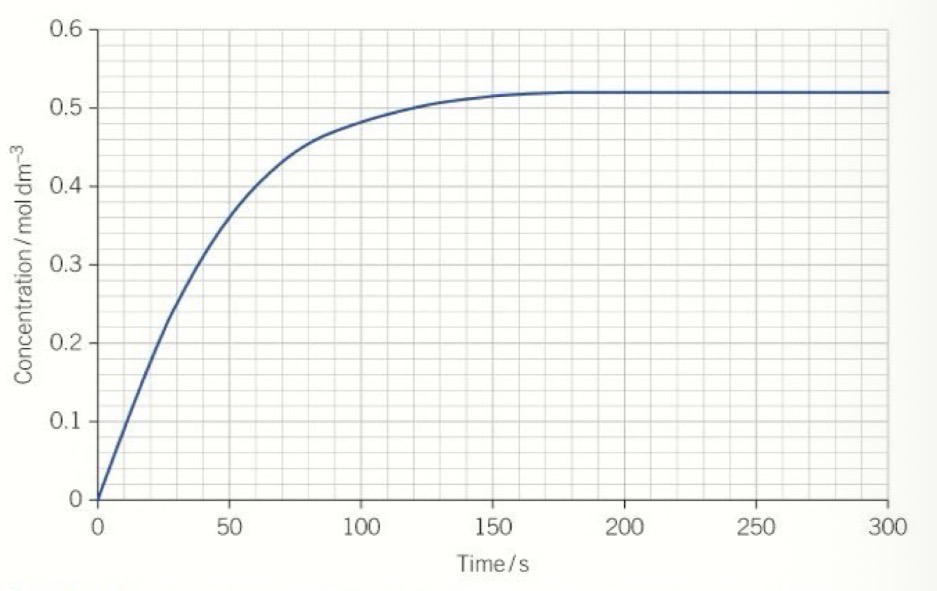
-slows as reaction proceeds ad reactant used up
-stops when reactants fully used
4
What 5 things alter rate of reaction?
-concentration
-pressure
-temp
-catalyst
-sa of solid reactant
-pressure
-temp
-catalyst
-sa of solid reactant
5
What is collision theory?
2 reacting particles must collide for reaction to occur
6
What happens in most collisions?
molecules collide then bounce off eachother and remain chemically unchanged
7
What must happen for a collision to become effective?
-particles collide with correct orientation
-particles have sufficient energy to overcome activation energy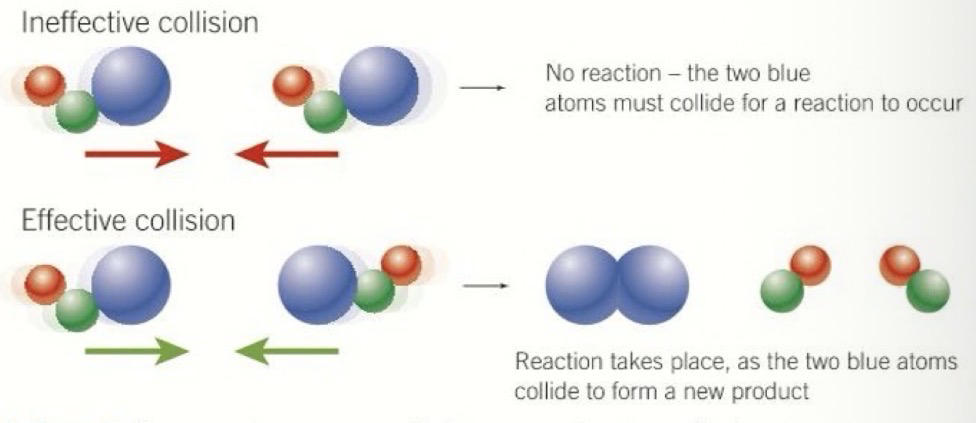
-particles have sufficient energy to overcome activation energy
8
How does increasing concentration of reactant affect rate of reaction?
increases bcos number of particles increase in same volume so closer together so collide more frequently so more effective collisions
9
How does increasing pressure of gas affect rate of reaction?
increases bcos gas molecules closer together so collide more so more frequent effective collisions
10
How do you measure progress of reaction?
-monitoring removal of reactant (decrease concentration)
-following formation of product (increase concentration)
-following formation of product (increase concentration)
11
How do you measure progress of reaction that produces gass?
-monitor volume of gas produced at regular intervals
-monitor loss of reactants using balance
-monitor loss of reactants using balance
12
What is a catalyst?
substance that changes rate of chemical reaction without undergoing permanent change itself
13
How does a catalyst increase rate of reaction?
provides alternate reaction pathway of lower activation energy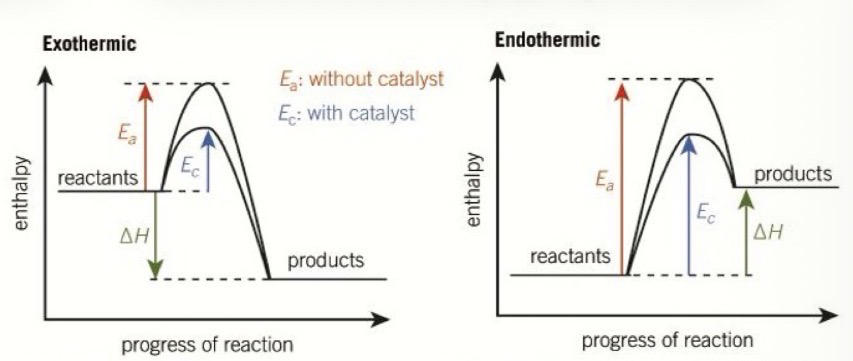
14
What is a homogeneous catalyst?
catalyst with same physical state as reactants
15
How does a homogeneous catalyst work?
-catalyst reacts with reactant to form intermediate
-intermediate breaks down to give product
-catalyst regenerates
-intermediate breaks down to give product
-catalyst regenerates
16
What is an example of a liquid homogeneous catalyst reaction?
making esters with sulfuric acid as catalyst
17
What is an example of a gas homogeneous catalyst reaction?
ozone depletion with Cl radicals as catalyst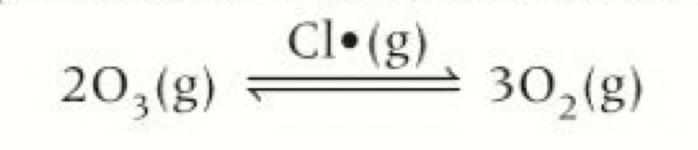
18
What is a heterogeneous catalyst?
catalyst with different physical state from reactants
19
How does a heterogeneous catalyst work?
-reactant molecules absorbed (weakly bonded) onto surface of catalyst where reaction takes place
-after, product molecules leave surface by desorption
-after, product molecules leave surface by desorption
20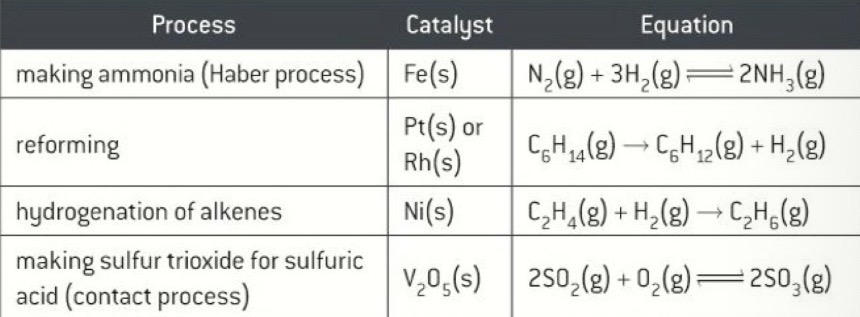
What are some examples of heterogeneous catalyst reactions? (4)
21
How are catalytic reactions more sustainable and economically ideal?
-reduce temp and energy needs
-less electricity and fossil fuels used
-which cuts cost increasing profit and is more sustainable
-less electricity and fossil fuels used
-which cuts cost increasing profit and is more sustainable
22
What is the Boltzmann distribution?
the spread of molecular energies in gases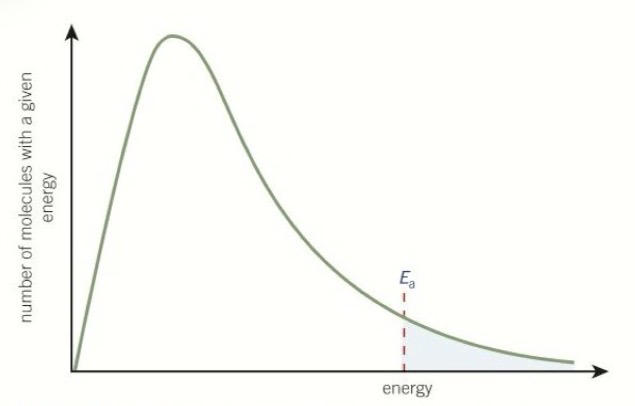
23
What is the area under the Boltzmann distribution curve?
total number of molecules
24
What does the fact that the Boltzmann distribution curve start at the origin mean?
no molecules have 0 energy
25
Is there a maximum energy for molcules on the Boltzmann distribution curve? How does this effect the graph?
no max energy so line never meets x axis (unless curve reached infinity)
26
How does increasing temperature effect Boltzmann distribution curve?
-average energy increases
-more molecules have higher energy
-graph stretched over greater range of energy values
-peak is lower and further along (at higher energy)
-number of molecules same so area beneath curve stays same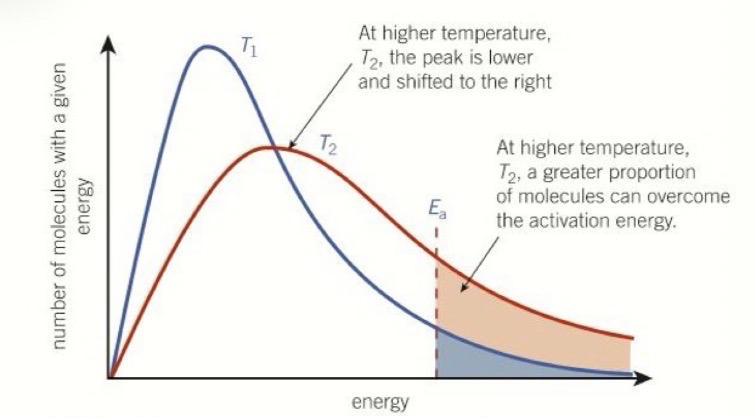
-more molecules have higher energy
-graph stretched over greater range of energy values
-peak is lower and further along (at higher energy)
-number of molecules same so area beneath curve stays same
27
How does higher temp effect reactions and activation energy on Boltzmann distibution curve?
-more molecules reach activation energy
-so greater proportion of successful collisions so greater rate of reaction
-collisions are also more frequent due to greater speed of molecules (not as important)
-so greater proportion of successful collisions so greater rate of reaction
-collisions are also more frequent due to greater speed of molecules (not as important)
28
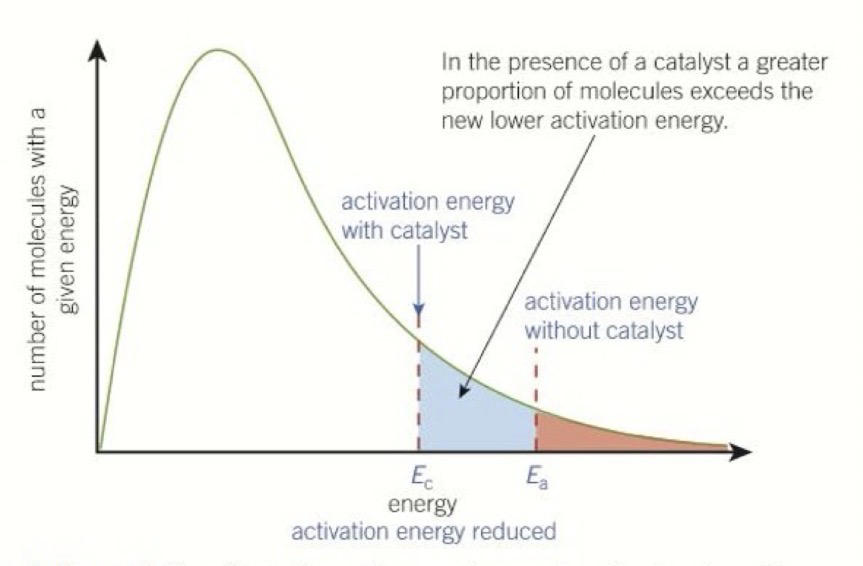
How do catalysts effect the Boltzmann distribution curve?
due to lower activation energy greater proportion of molecules have energy that reaches activation energy