4.12 Alkanes ✓
Study these flashcardsFree · spaced repetition · iPhone, Android, Mac & web
All cards
1
What are the main components of natural gas and crude oil?
alkanes
2
Why are alkanes one of the most stable organic compounds?
lack reactivity
3
What are alkanes mainly used for?
fuels
4
Are alkanes saturated or unsaturated?
saturated
5
What is a sigma bond?
strong covalent bond forming from the “end-to-end” overlap of atomic orbitals (electron density concentrated between 2 bonded atoms)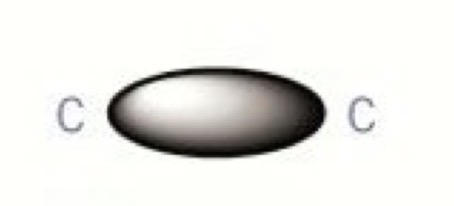
6
How many and what type of bonds does each C have in alkanes?
4 sigma bonds
7
How many electrons does one overlapping orbital in a sigma bond contain?
1
8
How does repulsion between electron pairs in sigma bonds affect alkane shape? Include bond angle
results in 3D tetrahedral arrangement around each carbon atom with bond angle 109.5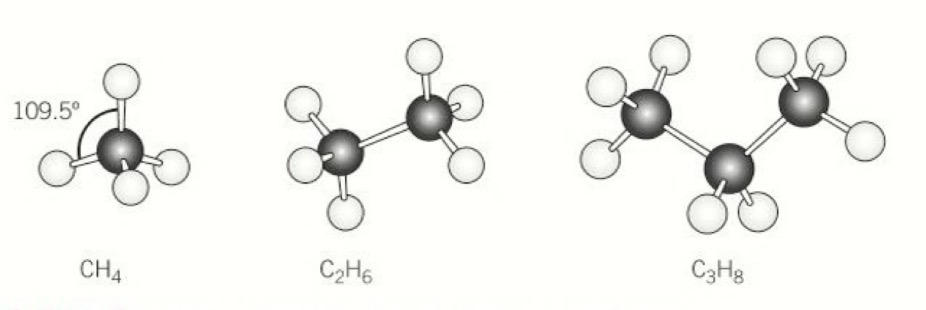
9
Why are the alkane shapes not rigid?
sigma bonds act as axes around which atoms can rotate freely
10
How is crude oil seperated?
fractional distillation in distillation tower
11
Why is fractional distillation possible?
boiling points of alkanes r different
12
Describe bp pattern in types of alkanes
as chain length increases so does temp
13
Why does chain length in an alkane effect bp?
as length increases, molecules have larger sa, so more surface comtact possible between molecules (which causes london forces to act): greater the london forces, larger energy requirement to overcome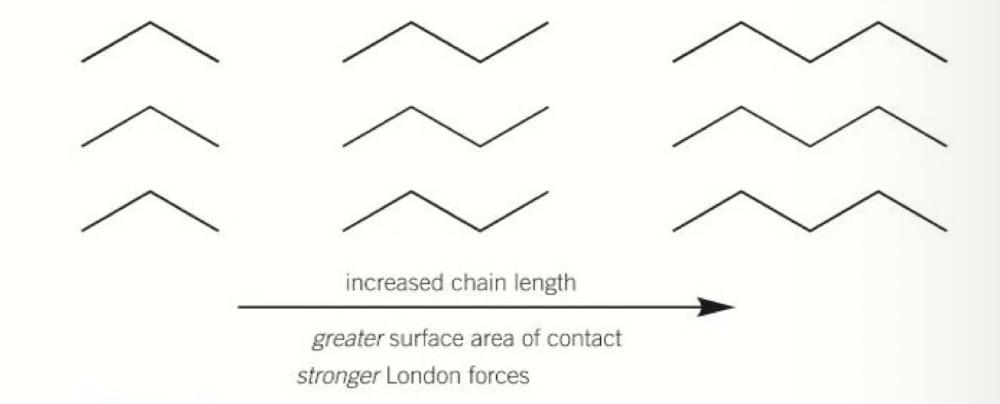
14
Do branched or unbranched alkane isomers have lower bp?
branched isomers
15
Why does being branched or unbranched effect bp in alkane?
-Fewer surface points of contact between molecules in branched so fewer london forces
-branches get in way, preventing getting close together, further decreasing intermolecular forces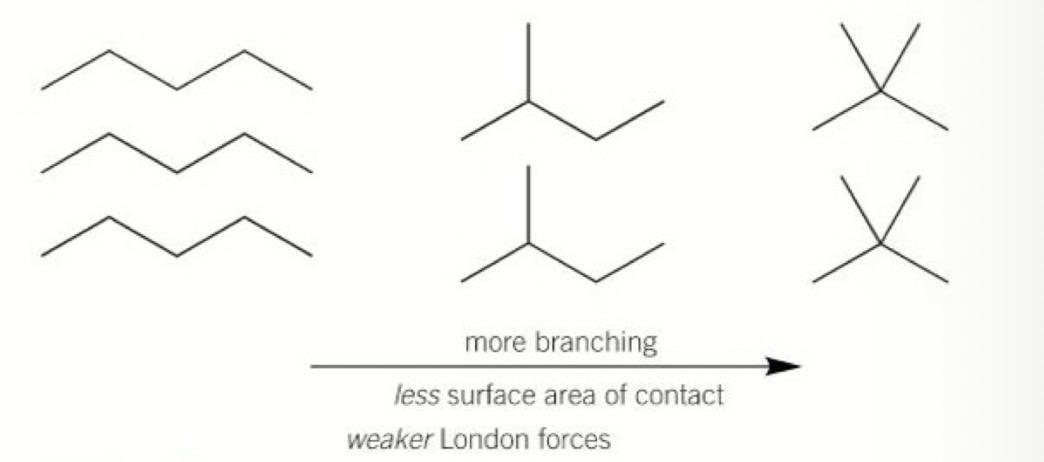
-branches get in way, preventing getting close together, further decreasing intermolecular forces
16
What does it mean if a molecule is saturated?
all atoms linked by single bonds
17
What is a hydrocarbon?
compound containing only H and C
18
What is an aliphatic?
compound containing H and C joined in straight or branched chains or non aromatic rings
19
Give 3 reasons why alkanes lack reactivity
-C-C and C-H sigma bonds are strong
-C-C bonds are non polar
-electronegativity of C and H similar enough to be non polar
-C-C bonds are non polar
-electronegativity of C and H similar enough to be non polar
20
Alkanes react with what during combustion?
oxygen
21
Give 3 reasons why alkanes are used as fuels
-readily available
-easy to transport
-burn in plentiful supply oxygen without releasing toxic products
-easy to transport
-burn in plentiful supply oxygen without releasing toxic products
22
What happens to hydrogen atoms in incomplete combustion?
oxidised to water
23
What happens to carbon in incomplete combustion?
forms toxic carbon monoxide or carbon (soot
24
Whats needed for alkanes to react with halogens and why?
sunlight as high-energy UV radiation provides initial energy for reaction
25
What is meant by reaction mechanism?
series of steps showing how electrons thought to move during reaction
26
What kind of mechanism is bromination of methane an example of?
radical substitution
27
What are the 3 stages of radical substitution?
1) initiation
2) propagation
3) termination
2) propagation
3) termination
28
What happens in initiation in radical substitution?
-reaction starts when covalent bond in Br molecule broken by homolytic fission
-each Br atom takes an electron from pair, forming 2 hughly reactive Br radicals
-each Br atom takes an electron from pair, forming 2 hughly reactive Br radicals
29
What is a radical?
very reactive species w unpaired electron
30
How is a radical shown in a formula?
dot representing electron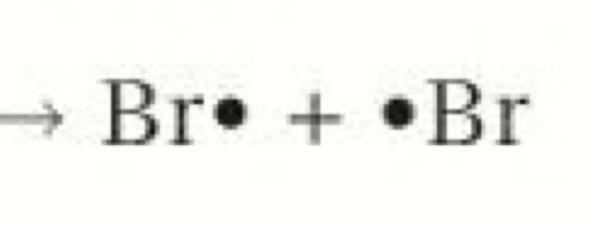
31
What happens in propagation in radical substitution?
1) Br radical reacts w C-H bond in methne ro form as shown products
2) each methyl radical reacts with another Br molecule to form bromomethane and new Br radical
3)Br radical then reacts with another methane causing a cyclical chain reaction
2) each methyl radical reacts with another Br molecule to form bromomethane and new Br radical
3)Br radical then reacts with another methane causing a cyclical chain reaction
32
What happens in termination in radical substitution?
2 radicals collide forming molecule with all electrons paired, radicals therefore removed from reaction stopping it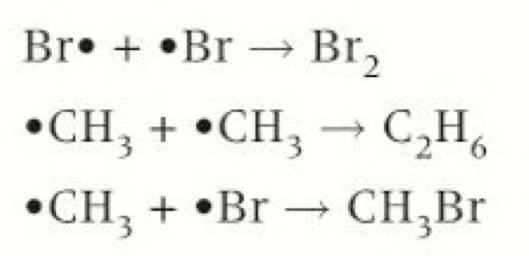
33
How can bromination of methane result in CBr4
further substitutions occur
34
How are the products of halogenation different with longer carbon chains than methane and ethane?
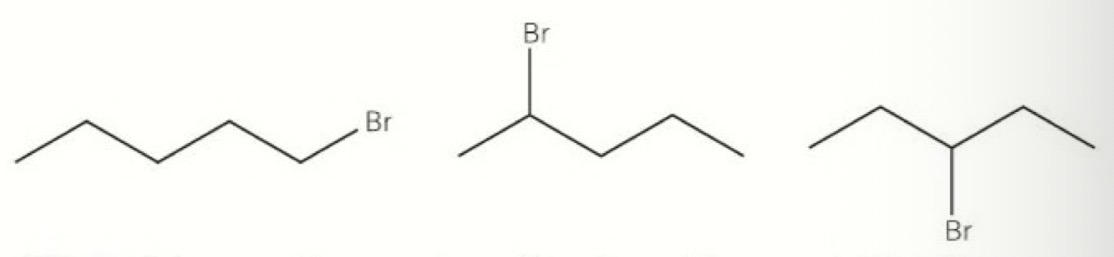
mixture of monosubstituted isomers by substitution at different positions in carbon chain