3.7 Periodicity ✓
Study these flashcardsFree · spaced repetition · iPhone, Android, Mac & web
All cards
1
What is periodicity?
across each period there are repeating trends in properties of elements
2
What are group 1 elements called?
alkali metals
3
What are group 3-12 elements called?
transition elements
4
What are group 7 elements called?
halogens
5
What are group 0 elements called?
noble gases
6
What is ionisation energy?
measure of how easily an atom loses electrons to form positive ions
7
What is first ionisation energy?
energy required to remove 1 electron from each atom in one mole of gaseous atoms of an element to form 1 mole of gaseous 1+ ions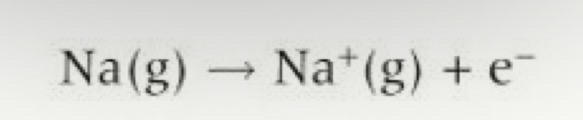
8
Which electron is lost first?
in the highest energy level experiencing the least attraction to the nucleus
9
Which factors affect ionisation energy?
-atomic radius
-nuclear charge
-electron shielding
-nuclear charge
-electron shielding
10
Why does atomic radius affect ionisation energy?
greater the distance between nucleus and outer electrons, the less nuclear attraction
11
Why does atomic radius have a large effect on ionisation energy?
attraction falls of sharply with increasing distance
12
Why does nuclear charge affect ionisation energy?
more protons means greater attraction between nucleus and outer electrons
13
Why does electron shielding affect ionisation energy?
reduces attraction between nucleus and outer shell electrons
14
What is electron shielding?
electrons are negatively charged so inner-shell elctrons repel outer-shell electrons
15
What is second ionisation energy?
energy required to remove one electron from each atom in 1 mole of gaseous 1+ ions of an element to form 1 mole of gaseous 2+ ions
16
Why is there a large increase in ionisation energy between shells?
electron in a different shell closer to nucleus has greater nuclear attraction and less shielding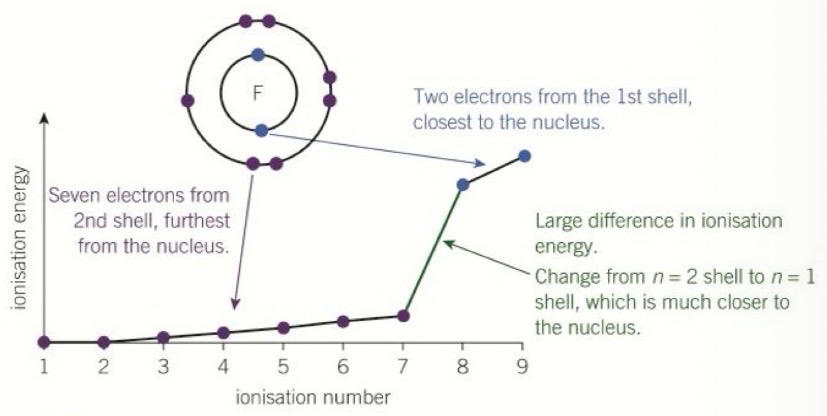
17
What is the trend in ionisation energy as you go along the periodic table?
-general increase across each period
-sharp decrease between each period
-sharp decrease between each period
18
What is the trend in ionisation energy going down a group? Why?
-decreases
-bcos eventhough nuclear charge increases, effect outweighed by increase radius and (to lesser extent) increased shielding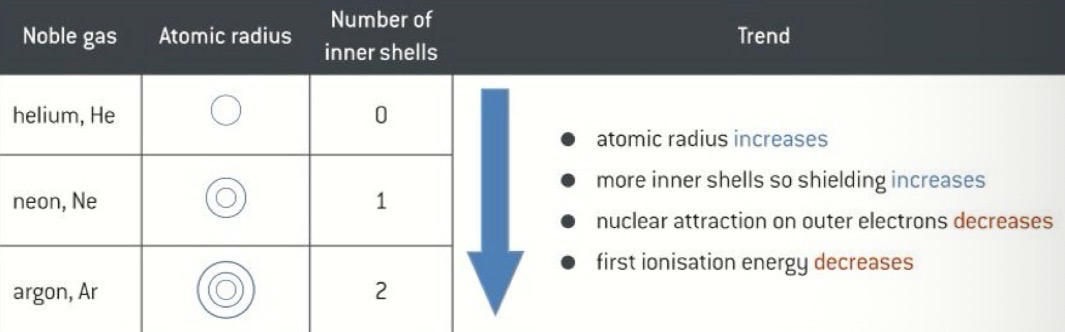
-bcos eventhough nuclear charge increases, effect outweighed by increase radius and (to lesser extent) increased shielding
19
What is the trend in first ionisation energy across a period? Why?
general increase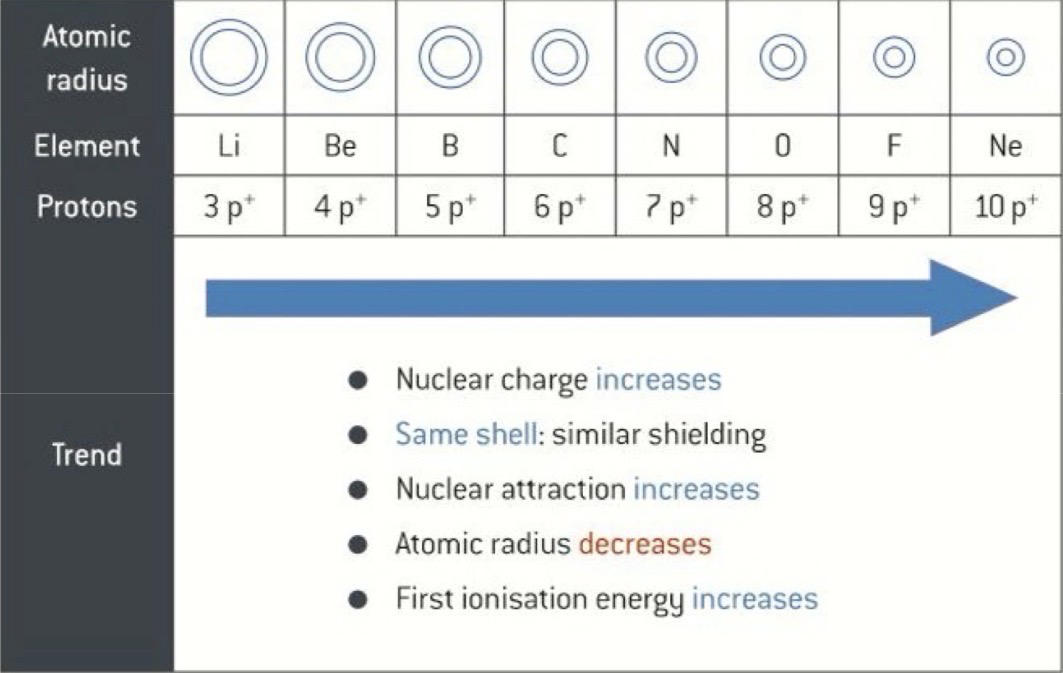
20
Why does the first ionisation energy fall twice in period 2 + 3?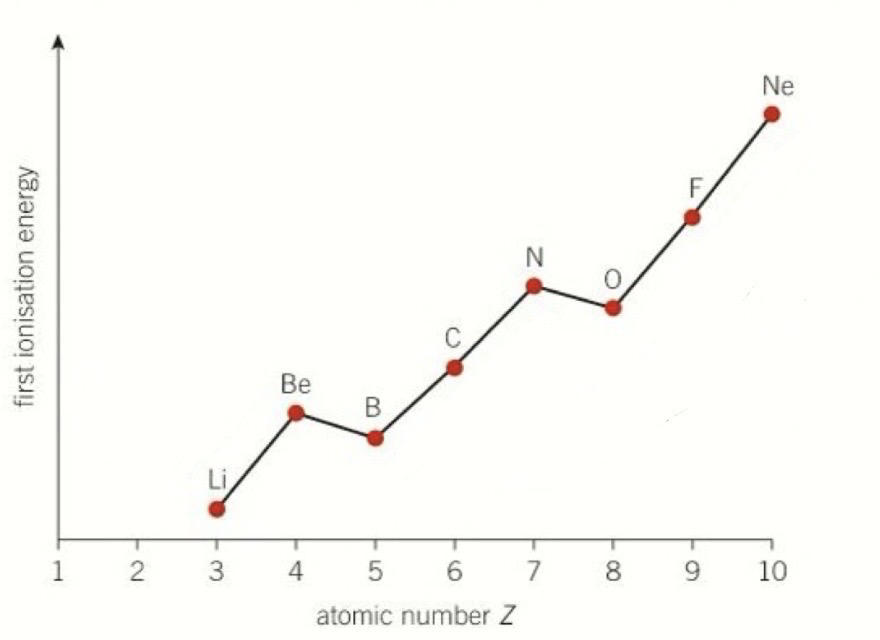
-first: start filling 2p sub-shell, 2p sub-shell has higher energy than 2s so 2p electron easier to remove
-second: start electron pairing in p-orbitals of 2p sub-shell, paired electrons in one orbital repel eachother making it easier for an electron to be removed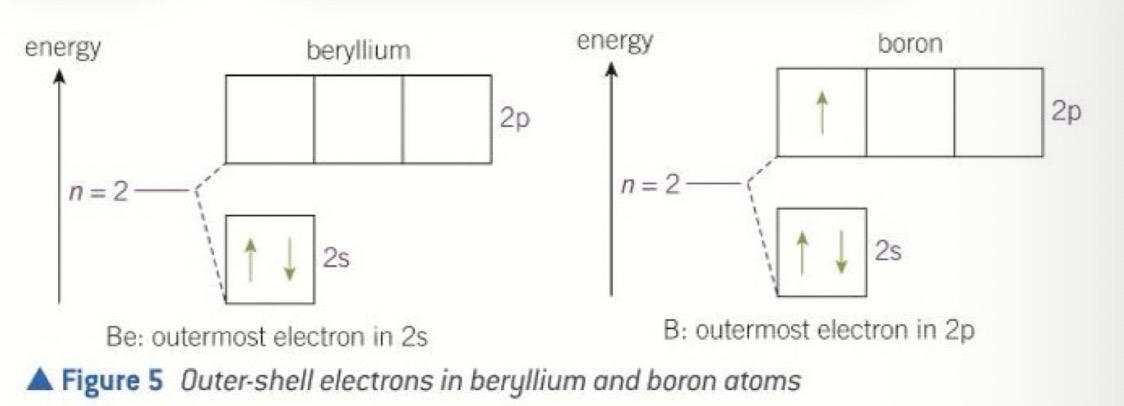
-second: start electron pairing in p-orbitals of 2p sub-shell, paired electrons in one orbital repel eachother making it easier for an electron to be removed
21
Where are metalloids located on the periodic table?
diagonal line from top of group 13 to bottom of group 12
22
What is another name for metalloids?
semi-metals
23
What kind of properties do metalloids show?
in-between metal + non-metal
24
What happens to electrons in metallic bonding?
atoms donate outer-shell electrons to shared pool of delocalised electrons
25
What happens to rest of atom when electrons delocalise in metallic bonding?
cations left behind with nucleus and inner electron shells
26
What is metallic bonding?
bonding between metals where there is strong electrostatic attraction between cations and delocalised electrons
27
How do cations act in metallic bonding and what effect does this have?
fixed position, maintaining structure and shape
28
How do delocalised electrons act in metallic bonding?
mobile throughout structure
29
What is a giant metallic lattice?
billions of metal atoms held together by metallic bonding
30
What are some properties of most metals?
-strong metallic bonds (due to electrostatic attraction)
-high electrical conductivity
-high mp +bp
-high electrical conductivity
-high mp +bp
31
Why are metals conductive?
delocalised electrons move through structure carrying charge
32
Why do metals usually have high mps and bps?
high temp/ energy needed to overcome electrostatic forces between cations and delocalised electrons in metallic bonding
33
Why dont metals dissolve?
when interaction happens between polar solvents and charges in metallic lattice reaction happens instead
34
Which non-metals form a giant covalent lattice?
boron, carbon, silicon
35
What is a giant covalent lattice?
billions of atoms held together by network of strong covalent bonds
36
What structure and bond angle is formed when carbon form bonds with 4 other atoms in a giant covalent lattice?
tetrahedral, 109.5
37
Why do giant covalent lattices have high boiling points?
high temp/ energy needed to break strong covalent bonds
38
Why are giant covalent lattices insoluble in most solvents?
covalent bonds too strong to be broken by interaction with solvents
39
Why dont most giant covalent lattices conduct electricity?
outer-hsell electrons involved in bonding so cant carry charge
40
Which giant covalent lattices are electrically conductive and why?
graphite and graphene as 1 electron available to conduct electricity
41
What is the trend of mp going across period 2 and 3? Why is there this trend?
-mp increases from group 1 to 14
-sharp decreases in mp between group 14-15
-mp comparitively low from group 15 to 18
defrease marks change from giant to simple molecular substances
-sharp decreases in mp between group 14-15
-mp comparitively low from group 15 to 18
defrease marks change from giant to simple molecular substances