2.3 Nucleic Acid ✓
Study these flashcardsFree · spaced repetition · iPhone, Android, Mac & web
All cards
1
What is the shape of a DNA molecule?
double helix
2
What is a nucleotide?
molecule consisting of a five-carbon sugar, phosphate group and nitrogenous base
3
What is a polynucleotide?
large molecule containing many nucleotides
4
Which carbon of the pentose is the nitrogenous base linked to?
1
5
Which carbon of the pentose is the phosphate group linked to?
5 or 3
6
What kind of reaction links pentose and phosphate group?
condensation reaction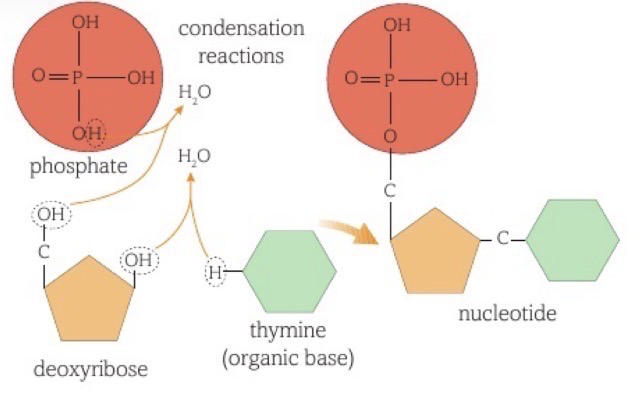
7
What is the monomer of nucleic acids, DNA and RNA?
nucleotides
8
Which sugar do nucleotides have in RNA?
ribose
9
Which sugar do nucleotides have in DNA?
deoxyribose
10
What do nucleotides become when they contain more than one phosphate group?
phosphorylated nucleotides
11
What are examples of phosphorylated nucleotides?
-ADP (adenosine diphosphate)
-ATP (adenosine triphosphate)
-ATP (adenosine triphosphate)
12
What is ATP?
energy-rich end-product of energy releasing biochemical pathways, used to drive energy-requiring metabolic processes
13
How do nucleotides regulate metabolic pathways?
by ATP, ADP, AMP
14
What can be components of many coenzymes?
nucleotides
15
What does the A base stand for?
adenine
16
What does the C base stand for?
cytosine
17
What does the G base stand for?
guanine
18
What does the T base stand for?
thymine
19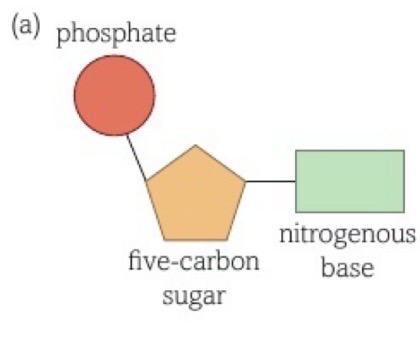
What does a nucleotide look like?
20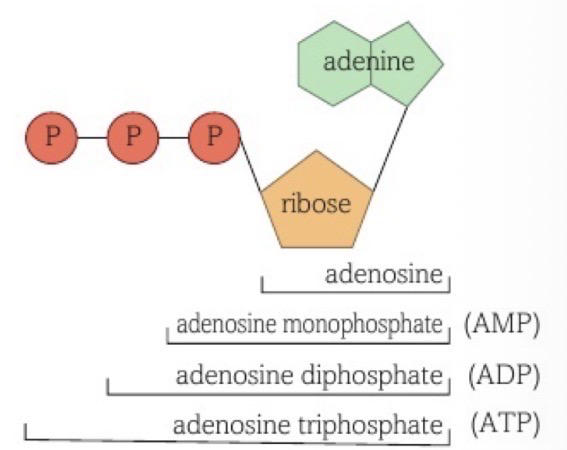
What does AMP, ADP and ATP look like?
21
Is DNA a macromolecule?
yes
22
Why are the polynucleotide strands described as antiparallel?
strands run in opposite directions (direction that C3 and C5 on sugar are facing)
23
What kind of bond forms between sugar residue and phosphate group?
covalent phosphodiester bond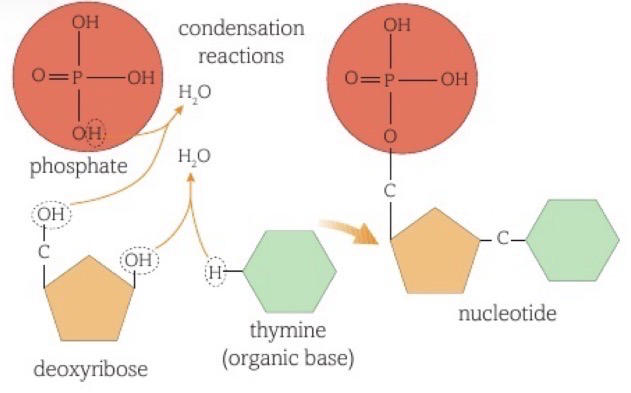
24
What happens when phosphodiester bonds break or form?
break: polynucleotides break down
form: polynucleotides synthesised
form: polynucleotides synthesised
25
Which bases are purines?
adenine and guanine
26
Which bases are pyrimidines?
thymine and cytosine
27
How are the 2 DNA strands joined together?
hydrogen bonds between nitrogenous bases
28
How many hydrogen bonds form between adenine and thymine?
2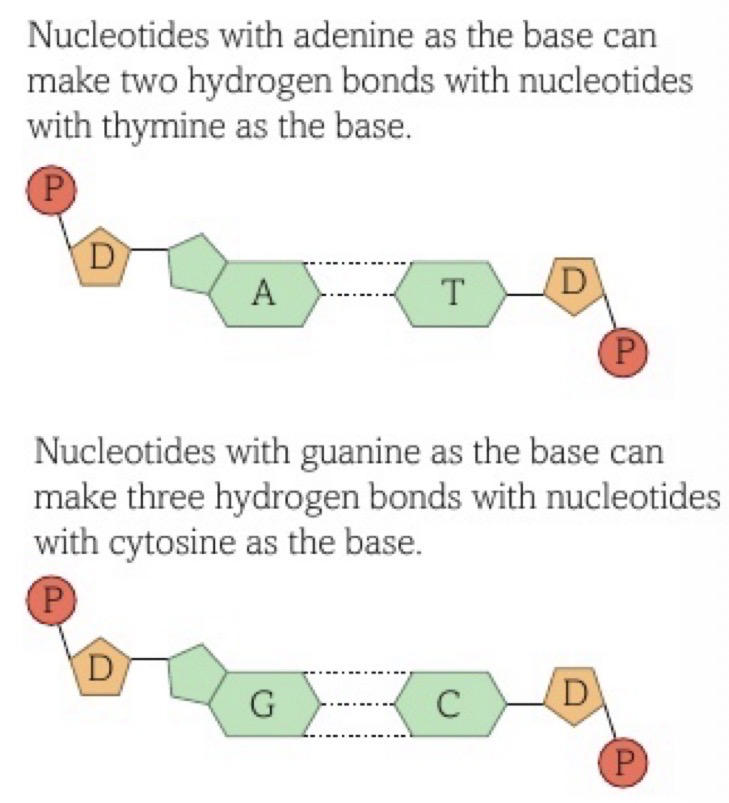
29
How many hydrogen bonds form between cytosine and guanine?
3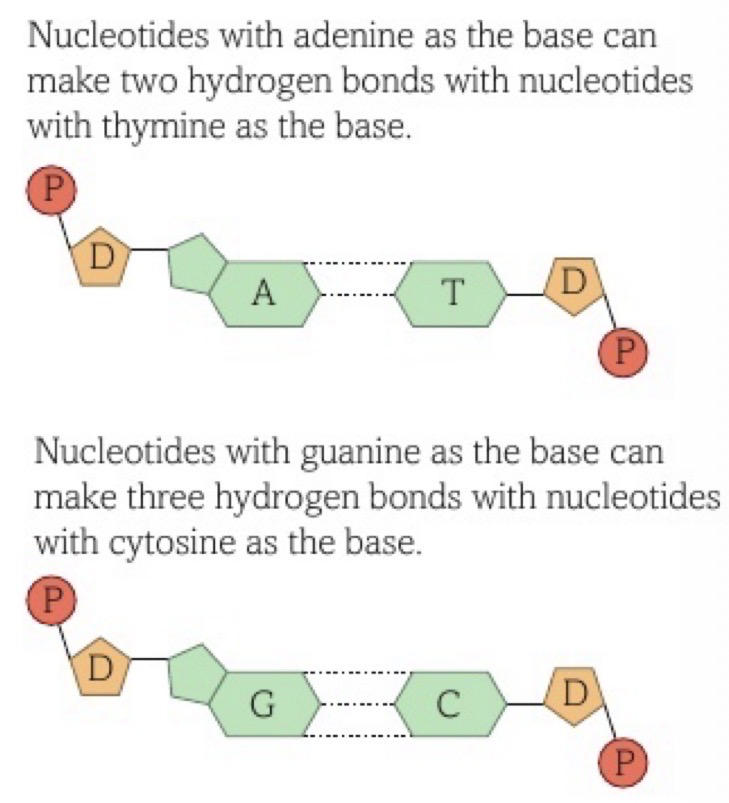
30
What is the difference between a purine and pyrimidine?
purine: 2 rings in base
pyrimidine: 1 ring in base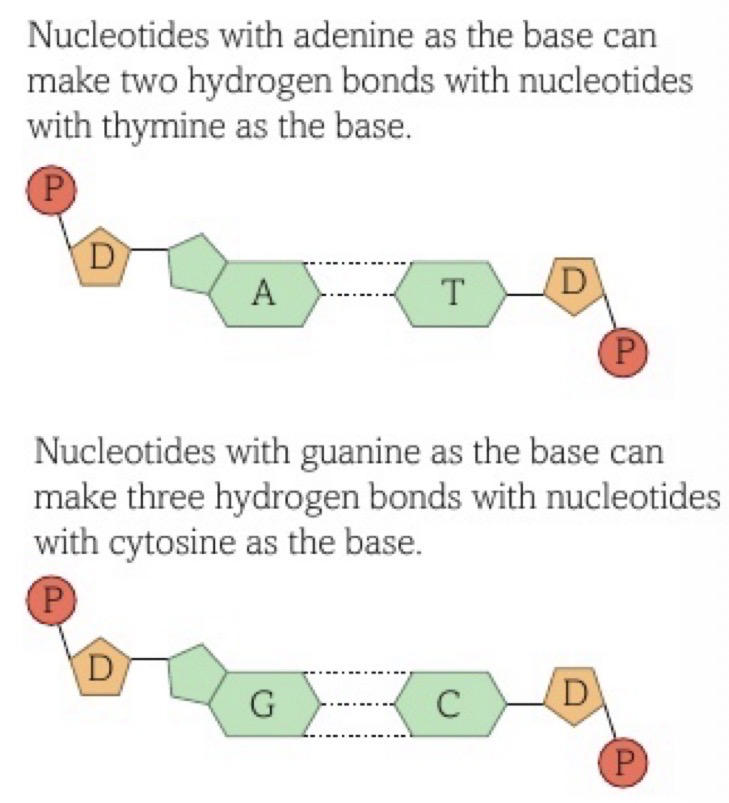
pyrimidine: 1 ring in base
31
Why does a purine always pair with a pyrimidine?
so equal-sized ‘rungs’ on DNA ladder which can then twist into double helix, providing stability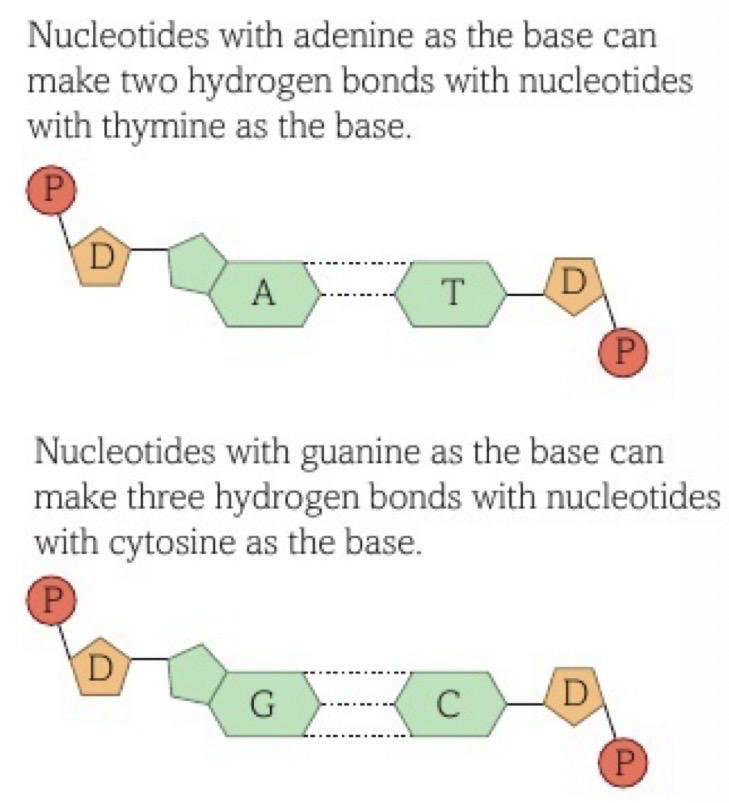
32
What forms the upright part of the DNA molecule?
sugar-phosphate backbones of antiparallel polynucleotide strands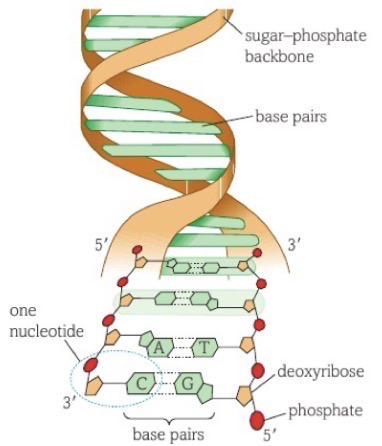
33
What is the 5’ end?
where phosphate group attached to C5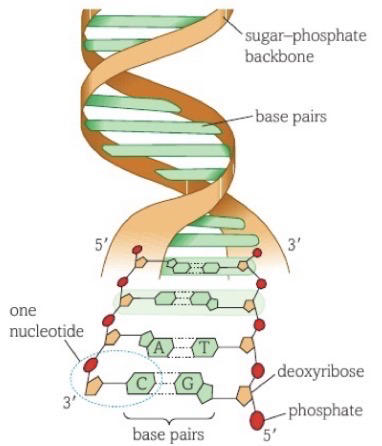
34
What is the 3’ end?
where phosphate group attached to C3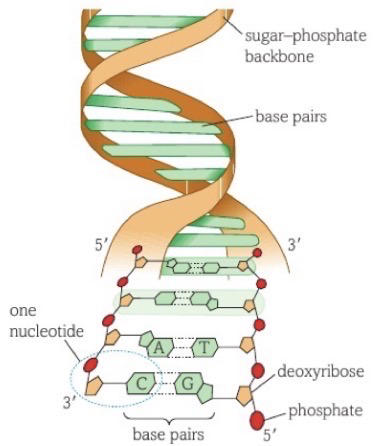
35
Where is the majority of DNA in a eukaryotic cell?
nucleus
36
How many molecules of DNA are in each chromosome?
1
37
What are chromosomes?
large DNA molecule tightly wound around histone protein
38
Where other than the nucleus can DNA be found?
as loops without histone proteins in mitochondria and chloroplasts
39
How is DNA found in prokaryotic cells?
DNA loop in cytoplasm without histone protein (described as naked)
40
How is DNA found in viruses?
in naked loop (no histone protein)
41
What is DNA polymerase?
enzyme that catalyses formation of DNA from activated deoxyribose nucleotides using single-stranded DNA as a template
42
What is helicase?
enzyme that catalyses breaking of H bonds between nitrogenous pairs of bases in a DNA molecule
43
What is the genome?
all DNA within cell
44
When does DNA replicate?
during interphase before cell divides
45
What does a DNA molecule have to do before making a copy of itself?
-unwind: double helix untwisted catalysed by gyrase enzyme
-unzips: H bonds between nucleotide bases are broken catalysed by DNA helicase resulting in 2 single strands of DNA with exposed bases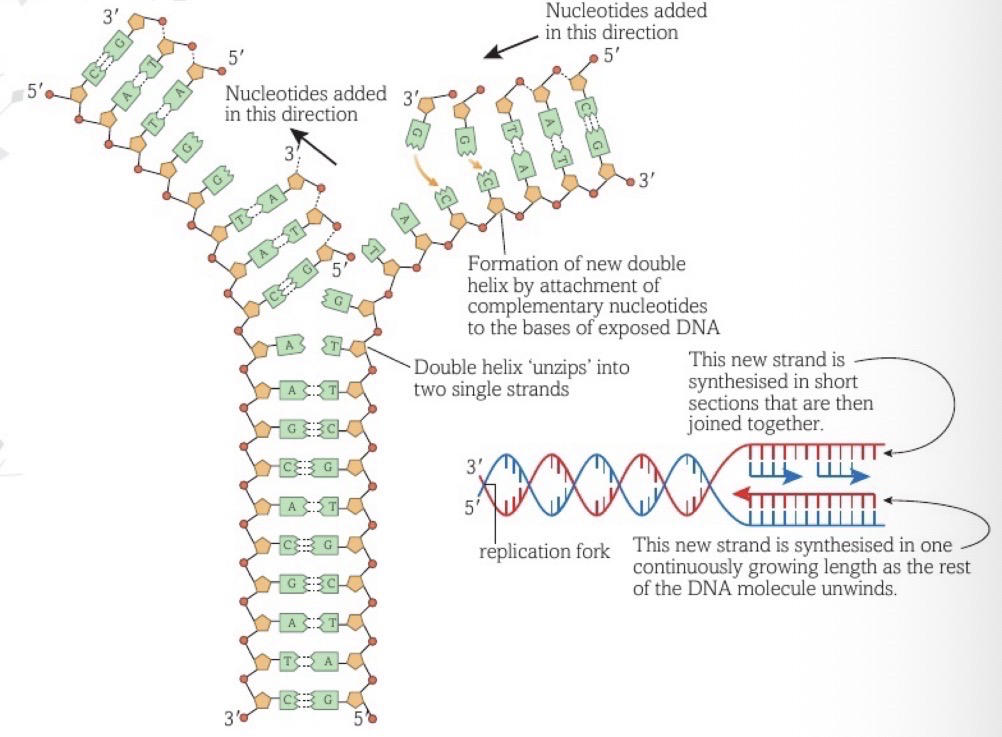
-unzips: H bonds between nucleotide bases are broken catalysed by DNA helicase resulting in 2 single strands of DNA with exposed bases
46
What is the product of semi-conservative DNA replication?
2 identical DNA molecules each containing 1 new strand and 1 old strand
47
What are alleles?
different versions of a particular gene
48
What are alleles also called?
gene variants
49
How are mutations prevented during DNA replication?
enzymes proofread and edit out incorrect nucleotides reducing rate mutations are made
50
What is point mutation?
a change with one nucleotide causing a change to genetic code
51
How does semi-conservative replication work?
after unwinding and unzipping…
1) free phosphorylated nucleotides in nucleoplasm bond to exposed bases following base pairing rules
2) DNA polymerase enzyme catalyses addition of new nucleotide bases (in 5’ to 3’ direction) to single strands of DNA
3) leading strand synthesised continuously and lagging strand in fragments (discontinuous) that are later joined (catalysed by ligase enzymes)
4) hydrolysis of activated nucleotides (which release extra phosphate groups) supply energy to make phosphodiester bonds between sugar residue and phosphate group of different nucleotides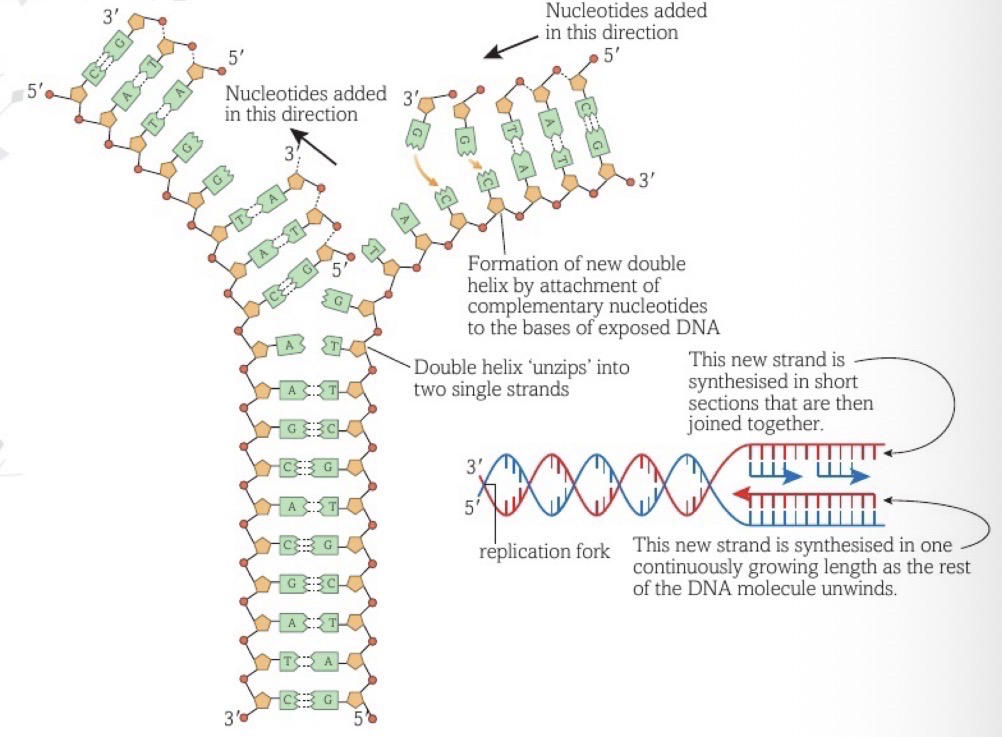
1) free phosphorylated nucleotides in nucleoplasm bond to exposed bases following base pairing rules
2) DNA polymerase enzyme catalyses addition of new nucleotide bases (in 5’ to 3’ direction) to single strands of DNA
3) leading strand synthesised continuously and lagging strand in fragments (discontinuous) that are later joined (catalysed by ligase enzymes)
4) hydrolysis of activated nucleotides (which release extra phosphate groups) supply energy to make phosphodiester bonds between sugar residue and phosphate group of different nucleotides
52
How does DNA replicate in prokaryotes, mitochondria and chloroplast?
semi-conservatively, bubble sprouts from loop which unwinds and unzips and then complementary nucleotides join exposed nucleotides until whole loop copied
53
What is a gene?
length of dna coding for a polypeptide or for length of RNA involved in regulating gene expression
54
What is transcription?
process of making messenger RNA from DNA template
55
What is translation?
formation of a protein at ribosomes by assembling amino acids into particular sequence according to coded instructions carried by mRNA
56
How is the sugar molecule in RNA different to that in DNA?
ribose instead of deoxyribose
57
How are the nitrogenous bases in RNA different to that in DNA?
uracil (pyrimidine) replaces thymine
58
How is the polynucleotide chain in RNA different to that in DNA?
-single-stranded not double
-shorter
-shorter
59
What are the 3 forms of RNA?
-messenger (mRNA)
-transfer (tRNA)
-ribosomal (rRNA)
-transfer (tRNA)
-ribosomal (rRNA)
60
What determines the amino acid sequence (primary structure) of polypeptides in DNA?
sequence of DNA base triplets
61
Why is it important that amino acid sequence is correct?
so polypeptide can fold correctly and hold tertiary shape
62
Why is it important for an enzyme to have the correct tertiary shape?
shape of active site must be complementary to shape of substrate molecule
63
Why is it important for an antibody to have the correct tertiary shape?
must be complementary to shape of antigens on invading pathogen
64
Why is it important for a receptor (cell membrane) to have the correct tertiary shape?
must be complementary to shape of cell signalling molecule (eg drug)
65
Why is it important for an ion-channel protein to have specific placement of amino acids?
hydrophilic amino acids lining inside of channel
lipophilic amino acids on outside portion next to lipid bilayer
lipophilic amino acids on outside portion next to lipid bilayer
66
What is a triplet of bases in DNA called?
base triplet
67
What is a triplet of bases in mRNA called?
codon
68
What is a triplet of bases in tRNA called?
anticodon
69
How is genetic code transported out of the nucleus?
copy of each gene transcribed into length of mRNA which passes through nucleus into cytoplasm and to ribosome
70
What is the nature of genetic code?
-universal
-degenerate
-non-overlapping
-degenerate
-non-overlapping
71
What does genetic code being universal mean?
same triplet of bases codes for same amino acids in almost all organisms
72
What does genetic code being degenerate mean?
for nearly all amino acids theres more than one base triplet
73
Why is genetic code being degenerate helpful?
reduce effect of point mutations as change in one base can still code for same amino acid
74
What does genetic code being non-overlapping mean?
read starting from a fixed point in groups of 3 bases
75
What happens if a base is added or deleted?
causes frame shift and due to genetic code being non-overlapping every base triplet and therefore amino acid is changed
76
How does transcription work?
-gene unwinds and unzips
-H bonds between complementary nucleotide bases break
-enzyme RNA polymerase catalyses formation of temporary H bonds between RNA nucleotides and complimentary unpaired DNA bases
-mRNA now passes out of nucleus through nuclear envelope and attaches to ribosome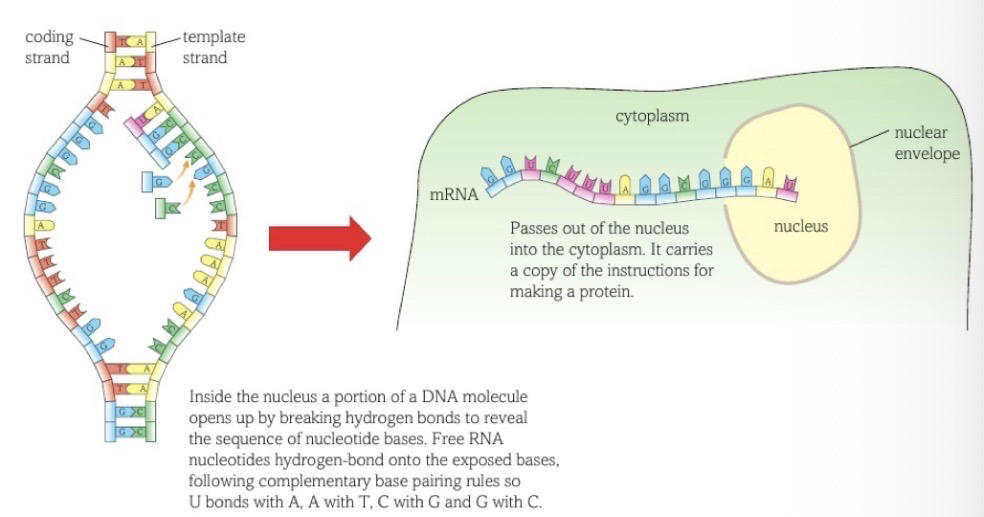
-H bonds between complementary nucleotide bases break
-enzyme RNA polymerase catalyses formation of temporary H bonds between RNA nucleotides and complimentary unpaired DNA bases
-mRNA now passes out of nucleus through nuclear envelope and attaches to ribosome
77
Which DNA strand is the template strand?
strand that bonds with mRNA during transcription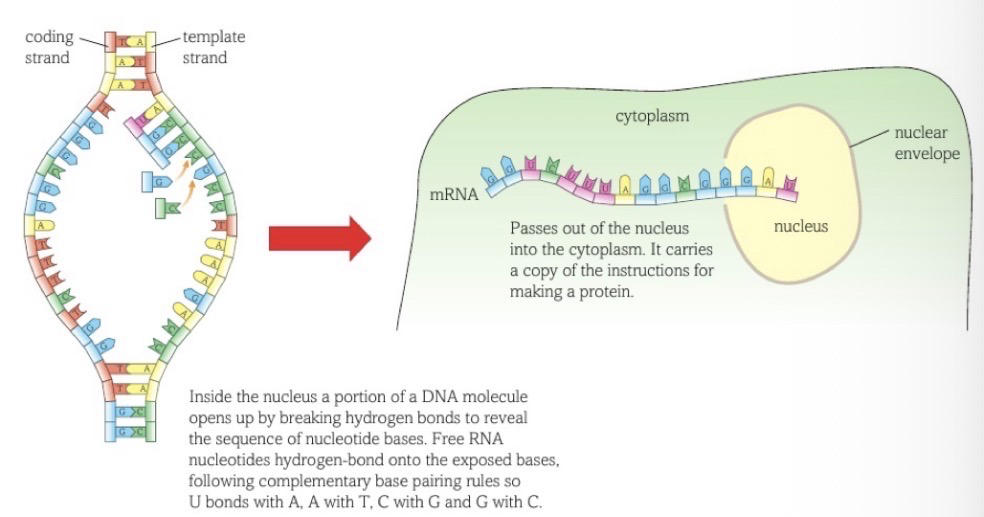
78
Which DNA strand is the coding strand?
what RNA is a copy of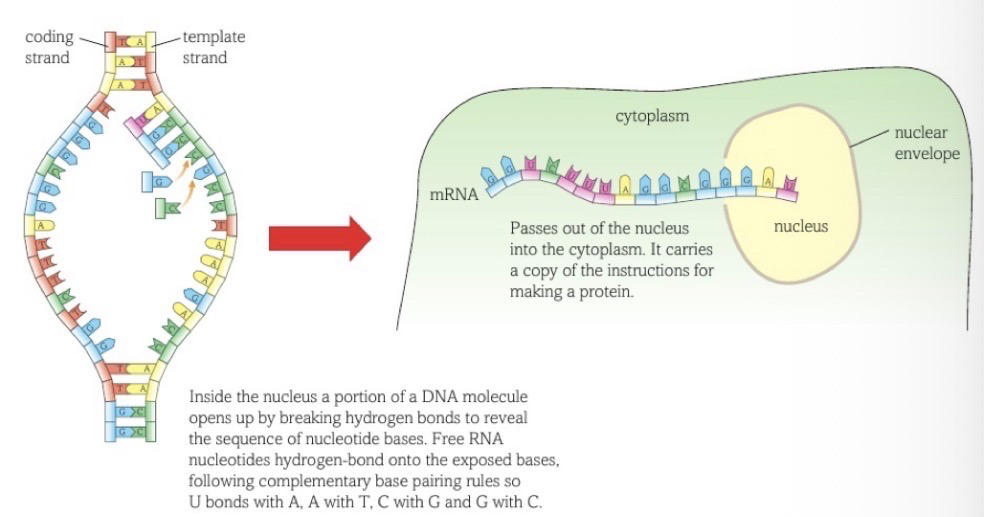
79
How are ribosomes formed?
-made in nucleolus in 2 smaller subunits which pass separately out of nucleus through pores in nuclear envelope
-magnesium ion helps bind 2 subunits together
-magnesium ion helps bind 2 subunits together
80
What are ribosomes made out of?
ribosomal RNA and protein in roughly equal parts
81
Where are tRNA molecules made?
nucleolus
82
Describe structure of tRNA
-single stranded polynucleotides that twist into hairpin shape
-one end is trio of nucleotide bases which recognises and attaches to specific amino acid
-at loop end anticodon which is complementary to specific codon on mRNA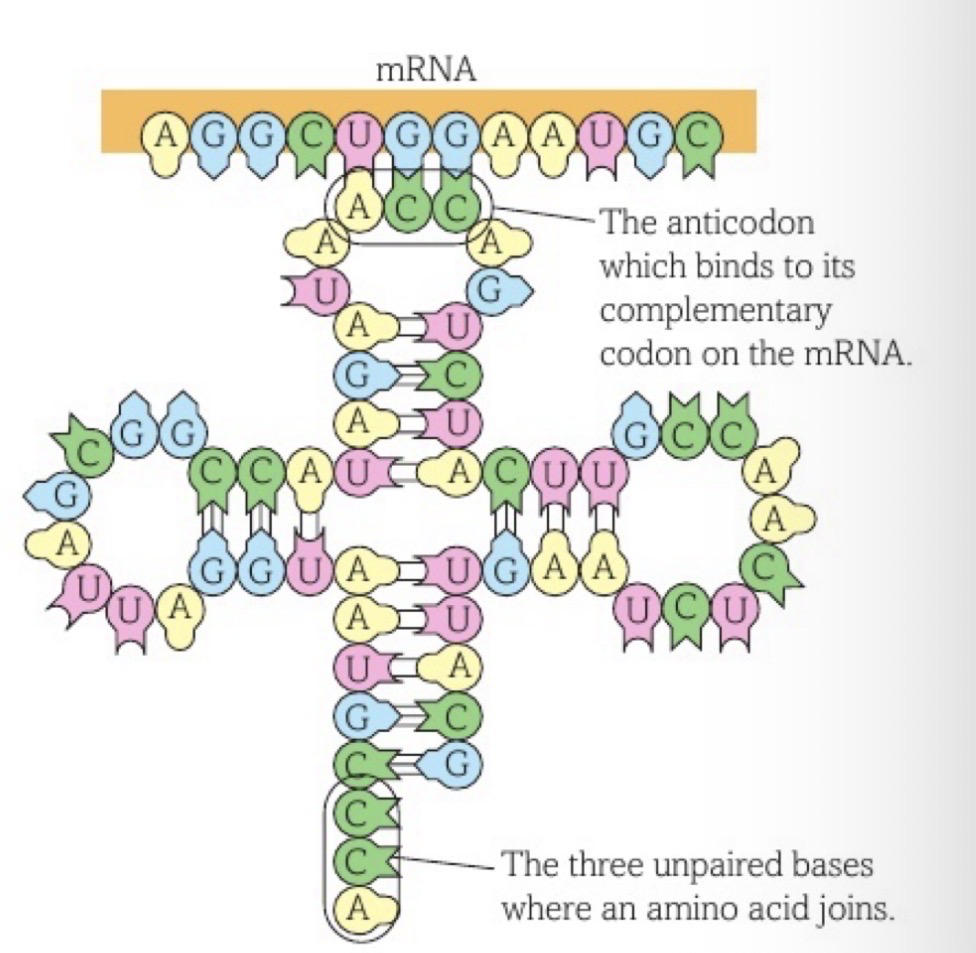
-one end is trio of nucleotide bases which recognises and attaches to specific amino acid
-at loop end anticodon which is complementary to specific codon on mRNA
83
How does translation work?
1) tRNA molecules bring amino acids and find place where anticodon binds by temporary H bonds to complimetary codon on mRNA
2) as ribosome moves along mRNA it reads code and when 2 amino acids are adjacent peptide bond forms between them
3) newly synthesised polypeptide helped by chaperone proteins to fold into correct tertiary structure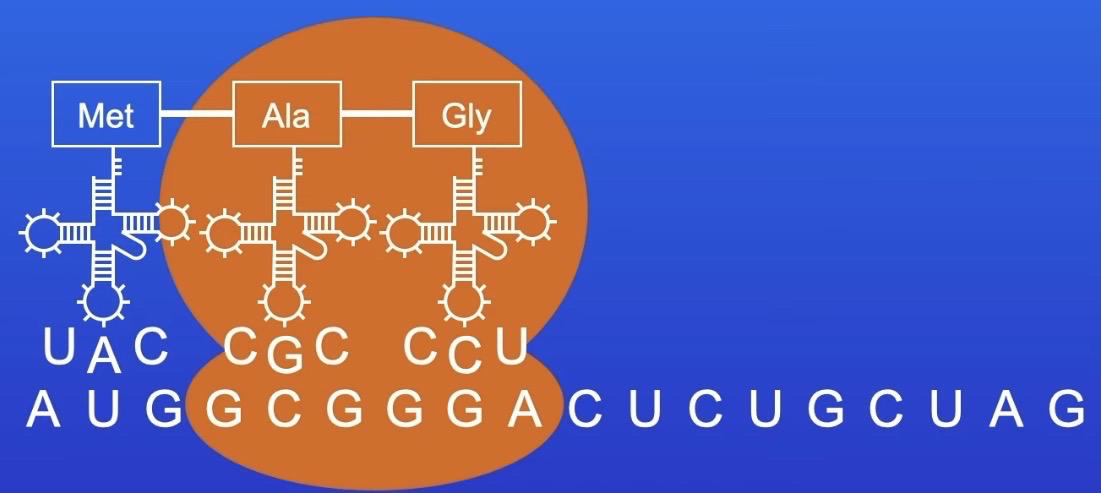
2) as ribosome moves along mRNA it reads code and when 2 amino acids are adjacent peptide bond forms between them
3) newly synthesised polypeptide helped by chaperone proteins to fold into correct tertiary structure
84
What happens to mRNA after translation?
breaks down and components can be recycled into new lengths of mRNA
85
Which strand is sense strand?
coding strand
86
Which strand is antisense strand?
template strand