2.5 Electrons and Bonding ✓
Study these flashcardsFree · spaced repetition · iPhone, Android, Mac & web
All cards
1
What is the principal quantum number (n)?
shell no. or energy lvl
2
What is the max no. of electrons in the 1st shell?
2
3
What is the max no. of electrons in the 2nd shell?
8
4
What is the max no. of electrons in the 3rd shell?
18
5
What is the max no. of electrons in the 4th shell?
32
6
What is the formula to find no. of electrons in shell?
$2n^2$
7
What is an atomic orbital?
region around the nucleus that can hold up to 2 electrons with opposite spins
8
What shape are s-orbitals?
sphere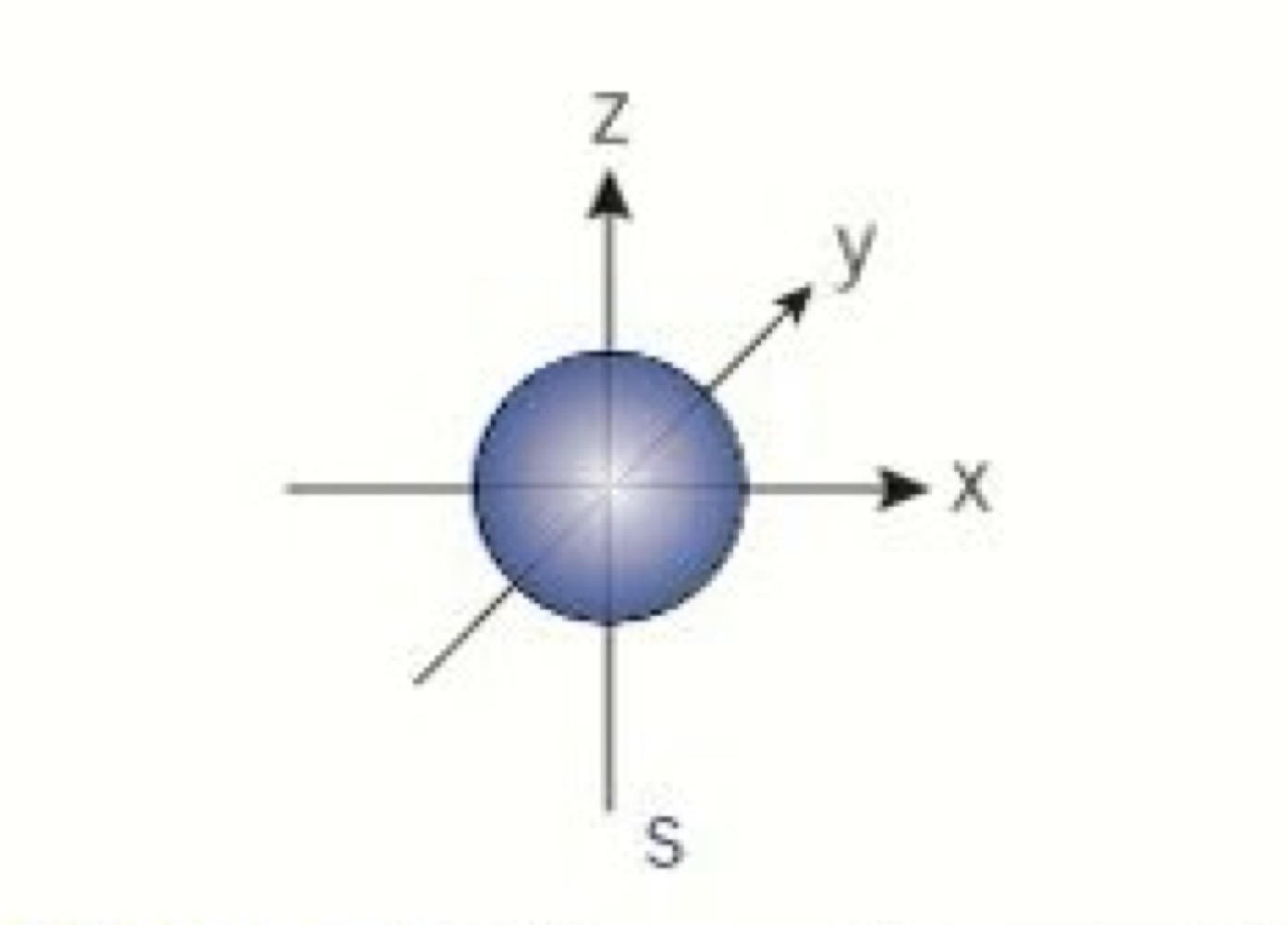
9
Each shell from n=__ contains __ s-orbital
1, 1
10
The greater the shell number (n), the greater the _____ of its s-orbital
radius
11
Each shell from n=__ contains __ p-orbital
2, 3
12
What shape are p-orbitals?
dumb-bell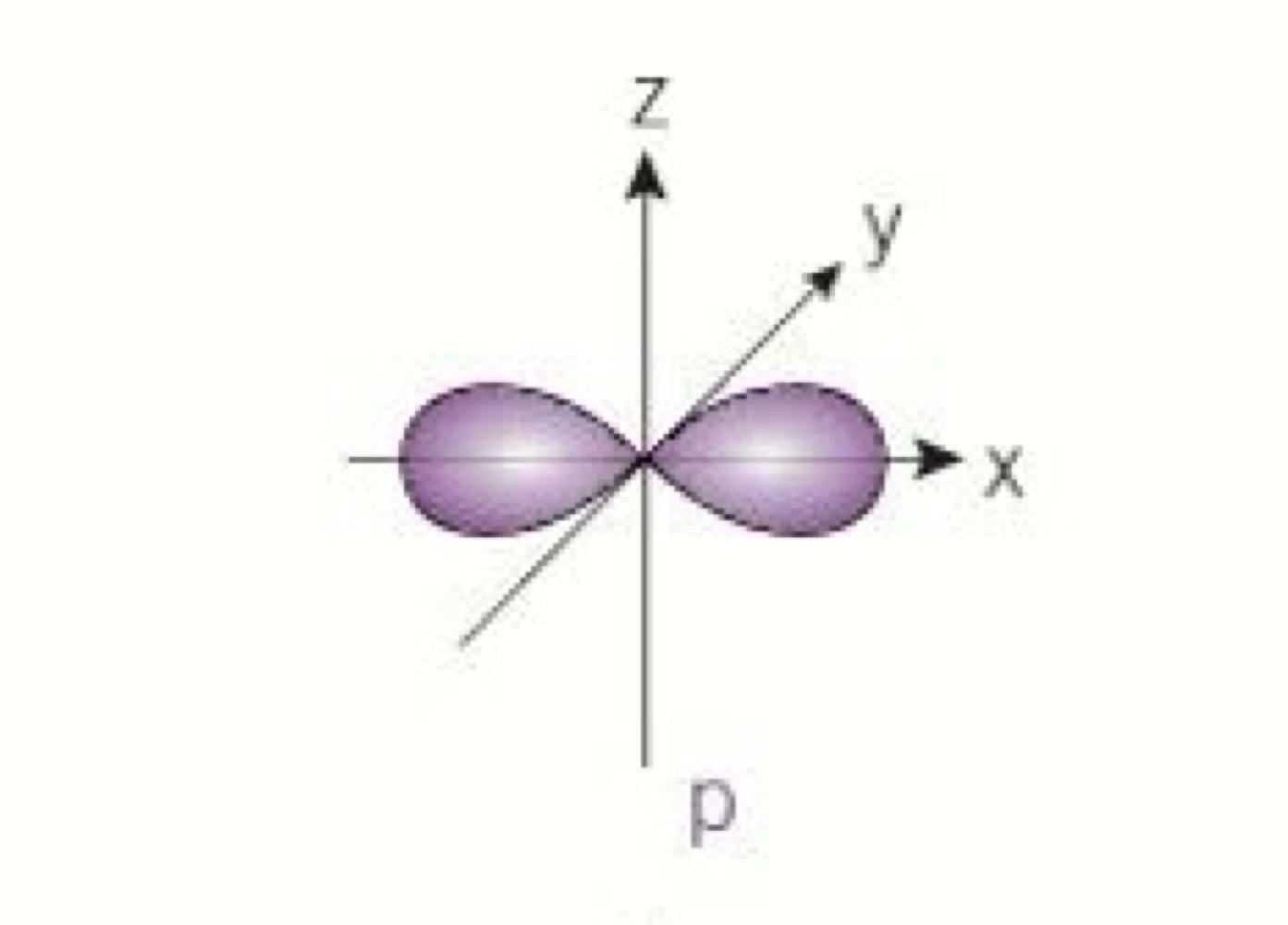
13
How are p-orbitals arranged?
90 degrees between each
14
The greater the shell number n, the _____ the p-orbital is from the nucleus
further
15
Each shell from n=__ contains __ d-orbital
3, 5
16
Each shell from n=__ contains __ f-orbital
4, 7
17
What is a sub-shell?
groups of orbitals that are the same type within a shell
18
What is the filling order of electrons up to shell 4?
1s, 2s, 2p, 3s, 3p, 4s, 3d, 4p, 4d, 4f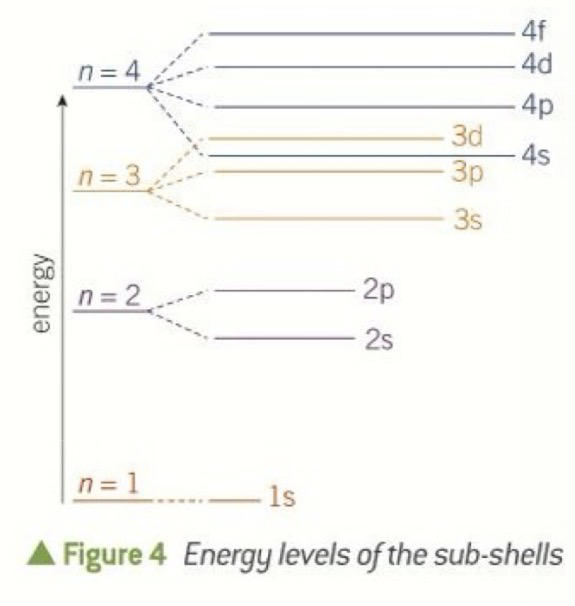
19
What is electron filling order based on?
orbitals fill in order of increasing energy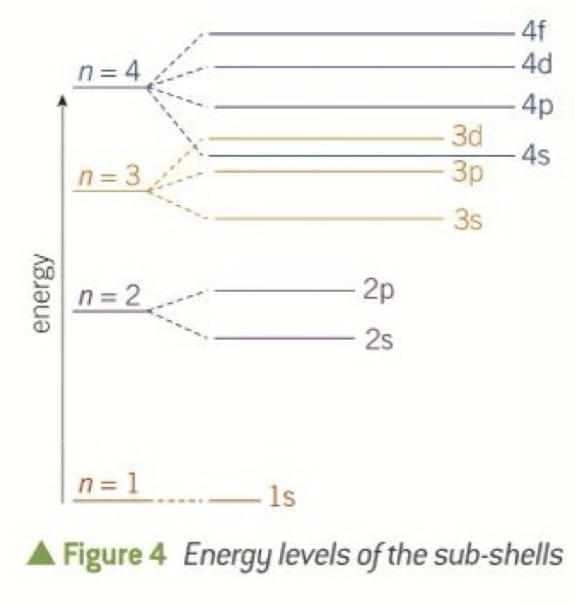
20
Why must the 2 electrons in an orbital have opposite spins?
to counteract repulsion between negative charges
21
How do sub-shells fill? Why?
one electron occupies each orbital before pairing, preventing repulsion between paired electrons until no further orbital available at same energy level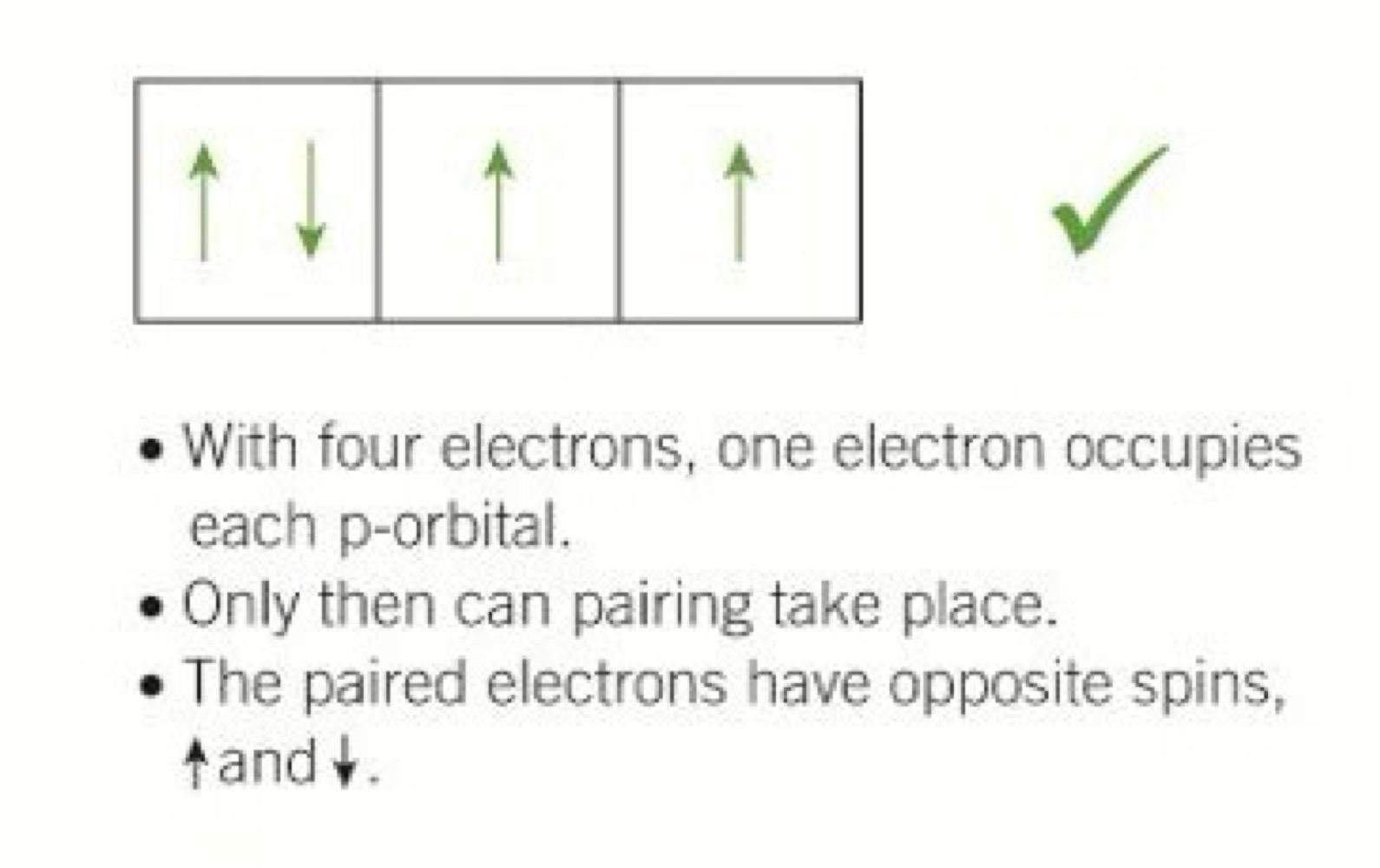
22
How is Na’s electron configuration presented (normally)? Na=11
$1s^2 2s^2 2p^6 3s^1$
23
How is Na’s electron configuration presented (shorthand)? Na=11
$[Ne]3s^1$
24
What is a cation?
positive ions formed when atoms lose electrons
25
What is an anion?
negative ion formed when atoms gain electrons
26
How are the blocks in the periodic table arranged and why?
-divided into blocks corresponding to their highest energy sub shell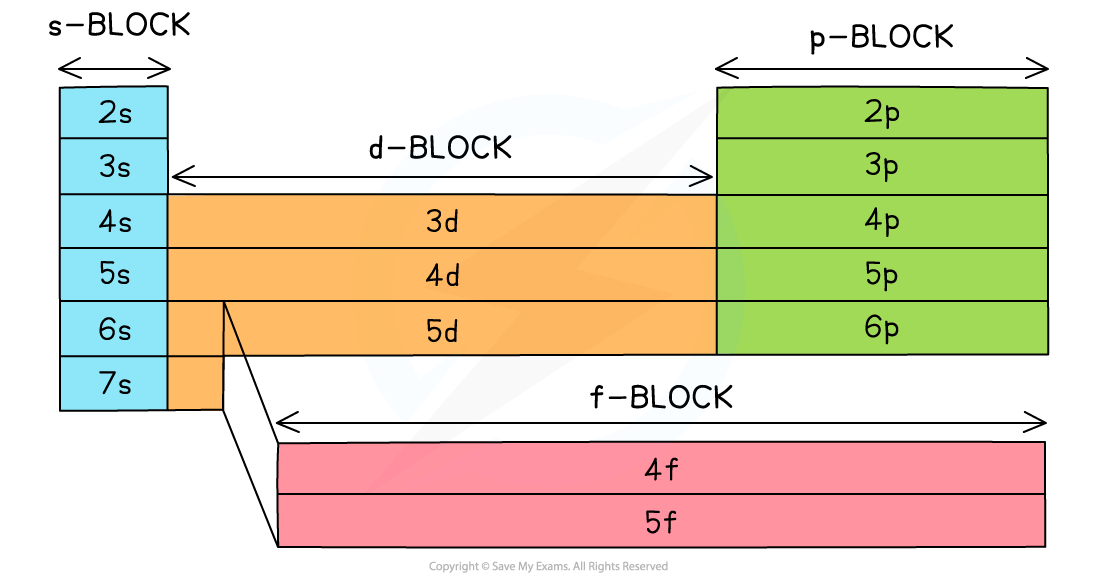
27
Which sub-shells gain/ lose electrons when forming an ion?
sub-shell with highest energy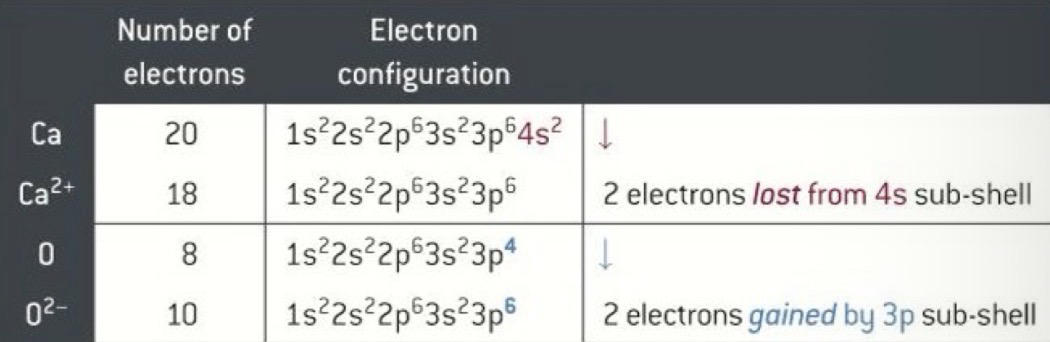
28
Does the 4s sub-shell fill before or after the 3d sub-shell? Why?
before, because the 4s energy level is lower than 3d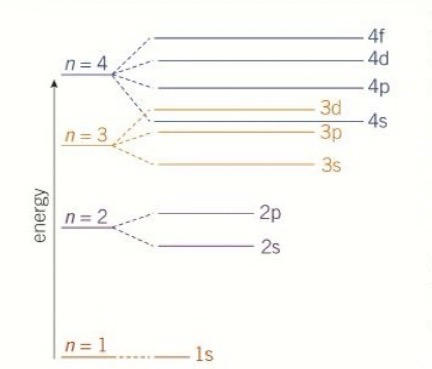
29
Does the 4s sub-shell empty before or after the 3d sub-shell? Why?
before, because once filled the 3d energy level falls below the 4s energy level
30
What is ionic bonding?
electrostatic attraction between positive and negative ions
31
What is aluminium’s charge as a cation?
$Al^{3+}$
32
How is an ammonium ion represented in symbols?
$NH_4^+$
33
How is a nitrate ion represented in symbols?
$NO_3^-$
34
How is a sulfate ion represented in symbols?
$SO_4 ^{2-}$
35
Why does a giant ionic lattice form?
each ion attracts oppositely charged ions in all directions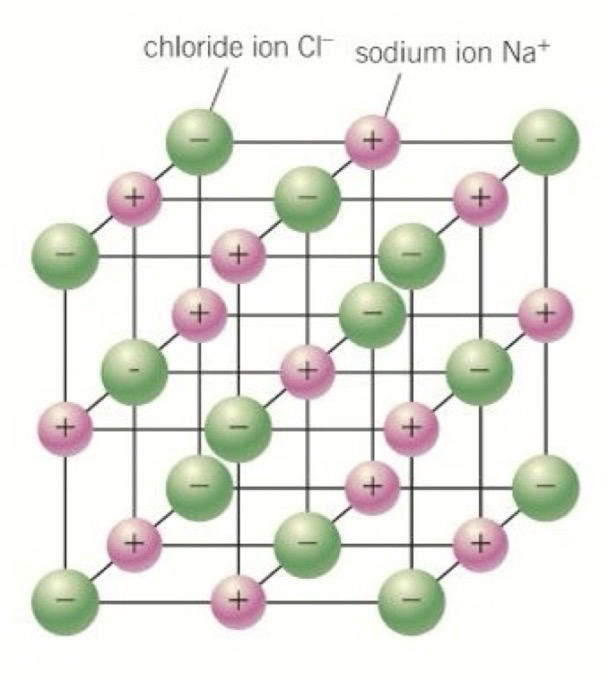
36
What state is an ionic compound usually at room temp? Why?
solid, insufficient energy to overcome strong electrostatic forces of attraction between oppositely chrged ions in giant ionic lattice
37
Do ionic compounds have high bp?
yes
38
How does a greater ionic charge effect the bp of an ionic compound?
stronger attraction so more energy needed
39
What kind of solvents do many ionic compounds dissolve in? Why?
polar solvents, as can break down lattice and surround each ion in solution
40
How does size of charge effect solubility in ionic bonds?
large charges mean ionic attraction may be too strong for water to break down lttice structure, making compound not very soluble
41
Which 2 main processes does solubility in water require? This means solubility of an ionic compound in water depends on what?
-ionic lattice must be broken down
-water molecules must attract and surround ions
-relative strengths of attractions within giant ionic lattice
-attractions between ions and water molecules
-water molecules must attract and surround ions
-relative strengths of attractions within giant ionic lattice
-attractions between ions and water molecules
42
Is an ionic compound conductive as a solid? Why?
no, ions fixed position in giant ionic lattice so no mobile charge carriers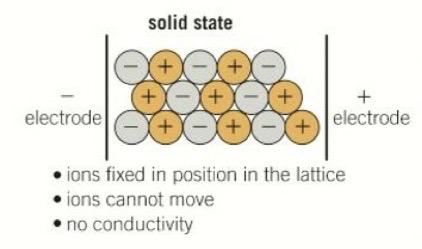
43
Is an ionic compound conductive as a liquid or aqueous? Why?
yes, solid ionic lattice broken down so ions free to move as mobile charge carriers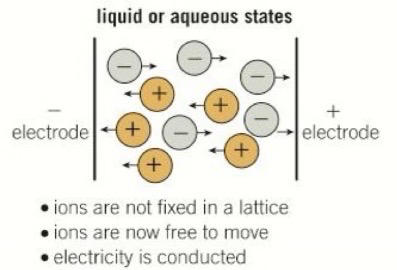
44
What is covalent bonding?
strong electrostatic attraction between shared pair of electrons and nuckei of bonded atoms
45
What does covalent bonding occur in?
-non metallic elements
-compounds of non metallic elements
-polyatomic atoms
-compounds of non metallic elements
-polyatomic atoms
46
Which nucleus in covalent bonding are the electrons attracted to?
both nuclei
47
Covalent bonds are localised, what does this mean?
acting solely between shared pair of electrons and muclei of 2 bonded atoms resulting in a molecule
48
What are lone pairs?
paired electrons that are not covalently shared
49
Does covalent bonding have to result in full outer shell?
no
50
What is the expansion of the octet?
covalent bonds resulting in more than 8 electrons in the outer shell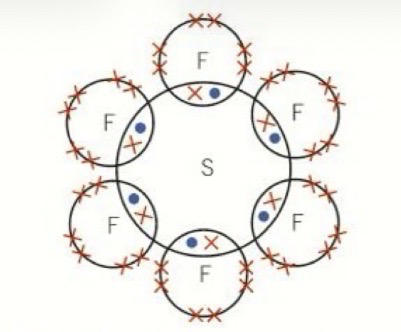
51
From when can expansion of the octet become possible?
from n=3 shell, when d-sub-shell available for expansion
52
What is a double covalent bond?
electrostatic attraction is between 2 shared pairs of electrons and nuclei of bonding atoms
53
What is a triple covalent bond?
electrostatic attraction is between 3 shared pairs of electrons and nuclei of bonding atoms
54
What is another word for a dative covalent bond?
coordinate bond
55
What is a dative covalent bond?
covalent bond where shared pair of electrons supplies by one of bonding atoms only
56
What was the shared pair originally in a dative bond?
lone pair
57
How is a dative bond shown in displayed formula?
arrow pointing towards atom being supplied with electrons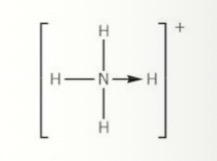
58
What does average bond enthalpy serve as with covalent bonds?
measurement of covalent bond strength (larger value= stronger bond)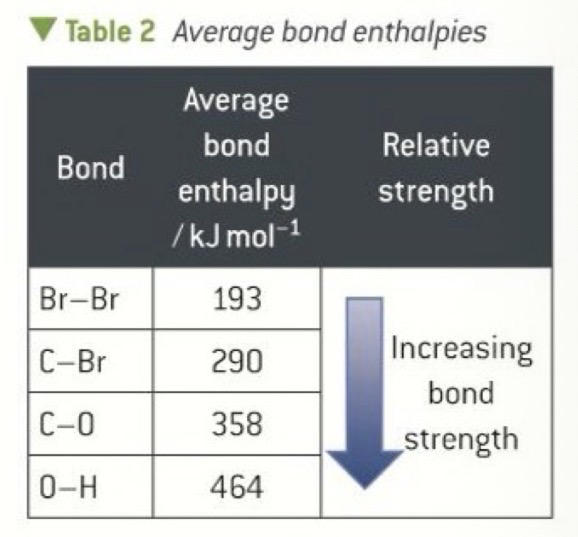
59
How do electron pairs determine the shape of molecules/ ions?
electron pairs repel eachother so arranged as far apart as possible, this minimises repulsion so holds definitive shape
60
Is covalent bonding strong or weak?
strong
61
What are intermolecular forces?
weak interactions
62
What are the 3 main intermolecular forces?
-induced dipole-dipole interactions (London forces)
-permanent dipole-dipole interactions
-hydrogen bonding
-permanent dipole-dipole interactions
-hydrogen bonding
63
What are intermolecular forces responsible for?
physical properties like mp and bp
64
What are covalent bonds responsible for?
identity and chemical reactions of molecules
65
Do London forces exist between all molecules?
yes
66
How are London forces created?
1) movement of electrons produces an instantaneous dipole
2) instantaneous dipole induces dipole in neighboring molecule
3) induced dipole induces further dipoles on neighboring molecules which then attract each other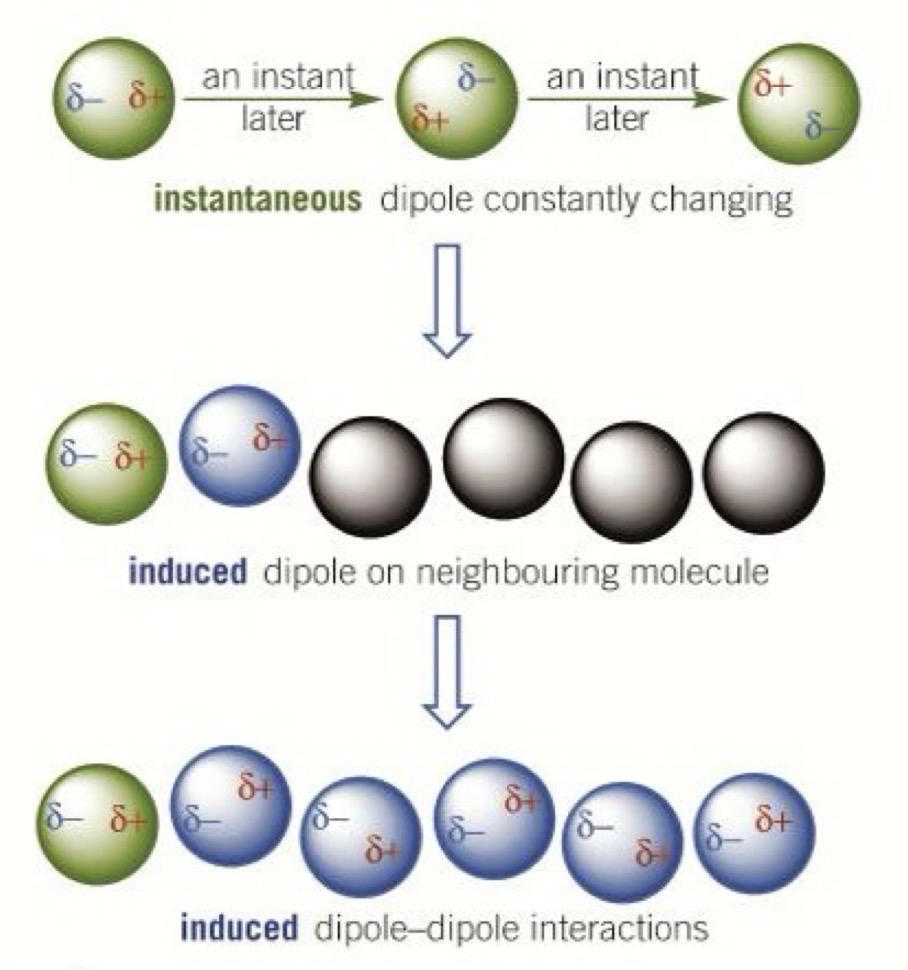
2) instantaneous dipole induces dipole in neighboring molecule
3) induced dipole induces further dipoles on neighboring molecules which then attract each other
67
How do more electrons in each molecule affect the instantaneous + induced dipoles?
larger
68
How do more electrons in each molecule affect the induced dipole-dipole interactions?
greater London force
69
Why is the boiling point greater in molecules with more electrons?
-intermolecular forces are greater with more electrons (due to it causing a greater impact with London forces)
-more energy is required to overcome greater intermolecular forces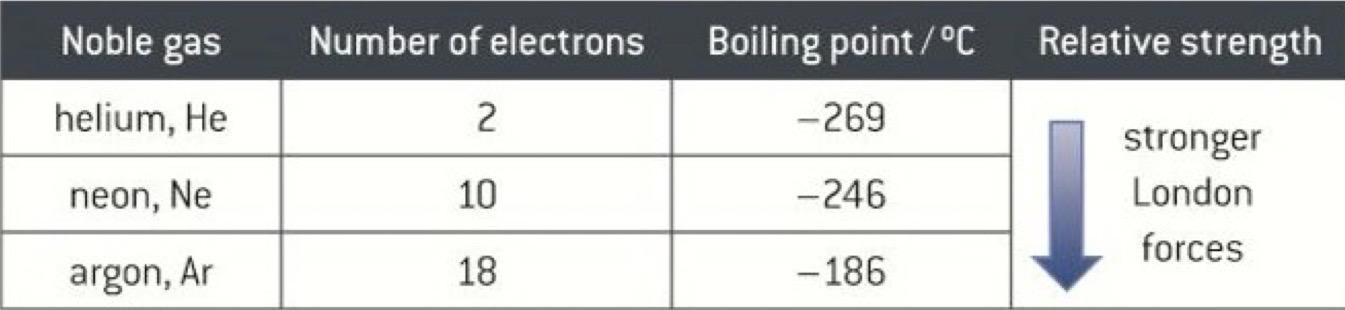
-more energy is required to overcome greater intermolecular forces
70
What will have a higher bp, F-F or H-Cl? Why?
Both have london forces but H-Cl also has permanent dipole interaction meaning more energy is required to overcome intermolecular forces in H-Cl, giving it a higher bp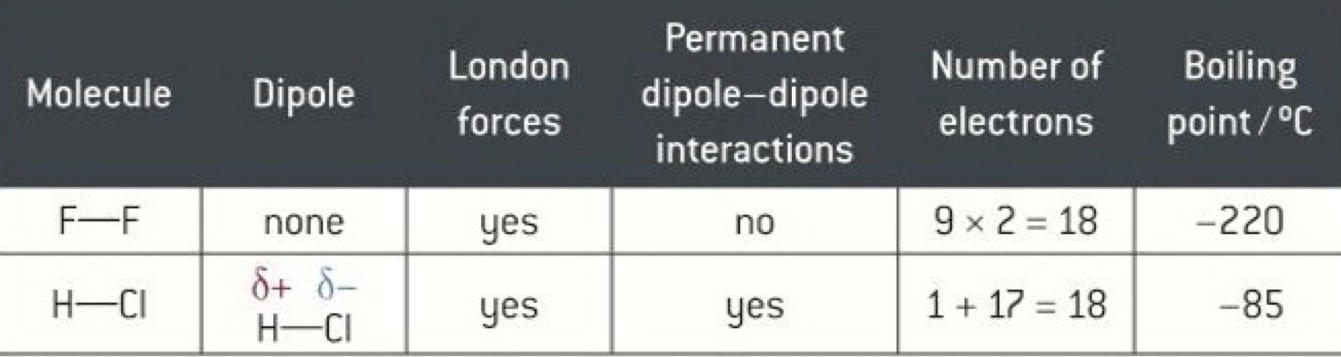
71
What is a simple molecule?
small unit containing definite number of atoms with definite molecular formula
72
Is the bp and mp high or low in simple molecular substances?
low
73
What kind of structure do simple molecules form in the solid state?
regular structure called a simple molecular lattice
74
Describe the intermolecular forces and covalent bonds in a simple molecular lattice
-molecules held in place by weak intermolecular forces
-atoms within molecules bonded together by strong covalent bonds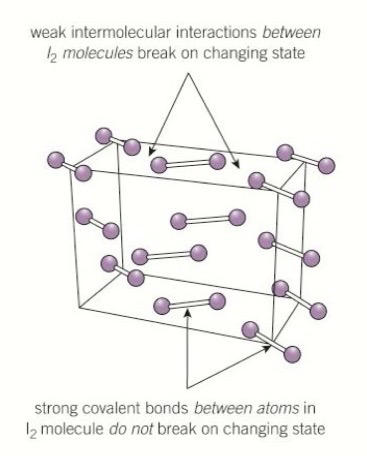
-atoms within molecules bonded together by strong covalent bonds
75
What kind of bond are all simple molecular substances?
Covalent
76
What is the order of strength of intermolecular forces? (highest to lowest)
-ionic/ covalent bonds
-hydrogen bonds
-dipole-dipole forces
-London forces
-hydrogen bonds
-dipole-dipole forces
-London forces
77
How do permanent dipole-dipole forces work?
Electron deficient atoms weakly attracted to electron rich atoms of other molecules
78
Do molecules with larger or smaller atoms tend to have stronger dipole-dipole forces?
larger
79
Do non-polar simple molecular substances tend to be soluble in non-polar solvents? Why?
yes
-intermolecular forces form between molecule and solvent
-interactions weaken intermolecular forces in simple molecular lattice
-intermolecular forces break and compound dissolves
-intermolecular forces form between molecule and solvent
-interactions weaken intermolecular forces in simple molecular lattice
-intermolecular forces break and compound dissolves
80
Do non-polar simple molecular substances tend to be soluble in polar solvents? Why?
no
-little interaction between molecules in lattice and solvent molecules
-intermolecular bonding within polar solvent too strong to be broken
-little interaction between molecules in lattice and solvent molecules
-intermolecular bonding within polar solvent too strong to be broken
81
Can polar covalent substances dissolve in polar solvents? Why/ why not?
yes as their molecules attract each other
82
What does the solubility of a polar covalent substance in a polar solvent depend on? Is the solubility easy to predict?
-strength of dipole
-hard to predict
-hard to predict
83
Why can some compounds dissolve in polar and non-polar solvents?
have polar (eg O-H) and non polar (eg carbon chain) parts
84
Are there mobile charged particles in simple molecular structures? What does this then mean
no, so nothing can complete electrical circuit making it a non-conductor
85
Are hydrophillic parts of biological molecules polar or non-polar?
polar, containing electronegative atoms (often oxygen) that can interact with water
86
Are hydrophobic parts of biological molecules polar or non-polar?
non-polar, comprised of carbon chain
87
What type of interaction is a hydrogen bond?
Permanent dipole-dipole interaction
88
What do hydrogen bonds occur between?
-hydrogen atom attached to electronegative atom
-electronegative atom with lone pair of electrons
-electronegative atom with lone pair of electrons
89
What kind of line represents a hydrogen bond?
dashed line
90
Why is ice being less dense than water good for life?
floats on tops of water forming an insulating layer and preventing the water from freezing solid
91
How do the hydrogen bonds affect water’s structure?
hydrogen bonds extend outwards, holding water molecules slightly apart + forming open tetrahedral lattice full of holes
92
How does water/ice’s structure affect their density?
-holes in open lattice structure decrease density of ice
-when melting, ice lattice collapses and molecules move closer together making it denser
-when melting, ice lattice collapses and molecules move closer together making it denser
93
Why does water have a higher boiling point than expected?
energy needed to break hydrogen bonds not just london forces
94
What happens to hydrogen bonds when water boils?
hydrogen bonds break completely
95
What happens to hydrogen bonds during melting?
their rigid arrangement is broken
96
What are other examples of anomalous properties of water?
relatively high surface tension and viscosity