6.2.1 Amines + 6.2.2 Amino acids, amides and chirality
Study these flashcardsFree · spaced repetition · iPhone, Android, Mac & web
All cards
1
What is an amine?
An organic derivative of ammonia in which one or more hydrogen atoms are replaced by alkyl or aryl groups.
2
What are the general formulae of primary, secondary and tertiary amines?
Primary: $RNH_2$; secondary: $R_2NH$; tertiary: $R_3N$.
3
How are amines classified as primary, secondary or tertiary?
By the number of alkyl or aryl groups directly bonded to nitrogen.
4
What is the difference between aliphatic and aromatic amines?
Aliphatic amines have alkyl groups; aromatic amines have an amino group directly attached to an aromatic ring.
5
What are the formulae of methylamine, ethylamine and phenylamine?
$CH_3NH_2$, $C_2H_5NH_2$ and $C_6H_5NH_2$.
6
What are the formulae of dimethylamine and trimethylamine?
$(CH_3)_2NH$ and $(CH_3)_3N$.
7
How are simple primary amines named?
Alkyl group + amine, e.g. ethylamine; or using amino- with a numbered carbon chain.
8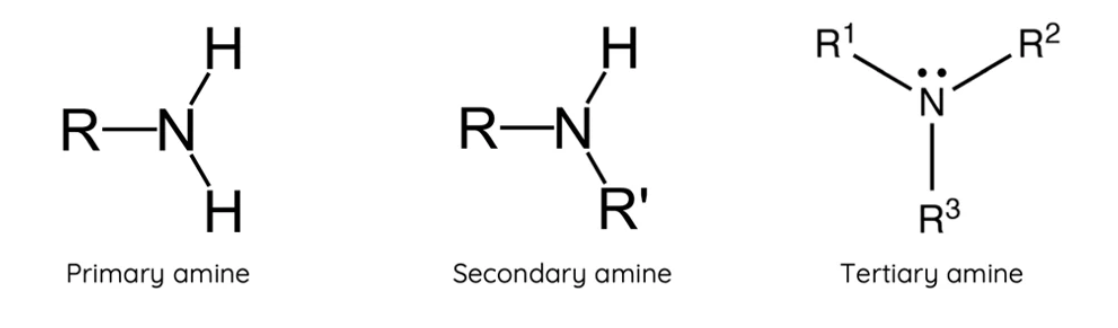
Draw the displayed structures of primary, secondary and tertiary amines
9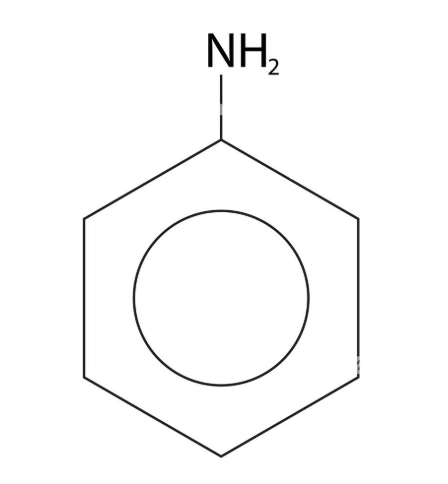
Draw the displayed structure of phenylamine
10
Why do amines act as Brønsted–Lowry bases?
The nitrogen lone pair accepts a proton, forming a dative covalent bond.
11
What type of bond forms when an amine accepts a proton?
A dative covalent bond from nitrogen to $H^+$.
12
What happens when amines react with dilute inorganic acids?
They accept a proton to form substituted ammonium salts.
13
Write the general equation for a primary amine reacting with HCl.
$RNH_2+HCl\rightarrow RNH_3^+Cl^-$
14
Write the equation for ethylamine reacting with hydrochloric acid.
$C_2H_5NH_2+HCl\rightarrow C_2H_5NH_3^+Cl^-$
15
What is the product of methylamine reacting with hydrochloric acid?
Methylammonium chloride, $CH_3NH_3^+Cl^-$.
16
What is the product of diethylamine reacting with hydrochloric acid?
Diethylammonium chloride, $(C_2H_5)_2NH_2^+Cl^-$.
17
How can an amine be regenerated from its ammonium salt?
Add aqueous sodium hydroxide to deprotonate the ammonium ion.
18
Write the equation for regenerating methylamine from methylammonium chloride.
$CH_3NH_3Cl+NaOH\rightarrow CH_3NH_2+NaCl+H_2O$
19
Why can amines form alkaline aqueous solutions?
They accept protons from water, producing hydroxide ions.
20
Write the general equation for an amine reacting with water.
$RNH_2+H_2O\rightleftharpoons RNH_3^++OH^-$
21
What reagents and conditions prepare primary aliphatic amines from haloalkanes?
Excess ethanolic ammonia, heated in a sealed tube under pressure.
22
What type of reaction produces aliphatic amines from haloalkanes?
Nucleophilic substitution.
23
Why does ammonia act as a nucleophile in this reaction?
Its nitrogen lone pair attacks the electron-deficient carbon bonded to the halogen.
24
Why is ethanolic ammonia used rather than aqueous ammonia?
To reduce competing hydrolysis of the haloalkane.
25
Why is excess ammonia used when preparing primary amines?
To favour primary amine formation and reduce further substitution.
26
What is the overall equation for producing a primary amine from a haloalkane and ammonia?
$RX+2NH_3\rightarrow RNH_2+NH_4X$
27
Write the equation for preparing ethylamine from bromoethane.
$CH_3CH_2Br+2NH_3\rightarrow CH_3CH_2NH_2+NH_4Br$
28
What are the two stages in the nucleophilic substitution of a haloalkane with ammonia?
Nucleophilic attack forming an alkylammonium ion, followed by deprotonation.
29
What removes a proton from the alkylammonium intermediate?
A second ammonia molecule acting as a base.
30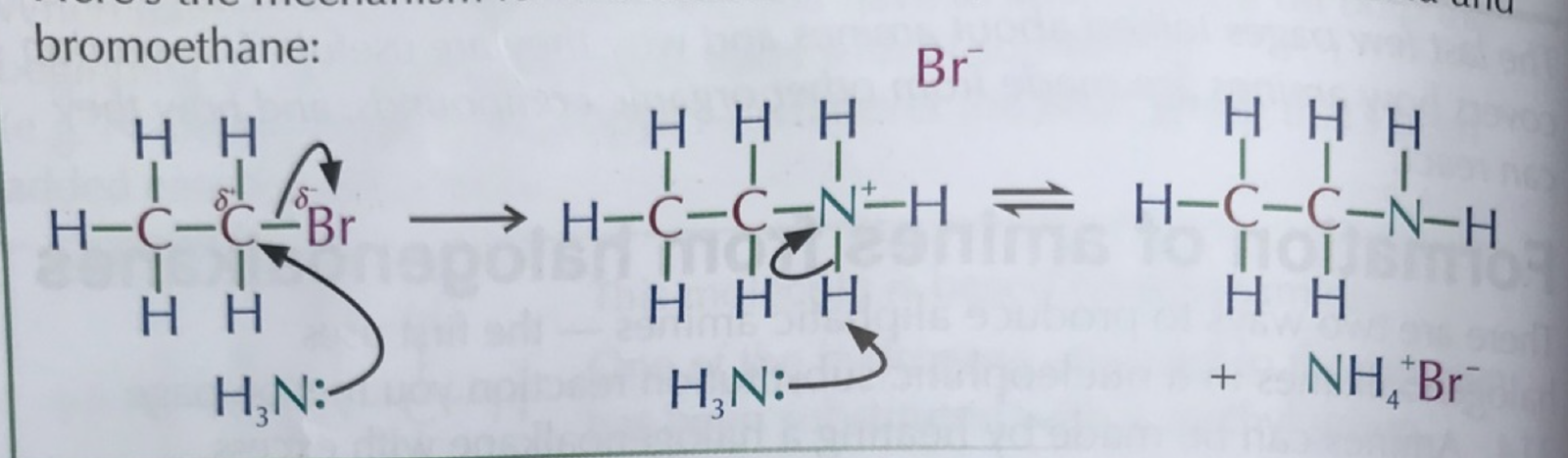
Draw the full nucleophilic substitution mechanism of bromoethane with ammonia
31
Why can a mixture of amines form during haloalkane substitution?
The amine products are also nucleophiles and can undergo further substitution.
32
How can secondary amines be prepared from haloalkanes?
React a haloalkane with excess primary amine in ethanol.
33
How can tertiary amines be prepared from haloalkanes?
React a haloalkane with excess secondary amine in ethanol.
34
What nucleophile is used to form a secondary amine from a haloalkane?
A primary amine, $RNH_2$.
35
What nucleophile is used to form a tertiary amine from a haloalkane?
A secondary amine, $R_2NH$.
36
Write the overall equation for producing diethylamine from bromoethane and ethylamine.
$C_2H_5Br+2C_2H_5NH_2\rightarrow(C_2H_5)_2NH+C_2H_5NH_3Br$
37
What can form if a tertiary amine undergoes further alkylation?
A quaternary ammonium salt, $R_4N^+X^-$.
38
How can a mixture of amines be separated?
Fractional distillation, using differences in boiling points.
39
What starting compound is used to prepare phenylamine by reduction?
Nitrobenzene.
40
What reagents and conditions reduce nitrobenzene to phenylamine?
Tin and concentrated hydrochloric acid, heated under reflux, followed by aqueous sodium hydroxide.
41
Why is sodium hydroxide added after reducing nitrobenzene?
To deprotonate the phenylammonium salt and release phenylamine.
42
Write the reduction equation for nitrobenzene using [H].
$C_6H_5NO_2+6[H]\rightarrow C_6H_5NH_2+2H_2O$
43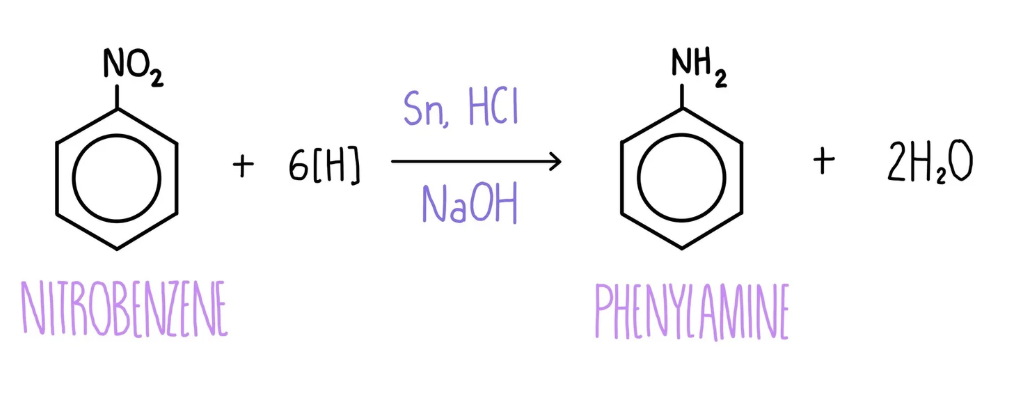
Draw the reaction scheme for converting nitrobenzene into phenylamine
44
What is the general formula of an α-amino acid?
$RCH(NH_2)COOH$
45
What two functional groups are present in amino acids?
An amino group, $-NH_2$, and a carboxylic acid group, $-COOH$.
46
What makes an amino acid an α-amino acid?
The amino group is attached to the carbon adjacent to the carboxylic acid carbon.
47
What does the R group represent in an α-amino acid?
A variable side chain, which may be hydrogen or contain other functional groups.
48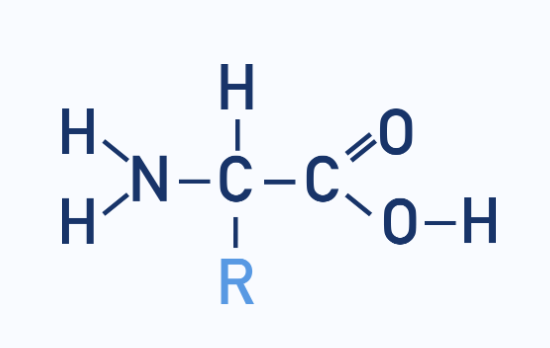
Draw the general displayed structure of an α-amino acid
49
What are the systematic names of glycine and alanine?
2-Aminoethanoic acid and 2-aminopropanoic acid.
50
Why can amino acids behave as both acids and bases?
They contain an acidic carboxyl group and a basic amino group.
51
How does the amino group of an amino acid react with acids?
It accepts a proton, forming $-NH_3^+$.
52
How does the carboxylic acid group react with alkalis?
It donates a proton, forming $-COO^-$ and water.
53
What happens to an amino acid in acidic conditions?
Its amino group is protonated, giving a positively charged ammonium species.
54
What happens to an amino acid in alkaline conditions?
Its carboxylic acid group is deprotonated, giving a negatively charged carboxylate species.
55
Write the equation for an α-amino acid reacting with HCl.
$RCH(NH_2)COOH+HCl\rightarrow[RCH(NH_3^+)COOH]Cl^-$
56
Write the equation for an α-amino acid reacting with NaOH.
$RCH(NH_2)COOH+NaOH\rightarrow RCH(NH_2)COO^-Na^++H_2O$
57
What happens if an amino acid contains two amino groups and reacts with excess HCl?
Both amino groups are protonated to $-NH_3^+$.
58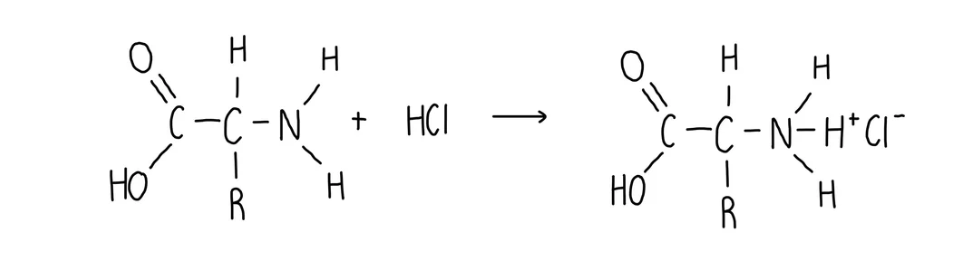
Draw the reaction of an α-amino acid reacting with excess HCl
59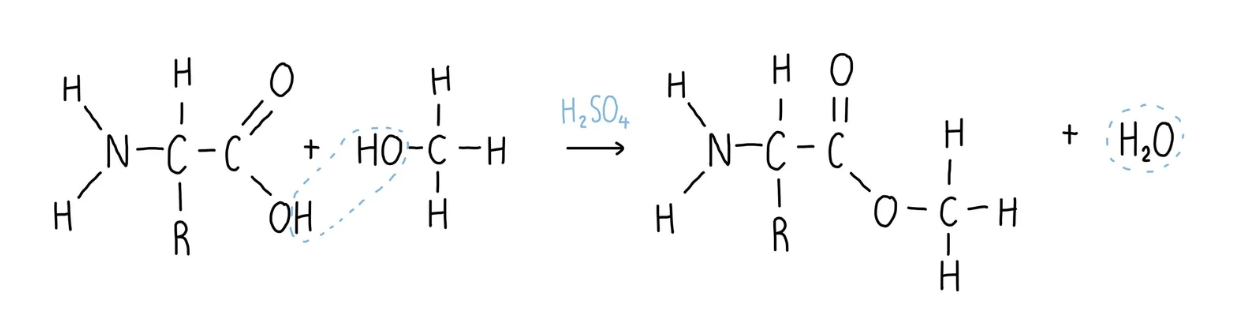
Draw the product of an α-amino acid reacting with aqueous NaOH
60
How do amino acids form esters?
Their carboxylic acid group reacts with an alcohol using a strong acid catalyst, forming an ester and water.
61
What are the conditions for esterifying an amino acid?
Heat with an alcohol and an acid catalyst, such as concentrated sulfuric acid.
62
Write the general esterification equation for an α-amino acid.
$RCH(NH_2)COOH+R'OH\rightleftharpoons RCH(NH_2)COOR'+H_2O$
63
What must be considered when drawing an amino acid esterification product in acidic conditions?
The amino group is also protonated to $-NH_3^+$.
64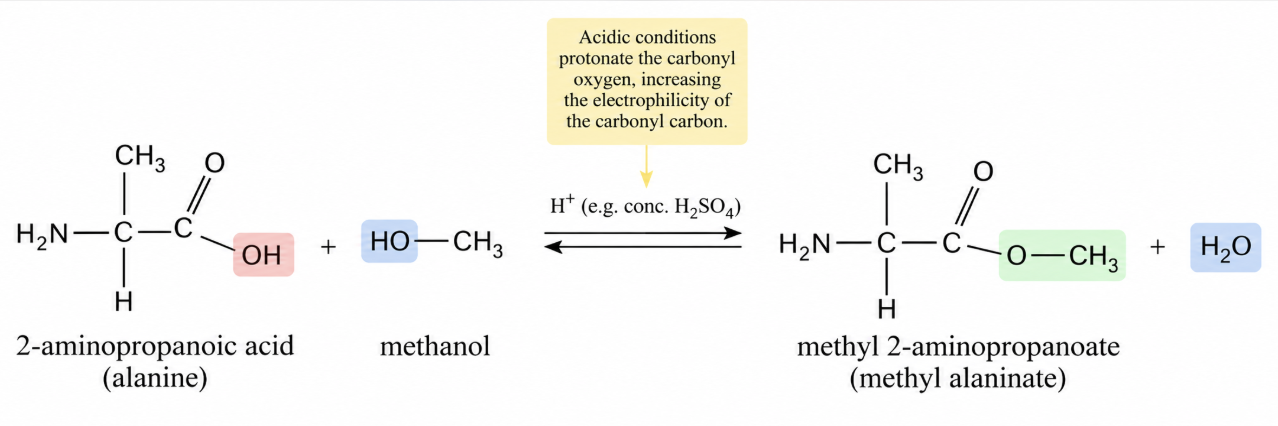
Draw the esterification of 2-aminopropanoic acid with methanol, including the effect of acidic conditions
65
What is a zwitterion?
A species containing both positive and negative charges but with no overall charge.
66
How does an amino acid form a zwitterion?
A proton transfers from $-COOH$ to $-NH_2$, forming $-COO^-$ and $-NH_3^+$.
67
What is the general formula of an α-amino acid zwitterion?
$RCH(NH_3^+)COO^-$
68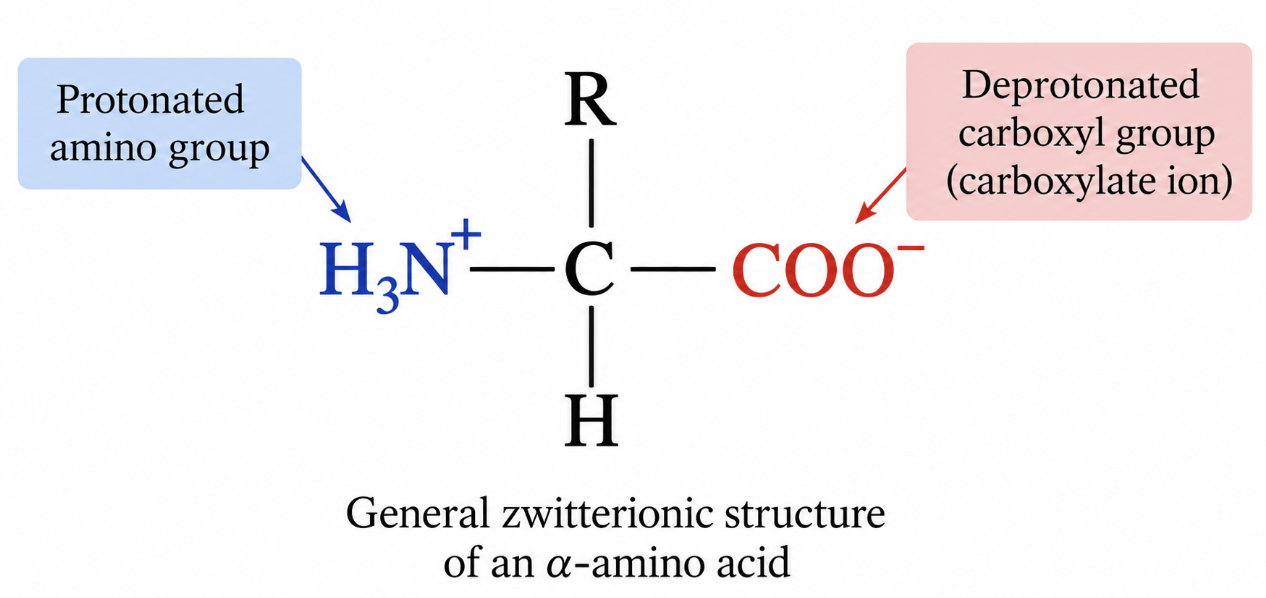
Draw the zwitterionic structure of an α-amino acid
69
Why do amino acids commonly form crystalline solids?
Their zwitterionic forms experience strong electrostatic attractions in the solid state.
70
What is an amide?
An organic compound containing a carbonyl group directly bonded to nitrogen.
71
What is the general formula of a primary amide?
$RCONH_2$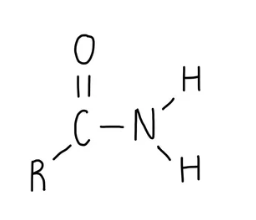
72
What is the general formula of a secondary amide?
$RCONHR'$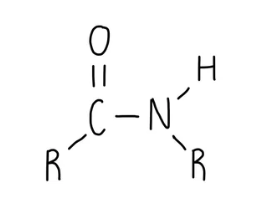
73
How are primary and secondary amides distinguished?
Primary amides have two N–H bonds; secondary amides have one N–H bond.
74
What is the general formula of a tertiary amide?
$RCONR'R''$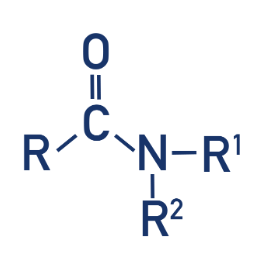
75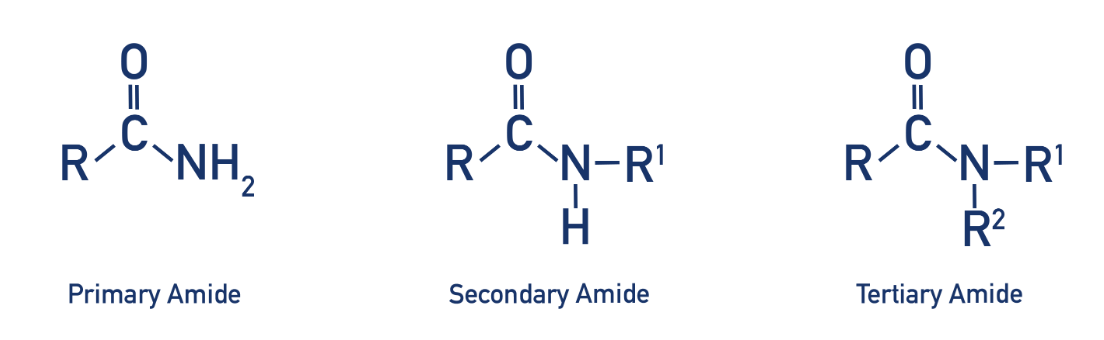
Draw the displayed structures of a primary and secondary amide
76
What are the formulae of methanamide and ethanamide?
$HCONH_2$ and $CH_3CONH_2$.
77
What does N- indicate in the name of an amide?
A substituent attached directly to the nitrogen atom.
78
What is the structure of N-methylpropanamide?
$CH_3CH_2CONHCH_3$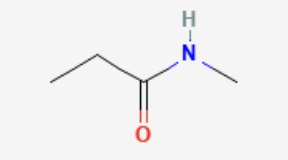
79
How can secondary amides be prepared from acyl chlorides?
React an acyl chloride with a primary amine by nucleophilic addition–elimination.
80
What type of reaction occurs between an acyl chloride and an amine?
Nucleophilic addition–elimination.
81
What is a peptide linkage?
The amide linkage $-CONH-$ joining amino acid residues.
82
What is stereoisomerism?
Compounds with the same structural formula but different arrangements of atoms in space.
83
What are the two main types of stereoisomerism studied in organic chemistry?
E/Z isomerism and optical isomerism.
84
What is optical isomerism?
Stereoisomerism involving non-superimposable mirror-image molecules called enantiomers.
85
What is a chiral centre?
A tetrahedral carbon atom bonded to four different atoms or groups.
86
How is a chiral centre commonly indicated in a structural formula?
With an asterisk (*).
87
What are enantiomers?
A pair of non-superimposable mirror-image stereoisomers.
88
What does non-superimposable mean?
The molecules cannot be placed exactly on top of one another with all atoms aligned.
89
What is the geometry around a typical carbon chiral centre?
Tetrahedral, with bond angles of approximately $109.5^\circ$.
90
What do solid wedges and dashed wedges represent in 3-D organic structures?
Solid wedges project towards the viewer; dashed wedges project away.
91
How can a chiral centre be identified in an organic molecule?
Find a tetrahedral carbon bonded to four different groups, comparing complete side chains.
92
Why can a carbon involved in a double bond not be a typical chiral centre?
It is not tetrahedral and cannot have four different single-bonded groups.
93
Which α-amino acid does not contain a chiral centre?
Glycine, because its α-carbon is bonded to two hydrogen atoms.
94
Why are most α-amino acids optically active?
Their α-carbon has four different groups, allowing optical isomerism.
95
How do two pure enantiomers affect plane-polarised light?
They rotate it by equal angles in opposite directions under identical conditions.
96
How do enantiomers compare in physical and chemical properties?
They generally have identical properties in achiral environments but may behave differently in chiral environments.
97
What is a racemic mixture?
An equal mixture of two enantiomers with no overall optical rotation.
98
How many optical isomers are possible for a molecule with one chiral centre?
Two enantiomers.
99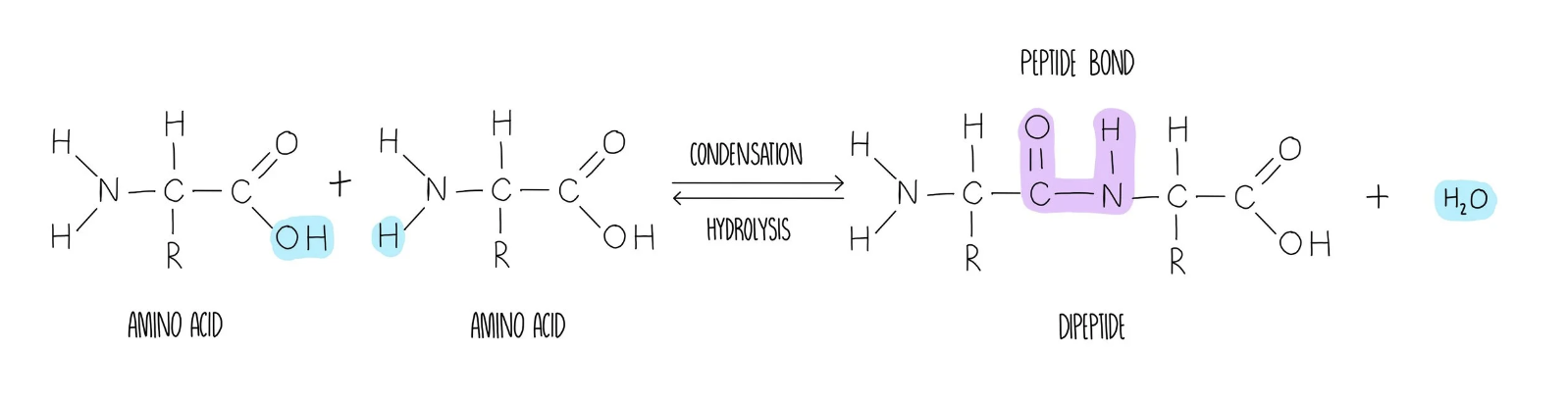
Draw the formation of a dipeptide from two amino acids.
100
What is a hydrolysis reaction?
A reaction in which a covalent bond is broken by reaction with water.
101
What is a condensation reaction?
A reaction in which two molecules join by forming a new covalent bond, eliminating a small molecule, usually water.