Chapter 45-Cirrhosis and Portal HTN
Study these flashcardsFree · spaced repetition · iPhone, Android, Mac & web
All cards
1
Cirrhosis is defined by the formation of what in the liver parenchyma?
scar tissue
2
What is the end result of progressive injury to hepatocellular elements?
Cirrhosis
3
What does scar formation in the liver lead to?
Increased resistance to blood flow
4
What condition results from increased resistance to portal blood flow?
Portal hypertension
5
What are formed due to portal hypertension and hepatocellular failure?
Portosystemic shunts
6
What triggers the inflammatory response in cirrhosis?
Acute or chronic liver injury
7
What does liver injury result in at the cellular level? (2 processes, 3 structures)
Destruction and regeneration of hepatocytes, bile ducts, and endothelial cells
8
What is the primary cell involved in liver fibrosis?
Stellate cell (Ito cell)
9
Where are stellate cells located?
Perisinusoidal space of Disse
10
What is the normal function of Ito cells?
Storage of vitamin A
11
What do Ito cells secrete in response to stimuli?
Pro-proliferative cytokines
12
What does secretion of cytokines by Ito cells lead to?
Fibrotic scar formation
13
What does fibrotic scar obliterate in cirrhosis?
Perisinusoidal space
14
What is the result of perisinusoidal space obliteration?
Nutrient depletion from hepatocytes
15
What is a micronodular liver morphology?
Nodules smaller than 3 mm uniformly distributed
16
What does micronodular morphology indicate?
Early stage cirrhosis
17
What is a macronodular liver morphology?
Nodules larger than 3 mm
18
What may macronodular cirrhosis result from?
Posthepatitis or postnecrotic changes
19
What characterizes mixed liver morphology?
Both micronodular and macronodular nodules in equal proportions
20
What is the most common cause of cirrhosis in the US?
Alcohol abuse
21
What type of cirrhosis is commonly seen in alcoholics?
Micronodular cirrhosis
22
What percentage of alcoholics develop cirrhosis?
10% to 30%
23
What is the damaging substrate of ethanol?
Acetaldehyde
24
What is the most common cause of cirrhosis worldwide?
Viral hepatitis
25
Which hepatitis types can cause chronic hepatitis?
Hepatitis B, C, and D
26
What percentage of acute HBV infections become chronic?
<5%
27
What percentage of chronic HBV infections lead to cirrhosis?
10% to 20%
28
What is the overall rate of cirrhosis from HBV infection?
<1%
29
What percentage of HCV infections become chronic?
90%
30
What percentage of chronic HCV infections progress to hepatitis?
60%
31
What percentage of HCV infections result in cirrhosis?
30%
32
What is the overall rate of cirrhosis in HCV infection?
10%
33
What therapy may eradicate HCV in 15%–30% of patients?
Interferon-based therapy
34
What does HDV require to be pathogenic?
Hepatitis B virus (HBV)
35
What percentage of HBV and HDV superinfections lead to cirrhosis?
80%
36
What non-viral condition may lead to cirrhosis?
Nonalcoholic steatohepatitis
37
Which inherited disorders may lead to cirrhosis?
Hemolytic anemia, cystic fibrosis, glycogen storage diseases, α1-antitrypsin deficiency
38
What is cholestasis?
Decreased bile flow into the duodenum
39
What causes intrahepatic cholestasis?
Primary biliary cirrhosis, primary sclerosing cholangitis, lymphoma, amyloidosis, Alagille syndrome, cystic fibrosis
40
What causes extrahepatic cholestasis?
Choledocholithiasis, pancreatic cancer, cholangiocarcinoma, pancreatic and choledochal cystic disease, AIDS, bile duct strictures, biliary atresia
41
What causes hepatocellular cholestasis?
Alcoholic hepatitis, viral hepatitis, inherited deficiencies
42
What percentage of patients with primary biliary cirrhosis are women?
95%
43
What antibody is associated with primary biliary cirrhosis?
Antimitochondrial antibody
44
What condition results from immune attack on the liver?
Autoimmune hepatitis
45
What chemicals are associated with occupational cirrhosis?
Carbon tetrachloride, beryllium, vinyl chloride
46
Where is schistosomiasis endemic?
Sub-Saharan Africa
47
What nutritional factor can cause cirrhosis?
Long-term total parenteral nutrition
48
What is veno-occlusive disease?
Obstruction of the hepatic veins
49
What conditions can cause veno-occlusive disease?
Chronic right-sided heart failure, constrictive pericarditis, Budd–Chiari syndrome
50
Which iron-related disorder can lead to cirrhosis?
Hemochromatosis
51
Which copper-related disorder can lead to cirrhosis?
Wilson’s disease
52
What kind of disease is cirrhosis?
A chronic disease process
53
What helps identify the cause of cirrhosis?
Patient history and awareness of diagnosis
54
What physical signs indicate hepatocellular failure and portal hypertension?
Jaundice, dark urine, muscle wasting, ascites, edema, purpura, encephalopathy, splenomegaly, spider angiomata, caput medusae, asterixis, gynecomastia, testicular atrophy, venous hum, palmar erythema, loss of body hair, Dupuytren’s contractures
55
What can cause liver enlargement or shrinkage?
Vascular congestion or chronic disease
56
What non-specific finding might also be evaluated in cirrhosis?
Hemorrhoids
57
What indicates direct hyperbilirubinemia?
Excess conjugated bilirubin due to overproduction or underexcretion
58
What causes indirect hyperbilirubinemia?
Excess unconjugated bilirubin from enzymatic deficiency
59
At what bilirubin level does jaundice become clinically apparent?
Greater than 2 mg/dl
60
How is conjugated bilirubin excreted?
By the kidney, since it is water soluble
61
Where is alkaline phosphatase produced?
Bone, placenta, and liver
62
Where is alkaline phosphatase excreted?
In bile
63
What does elevated alkaline phosphatase indicate?
Obstruction of bile ducts
64
What are the two main liver transaminases?
Aspartate aminotransferase (AST) and alanine aminotransferase (ALT)
65
Which transaminase is higher in viral hepatitis?
ALT > AST
66
Which transaminase is higher in alcoholic hepatitis?
AST > ALT
67
Can transaminase levels be normal in long-standing disease?
Yes, even during acute exacerbation
68
What serum protein indicates synthetic liver function?
Albumin
69
What happens to albumin levels when liver function is impaired?
They decrease
70
What does prothrombin time reflect?
Production of fibrinogen, prothrombin, and clotting factors V, VII, IX, X
71
What causes prolonged prothrombin time?
Fat and vitamin K malabsorption or hepatocellular insufficiency
72
What does thrombocytopenia indicate in cirrhosis?
Hypersplenism and portal hypertension
73
What can ultrasound detect in cirrhosis?
Nodular irregularities and hepatic ductal anatomy
74
How sensitive is ultrasound in diagnosing cirrhosis?
Up to 90%
75
What can CT/MRI assess in liver disease?
Liver size, ascites, and presence of varices
76
What does angiography measure in cirrhosis?
Hepatic artery pressures and portal vein flow
77
What is CT angiography useful for in liver disease?
Assessing portal/systemic vessel patency and hepatobiliary pathology
78
What is the purpose of a percutaneous liver biopsy?
To permit histologic diagnosis
79
What are contraindications to liver biopsy?
Coagulopathy, thrombocytopenia, cholangitis, tense ascites
80
What are possible complications of liver biopsy?
Bile leak, peritonitis, pneumothorax, bleeding, pain
81
What is the purpose of paracentesis in cirrhosis?
To relieve dyspnea and anorexia from increased intraabdominal pressure
82
What can cytologic analysis of ascitic fluid determine?
Cause of ascites and presence of spontaneous bacterial peritonitis
83
What are complications of paracentesis?
Infection, bleeding, perforation of viscus
84
What role does the liver play in the body?
It acts as the metabolic clearinghouse regulating almost every aspect of metabolism
85
What causes ascites in cirrhosis?
Portal hypertension, lymphatic obstruction, hypoalbuminemia, hyperaldosteronism, and increased ADH
86
How does portal hypertension lead to ascites?
By increasing hydrostatic pressure
87
What role does lymphatic obstruction play in ascites?
It allows fluid to leak (weep) from the liver surface
88
How does hypoalbuminemia contribute to ascites?
By lowering oncotic pressure and promoting fluid loss into the extravascular space
89
What is secondary hyperaldosteronism?
Increased aldosterone due to impaired liver function
90
How does hyperaldosteronism affect fluid balance?
It increases total body sodium and water by enhancing sodium resorption in the distal tubule
91
Why is antidiuretic hormone (ADH) increased in cirrhosis?
Due to perceived hypovolemia sensed by the carotid body and CNS
92
What is the effect of increased ADH in cirrhosis?
Decreased free water clearance
93
What cardiovascular changes occur in cirrhosis?
High cardiac output with low systemic vascular resistance
94
What may cause low systemic vascular resistance in cirrhosis?
Peripheral shunting and vasodilatory agents
95
Name some vasodilators involved in cirrhosis
Prostaglandins, GABA, VIP, substance P, insulin, glucagon, bile acids
96
How does estrogen metabolism affect vascular resistance?
Decreased metabolism may contribute to vasodilation
97
What are "false" neurotransmitters in cirrhosis?
Phenylethylamine, tyramine, octopamine
98
What do false neurotransmitters do?
They displace sympathetic transmitters like norepinephrine
99
What is hepatorenal syndrome?
Renal failure in cirrhosis with oliguria, increased BUN and creatinine
100
What is type 1 hepatorenal syndrome?
Resolves with relief of ascites and improved renal perfusion
101
What is type 2 hepatorenal syndrome?
Resolves with improved liver function and increased vascular resistance
102
What is a key urinary finding in hepatorenal syndrome?
Urine sodium concentration less than 10 mEq/L
103
What is the blood pressure status in Type 1 hepatorenal syndrome?
Normal or low
104
What is the blood pressure status in Type 2 hepatorenal syndrome?
Increased
105
How is cardiac index affected in Type 1 hepatorenal syndrome?
Normal or decreased
106
How is cardiac index affected in Type 2 hepatorenal syndrome?
Increased
107
What happens to peripheral resistance in Type 1 hepatorenal syndrome?
Normal or increased
108
What happens to peripheral resistance in Type 2 hepatorenal syndrome?
Decreased
109
What is intravascular volume like in Type 1 hepatorenal syndrome?
Low
110
What is intravascular volume like in Type 2 hepatorenal syndrome?
Normal
111
What is urinary sodium concentration in both types of hepatorenal syndrome?
Less than 10 mEq/L
112
What is the pathophysiology of Type 1 hepatorenal syndrome?
Effective hypovolemia
113
What is the pathophysiology of Type 2 hepatorenal syndrome?
Maldistribution of blood flow and portorenal reflex
114
What are associated findings with Type 1 hepatorenal syndrome?
Intractable ascites and hepatic encephalopathy
115
What is a key pressure-related finding in Type 1 hepatorenal syndrome?
High hepatic vein wedge pressure
116
What therapy is used in Type 1 hepatorenal syndrome?
Volume infusion, β-adrenergic agents, levodopa
117
When do β-adrenergic agents and levodopa improve survival?
Only when hepatic function improves
118
What rare therapy may be used in Type 1 hepatorenal syndrome?
Ascites reinfusion
119
What surgical interventions may help Type 2 hepatorenal syndrome?
Peritoneal-atrial shunt and side-to-side portal decompression
120
What are common precipitating factors for hepatic encephalopathy?
Gastrointestinal hemorrhage, portosystemic shunting, infection, excessive dietary protein, constipation, narcotics, and sedatives
121
Which infection is particularly a precipitating factor for hepatic encephalopathy?
Spontaneous bacterial peritonitis
122
How does excessive dietary protein contribute to hepatic encephalopathy?
It increases ammonia levels, exacerbating encephalopathy
123
What role does constipation play in precipitating hepatic encephalopathy?
It may increase ammonia absorption from the gut
124
How do narcotics and sedatives affect hepatic encephalopathy?
They can exacerbate the condition by altering mental status and reducing liver function
125
Why are patients with cirrhosis at increased risk during surgery?
Because cirrhosis can lead to complications that increase surgical risk
126
What should be considered before elective surgery in cirrhotic patients?
Prophylactic treatment for complications of cirrhosis
127
What is the purpose of the Child’s classification in cirrhosis patients?
To serve as a prognostic guide and estimate surgical risk
128
How can surgical risk be reduced in cirrhotic patients?
Through preoperative interventions like nutritional support and bowel preparation
129
What does an improvement in Child’s class indicate?
Improved liver function and reduced surgical risk
130
Why are patients with cirrhosis at increased risk during surgery?
Because cirrhosis can lead to complications that increase surgical risk
131
What should be considered before elective surgery in cirrhotic patients?
Prophylactic treatment for complications of cirrhosis
132
What is the purpose of the Child’s classification in cirrhosis patients?
To serve as a prognostic guide and estimate surgical risk
133
How can surgical risk be reduced in cirrhotic patients?
Through preoperative interventions like nutritional support and bowel preparation
134
What does an improvement in Child’s class indicate?
Improved liver function and reduced surgical risk
135
What does the Child–Turcotte–Pugh classification assess?
The severity of cirrhosis and surgical risk
136
What are the scoring categories in the Child–Turcotte–Pugh classification?
Ascites, bilirubin, encephalopathy, prothrombin time, and albumin
137
What bilirubin level scores 1 point in the Child–Turcotte–Pugh classification?
Less than or equal to 2.0 mg/dl
138
What bilirubin level scores 3 points in the Child–Turcotte–Pugh classification?
Greater than or equal to 3.0 mg/dl
139
What kind of ascites scores 1 point in the Child–Turcotte–Pugh classification?
None
140
What kind of encephalopathy scores 2 points in the Child–Turcotte–Pugh classification?
Minimal
141
What albumin level scores 3 points in the Child–Turcotte–Pugh classification?
Less than or equal to 3.0 g/dl
142
What prothrombin time prolongation scores 2 points in the Child–Turcotte–Pugh classification?
4–6 seconds
143
What total score range is considered Class A in Child–Turcotte–Pugh?
5–6 points
144
What total score range is considered Class C in Child–Turcotte–Pugh?
10–15 points
145
What is the total score range for Child's Class A cirrhosis?
5 to 7 points
146
What is the total score range for Child's Class B cirrhosis?
8 to 10 points
147
What is the total score range for Child's Class C cirrhosis?
11 points or more
148
What is the surgical mortality rate for Child's Class A?
2%
149
What is the surgical mortality rate for Child's Class B?
10%
150
What is the surgical mortality rate for Child's Class C?
50%
151
What are the primary complications of cirrhosis?
Ascites, variceal bleeding, encephalopathy, and hepatorenal failure
152
What is the purpose of sodium and water restriction in cirrhosis?
To manage fluid and electrolyte balance
153
What is a risk of overdiuresing cirrhotic patients?
Intravascular dehydration and prerenal acute renal failure
154
How much protein is needed to maintain nitrogen balance in cirrhosis?
1.1 g protein/kg/day
155
What is HepatAmine?
A total parenteral nutrition solution high in branched-chain amino acids and low in aromatic amino acids
156
What is the preferred primary source of nutrition in cirrhosis patients?
Low-sodium enteral diet
157
Why should gastrointestinal bleeding be prevented in cirrhosis?
It increases intraluminal protein load
158
What medications help prevent gastrointestinal bleeding in cirrhosis?
H2 blockers
159
How does neomycin help reduce ammonia in cirrhosis?
It decreases intraluminal bacterial counts
160
How does lactulose help manage ammonia levels in cirrhosis?
It converts NH3 to poorly absorbed NH4 by lowering colonic pH
161
What percentage of upper gastrointestinal bleeding is due to variceal hemorrhage?
10%
162
What percentage of cirrhotic patients have varices?
20% to 70%
163
What percentage of cirrhotic patients with varices will experience bleeding?
Up to 30%
164
What is the mortality rate of the first episode of variceal bleeding?
20% to 50%
165
What percentage of survivors rebleed within 6 weeks?
30%
166
What percentage of survivors rebleed within 1 year?
Up to 70%
167
At what hepatic venous pressure is bleeding likely to occur?
Greater than 12 mm Hg
168
What is the first diagnostic step for suspected variceal bleeding?
Nasogastric lavage
169
What diagnostic tool is used to identify the source of upper GI bleeding?
Esophagogastroduodenoscopy
170
What percentage of upper GI bleeds in cirrhotics are variceal?
50% to 90%
171
What are other causes of upper GI bleeding in cirrhotics?
Mallory–Weiss tears, portal hypertensive gastropathy, peptic ulcers, neoplasms
172
What is the top priority in treating variceal bleeding?
Airway protection
173
What can be used to control bleeding in the emergency department?
Nasogastric tube with saline lavage
174
What is the initial fluid management for variceal bleeding?
Crystalloid resuscitation
175
What blood products might be needed in variceal bleeding?
Packed red blood cells, fresh frozen plasma, cryoprecipitate, platelets
176
What is the bolus dose of octreotide for variceal bleeding?
250 μg IV bolus
177
What is the infusion rate of octreotide after bolus?
25 to 50 μg/hr for 2 to 4 days
178
What is the initial dose of vasopressin for variceal bleeding?
20 units IV over 20 minutes
179
What is the infusion rate of vasopressin?
0.2 to 0.4 units/min
180
What drug can be combined with vasopressin to reduce cardiac risk?
Nitroglycerin
181
What are the two main endoscopic treatments for variceal bleeding?
Sclerosant injection and band ligation
182
Which endoscopic treatment has fewer long-term complications?
Variceal banding
183
What are complications of sclerotherapy?
Esophageal stricture, chest pain, perforation, hemorrhagic ulceration, bacteremia
184
What is the name of the tube used for balloon tamponade?
Sengstaken–Blakemore or Minnesota tube
185
How much air is used initially to inflate the gastric balloon?
40 to 50 ml
186
What is the additional volume instilled after positioning the gastric balloon?
200 to 300 ml
187
What pressure is used to inflate the esophageal balloon if needed?
35 to 40 mm Hg
188
What are complications of balloon tamponade?
Gastric erosion, perforation, aspiration pneumonia
189
What is the treatment-related mortality of balloon tamponade?
20%
190
What does TIPS stand for?
Transjugular Intrahepatic Portosystemic Shunt
191
What is the success rate of TIPS in controlling bleeding?
90%
192
What is the rebleeding rate after TIPS?
10%
193
What are the major complications of TIPS?
Hepatic encephalopathy (25%), accelerated liver failure (5%)
194
What is the most effective method of controlling portal hypertension?
Surgical decompression
195
What are the three types of surgical options for portal hypertension?
Portosystemic shunt, esophagogastric devascularization, liver transplant
196
What is the principal complication of portosystemic shunt procedures?
Hepatic encephalopathy
197
What is a nonselective portosystemic shunt?
One that eliminates all portal flow, like portacaval shunt
198
What is the gold standard nonselective shunt?
Portacaval end-to-side shunt (Eck fistula) or side-to-side portacaval shunt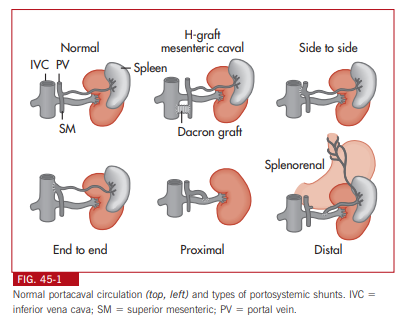
199
What did prospective randomized trials show about rebleeding rates in surgical vs. medical management?
Surgical patients had significantly lower rebleeding rates (9–25% vs. 68–98%).
200
Does surgical treatment significantly decrease mortality compared to medical treatment?
No, current data do not show a statistically significant survival benefit.
201
How effective is surgery in preventing recurrent variceal hemorrhage?
90% effective
202
What percentage of patients develop hepatic encephalopathy after shunt surgery?
15% to 30%
203
What is a major cause of postshunt mortality?
Hepatic failure (13–18%)
204
Why has the use of total portosystemic shunts decreased?
Lack of significant survival benefit
205
What are current indications for shunt surgery?
End-to-side shunt for acute hemorrhage and side-to-side shunt for refractory ascites
206
What are relative contraindications for portosystemic shunts?
Budd–Chiari syndrome, liver transplant anticipation, refractory ascites
207
What are interposition H-graft shunts?
Mesocaval, portacaval, and mesorenal shunts using a graft
208
What is the significance of graft size in H-graft shunts?
Grafts >10 mm are considered total shunts
209
What is a drawback of H-graft shunts compared to conventional shunts?
Higher rate of late thrombosis
210
Why are H-graft shunts useful in some patients?
They are useful in liver transplant candidates
211
What is a central splenorenal (Linton) shunt?
Splenectomy with anastomosis of splenic vein to left renal vein
212
How does the Linton shunt compare to a portacaval shunt?
Physiologically similar to side-to-side portacaval shunt
213
What is a drawback of the Linton shunt?
Probably has a higher thrombosis rate compared to portacaval shunts
214
Central splenorenal (Linton) shunt involves what surgical steps?
Splenectomy with anastomosis of the portal side of the splenic vein to the left renal vein
215
How does the Linton shunt compare hemodynamically to other shunts?
It is similar to a side-to-side portacaval shunt
216
What is a drawback of the Linton shunt?
Probably has a greater thrombosis rate
217
What do selective portosystemic shunts aim to preserve?
Portal venous flow to the liver via the mesenteric veins
218
What is the distal splenorenal (Warren–Zeppa) shunt?
A selective shunt involving ligation of the splenic vein and end-to-side anastomosis to the left renal vein
219
How does the Warren–Zeppa shunt decompress varices?
Via the short gastric veins
220
How well does the Warren–Zeppa shunt maintain portal perfusion?
Maintains portal perfusion in 90% of patients
221
What is the operative mortality for the Warren–Zeppa shunt?
7–10%
222
How does survival after selective shunts compare in alcoholic vs. nonalcoholic cirrhosis?
Improved survival in nonalcoholic cirrhosis
223
What is an advantage of selective shunts over nonselective shunts?
Possibly lower incidence of hepatic failure and encephalopathy
224
What is the long-term survival rate after distal splenorenal shunt?
60% 5-year survival rate
225
What is a comparison of rebleeding and liver dysfunction between shunting and sclerotherapy?
Rebleeding is more common in sclerotherapy; shunting may cause liver dysfunction
226
What is required for distal splenorenal shunt to be feasible?
Splenic vein >7 mm and absence or control of ascites
227
What is esophageal transection with stripping of coronary veins called?
Sugiura procedure
228
Where has the Sugiura procedure shown more success?
Japan
229
What is the definitive treatment for portal hypertension and its complications?
Orthotopic liver transplantation
230
What limits the use of orthotopic liver transplantation?
Donor availability
231
What is the 5-year survival rate after liver transplantation in nonalcoholic cirrhosis?
70%
232
Why should portacaval shunts be avoided in transplant candidates?
To preserve portal anatomy for transplantation
233
What are alternatives to portacaval shunts in transplant candidates?
Banding, sclerotherapy, TIPS, or selective shunting
234
What is splenopneumopexy?
Anastomosis of spleen to lung through diaphragm to decompress varices through pulmonary circulation
235
What is the surgical treatment of choice for ascites?
Peritoneovenous shunt
236
Where does a peritoneovenous shunt drain fluid?
Directly into the superior vena cava
237
What feature does the LeVeen shunt have?
A one-way valve that opens when intraabdominal pressure exceeds 3 cm H2O
238
What is a unique feature of the Denver shunt?
It has a subcutaneous pump to prevent clogging by active pumping
239
What are complications of peritoneovenous shunts?
Sepsis, CHF, DIC, hypokalemia, shunt malfunction, air embolism, and SVC thrombosis
240
How should you monitor for DIC after peritoneovenous shunt surgery?
With serial fibrinogen levels, fibrin degradation products, and platelet counts
241
What must be done if DIC cannot be controlled after a peritoneovenous shunt?
The shunt must be ligated