Preparing to Drive: your Vehicle
Study these flashcardsFree · spaced repetition · iPhone, Android, Mac & web
All cards
1
What six things should you do before you start your engine?
- Be sure your vehicle is in park or neutral
- Adjust the seat so you can reach all controls
- Adjust all rear-view mirrors so that you can use them without having to lean forward or backward
- Move anything that blocks your view of mirrors or roadway
- Lock all car doors
- Fasten your safety belt and make sure all passengers do the same
2
When may law enforcement stop you for a vehicle inspection?
at any time
3
How many braking systems should you have? How strong should they be? How strong should the parking or emergency brake be?
Two braking systems. Each must be able to stop the car alone. The parking or emergency brake should be strong enough to hold the car on any hill.
4
How far ahead should your low beam headlights see? From how far should they be visible?
Show objects 150 feet ahead. Visible from 1,000 feet.
5
How far ahead should your high beam headlights see? From how far should they be visible?
Show objects 450 feet ahead. Visible from 1,000 feet.
6
From how far ahead should your tailights be visible? How many and what color should you have?
Two red taillights. visible from 1000 feet
7
How many, and what color, should your brake lights be? How far away should they be seen from in the daytime?
two red brake lights. visible from 300 feet in the daytime
8
What color should your license plate lights be? How far should they be visible from?
White light that makes the license plate visible from 50 feet.
9
What color should your directional signals be? From how far should they be visible?
Amber; or white (front) or red (rear). Visible from 500 feet.
10
From how far should your horn be heard?
Heard from a distance of 200 feet.
11
How many rear-view mirrors should you have, and how far should its view to the rear be?
At least one rear-view mirror with view 200 feet to the rear.
12
What is the standard for the windshield wiper?
In good working order to clear the driver’s view.
13
What should your windshields be composed of? What is it not allowed to be covered or treated with? Can it have small stickers out of line of sight?
Must be safety glass and may not be covered or treated with any material that makes the windshield reflective or non-transparent. Must be free of any stickers not required by law.
14
What should your side and rear windows be composed of and what are they not allowed to be covered or treated with?
May not be composed of, covered by, or treated with any material which has a mirrored appearance or reflects more than 25% of the light (side windows) or more than 35% of the light (rear window).
15
What is the minimum tread for your tiers and how much wear showing the ply is it permitted to have?
Should have a minimum tread of at least 3/32 of an inch or greater, and no worn spots showing the ply.
16
Can you have red lights visible from the front?
no, only law enforcement can
17
Can you have blue lights?
no, that’s law enforcement only
18
Can you have a siren, bell, or whistle?
No, not permitted
19
Can you have any extra lights, more than two spotlights, cowl or fender lights, or fog lights?
No
20
Your muffler can be heard from 50 feet or is emitting smoke. what should you do
replace it, that’s not allowed
21
What sorts of signs/posters/stickers can you have on the windshield/windows?
None unless required by law (sunpasses are out of the way behind rear view mirror)
22
Can you have a TV type receiver in your vehicle?
Not that the driver can see
23
Are headsets or headphones allowed to be worn while operating a vehicle?
technically not, tho one bud of a wireless headphone could be used for a hands-free phone call if necessary
24
What are the bumper height requirements for cars of <2500 lbs, 2500-3499 lbs, or >= to 3500 lbs? What about trucks of <2000 lbs, 2000-3000lbs, and 3000-5000lbs?
In order, front bumpers must be 22, 24, 27, 24, 27, and 28 inches. Rear bumpers must be 22, 26, 29, 26, 29, and 30 inches (2 inches higher, except for cars <2500 lbs).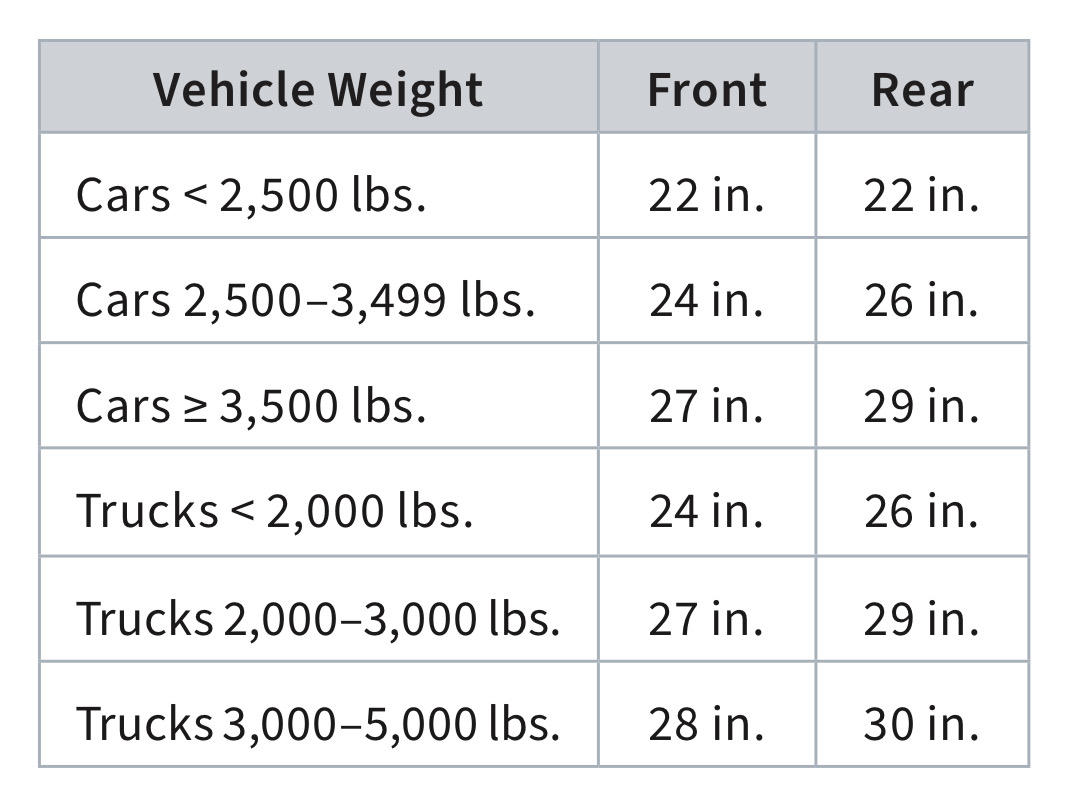
25
What should you do if you emission control device is malfunctioning?
It is illegal to tamper with, remove, or cause not to work, any pollution control device on your vehicle. Tampering can cause damage your vehicle, increased air pollution, lower gas mileage, less vehicle eficiency & breathing dificulties. [Get it repaired ASAP, do not remove]
26
What should you do to keep your brakes in good condition?
Brakes: Check to see that the pedal stays well above the floor when you step on it. If the car pulls to one side when you use the brakes or if you hear any scraping or squealing noises, your brakes may need to be repaired.
27
What should you do to keep your lights in good condition?
Lights: Check ofen, replace burned- out bulbs and keep lenses clean.
28
What should you do to keep your tires in good condition?
Tires: Inspect ofen for proper inflation/tire pressure, even tread wear and damage.
29
What should you do to keep your windows and windshields in good condition?
Windows and Windshields: Keep the glass clean inside and out.
30
What should you do to keep your rear window in good condition?
Rear Window: If the rear window is covered by or treated with any material that makes it non-transparent, the vehicle must be equipped with side mirrors on both sides that allow the driver a rearview of at least 200 feet.
31
What should you do to keep your car in good condition in general?
Read your vehicle owner’s manual!
It is an excellent resource for infor- mation specific to your vehicle, such as: what types of fluids your car requires, what dashboard warn- ing lights mean, what your car ser- vices intervals are, and more.
It is an excellent resource for infor- mation specific to your vehicle, such as: what types of fluids your car requires, what dashboard warn- ing lights mean, what your car ser- vices intervals are, and more.
32
What is ABS? What does it do?
Anti-lock brake system (ABS) prevents skidding and allows drivers to steer during an emergency braking situation. ABS can help improve vehicle stability, steering, and stopping capability.
33
In an emergency situation, how should you drive if you have an anti-lock brake system?
Drivers with ABS need to press down hard on the brake pedal, hold it, and steer out of danger. In an emergency situation, the ABS auto- matically pumps the brakes at a faster rate than the driver could. Removing steady pressure from the brake pedal or pumping the brakes will disengage or “turn of” the ABS.
34
In an emergency situation, how should you drive if you do not have an anti-lock brake system?
Drivers with conventional brakes must pump the brakes in order to stop in an emer- gency situation where traction is lost and the vehicle slides.
35
How can you determine if your vehicle has an anti-lock brake system?
You can determine if the vehicle has ABS by looking for a lighted ABS symbol on the dashboard right afer starting the engine, checking the owner’s man- ual, or asking the dealer.
36
What are the equipment requirements for trailers, semitrailers or pole trailers weighing 3000 pounds or less?
► REAR—two reflectors, one at each side.
► A brake light if the trailer or load blocks/hides the brake lights on the towing vehicle.
► A brake light if the trailer or load blocks/hides the brake lights on the towing vehicle.
37
What are the equipment requirements for trailers or semitrailers weighing more than 3000 pounds?
► FRONT—two clearance lamps, one at each side.
► EACH SIDE—two side marker lamps, one at or near the front and one at or near the rear. Two reflectors, one at or near the front and one at or near the rear.
► REAR— two clearance lamps, one at each side, and two reflectors, one at or near the front and one at or near the rear.
► Brakes that can be operated by the driver in the towing vehicle. They must be designed and connected so that they will automatically stop the trailer if it breaks away from the towing vehicle.
► EACH SIDE—two side marker lamps, one at or near the front and one at or near the rear. Two reflectors, one at or near the front and one at or near the rear.
► REAR— two clearance lamps, one at each side, and two reflectors, one at or near the front and one at or near the rear.
► Brakes that can be operated by the driver in the towing vehicle. They must be designed and connected so that they will automatically stop the trailer if it breaks away from the towing vehicle.
38
What are the equipment requirements for pole trailers weighing more than 3000 pounds?
► EACH SIDE—one side marker lamp and one clearance lamp.
► REAR—two reflectors, one at each side.
► REAR—two reflectors, one at each side.
39
How many stop lamps must every motor vehicle, trailer, semitrailer, and pole trailer have?
two or more stop lamps (one stop lamp is permitted on vehicles built before January 1, 1972).
40
A drawbar/towing connection must:
► be strong enough to pull all towed weight;
► not be more than 15 feet long unless you are towing poles, pipes, machinery, or other objects that cannot be easily taken apart; and
► have a white flag at least 12 inches square attached to it if it is chain, rope, or cable.
► not be more than 15 feet long unless you are towing poles, pipes, machinery, or other objects that cannot be easily taken apart; and
► have a white flag at least 12 inches square attached to it if it is chain, rope, or cable.
41
How should you secure a load?
► You must use a close-fitting cover when hauling loads which could fall or blow onto the roadway (e.g., dirt, sand, gravel).
► Every truck carrying logs or pulp- wood must use lock chains to securely fasten the load.
► Every truck carrying logs or pulp- wood must use lock chains to securely fasten the load.
42
What is a projected load?
A load that extends beyond the sides of a vehicle and more than four feet or more beyond its rear. It must be clearly marked.
43
How do you mark a projected load during the day?
During the day, red flags at least 18 inches square must mark the extremities of the load.
44
What are the requirements from sunset to sunrise, and during any rain, smoke, or fog for a projected load?
► two red lamps on the back of the load that can be seen from at least 500 feet to the rear;
► two red reflectors on the rear that can be seen from 100 to 600 feet when directly in front of low beam headlights, and located to show the load’s full width; and/or
► one red lamp on each side of the load, visible from at least 500 feet to show maximum overhang of the load.
► two red reflectors on the rear that can be seen from 100 to 600 feet when directly in front of low beam headlights, and located to show the load’s full width; and/or
► one red lamp on each side of the load, visible from at least 500 feet to show maximum overhang of the load.
45
If a trailer or motor vehicle is trans- porting logs, pulpwood, poles, or posts that extend more than four feet beyond the rear of the load
you must have one amber strobe-type lamp equipped so that the lamp is visible from the rear and both sides of the projecting load. The lamp must be operational and seen any time of day or night.
46
How can projected loads be transported on a highway?
Passenger vehicles must not be driven on any highway with a load extending beyond the fenders on the left side of the vehicle or extending more than 6 inches beyond the line of the fenders on the right side.
47
What sort of sign should farm vehicles designed for operation at speeds less than 25 MPH display when on public highways?
48
What sort of sign should farm vehicles designed for operation at speeds less than 25 MPH display when on public highways?
49
When can slow-moving farm vehicles be operated?
these vehicles must only be operated during daylight hours unless equipped with the proper lights or reflectors required for night driving.
50
What should you do if you’re in the left lane and a car from behind you is overtaking you at a higher speed?
Florida law states that a driver must move out of the left lane when being overtaken from behind by another vehicle traveling at a higher rate of speed.