Topic 2 - Cells and Controll
Study these flashcardsFree · spaced repetition · iPhone, Android, Mac & web
All cards
1
What is the cell cycle?
The regular sequence of growth and division that cells undergo
It is also described as the life cycle of cells
It is also described as the life cycle of cells
2
What are the 3 stages of the cell cycle?
interphase, mitosis, cytokinesis
3
What happens in interphase?
cells grow, organelles are replicated, DNA synthesiseplication,
4
What does DNA replication involve?
● Double helix 'unzips' exposing two strands
● DNA bases align next to complementary bases on
the DNA strands
● Complementary base pairs join
● Two identical DNA molecules formed
● DNA bases align next to complementary bases on
the DNA strands
● Complementary base pairs join
● Two identical DNA molecules formed
5
What is a chromosome?
A linear DNA molecule tightly coiled around proteins
6
What happens to chromosomes during DNA replication?
The DNA in the arm of each of the chromosome is replicated
7
What is growth?
An increase in the number or size of cells. More cells produced from mitosis.
8
Explain what it means if a 7 year old boy has a height on the 25th percentile of the growth chart.
75% of boys of that age have a height equal to or greater than this value. Or 25% of boys of that age have a height which is equal to or less than that value.
9
Why are percentile curves used to measure the growth of babies?
It is possible to track growth of the child and see if it changes significantly from the percentile the child is following over time. This may indicate a problem with the child's growth.
10
Explain why differentiation is important to a multicellular organism.
Differentiation allows unspecialised cells to change into specialised cells which perform specific functions in the body.
11
Explain why the meristem is important for growth in plants.
The cells in the meristem divide rapidly by mitosis. They can elongate (get longer in length) and differentiate into the specialised cells of the plant.
12
What are some specialised features of the xylem?
Thick walls with lignin to withstand water pressure, no cytoplasm so lots of space for water, pores in the sides of the vessel to allow water and mineral ions to leave the vessel.
13
How could you calculate the precentage change in growth for a plant?
(final value - starting value)/ starting value x 100%
14
Explain why plant meristem cells contain many ribosomes.
As the cells divide and differentiate, they will need many new proteins to make more cell structures which are provided by the ribosomes.
15
Why is mitosis important?
Used for growth and repair and replacement of damaged cells ,asexual reproduction
16
Define the terms diploid and haploid
A diploid cell has two sets of chromosomes (46 in humans) and a haploid cell has half the usual number of chromosomes, one set (23 in humans).
17
Explain what happens during interphase in the cell cycle.
The cell grows and makes new sub-cellular structures such as mitochondria. At the end of interphase, the DNA replicates.
18
Describe the two new cells produced in mitosis.
The two daughter cells are genetically identical.
19
What are the different stages in mitosis in order?
prophase, metaphase,anaphase, telophase
20
What happens in prophase?
The membrane of the nucleus breaks down and the spindle fibres appear. The chromosomes are visible in the nucleus.
21
What happens in metaphase?
The chromosomes line up in the middle of the cell. The spindle fibres attach to the chromosomes. The chromosomes are made up of two sister chromatids attached at the middle. M IS FOR MEET IN MIDDLE
22
What happens in anaphase?
The chromatids are pulled apart by the spindle fibres, and the chromosomes move to opposite sides of the cell. A IS FOR APART
23
What happens in telophase?
A membrane forms around the chromosomes to make the nucleus.
24
What happens in cytokinesis?
IS NOT PART OF MITOSIS Cytokinesis, A new membrane, and in plants a cell wall, forms between the two new cells to separate them
25
Why does mitosis not lead to genetic variation?
Because the two offspring produced are genetically identical- have the same chromosomes as the parent
26
Why does asexual reproduction rely on mitosis?
In asexual reproduction, the offspring are genetically identical to the parent (clones) so cells must divide by mitosis in order for this to take place.
27
What happens to cell division in cancer?
The cells no longer divide in a controlled way and can divide rapidly forming tumours that cause damage to the body.
28
Explain why sperm cells cannot be produced using the cell cycle.
Sperm cells are haploid, so only have half the number of chromosomes. Mitosis results in an exact copy of a diploid cell, so cannot produce sperm cells.
29
What is cancer?
the disease caused by an uncontrolled division of abnormal cells in a part of the body.
30
What can doctors determine from percentile charts?
● Slower growth than normal (below the bottom line)
● Faster growth than normal (above the top line)
● Abnormal growth (irregular growth patterns)
● Faster growth than normal (above the top line)
● Abnormal growth (irregular growth patterns)
31
Describe growth in animals
● Cell division occurs in all body cells. It occurs at a slower rate in adults that in younger animals as growth stops and cell division is only required for replacement and repair.
● Most cells differentiate at an early stage and become specialised. Some adult stem cells retain their ability to differentiate.
● Most cells differentiate at an early stage and become specialised. Some adult stem cells retain their ability to differentiate.
32
Describe growth in plants
● Cell division can only occur in meristematic tissue. The rate of cell division remains the same throughout a plant's life.
● Meristematic stem cells can differentiate into any cell type for as long as the plant lives
● Cell elongation occurs in all cells. Cells expand and enlarge enabling growth of the plant.
● Meristematic stem cells can differentiate into any cell type for as long as the plant lives
● Cell elongation occurs in all cells. Cells expand and enlarge enabling growth of the plant.
33
What are stem cells?
Stem cells can divide over and over again and produce cells which differentiate into specialised cells.
34
What is differentiation?
The process by which a cell changes to become specialised for its job - some genes are switched on or off.
35
Where can you find stem cells in a plant?
In the growing root and shoots of the plant. Meristem cells.
36
What is the difference between embryonic stem cells and adult stem cells?
Embryonic stem cells can produce any type of specialised cell. Adult stem cells can only produce a limited number of specialised cells, usually part of the tissue where they are located.
37
Explain why it is important to have stem cells in the bone marrow. What type of stem cells are these?
These are adult stem cells. They can differentiate to produce cells of the blood and are necessary to replace the cells that make up the blood tissue.
38
Why are stem cells a potential treatment for damage to tissue in the body?
Stem cells can differentiate into some or all cell types, could replace damaged cells, such as cells of the heart tissue following a heart attack.
39
What are the risks of using stem cells as a medical treatment?
The stem cells may not divide as expected and could continue to divide and form a cancer. The cells may be rejected by the patient because they are recognised as foreign by the immune system. Potential side effects. Hard to find a suitable donor for stem cells
40
What is the function of embryonic stem cells?
Enable the growth and development of tissues in human embryos
41
What is the primary function of adult cells?
Replacement of dead cells
42
Where is meristem tissue found?
In the roots and shoots of plants
43
What are meristematic stem cells?
Stem cells found in meristems that are unspecialised and capable of differentiating into any cell type during the life of a plant
44
How can stem cells be used in medicine?
● Stem cells collected
● Stem cells stimulated to differentiate into specific
cell types e.g. heart muscle cells
● Specialised cells transplanted into the patient
● Used to treat damage or disease e.g. heart disease
● Stem cells stimulated to differentiate into specific
cell types e.g. heart muscle cells
● Specialised cells transplanted into the patient
● Used to treat damage or disease e.g. heart disease
45
What are the ethical issues related to the use of stem cells in medicine?
The embryos used to take stem cells are destroyed and seen as a potential waste of human life
May lead to the reproductive cloning of humans
May lead to the reproductive cloning of humans
46
How can stem cells be benficial to cure ilnesses
They can differenciate into any cell types and replace and repair tissues and faulty cells.
47
What is the structure of the Cerebral Cortex
Mainly made of neurones
It is wrinkled
Has 2 hemispheres
It is wrinkled
Has 2 hemispheres
48
What is the function of the cerebral cortex?
Controlls Personalty, senses, language, memory,behavior and consiousness
49
What is the function of the iris
Controls how much light enters the eye
50
What is the stucture of the Medula oblongata
Mainly made up of neurones
Has neurones that connect to the back of the spinal chord
Has neurones that connect to the back of the spinal chord
51
What is the function of the Medula oblongata
Controlls reflexes
Controlls breathing and heart rate
Controlls breathing and heart rate
52
What is the function of the Cerebellum
Controlls balence and posture
Co ordinates the timing and fine controll of muscle activity making sue movements are smooth
Co ordinates the timing and fine controll of muscle activity making sue movements are smooth
53
What is the structure of the spinal chord
Contains Nerves - Long neurones with blood vessels
54
What is the function of the spinal chord
Carries information betwee the brain and the rest of the body
55
What are the parts of a Nervous system
The brain and spianal chord (Central Nervous System)
All the nerves outside the brain and spinal chord (Periphral Nervous System)
All the nerves outside the brain and spinal chord (Periphral Nervous System)
56
How does a body respond to a simulus?
Stimulus : A change in the Environment
Receptor : Detects the stimulus
(Electrical impulse transfered to the brain via the sensory neurone)
Co-ordinator: Brain and Spinal Chord controll responce
(Transfered to the effector via the Motor neurone)
Effector: The part of the body responds to the stimulus
Responce : The action in responce to the stimulus
Receptor : Detects the stimulus
(Electrical impulse transfered to the brain via the sensory neurone)
Co-ordinator: Brain and Spinal Chord controll responce
(Transfered to the effector via the Motor neurone)
Effector: The part of the body responds to the stimulus
Responce : The action in responce to the stimulus
57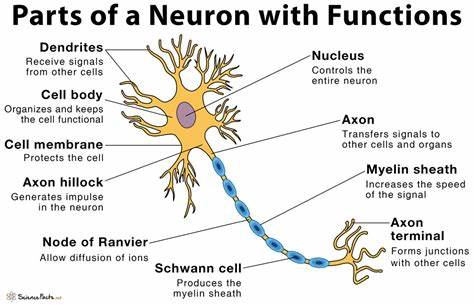
Structure of a motor neurone
58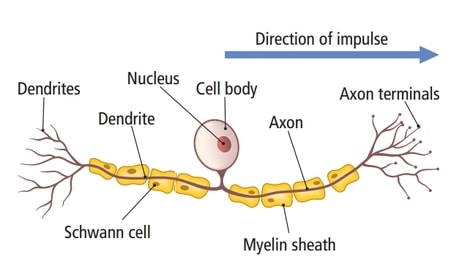
Structure of a Sensory neurone
59
Describe what happens in the reflex arc
1) Pain receptors sence stimulus
2)An electrical impusle is generated and travels down the sensory neuron in the arm
3)The impule passes from a sensory neurone to a relay neuron in the spinal chord
4) The impolse is passed from the relay neuron to the motor neurone at the synapse
5) The impulse travels down the axon of the motor neurone to the effector
6) The hand is moved away from the object causing pain
2)An electrical impusle is generated and travels down the sensory neuron in the arm
3)The impule passes from a sensory neurone to a relay neuron in the spinal chord
4) The impolse is passed from the relay neuron to the motor neurone at the synapse
5) The impulse travels down the axon of the motor neurone to the effector
6) The hand is moved away from the object causing pain
60
Why is the reflex arc very fast
The pathway is shorter than if the impulses went to the brain to be processed
61
Why do relay neurones lack a mylean sheath
This is because they do not need to transfer impulses over long distances
62
How does an electrical impulse get transferred from one neurnone to the next?
1) The electrical impulse arrives at the end of the neurone. The gap between the two neurones is called the synapse
2) The vesicle containing neurotransmitters merges with the cell membrane
3)The neurotransmitter diffuses accross the synapse
4)The neurotransmitter bindes to a receptor on the post synaptic neurone
5) THe impulse is generated in the next neurone/ travels down the axon
2) The vesicle containing neurotransmitters merges with the cell membrane
3)The neurotransmitter diffuses accross the synapse
4)The neurotransmitter bindes to a receptor on the post synaptic neurone
5) THe impulse is generated in the next neurone/ travels down the axon
63
Brain Scaning
REFER TO TABLE IN BOOK
64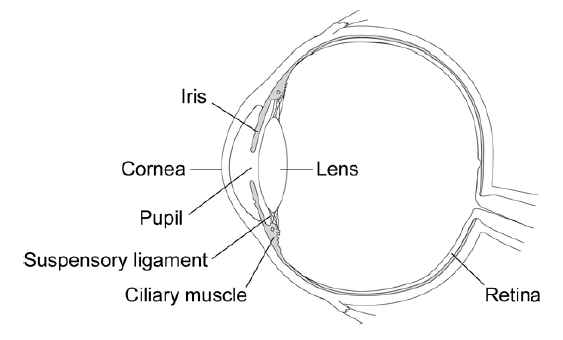
Label the parts of the eye: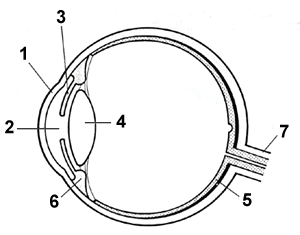
65
What is the function of the retina
It contains a layer receptor cells called cones that are sensitive to coloured light and cones to detect high intencity light and seeing colours
66
What is the function of the cornea
The transparent front part of the eye which covers the iris and the pupil ad converges the light
67
What is the function of the iris
Musicles in the iris controls how much light enters the eye. Also is the colured part of the eye
68
What is the function of the lens
Part of the eye that further converges the light to focus on the eye
69
What is the function of the optic nerve
Impulses generated by cones are sent by the opic nerve to the brain
70
What is the function of the iris
Controls how much light enters the eye
71
How do we see things?
1) light is reflected of an object
2) lens changes shape to focus light on retina
3) Rods and Cones dectect light
4) Electrical impulse via the optic nerve to the brain
2) lens changes shape to focus light on retina
3) Rods and Cones dectect light
4) Electrical impulse via the optic nerve to the brain
72
What is colour blindness
Have some cones that do not dectect some wavelengths of light and so have diffuculty in seeing some colour
73
How can colour blindness be cured and corrected?
It cannot be cured or corrected
74
What is shortsightnedness
when the eyeball is too long or the lens is doing too much bending. The light converges in front of the retina
75
How can shortsightedness be corrected
with a diverging lens that spreds out rays before they reach the eye
76
What is long sighted ness?
The light rays converge behind the retina. This is because the eyeball is too small or the cornea is too flat or the lens cannot bend the light enough
77
A correcton for long sightedness
A converging lens to bend the light before it reaches the eye
78
What are cataracts?
Cloudy protein building up in the lens, blocking light from hitting the retina
79
A correction for cataracts
Artificial lens that is flexible clear and transparant
80
How does lazar eye surgery work?
Reshapes the cornea to bend light better