Hydrocarbons - 16
Study these flashcardsFree · spaced repetition · iPhone, Android, Mac & web
All cards
1
What is the homolgous series?
A family of organic compounds with the same general formula and same functional group, hence have similar chemical properties and undergo similar chemical reactions
2
What are the prefixes for organic compounds of 1 to 3 carbon?
Meth- , Eth- & Prop-
3
What is the functional group and general formulae for alkanes?
NIL & $C_nH_{2n + 2} \space$ where n greater than or equal to 1
4
What is the suffix for alkanes?
-ane
5
Image occlusion: name the hidden labels
6
What are the physical properties of alkanes & alkenes?
Low melting & boiling point, insoluble in water, soluble in organic solvents
7
What are the chemical properties of alkanes?
Combustion can be complete (burning in excess oxygen) or incomplete (burning in insufficient amount of oxygen), Alkanes react with halogens in the prescence of UV light
8
Complete vs incomplete combustion in alkanes & alkenes
Complete: Alkane/alkene + oxygen —> Carbon dioxide + water, Incomplete: Alkane/alkene + oxygen —> Carbon monoxide + water
9
What is an example of a substitution reaction in alkanes?
$CH_4 + Cl_2 \rightarrow CH_3Cl + HCl$
10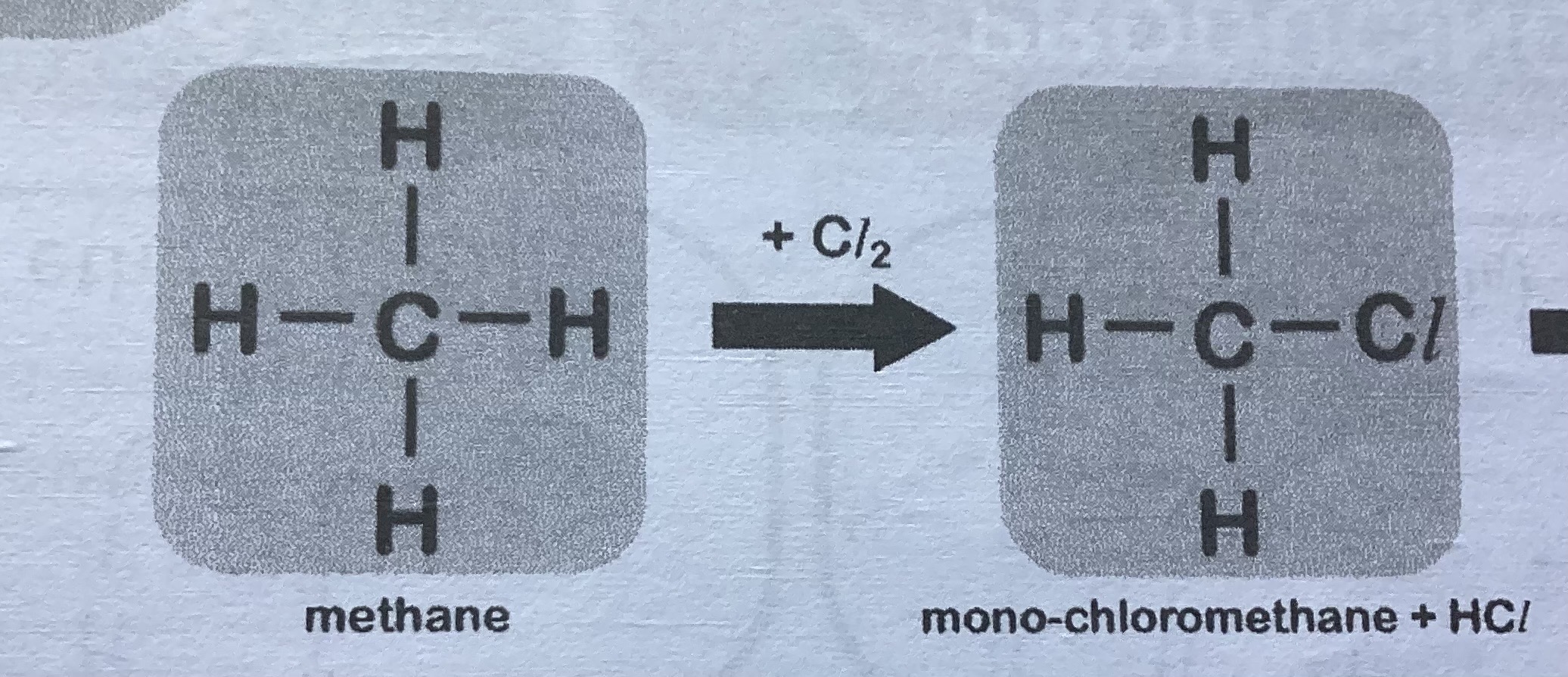
Image occlusion: name the hidden labels
11
How does flammability change in alkanes & alkenes?
It decreases down the series; as percentage of carbon increases, tendency to go into incomplete combustion is higher and flame produced is smokier
12
How does melting & boiling point and viscosity change in alkanes & alkenes?
It increases down the series; as the size and mass of the molecules increase down the series, the intermolecular forces of attraction between the molecules increases, resulting in members showing a gradation in physical properties
13
What is the functional group and general formulae of alkenes?
Carbon - Carbon double bond & $C_nH_{2n}$ where n is greater than or equal 2
14
What is the suffix for alkenes?
-ene
15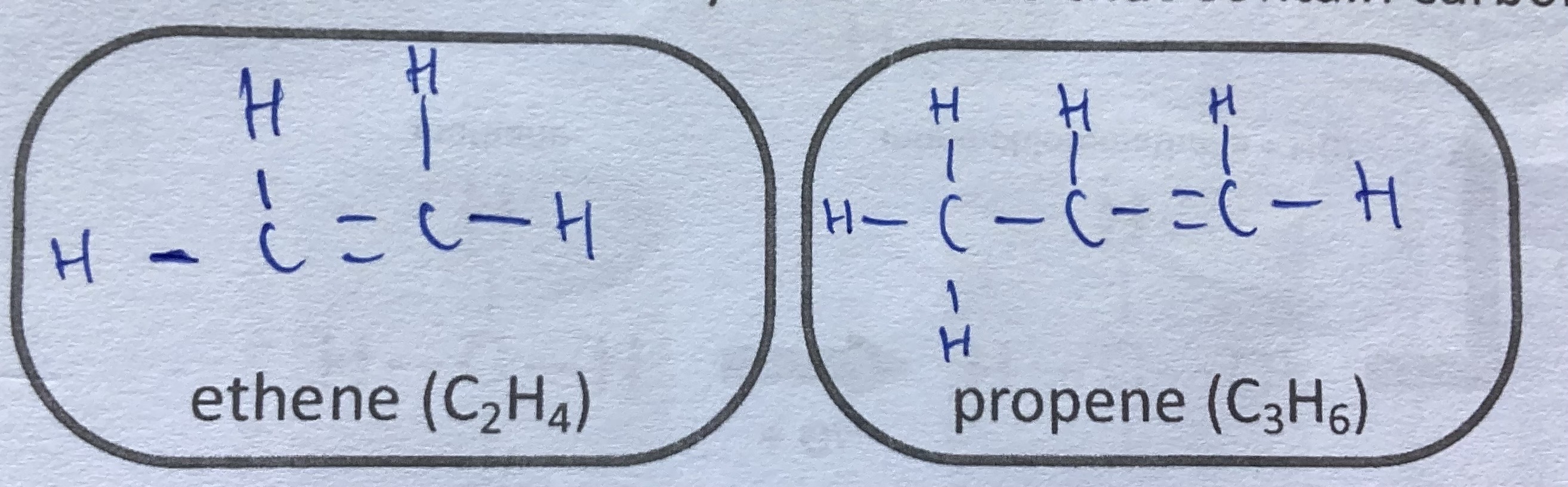
Image occlusion: name the hidden labels
16
How are alkenes produced?
Alkenes are obtained by catalytic cracking of petroleum (crude oil) and is the breaking down of long-chain hydrocarbons into smaller molecules
17
What are the conditions to produce alkenes?
About 600°C, aluminium oxide or silicon dioxide catalyst
18
How to write an equation for producing alkenes?
choose any valid alkene ($C_nH_{2n}$) first, then subtract its carbon and hydrogen counts from your starting alkane. The leftover atoms will form your remaining product (an alkane, another alkene, or $H_2$), ensuring both sides balance perfectly.
19
What are 2 example equations for how alkenes are produced?
$C_{18}H_{38} \rightarrow 6C_2H_4 + C_6H_{14} \space and \space C_{18}H_{38} \rightarrow C_8H_{16} + C_{10}H_{20} + H_2$
20
What are the uses of producing alkenes?
Produce short-chain alkenes, produce hydrogen gas for manufacture of ammonia, produce petrol due to greater demand
21
How are alkenes used in fats & oils?
Some fats and oils are polyunsaturated and the higher the percentage of carbon-carbon double covalent bonds, the lower the melting point. Fats are solids at room temp while oils are liquid
22
What are the chemical properties of alkenes?
Combustion where alkenes have higher % of carbon than alkanes, burning with sootier flames, and addition reactions where an unsaturated organic compound combines with another molecule to form a single compound
23
What are the conditions for hydrogenation?
Moderately high temp, nickel catalyst
24
What’s the equation for hydrogenation?
$Alkene + H_2 \rightarrow Alkane $
25
What is the use of hydrogenation?
Converting vegetable oil (polyunsaturated fat) to margarine
26
What are the conditions for bromination?
Nothing specific other than room conditions
27
What’s the equation for bromination?
$Alkene + Br_2 \rightarrow bromoalkane$
28
What is the use for bromination?
Test for unsaturation. alkene: reddish brown decolourises, alkane: reddish brown remains
29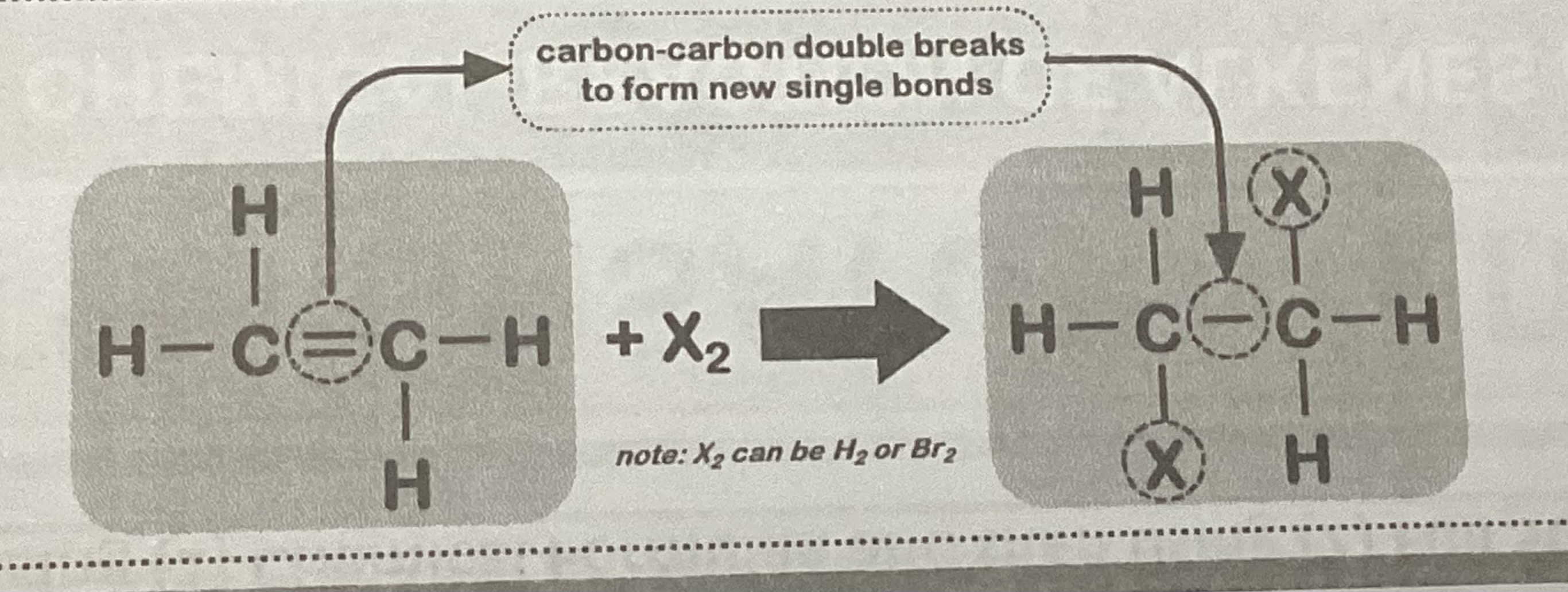
Image occlusion: name the hidden labels
30
Image occlusion: name the hidden labels
31
Image occlusion: name the hidden labels
32
Image occlusion: name the hidden labels