Air Quality - 19
Study these flashcardsFree · spaced repetition · iPhone, Android, Mac & web
All cards
1
What is the composition of gases in the earth’s atmosphere?
78% Nitrogen, 21% Oxygen, 1% Other gases of which 0.04% Carbon dioxide & 0.97% noble gases mainly Argon
2
How to determine the proportion of oxygen in the air?
By using a graduated gas syringe with $100cm^3$ of air and plugging it into the glass tube with copper turnings in it & heating it. Final volume of air should be $79cm^3$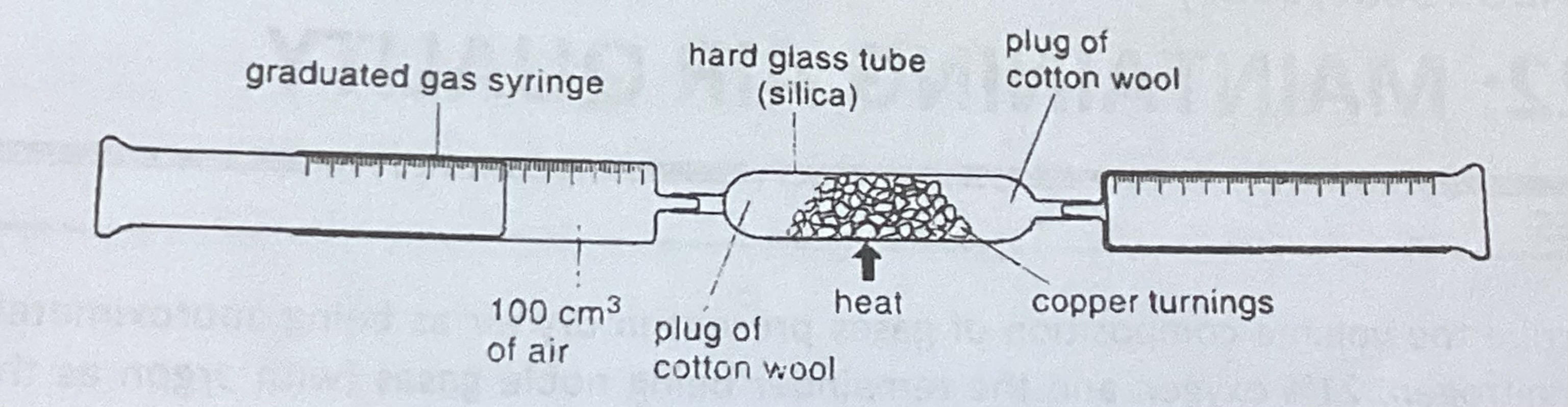
3
What are some examples of air pollutants?
Carbon monoxide, Nitrogen Oxides (NO & $NO_2$), sulfur dioxide, ozone & unbrined hydrocarbons
4
What is the source of carbon monoxide?
Incomplete combustion of carbon containing fuels (e.g. petrol)
5
What is the source and equation of nitrogen oxides?
Formed in vehicle combustion engines at high temperatures (nitrogen reacts with oxygen in the air) & lightning activity. $N_2 \space (g) + O_2 \space (g) \rightarrow 2NO \space (g)$
6
What is the source and equation of sulfur dioxide?
Combustion of fossil fuels with sulfur impurities & volcanic eruptions. $S \space (s) + O_2 \space (g) \rightarrow SO_2 \space (g)$
7
What are the effects of carbon monoxide?
Binds irreversibly with haemoglobin (Hb) in red blood cells, reducing the ability of Hb to transport oxygen to the rest of the body, leading to fainting or even death
8
What are the effects of nitrogen oxides and sulfur dioxide?
Both react with oxygen in air to form acidic compounds which dissolve in rain water to form acid rain. Sulfur dioxide also caused breathing difficulties in humans and animals
9
What are the effects of acid rain?
Acidifies soil so crops grow poorly as essential nutrients e.g. mg and Ca are leached from soil. Soil becomes too acidic —> plants die. Water bodies get acidified —> aquatic life get killed. Buildings and structures made from limestone, marble and metals corrode
10
What is the carbon cycle?
A set of processes that regulates the amount of carbon dioxide in the atmosphere and keeps it constant at about 0.03% by volume.
11
Describe how combustion of fossil fuels releases carbon dioxide into the atmosphere
Coal and hydrocarbon fuels undergo complete combustion to release carbon dioxide
12
Describe how respiration releases carbon dioxide into the atmosphere
All living things respire to release energy for the organisms’ needs.
13
Describe how bacterial decomposition releases carbon dioxide into the atmosphere
Bacteria break down dead plants and animals into simpler compounds. Aerobic decomposition releases carbon dioxide while anaerobic decomposition results in fossil fuels formation which trap carbon deep underground and releases carbon dioxide when these fuels are burnt
14
Describe how photosynthesis removes carbon dioxide from the atmosphere
During photosynthesis, chlorophyll in green plants trap sunlight and convert carbon dioxide and water into glucose and oxygen.
15
Describe how photosynthesis ocean uptake carbon dioxide from the atmosphere
Oceans are carbon sinks which absorb and dissolve carbon dioxide. Marine plants use the carbon dioxide to photosynthesize. Marine organisms convert carbon dioxide into calcium carbonate in shells and skeletons. Shells and skeletons of dead organisms settle to the seabed to form limestone
16
What are the greenhouse gases?
Carbon dioxide & methane
17
What are the sources of methane?
Anaerobic bacterial decay of organic matter (plants and animals), waste gases from cattle
18
What are some consequences of global warming?
More extreme weather events such as heat waves, droughts, hurricanes, floods leading to loss of lives, property & fertility of land. Melting of polar ice caps and glacial retreat causing ocean levels to rise and flood low-lying countries, disruption of ocean currents, communities needing glacial water for drinking & irrigation affected by glaciar depletion