Polymers - 18
Study these flashcardsFree · spaced repetition · iPhone, Android, Mac & web
All cards
1
What is a polymer?
A very large molecule built from many small units or molecules called monomers. Monomers are joined together by covalent bonds. The chemical process of joining the large number of monomers to form a polymer is called polymerisation
2
How must the monomers be for addition polymerisation to occur?
They must be unsaturated, contain C=C or $C\equiv C$
3
What is the formation in addition polymerisation?
Results in the formation of only one product, the polymer. Monomers join together without any loss of atoms or molecules
4
What is the reaction condition for addition polymerisation and the reason?
high temp & pressure, catalyst. Reason: High temp & pressure provides the activation energy required to break the strong C=C bond Catalyst increases rate of reaction
5
What is the mass of a polymer in addition polymerisation?
Mass of polymer formed using a given number of monomers equals the total mass of monomers used
6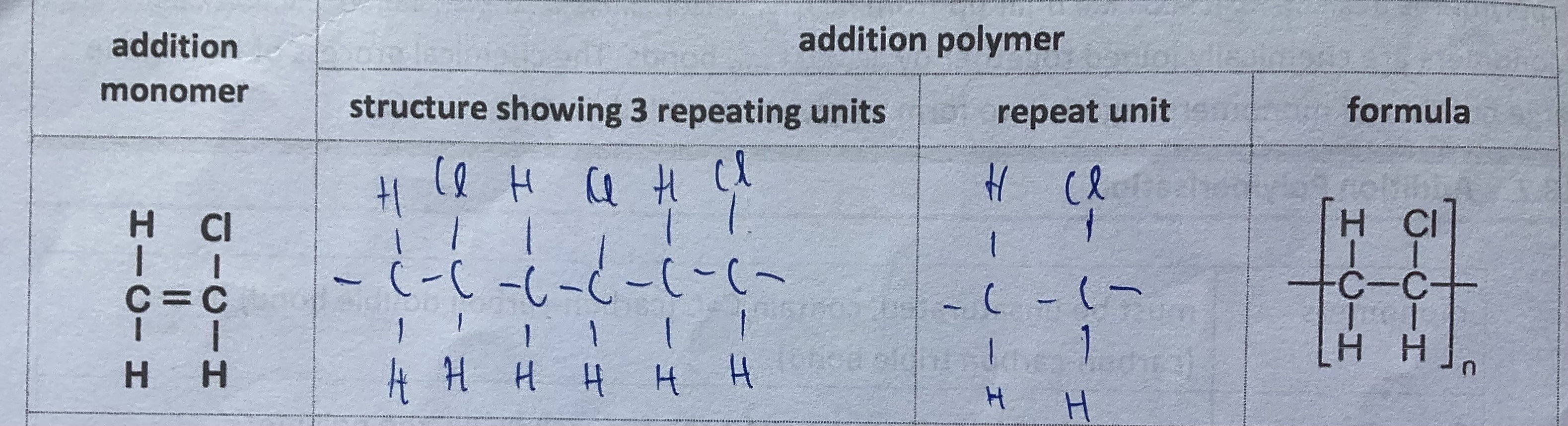
Image occlusion: name the hidden labels
7
Image occlusion: name the hidden labels
8
Image occlusion: name the hidden labels
9
What are some uses of polyethene?
As clingfilm to wrap food, plastic ziploc bags and plastic grocery bags, to make plastic toys, plastic pails
10
How does disposal of plastic cause land pollution?
Plastic waste cannot be decomposed hence take up space in landfills and accumulates
11
How does disposal of plastic cause water pollution?
Plastics thrown into the sea endanger marine animals e.g. turtles mistaking plastic bags for food and choking on them. Plastics also clog up rivers and drains potentially becoming breeding grounds for mosquitoes
12
How does disposal of plastic cause air pollution?
Plastics are flammable and when incenerated, poisonous gases are formed. E.g. PVC producing acidic and corrosive hydrogen chloride gas; polyethene producing carbon dioxide
13
What is the physical method of recycling plastic?
Mechanical recycling where chemical composition of recycled plastic remains unchanged. Small pieces of plastics are melted, cooled, and pulled into strands then cut into pellets used to make new products
14
What is the chemical method of recycling plastic?
Uses chemical reactions e.g. cracking to convert plastic waste into different useful raw materials. Plastic waste e.g. polyethene waste are cracked to form short-chain alkanes and alkenes. Conditions for cracking include high temps and presence of catalyst
15
What are the environmental issues of recycling plastics?
Steps in recycling may produce wastewater containing harmful substances which needs to be treated before release to prevent water pollution
16
What are the economic issues of recycling plastics?
May be more expensive than disposal in landfills or incineration due to energy, machinery and manpower costs in transportation, sorting, and cleaning, thus not being economically viable if those costs exceed market value of recycled plastics
17
What are the social issues of recycling plastics?
Time and effort to educate people to form new lifestyle habits of correct recycling, inappropriate disposal of recyclable plastics together with food waste, throwing non-recyclable items into recycling bins