Climate Topic 1: Weather and Climate
Study these flashcardsFree · spaced repetition · iPhone, Android, Mac & web
All cards
1
What is weather
It is the state of the atmosphere at a specific place and time
2
What is climate
It is the average state of the atmosphere at a particular place over a long period of time, usually 25 years or more.
3
What are the 3 climatic types?
Tropical Equatorial, Tropical Monsoon & Cool Temperate climate
4
What are the characteristics of the tropical equatorial climate
Located between 10°N and 10°S of the equator. High annual temperatures of 27°C all year round. Small annual temperature range of 2 to 3°C. High total annual precipitation of more than 2000mm falling evenly throughout the year
5
What are the characteristics of the tropical monsoon climate
Located between 5°N and 30°N and 5°S and 30°S of the equator. High mean annual temperatures of 25°C all year round. Small annual temperature range of 3 to 4°C. High total annual precipitation of 1500mm with distinct wet and dry seasons
6
What are the characteristics of the cool temperate climate
Located between 45°N and 60°N and 45°S and 60°S of the equator. Four distinct seasons. Moderate mean annual temp of 10°C. Large annual temperature range of 10 to 15°C. Low total annual precipitation of 75 to 200mm falling evenly throughout the year
7
What is latitude?
The distance of a place north and south of an equator from 0° to 90° North or South. Latitude lines are horizontal, parallel to the equator
8
Where is the Tropic of Cancer and Capricorn located respectively?
23.5°N and 23.5°S respectively
9
Where is the arctic and antarctic circle respectively?
66.5°N and 66.5°S respectively
10
How to calculate mean annual temperature
$\frac{Sum \space of \space mean \space monthly \space temperatures}{12}$
11
How to calculate Annual Temperature Range
Maximum mean monthly temperature - minimum mean monthly temperature
12
What is considered moderate annual temperature range?
5-14°C
13
What is considered moderate mean annual temperature
10-19°C
14
What is considered moderate total annual precipitation
250-999mm
15
What are climatic hazards
Climate-related processes or phenomena, such as extreme weather events that may cause loss of life or injury, property damage, social and economic disruption or environmental degredation
16
What are extreme weather events
Rare and severe events such as heat waves, droughts, floods, cyclones and wildfires
17
What are natural and human systems
Consist of natural processes that occur on Earth and all living and non-living things that are found naturally vs consist of human-led processes and the interconnected human activities
18
What is an example of a natural and human system respectively
Ecosystem and Agriculture respectively
19
What is the greenhouse effect?
It is a natural process by which the greenhouse gases in the Earth's atmosphere trap longwave radiation, and which makes Earth liveable
20
What are some examples of greenhouse gases?
Carbon dioxide, methane, nitrous oxide and water vapour
21
What is shortwave/solar radiation?
The processs in which heat that is given out by the sun reaches the earth
22
What is longwave / terrestrial radiation?
Heat that is re-emitted from the Earth's surface to the atmosphere
23
What happens after shortwave radiation, hits the earth?
Most of it is absorbed by the earth's surface while some of it is absorbed and reflected by clouds
24
What happens to longwave radiation on earth?
Most of it escapes from earth into space, but some of it is absorbed by greenhouse gases and is re-emitted in the atmosphere keeping the earth warm
25
Why are there variations in air temperatures throughout the day?
Largely due to earth's rotation on its own axis. In the day, the side of the earth facing the sun receives solar radiation and hence experiences higher temperatures compared to the other side that does not receive solar radiation
26
When it is midday...
The sun is directly overhead, and due to earth's spherical shape, solar radiation is spread over a smaller area making it more concentrated and thus makes it have the highest temperatures ranging from 31 to 33°C
27
When it is before or after midday...
The sun isn't directly overhead, and due to earth's spherical shape, solar radiation is spread over a larger area making it less concentrated and thus makes it have lower temperatures ranging from 25 to 31°C
28
In september and march, what seasons do the northern and southern hemispheres experience respectively
In September, northern experiences autumn and southern experiences spring and in march, northern experiences spring and southern experiences autumn due to the fact that neither hemispheres lean towards the sun, they therefore experience moderate temperatures
29
In December, what seasons do the northern and southern hemispheres experience respectively
Winter and Summer as the northern hemisphere leans away from the sun, receiving less direct solar radiation therefore having lower temperatures while the southern hemisphere leans towards the sun, receiving more direct solar radiation therefore having higher temperatures
30
In June, what seasons do the northern and southern hemispheres experience respectively
Summer and Winter as the southern hemisphere leans away from the sun, receiving less direct solar radiation therefore having lower temperatures while the northern hemisphere leans towards the sun, receiving more direct solar radiation therefore having higher temperatures
31
What is the earth's tilt angle
23.5°
32
Why do places of lower latitudes experience higher temperatures?
The solar angle is higher meaning solar radiation is concentrated over a smaller surface area
33
Why do places of higher latitudes experience lower temperatures?
The solar angle is lower meaning solar radiation is concentrated over a larger surface area
34
Why do places of lower altitudes have higher temperatures
The air is denser, meaning air pressure is higher. This means that there are more air molecules as gravity pulls down most of them to the surface resulting in a higher ability to absorb and radiate heat
35
Why do places of higher altitudes have lower temperatures
The air is less dense, meaning air pressure is lower. This means that there are less air molecules as gravity pulls down most of them to the surface resulting in a lower ability to absorb and radiate heat
36
What is the order of solar radiation reflected by different surfaces
Water, Forest, Grass, Ice (old snow), Clouds and ice (fresh snow)
37
What is the urban heat island effect
Urban area experiences much warmer temperatures than surrounding rural areas, forming island of heat as tarmac roads absorb and radiate a lot of solar radiation and glass covered sky scrapers reflect a lot of solar radiation and sunlight into the ground
38
What is the golden rule for variations of temperature based on distance of places from the sea
The land heats up and cools down faster than water bodies
39
Use the maritime effect to explain why coastal areas have warmer winters and cooler summers (lower atr)
In coastal areas during winter, the sea remains warmer than the land as the sea loses heat slowly. Hence, the warmer air above the sea warms the coastal areas, giving warmer winters. During summer, the sea remains cooler than land as it gains heat slower. Hence, the cooler air above the sea cools the coastal areas giving cooler summers
40
Use the continental effect to explain why inland areas have cooler winters and warmer summers (higher atr)
In inland areas during winter, the land is cooler than the sea as the land loses heat quickly. Hence, the cooler air above the land cools the inland areas, giving cooler winters. During summer, the land is warmer than the sea as it gains heat faster. Hence, the warmer air above the land heats up the inland areas giving warmer summers
41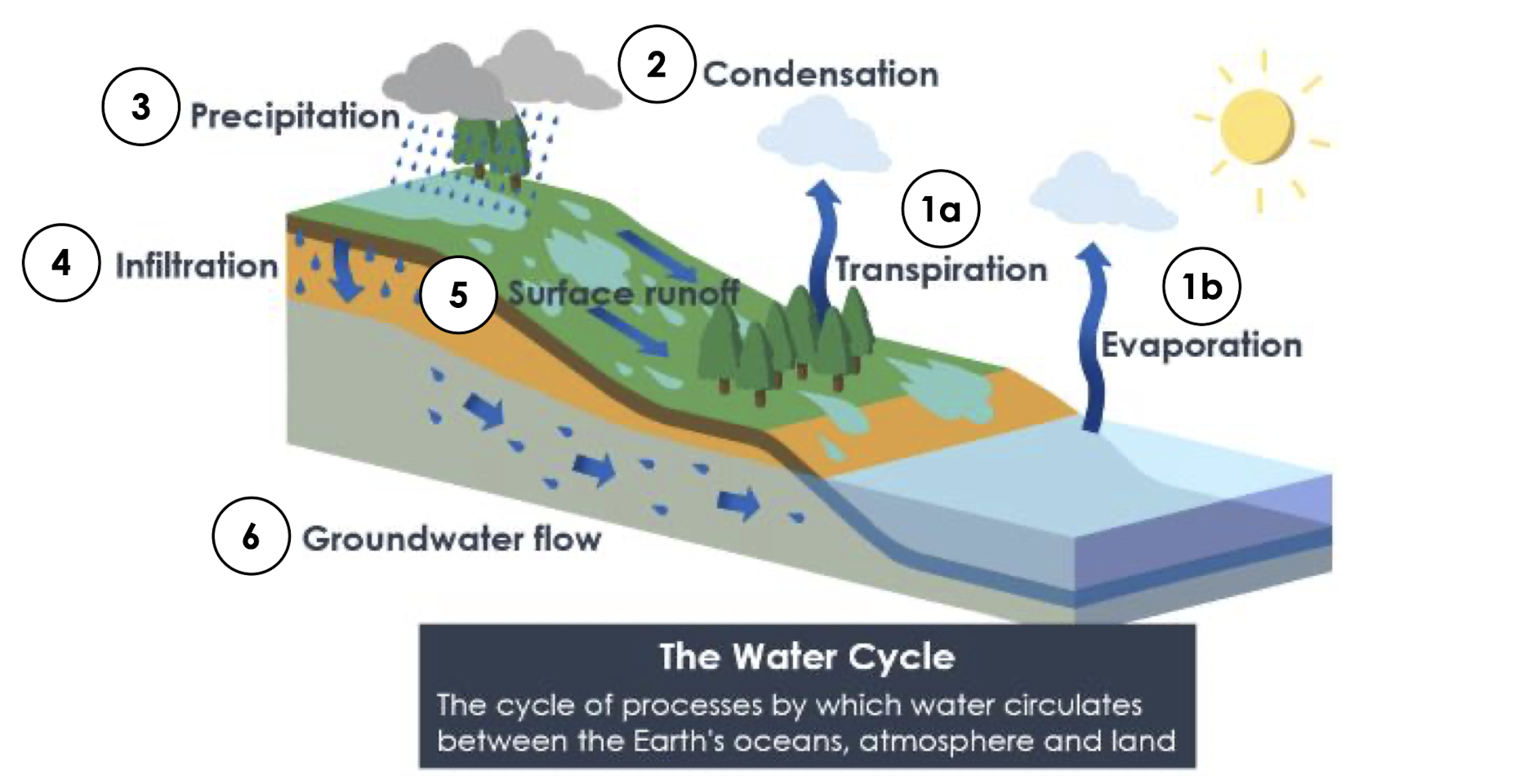
Image occlusion: name the hidden labels
42
Image occlusion: name the hidden labels
43
Image occlusion: name the hidden labels
44
Image occlusion: name the hidden labels
45
Image occlusion: name the hidden labels
46
Image occlusion: name the hidden labels
47
What is the dew point temperature
The temperature where the air becomes saturated with water vapour. As such, below this temperature, condensation occurs
48
Describe steps 1a to 3 of the water cycle
Water enters atmosphere through evapotranspiration & as water vapour rises —> cools and condenses into tiny water droplets at dew point temperature and clouds are formed. When the water droplets become big and heavy enough, they fall to the ground as precipitation (eg water and snow)
49
Describe steps 4 to 5 of the water cycle
Water on the ground then infiltrates the top layer of soil and rock (subsurface soil and rock)
50
Describe step 6 of the water cycle
Below the earth's surface, water moves horizontally above the impermeable rock (rock which does not allow water to pass through)
51
What are the 2 types of soil and their pore sizes
Sandy (larger pores, more permeable) & silt/clayey soil (smaller pores, less permeable)
52
Why do built-up areas have higher speeds of surface runoff?
More ground surfaces are covered in concrete which has tiny pores making them less permeable and have lower infilration rates and groundwater flows. There are also smoother ground surfaces like roads and footpaths with fewer obstructions and less friction
53
Why do forested and rural areas have lower speeds of surface runoff
Roots of plants loosen soil creating larger pores and more space for water to pass through resulting in faster infiltration rates and groundwater flows. Also, vegetated areas have rougher ground surfaces and more barriers to flow (eg stems / roots of plants) resulting in greater friction
54
How does the gradient of the ground surface affect surface runoff
Steeper slopes have higher speeds of surface runoff compared to gentler ones due to the force of gravity acting on the water
55
How to calculate relative humidity
$\frac{Actual \space amount \space of \space water \space vapour \space in \space the \space air \space (g/m^3)}{Maximum \space amount \space of \space water \space the \space air \space can \space hold \space (g/m^3)} \times 100%$
56
When the air temperature increases, does the relative humidity increase or decrease and why
Decrease as the amount of water vapour the air can hold increases
57
When does condensation occur
When relative humidity exceeds 100% and if a condensation nuclei is present
58
How are clouds formed
As the air rises after evaporation, it cools which decreases amount of water vapour it can hold. At dew point temperature, the air cools and condenses tiny water droplets on the condensation nuclei
59
What are some examples of condensation nuclei
dust, salt crystals, soot, pollen, bacteria and ash from volcanoes. These provide surfaces for water to condense on
60
How is rain formed
Water droplets in the clouds, collide and coalesce, becoming bigger and heavier and when large (> 0.5mm) and heavy enough, they fall to earth as raindrops.
61
Relief rainfall vs convectional rainfall
Convectional rain forms when the sun heats the ground, warming the air above it until it rises, cools, and condenses into raindrops. In contrast, relief (or orographic) rain occurs when moist, onshore winds are forced to rise over a mountain range.
62
What is wind?
It is the horizontal movement of air across the Earth’s surface
63
How does wind occur?
Due to the unequal distribution of air temperature, which results in an uneven distribution of pressure
64
Image occlusion: name the hidden labels
65
Image occlusion: name the hidden labels
66
Image occlusion: name the hidden labels
67
The higher the speed of wind…
The closer spaced the isobars in a diagram are
68
What is the difference between high pressure gradient and low pressure gradient?
Lower means less difference in pressure between 2 areas while higher means more difference leading to slower and faster wind speeds respectively
69
What are the 2 factors affecting wind speed?
Strength of pressure gradient (Lower is slower, higher is faster) and friction (uneven relief and rough surfaces like valleys and mountains)
70
Why does wind direction vary across earth’s surface on a regional scale
Due to the unequal distribution of air temperatures. So, air moves from high pressure to low pressure zones
71
What are the 2 regional winds
Northeast Monsoon & Southwest Monsoon
72
How does the northeast monsoon form?
From Oct to Feb, the northern & southern hemispheres experience winter & summer respectively. Air thus moves from Central Asia (higher pressure) towards Australia (lower pressure). When they reach India, they are deflected right due to the coriolis effect.
73
How does the southwest monsoon form?
From Jun to Sep, the northern & southern hemispheres experience summer & winter respectively. Air thus moves from Austrailia (higher pressure) towards Central Asia (lower pressure). When they cross into the northern hemisphere, they are deflected to the right