PROBABILITY
Study these flashcardsFree · spaced repetition · iPhone, Android, Mac & web
All cards
1
MEASURES of CENTRAL TENDENCY
$MEAN\ $
$\left(\bar{x}\right)\ $
$MEAN\ $
$\left(\bar{x}\right)\ $
The average of the number
$\bar{x}\ =\ \frac{\sum x}{n}$
$\bar{x}\ =\ \frac{\sum x}{n}$
2
MEASURES of CENTRAL TENDENCY
$MEDIAN\ $
$\left(\widetilde{x}\right) $
$MEDIAN\ $
$\left(\widetilde{x}\right) $
The MIDDLE DATA,
when ARRANGE from
LEAST to GREATEST
when ARRANGE from
LEAST to GREATEST
3
MEASURES of CENTRAL TENDENCY
$MODE\ $
$\left(\hat{x}\right)\ $
$MODE\ $
$\left(\hat{x}\right)\ $
The VALUE that
APPEARS MOST FREQUENTLY
in a data set
APPEARS MOST FREQUENTLY
in a data set
4
MEASURES of CENTRAL TENDENCY
$RANGE $
$RANGE $
The DIFFERENCE between the
MAXIMUM value
to the
MINIMUM value
${\rm Value}_{max}\ -\ {\rm Value}_{min}$
MAXIMUM value
to the
MINIMUM value
${\rm Value}_{max}\ -\ {\rm Value}_{min}$
5
MEASURES of DISPERSION
$if\ n>30$
$if\ n>30$
Population Standard Deviation
$\sigma_p=\ \sqrt{\frac{\sum\left(x-\bar{x}\right)^2}{n}}$
$\sigma_p=\ \sqrt{\frac{\sum\left(x-\bar{x}\right)^2}{n}}$
6
MEASURES of DISPERSION
$if\ n\le\ 30$
$if\ n\le\ 30$
Sample Standard Deviation
$\sigma_s=\ \sqrt{\frac{\sum\left(x-\bar{x}\right)^2}{n-1}}$
$\sigma_s=\ \sqrt{\frac{\sum\left(x-\bar{x}\right)^2}{n-1}}$
7
MEASURES of POSITION (QUANTILES)
Quartiles
Quartiles
$Q_i=\ \frac{i}{4}\left(n\ +\ 1\right)\ $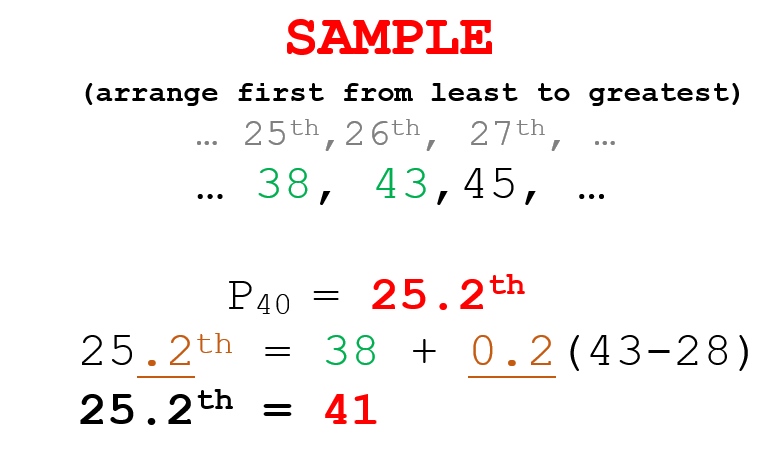
8
MEASURES of POSITION (QUANTILES)
Decile
Decile
revised figure
$D_i=\ \frac{i}{10}\left(n\ +\ 1\right)\ $
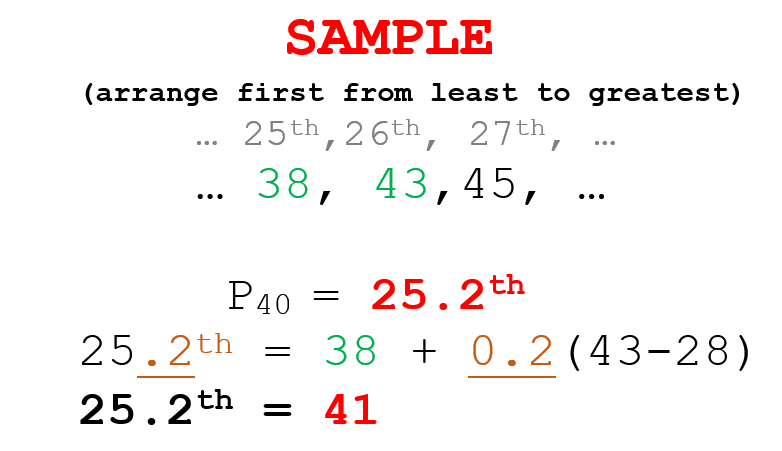
$D_i=\ \frac{i}{10}\left(n\ +\ 1\right)\ $
9
MEASURES of POSITION (QUANTILES)
Percentile
Percentile
revised figure
$P_i=\ \frac{i}{100}\left(n\ +\ 1\right)$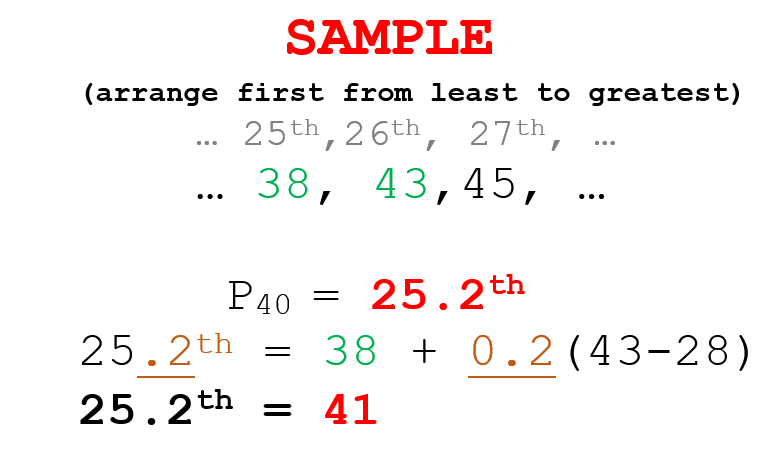
$P_i=\ \frac{i}{100}\left(n\ +\ 1\right)$
10
DETERMINE FIRST if ARRANGEMENT is
IMPORTANT or NOT IMPORTANT
IMPORTANT or NOT IMPORTANT
IMPORTANT = PERMUTATION
NOT IMPORTANT = COMBINATION
NOT IMPORTANT = COMBINATION
11
PERMUTATION - arrangement is IMPORTANT
Distinct Permutation
the number of all possible
arrangements or permutations
of n distinct objects taken r at a time.
Distinct Permutation
the number of all possible
arrangements or permutations
of n distinct objects taken r at a time.
$n\ P\ r\ =\ \frac{n!}{\left(n\ -r\right)!}$
12
PERMUTATION - arrangement is IMPORTANT
Repetitive Permutation
the number of all possible
arrangements or permutations
of n distinct objects taken r at a time with identical objects
Repetitive Permutation
the number of all possible
arrangements or permutations
of n distinct objects taken r at a time with identical objects
$n\ P\ r\ =\ \frac{N!}{R!}$
N= number of obj. (counting certain identical obj as 1)
R= number of how many times the certain obj repeated
N= number of obj. (counting certain identical obj as 1)
R= number of how many times the certain obj repeated
13
PERMUTATION - arrangement is IMPORTANT
Circular Permutation
total number of ways in which n distinct objects can be arranged
around a fixed circle.
the start and end is indistinctive
Circular Permutation
total number of ways in which n distinct objects can be arranged
around a fixed circle.
the start and end is indistinctive
$n\ P\ r\ =\ \left(n-1\right)!$
14
PERMUTATION - arrangement is IMPORTANT
Circular in Space Permutation
Circular in Space Permutation
$n\ P\ r\ =\ \frac{\left(n-1\right)!}{2}$
15
COMBINATION - arrangement is NOT IMPORTANT
Distinct Combination
Distinct Combination
$n\ C\ r\ =\ \frac{n!}{r!\ \left(n-r\right)!}$
n= number of choices
r= number of outcomes
n= number of choices
r= number of outcomes
16
COMBINATION - arrangement is NOT IMPORTANT
Derangement Combination
a derangement of a set leaves no element in its original place
Derangement Combination
a derangement of a set leaves no element in its original place
$!n\ =n!\sum_{k=0}^{n}{\ \frac{\left(-1\right)^k}{k!}}$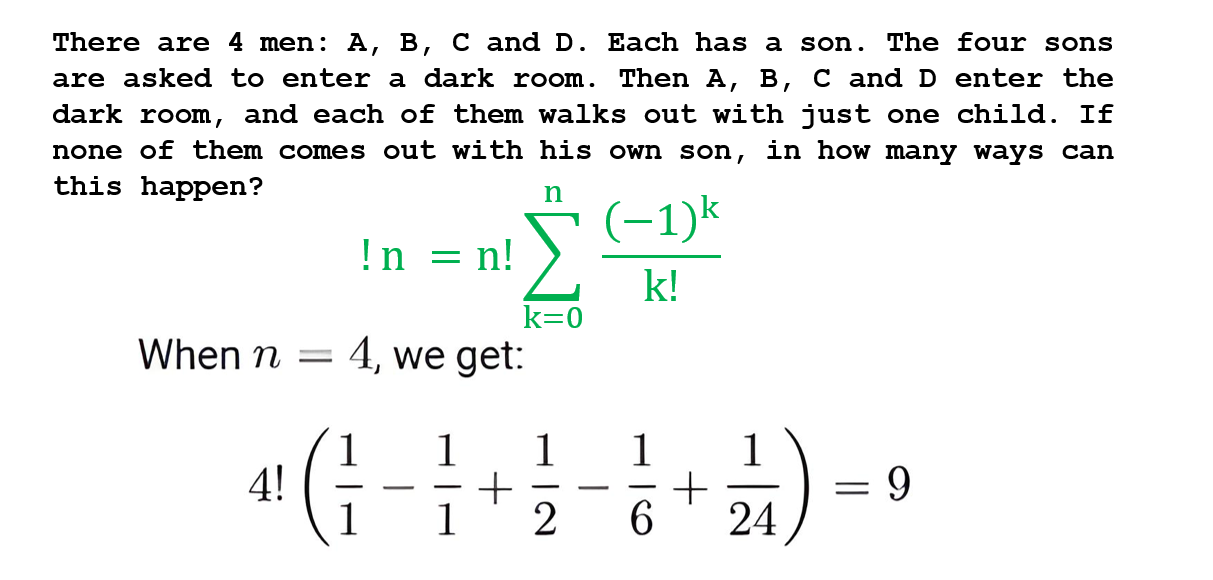
17
relationship between
PERMUTATION and COMBINATION
PERMUTATION and COMBINATION
$n\ C\ r=\ \frac{n\ P\ r}{r\ !}$
18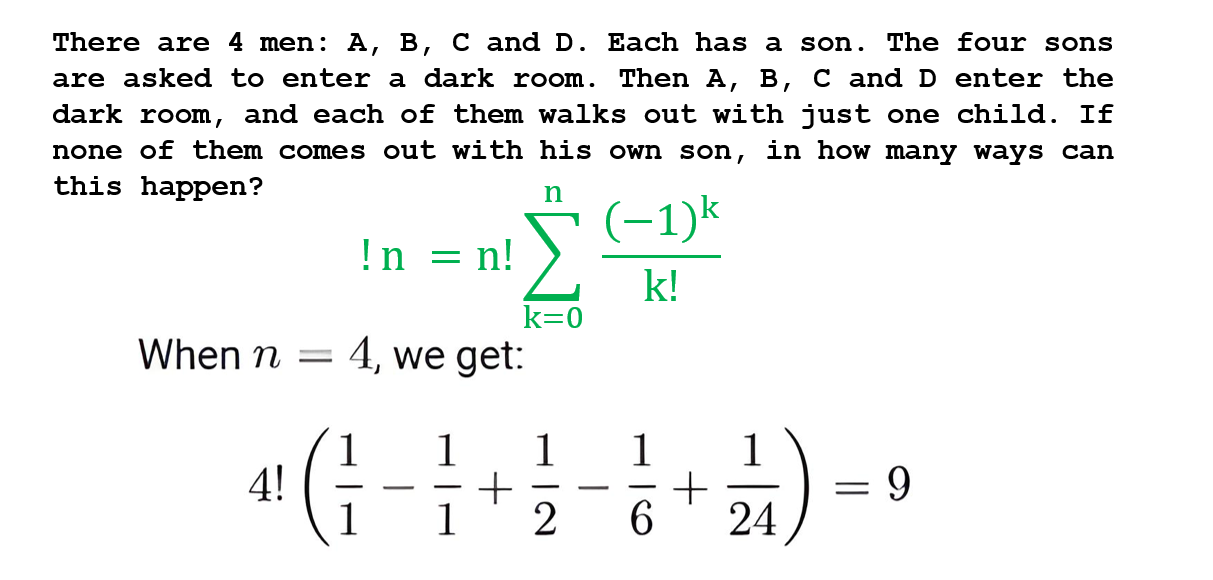
Image occlusion: name the hidden labels
19
PROBABILITY
$P\ =\ \frac{SUCCESSFUL\ outcomes}{total\ number\ of\ POSSIBLE\ outcomes}$
20
$E = pS$
p= probability of success
S= sum of prize
MATHEMATICAL EXPECTATION
If p is the probability that a person
will receive a sum of money S,
the mathematical expectation is defined
If p is the probability that a person
will receive a sum of money S,
the mathematical expectation is defined
$E = pS$
p= probability of success
S= sum of prize
21
ODDS in FAVOR
the likelihood of something occurring.
It is a gambling term referring to a mathematical calculation of probability.
the likelihood of something occurring.
It is a gambling term referring to a mathematical calculation of probability.
$Odds\ in\ Favor\ =\ \frac{SUCCESSFUL\ }{failure}$
22
ODDS in AGAINST or FAILURE
the likelihood of something occurring. It is a gambling term referring to a mathematical calculation of probability.
the likelihood of something occurring. It is a gambling term referring to a mathematical calculation of probability.
$Odds\ Against\ =\ \frac{failure\ }{SUCCESS}$
23
MUTUALLY EXCLUSIVE EVENTS
Two or more events are mutually exclusive ,
they cannot occur simultaneously.
Two or more events are mutually exclusive ,
they cannot occur simultaneously.
$P\left(A\ \cap B\ \right)=\ 0$
$P\left(A\ \cup B\ \right)=\ P\ \left(A\right)\ +P\ \left(B\right)$
the probability of both events happening at the same time is zero.
For example, when tossing a coin, the result can either be heads or tails, but not both
$P\left(A\ \cup B\ \right)=\ P\ \left(A\right)\ +P\ \left(B\right)$
the probability of both events happening at the same time is zero.
For example, when tossing a coin, the result can either be heads or tails, but not both
24
MUTUALLY INCLUSIVE EVENTS
Two or more events are mutually inclusive,
if one or the other or both can occur.
Two or more events are mutually inclusive,
if one or the other or both can occur.
$P\left(A\ \cap B\ \right)\neq\ 0$
$P\left(A\ \cup B\ \right)=\ P\ \left(A\right)\ +P\ \left(B\right)-P\left(A\ \cap B\ \right)$
For example, the events “buying an alarm system” and “buying bucket seats”
are mutually inclusive, as both events can happen at the same time
$P\left(A\ \cup B\ \right)=\ P\ \left(A\right)\ +P\ \left(B\right)-P\left(A\ \cap B\ \right)$
For example, the events “buying an alarm system” and “buying bucket seats”
are mutually inclusive, as both events can happen at the same time
25
CONDITIONAL PROBABILITY
Bayes Theorem
Bayes Theorem
$P\left(A|B\right) \cdot P\ \left(B\right)=\ P\left(B|A\right) \cdot P\ \left(A\right)\ =P\left(A\cap B\right)$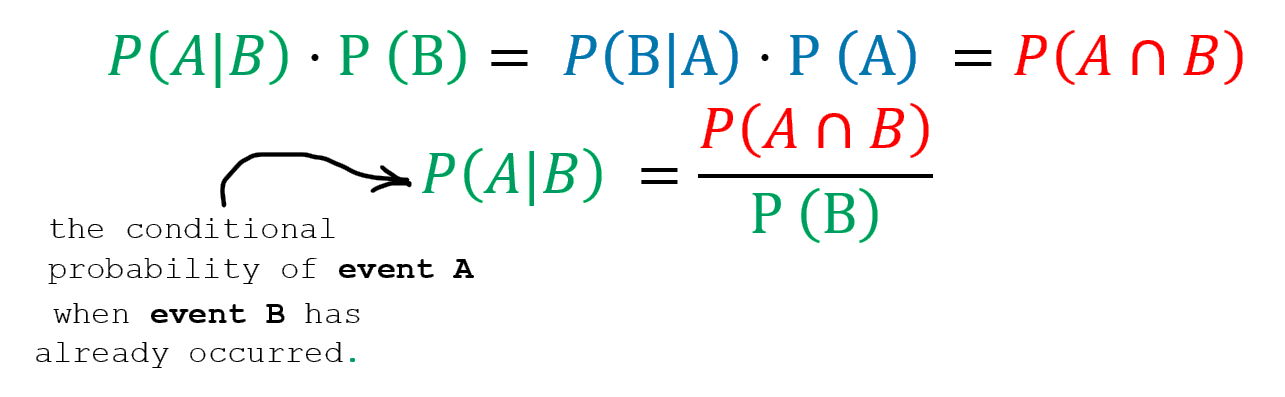
26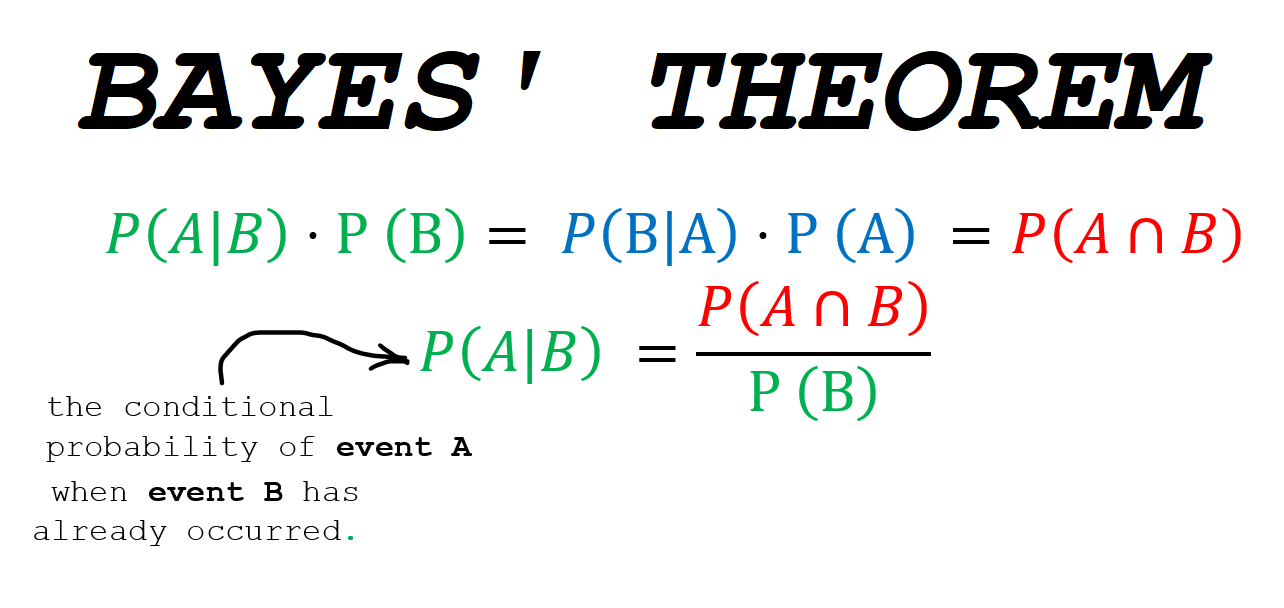
Image occlusion: name the hidden labels
27
BINOMIAL DISTRIBUTION
In a binomial experiment
(also called the Bernoulli trial),
there are 2 mutually exclusive outcomes often referred to as “success” and “failure”, or the probability of each trial
is not affected
In a binomial experiment
(also called the Bernoulli trial),
there are 2 mutually exclusive outcomes often referred to as “success” and “failure”, or the probability of each trial
is not affected
$ P\ \left(x\ =r\right)=\ \left(n\ C\ r\right)\cdot\left(p^r\right)\cdot{\ \left(q\right)}^{n-r}$
n =number of trials (occurrences)
r =number of successful trials
p =probability of success in a single trial
q = (1-p)
n =number of trials (occurrences)
r =number of successful trials
p =probability of success in a single trial
q = (1-p)
28
BINOMIAL APPROXIMATION
to
NORMAL DISTRIBUTION
usually used in large value
n to be “sufficiently large” it needs to meet
the following criteria
$np\geq\ 5$
$n\left(1-p\right)\geq\ 5$
to
NORMAL DISTRIBUTION
usually used in large value
n to be “sufficiently large” it needs to meet
the following criteria
$np\geq\ 5$
$n\left(1-p\right)\geq\ 5$
$\bar{x}\ =\ np$
$\sigma\ =\ \sqrt{npq}$
$\sigma\ =\ \sqrt{npq}$
29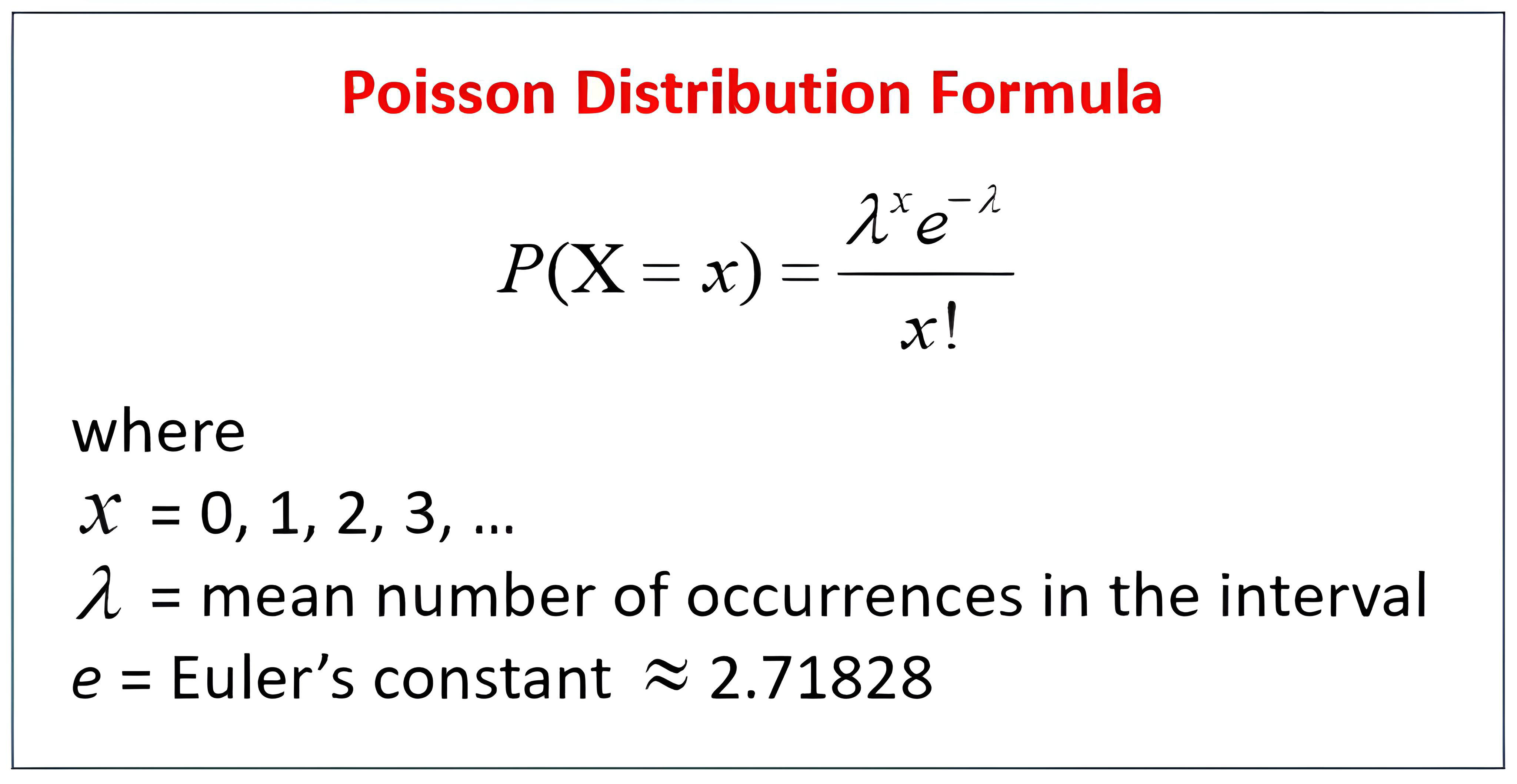
POISSON's DISTRIBUTION
The Poisson’s probability that exactly
“r” successes occur in a Poisson experiment
The Poisson’s probability that exactly
“r” successes occur in a Poisson experiment
30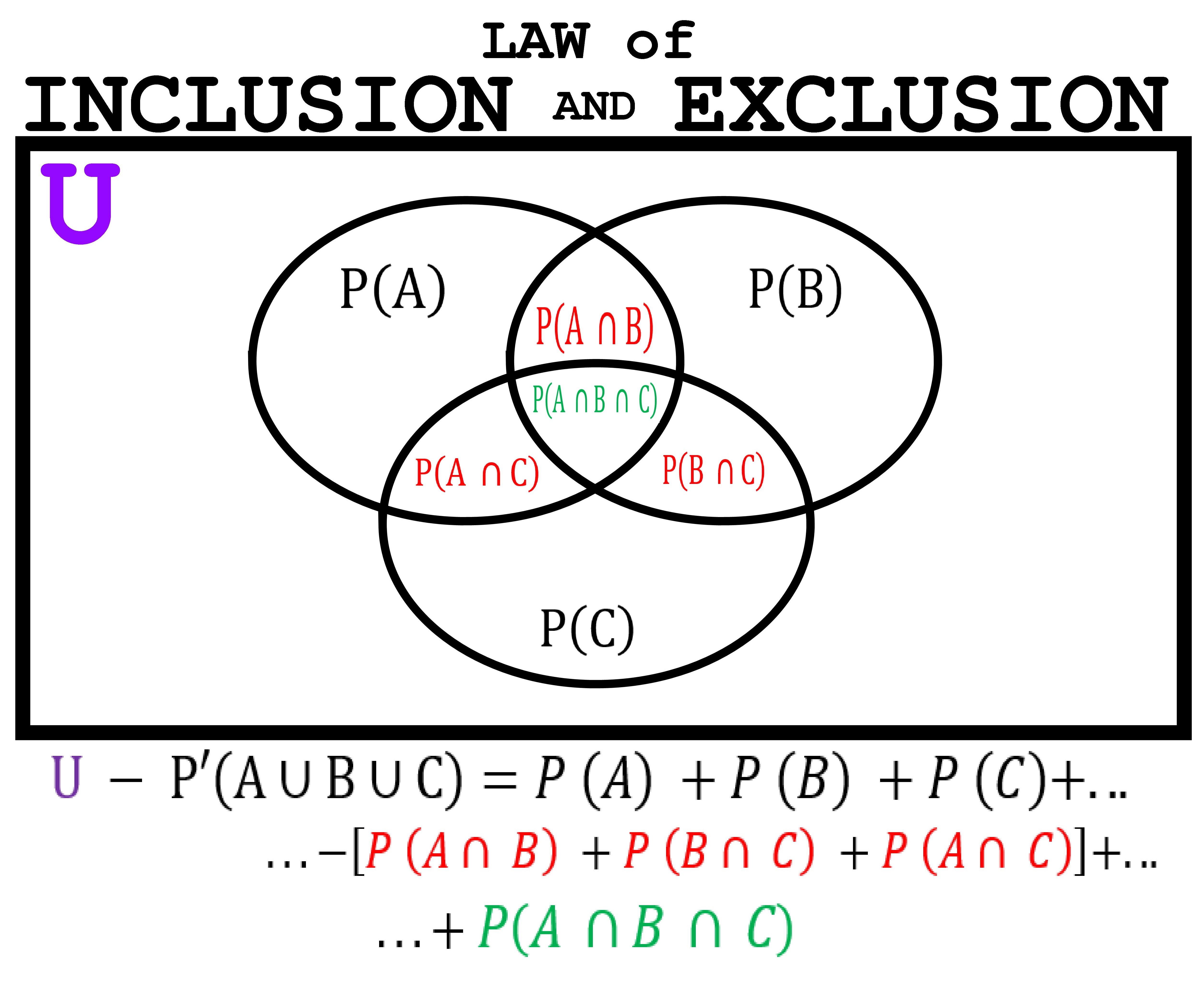
Image occlusion: name the hidden labels
31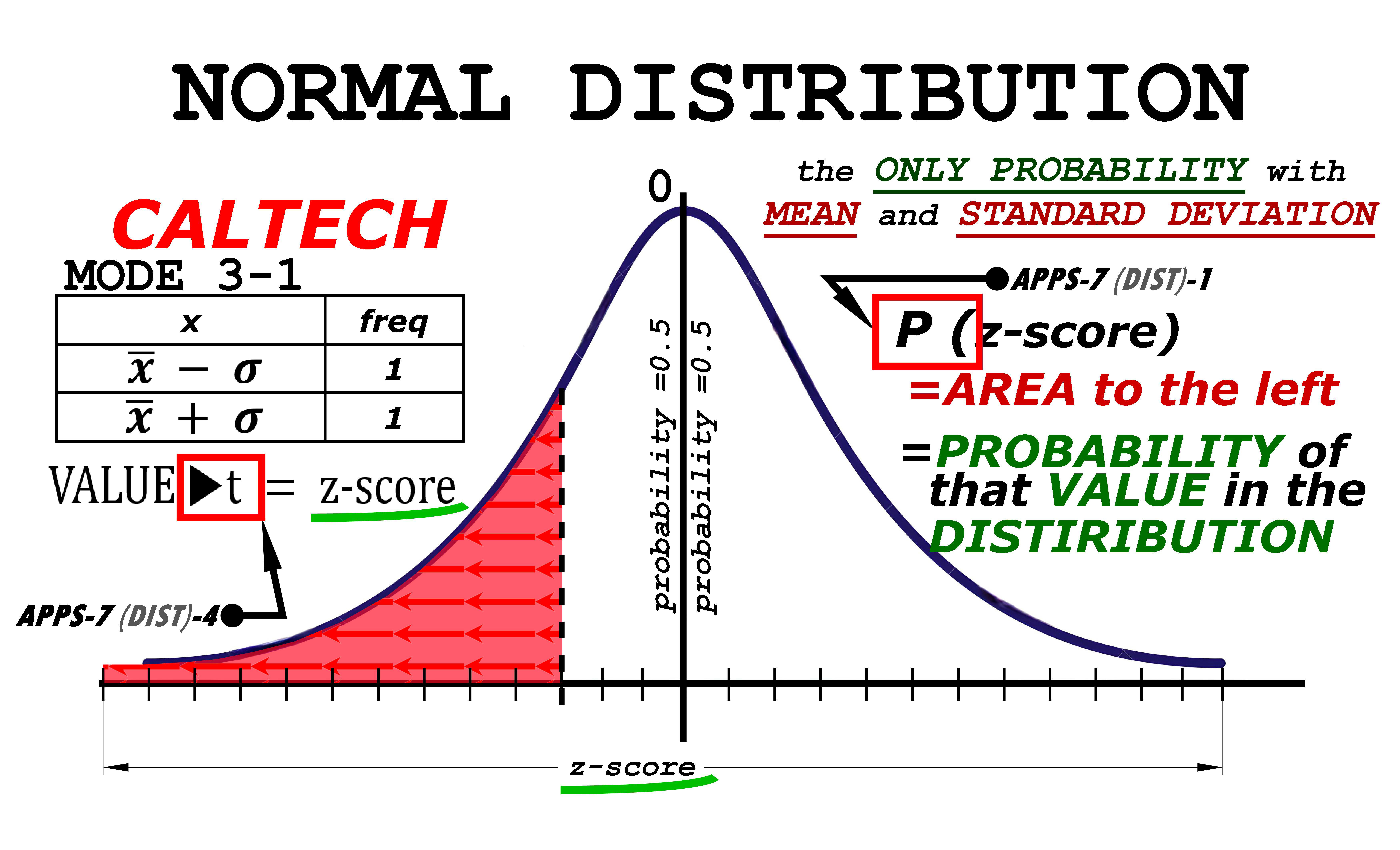
NORMAL DISTRIBUTION
LESS than the VALUE
to the left of VALUE
LESS than the VALUE
to the left of VALUE
32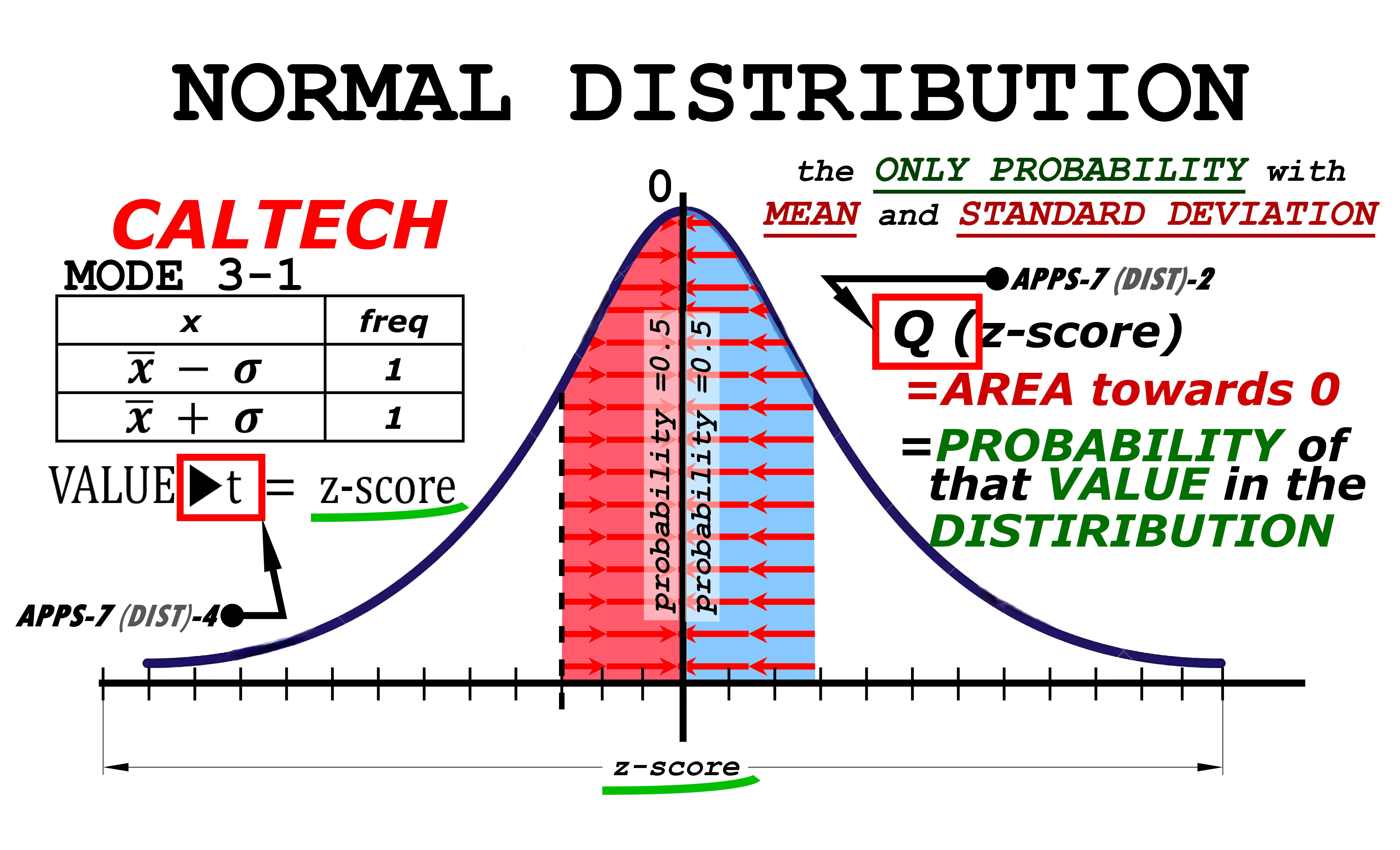
NORMAL DISTRIBUTION
in BETWEEN the 2 VALUE
towards 0
in BETWEEN the 2 VALUE
towards 0
33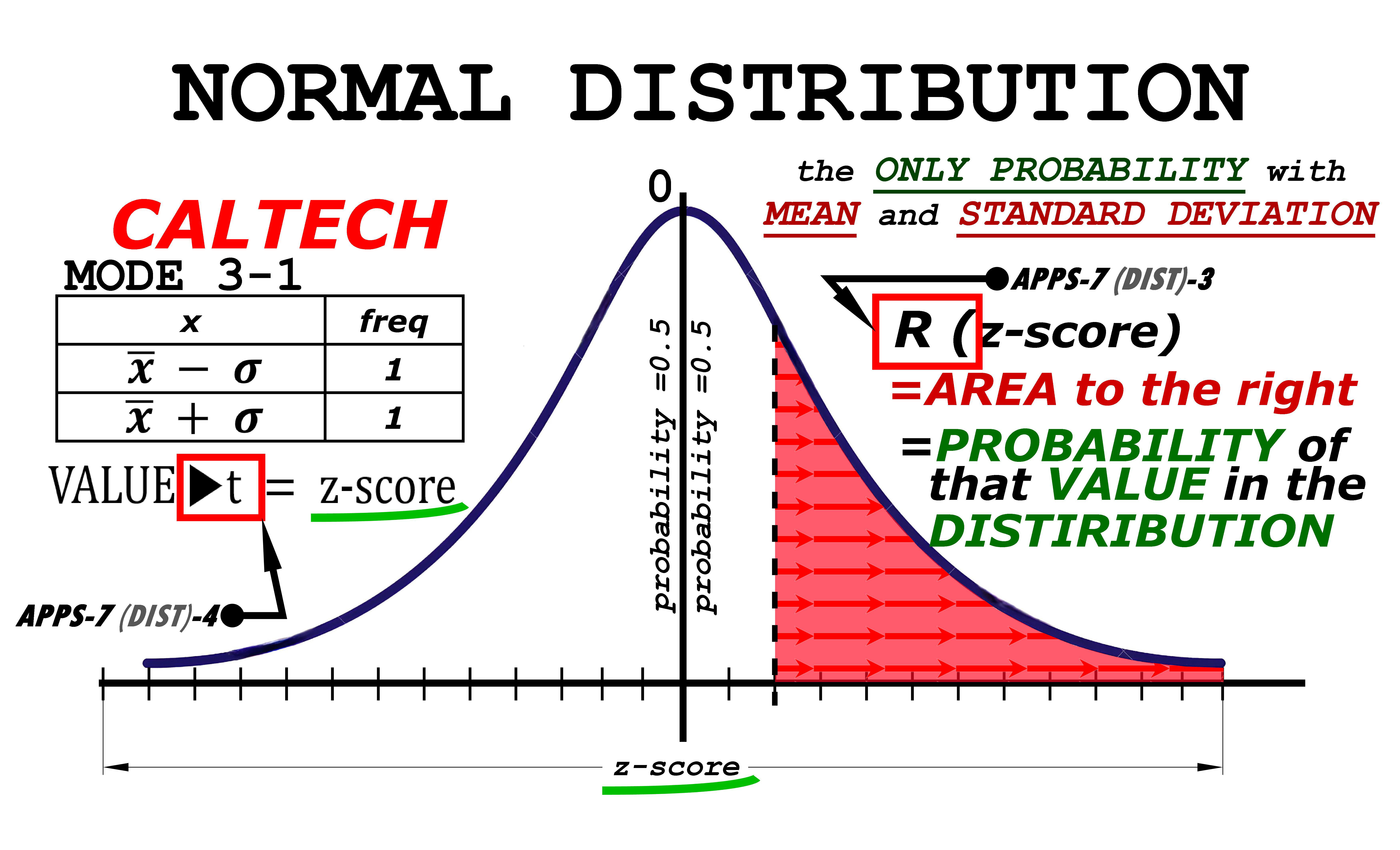
NORMAL DISTRIBUTION
GREATER than the VALUE
to the right of VALUE
GREATER than the VALUE
to the right of VALUE
34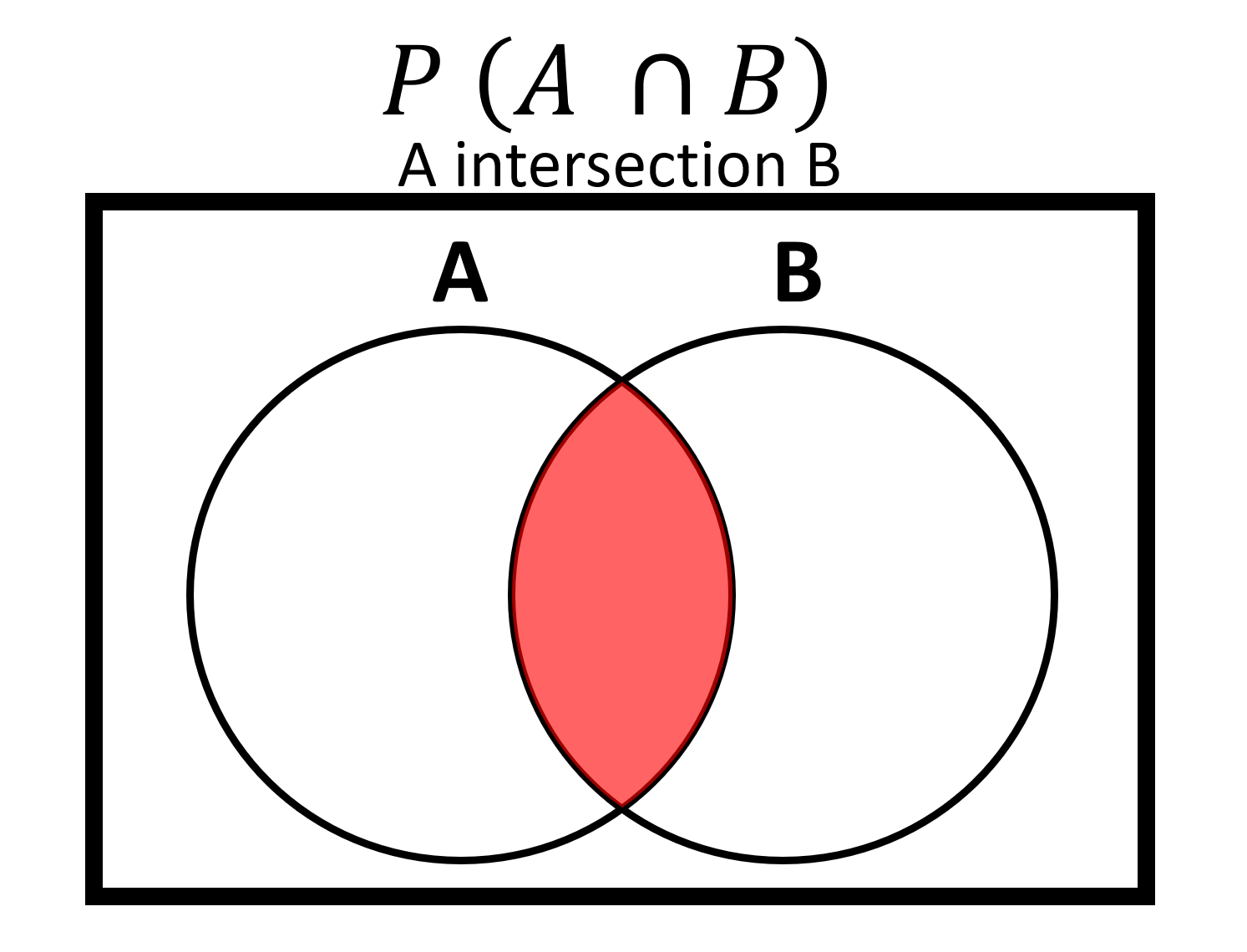
Image occlusion: name the hidden labels
35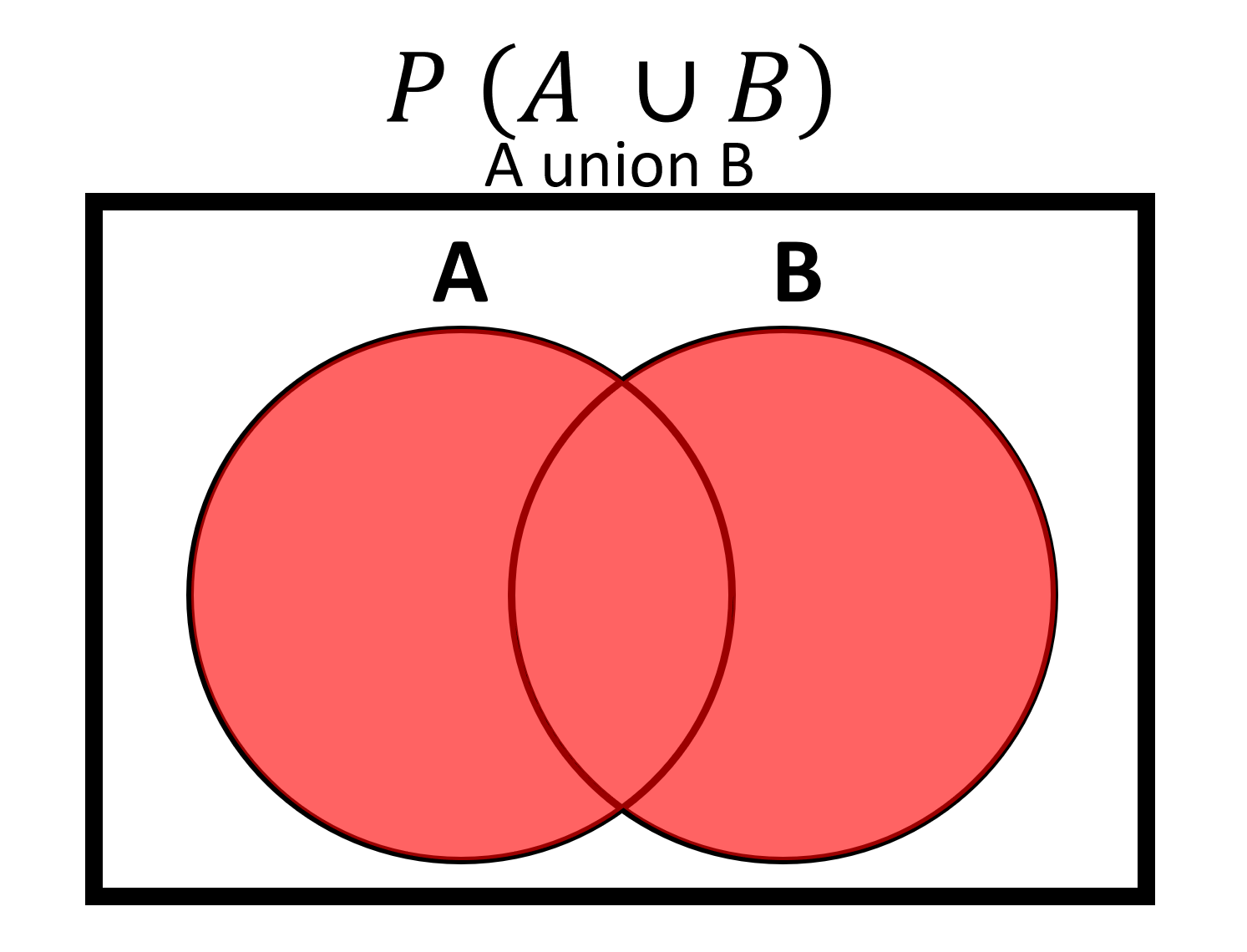
Image occlusion: name the hidden labels
36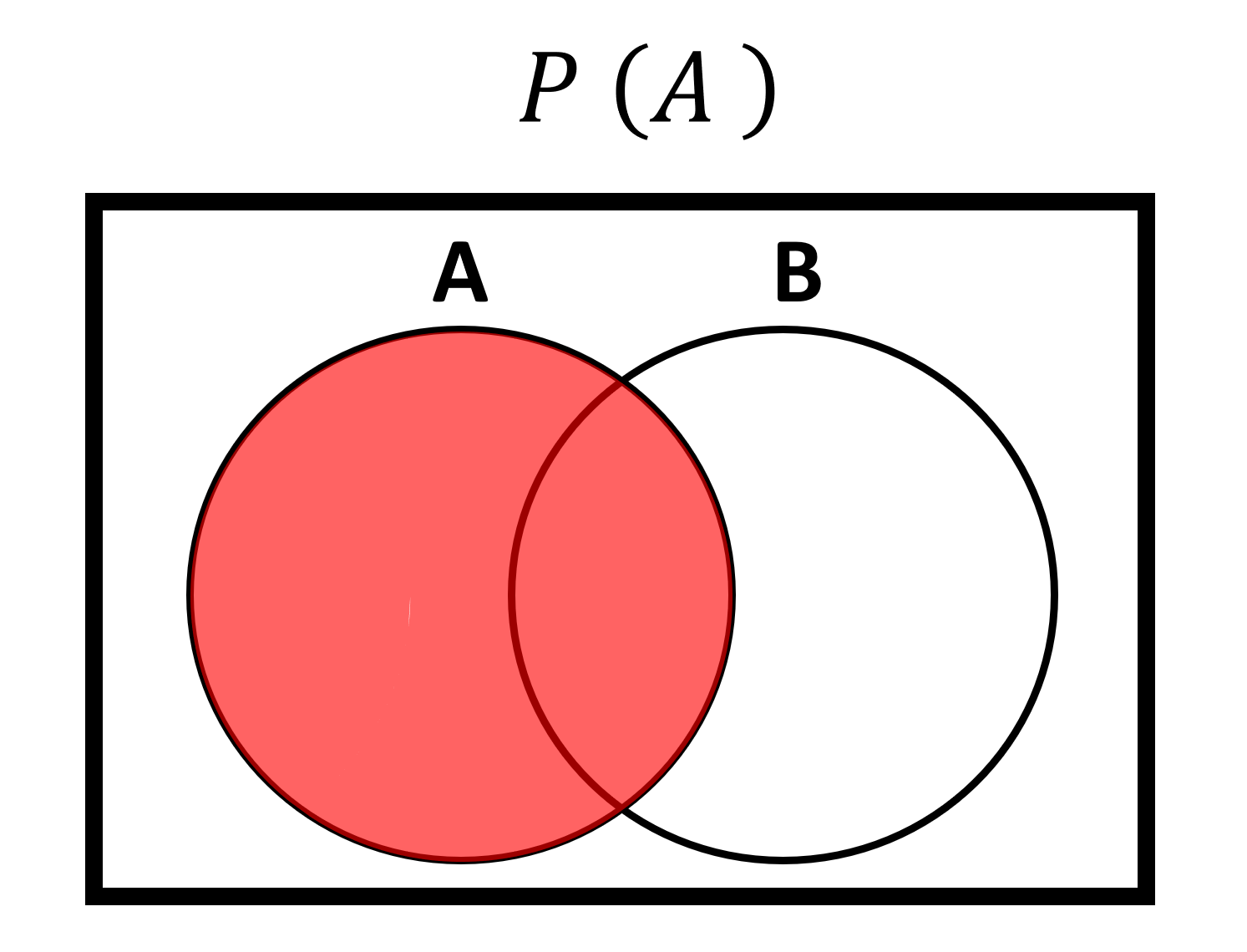
Image occlusion: name the hidden labels
37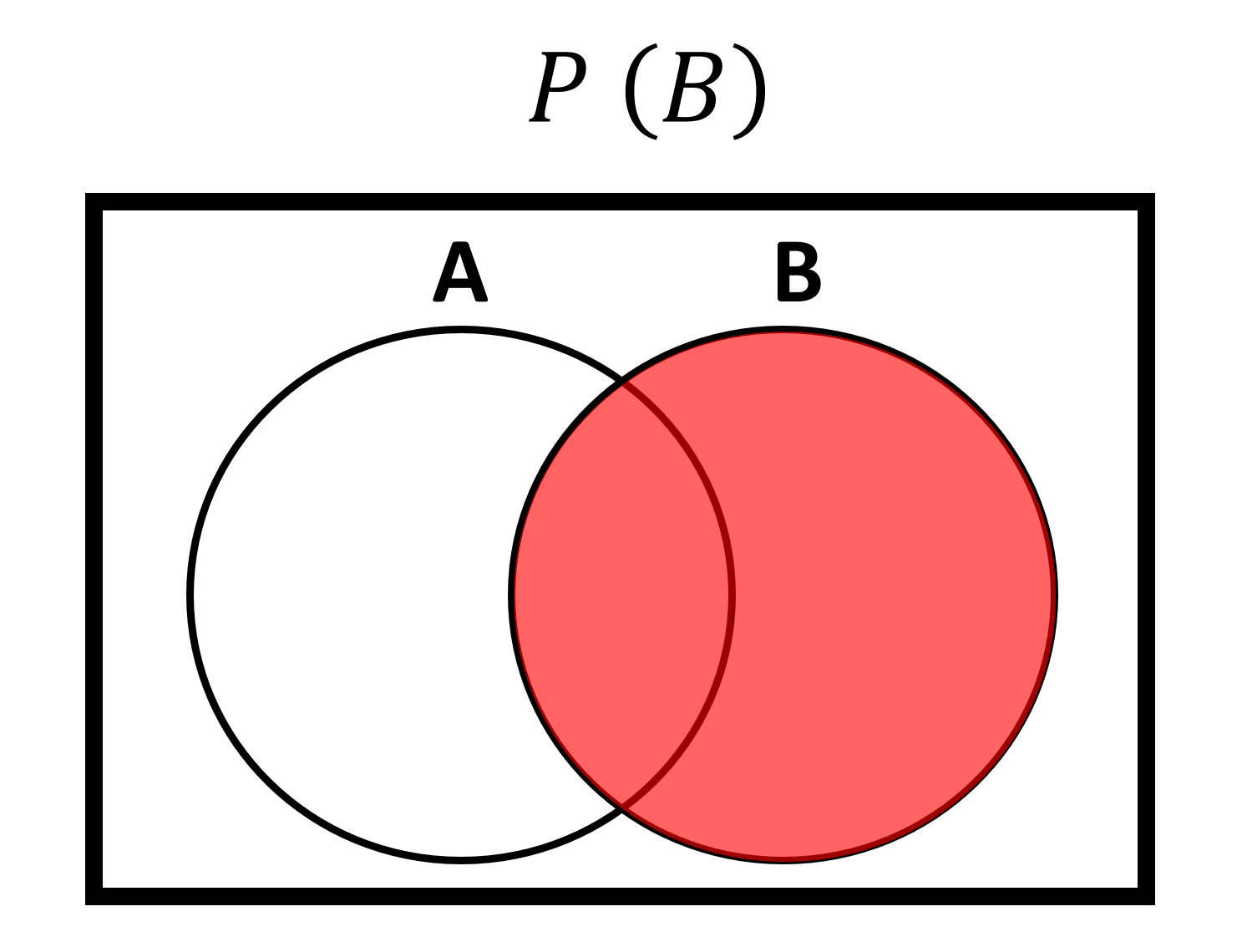
Image occlusion: name the hidden labels
38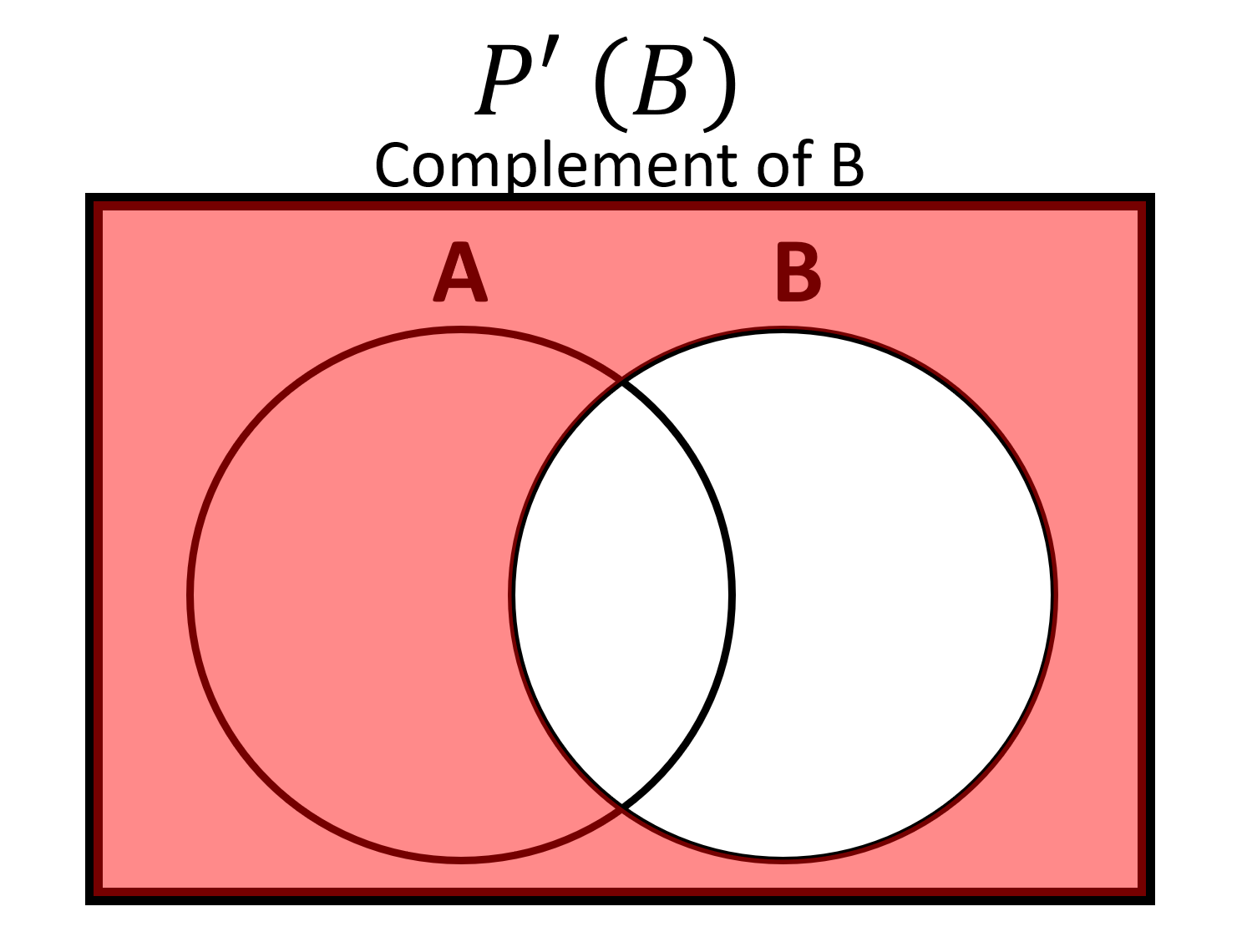
Image occlusion: name the hidden labels
39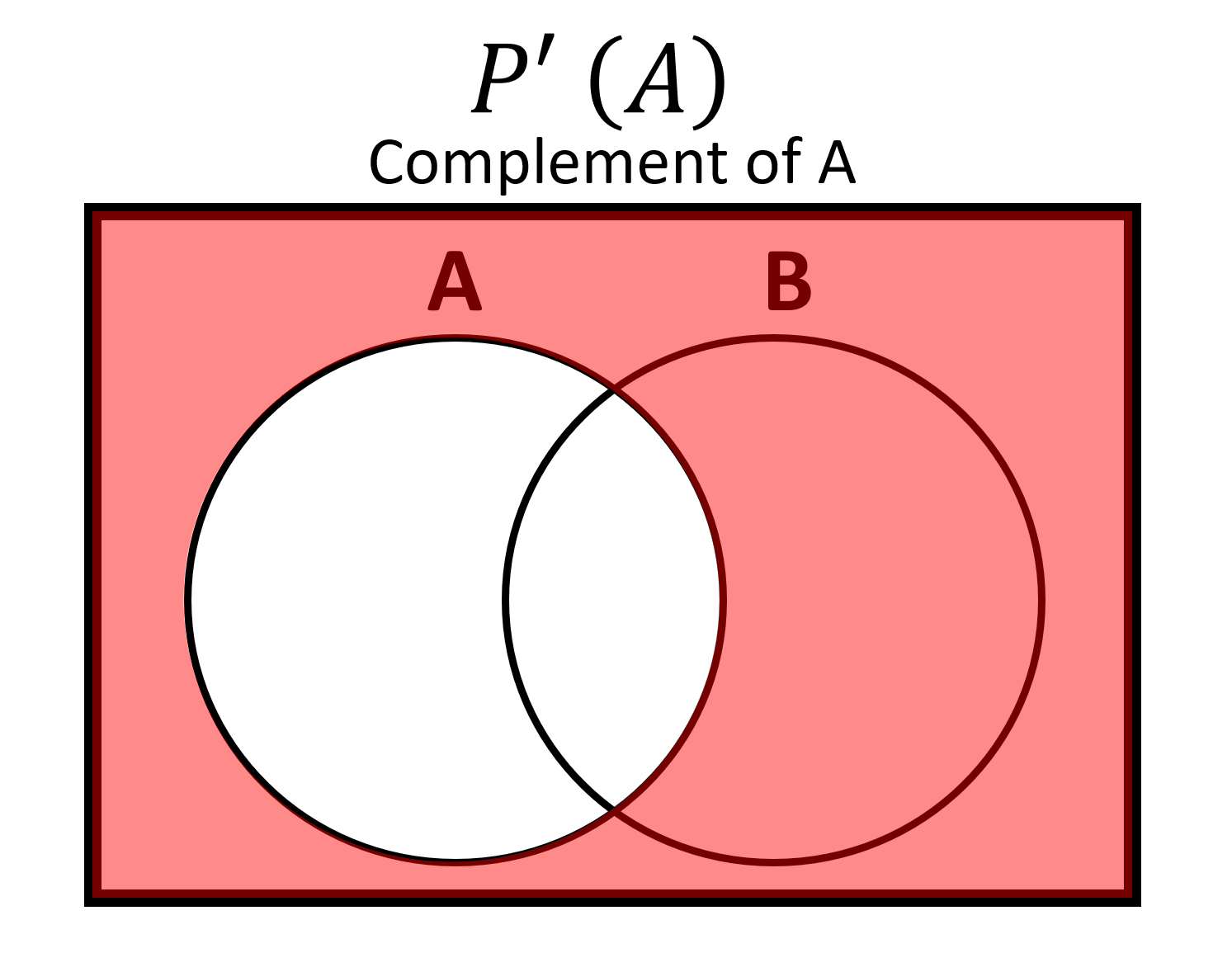
Image occlusion: name the hidden labels
40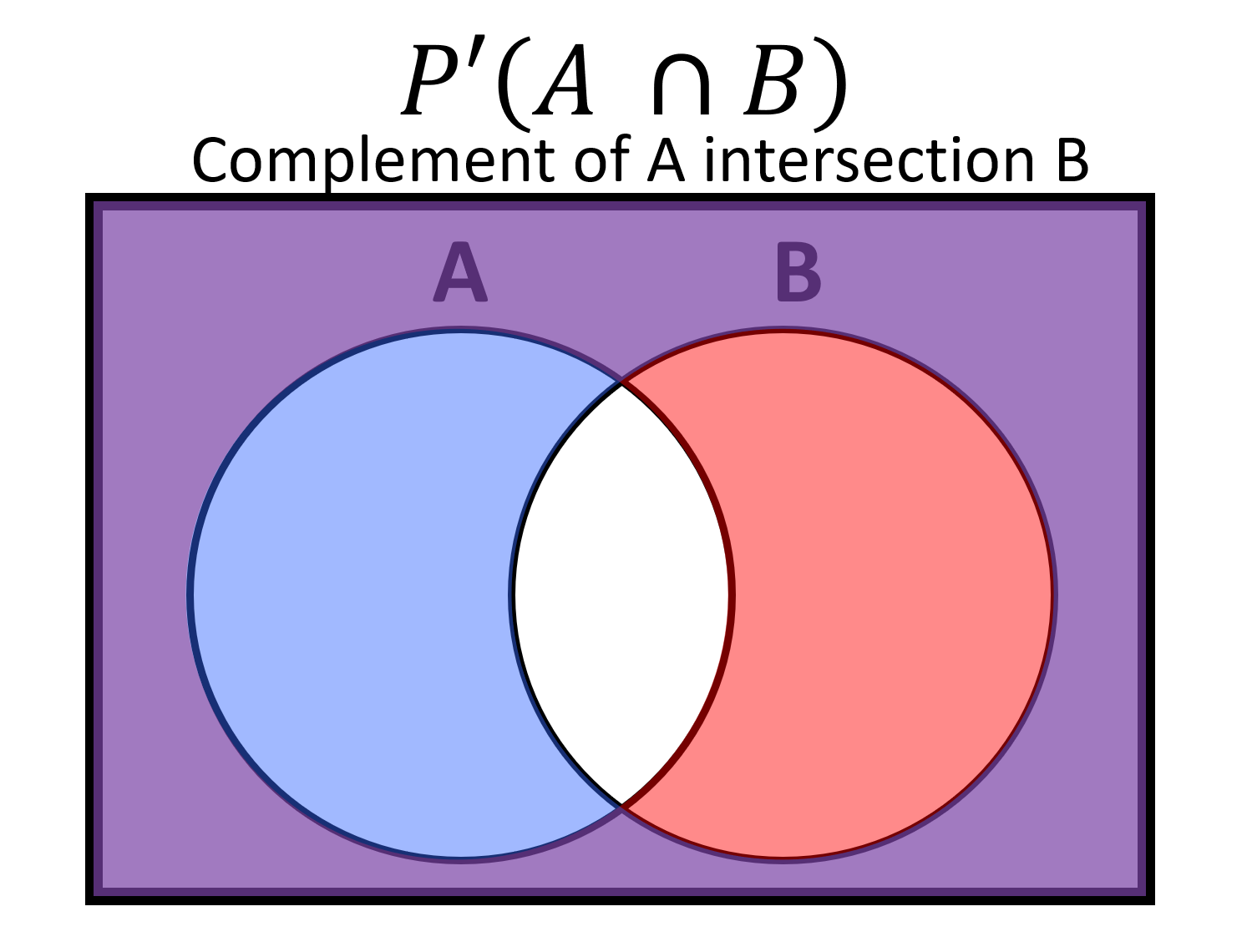
Image occlusion: name the hidden labels
41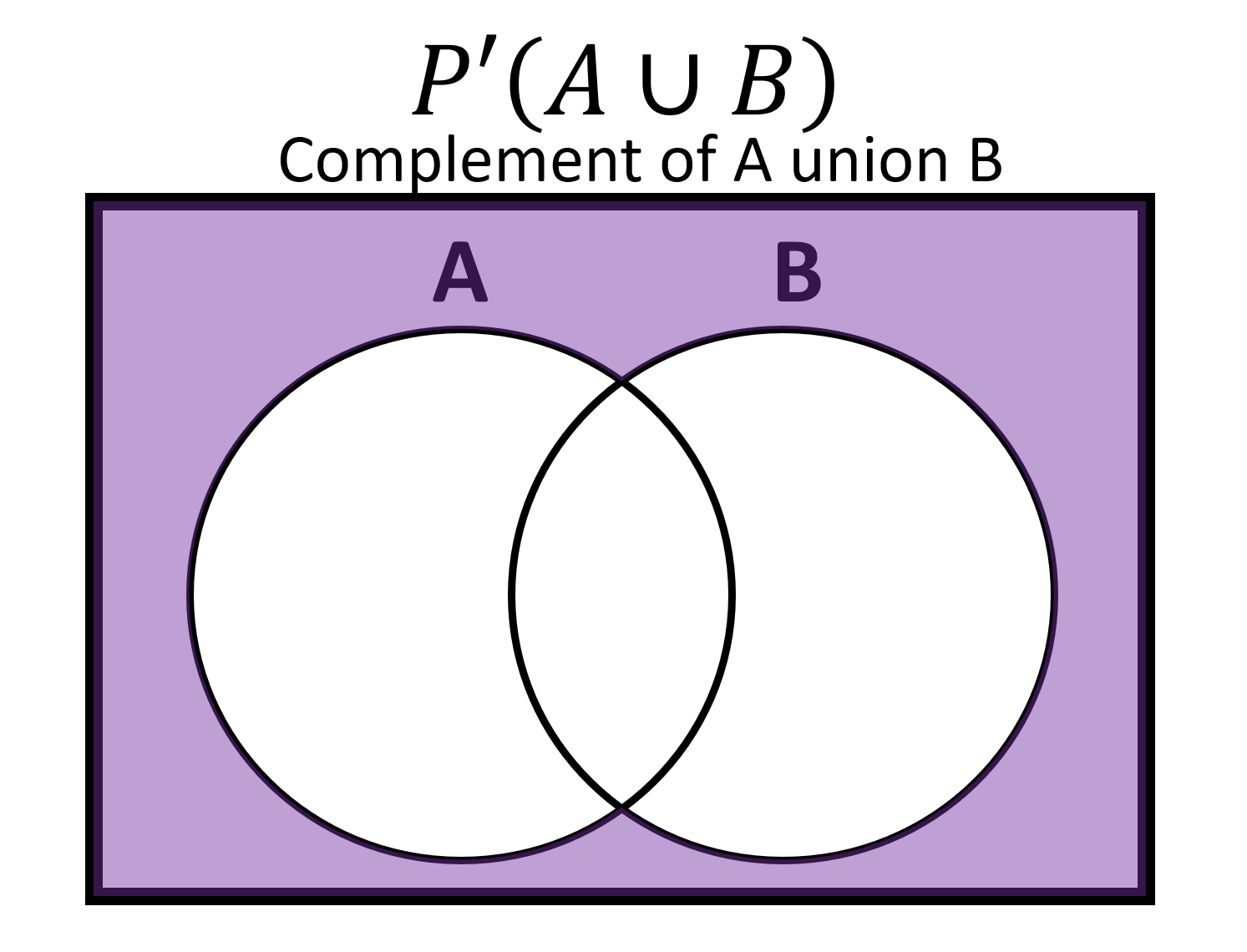
Image occlusion: name the hidden labels
42
Image occlusion: name the hidden labels
43
Image occlusion: name the hidden labels
44
Image occlusion: name the hidden labels
45
Image occlusion: name the hidden labels
46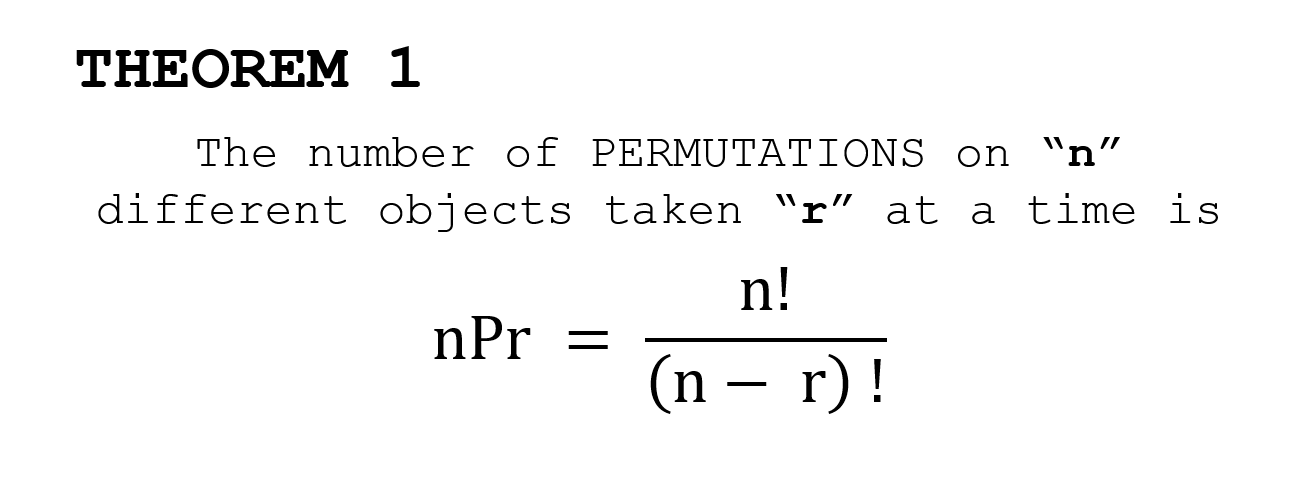
Image occlusion: name the hidden labels