Mechanics
Study these flashcardsFree · spaced repetition · iPhone, Android, Mac & web
All cards
1
When and only when are newtons laws valid?
In intertial frames. i.e. when the observer is stationary
2
What are the steps for solving problems with newtons laws?
1. Draw a sketch
2. Draw a free body diagram, labelling all forces ($F_{A \text{ on } B}$ etc.)
3. Define a coordinate system (try to have one axis in the same direction as an acceleration vector and the origin at the position of the particle at t=0)
4. Resolve forces, apply Newton's laws and solve
2. Draw a free body diagram, labelling all forces ($F_{A \text{ on } B}$ etc.)
3. Define a coordinate system (try to have one axis in the same direction as an acceleration vector and the origin at the position of the particle at t=0)
4. Resolve forces, apply Newton's laws and solve
3
What is the equation for static friction and when is it valid?
$f_{s, \text{max}} = \mu_{s} \, n$
Valid when the object is stationary
Valid when the object is stationary
4
What is the equation for kinetic friction and when is it valid?
$f_k = \mu_{k} \, n$
Valid when the object is moving
Valid when the object is moving
5
What is the equation for the vector dot product?
$\underline{A} \cdot \underline{B} = |\underline{A}| |\underline{B}| \cos \theta$
6
What is the equation for the vector cross product?
$
\underline{A} \times \underline{B} = \underline{C} = \begin{vmatrix}
\hat{i} & \hat{j} & \hat{k} \\
a & b & c \\
d & e & f
\end{vmatrix}
$
7
What does |$\underline{A}$ x $\underline{B}$| =?
|$\underline{A}$||$\underline{B}$| sin($\theta$)
8
How do you decide on the direction of $\underline{C}$ in the vecor cross product?
Use the right hand screw rule (place right hand on $\underline{A}$ and curl fingers towards $\underline{B}$, the direction of your thumb gives the direction of $\underline{C}$)
9
What are the three cartesian unit vectors, and their directions?
$\hat{i}$ in the direction of the +ve x-axis
$\hat{j}$ in the direction of the +ve y-axis
$\hat{k}$ in the direction of the +ve z-axis
$\hat{j}$ in the direction of the +ve y-axis
$\hat{k}$ in the direction of the +ve z-axis
10
What is the equation of a particles position in vector notation?
$\underline{r} = x \hat{i} + y \hat{j} + z \hat{k}$
11
What is the equation of a particles velocity in vector notation?
$\underline{v} = \frac{dx}{dt} \hat{i} + \frac{dy}{dt} \hat{j} + \frac{dz}{dt} \hat{k}$
12
What is the equation of a particles acceleration in vector notation?
$\underline{a} = \frac{d^2x}{dt^2} \hat{i} + \frac{d^2y}{dt^2} \hat{j} + \frac{d^2z}{dt^2} \hat{k}$
13
What is the equation of a force in vector notation?
$\underline{F} = m \left( \frac{d^2x}{dt^2} \hat{i} + \frac{d^2y}{dt^2} \hat{j} + \frac{d^2z}{dt^2} \hat{k} \right)$
14
What is a central force?
A force that acts between two particles along the imaginary line joining the two particles
15
What are the 4 equations that relate polar and cartesian coordinates?
$x = r \cos \theta$
$y = r \sin \theta$
$\frac{y}{x} = \tan \theta$
$x^2 + y^2 = r^2$
$y = r \sin \theta$
$\frac{y}{x} = \tan \theta$
$x^2 + y^2 = r^2$
16
How do you sketch polar graphs?
1. Take r($\theta$) and find cooridinate of points on the graph by subbing in values of $\theta$
2, Plot the points then draw the graph
2, Plot the points then draw the graph
17
What are the polar unit vectors and their directions?
$\hat{r}$ in the direction of the line connecting the particle and the origin
$\hat{\theta}$ perpendicular to $\hat{r}$ and in the direction the particle is traveling in
$\hat{\theta}$ perpendicular to $\hat{r}$ and in the direction the particle is traveling in
18
What is the equation for a particles position in polar form?
r = r$\hat{r}$
19
What is the equation for a particles velocity in polar form?
$\underline{v} = \dot{r} \, \hat{r} + r \, \dot{\theta} \, \hat{\theta}$
20
What is the equation for a particles acceleration in polar form?
$\underline{a} = \left( \ddot{r} - r \dot{\theta}^2 \right) \hat{r} + \left( r \ddot{\theta} + 2 \dot{r} \dot{\theta} \right) \hat{\theta}$
21
What is the equation for a force in polar form?
$\underline{F} = m \left( \ddot{r} - r \dot{\theta}^2 \right) \hat{r} + m \left( r \ddot{\theta} + 2 \dot{r} \dot{\theta} \right) \hat{\theta}$
22
How can you identify UCM in polar?
$a_{\theta}$ = 0
23
What are the three conditions to consider for central forces in polar coordinates?
$a_\theta = 0$
$r^2 {\theta} = h$ (where h is the angular momentum per unit mass)
$\frac{dL}{d\theta} = 0$ (where L is the angular momentum)
$r^2 {\theta} = h$ (where h is the angular momentum per unit mass)
$\frac{dL}{d\theta} = 0$ (where L is the angular momentum)
24
What is the method for solving problems with central forces in polar coordinates?
1. Find h
2. Use $a_r = \ddot{r} - r \dot{\theta}^2$
3. Solve for what the question is asking for
2. Use $a_r = \ddot{r} - r \dot{\theta}^2$
3. Solve for what the question is asking for
25
What is the equation for the work done in cartesian coordinates where $\underline{F}$ is constant?
$W = \underline{F} \cdot \underline{r} = |\underline{F}| |\underline{r}| \cos \theta$
26
What is the equation for the work done in cartesian coordinates where $\underline{F}$ varies?
$W = \int_{x_1}^{x_2} F_x \, dx + \int_{y_1}^{y_2} F_y \, dy + \int_{z_1}^{z_2} F_z \, dz$
27
What is the method for finding the work done between two points in cartesian coordinates where $\underline{F}$ varies?
1. Decide on a path between the points
2. Get equation relating x, y and maybe z, along that path
3. get $F_x$ in terms of only x get $F_y$ in terms of only y and maybe get $F_z$ in terms of only z
4. Use equation for work
2. Get equation relating x, y and maybe z, along that path
3. get $F_x$ in terms of only x get $F_y$ in terms of only y and maybe get $F_z$ in terms of only z
4. Use equation for work
28
What is the equation for the work done in polar coordinates?
$W = \int_{r_1}^{r_2} F_r \, dr + \int_{\theta_1}^{\theta_2} F_{\theta} \, d\theta$
29
What is the equation for the work energy theorem?
W = Δ$E_k$ + Δ$E_p$
30
What is the equation for instantaneous power?
$P = \frac{dW}{dt} = \underline{F} \cdot \underline{v}$ $\therefore \text{W = } \int_{t_1}^{t_2} P \, dt$
31
What are the general equations of $\underline r$ and $\underline \theta$
$\underline r = r \hat r$ $\underline \theta = \theta \hat \theta$
32
What is the condition for a force to be a conservative force?
$
\oint \mathbf{F} \cdot d\mathbf{r} = 0
$
33
$\text{What is the formula for } \mathbf{V}(\underline{r}) \text{ and its associated derivative?}$
$V(\underline{r}) = - \int \mathbf{F} \cdot d\mathbf{\underline{r}}$
$-\frac{dV}{d\underline{r}} = \mathbf{F}(r)$
$-\frac{dV}{d\underline{r}} = \mathbf{F}(r)$
34
What is the formula for torque?
$\underline{\tau} = \underline{r} \times \underline{F}$
35
What is the formula for angular momentum?
$\underline{L} = \underline{r} \times \underline{p}$
36
What is the relationship between torque and angular momentum?
$\underline{\tau} = \frac{d\underline{L}}{dt}$
37
$\text{What is the formula for the } x_{\text{cm}}?$
$x_{\text{cm}} = \frac{1}{M} \int x \, dm$
38
$ \text{What is } dm \text{ when finding the } x_{cm}? $
$ dm = \sigma y \, dx $
39
$\text{What is the formula for the } y_{\text{cm}}?$
$y_{\text{cm}} = \frac{1}{M} \int y \, dm$
40
$ \text{What is } dm \text{ when finding the } y_{cm}? $
$ dm = \sigma x \, dy $
41
What is the mass (M) of an object with density $\sigma$?
$ M = \int \sigma \cdot \text{Area} \, (dx \, or \,dy) $
42
What is the cm of a system of 2 point masses?
$ \text{CM} = \frac{ m_1 (CM_1) + m_2 (CM_2)}{m_1 + m_2} $
43
What is the formula for the moment of inertia I for an object rotating around an axis?
$\int r^2 \, dm = \frac{\underline{L}}{\omega}$
44
What is the dm when finding I?
dm ....
45
What is the $I_{comp}$ for a composite object, made of multiple objects all rotating around the same axis simultaneously?
$I_{comp} = I_1 + I_2 ...$
46
What is a principle axis?
An axis which has even mass distributed on either side
47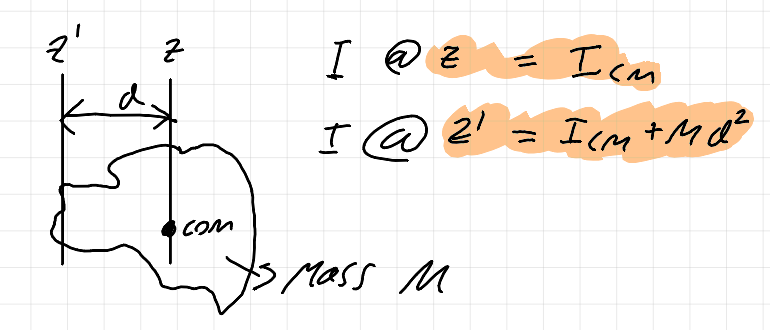
What is the parallel axis theorem? (in image form)
48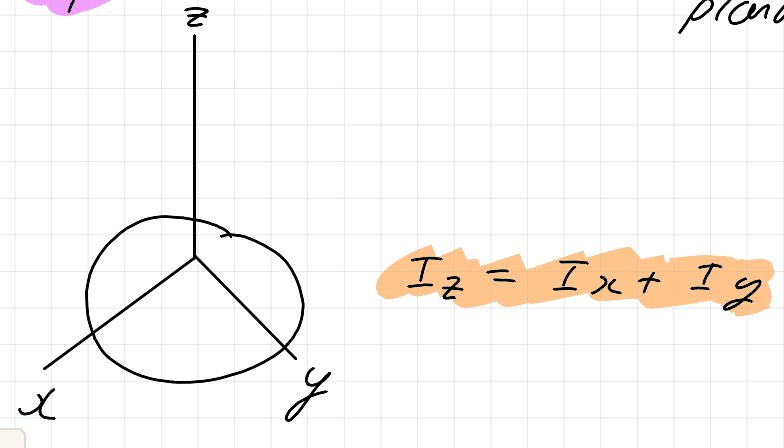
What is the perpendicular axis theorem? (in image form)
49
What is the rotational equivelant of $V_f = V_i^2 + 2 a \Delta x$?
$\omega_f^2 = \omega_i^2 + 2 \underline{\alpha} \Delta \theta$
50
What is the rotational equivelant of $V_f = V_i + \underline{a} t$?
$\omega_f = \omega_i + \underline{\alpha} t$
51
What is the rotational equivelant of $\Delta x = V_i t + \frac{1}{2} \underline{a} t^2$?
$\Delta \theta = \omega_i t + \frac{1}{2} \underline{\alpha} t^2$
52
What is the rotational equivelant of $E_k = \frac{1}{2} m \underline{v}^2$?
$E_k = \frac{1}{2} {I} \, {\omega}^2$
53
What is the rotational equivelant of $\underline{F} = m\underline{a}$?
$\tau = I \, \underline{\alpha}$