Physics Topics 12 -14
Study these flashcardsFree · spaced repetition · iPhone, Android, Mac & web
All cards
1
1. Explain the difference between permanent magnets and induced magnets.
Permanent magnets retain their magnetism. Induced magnets are only magnets in the presence of a permanent magnet/magnetic field.
2
2. What materials can be magnetised?
Iron, cobalt, nickel
3
3. Explain what is meant by "hard" (permanent) and "soft" (temporary) magnetic materials, and suggest an application of each.
Hard magnetic materials are difficult to magnetize, but difficult to demagnetize. These would be used to construct permanent magnets (e.g. a fridge magnet, a compass needle) Soft magnetic materials are easy to magnetize but also easy to demagnetize, these are used in electromagnet
4
4. What happens when two similar magnetic poles are brought near each other? What about unlike poles?
Like magnetic poles repel, and unlike poles attract
5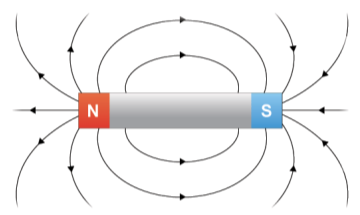
Draw the magnetic field surrounding a bar magnet, and include the direction.
6
The north pole of a bar magnet faces the south pole of another magnet. Draw the field between these two poles. How does your diagram show that the field is uniform? How does the diagram show the strength of the field?
The spacing of the magnetic field lines is the same between the poles; this represents a uniform field. The strength of the field is shown by how close the magnetic field lines are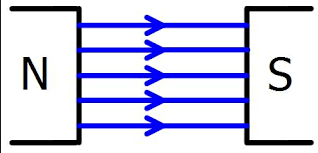
7
Explain how a plotting compass can be used to determine the shape and direction of the magnetic field of a magnet.
Position a plotting compass near one pole of the magnet. Mark where the arrow points to. Reposition the compass to that the tail of the arrow lies on the mark, and again mark where the arrow points to. Repeat this until the compass touches the magnet again. Draw a curve connecting the marks you have drawn; this represents a magnetic field line. The direction of the field is the direction of the compass arrow.
8
8. What evidence is there that the Earth's core is magnetic?
The behaviour of a compass needle provides evidence that the Earth's core is magnetic; the compass needle aligns itself with the Earth's magnetic field if there are no other magnets near.
9
9. How can a compass be used to show that there is a magnetic field surrounding a current carrying conductor?
Place a compass near the wire; when the current flows, the compass needle will deflect.
10
10. Draw the magnetic field associated with a wire carrying a current that is going INTO this page.
A series of concentric circles, getting progressively further apart. Arrows should be drawn on these in a clockwise sense.
11
11. What factors affect the strength of the magnetic field associated with a current?
(i) Size of electric current (ii) distance from the wire
12
12. Explain what is meant by a solenoid, and draw the magnetic field.
A solenoid consists of a wire made into many loops next to each other. The magnetic field from opposite sides of each loop reinforce each other inside the loop, giving a stronger resultant field inside the coil.
13
13. What happens to a current carrying conductor if it is brought near a permanent magnet? How does Newton's 3rd law apply here?
The current carrying conductor will experience a magnetic force. The size of the force depends upon the size of the current, the strength of the magnetic field (magnetic flux density) and the length of the conductor. The biggest force is obtained when the wire is at 90º to the magnetic field Newton's 3rd law applies as the force of the magnet on the wire is equal and opposite to the force of the wire on the magnet i.e. the magnet experiences a force too.
14
14. What is Fleming's left hand rule, and how is it used?
A rule to allow you to determine the direction of the force on a current carrying conductor. Point your left thumb, first finger and second finger so they are perpendicular. The first finger should point in the direction of the magnetic FIELD. The second finger should point in the direction of CONVENTIONAL current. The thumb then tells you the direction of the force.
15
15. How does a DC motor work? Your answer should refer to rotational forces, and should explain how the motor continues to turn.
The motor consists of a coil of wire with a pivot along the middle, between a north and south magnetic pole. When a current flows through the coil one side of the coil experiences an upwards force and the other side experiences a downwards force. These forces act a distance from the pivot, therefore there is a rotational effect and the coil rotates. When the coil overshoots the vertical position, a split ring commutator reverses the direction of the current passing through each half of the coil. This swaps the direction of the magnetic force on each half of the coil so that the turning effect is the same.
16
1. How can a potential difference be induced in a wire using a magnet?
Relative movement between the wire and the magnet. The biggest potential difference is induced when the wire is at 90 degrees to the magnetic field.
17
2. What factors affect the size and direction of the induced potential difference?
(i) Magnetic flux density (strength of magnetic field); higher magnetic flux density = bigger induced p.d. (ii) speed at which magnet or wire is moved; greater speed = bigger induced p.d. (iii) angle of the wire (see above) (iv) the direction of the movement affects direction of p.d.; move the wire in the opposite direction and p.d. is induced in the opposite direction (iv) direction of magnetic field; swap the poles and the p.d. is induced in the opposite direction The induced potential difference is directly proportional to the rate of change of the magnetic field
18
3. Explain why the magnetic field produced when a potential difference is induced opposes the change that created it.
Due to conservation of energy; work must be done to move the charges along the wire, and so the magnetic field produced by this induced current opposes the magnetic field used to generate it. If the magnetic field did NOT oppose the change, then the magnet and wire would attract each other and accelerate towards each other; this would mean energy has been created from nowhere, which is not possible.
19
4. Explain how electromagnetic induction can be used to generate (a) AC electricity using a alternator (AC generator) and (b) DC electricity using a dynamo.
In both cases, a coil of wire is rotated by an external driver e.g. a turnine, a crank etc between a magnetic north and south pole. (a) The two ends of the coil are connected to slip rings; carbon brushes are in contact with these rings, which connects the generator to an external circuit. The direction of the induced current will change every half a rotation (b) The two ends of the coil are connected to opposite sides of a split ring commutator; carbon brushes make contact with the commutator. When the direction of the current induced in one half of the coil changes (due to it now moving down through the field rather than up), the commutator will be in contact with the other half of the external circuit; as a result the current in the external circuit always flows in the same direction.
20
5. How do microphones and loudspeakers work?
A microphone and a loudspeaker have the same structure; a coil of wire is wrapped around a
magnet, and the coil is attached to a cone/diaphragm. For a microphone, the pressure variations in a sound wave cause the cone/diaphragm to vibrate. This makes the coil move relative to the magnetic field, inducing an alternating potential difference across it i.e. an electrical signal. For a loudspeaker, the alternating current in the wire makes the coil experience a force (current carrying conductor in a magnetic field); this makes the cone vibrate, producing a sound wave
magnet, and the coil is attached to a cone/diaphragm. For a microphone, the pressure variations in a sound wave cause the cone/diaphragm to vibrate. This makes the coil move relative to the magnetic field, inducing an alternating potential difference across it i.e. an electrical signal. For a loudspeaker, the alternating current in the wire makes the coil experience a force (current carrying conductor in a magnetic field); this makes the cone vibrate, producing a sound wave
21
6. Draw and label the structure of a typical transformer, and explain how an alternating voltage in the primary coil induces an alternating voltage in the secondary coil.
Alternating current in the primary coil causes a changing magnetic field in the primary coil. The soft iron core transmits this magnetic field to the secondary coil; the changing magnetic field in the secondary coil induces an alternating voltage in the secondary coil.
22
7. How can you tell if a transformer is "step up" or "step down"? What is meant by these terms?
A step up transformer increases the voltage, and a step down transformer decreases the voltage. A step up transformer has more turns on the secondary coil than the primary coil, and a step down transformer has fewer turns on the secondary coil than the primary coil.
23
8. Why does the National Grid transfer electric energy at high voltages?
High voltage transmission results in more efficient transmission of electrical energy; the smaller current associated with high voltage electricity means there is less energy loss owing to heating of the transmission wire by a current owing to the resistance of the wire.
24
9. Where would you find step up and step down transformers on the National Grid?
Step up transformers are found after the power station to increase the voltage, and would be found anywhere else where high voltages are needed e.g. industrial plants. Step down transformers are found at substations to reduce the voltage to a suitable level for the users.
25
10. Explain the advantage of high voltage power transmission using the two transformers equations, and P = I2R.
The power input to the transformer is equal to the power output of the transformer; IpVp = IsVs. By using a step up transformer, Vs (= Vp ´Ns/Np) increases so Is decreases. The power losses in the cable are given by I2R, so by reducing the current, you greatly reduce the power loss (as the power loss is directly proportional to current SQUARED). The bigger Vs is, the smaller the current will be.
26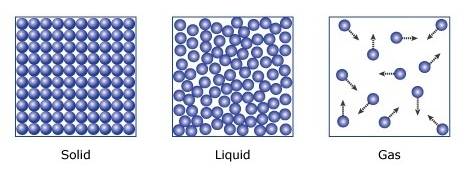
1. In terms of particles, draw the structure of a typical solid, liquid, and gas.
27
2. What is the equation used to calculate density?
Density = mass/volume
r = m/V; you must use the correct symbol for density i.e. rho. If in doubt, quote the word equation.
r = m/V; you must use the correct symbol for density i.e. rho. If in doubt, quote the word equation.
28
3. Describe an experiment to find the density of (a) a regular solid (b) an irregular solid (c) an irregular solid that floats (d) a liquid
(a) Measure the mass of the object using a mass balance. Measure the dimensions of the object (length, breadth, height) using a ruler. Calculate the volume using volume = length x breadth x height. Density = mass/volume
(b) Measure the mass of the object using a mass balance. Fill a Eureka can to the brim, and wait for water to stop dripping from the spout. Position a measuring cylinder beneath the spout. CAREFULLY lower the object into the can, taking care to avoid splashing. Collect the fluid displaced from the spout in a measuring cylinder; the volume of this displaced fluid is the volume of the object. Density = mass/volume
(c) Measure the mass using a mass balance. Prepare a Eureka can as above. Place the object in the can and collect any displaced fluid. Use a mounted needle to JUST submerge the entirely of the object under the level of the water, whilst continuing to collect the displaced liquid. Take care to minimise the amount of the needle that is placed under water. The volume of the displaced fluid is the volume of the object.
(d) Put a measuring cylinder on a mass balance and zero the scales. Add the liquid to the measuring cylinder and record the mass. Record the volume of the liquid in the measuring cylinder. Density = mass/volume.
(b) Measure the mass of the object using a mass balance. Fill a Eureka can to the brim, and wait for water to stop dripping from the spout. Position a measuring cylinder beneath the spout. CAREFULLY lower the object into the can, taking care to avoid splashing. Collect the fluid displaced from the spout in a measuring cylinder; the volume of this displaced fluid is the volume of the object. Density = mass/volume
(c) Measure the mass using a mass balance. Prepare a Eureka can as above. Place the object in the can and collect any displaced fluid. Use a mounted needle to JUST submerge the entirely of the object under the level of the water, whilst continuing to collect the displaced liquid. Take care to minimise the amount of the needle that is placed under water. The volume of the displaced fluid is the volume of the object.
(d) Put a measuring cylinder on a mass balance and zero the scales. Add the liquid to the measuring cylinder and record the mass. Record the volume of the liquid in the measuring cylinder. Density = mass/volume.
29
4. Explain how the density of a solid, liquid, and gas is linked to its structure.
For most substances, the density of a liquid is slightly less than the density of a solid, and the density of a gas is considerably less than that of a liquid. This is because the molecules of a solid are slightly closer together than that of a liquid (i.e. the volume of 1 kg of the liquid is greater than 1 kg of the solid), and the molecules of a gas are very far apart.
30
5. What is the difference between a physical change and a chemical change? Give an example of each.
A physical change can easily be reversed and the material will regain its original properties e.g. ice melting A chemical change cannot easily be reversed e.g. burning coal.
31
6. Explain what happens to the particles of a system if it is heated and its temperature increases. What happens if the system changes state?
When heated, the particles will move faster (and in a solid, will vibrate with a greater amplitude). When the system changes state, the temperature remains constant; the molecular spacing increases with no increase in the speed of the molecules.
32
7. Define the terms "specific heat capacity" and "specific latent heat" (of melting, and of boiling).
Specific heat capacity is the amount of energy required to raise the temperature of 1 kg of a substance by 1ºC. Specific latent heat is the amount of energy required to change the state of 1 kg of a substance at a constant temperature; for melting this would be solid to liquid, for boiling this would be liquid to gas.
33
8. Explain how to calculate the final temperature of two substances at different temperatures that are mixed together.
Assume that the two substances end up at the same final temperature, and that the thermal energy lost by the hot substance = thermal energy gained by the cold substance
34
9. Explain how to calculate the final temperature of two substances at different temperatures mixed together, when one of them changes state (e.g. ice melting, or steam condensing)
Make the same assumptions as above, only remember to account for the energy required to change state as well. For melting and evaporation, energy is absorbed and for freezing and condensing, energy is released. E.g. cold ice added to hot water: Thermal energy lost by hot water = thermal energy gained to heat ice to melting point + thermal energy required to melt ice to cold water + thermal energy gained by this cold water E.g. steam condensing in cold water Thermal energy released by condensing steam + thermal energy released from cooling this hot
water = thermal energy gained by cold water
water = thermal energy gained by cold water
35
10. Explain how to reduce unwanted thermal energy transfers.
Wrap the object/container in an insulating material. For experiments involving liquids, use a lid and ensure your container has a small mass (e.g. polystyrene) to reduce the amount of energy used to heat the container itself.
36
11. Describe an experiment to measure how the temperature of ice varies with time. How can you ensure these results are as reliable as possible?
Add crushed ice to a boiling tube, and insert a thermometer. Add this boiling tube to a beaker of hot water/a water bath at a constant temperature. Measure the temperature of the ice every minute. As the ice begins to melt, ensure regular stirring to mix the melting ice with the melted ice.
37
12. Describe an electrical experiment to determine the specific heat capacity of water. How can you ensure your results are as accurate as possible?
Measure a known mass of water into a polystyrene cup. Fully submerge an immersion heater in this water, and insert a thermometer. Record the initial temperature of the water. Connect the immersion heater to a power supply, switch it on and start a stopwatch. Use a joulemeter to record the energy supplied OR record the current and p.d. using an ammeter and voltmeter. Switch off the heater after 5 minutes, stir the water and wait for the thermometer reading to stop increasing. Record the maximum temperature. If not using a joulemeter, calculate energy supplied using IVt. Specific heat capacity = energy supplied/(mass x temperature change)
38
13. Explain, in terms of particle movement, why a gas exerts a pressure on its container.
Particles move and collide with the container walls, where they change direction. A force was exerted by the container on the molecules to change their direction, so an equal and opposite force was exerted on the wall by the molecules. Pressure = the sum of all of these forces/area of container walls.
39
14. What happens to the velocity of gas molecules as their temperature changes? Hence, explain what will happen to the pressure of a fixed mass of gas at a constant volume if it is heated up.
The velocity of the molecules increases as temperature increases. The pressure of a fixed mass and constant volume of a gas will increase as temperature increases; this is because the molecules collide more frequently with the container walls, and do so with a greater force (as they have more momentum)
40
15. What is meant by "absolute zero"? What is this temperature in °C?
Absolute zero is the temperature at which molecules would not move at all. Absolute zero = -273ºC
41
16. Give the equation used to convert between the Celsius and kelvin temperature scales.
Temperature in kelvin = temperature in degrees Celsius + 273 T(K) = q(ºC) + 273
42
17. What happens to the volume of a gas if the pressure acting on it decreases?
If the pressure decreases, the volume increases (assuming constant mass and temperature)
43
18. Explain why the pressure of a gas will increase if it is compressed to a smaller volume at a constant temperature.
At a smaller volume, the same number of molecules occupies a smaller space. The rate of collisions between the molecules and the container walls will increase, increasing the force exerted on the container walls and thus increasing the pressure.
44
19. Explain, in terms of molecules, why doing work on a gas (e.g. a bike pump) increases its temperature.
When you compress the gas, molecules colliding with the piston rebound from it with a greater speed; faster molecules mean the temperature has increased.