3.3.3 HALOGENOALKANES AAA MECHANISMS
Study these flashcardsFree · spaced repetition · iPhone, Android, Mac & web
All cards
1
How are halogenoalkane formed
Alkanes reacts with halides in presence of UV light
2
Whats a free radical
An atom with an unpaired electron
3
Whats 1st step of free radical substitution
Initiation: UV light breaks covalent bond between halogens
CL2 →2CL•
CL2 →2CL•
4
2nd and 3rd step of free radical substitution?
Propagation:
1)Cl free radical reacts and takes a hydrogen from an alkane.
CL• + CH4 → HCL + •CH3
2)Methyl free radical reacts with Cl2 and takes a Cl.
•CH3 + CL2 → CH3CL + CL•
These are chain reactions
1)Cl free radical reacts and takes a hydrogen from an alkane.
CL• + CH4 → HCL + •CH3
2)Methyl free radical reacts with Cl2 and takes a Cl.
•CH3 + CL2 → CH3CL + CL•
These are chain reactions
5
Whats last step?
Termination:
Free radicals react together to form stable molecule
Can be Two halogens
1 halogen and 1 hydrocarbon
Can be two hydrocarbons
Free radicals react together to form stable molecule
Can be Two halogens
1 halogen and 1 hydrocarbon
Can be two hydrocarbons
6
Whats the issue with free radical substitution?
Produces LOTS of side products
7
why is our ozone layer important?
Protects us from UV light by absorbing a large amount of it
8
How was the ozone layer once depleting?
Chlorofluorocarbons(CFC) from fridges/freezers
9
How did CFC deplete ozone layer
1)UV light breaks C-CL bond in CFCs forming CL•
Propagation occurs
2)CL• reacts with 03 to form CLO• + O2
3) The CLO• reacts with O3 forming another Cl• + 2O2
These are chain reactions
Propagation occurs
2)CL• reacts with 03 to form CLO• + O2
3) The CLO• reacts with O3 forming another Cl• + 2O2
These are chain reactions
10
What are nucleophiles and electrophiles?
N -species with a lone pair. An electron pair donor
E - An electron deficient species. Electron pair acceptor
E - An electron deficient species. Electron pair acceptor
11
whats general mechanism of nucleophillic substitution?
1)Nucleophile gives lone pair to C
2)Lone pair between C and halide goes to halide
3)Nucleophile forms a bond with C and halide leaves
2)Lone pair between C and halide goes to halide
3)Nucleophile forms a bond with C and halide leaves
12
Halogenoalkanes undergo substitution by what compounds?
OH- CN NH3
13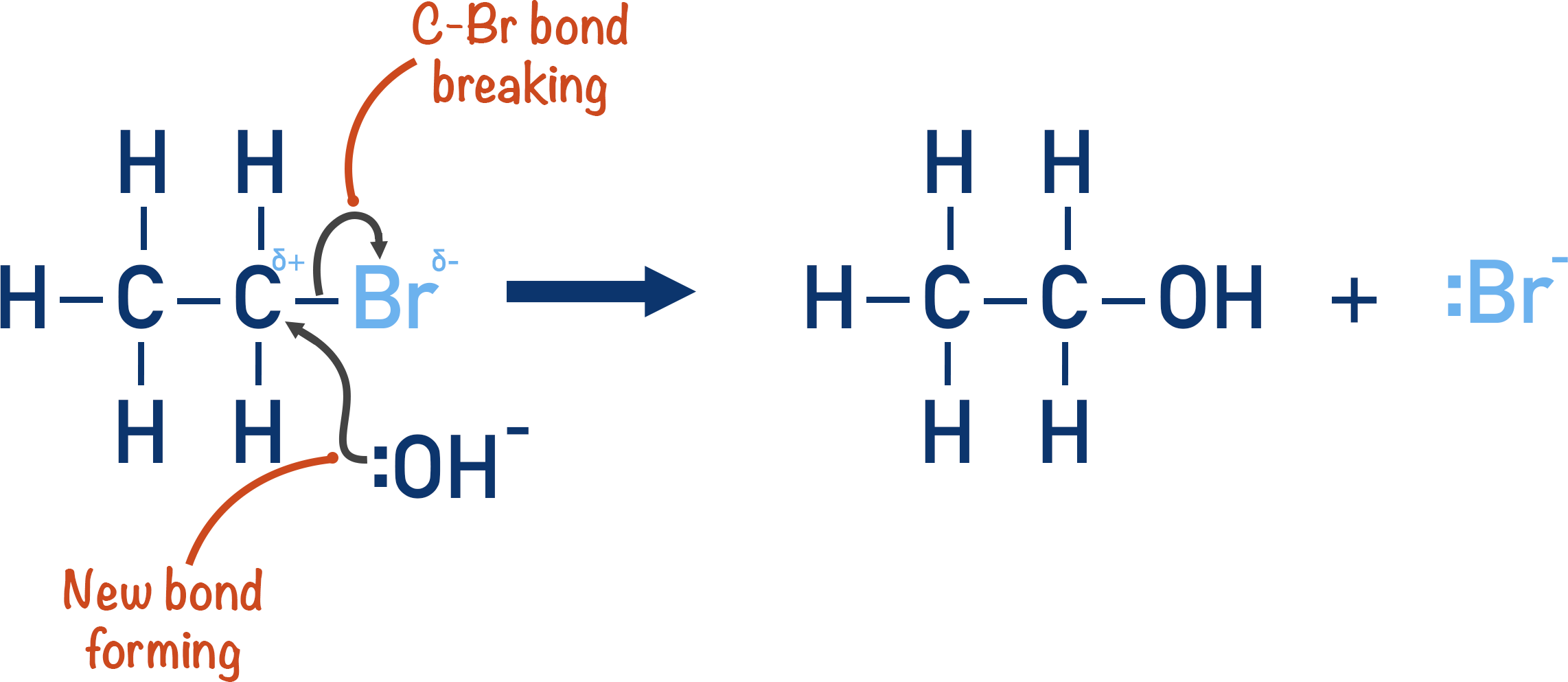
Show mechanism of halogenoalkane + OH-
14
What are the products and conditions of OH-
Reagents = Sodium/potassium hydroxide
conditions = heat under REFLUX in aq solution
products = alcohol + halide ion(forms salt later)
conditions = heat under REFLUX in aq solution
products = alcohol + halide ion(forms salt later)
15
show mechanism of halogenoalkane with CN-
used to add a carbon to a chain
16
what are products and conditions of CN-
Reagents = Sodium/potassium cyanide
conditions = heat under reflux in ethanolic solution
products = Nitrile + halide ion(forms salt later)
conditions = heat under reflux in ethanolic solution
products = Nitrile + halide ion(forms salt later)
17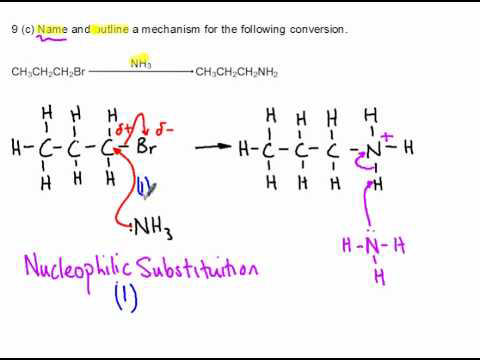
Show mechanism of halogenoalkane with NH3
18
What are products and conditions of NH3
reagents = excess ammonia
conditions = heat it in concentrated solution of ammonia in ethanol in sealed container(increases pressure)
product = amine
conditions = heat it in concentrated solution of ammonia in ethanol in sealed container(increases pressure)
product = amine
19
What's an elimination reaction?
Two groups are removed from adjacent C atoms, forming an alkene
20
whats a base?
proton accepter
21
Elimination reaction with OH-
OH acts as a proton accepter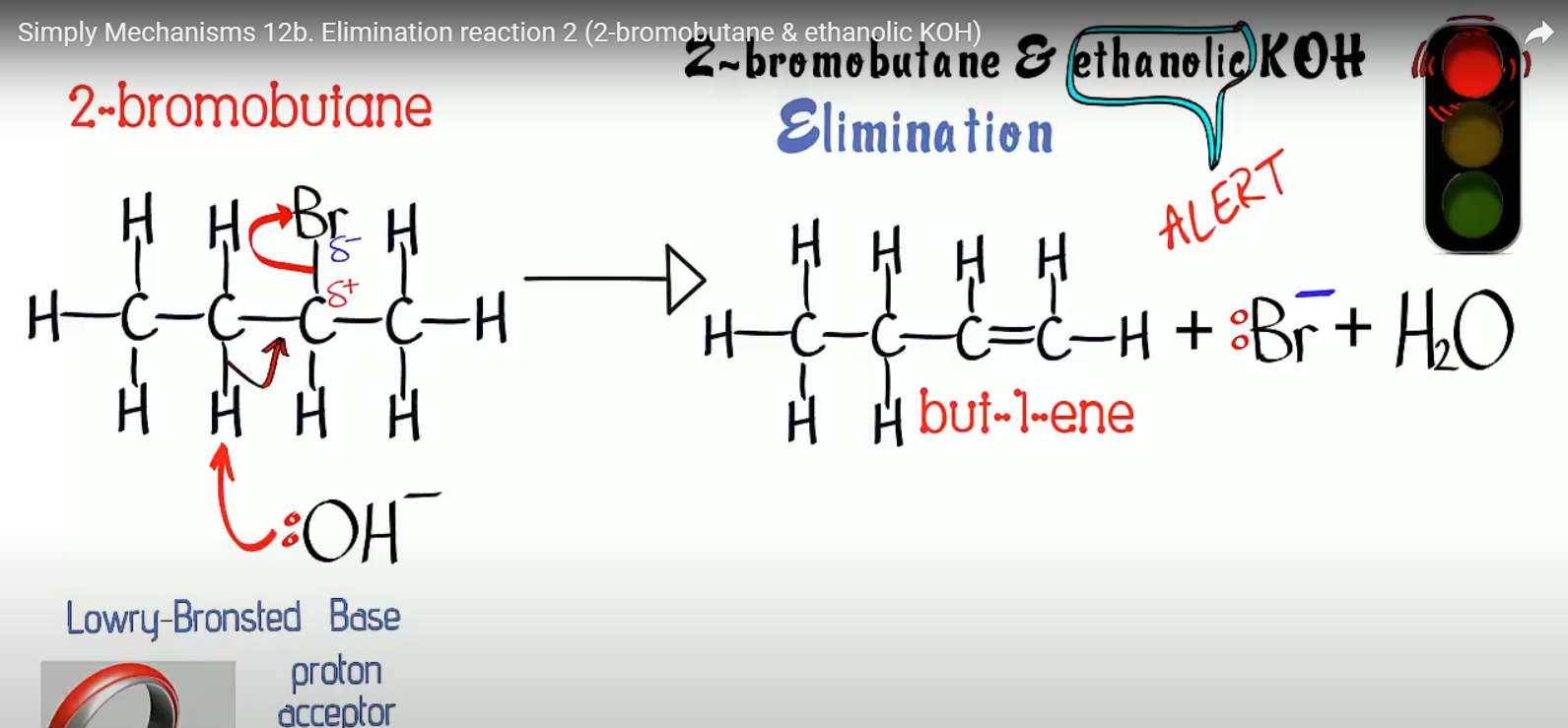
22
Can structural isomers of alkenes be formed from it?
Yes
23
Can E-Z isomerism form?
Yes one of the isomers will have E-Z
24
Do you add a double bond symbol in structural formulas
Yes
25
Conditions of eleimination reaction in haloalkanes
Reagents = concentrated sodium/potassium hydroxide in ethanol
Conditions: heat under reflux
Product = alkene
Conditions: heat under reflux
Product = alkene
26
What favours elimination reactions?
Tertiary haloalkanes
If secondary:
Ethanol as solvent
High temp
Concentrated Na/KOH
If secondary:
Ethanol as solvent
High temp
Concentrated Na/KOH
27
what favours substitution?
Primary haloalkane
If secondary:
Lower temp
Water as solvent
Dilute Na/KOH
If secondary:
Lower temp
Water as solvent
Dilute Na/KOH