1.4.1 DATA TYPES
Study these flashcardsFree · spaced repetition · iPhone, Android, Mac & web
All cards
1
Sign and magnitude?
The most significant bit becomes a sign bit
0 = positive
1 = negative
0 = positive
1 = negative
2
Twos complement system
MSB represents negative value
3
How to convert positive to negative value in Twos complement?
Flip bits and then add 1
4
why sign and magnitude not good?
Multiple representatives of 0
Hard to do calculations on
Hard to do calculations on
5
How to do subtraction using Twos complement
Flip the number you will subtract , add one to it and then add it to the first number
6
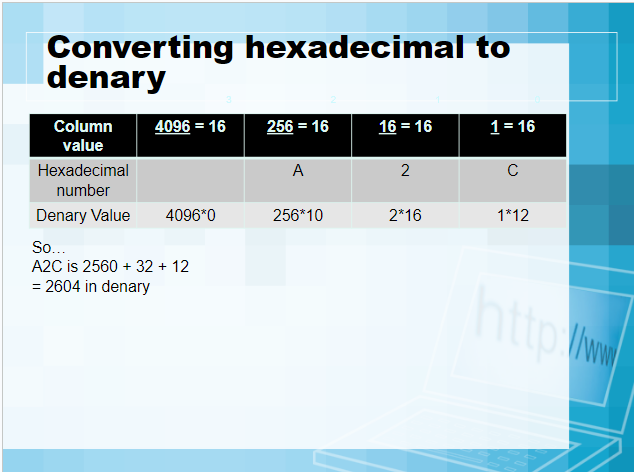
converting hexadecimal to denary (unique way)
times the hex value by 16 exponential from right to left starting with 1.
7
How to convert denary to hexadecimal new methood
Divide number by 16 until 0 and read remainders up
https://docs.google.com/presentation/d/1rShJaQFi0kzi_cL-FwIFAzLrwqbLdzUzljnwqJK1eTA/edit#slide=id.p52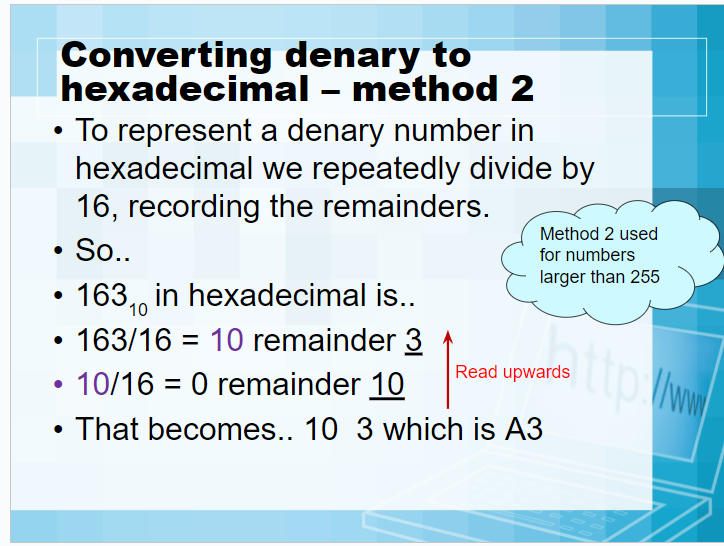
https://docs.google.com/presentation/d/1rShJaQFi0kzi_cL-FwIFAzLrwqbLdzUzljnwqJK1eTA/edit#slide=id.p52
8
ways to show fraction numbers
fixed and floating point
9
Exponent and mantissa?
Mantissa - number itself
Exponent - position of binary point
Exponent - position of binary point
10
Positive/negative exponent?
P - move to right
N - move to left
If value is positive backfill with 0 and the opposite for negative
N - move to left
If value is positive backfill with 0 and the opposite for negative
11
How to turn binary to mantissa and exponent format normallisation
1)Float the point between the first 10 or 01.
2)Count how many hops that was. Do opposite for exponent
3)Place the num into the mantissa amt of bits
2)Count how many hops that was. Do opposite for exponent
3)Place the num into the mantissa amt of bits
12
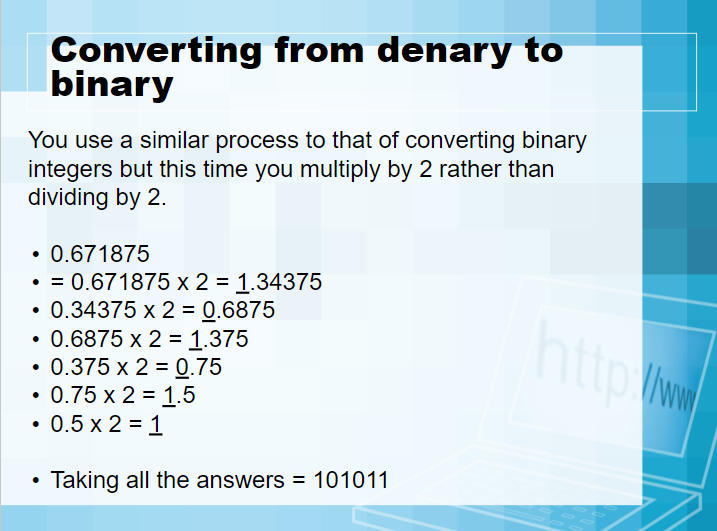
how to convert denary decimals to binary
1)Times num by 2
2)Repeat but use the num after point
3)Stop when reach 1
4)Read first num downwards
2)Repeat but use the num after point
3)Stop when reach 1
4)Read first num downwards
13
how to add/minus floating point numbers
1)Work out where point supposed to be using exponent
2)Line them up so floating points are at same point
3)Do the usual adding/subtracting.
2)Line them up so floating points are at same point
3)Do the usual adding/subtracting.
14
What do one left / right logical shifts do
Divides/times it by 2
15
What are the different MASKS?
AND: lets anything through if 1 and blocks if 0
OR: the opposite to AND
XOR: toggles if 1
OR: the opposite to AND
XOR: toggles if 1
16
whats a character set
collection of alphanumeric characters and etc that a computers recognise and output via a binary number
17
how to ASCII and unicode work
letters and etc represented by a binary number