3.19 RATE EQUATIONS
Study these flashcardsFree · spaced repetition · iPhone, Android, Mac & web
All cards
1
ROR equation?
Change in concentration/time
2
What affects ROR?
Surface area
Temperature
Concentration(pressure if gas)
Catalyst
Temperature
Concentration(pressure if gas)
Catalyst
3
What is order of reaction?
Number that tells you how concentration of a reactant affects the reaction rate
4
Rate equation?
Gives mathematical link between concentration of reactants to ROR
Rate(ROR) = k [A]$^m$[B]$^n$
Rate(ROR) = k [A]$^m$[B]$^n$
5
How to find order in a reaction for a reactant
Carry multiple experiments with reactant in different concentration with other reactants in excess and calculate initial rate(gradient)
Then plot a graph with rate against reactant concentration and find order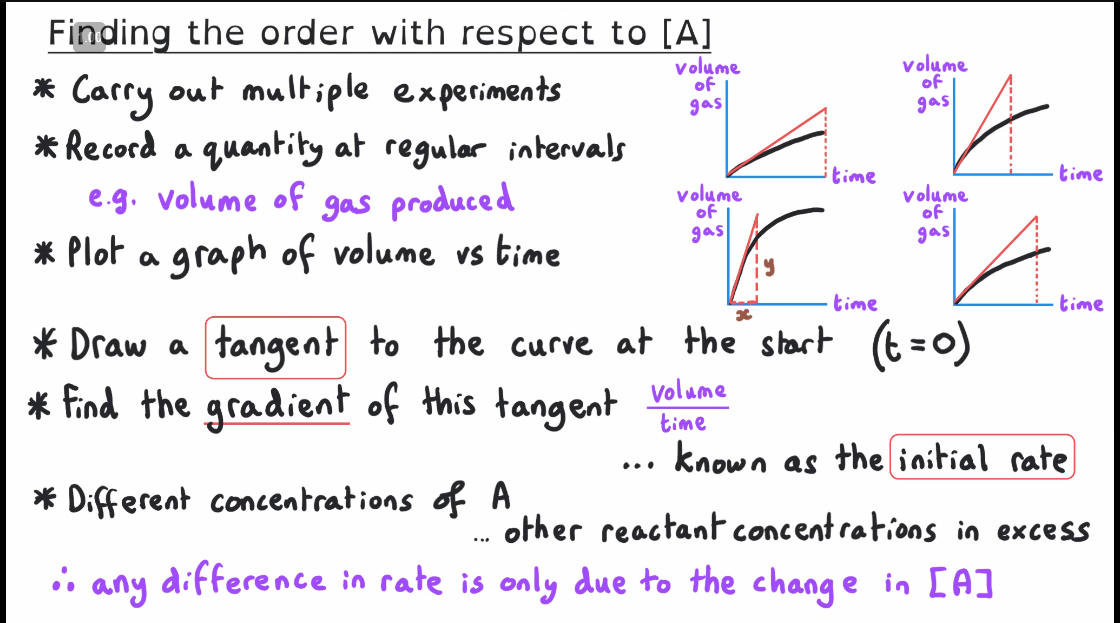
Then plot a graph with rate against reactant concentration and find order
6
Different orders number?
0 = no change EG if concentration x2 = rate x 2$^0$
1 = directly proportional EG if concentration x2 = rate x 2$^1$
2 = x$^2$ EG if concentration x2 = rate x 2$^2$
1 = directly proportional EG if concentration x2 = rate x 2$^1$
2 = x$^2$ EG if concentration x2 = rate x 2$^2$
7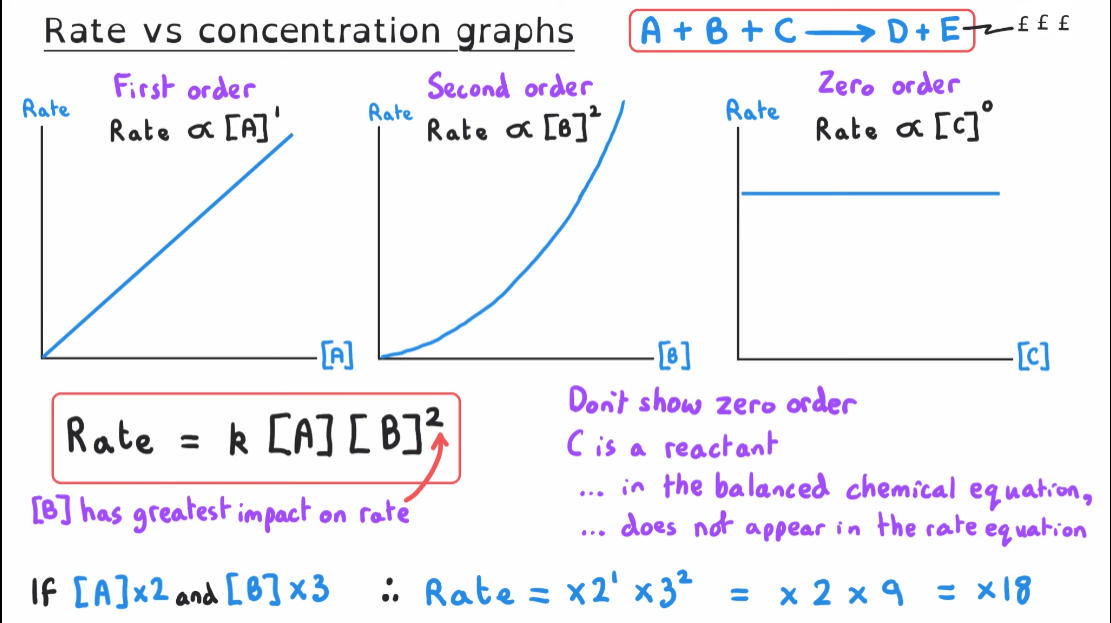
Different order graphs?
8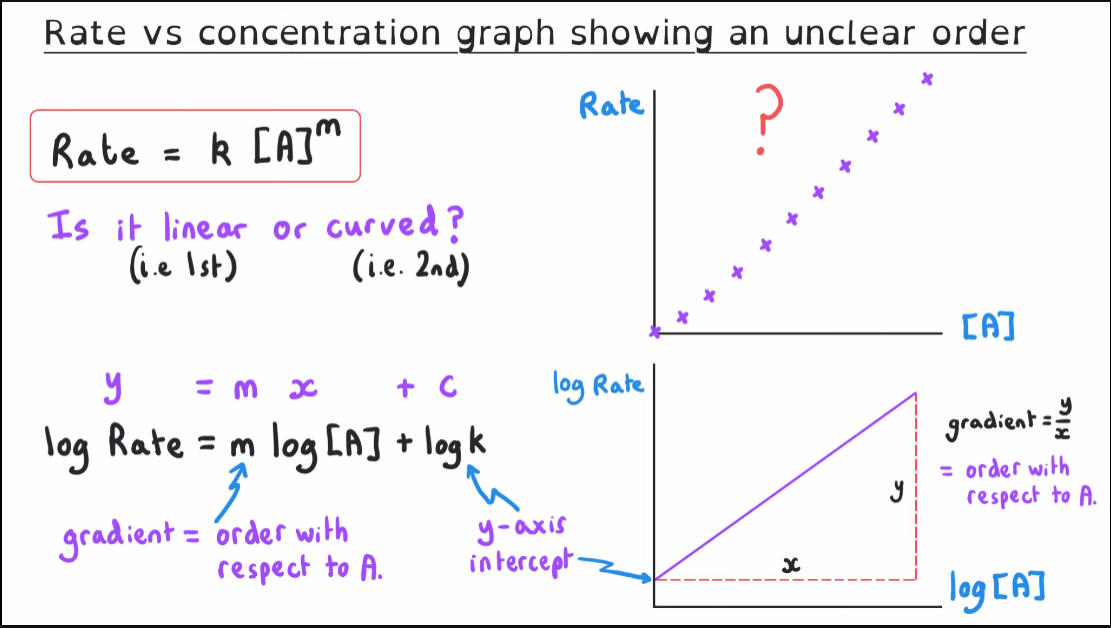
What if order graph is unclear
9
Overall order?
Sum of all order numbers of reactants
10
catalyst?
Increase ROR without being used so doesnt appear in chemical equations but DOES in rate equation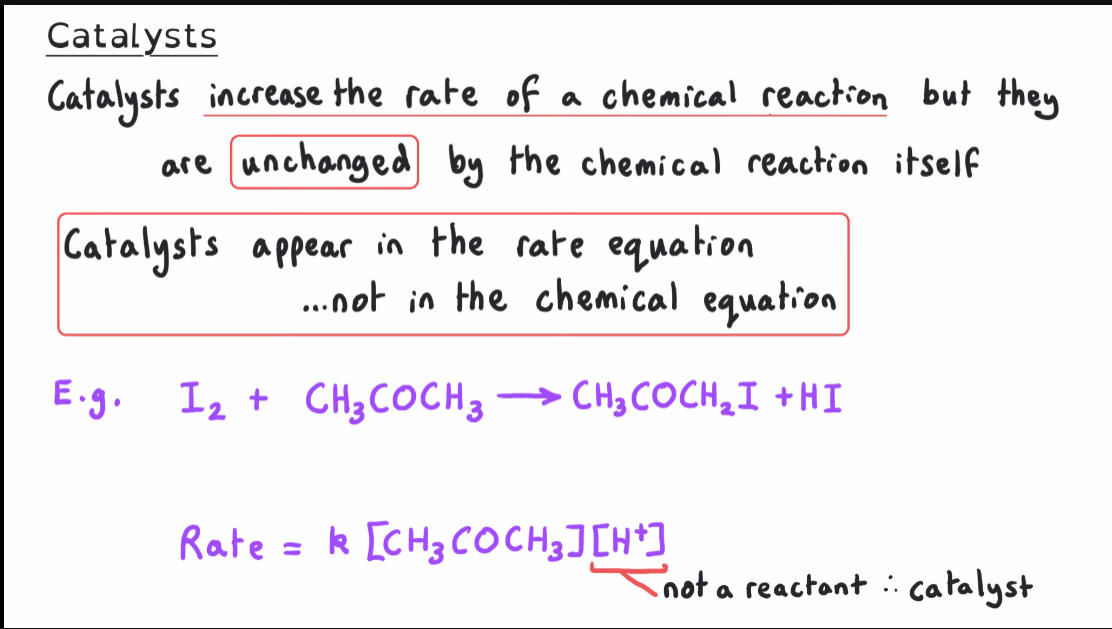
11
What if a reactant is MUCH excess than other reactant
its concentration will change little so it can be considered constant so unlikely to change ROR so we give zero order to it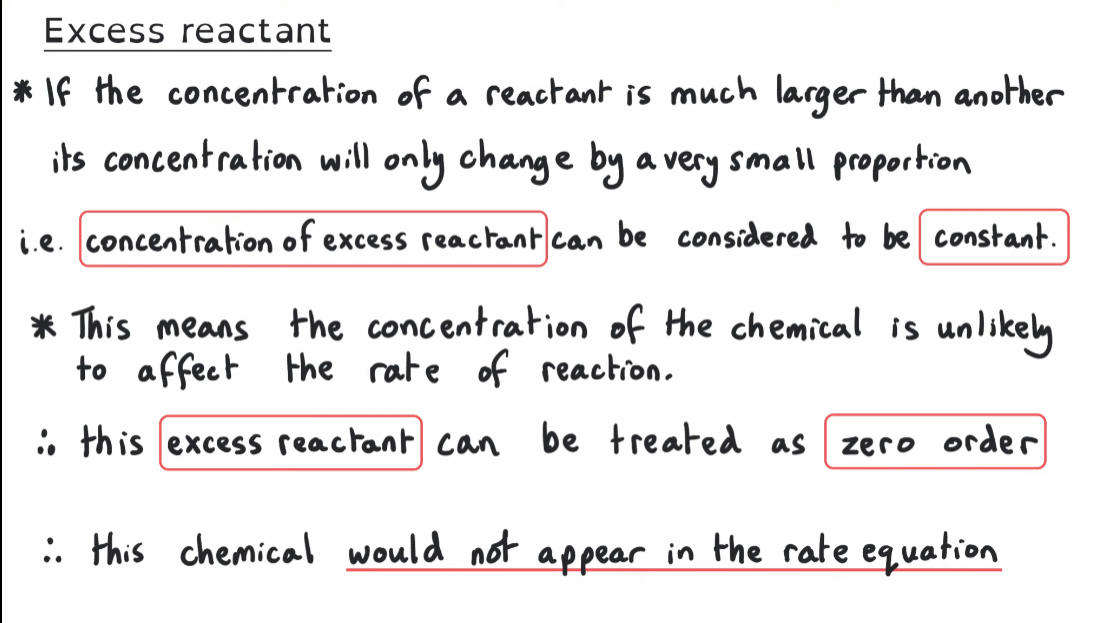
12
Conc vs time graph : Zero order
rate = k[A]$^0$ but you remove A since 0 so rate = k constant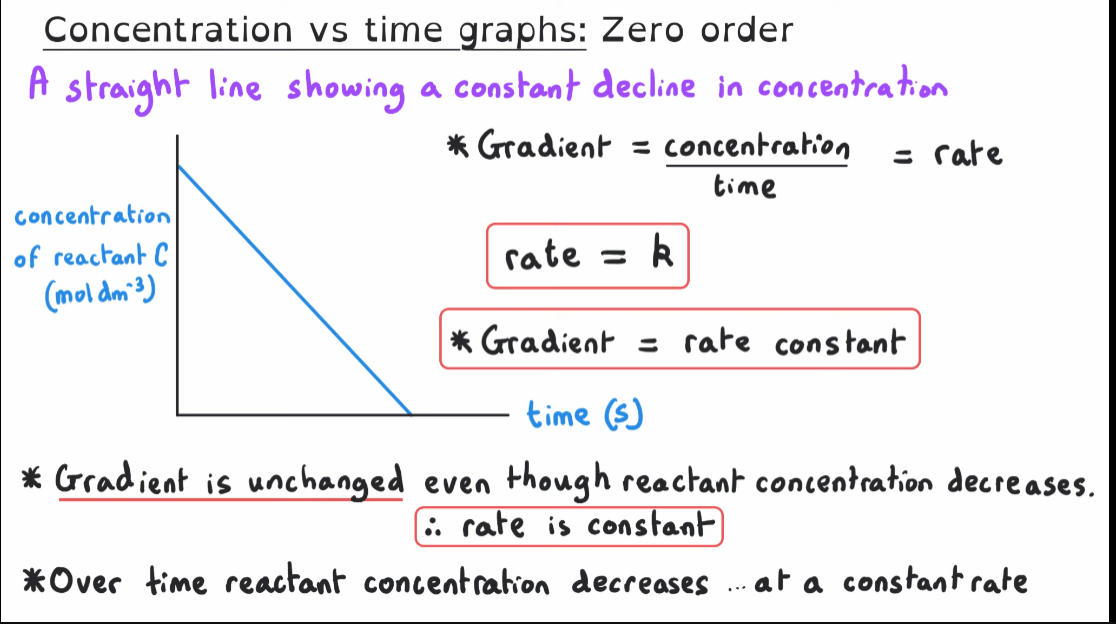
13
Conc vs time graph : First order
constant half life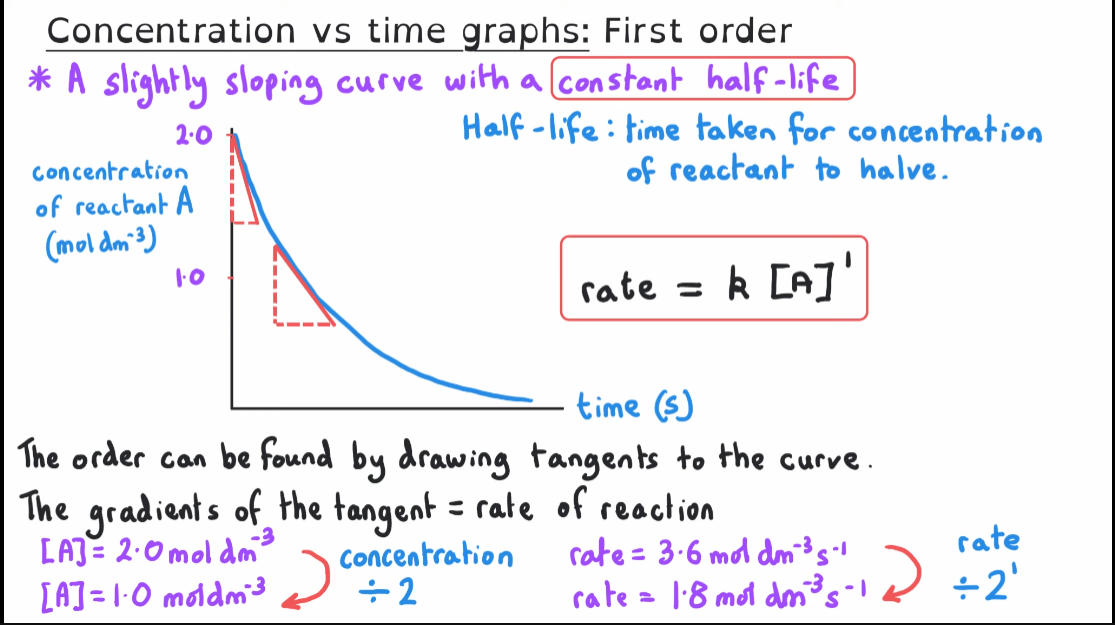
14
Conc vs time graph : 2nd order
Increasing half life
Calculate order via finding conc and rate(gradient) at two points and compare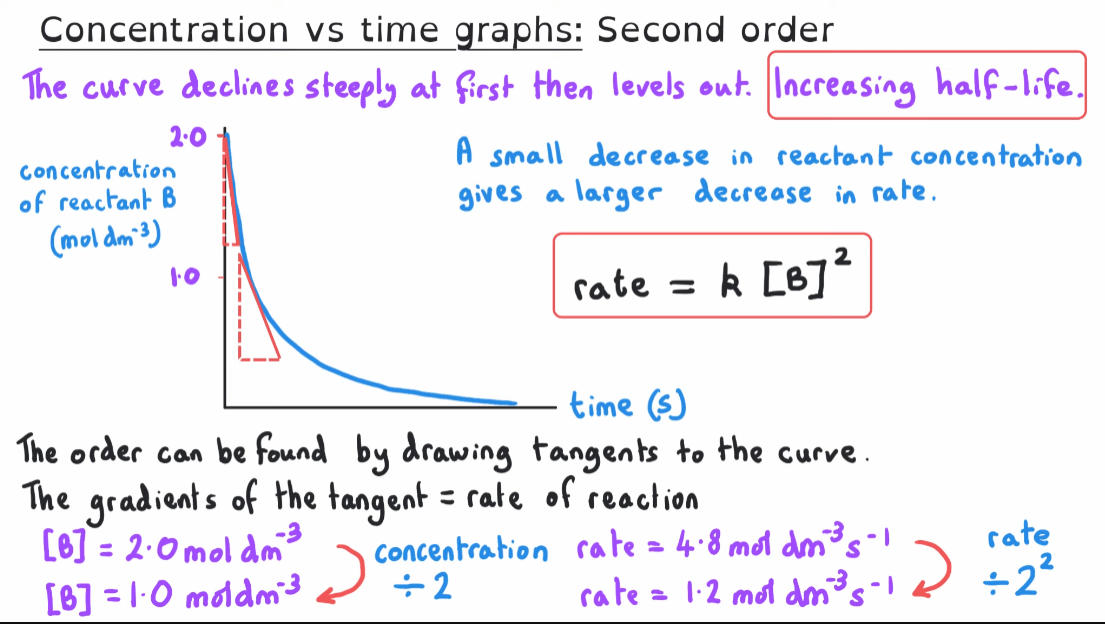
Calculate order via finding conc and rate(gradient) at two points and compare
15
Rate constant?
Links ROR with concentration of reactants
Increases with temperature exponentially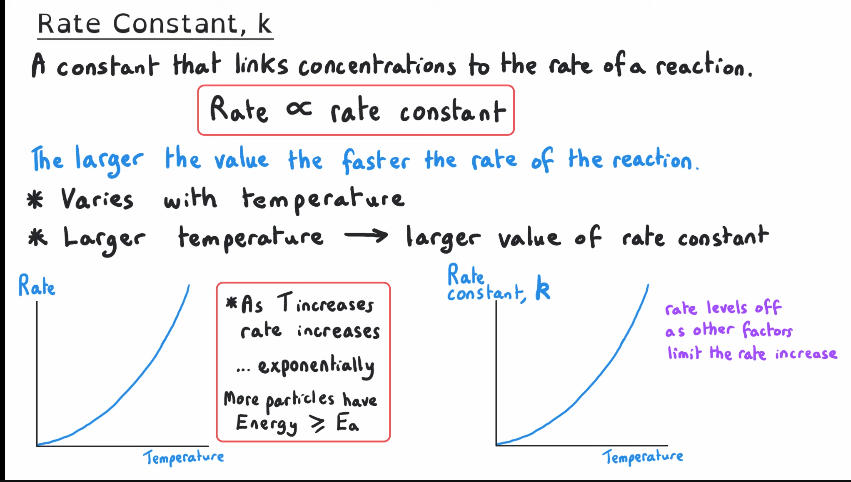
Increases with temperature exponentially
16
How to calculate k and its units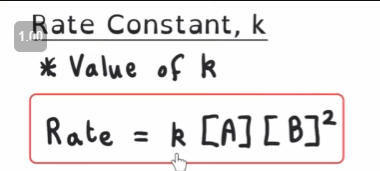
Re-arrange equation for k
rate units = mol dm$^{-3}$ s$^{-1}$
concentratio units = mol dm$^{-3}$
Cancel anything on top and bottom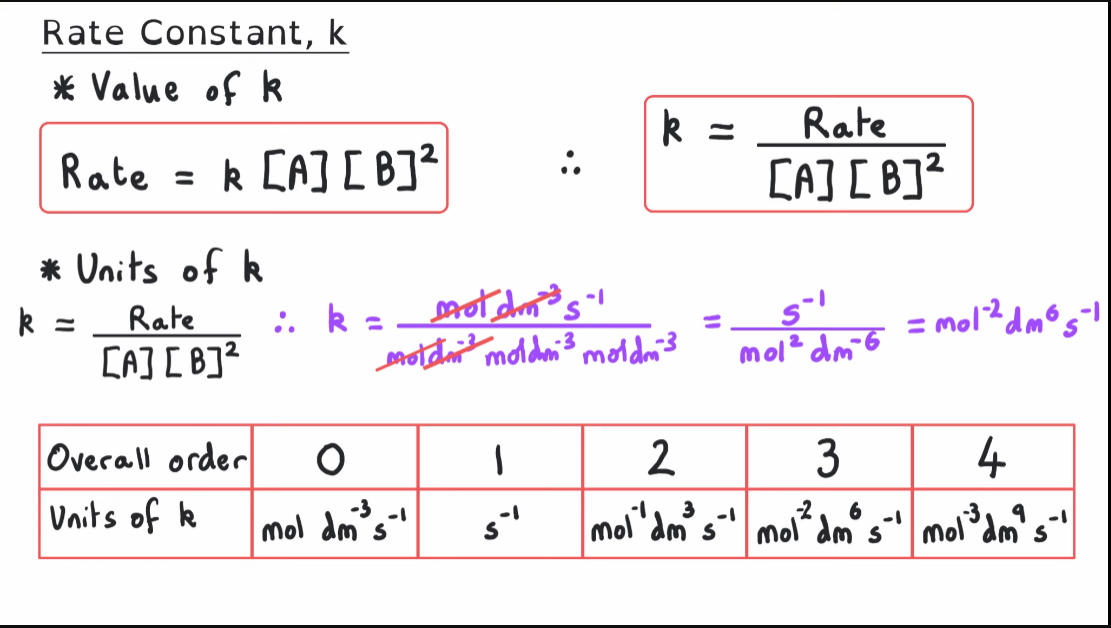
rate units = mol dm$^{-3}$ s$^{-1}$
concentratio units = mol dm$^{-3}$
Cancel anything on top and bottom
17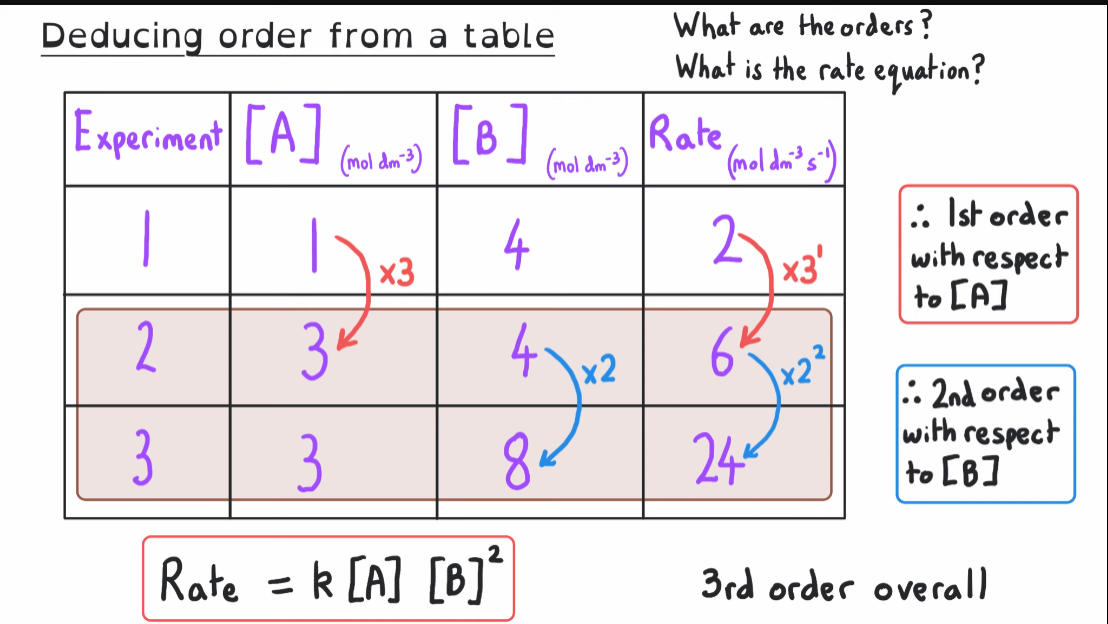
Deducing order from table
18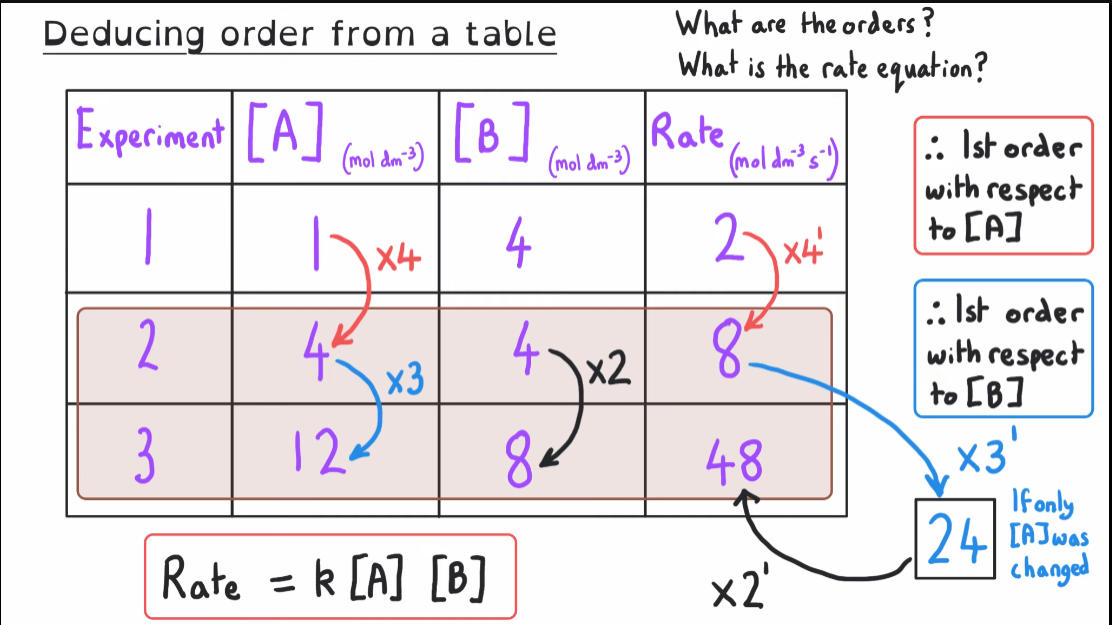
Deducing order from table WHEN you cant find one where other reactant doesnt change
19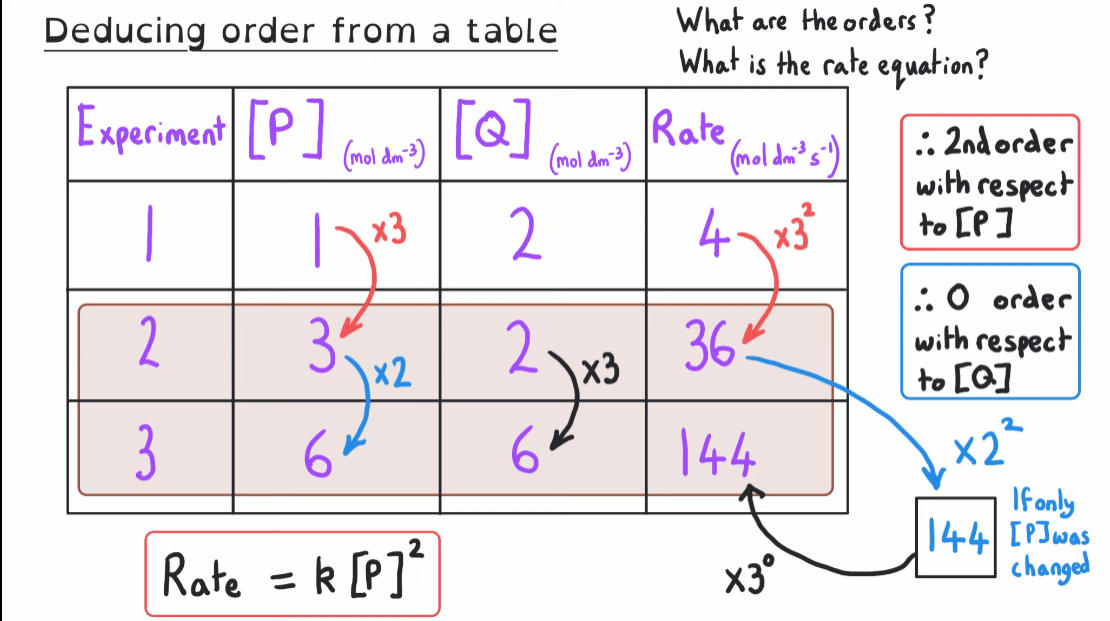
Do this 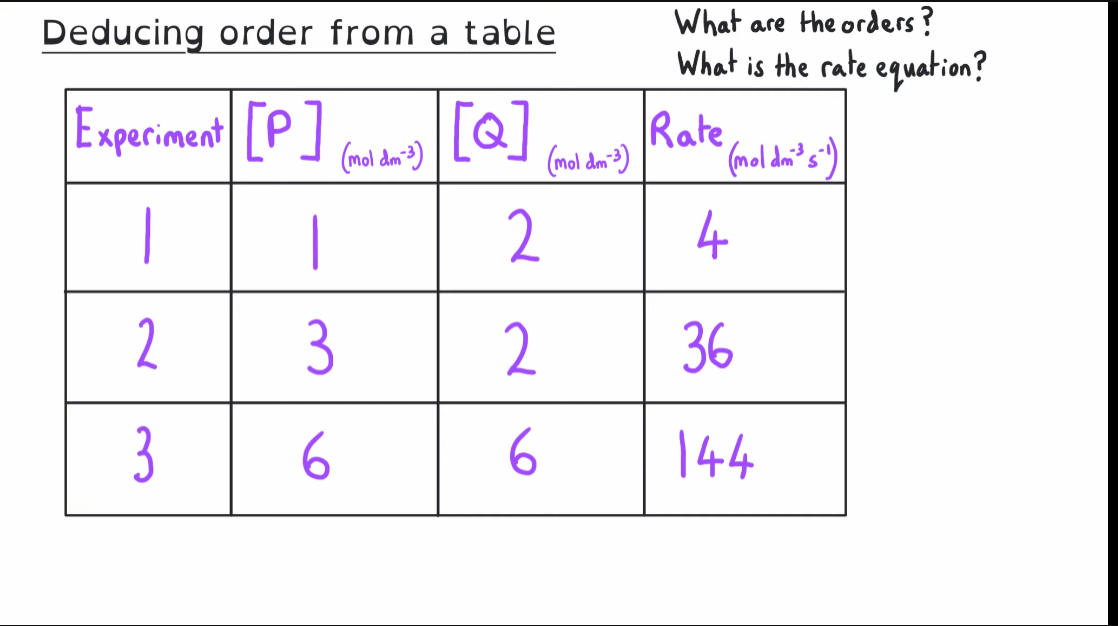
20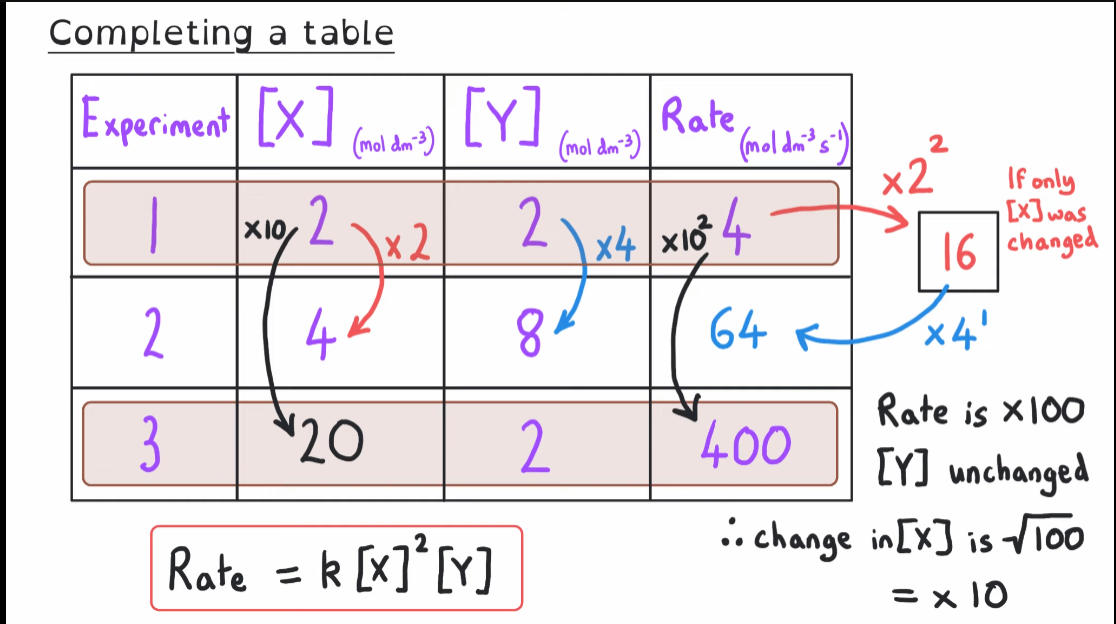
do this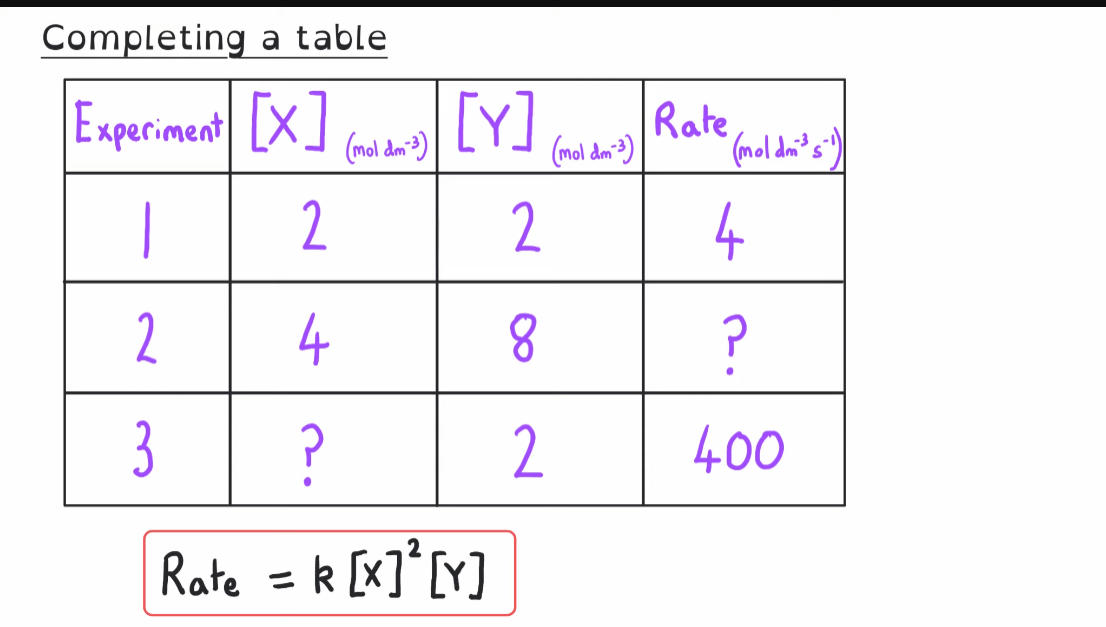
21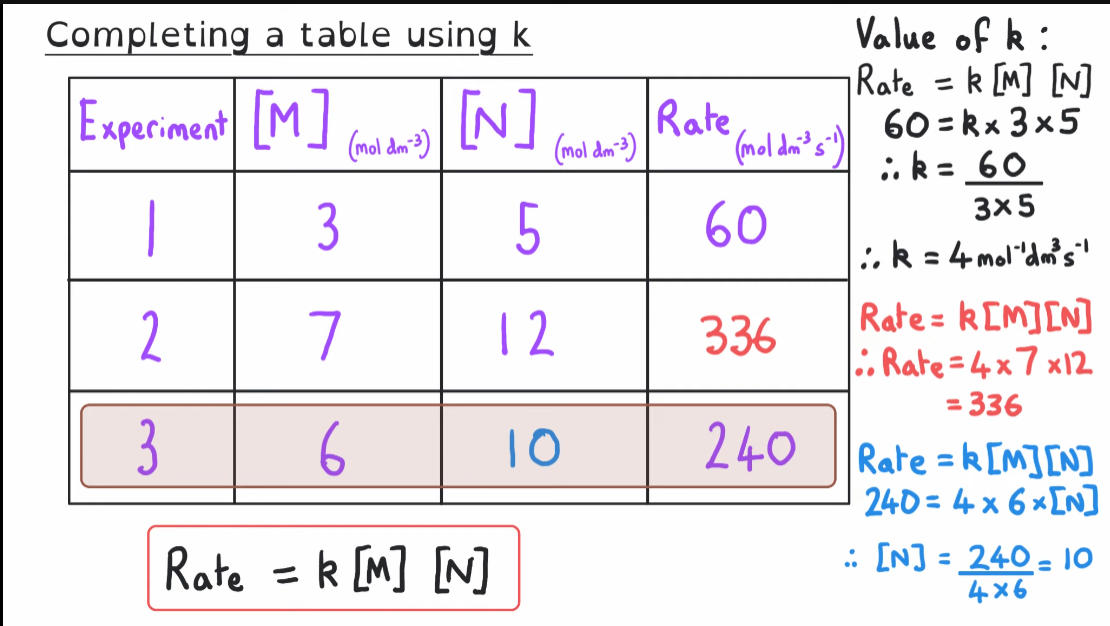
do trhis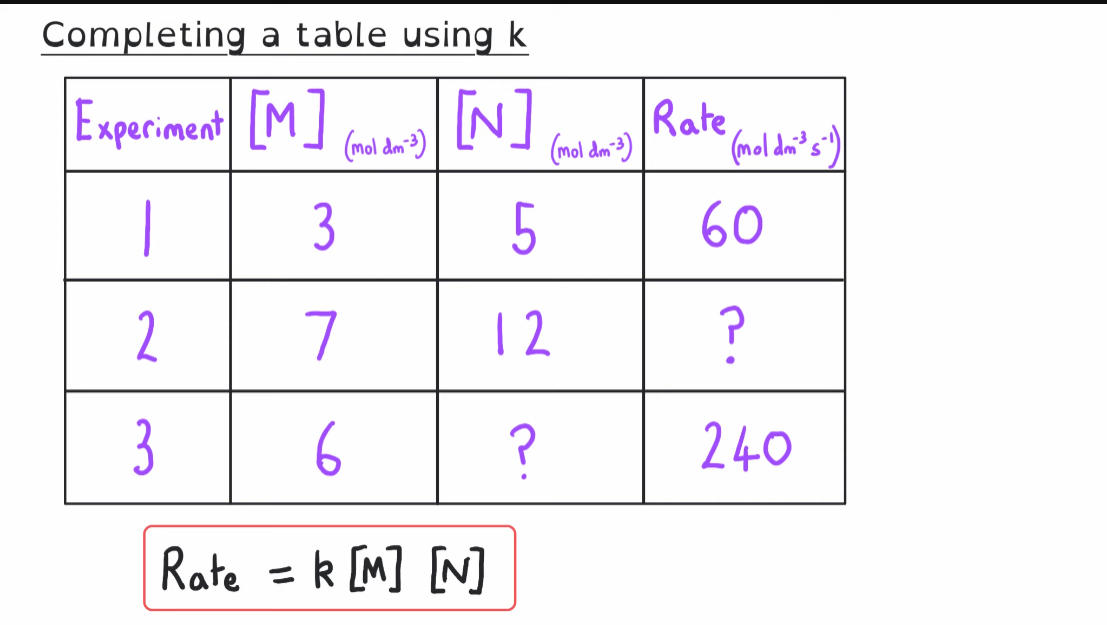
22
Rate determining step?
Its the slowest step in a reaction which takes multiple steps to do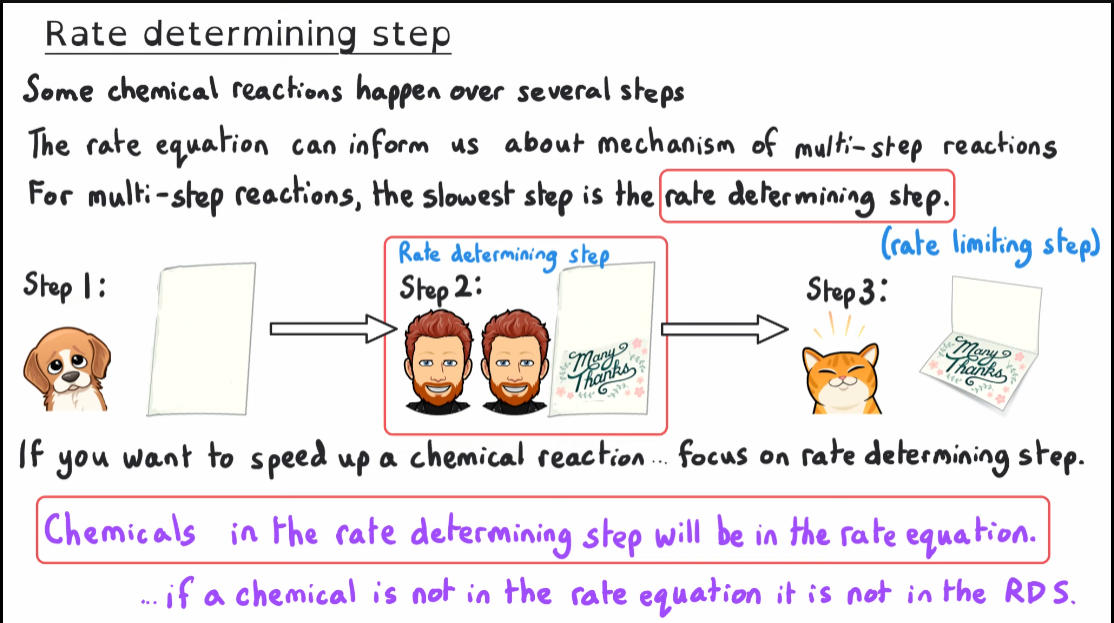
23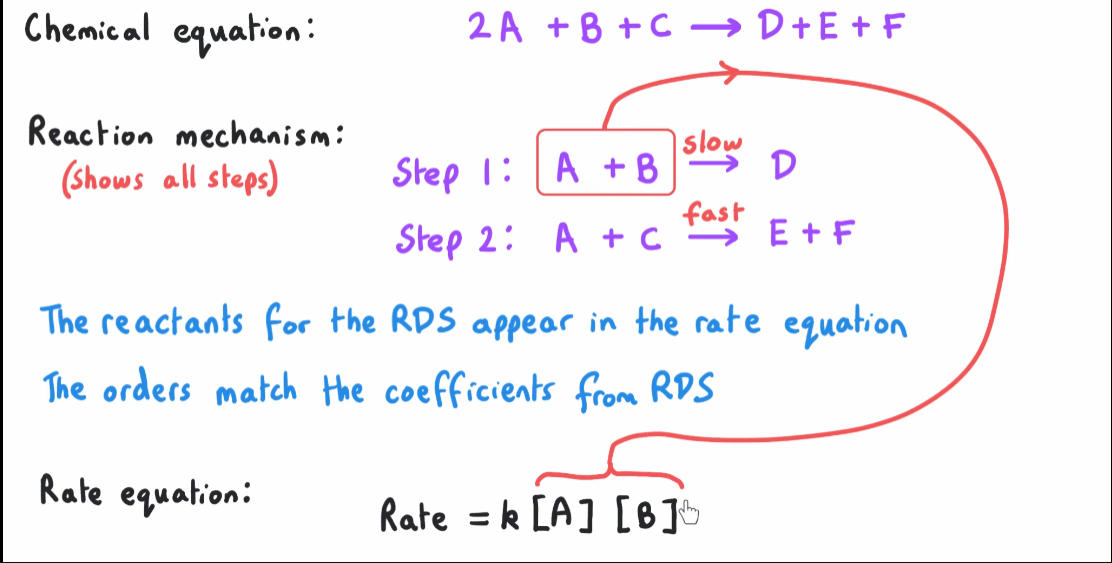
Do this. Determine the rate determining steps and calculate rate equation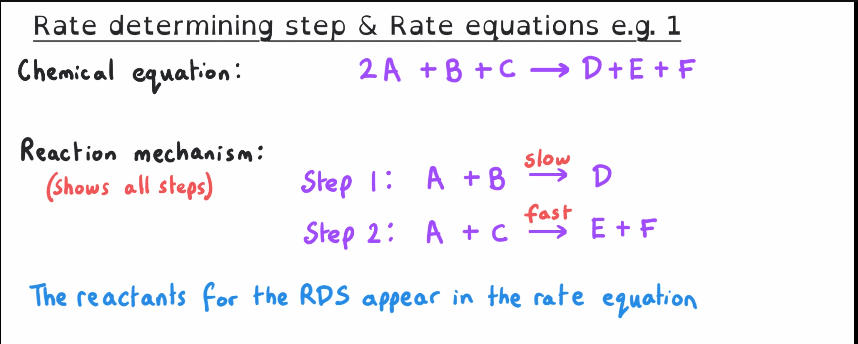
24
Do this. Determine the rate determining steps and calculate rate equation 2nd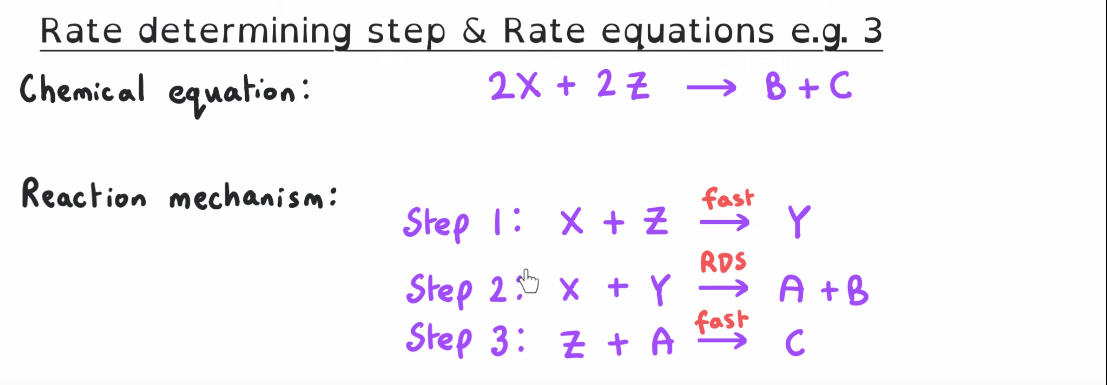
y is created but then used up so you dont include it (since its hard to calculate its concentration) but instead include the things that created it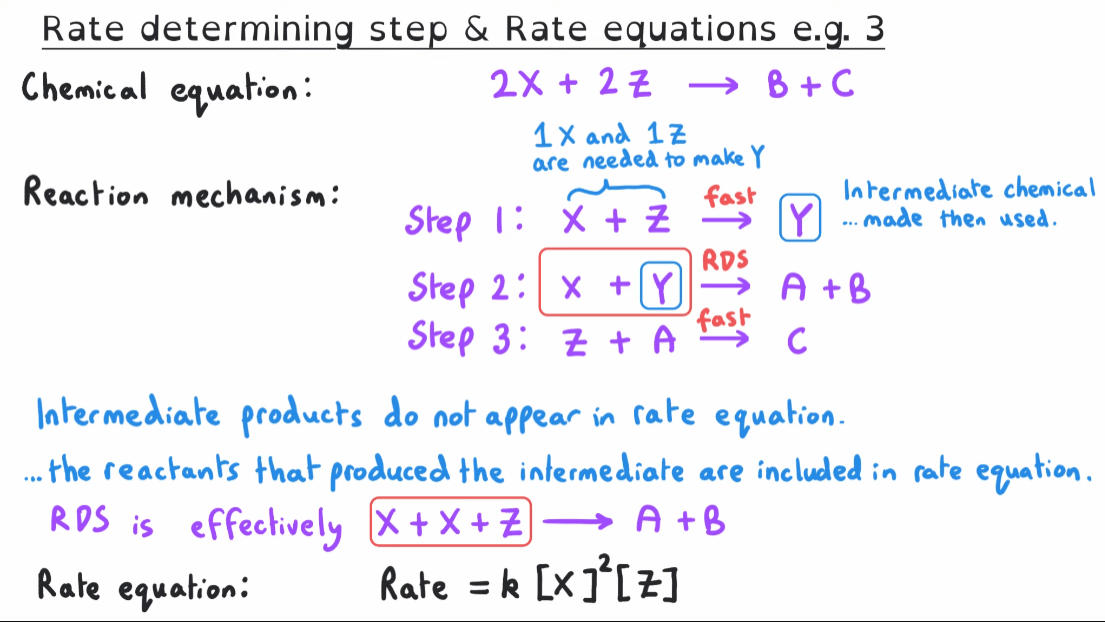
25
Explain 1) and 2)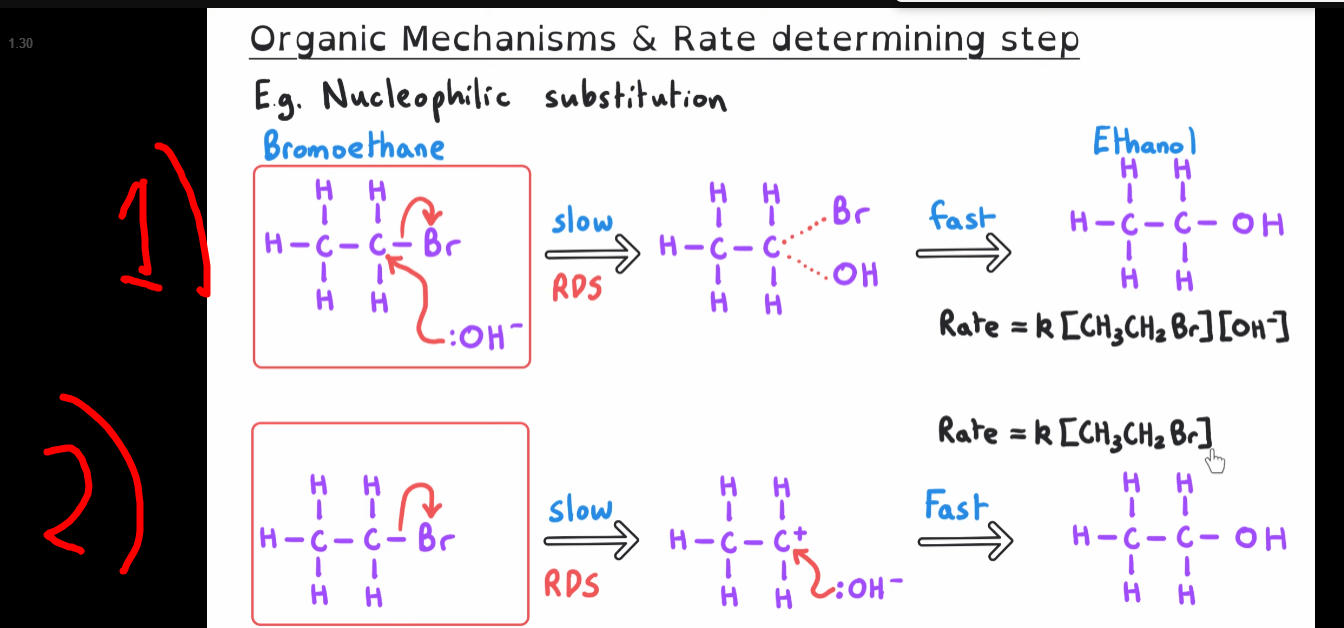
1) OH- immediately attacks C this is slow and leads to formation of intermediate where OH- has partially bonded to C while Br has partially broken which is then followed up fast step of it fully breaking bond and forming bond.
Since both OH and haloalkane are part of rate determining step equation is Rate = k[CH3CH2Br][OH-]
2) First Br breaks bond with C forming carbocation then in part 2 OH- attacks carbon and forms bond.
Since only haloalkane is part of rate determining step equation is Rate = k[CH3CH2Br]
Since both OH and haloalkane are part of rate determining step equation is Rate = k[CH3CH2Br][OH-]
2) First Br breaks bond with C forming carbocation then in part 2 OH- attacks carbon and forms bond.
Since only haloalkane is part of rate determining step equation is Rate = k[CH3CH2Br]
26
What is 1) and 2) referred as?
1) $S_{N}$ 2
2) $S_{N}$ 1
Primary haloalkanes tend to undergo $S_{N}$ 2 while tertiary $S_{N}$ 1
2) $S_{N}$ 1
Primary haloalkanes tend to undergo $S_{N}$ 2 while tertiary $S_{N}$ 1
27
Arrhenous equation
K = Ae$^{-Ea/RT}$
K = rate constant
A = pre-exponential factor constant(arrhenius constant) ( mol$^{-1}$dm$^{3}$ s$^{-1}$ )
Ea = Activation energy (J mol$^{-1}$)
R = constant gas (8.314 J mol)
T = temperature (kelvin)
K = rate constant
A = pre-exponential factor constant(arrhenius constant) ( mol$^{-1}$dm$^{3}$ s$^{-1}$ )
Ea = Activation energy (J mol$^{-1}$)
R = constant gas (8.314 J mol)
T = temperature (kelvin)
28
How to make arrhenous equation easier to use?
take natural log of both removing the e part
Turns K = Ae$^{-Ea/RT}$
INTO InK = InA - Ea/RT
Turns K = Ae$^{-Ea/RT}$
INTO InK = InA - Ea/RT
29
Calculate activation energy
Rearrange for ea by first adding Ea/RT to both sides making it go left side then subtract InK then multiply RT 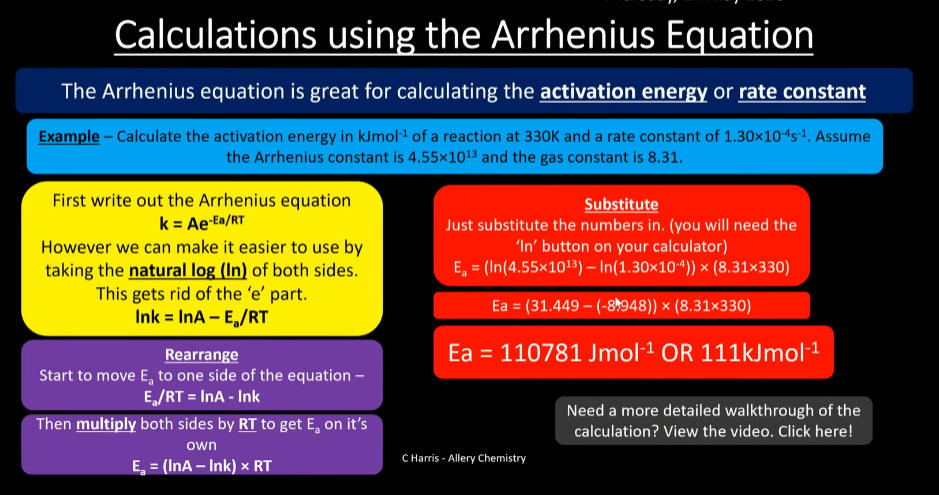
30
When using InK =InA -Ea/RT to plot a graph of InK against 1/T and then draw line of best fit. What equals gradient?
-Ea/R
31
Calculate activation energy via arrhenous plot 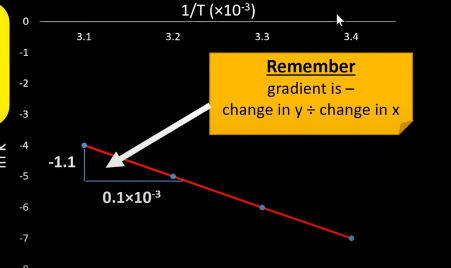
R = 8.31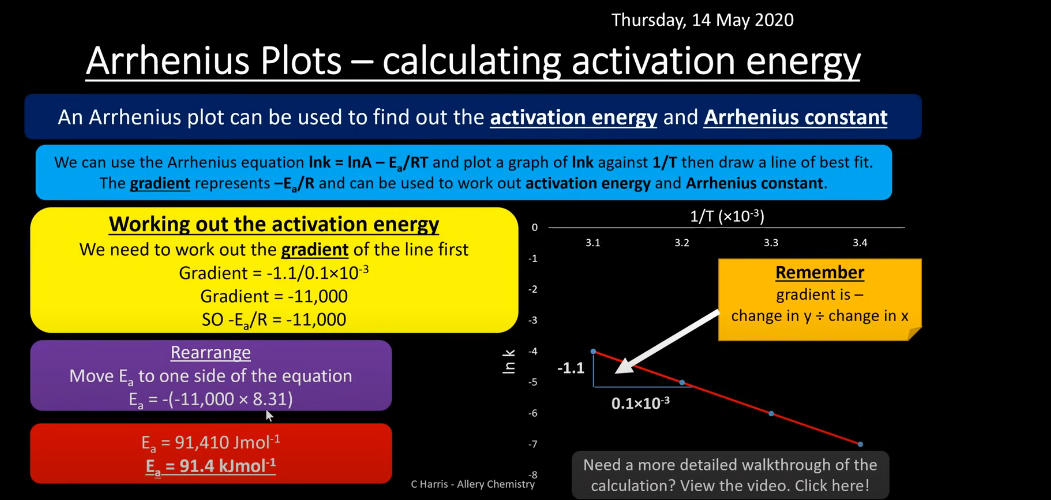
32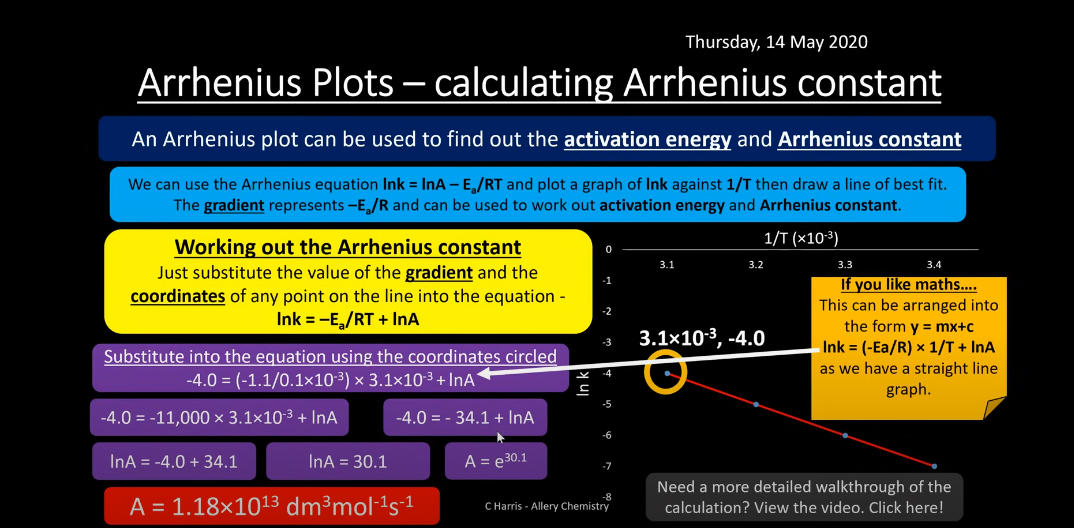
Calculate arrhenius constant.
-ea / r = -1.1/0.1x 10 -3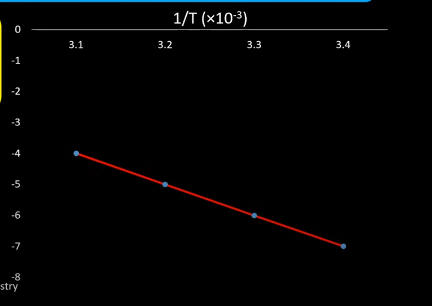
-ea / r = -1.1/0.1x 10 -3