1.2.1 System software
Study these flashcardsFree · spaced repetition · iPhone, Android, Mac & web
All cards
1
what does operating system do?
Controls hardware and software of a computer system and provides UI
2
Need of OS?
Provides UI
Utility programs
Memory/ resource management
Device drivers
User Security
File management
Interupts
Multitasking
Utility programs
Memory/ resource management
Device drivers
User Security
File management
Interupts
Multitasking
3
Multi tasking?
When multiple programs are ran at the same time via cpu allocating a small amt of time to each process and cycling between them rapidly
4
WIMP?
Windows
Icons
Menus
Pointers
Optomised for mouse gesture input for user interface
Icons
Menus
Pointers
Optomised for mouse gesture input for user interface
5
Types of memory management?
Paging
Segmentation
Segmentation
6
Paging?
Pages are fixed in sized and are made to fit sections of memory.
They are physical divisions and programs are split to fit into pages and paging doesnt take into account of how it splits it.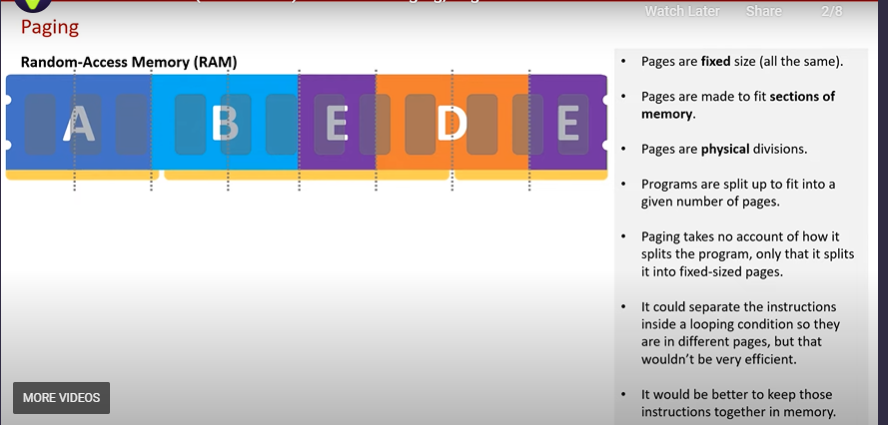
They are physical divisions and programs are split to fit into pages and paging doesnt take into account of how it splits it.
7
Segmentation?
Segments are different sized and are complete sections of programs
Segments are logical divisions
If there isnt enough space in one area but there is in total for a program, it splits it logically and places them in both segments while leaving some free space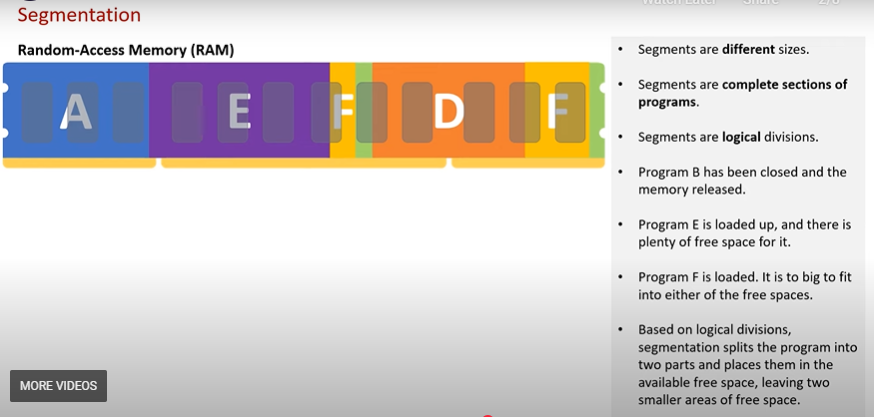
Segments are logical divisions
If there isnt enough space in one area but there is in total for a program, it splits it logically and places them in both segments while leaving some free space
8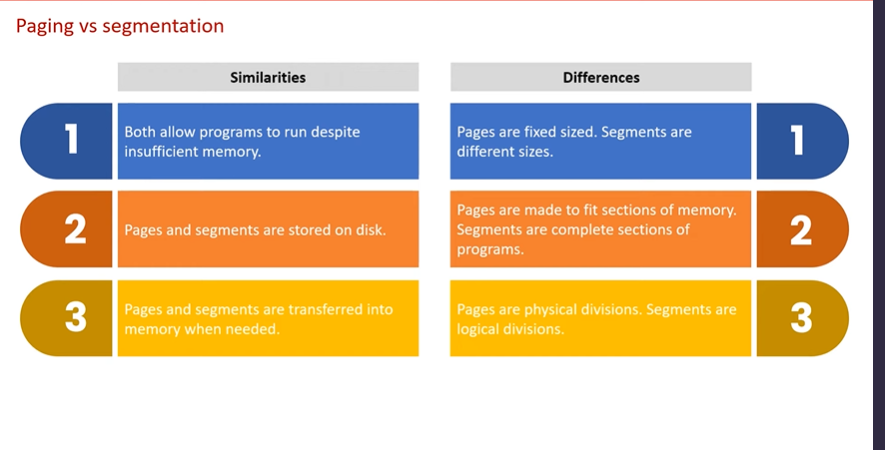
similarities and differences of them
9
Virtual memory?
Section of secondary storage used to store running inactive programs.
10
Interrupt?
When different hardware/devices require the processors attention and halts current instruction
11
Interrupt service routine?
A program with a set of instruction that need to be FDE'd to carry operations of interrupt
12
What happends when a interrupt is received?
Values in registers are copied/pushed onto a stack in a stack frame, saving it.
Once interrupt is complete the frame is popped and all values are retrieved and sent back to their registers
Once interrupt is complete the frame is popped and all values are retrieved and sent back to their registers
13
What if an higher authority interrupt is received
The values in register for the lower authority interrupt are pushed as a stack frame on top of the other stack frame.
14
Whats a sheduler?
Manages which processes to execute next and amt of time it can be processed for b4 being suspended
15
General simple steps of scheduler?
1)Process A enters ready queue and as its the first on queue moves into running state
2)It will either finish executing or get blocked as it needs input/output commands or run out of time in which it is sent back to the back of queue.
There are multiple algorithsm to help manage this.
2)It will either finish executing or get blocked as it needs input/output commands or run out of time in which it is sent back to the back of queue.
There are multiple algorithsm to help manage this.
16
First come first serve
queue processes are executed in order they arrived.
Time taken is irrelevant and if one takes too long other processes have to wait.
Time taken is irrelevant and if one takes too long other processes have to wait.
17
Shortest job first?
The processes which requre the least time are executed first and orders them via shortest time first.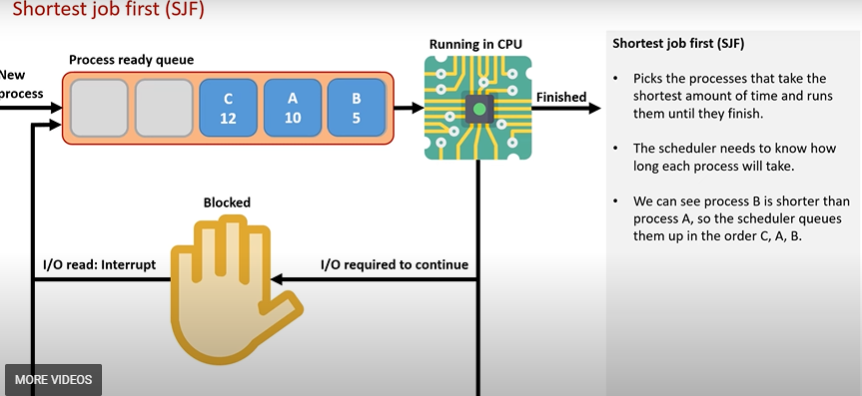
18
Round robin?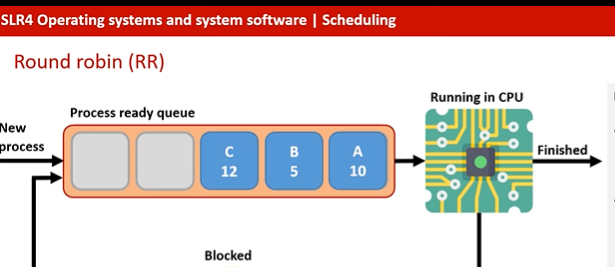
Each process is allocated a time slice and if process is not completed by end of time slice it is sent to the back of queue. 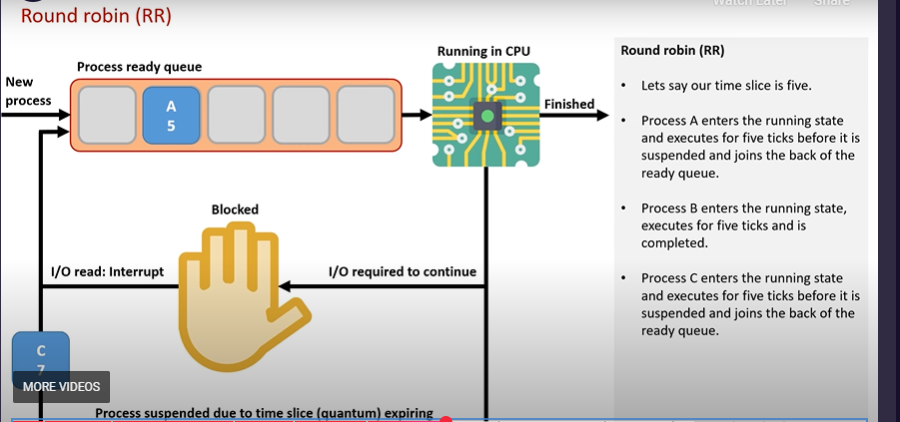
19
Shortest remaining time?
Similar to shortest job but its a pre-emptive algorithm meaning a process can be suspended midway if a shorter process job joins queue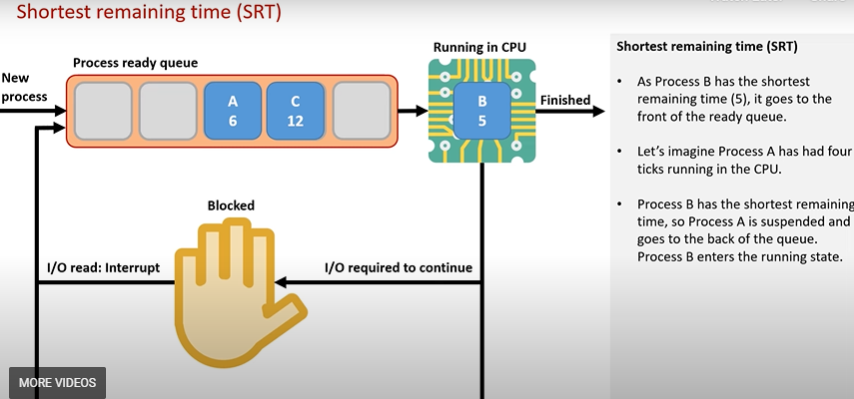
20
Process blocking?
process A enters running state but while it is run it requires data from secondary storage and this is a slow component compared to CPU so process is blocked and another process B can be run.
While process B is run process A receives its data and produces an interrupt to enter ready queue
While process B is run process A receives its data and produces an interrupt to enter ready queue
21
Multi-level feedback queues(MLFQ)
Multiple ready queues are used which can use different scheduling algorithms.
Processes can move between queues as their priorities changes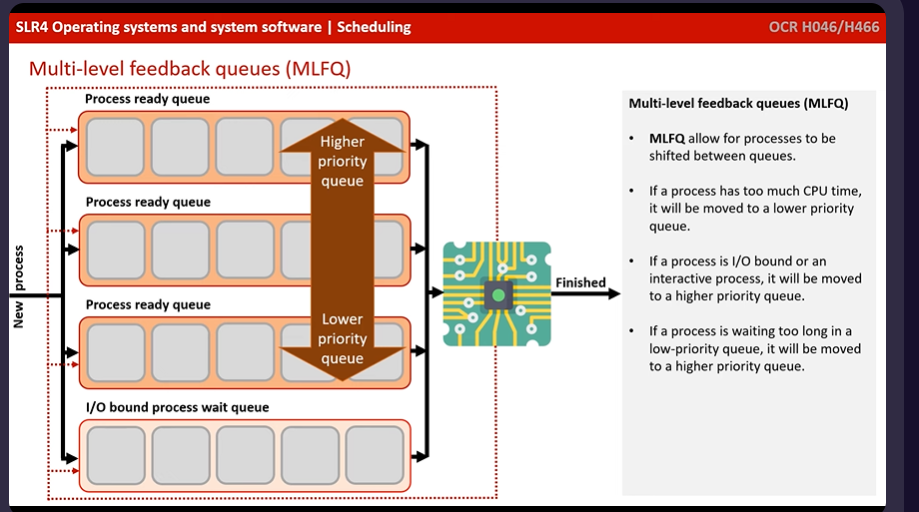
Processes can move between queues as their priorities changes
22
Types of operating systems:
Multi-tasking
Multi-user
Embedeed
Distributed
Real time
Multi-user
Embedeed
Distributed
Real time
23
Multi user?
PC manages the users permissions and access right when they log in
24
Destributed?
OS controls and co ordinates multiple computers power presenting them to user as if its one pc
25
Embedded?
OS runs on dedicated hardware so runs with max efficiency and use little memory.
Specialised for the particular task theyre designed for
Specialised for the particular task theyre designed for
26
Real time
Processes are guaranteed to execute within a short time frame
Lots of redundancy is built into so systems can handle sudden increase inputs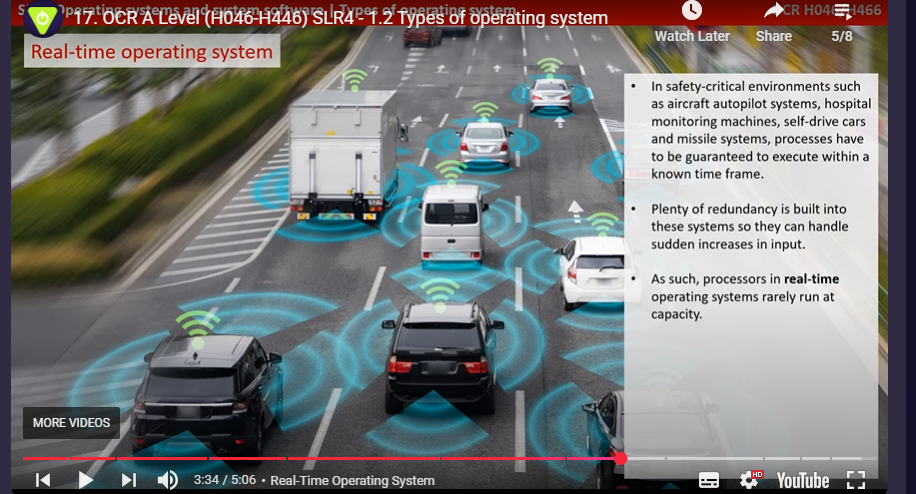
Lots of redundancy is built into so systems can handle sudden increase inputs
27
What does BIOS stand for
Basic input/output system
28
Where is BIOS stored in and responsbile for?
ROM and is responsible for loading OS when it first turns on and checks if hardware it needs is connected(POST)
BUT BIOS SETTINGS STORED IN FLASH MEMORY
BUT BIOS SETTINGS STORED IN FLASH MEMORY
29
Device driver?
Software which tells OS how to communicate with a device.
Translates OS instructions into series of instructions which device understand
Translates OS instructions into series of instructions which device understand
30
Virtual machine?
A program that has same functionality as a physical computer
Mirrors a computers hardware
Mirrors a computers hardware
31
Server virtual machines?
Can be used to support a large number of virtual servers over small number of physical servers
If one server fails other servers picks up those loads
If one server fails other servers picks up those loads
32
Intermediate code?
Eg java compiles code into a half way code known as the intermediate code
This is then translated by a Java Virtual machine running on device.
This makes the code very portable.
This is then translated by a Java Virtual machine running on device.
This makes the code very portable.