3.6.2 Neurone co ordination
Study these flashcardsFree · spaced repetition · iPhone, Android, Mac & web
All cards
1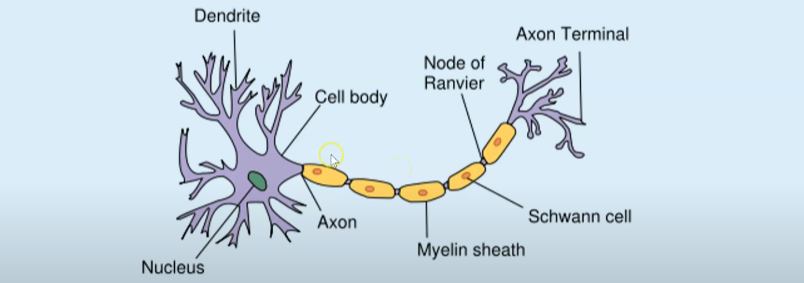
Image occlusion: name the hidden labels
2
Image occlusion: name the hidden labels
3
Image occlusion: name the hidden labels
4
Image occlusion: name the hidden labels
5
Image occlusion: name the hidden labels
6
Image occlusion: name the hidden labels
7
Image occlusion: name the hidden labels
8
Image occlusion: name the hidden labels
9
WHat is resting potential
-When outside axon is more positive than inside making inside have a -ve potential (around -65mV)
-Not sending nerve impulse and axon said to be polarised
-Not sending nerve impulse and axon said to be polarised
10
how resting potential is established/maintained
1)There are sodium potassium pumps(co-transport) which 3 Na+ ions move out and 2 K+ ions move in
2)Na+ ions and K+ ions diffuse naturally in and out
3)But more potassium gates are opened compared to sodium gates so more K+ ions diffuse out while less Na+ ions can go in
This maintains the electro gradient making the inside be more negative than outside
2)Na+ ions and K+ ions diffuse naturally in and out
3)But more potassium gates are opened compared to sodium gates so more K+ ions diffuse out while less Na+ ions can go in
This maintains the electro gradient making the inside be more negative than outside
11
whats action potential
when a stimulus of sufficient size is detected and its energy causes the reversal of resting potential
12
what happeneds during AP
1)Energy of a stimulus causes Na voltage gate channels to open
2)Due to the electrochemical gradient Na ions diffuse in triggering a reversal in potential difference
3)As Na ions diffuse in more Na channels open
4)Once AP of +40mV is established Na+ voltage gates close and some voltage K+ channels open
5)K + ions now diffusing out cause more channels to open
6)The outward diffusion of K+ ions cause a temporary overshoot making the inside more negative than usual
7)Closable K+ ion gates close and Na/K pump causes RP to re-establish
2)Due to the electrochemical gradient Na ions diffuse in triggering a reversal in potential difference
3)As Na ions diffuse in more Na channels open
4)Once AP of +40mV is established Na+ voltage gates close and some voltage K+ channels open
5)K + ions now diffusing out cause more channels to open
6)The outward diffusion of K+ ions cause a temporary overshoot making the inside more negative than usual
7)Closable K+ ion gates close and Na/K pump causes RP to re-establish
13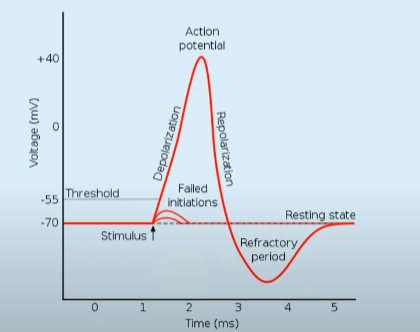
Image occlusion: name the hidden labels
14
Image occlusion: name the hidden labels
15
Image occlusion: name the hidden labels
16
Image occlusion: name the hidden labels
17
Image occlusion: name the hidden labels
18
All or nothing principal?
If stimulus doesnt reach a certain threshhold, AP is not form
All successful stimuli produce the same AP strength
The larger the stimulus, the higher the AP frequency
All successful stimuli produce the same AP strength
The larger the stimulus, the higher the AP frequency
19
What is refractory period?
Whem membrane can't be stimulated and produce a AP at that moment
20
Three main reasons why we have refractory period?
1) Ensures AP only travels in forward direction. As going both directions would prevent response
2)Ensures AP's are discrete/separate - allows us to detect/calculate strength of stimuli
3)Limits the number of AP's passing at once
2)Ensures AP's are discrete/separate - allows us to detect/calculate strength of stimuli
3)Limits the number of AP's passing at once
21
Factors affection speed of AP?
1)Myelin sheath - forces AP to jump from "node" to "node"
2)Axon diameter - larger means AP is quicker since ions tend to leak less and potential difference is more easily maintained
3)Temparature - molecules move faster and increases efficiency of enzymes involved in respiration (ATP needed for Na/K pump)
2)Axon diameter - larger means AP is quicker since ions tend to leak less and potential difference is more easily maintained
3)Temparature - molecules move faster and increases efficiency of enzymes involved in respiration (ATP needed for Na/K pump)
22
What is a synapse
Connection between neurones or a muscle
23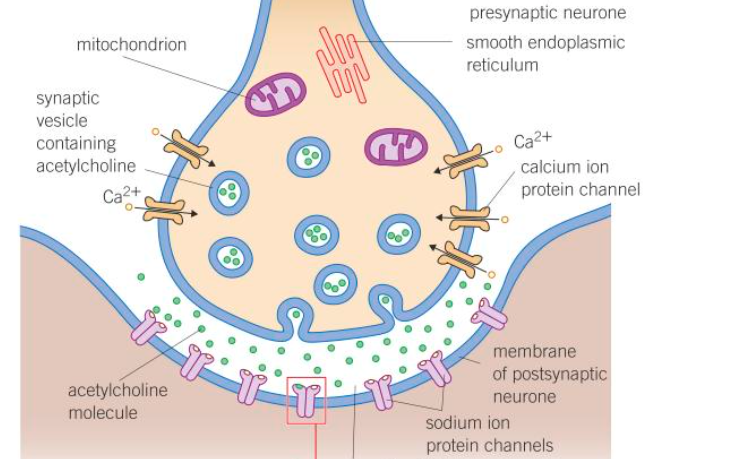
Image occlusion: name the hidden labels
24
Image occlusion: name the hidden labels
25
Image occlusion: name the hidden labels
26
Image occlusion: name the hidden labels
27
Image occlusion: name the hidden labels
28
Whats the swollen end part of a neurone called
Synaptic knob
29
Process of stimulus going across?
1)AP at end of presynaptic neuorone cause Ca channels to open causing Ca to diffuse in
2)Excess calcium cause synpatic vesicles to fuse with membrane, releasing acetylcholine into cleft
3)Acetylcholine diffuse across and bind to receptors on Na channels. This opens the Na channels
4)Influx of Na+ ions move in generating new AP in post synaptic neurone
2)Excess calcium cause synpatic vesicles to fuse with membrane, releasing acetylcholine into cleft
3)Acetylcholine diffuse across and bind to receptors on Na channels. This opens the Na channels
4)Influx of Na+ ions move in generating new AP in post synaptic neurone
30
What happeneds to acetylcholine after?
1)Acetylcholinesterase hydrolyses it into choline and ethanoic acid
2)These then diffuse back in presynaptic neurone(recycle) which prevents continuous formation of AP
3)ATP from mitochondria recombine them into acetylcholine and stored in vesicles while Na+ channels now close in post synaptic neurone
2)These then diffuse back in presynaptic neurone(recycle) which prevents continuous formation of AP
3)ATP from mitochondria recombine them into acetylcholine and stored in vesicles while Na+ channels now close in post synaptic neurone
31
Summation?
When low frequency AP can trigger new AP in postsynaptic neurone through rapid build up of neurotransmitter
32
Types of summation?
Spatial summation: Multiple presynaptic neurones together release enough neurotransmitter to form new AP
Temporal summaion: Single presynaptic neurone repeatedly release neurotransmitter in a short period of time to form new AP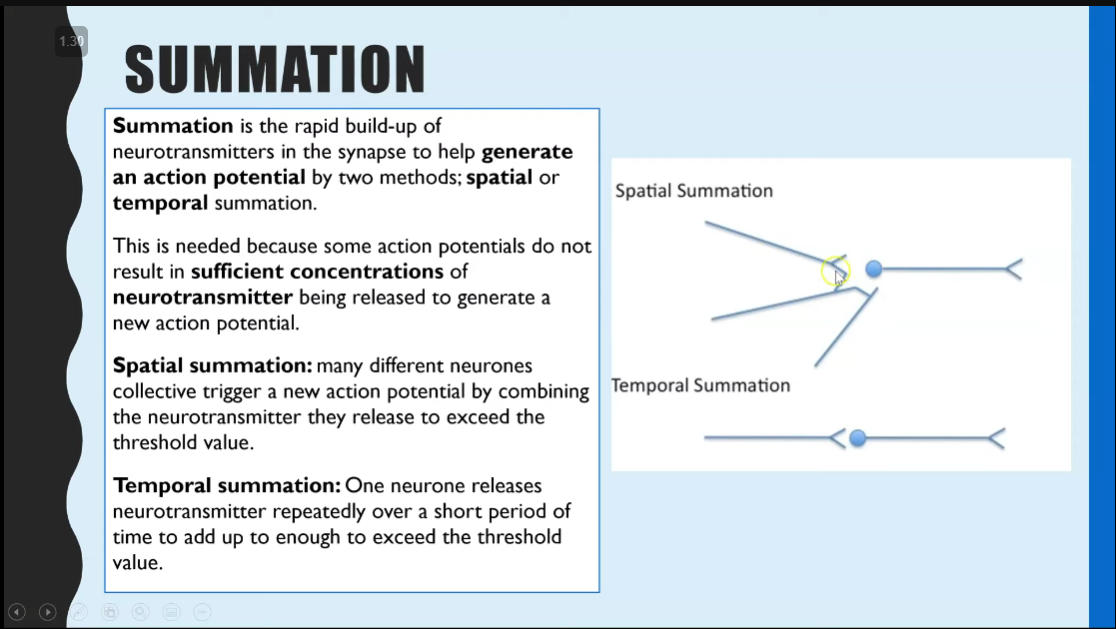
Temporal summaion: Single presynaptic neurone repeatedly release neurotransmitter in a short period of time to form new AP
33
Inhibitory synapse?
hyperpolarises post synaptic neurone preventing formation of AP
34
Inhibitory synapse stages
1)Pre synaptic neurone releases GABA neurotransmitter
2)Binds to Cl - protein channels on post synaptic neurone and opens them
3)Cl- ion move in post synaptic neureone by FD.
4)Gaba also causes K+ channel to open so K+ move out of axon
5)Combined effect causes a hyperpolarisation (even more negative than usual one like -80mV) making it hard to form AP
2)Binds to Cl - protein channels on post synaptic neurone and opens them
3)Cl- ion move in post synaptic neureone by FD.
4)Gaba also causes K+ channel to open so K+ move out of axon
5)Combined effect causes a hyperpolarisation (even more negative than usual one like -80mV) making it hard to form AP
35
Types of neurotransmitter?
Excitatory neurotransmitter = depolarises post synaptic neurone forming AP
Inhibitory neurotransmitter = hyperpolarises post synaptic neurone preventing formation of AP
Inhibitory neurotransmitter = hyperpolarises post synaptic neurone preventing formation of AP
36
Neuromuscular junction?
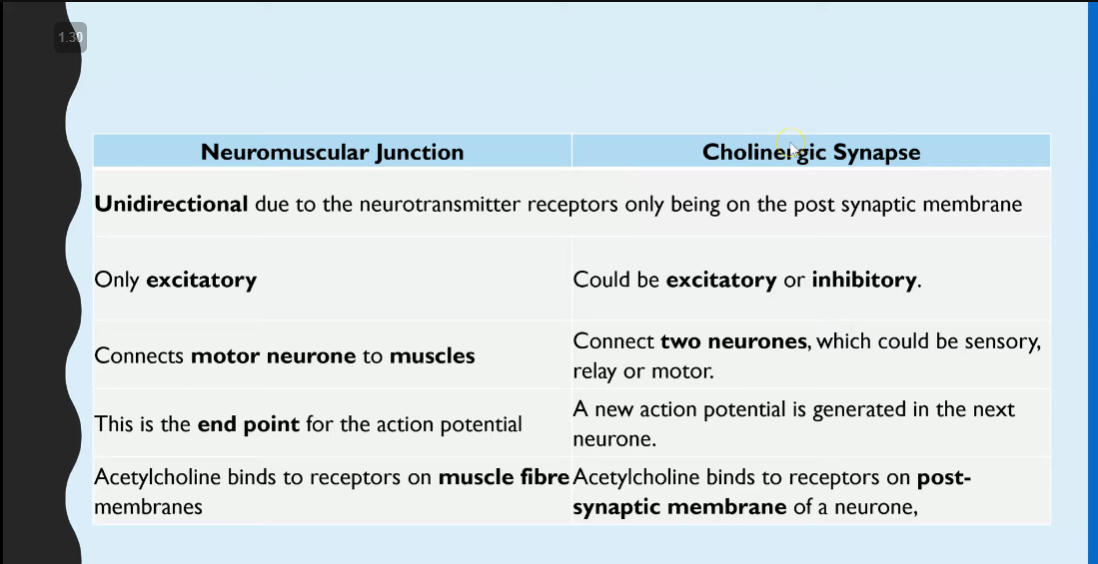
Synapse between a motor neurone and a muscle very similar to a normal one
37
Differences between neuromuscular junction and neurone junction(first one is a similarity)
cholinergic is neurone