3.3.10 Aromatic compounds like benzense stuff
Study these flashcardsFree · spaced repetition · iPhone, Android, Mac & web
All cards
1
Benzene molecular formula?
C6H6
2
Why is benezene an aromatic compound?
Cyclic
Has planar structure
Delocalised electrons
Has planar structure
Delocalised electrons
3
How was kekules idea proved wrong
The hydrogenation of cyclohex-1-ene is -120 so it would be expected if benzene used kekules structure itd be 3x being -360 but its rather -208kjmol.
This means benzene is more stable then expected and releases less energy when hydrogenated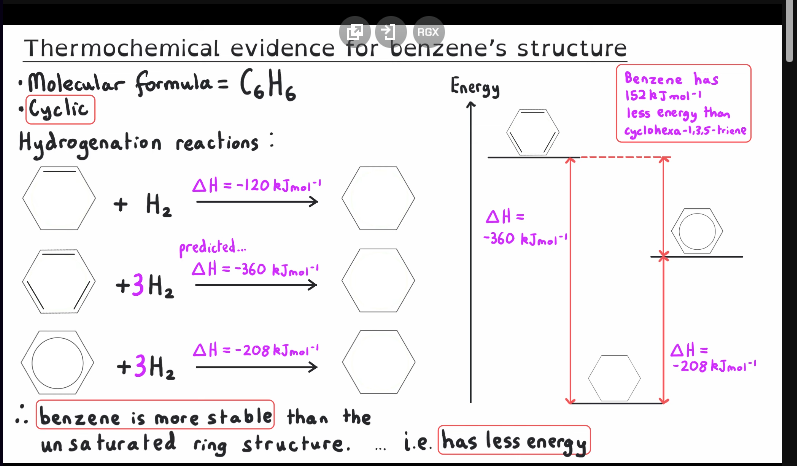
This means benzene is more stable then expected and releases less energy when hydrogenated
4
Electrophillic substitution?
Electrophile replaces one of benezens hydrogen due to the high charge density of the delocalised electrons.
5
Nitration electrophillic substitituon reagents?
Reagents:
Concentrated nitric and sulfuric acid at warm temps
Concentrated nitric and sulfuric acid at warm temps
6
How electrophile formed in nitration?
HN03 + H2SO4 --> H2NO3$^+$ + HSO4$-$
H2NO3$^+$ --> NO2$^+$ + H2O
NO2 IS ELECTROPHILE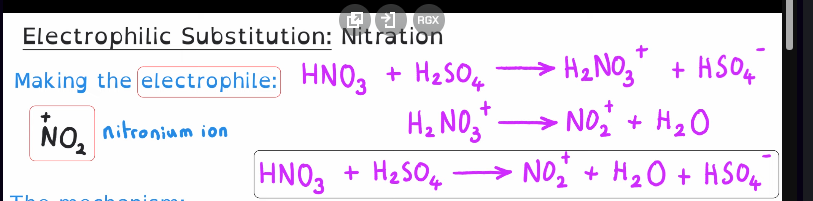
H2NO3$^+$ --> NO2$^+$ + H2O
NO2 IS ELECTROPHILE
7
Nitration mechanism?
The H+ goes to react with HSO4 regenerating H2SO4 catalyst
H$^+$ + HSO4$^-$ --> H2SO4
The amount of NO2+ substituted is based on temperature.
<55 - single
>55 - multiple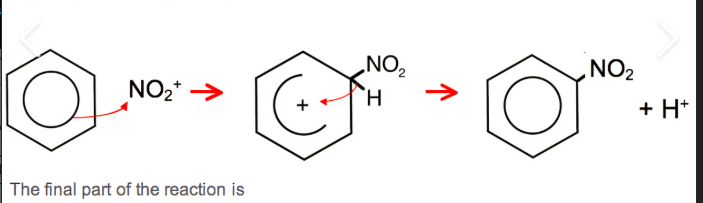
H$^+$ + HSO4$^-$ --> H2SO4
The amount of NO2+ substituted is based on temperature.
<55 - single
>55 - multiple
8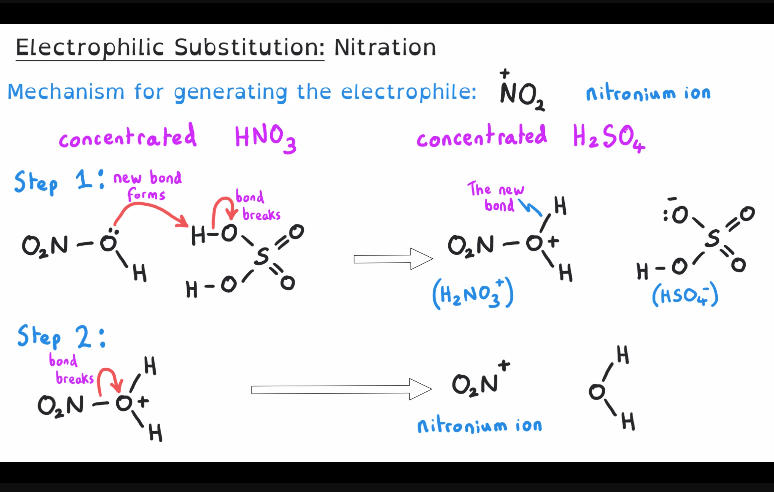
Not sure if need to know but just putting
9
Friedel crafts acylation and formation of electrophile
Reagent: Acyl chloride(weak electrophile)
Making electrophile:
Acyl chloride + AlCL3 ---> R-C=O$^+$ + ALCL4$^-$
R-C=O is acylium ion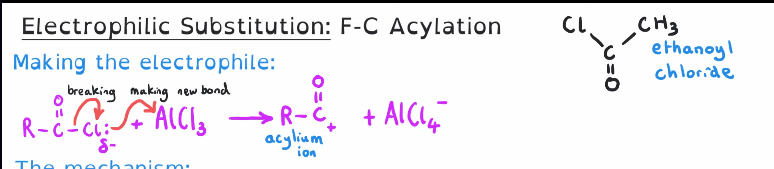
Making electrophile:
Acyl chloride + AlCL3 ---> R-C=O$^+$ + ALCL4$^-$
R-C=O is acylium ion
10
Friedel crafts acylation mechanism
Catalyst regenerated:
H$^+$ + AlCL4$^-$ --> AlCl3 + HCl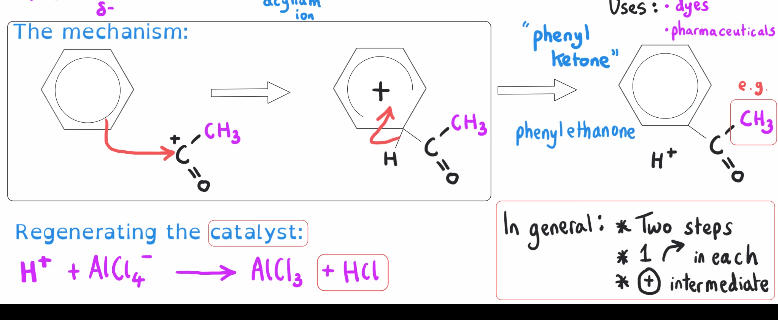
H$^+$ + AlCL4$^-$ --> AlCl3 + HCl