3.1.11 Electrode
Study these flashcardsFree · spaced repetition · iPhone, Android, Mac & web
All cards
1
Whats a half cell/electrode
When we place a rod of a metal in a solution of its salt/ions. Forming an equilibrium.
Eg placing a zinc rod in a Zn(NO3)2 aq solution
Always do NO3 salts(easiest)
Eg placing a zinc rod in a Zn(NO3)2 aq solution
Always do NO3 salts(easiest)
2
WHat happeneds in a half cell eg zinc and zinc nitrate
Oxidation and reduction occurs
Zn(s) ----> Zn$^{2+}$ + 2e$^{-}$
Zn$^{2+}$ + 2e$^{-}$ ----> Zn(s)
This creates a potential difference as electrons goes to electrode
Zn(s) ----> Zn$^{2+}$ + 2e$^{-}$
Zn$^{2+}$ + 2e$^{-}$ ----> Zn(s)
This creates a potential difference as electrons goes to electrode
3
Overall redox reaction?
Zn +2e$^{-}$ ⇌ Zn
Always do reduction reaction as its IUPAC way
Always do reduction reaction as its IUPAC way
4
Relation of reactive with electrode potential?
The more reactive, the more negative its electrode value
The less the reactive, the more POSITIVE its electrode potential value
NO PRoblem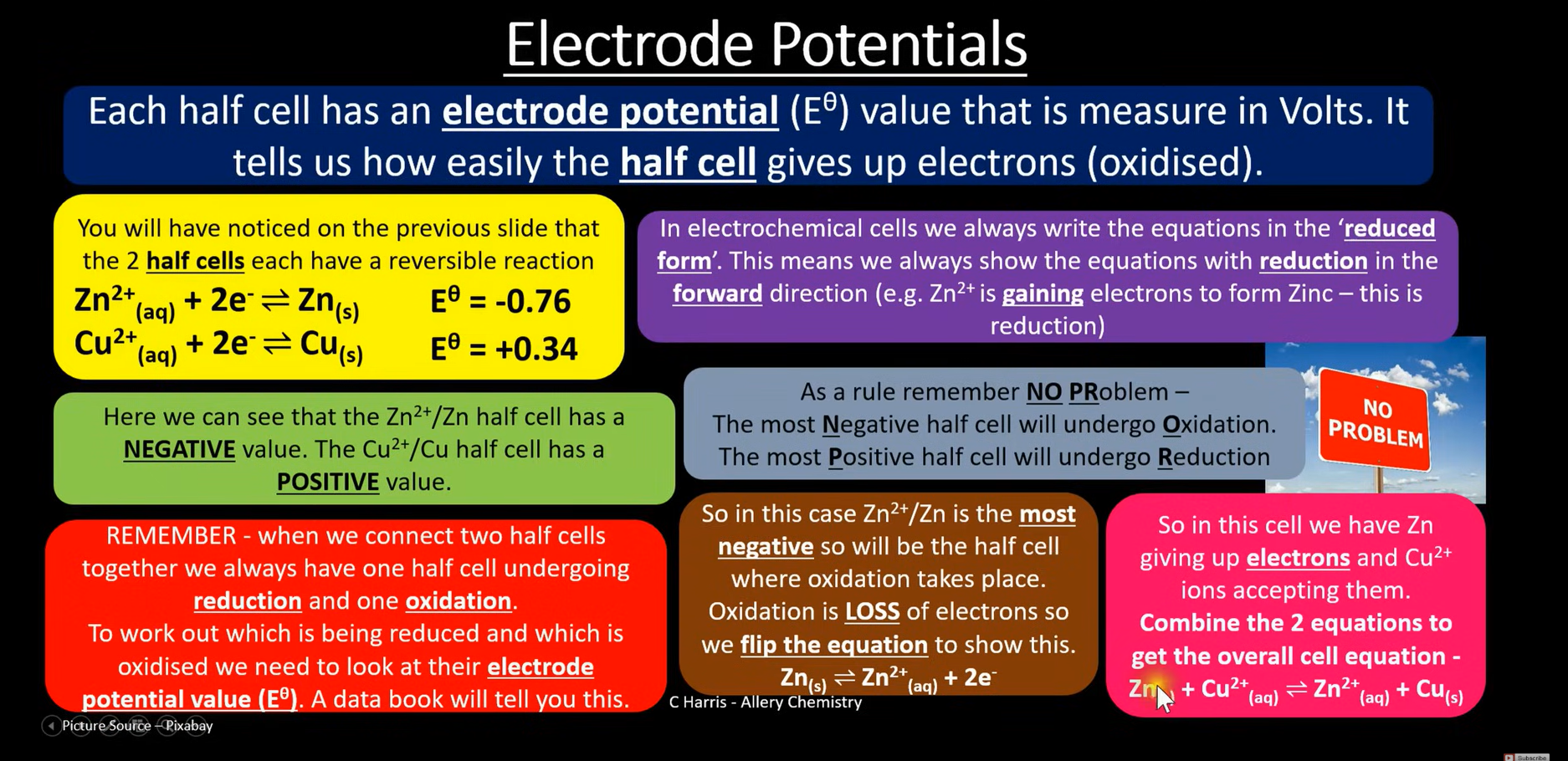
The less the reactive, the more POSITIVE its electrode potential value
NO PRoblem
5
Whats redox couple?
Shows the redox reaction but shorter
eg:
Zn$^{2+}$ +2e$^{-}$ ⇌ Zn
becomes
Zn$^{2+}$/Zn
eg:
Zn$^{2+}$ +2e$^{-}$ ⇌ Zn
becomes
Zn$^{2+}$/Zn
6
Whats a salt bridge?
Filter paper/wire that completes the circuit and is soaked in an inert salt (eg KNO3)
Allows its ions to flow into electrolytes to neutralise excess charge being build up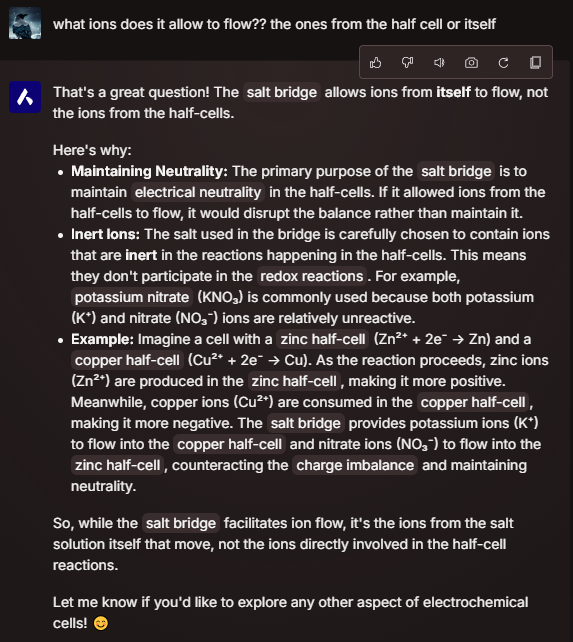
Allows its ions to flow into electrolytes to neutralise excess charge being build up
7
Draw a full circuit of Cu and Zn and show the correct electron flow etc
More reactive metal OXIDISES and less reactive reduces.
Zn--> Zn$^{2+}$ + 2e-
Cu + 2e$^-$ --> Cu$^{2-}$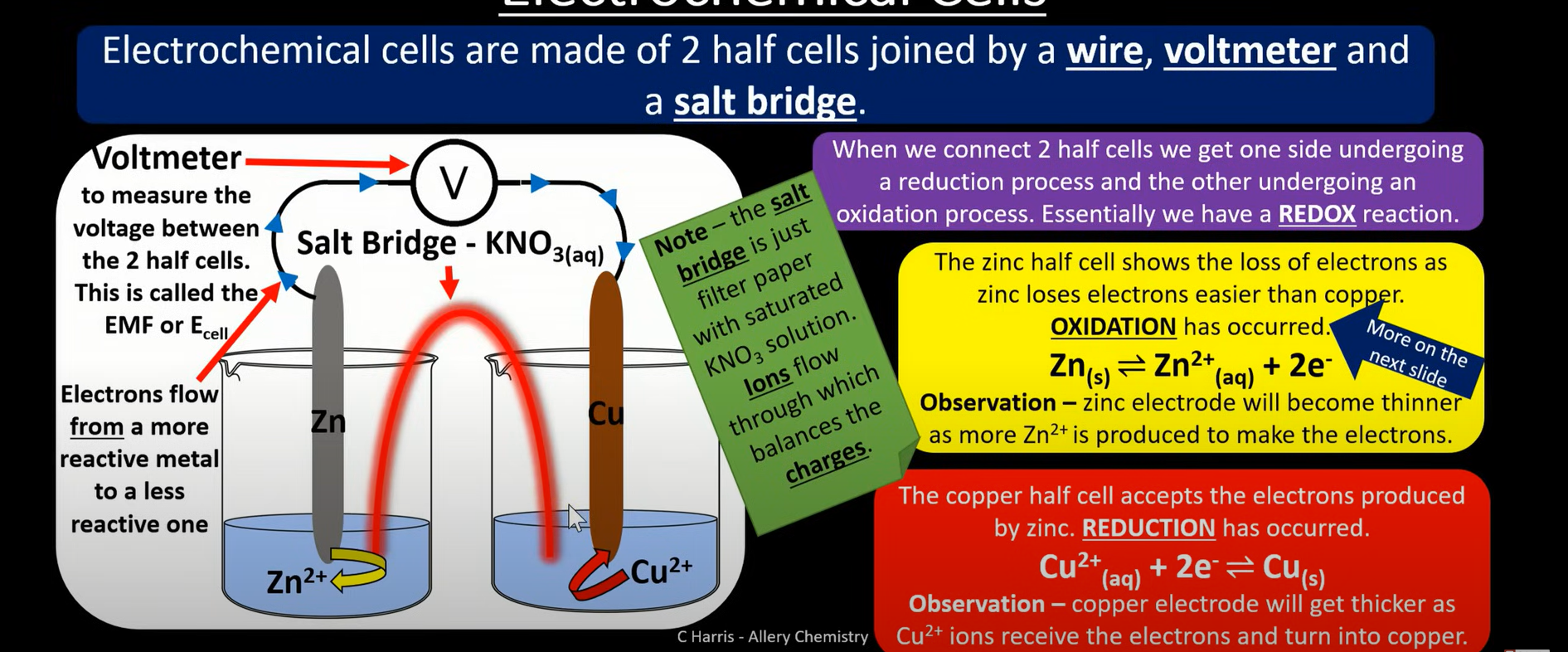
Zn--> Zn$^{2+}$ + 2e-
Cu + 2e$^-$ --> Cu$^{2-}$
8
How to use a gas in a half cell? if it isnt solid
Bubble it through a tube and use platinum electrode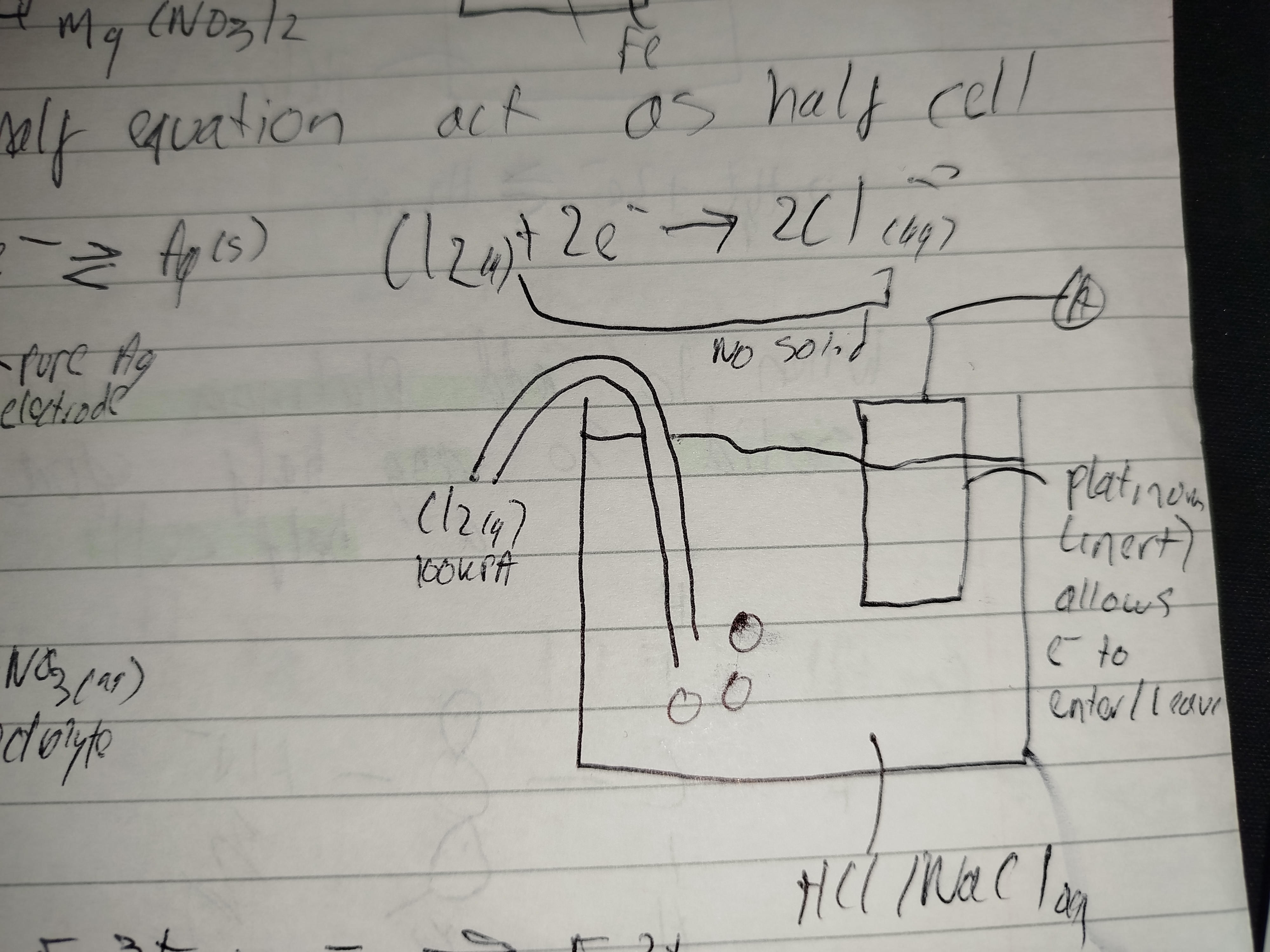
9
what is a SHE?
Its a standard hydrogen electrode which is used as a reference.
Its electrode potential is 0
Its electrode potential is 0
10
Whats emf?
The measured voltage when 2 electrodes connected
If youre using SHE that emf value = electron potential of the other cell AND If that other half cell is standard its symbol is E$\theta$
If youre using SHE that emf value = electron potential of the other cell AND If that other half cell is standard its symbol is E$\theta$
11
Conditions of SHE?
Uses high resistance voltmeter
Platinum electrode
298K
100kPa hydrogen gas
1mol/dm$^3$ HCL as H+ source( if diprotic 0.5 as we actually want 1 mol of H+)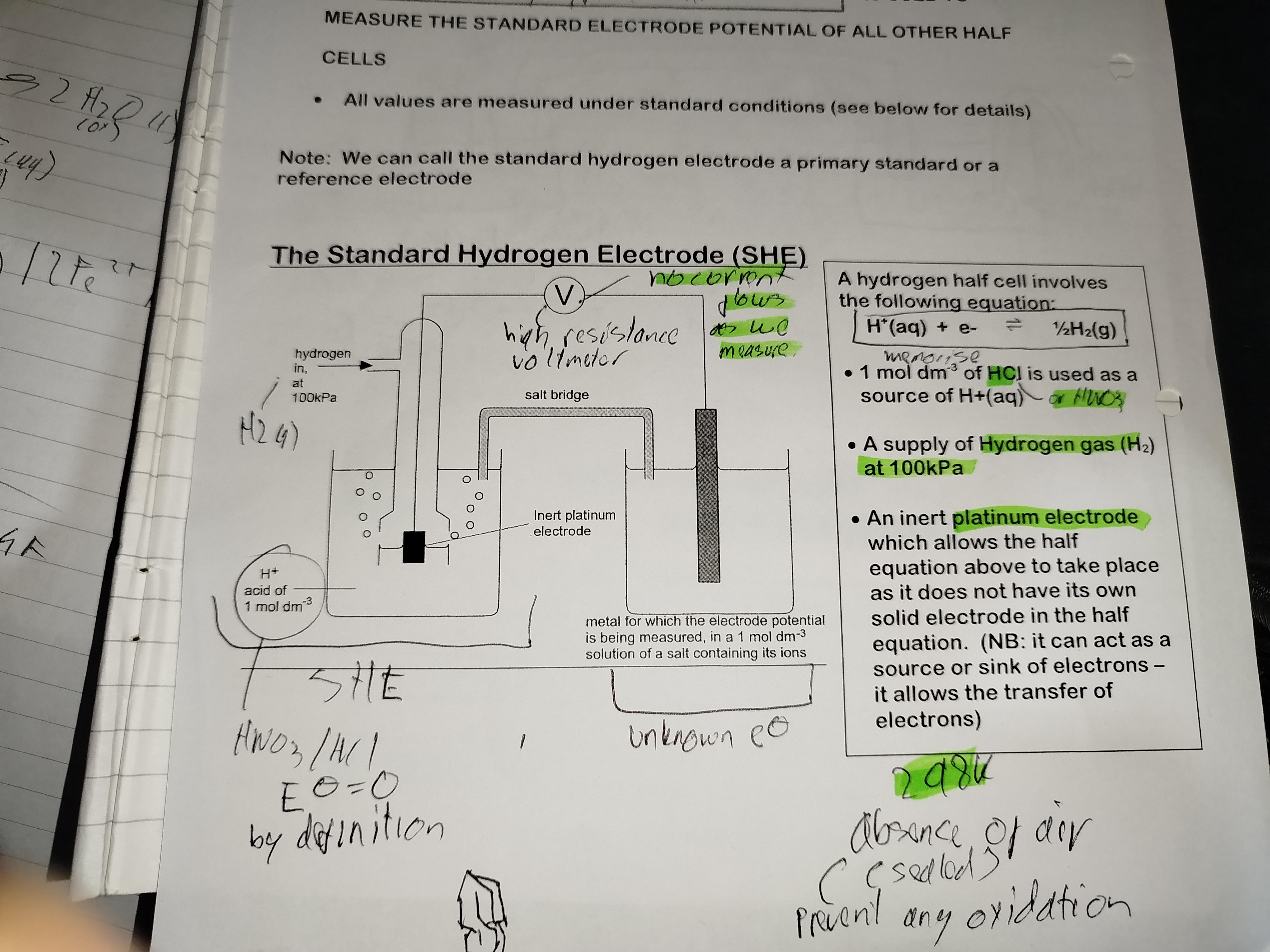
Platinum electrode
298K
100kPa hydrogen gas
1mol/dm$^3$ HCL as H+ source( if diprotic 0.5 as we actually want 1 mol of H+)
12
Emf (standard CELL potential) equation?
Reduction electrode potential - oxidation electrode potential
Order is same as like RED OX
Order is same as like RED OX
13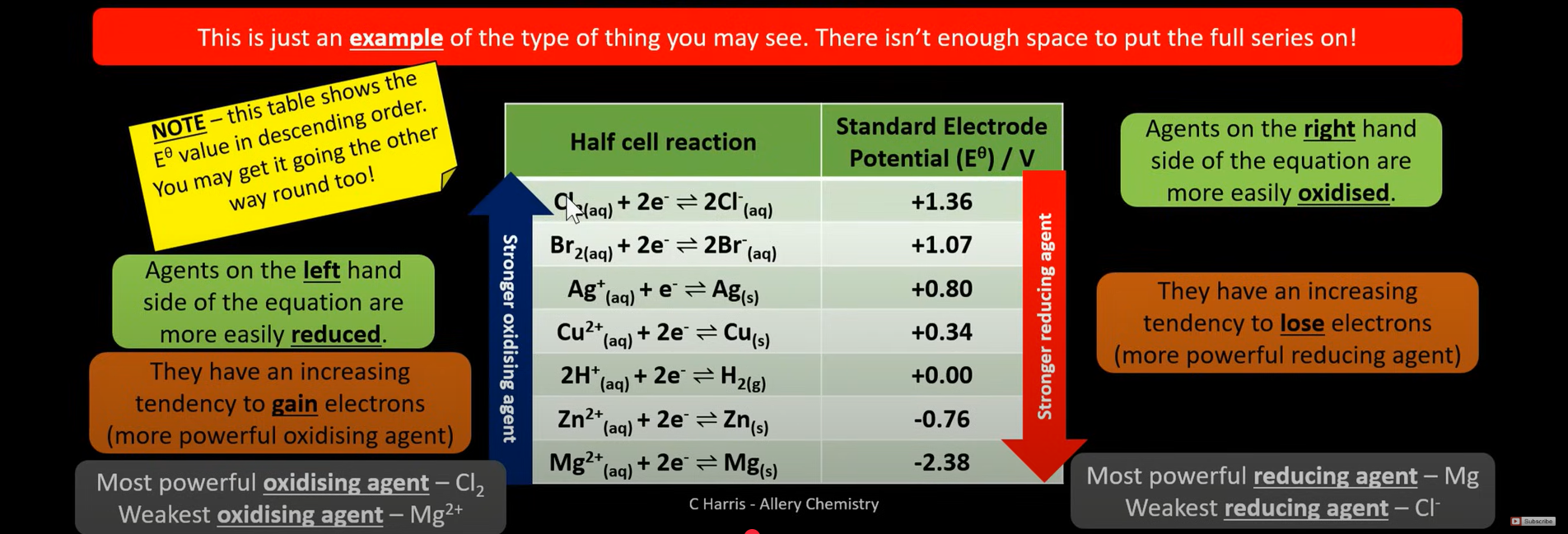
Example of what to know and write in electrochemical series if given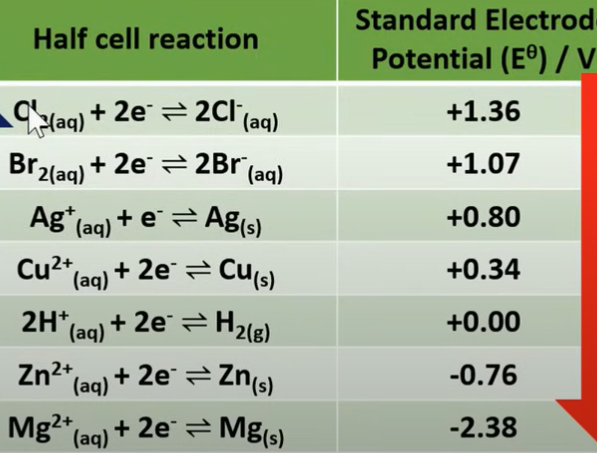
14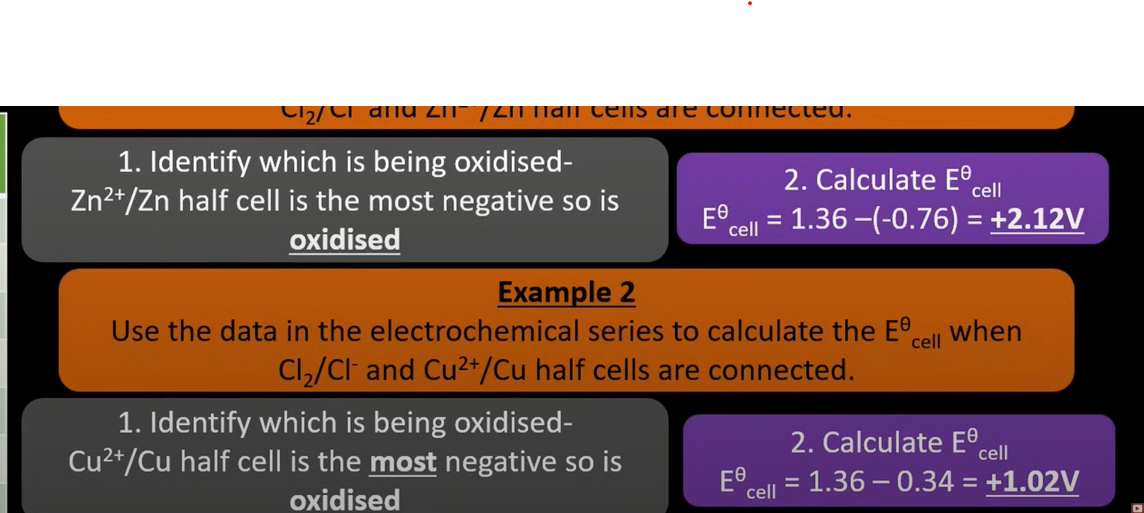
Do question at bottom right dont look at purple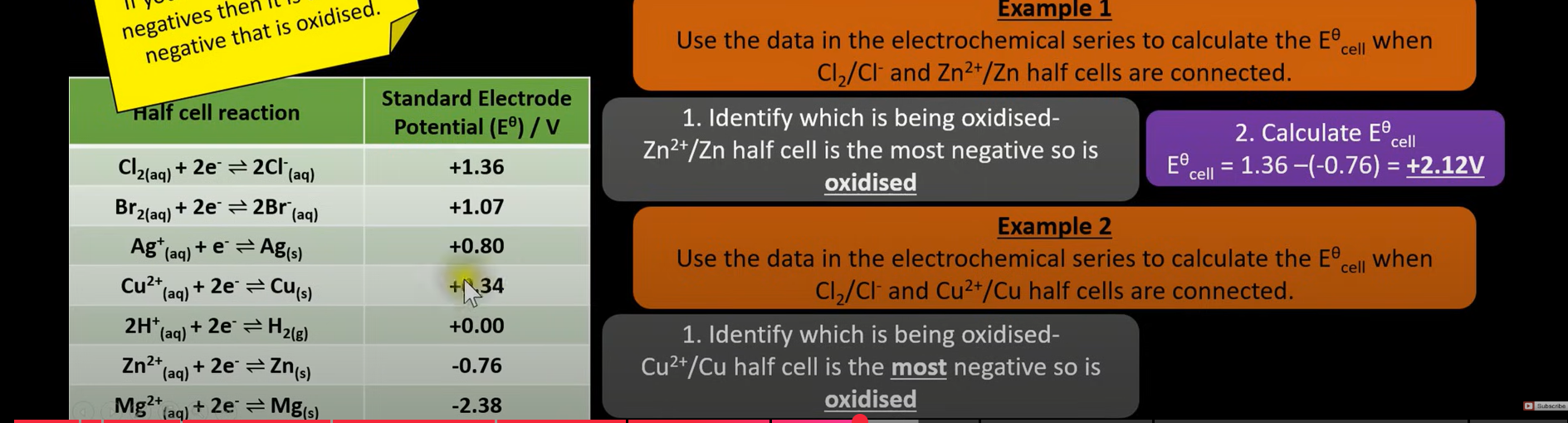
15
Do convensional representation of Cu and Zinc
Zn(s)|Zn$^{2+}$(aq) | | Cu$^{2+}$(aq)|Cu(s)
Oxidation is on left(unless theres a SHE in which SHE will be on left) and flip its redox reaction so its actually a oxidation reaction
Write it in order they appear in half equation
use phase boundary "|" when they change state
Add salt bridge symbol "| |" when you finish left side
Oxidation is on left(unless theres a SHE in which SHE will be on left) and flip its redox reaction so its actually a oxidation reaction
Write it in order they appear in half equation
use phase boundary "|" when they change state
Add salt bridge symbol "| |" when you finish left side
16
Do convensional representation of Fe${^2+}$ and Cl2
Pt|Fe$^{2+}$(aq) Fe$^{3+}$ | |Cl2(g)|2Cl${^-}$(aq)|Pt
Dont add phase boundary if same state and instead use comma
Add Pt at the beginning or end if used
Dont add phase boundary if same state and instead use comma
Add Pt at the beginning or end if used
17
Non-rechargeable?
Uses:smoke detectors, clocks,toys
Doesnt generate large currents so used in low power devices
Single use BUT long lasting
Uses a irreversible reaction
Discharging only
Has less toxic chemicals
Doesnt generate large currents so used in low power devices
Single use BUT long lasting
Uses a irreversible reaction
Discharging only
Has less toxic chemicals
18
Rechargeable?
Uses: Laptop,phone,cameras
Generates large currents so used in high power devices
Multi-use but shorter life per charge
Reversible reaction
Discharges then RECHARGES(lifetime becomes shorter per charge)
Has more toxic chemicals
Generates large currents so used in high power devices
Multi-use but shorter life per charge
Reversible reaction
Discharges then RECHARGES(lifetime becomes shorter per charge)
Has more toxic chemicals
19
How fuel cell produces electricity? All steps?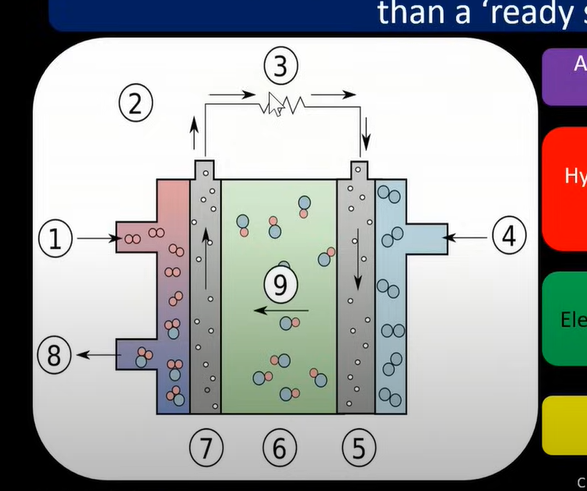
Via contiguous supply of chemicals
Skipped some numbers
1)Hydrogen fed here and reacts with OH- to form 4H2O and 4 e
2)Electrons travel through platinum anode electrode
3)Flow of electrons used to power smth like car
4) Oxygen fed here and reacts with water and the 4e forming 4OH-
6)electrolyte(salt bridge) made of KOH carries OH- down back to anode/left side
8)Product from step 1 (H20) released
- Ion exchange membranes (borders of electrolye) allow OH- to pass thru but NOT hydrogen or oxygen
Skipped some numbers
1)Hydrogen fed here and reacts with OH- to form 4H2O and 4 e
2)Electrons travel through platinum anode electrode
3)Flow of electrons used to power smth like car
4) Oxygen fed here and reacts with water and the 4e forming 4OH-
6)electrolyte(salt bridge) made of KOH carries OH- down back to anode/left side
8)Product from step 1 (H20) released
- Ion exchange membranes (borders of electrolye) allow OH- to pass thru but NOT hydrogen or oxygen
20
Pros of fuel cell?
Fuel cell only waste product is H2O
More efficient and generates more useful energy than heat
More efficient and generates more useful energy than heat
21
Cons of fuel cell?
Hydrogen is HIGHLY flammable so storage and transport is expensive and complex
Hydrogen needed is produced via fossil fuel combustions
Hydrogen needed is produced via fossil fuel combustions