3.8 Control of Gene Expression
Study these flashcardsFree · spaced repetition · iPhone, Android, Mac & web
All cards
1
All types of mutations?
Substitution
Addition
Deletion
Duplication
Inversion
Translocation
Addition
Deletion
Duplication
Inversion
Translocation
2
Addition?
Extra base is added to sequence.
Frame-shift
Frame-shift
3
Deletion?
Deletes a base
Frame shift
Frame shift
4
Substitution?
Changes a base to another
Varied effects due to degenerate code
Varied effects due to degenerate code
5
Inversion?
Section of bases detach and retach but inverted
eg:
TAC TTC AGG TGG
TO
TAC GGA CTT TGG
eg:
TAC TTC AGG TGG
TO
TAC GGA CTT TGG
6
Translocation?
Section of bases detach on one chromosome and retaches to a different chromosome.
Significant impact
Significant impact
7
Duplication?
section of DNA is duplicated once or multiple times
eg: TAC TTC AGG TGG
TO
TAC TTC AGG TTC AGG TGG
eg: TAC TTC AGG TGG
TO
TAC TTC AGG TTC AGG TGG
8
Stem cells?
Undifferentiated cells that can continually divide and become specialised
9
Name all types of stem cells need to know
Totipotent
Pluripotent
Multipotent
Unipotent
Pluripotent
Multipotent
Unipotent
10
Totipotent?
Can differentiate into any types of cells
Occur for little time in early mammal embryos
Occur for little time in early mammal embryos
11
Pluripotent
Can differentiate into almost any type of cells
Found in embryos and can be used to treat human disorders
Found in embryos and can be used to treat human disorders
12
Multipotent?
Can differentiate into limited types of cells
Found in bone marrow,placenta,umbilical cord
Found in bone marrow,placenta,umbilical cord
13
Unipotent?
Can differentiate into one type of cell(same)
14
Ips cells?
Induced pluripotent cells - produced from adult cells by using appropiate protein transcription factors
15
Epigenetic meaning?
Heritable change in gene function without changing DNA base sequence.
Caused by environment and can inhibit transcription
Caused by environment and can inhibit transcription
16
DNA methylation?
Addition of methyl groups to bases that have cytosine causes DNA to wrap MORE TIGHTLY preventing transcription factors from being able to bind
INHIBITS TRANSCRIPTION
INHIBITS TRANSCRIPTION
17
ACETYLATION OF HISTONES?
Addition of actyl groups(acetylcoenzyme a ) to histones causing it to loosen its association with DNA making DNA wrap LESS TIGHTLY, exposing genes allowing transcription factors to bind
18
Tumour suppressor gene?
Controls and slows down cell division and can cause cell death if DNA corrupted.
Can be affected by chemical tags
Can be affected by chemical tags
19
Transcriptional factors?
Proteins which regulates transcription, binds to a specific base sequence on DNA(promoter region) and initiate transcription
Without it binding, genes are inactive and proteins wont be made
Without it binding, genes are inactive and proteins wont be made
20
Oestrogen?
Can initiate transcription via binding onto receptor site of TRANSCRIPTIONAL FACTOR and changing its shape so it becomes active and abling it to bind to DNA.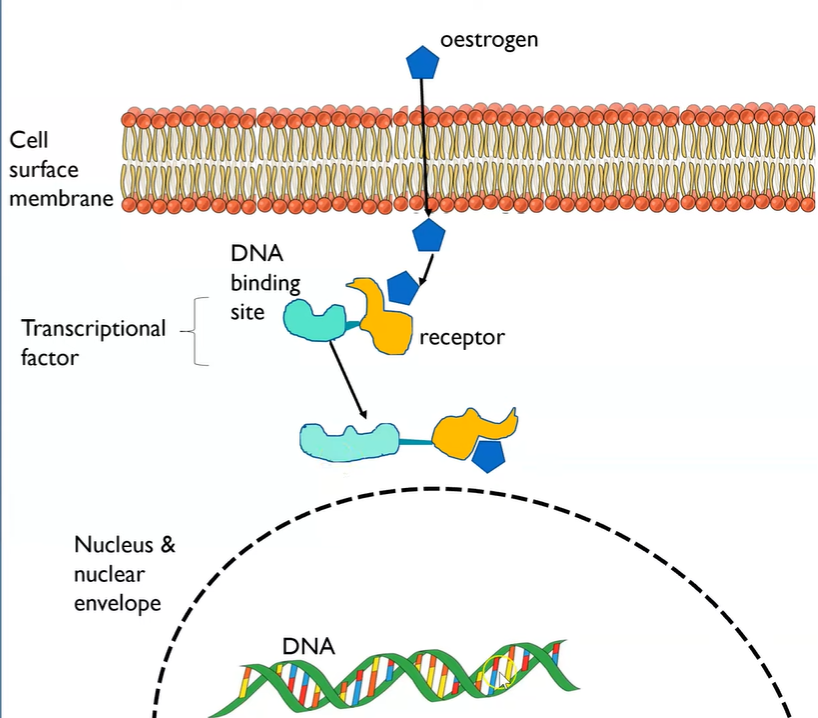
21
RNA INTERFERENCE? (RNAi)
Cellular process that silences specific genes and destroys mRNA b4 it gets translated.
This can be done by small interfering RNA (SiRNA)
This can be done by small interfering RNA (SiRNA)
22
Process of RNA inteference?
1) An enzyme cuts double stranded molecule of RNA(dsRNA) into siRNA
2)One strand of siRNA combines with an enzyme forming siRNA-enzyme complex
3)This thens bind to another mRNA molecule in which then the enzyme cuts up the mRNA so it can't be translated
2)One strand of siRNA combines with an enzyme forming siRNA-enzyme complex
3)This thens bind to another mRNA molecule in which then the enzyme cuts up the mRNA so it can't be translated
23
Benign and malignant?
B:
Not cancerous and grow slowly
Doesnt invade other tissues
Cause damage like blockades/excess pressure
M:
Cancerous and grow rapidly
Can invade other tissues
Secretes chemicals forming blood vessels to it
Can regrow after removal
Not cancerous and grow slowly
Doesnt invade other tissues
Cause damage like blockades/excess pressure
M:
Cancerous and grow rapidly
Can invade other tissues
Secretes chemicals forming blood vessels to it
Can regrow after removal
24
Oncogenes?
Proto oncogenes that got mutated to become oncogene leading it to drastically overstimulate the duplication of cells by being permanently active
25
The first step to creatign DNA fragments is isolation. What are the three ways?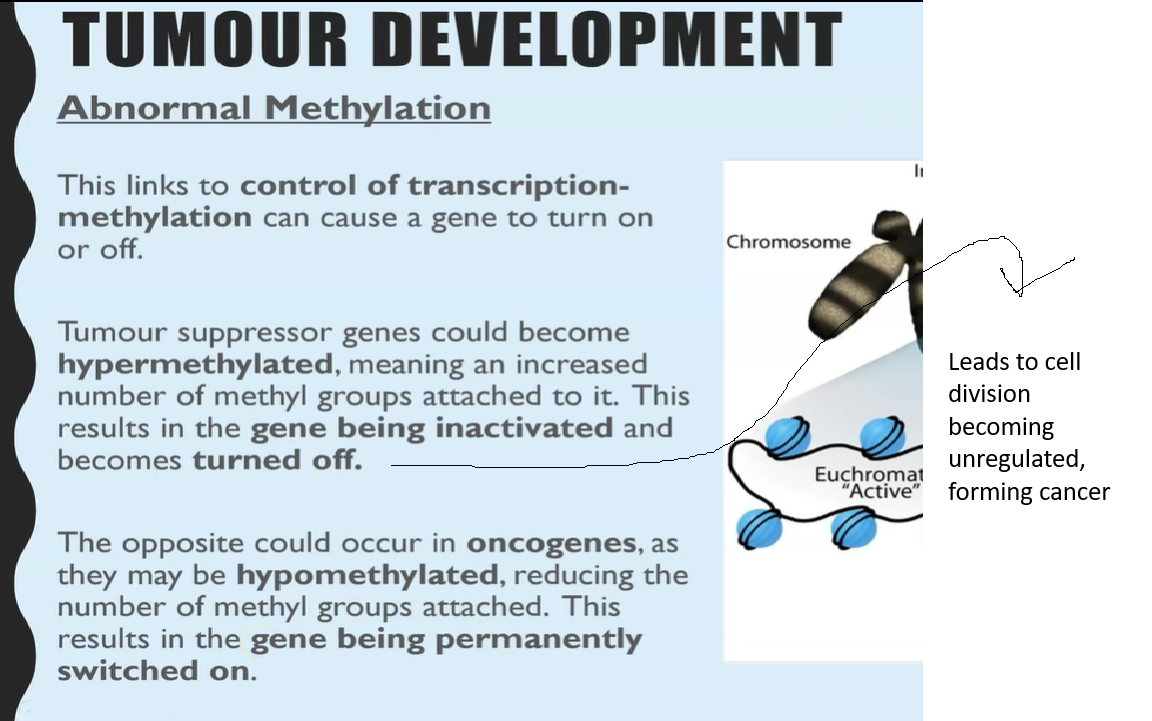
1)Reverse transcriptase
2)Restriction endonucleases
3)Gene machine
2)Restriction endonucleases
3)Gene machine
26
Reverse transcription way?
1)mRNA needed to create proteins is isolated from cell that produces it (eg beta cells)
2)mRNA acts as template strand to create single strand copy of DNA with DNA nucelotides using reverse transcriptase called cDNA
3)DNA polymerase used to turn it into double stranded DNA
2)mRNA acts as template strand to create single strand copy of DNA with DNA nucelotides using reverse transcriptase called cDNA
3)DNA polymerase used to turn it into double stranded DNA
27
Restriction endonucleases way?
Found in bacteria and able to hydrolyse phosphodiester bonds of both dna strands at specific area
Can cut in two ways:
1) Blunt- straight down
2)Staggered/zigzag way - Forms ends that are palindromic known as sticky ends which can join to DNA with complementary base pairs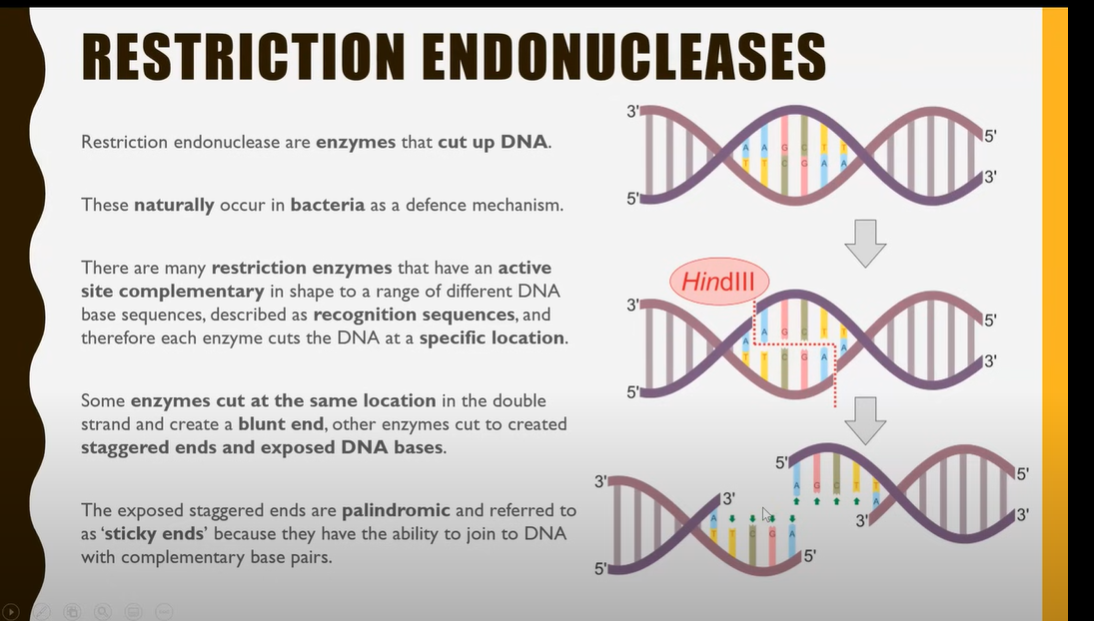
Can cut in two ways:
1) Blunt- straight down
2)Staggered/zigzag way - Forms ends that are palindromic known as sticky ends which can join to DNA with complementary base pairs
28
Gene machine?
1)Desired sequence of nucleotide is determined from the proteins
2)This is entered to the PC which checks for biosafety
3)PC creates small overlapping single strands of nucleotides which make up a gene called oligonucleotides
4)Oligonucleotides then joined to create gene
- This can be replicated via PCR
2)This is entered to the PC which checks for biosafety
3)PC creates small overlapping single strands of nucleotides which make up a gene called oligonucleotides
4)Oligonucleotides then joined to create gene
- This can be replicated via PCR
29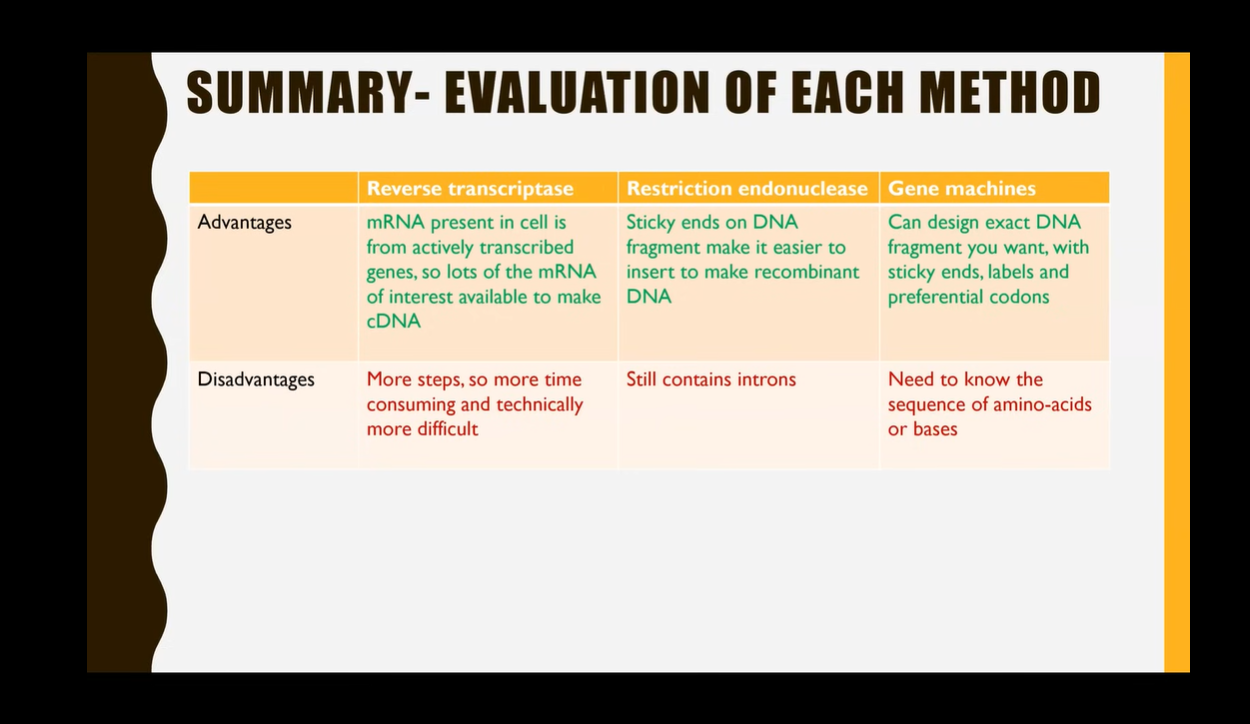
Pros and cons of methodss
30
Insertion (in vivo):
1)Restriction enzymes used to cut out gene and leaves sticky ends.
2)Then promotor and terminator region is added which tells where RNA polymerase is to start and end transcription
3)Plasmid(vector) is cut open using same restriction enzyme creating same sticky ends so GENE ends are complementary to those in plasmid
4)DNA ligase sticks both of them together by forming phosphodiester bond via condensation reaction
2)Then promotor and terminator region is added which tells where RNA polymerase is to start and end transcription
3)Plasmid(vector) is cut open using same restriction enzyme creating same sticky ends so GENE ends are complementary to those in plasmid
4)DNA ligase sticks both of them together by forming phosphodiester bond via condensation reaction
31
Transformation (invivo)
To insert vector into host cell we increase membrane permeability via mixing the vector and host cell in a medium with Ca 2+ and do a big change in temperature
HOWEVER NOT ALL HOST CELL WILL TAKE VECTOR UP
So we need to identify which did take it up
HOWEVER NOT ALL HOST CELL WILL TAKE VECTOR UP
So we need to identify which did take it up
32
Identification types (in vivo) :
We uses marker genes to identify being:
- Anti biotic resistance genes
- Florescent marker(GFP)
- Enzyme markers(lactase)
- Anti biotic resistance genes
- Florescent marker(GFP)
- Enzyme markers(lactase)
33
Anti biotic resistance markers
E and G has gene we placed 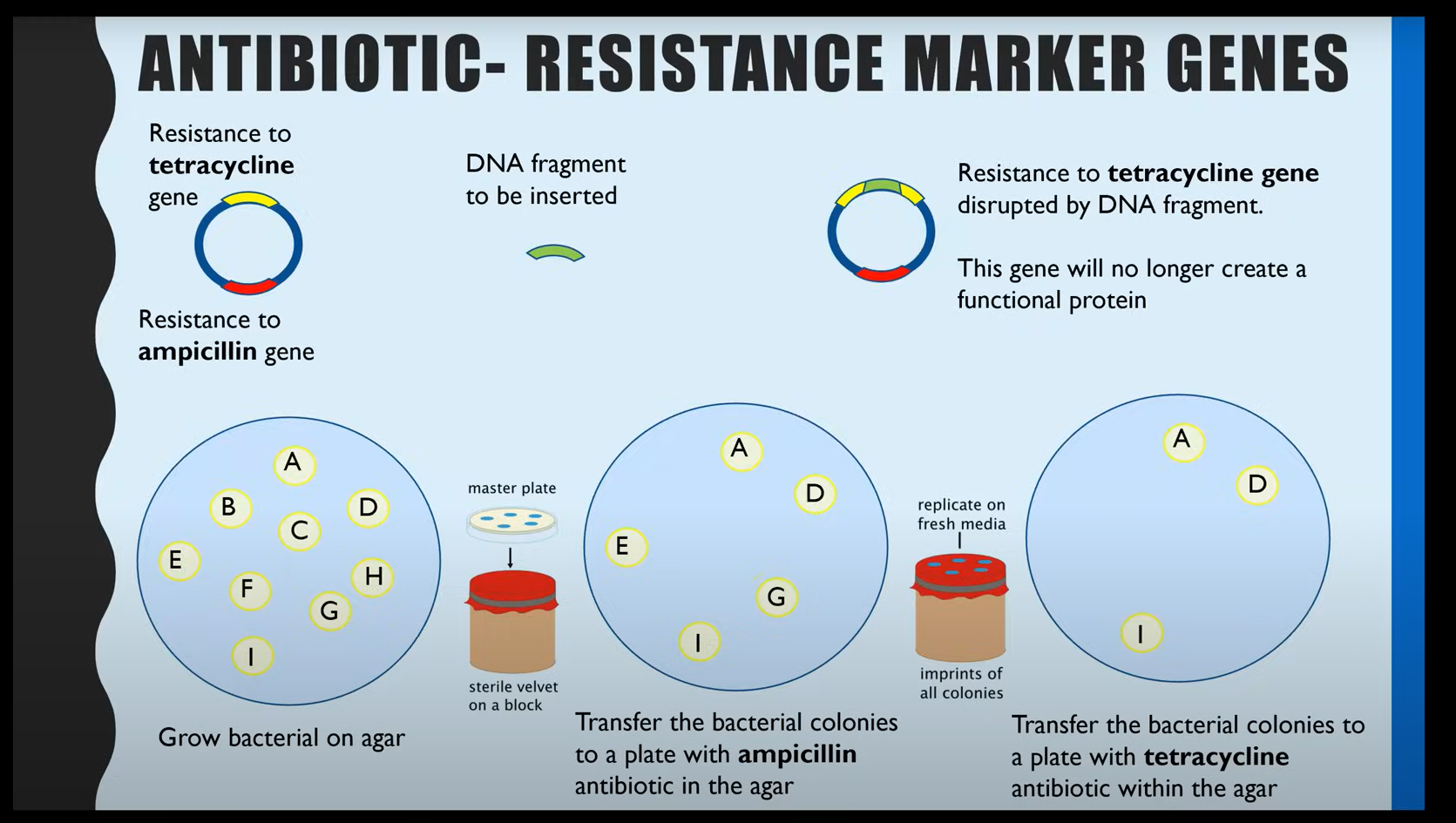
34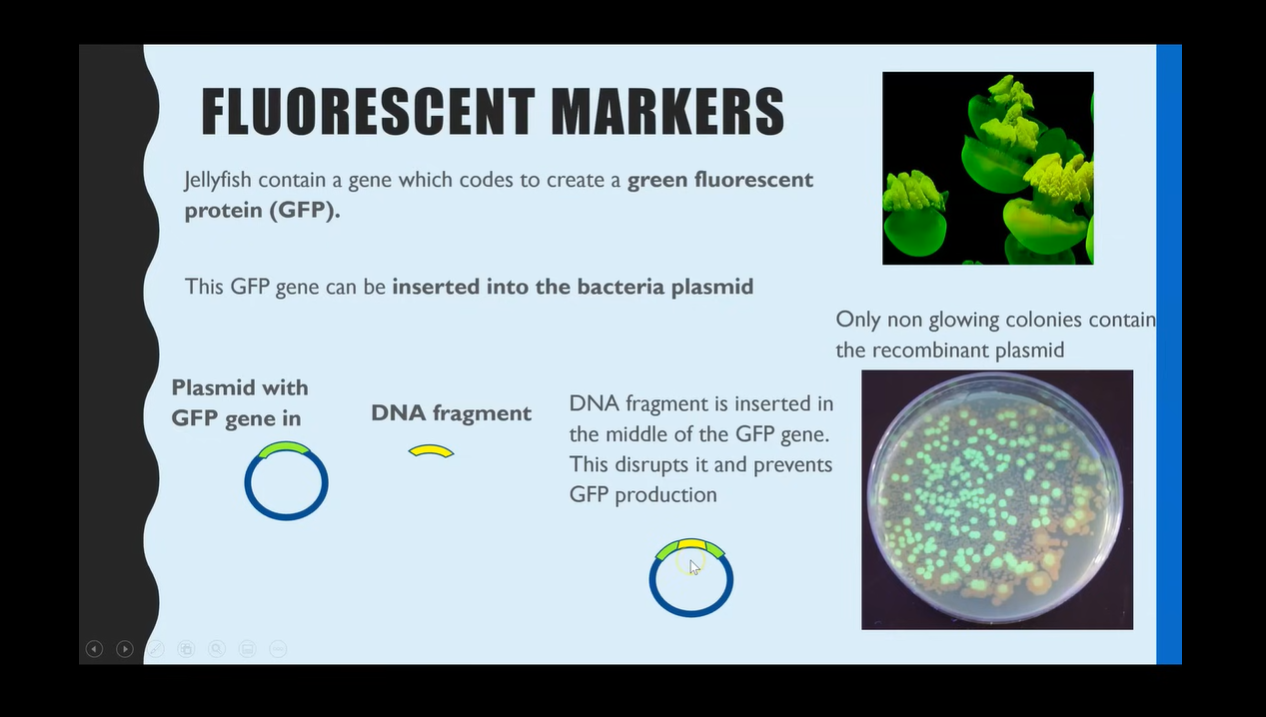
Fluorescent markers
35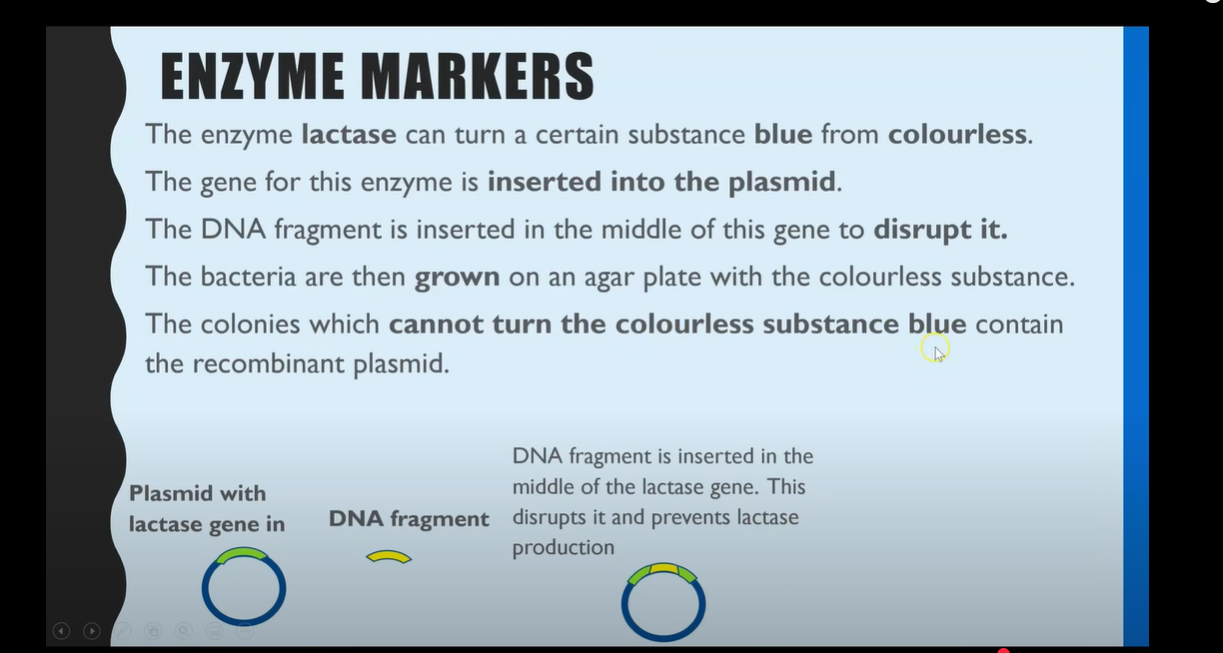
Enzyme(lactase) markers
36
Growth/cloning (last step of INVIVO)
After host cell now has recombined plasmid/vector this is cloned/ grown in fermenter
37
Invitro cloning(PCR)
1- DENATURATION = All stuff is added and Temperature increased to 95C breaking hydrogen bonds and splitting strands to two
2-ANNEALING = Temperature decreased to 55C so primers can attach which provide starting point for taq polymerase
3- AMPLIFICATION = Temperature increased to 72C so taq polymerase CATALYSES FORMATION OF phosphodiester bonds between nucleotides to form new double strands of DNA
2-ANNEALING = Temperature decreased to 55C so primers can attach which provide starting point for taq polymerase
3- AMPLIFICATION = Temperature increased to 72C so taq polymerase CATALYSES FORMATION OF phosphodiester bonds between nucleotides to form new double strands of DNA
38
VNTR?
Variable number tandem repeats= Section of DNA bases that are introns and repeat throughout genome.
Very unlikely for two people to have same VNTR
Very unlikely for two people to have same VNTR
39
Genetic engineering steps?
1)Sample of DNA is collected via blood,hair etc.
2)Restriction enzymes used to cut DNA into smaller fragments. They cut it just before and after VNTRS
3)Gel electrophoresis occurs.
4)Lots of different DNA probes are mixed with VNTRs to bind.
5)DNA probes and VNTR transferred to nylon sheet and UV light/ x ray is shined
6) Position of DNA bands are then compared to known ones.
2)Restriction enzymes used to cut DNA into smaller fragments. They cut it just before and after VNTRS
3)Gel electrophoresis occurs.
4)Lots of different DNA probes are mixed with VNTRs to bind.
5)DNA probes and VNTR transferred to nylon sheet and UV light/ x ray is shined
6) Position of DNA bands are then compared to known ones.
40
what are DNA probes?
Small single strands of DNA complementary to a specific VNTR and are radioactively/florescently labelled
41
Gel electrophoresis?
-Used to separate DNA fragments by size
1)DNA fragments placed onto agar gel and voltage is applied across
2)Resistance of gel means the larger a fragment, the slower they move towards anode
3)So over a fixed period of time, smaller fragments move further than large ones.
-Separating them
1)DNA fragments placed onto agar gel and voltage is applied across
2)Resistance of gel means the larger a fragment, the slower they move towards anode
3)So over a fixed period of time, smaller fragments move further than large ones.
-Separating them