3.5.1 FOTOSYNTHESIS
Study these flashcardsFree · spaced repetition · iPhone, Android, Mac & web
All cards
1
Where do Light dependant reaction occur?
In thylakoids(granum)
2
Purpose of light dependent reaction?
Produces ATP and NADPH (needed for LIR)
3
What is photolysis?
Light energy is absorbed by chlorophyll splitting H20 into 1/2 O2 + 2H+ and 2e-
4
Photoionisation?
Light energy hits chlorophyll causing electrons to become excited and causes electrons to move out into ETC
5
Chemiosmosis?
1)Electrons pass along ETC through redox reactions
2)This releases enough energy to allow H+ to diffuse from stroma into thylakoid lumen. Forming electrochemical gradient
3)H+ in thylakoid lumen facilitate diffuse through ATP synthase catalysing ADP+ Pi to ATP.
4)Electrons at end of ECT react with NADP+ and H+ to form NADPH.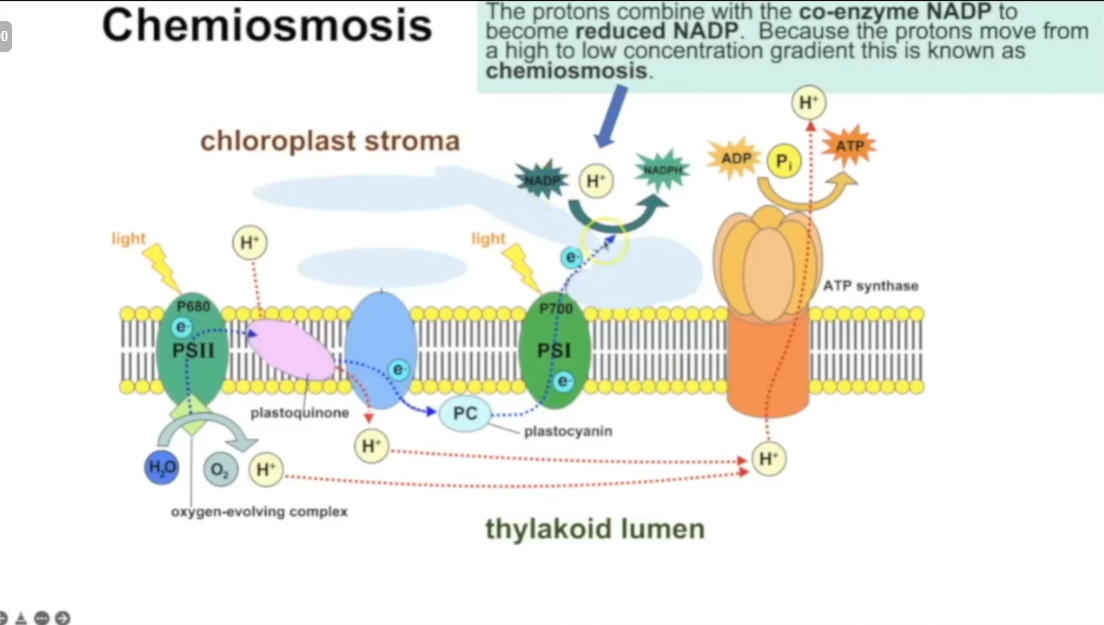
2)This releases enough energy to allow H+ to diffuse from stroma into thylakoid lumen. Forming electrochemical gradient
3)H+ in thylakoid lumen facilitate diffuse through ATP synthase catalysing ADP+ Pi to ATP.
4)Electrons at end of ECT react with NADP+ and H+ to form NADPH.
6
Light dependent reaction?
1)Light energy is absorbed by chlorophyll splitting H20 into 1/2 O2 and 2H+ and 2e-
2)Light energy also causes electrons to become excited and causes electrons to move out into ETC
3)Electrons pass along ETC through redox reactions
4))This releases enough energy to allow H+ to diffuse from stroma into thylakoid lumen. Forming electrochemical gradient
5)Electrons at end of ECT react with NADP+ and H+ to form NADPH.
6)H+ in thylakoid lumen facilitate diffuse through ATP synthase catalysing ADP+ Pi to ADP. (CHEMIOSMOSIS)
2)Light energy also causes electrons to become excited and causes electrons to move out into ETC
3)Electrons pass along ETC through redox reactions
4))This releases enough energy to allow H+ to diffuse from stroma into thylakoid lumen. Forming electrochemical gradient
5)Electrons at end of ECT react with NADP+ and H+ to form NADPH.
6)H+ in thylakoid lumen facilitate diffuse through ATP synthase catalysing ADP+ Pi to ADP. (CHEMIOSMOSIS)
7
Where does Light independent reaction (calvin cycle) occur?
stroma
8
Calvin cycle steps?
1) 5C RuBP(Ribulose bisphosphate) reacts with CO2 to form unstable intermediate. RUBISCO speeds up reaction
2) Unstable intermediate splits into 2 Glycerate-3-phosphate
3) GP each get reduced by a NADPH and energy is provided by an ATP each
4) This forms 2 triose phosphate.
5) 1/6th of the two triose phosphate goes to form hexose sugars/lipids/amino acid while rest (5/6th) reforms RuBP by using an ATP.
2) Unstable intermediate splits into 2 Glycerate-3-phosphate
3) GP each get reduced by a NADPH and energy is provided by an ATP each
4) This forms 2 triose phosphate.
5) 1/6th of the two triose phosphate goes to form hexose sugars/lipids/amino acid while rest (5/6th) reforms RuBP by using an ATP.
9
What happends to the oxidised NADP?
It goes back to LDR to get H+ and e-.
10
Factors limiting PHOTOSYNTHESIS
Carbon dioxide concentration
Temperature
Light intensity
Temperature
Light intensity