3.6.1 Stimuli,both internal and external are detected and lead to a response what
Study these flashcardsFree · spaced repetition · iPhone, Android, Mac & web
All cards
1
Stimulus?
A detectable change in environment eg light/pressure/temp
2
Taxes?
Simple response whose direction is determined by direction of stimulus
Positive taxes = towards stimulus
Negative taxeis = away from stimulus
Positive taxes = towards stimulus
Negative taxeis = away from stimulus
3
Kineses?
Response which organism changes its speed and rate it changes directions
4
Tropism and examples?
When plants respond via growth to stimuli. Can be positive/negative
Phototropism = response to light
Geotropism = response to gravity
hydrotropism = response to water
Phototropism = response to light
Geotropism = response to gravity
hydrotropism = response to water
5
IAA?
Indolacetic acid - Type of auxin which stimulates cell elongation/ growth in shoots and inhibit growth in roots. Made in tips of roots and shoots
6
Phototropism?
1)Shoot tips produce IAA, IAA will diffuse/move towards area of shade of shoots.
2)This causes the cells on shaded side to elongate more, causing plant to bend towards light source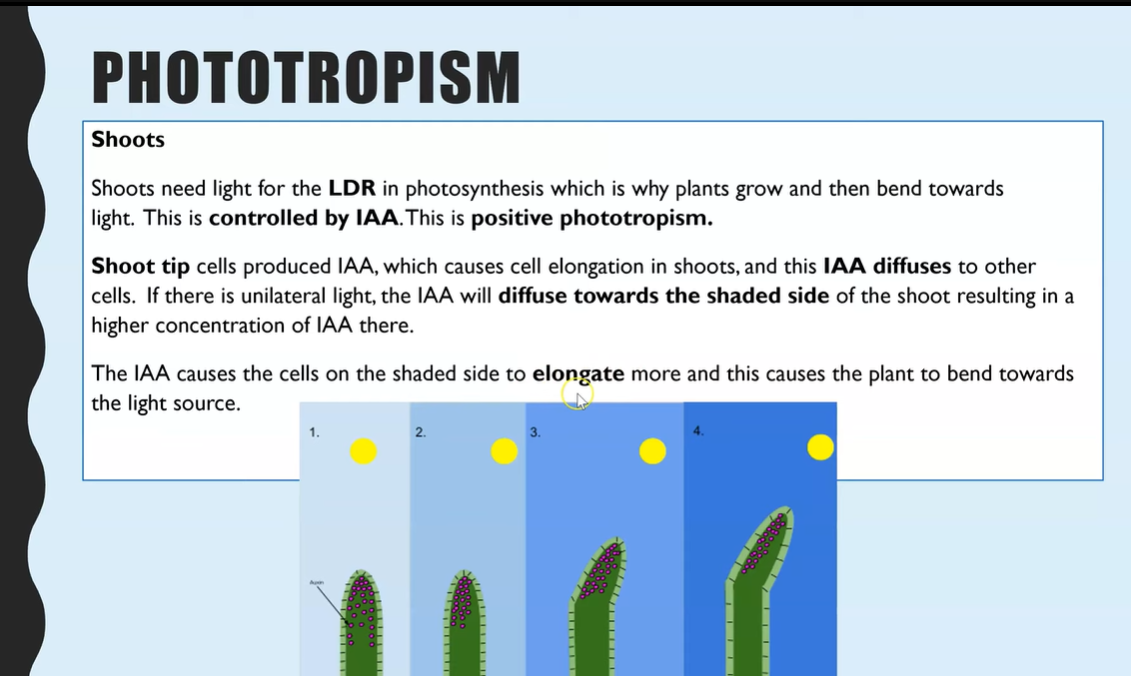
2)This causes the cells on shaded side to elongate more, causing plant to bend towards light source
7
Gravitropism?
SHOOTS:
IAA diffuses from upper to lower side, if plant is on its side it will cause shoot to bend upwards.
ROOTS
IAA moves to lower side of roots so roots bend down towards gravity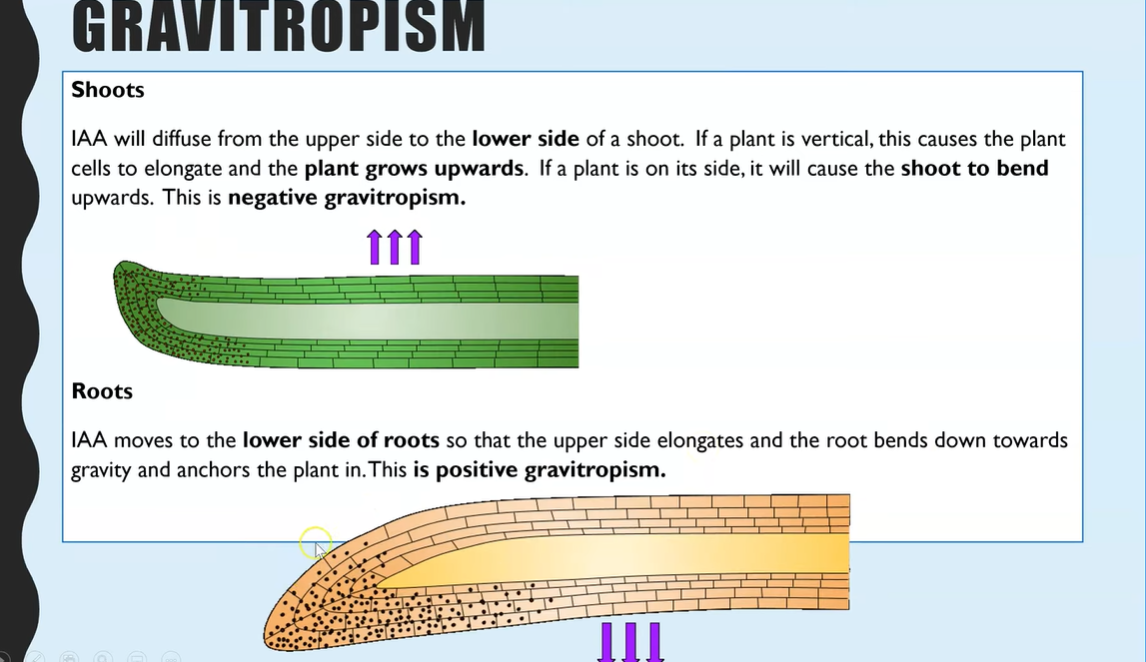
IAA diffuses from upper to lower side, if plant is on its side it will cause shoot to bend upwards.
ROOTS
IAA moves to lower side of roots so roots bend down towards gravity
8
Pacinian corpuscle?
Touch/pressure receptor which has stretch-mediated Na channels.
When enough pressure applied Na channels open forming AP.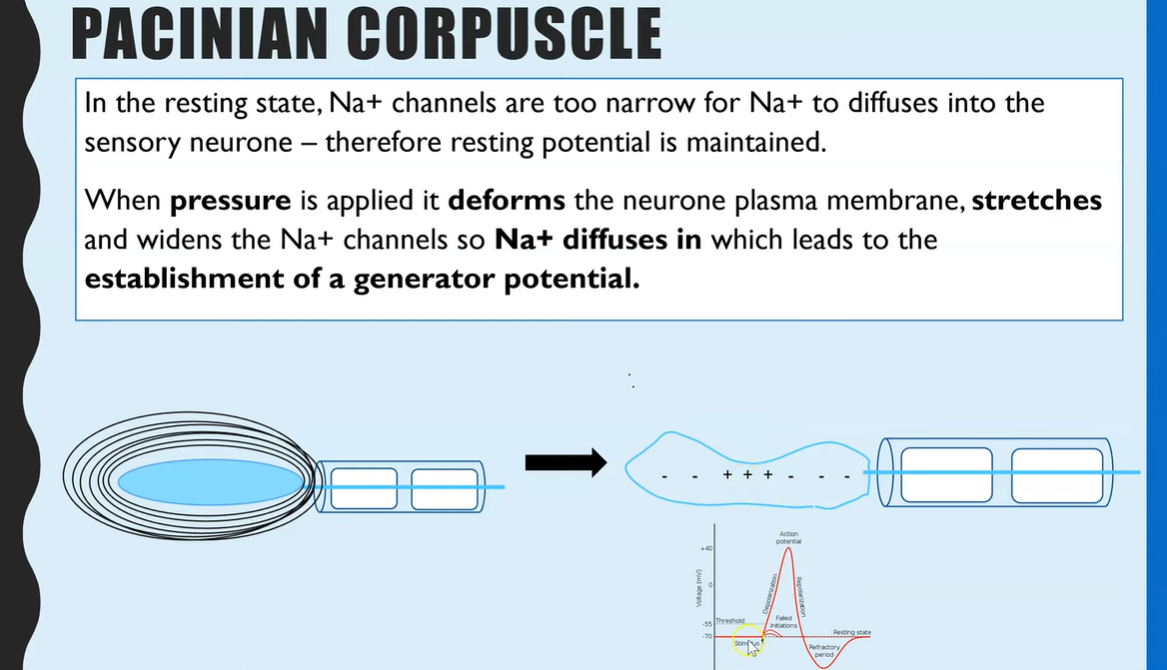
When enough pressure applied Na channels open forming AP.
9
Where are the photoreceptors found and what types?
In the retina containing rod and cone cells
10
Rod cells?
Used to detect light of very low intensity as many rods cells connect to one sensory neurone but gives low visual acuity(low resolution)
11
How do they work at low intensity?
To form AP enough rhodopsin needs to be broken down which requires little light intensity and multiple rod cells connect to one neurone making it even easier to form AP via spatial summation
12
Cone cells?
Three types of them which contain different types of iodopsin which absorb different wavelengths of light.(red,green,blue).
Iodopsin only broken if there is high light intensity
No spatial summation
High visual acuity
Iodopsin only broken if there is high light intensity
No spatial summation
High visual acuity
13
Distribution of rod and cone cells?
Most of cone cells at fovea as it absorbs highest amount of light while rod is distributed more evenly out
14
What controls heart beat?
Sinoatrial node(SAN) located at right atrium
Atrioventricular node(AVN) located near border of right and left ventricle within atria still
Both known as pacemakers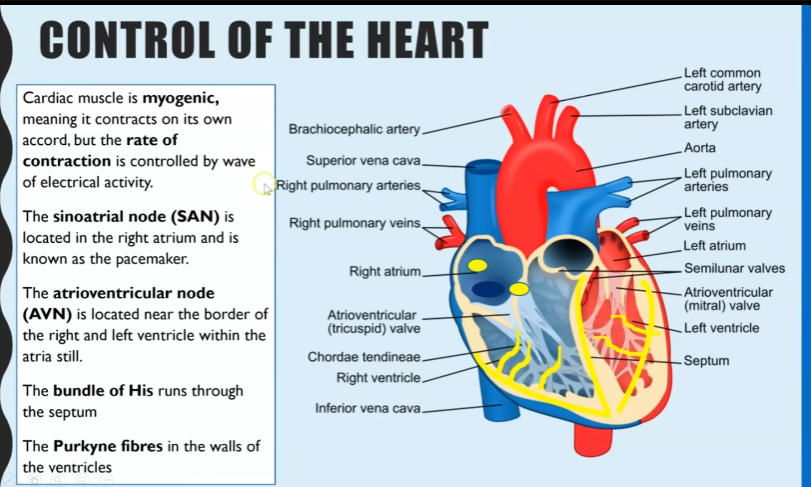
Atrioventricular node(AVN) located near border of right and left ventricle within atria still
Both known as pacemakers
15
Bundle of His?
Conductive and Runs through septum
16
Control of heart beat?
1)SAN gives electrical impulse causing atria to contract, this then stimulates AVN
2)AVN delays impulse giving time for blood to go to ventricle.
3)Impulse passed down bundle of his being electrical insulating which forces impulse to carry along down to the apex of heart, delaying contraction of ventricles further.
4)Electrical impulse travels up and out the purkyne fibres from apex, causing ventricle to contract from bottom.
2)AVN delays impulse giving time for blood to go to ventricle.
3)Impulse passed down bundle of his being electrical insulating which forces impulse to carry along down to the apex of heart, delaying contraction of ventricles further.
4)Electrical impulse travels up and out the purkyne fibres from apex, causing ventricle to contract from bottom.
17
what part of brain controls heart rate
Medulla oblungata in brain via autonomic nersvous system which contains two parts linked to SAN.
One increases heart rate via sympathetic nervous system
One decreases heart rate via parasympathetic system
One increases heart rate via sympathetic nervous system
One decreases heart rate via parasympathetic system
18
Receptors?
Found in carotid arteries(neck) and aorta
Chemoreceptors - Detect change in pH of blood ie CO2
Baroreceptors-Detect change in blood pressure
Chemoreceptors - Detect change in pH of blood ie CO2
Baroreceptors-Detect change in blood pressure
19
Low blood pressure?
1)Baroreceptors detect this and causes more impulses sent to medulla.
2)More impulses sent via sympathetic nervous system to SAN to increase heart rate frequency
For high instead more impulse sent via parasympathetic
2)More impulses sent via sympathetic nervous system to SAN to increase heart rate frequency
For high instead more impulse sent via parasympathetic
20
Low pH?
1)Chemoreceptor detect this and causes more impulse sent to medulla
2)More impulses sent via sympathetic nervous system to SAN to increase heart rate frequency
For high more impulse sent via parasympathetic
2)More impulses sent via sympathetic nervous system to SAN to increase heart rate frequency
For high more impulse sent via parasympathetic