3.7.2 and 3.7.3 Populationsand Evolutions may lead to speciation
Study these flashcardsFree · spaced repetition · iPhone, Android, Mac & web
All cards
1
Gene pool?
All alleles of all genes of all individuals in a population at one time
2
Allele frequency?
Proportions of an allele within a gene pool
3
Population?
All the individuals of one species in same area at same time that can interbreed to produce fertile offspring
4
What is Hardy-weinberg equation
used to calculate allele frequency in a population
5
What are the assumptions?
Allele frequency of alleles remain same from one gen to next which relies on 5 assumptions being:
- NO SELECTION
- NO MUTATION
- NO MIGRATION
- LARGE POPULATION
- RANDOM MATING
- NO SELECTION
- NO MUTATION
- NO MIGRATION
- LARGE POPULATION
- RANDOM MATING
6
First equation of Hardy weinberg?`
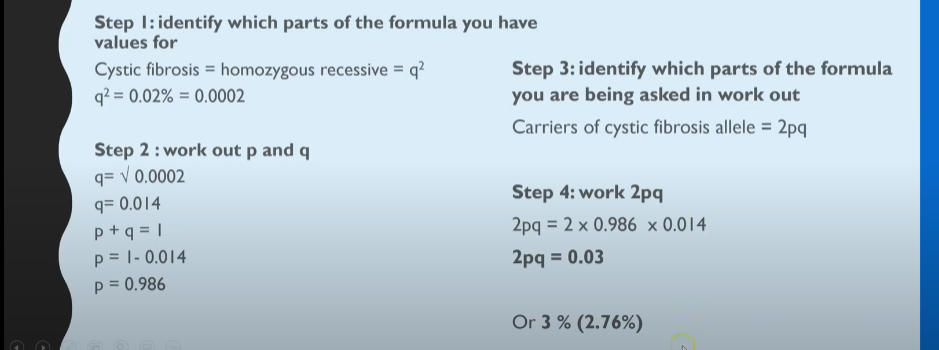
p + q = 1
p = frequency of dominant allele
q = frequency of reccessive allele
p = frequency of dominant allele
q = frequency of reccessive allele
7
SEcond equation of hardy weinberg?
p$^2$+2pq +q$^2$ = 1
p$^2$= frequency of dominant genotype
2pq = frequency of hetero genotype
q$^2$= frequency of recessive genotype
p$^2$= frequency of dominant genotype
2pq = frequency of hetero genotype
q$^2$= frequency of recessive genotype
8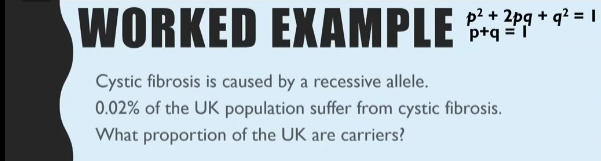
9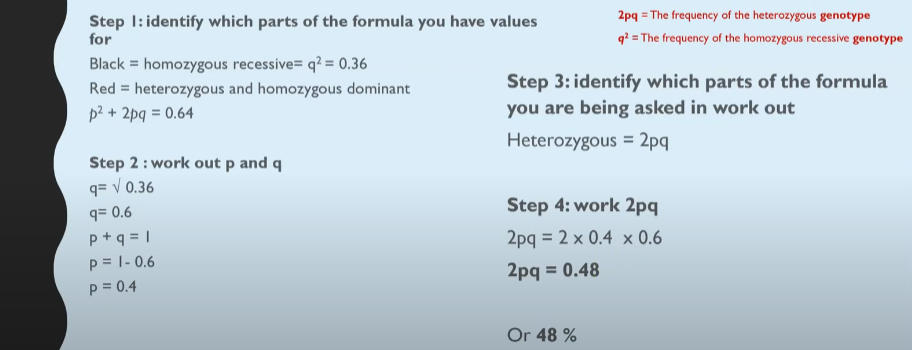
red is dominant black is recessive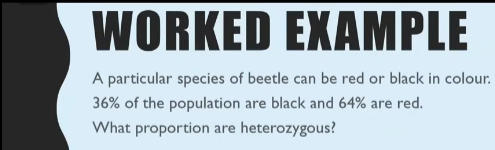
10
Relation of disruptive selection with speciation?
Disruptive selection can lead to speciation
11
whats speciation?
Evolution of a new species from an existing one
Occurs when one population splits and becomes reproductively isolated
Occurs when one population splits and becomes reproductively isolated
12
How can species become reproductively isolated?
Allopatric(geographically)
Sympatric(changes in reproductive mechanisms)
Sympatric(changes in reproductive mechanisms)
13
Examples of sympatric speciation?
Mutation leading to different courtship sequences
Mutation leading to becoming fertile at different times
Mutation leading to becoming fertile at different times
14
Genetic drift?
Change in allele frequency in a population from one generation to the next
The smaller the population the bigger impact a change in allele frequency does.
Evolutions occurs must faster in smaller populations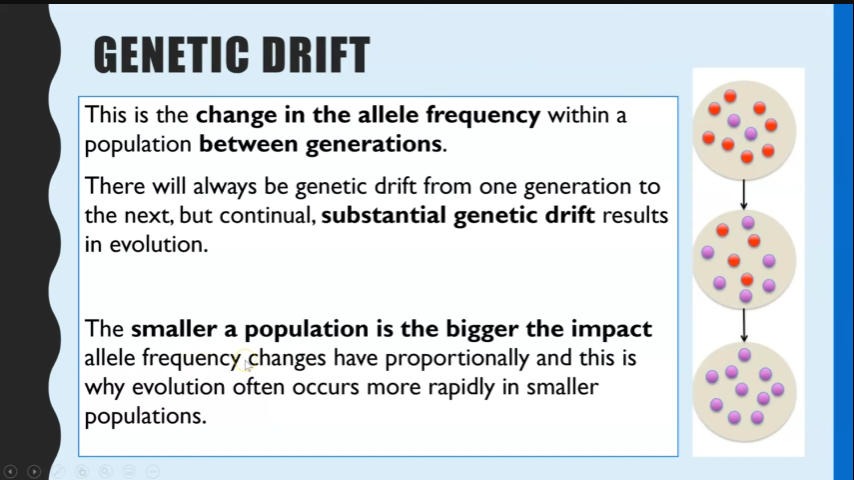
The smaller the population the bigger impact a change in allele frequency does.
Evolutions occurs must faster in smaller populations
15
Example of allopatric speciation
1)A population with genetic variation live together in an area
2)Habitat is split due to geographical barrier splitting the population into two, preventing them from interbreeding
3) Both groups will suffer different selection pressures leading to different alleles being favoured
4)Over time the allele frequencyand phenotypes of groups will be so different they aren't classified as same species (cant interbreed)
2)Habitat is split due to geographical barrier splitting the population into two, preventing them from interbreeding
3) Both groups will suffer different selection pressures leading to different alleles being favoured
4)Over time the allele frequencyand phenotypes of groups will be so different they aren't classified as same species (cant interbreed)