3.2.5 transition metals holy smoke
Study these flashcardsFree · spaced repetition · iPhone, Android, Mac & web
All cards
1
What are transition metals?
Elements which contain an incomplete d sub shell in atleast one of its stable ions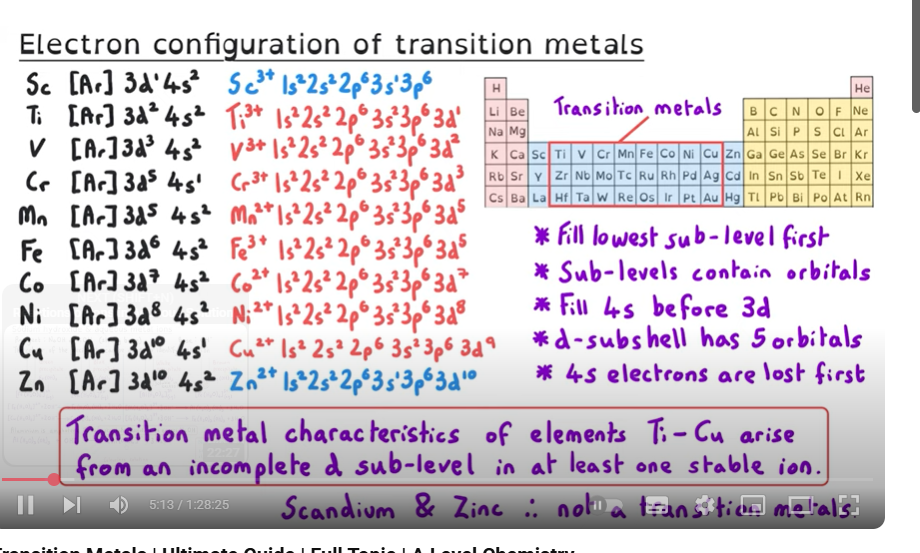
2
Properties of transition metals?
Complex formation
Catalytic activity
Formation of colored ion
Variable oxidation states
Catalytic activity
Formation of colored ion
Variable oxidation states
3
Transition metal colours stuff?
When white light is shined at a transition metal it absorbs specific wavelengths due to it having an incomplete d shell while rest get reflected/transmitted through
4
Why transition metal complex ions coloured?
When ligands bond to transition metal it causes d subshell to split into ground and excited state.
When white light is shined electrons in ground state will absorb a specific amt of energy and move to excited state
The difference in energy is ΔE which corresponds to wavelengths of light absorbed
When white light is shined electrons in ground state will absorb a specific amt of energy and move to excited state
The difference in energy is ΔE which corresponds to wavelengths of light absorbed
5
Equations need to know for coloured ions
ΔE = hv and c = vλ these can be linked to form ΔE = h x c/λ
ΔE = Joules
h = plancks constant(dont need to memorise number)
v = frequency Hz
c = wave speed(ms$^{-1}$)
λ = wavelength(m)
ΔE = Joules
h = plancks constant(dont need to memorise number)
v = frequency Hz
c = wave speed(ms$^{-1}$)
λ = wavelength(m)
6
Exam question way to answer why transition metal absorb specific colour?
Certain wavelengths of white light are absorbed and these move 3d sub shell electrons from ground to excited state. Wavelengths of light not absorbed are transmitted and is what we see
7
Factors which change colour in TMs/complex ions
Oxidation state
coordination number
ligand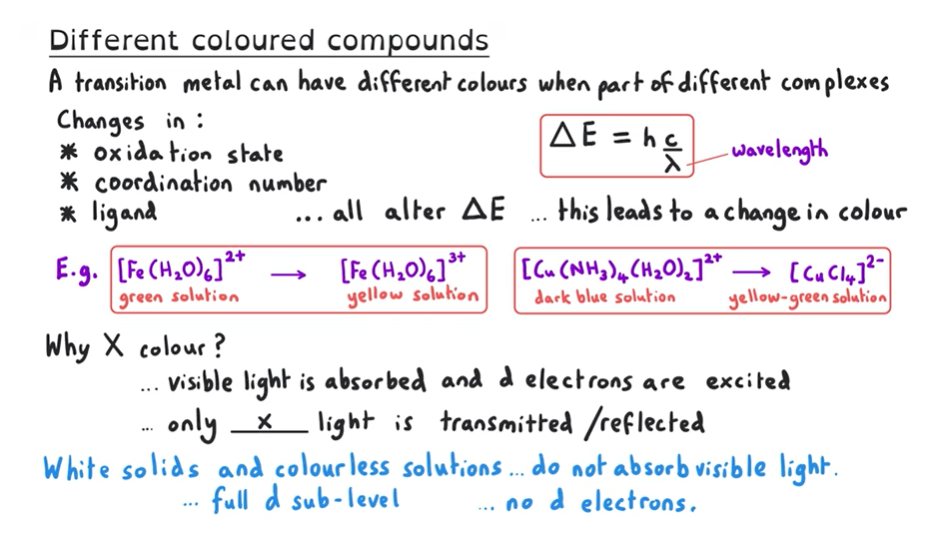
coordination number
ligand
8
Colorimetry?
-White light is shined and a coloured filter which only transmits the wavelength of light that the sample absorbs best
-Sample then placed after and detector which measures absorbance/transmittance.(it it set to zero with distilled water)
-Sample then placed after and detector which measures absorbance/transmittance.(it it set to zero with distilled water)
9
actual steps of calorimetry?
1)First create a calibration curve via measure absorbance of range of known concentration
2)then plot absorbance vs concentration.
3)Take solution with unknown concentration and measure absorbance
4)Use graph to read across and calculate concentration
2)then plot absorbance vs concentration.
3)Take solution with unknown concentration and measure absorbance
4)Use graph to read across and calculate concentration
10
Redox potential?
Indicates how easily an ion is reduced and the redox potential for TM ions is influenced by the ligand and pH
11
Whata a complex?
Central metal atom/ion surrounded by ligands
12
Ligand?
Molecule/ion which forms a co-ordinate bond with a centre metal atom/ion via lone pair of electrons
13
Types of catalyst?
Heterogeneous = different state from reactants (like solid catalyst and gas reactants) eg haber process
Homogeneous = same state
Homogeneous = same state
14
First homogenous example?
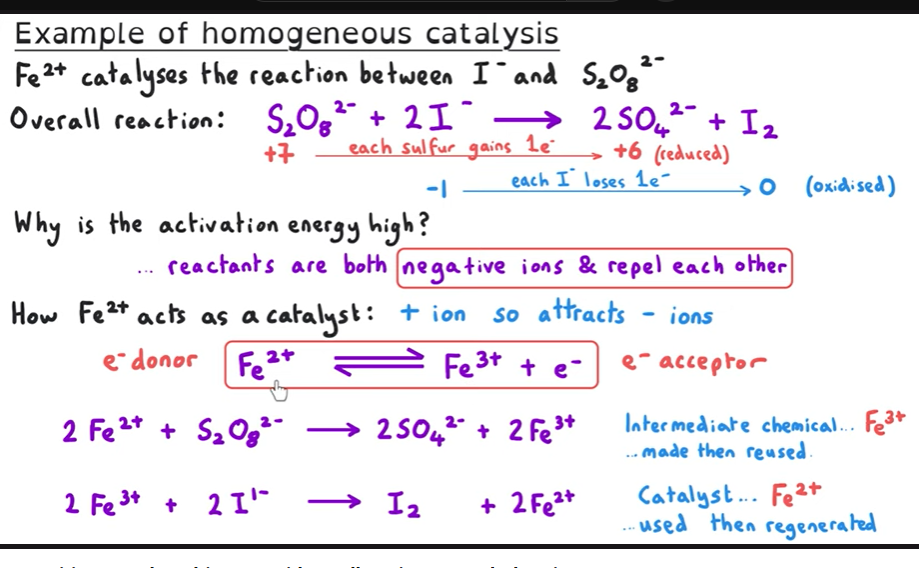
Overall reaction :S₂O₈²- + 2 I⁻ --> I₂ + 2 SO₄²⁻
Fe$^{2+}$ catalysts reaction between I$^{-}$ and S2O8$^{2-}$
FE$^{2+}$ REDUCES S2O8$^{2-}$ and FE$^{3+}$ OXIDISES I$^{-}$
2 Fe²⁺ + S₂O₈²⁻ → 2 SO₄²⁻ + 2 Fe³⁺
2 Fe³⁺ + 2 I⁻ → I₂ + 2 Fe²⁺
Catalyst is regenerated
Fe$^{2+}$ catalysts reaction between I$^{-}$ and S2O8$^{2-}$
FE$^{2+}$ REDUCES S2O8$^{2-}$ and FE$^{3+}$ OXIDISES I$^{-}$
2 Fe²⁺ + S₂O₈²⁻ → 2 SO₄²⁻ + 2 Fe³⁺
2 Fe³⁺ + 2 I⁻ → I₂ + 2 Fe²⁺
Catalyst is regenerated
15
Autocatalysis?
Product of reaction catalyses reaction and it starts slow then speeds up
overall equation : 2MNO4$^{-}$ + 5C2O4$^{2-}$ + 16H$^{+}$ --> 2Mn$^{2+}$ +10CO2 + 8H20
Mn2+ catalyses reaction as it can give e to MnO4 which forms Mn$^{3+}$ which can receive electron from C2O4
overall equation : 2MNO4$^{-}$ + 5C2O4$^{2-}$ + 16H$^{+}$ --> 2Mn$^{2+}$ +10CO2 + 8H20
Mn2+ catalyses reaction as it can give e to MnO4 which forms Mn$^{3+}$ which can receive electron from C2O4
16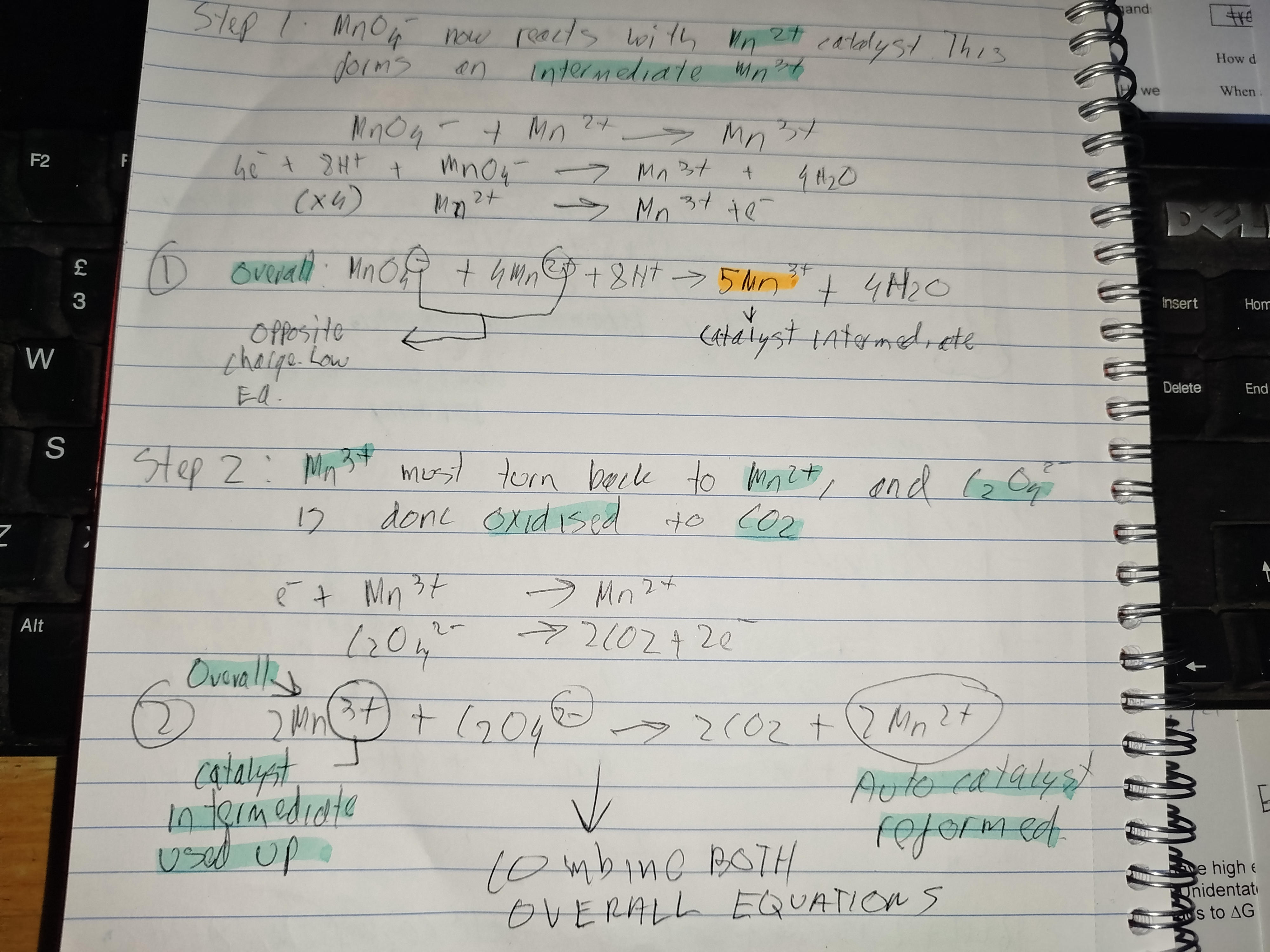
Autocatalysis mechanism
17
why are these 2 homo reactioms bad
Both reactants are negatively charged so repel eachother leading to high activation energy
18
How to maximise hetero catalyst?
Use support medium to coat it around and turn it into powder/pellet catalyst to maximise surface area of catalyst and minimise cost
19
How heterocatalysts work?
1)One of reactants adsorbs(weakly bonds to) onto active site on surface of catalyst
2)Reactant has their bonds weakened and since theres a high concentration of them in surface and is stationary there are more successful collisions.
3)Product is desorbed from active site
2)Reactant has their bonds weakened and since theres a high concentration of them in surface and is stationary there are more successful collisions.
3)Product is desorbed from active site
20
Catalyst poisoning
Catalyst can be poisoned via two ways:
Impurities adsorb/ block active sites preventing reactant from adsorbing. Can be irreversible
Sometimes not all products desorb which leads to accumulation of poisoning.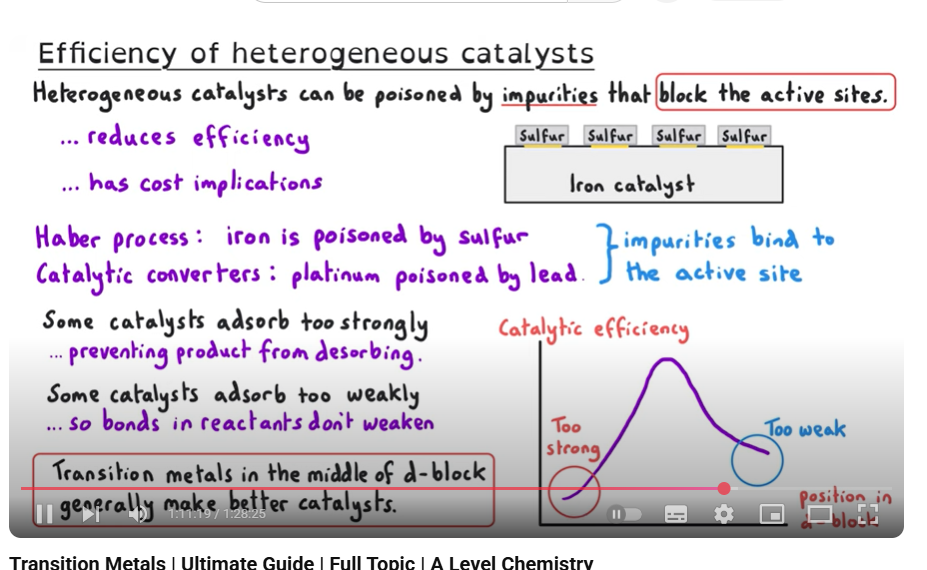
Impurities adsorb/ block active sites preventing reactant from adsorbing. Can be irreversible
Sometimes not all products desorb which leads to accumulation of poisoning.
21
Contact process?
V2O5 used as heterogeneous catalyst for making H2SO4:
V2O5 + SO2 --> SO3 +V2O4
V2O4 + 1/2O2 --> V2O5 (catalyst regen)
After cancelling catalyst you get:
SO2+ 1/2O2 --> SO3
V2O5 + SO2 --> SO3 +V2O4
V2O4 + 1/2O2 --> V2O5 (catalyst regen)
After cancelling catalyst you get:
SO2+ 1/2O2 --> SO3
22
Co-ordination number?
Number of co-ordinate bonds to a central metal (usually 4/6)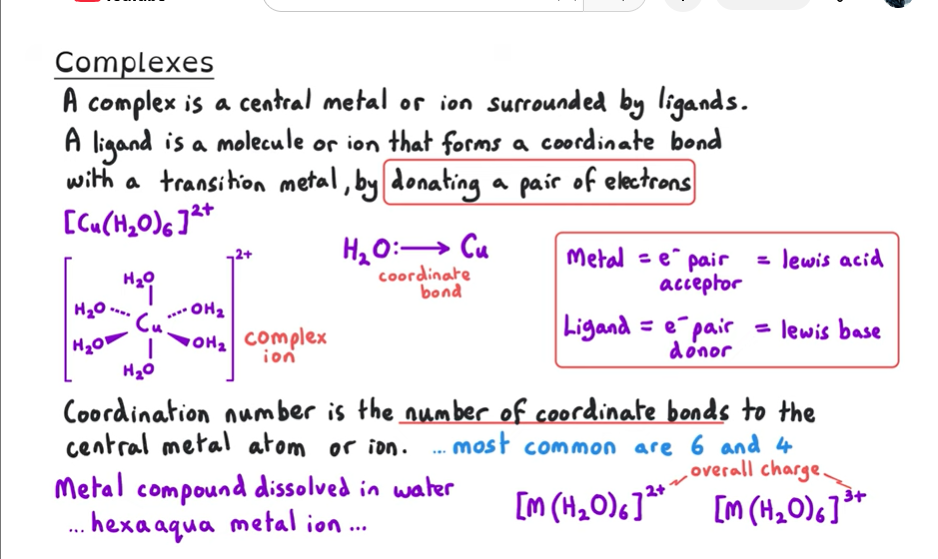
23
Types of ligands?
Monodentate = only forms one co-ordinate bond to metal (H20,NH3,CL$^-$
Bidentate = forms two co ordinate bonds to metal(Ethanediote = C2O4$^2-$ Ethane-1,2-diamine)
Multidentate = forms multiple co ordinate bonds to metale EDTA$^{4-}$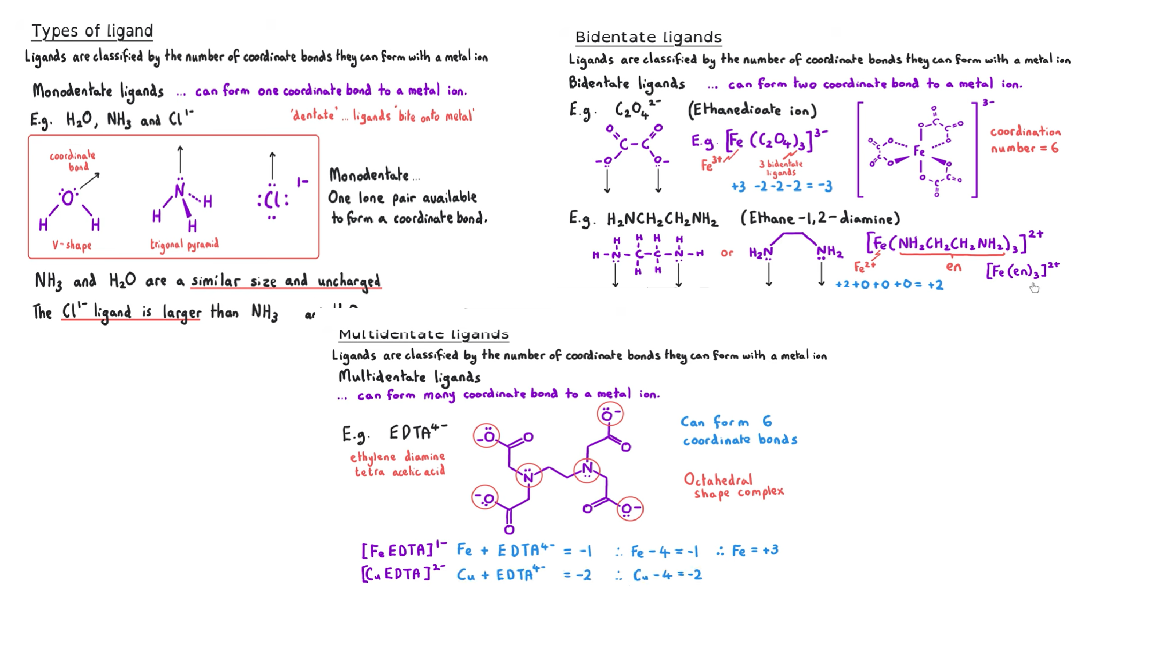
Bidentate = forms two co ordinate bonds to metal(Ethanediote = C2O4$^2-$ Ethane-1,2-diamine)
Multidentate = forms multiple co ordinate bonds to metale EDTA$^{4-}$
24
SHAPES OF COMPLEX IONS?
Octahedral complex with small ligands(3/6 bonds and 90$^o$)
Tetrahedral with larger ligands(4 bonds and 109.5$^0$)
Linear (2 bonds and 180 degrees such as [Ag(NH3)2]$^+$ aka tollens)
Tetrahedral with larger ligands(4 bonds and 109.5$^0$)
Linear (2 bonds and 180 degrees such as [Ag(NH3)2]$^+$ aka tollens)
25
How is tollens reagent formed?
When silver halide dissolved in NH3(ie nuclephillic sub)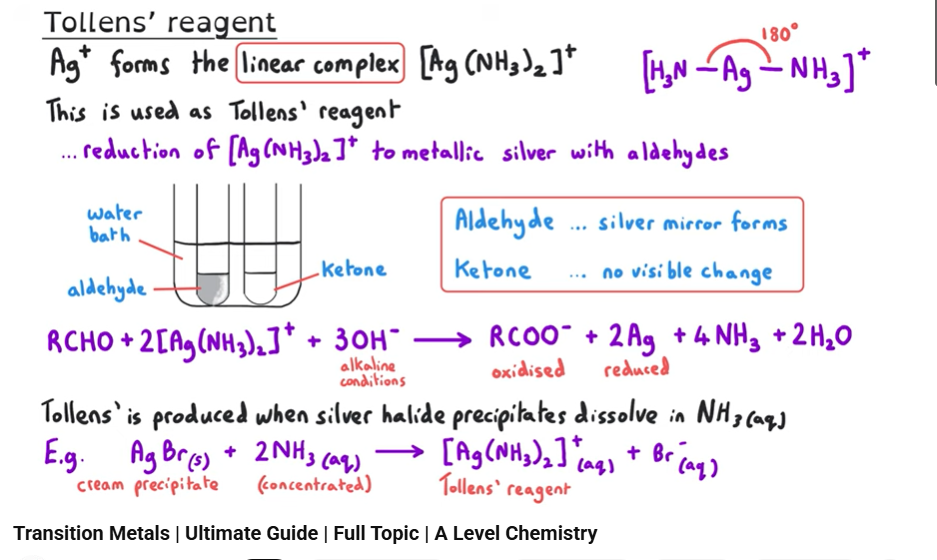
26
Isomerism in complexes?
Complexes can display stereoisomerism
eg Cis-trans isomerism in octahedral complexes with monodentate and optical with bidentate
If next to each other = Cis isomerism(like z) If opposite to each other = trans isomerism (like e)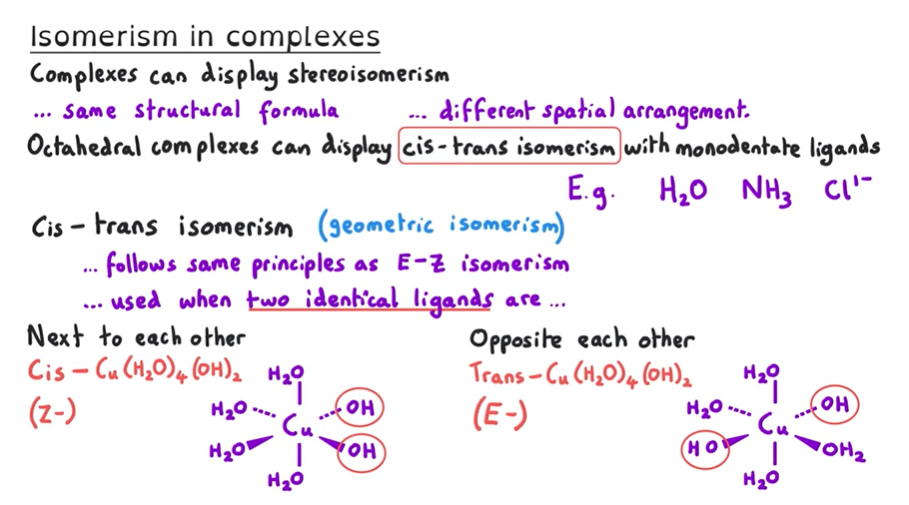
eg Cis-trans isomerism in octahedral complexes with monodentate and optical with bidentate
If next to each other = Cis isomerism(like z) If opposite to each other = trans isomerism (like e)
27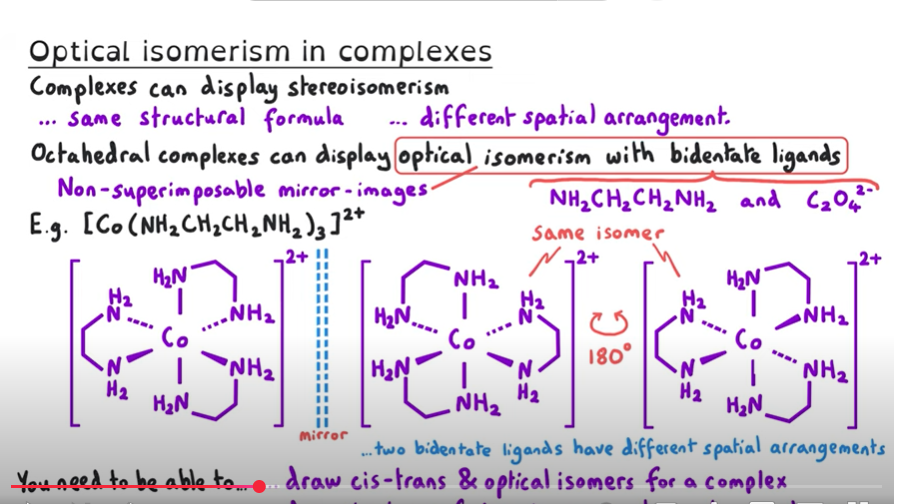
Image occlusion: name the hidden labels
28
Cisplatin?
Forms sqaure planar complex as PT(NH3)2CL2 and has cis-trans isomerism
Cisplatin is ligans next to eachother while trans-platin opposite side
Only cisplatin can act as anti cancer drug
Cisplatin is ligans next to eachother while trans-platin opposite side
Only cisplatin can act as anti cancer drug
29
Ligand substitution reactions?
When one ligand replaces another ligand type:
When concentrated NH3 replaces H20 it doesnt change co ordination number:
[Co(H20)6]$^2+$ + 6NH3 ---> [Co(NH3)6]$^{2+}$ + 6H20
IT CAN ALSO BE INCOMPLETE THO
[Co(H20)6]$^{2+}$ + 4NH3 --->[Co(NH3)4(H20)2]$^{2+}$ + 4H20
When concentrated NH3 replaces H20 it doesnt change co ordination number:
[Co(H20)6]$^2+$ + 6NH3 ---> [Co(NH3)6]$^{2+}$ + 6H20
IT CAN ALSO BE INCOMPLETE THO
[Co(H20)6]$^{2+}$ + 4NH3 --->[Co(NH3)4(H20)2]$^{2+}$ + 4H20
30
CHlorine ligand substitution?
When concentrated HCL replaces H20 it changes coordination number:
[Co(H20)6]$^2+$ + 4CL- ---> [CoCL4]$^{2-}$ + 6H20
[Co(H20)6]$^2+$ + 4CL- ---> [CoCL4]$^{2-}$ + 6H20
31
Chelating effect?
Happeneds when bidentate/multidentate replace unidentate ligands which results in formation of a stable complex and prevents other ligands from substituting it
This is because it leads to an increase in entropy from reactants to products(more moles in RIGHT side then left) making the reaction more feasible unlike with uni to uni.
This means the opposite way would be VERY unfeasible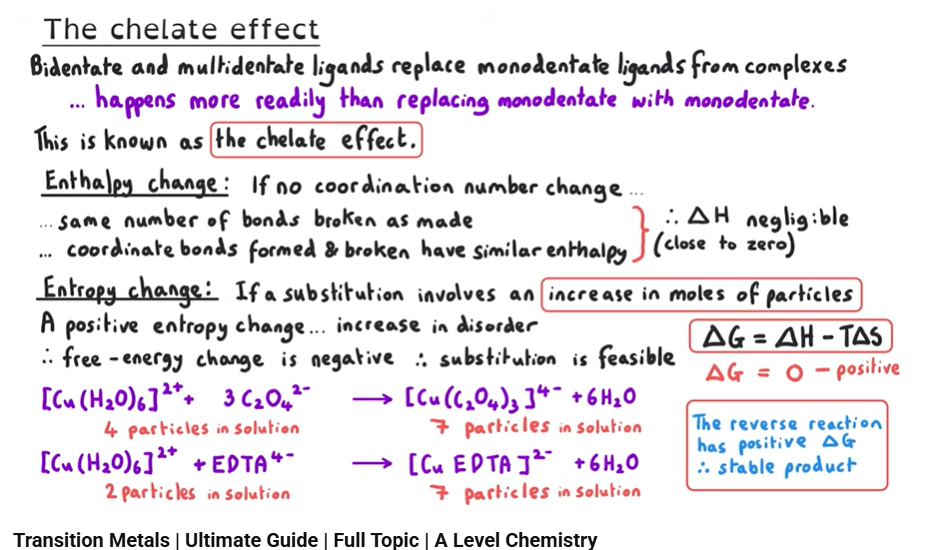
This is because it leads to an increase in entropy from reactants to products(more moles in RIGHT side then left) making the reaction more feasible unlike with uni to uni.
This means the opposite way would be VERY unfeasible
32
Haemoglobin?
It is a FE2+ with 6 co ordinate bonds with 4 from porphyrins NITROGEN, 1 from globin and one from oxygen.
Oxygen binds REVERSIBLY allowing it to be transported and then detach which H20 then takes itd place
However CO can also bind IRREVERSIBLY strongly preventing O2 from binding.
Oxygen binds REVERSIBLY allowing it to be transported and then detach which H20 then takes itd place
However CO can also bind IRREVERSIBLY strongly preventing O2 from binding.