3.3.8 ALDEHYDES AND KETONES
Study these flashcardsFree · spaced repetition · iPhone, Android, Mac & web
All cards
1
whats a carbonyl group?
C=O
Form trigonal planar shape with 3 bonds in total
Form trigonal planar shape with 3 bonds in total
2
Ketone/aldehyde relation with solubility?
The larger carbon chain = less soluble
3
Ketone naming scheme?
You only add position number of carbonyl group in ketone from pentan and onward eg pentan-2-one
carbonyl groups (such as in aldehydes/ketones/carboxylic acid) always given smallest number possible
carbonyl groups (such as in aldehydes/ketones/carboxylic acid) always given smallest number possible
4
Fehling soluition test in reference of oxidation?
Aldehydes can readily be oxidised to form Carboxylic acids while Ketones DONT
So Cu2+ in fehling get reduced and form brick red precipitaite while aldehyde gets oxidised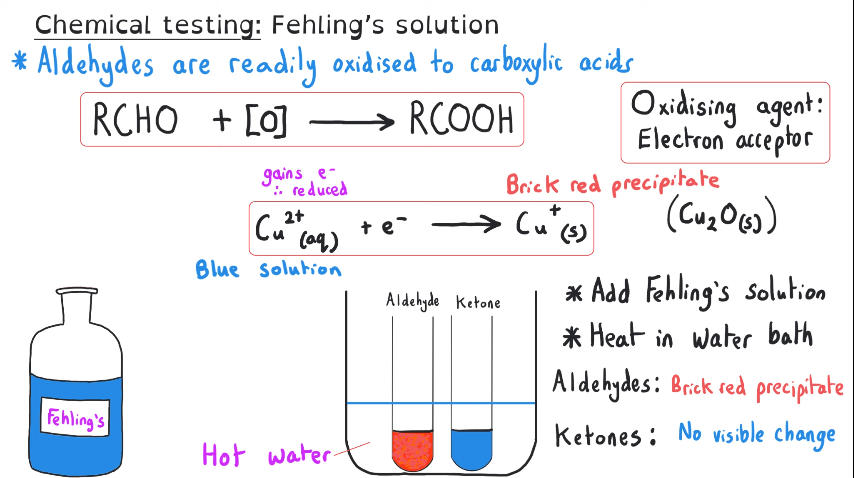
So Cu2+ in fehling get reduced and form brick red precipitaite while aldehyde gets oxidised
5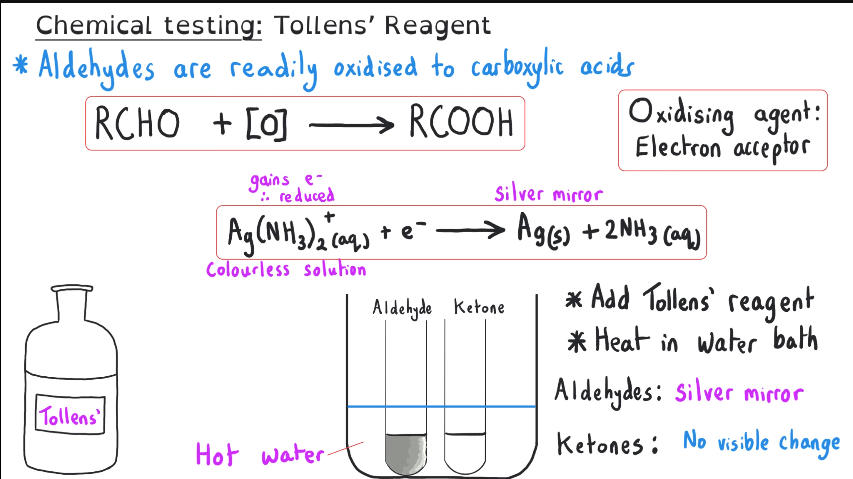
tollens solution in reference to oxidation
6
Nucleophilic addition on aldehyde/ketone (reduction) mechanism steps
1)H- attacks (partially positive) C+ and C=O turns into C-O and lone pair goes to O-
2)Lone pair on O- forms bond with H+ to form OH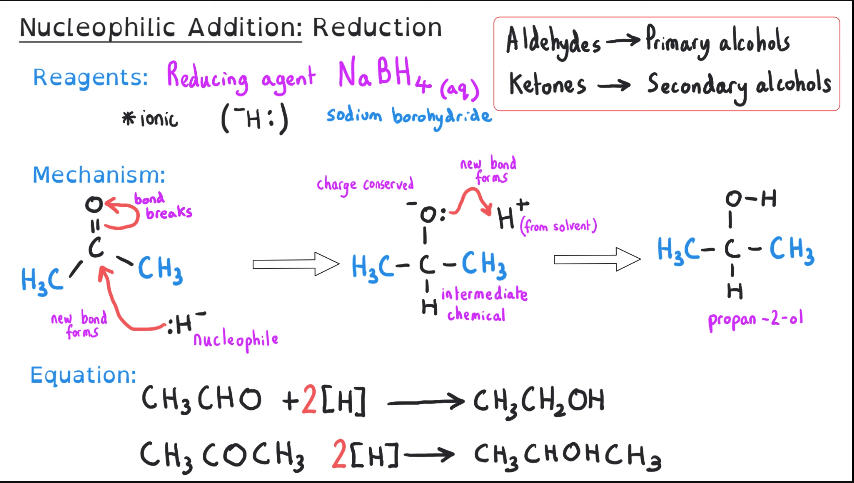
2)Lone pair on O- forms bond with H+ to form OH
7
Reactants and product of reduction
Reagent: Reducing agents eg NaBH4/LiAlH4(aq). H- source
Products : primary/secondary alcohol
Products : primary/secondary alcohol
8
Write chemical equation for ethanal with r agent (C2H4O)
2[H] one from H- and one from H+
9
Nucleophilic addition on aldehydes/ketones with CN
1) :$^-$CN attacks (partially positive) C+ and C=O turns into C-O and lone pair goes to O-
2) Lone pair on O- forms bond with H+ to form OH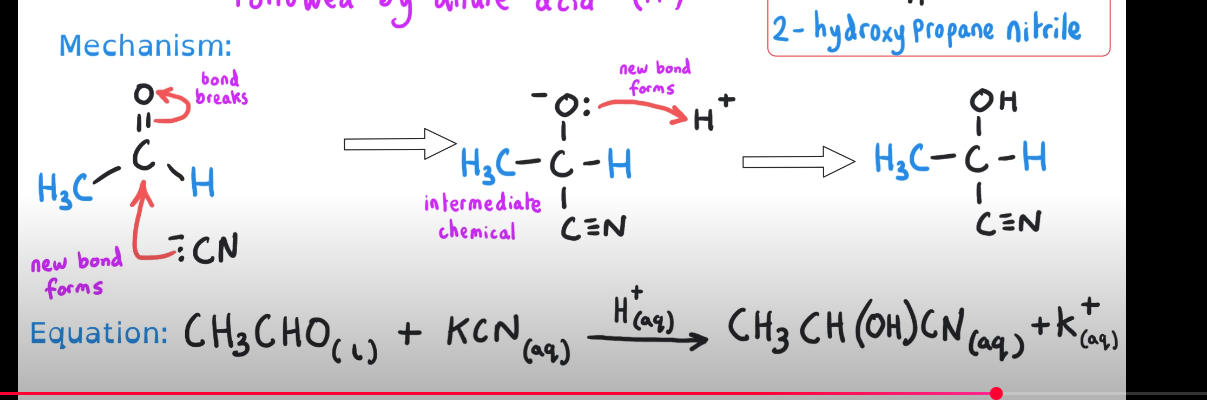
2) Lone pair on O- forms bond with H+ to form OH
10
reactants and products of CN
Reagents: potassium/sodium cyanide THEN HCL
product: hydroxynitrile
product: hydroxynitrile
11
Why using KCN kinda bad?
Its toxic and produces organic products
HCN could be replacement to use as it also doesnt need acid
BUT KCN is ionic so gives more [CN] and HCN is gas so harder to store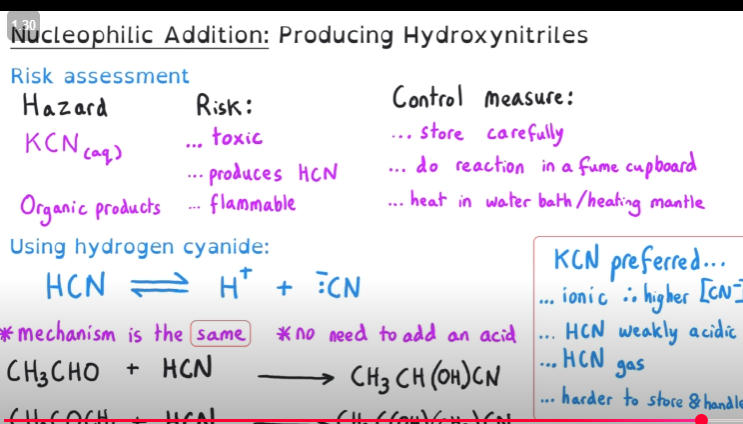
HCN could be replacement to use as it also doesnt need acid
BUT KCN is ionic so gives more [CN] and HCN is gas so harder to store