3.1.8 Thermodynamicsss
Study these flashcardsFree · spaced repetition · iPhone, Android, Mac & web
All cards
1
What is lattice formation enthalpy
ΔHL(form) = Standard enthalpy change when one mole of gaseous ions form one mole of its solid ionic lattice.
Always exo
Always exo
2
What is lattice dissociation enthalpu
ΔHL(diss) = standard enthalpy change when one mole of solid ionic lattice breaks down into its gas ions.
Always endo
Always endo
3
What is charge density?
Concentration of a charge (based on size of ion and size of charge)
4
What is 1st ionisation energy/enthalpy
ΔHiθ= enthalpy change when one mole of electrons are removed from one mole of atoms in their gaseous state to form one mole of 1+ ions in their gaseous state.
5
Is ionisation energy endo or exo?
Endothermic because your putting energy to break the electrostatic attraction between nucleus and electron. Further IE have larger endo values
6
What is electron affinity enthalpy
ΔHea= standard enthalpy when one mole of electrons are added to one mole of atoms in their gaseous state to form one mole of 1- ions in their gaseous state.
7
What will the first and second electro afinity be? exo or endo
1st = EXO as we are forming new attractions
2nd =ENDO this is because we have to overcome the repulsion from the now O- which repels the 2nd electron
2nd =ENDO this is because we have to overcome the repulsion from the now O- which repels the 2nd electron
8
What is atomisation?
ΔHatθ= standard enthalpy change when one mole of elements in their standard state form one mole of its gas atoms
Eg: Na(s) ----> Na(g) 1/2 Cl2(g) ---> Cl(g) (has to be one atom since one mole)
Atomisation energy is HALF of bond dissociation energy
Eg: Na(s) ----> Na(g) 1/2 Cl2(g) ---> Cl(g) (has to be one atom since one mole)
Atomisation energy is HALF of bond dissociation energy
9
Is atomisation ENDO or EXO:
ENDOTHERMIC AS WE ARE BREAKING ELECTROSTATIC ATTRACTIONS/BONDS
10
How to calculate ΔHf
ΔHf = ∑ all other enthalpies (inluding lattice formation_)
11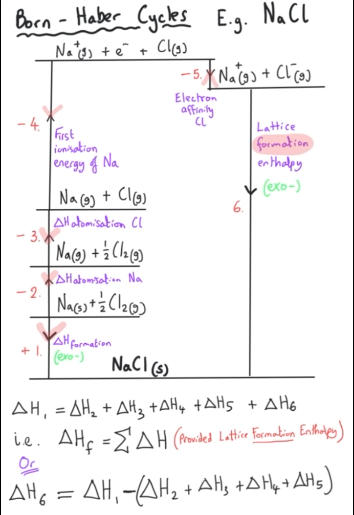
Born haber cycle for GROUP 1 AND GROUP 7:
12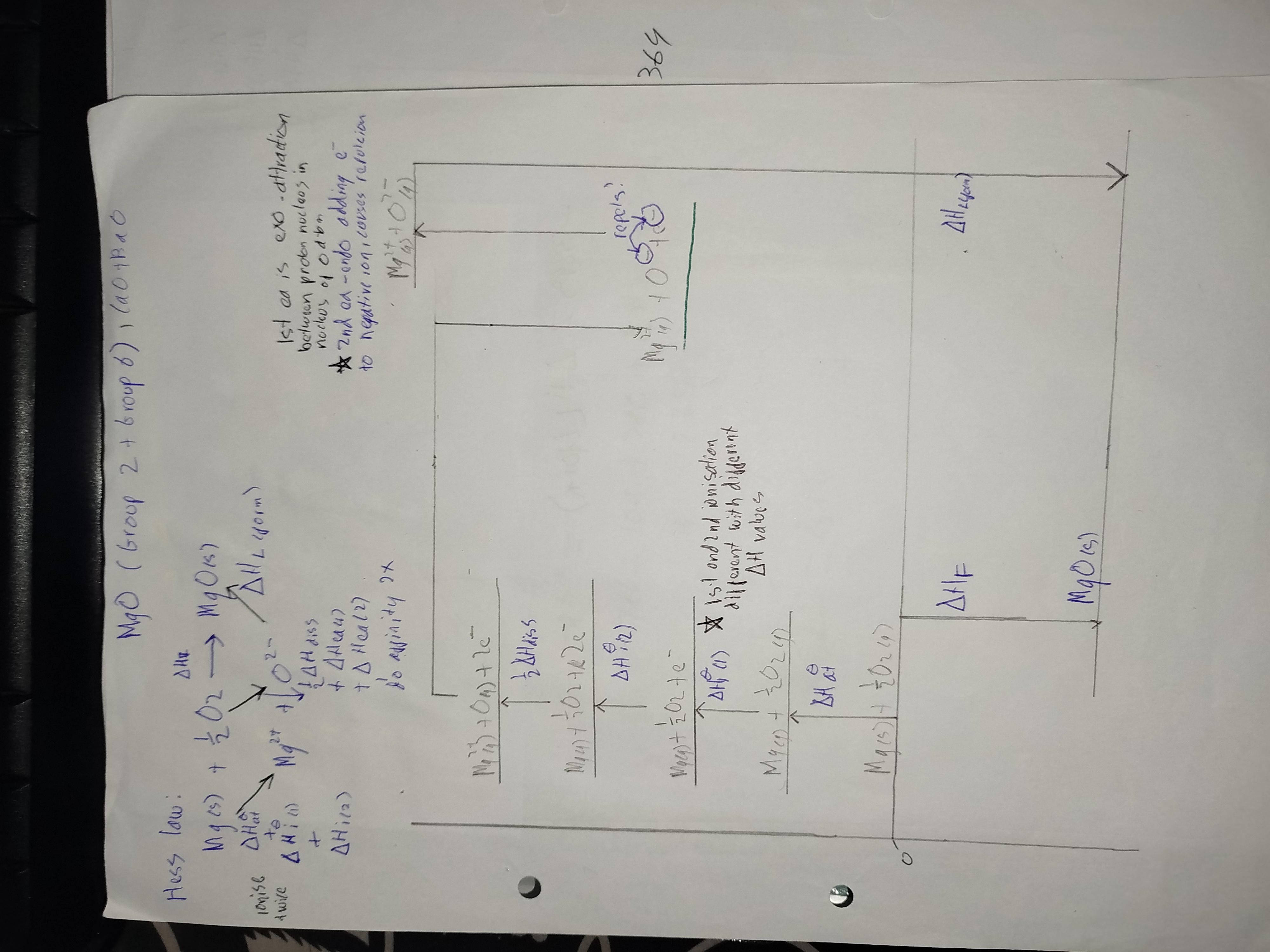
Born haver cycle for group 2 and group 6
13
There are two ways to calculate lattice enthalpy(either) what are they?
Experimental = Calculated via born haber cycle
Theoretical = uses computer model called THE PERFECT IONIC MODEL
Experimental is more accurate
Theoretical = uses computer model called THE PERFECT IONIC MODEL
Experimental is more accurate
14
What does the PERFECT IONIC MODEL assume?
Assumes all compounds are perfect spheres with no distortion (which they don't)
15
Explain me what it means if perfect model and born haber results are similar/ not similar
If similar - Compound has little to no covalent character as theres little to no polarisation due to small charge density of an atom
If not similar - Compound has significant covalent character as theres alot of polarisation due to big charge density of an atoms
If not similar - Compound has significant covalent character as theres alot of polarisation due to big charge density of an atoms
16
What is enthalpy change of solution?
ΔHsol =Standard enthalpy change when one mole of a solid ionic lattice dissolves completely in just enough water to ensure the aqueous ions dont interact with eachother anymore
17
enthalpy change of hydration?
ΔHyd =Standard enthalpy change when one mole of gas ions is completely dissolved in water to form 1 mole of aqeuous ions
18
How to calculate ΔHsol?
Break down lattice into ions and then hydrate them fully
eg : ΔHsol = ΔHLdiss + ΔHhyd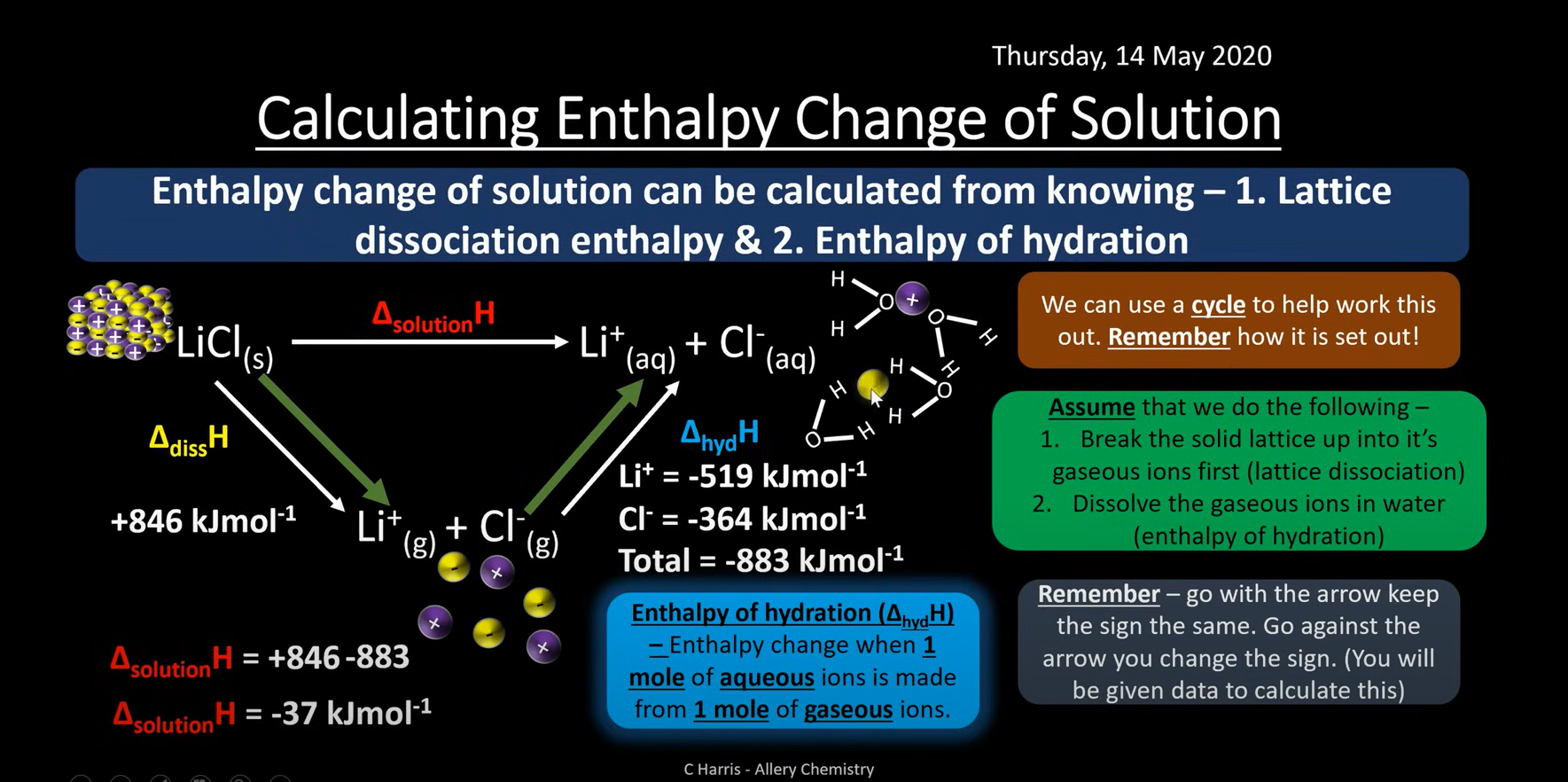
eg : ΔHsol = ΔHLdiss + ΔHhyd
19
What is a FEASIBLE reaction?
A reaction that has tendency to react without any external influences and no energy is put in overall
A reaction is feasible when DISORDER INCREASES from reactants to product
A reaction is feasible when DISORDER INCREASES from reactants to product
20
What is ENTROPY
Measure of amount of disorder in a system.
Symbol is S and units JK-1 mol-1 = Joules per kelvin per mol
Symbol is S and units JK-1 mol-1 = Joules per kelvin per mol
21
When does entropy increase and is likely to be feasible?
When from going to GAS to GAS
or LIQUID/SOLID TO GAS
or SOLID TO LIQUID
NOT GAS TO SOLID
or LIQUID/SOLID TO GAS
or SOLID TO LIQUID
NOT GAS TO SOLID
22
Correlation with moles and entropy?
IF reactants has less moles than products = ENTROPY INCREASES
IF reactants has more moles than products = ENTROPY DECREASES
IF reactants has more moles than products = ENTROPY DECREASES
23
How to calculate ΔS
ΔS = ∑S of products - ∑S of reactants
IF + = entropy increase
If - = entropy decrease
IF + = entropy increase
If - = entropy decrease
24
Symbol for Gibbs energy
ΔG
25
Gibbs reaction?
ΔG = ΔH - T $\times$ ΔS
ΔG = KJ mol-1
ΔH = KJ mol-1
ΔS = JK-1 mol-1 WILL NEED TO BE CONVERTED TO KILO JOULES
T = Temperature (Kelvin)
ΔG = KJ mol-1
ΔH = KJ mol-1
ΔS = JK-1 mol-1 WILL NEED TO BE CONVERTED TO KILO JOULES
T = Temperature (Kelvin)
26
Tell me when/if reactions are feasible if ΔH and ΔS are positive or not
Reaction is feasible if ΔG $\leq$ 0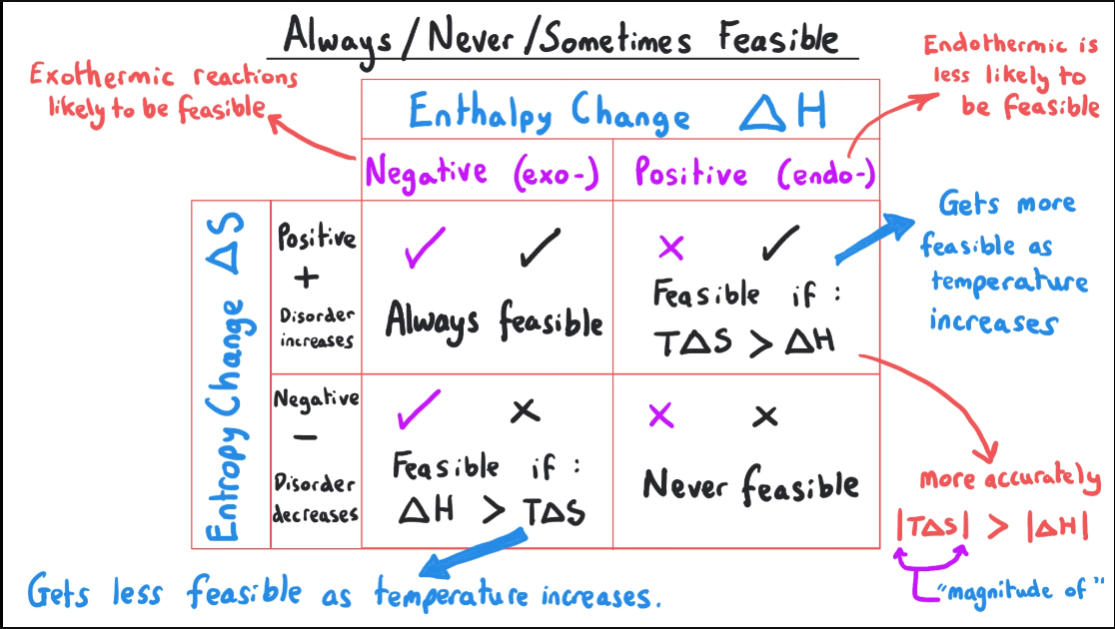
27
How to calculate what temperature reaction becomes feasible
when ΔG = 0
T =$\frac{ΔH}{ΔS}$
T =$\frac{ΔH}{ΔS}$
28
How to calculate melting point
Use T =$\frac{ΔH}{ΔS}$
as melting point = zero ΔG
as melting point = zero ΔG
29
How to plot gibbs free energy
ΔG = - ΔST + ΔH
y = m x + c
y = ΔG
m = - ΔS
x = T
c = ΔH
y = m x + c
y = ΔG
m = - ΔS
x = T
c = ΔH
30
For graph which use a positive value of ΔS, when is x feasible and how does graph look like
Any temperature greater than temperature at zero ΔG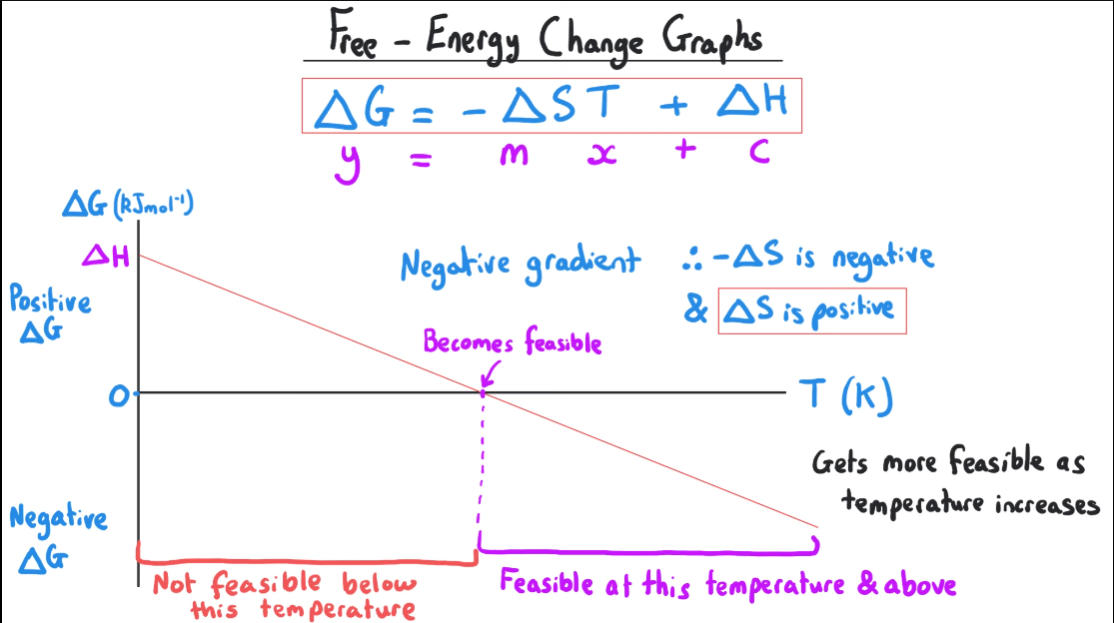
31
for GRAPHIS WHICH USE NEGATIVE VALUE OF ΔS. WHEN IS X FEASIBLE AND HOW GRAPH LOOK LIKE
Any temperature lower than temperature at zero ΔG