3.1.12 ACIDS AND BASESSS
Study these flashcardsFree · spaced repetition · iPhone, Android, Mac & web
All cards
1
Bronsted lowry definitions of acids and bases?
ACID = Proton donors
BASE = Proton acceptor
BASE = Proton acceptor
2
Acid + base reaction?
Acid + Base -----> Salt + water
eg: HCL +NaOH ----> Nacl + H2O
eg: HCL +NaOH ----> Nacl + H2O
3
Acid + metal oxide?
Acid + Metal oxide -----> Salt + water
eg : H2SO4 + CuO -----> CuSO4 + H2O
eg : H2SO4 + CuO -----> CuSO4 + H2O
4
Acid + metal carbonate?
Acid + metal carbonate -----> CO2 + Salt + Water
eg: 2HNO3 + NaCo3 -----> CO2 + 2NaNO3 + H20
eg: 2HNO3 + NaCo3 -----> CO2 + 2NaNO3 + H20
5
Acid + metal
Acid + metal ------> Salt + H2
H2SO4+ Mg ------> MgSO4 + H2
H2SO4+ Mg ------> MgSO4 + H2
6
Conjugate acid and base?
Conjugate Base : Substance formed when acid donates proton
Conjugate Acid: Substance formed when base accepts proton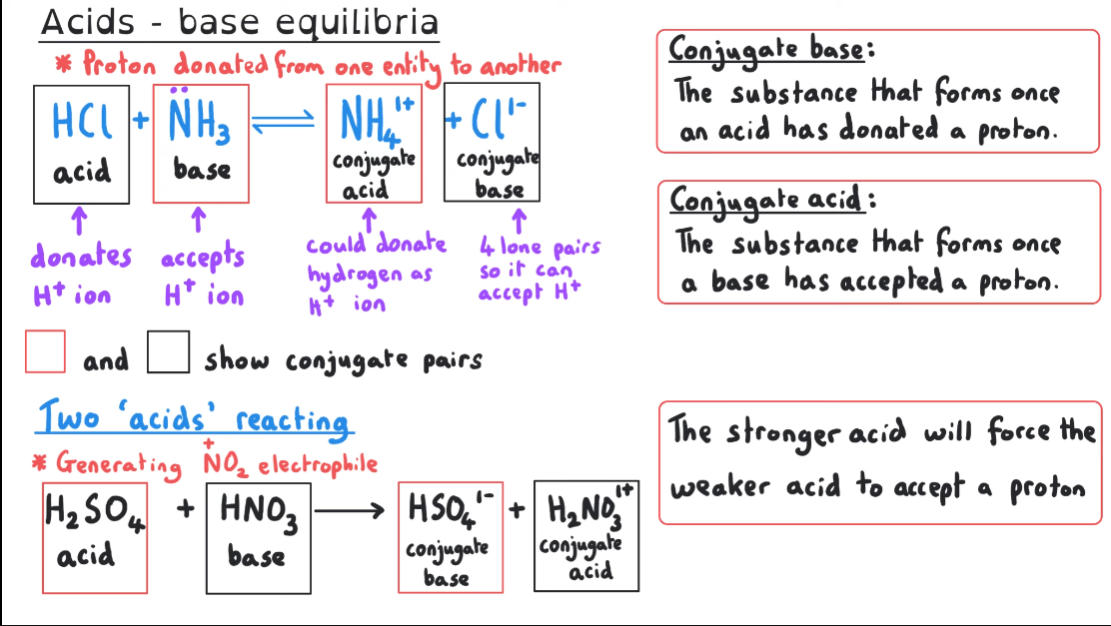
Conjugate Acid: Substance formed when base accepts proton
7
Define pH (1 mark)
pH = -log[H+]
pH is always in 2dp
pH is always in 2dp
8
Equation for [H+] concentrationss:
[H+] = $10^{-pH}$
9
Strong Acids correlation with [H+]?
Since strong acids FULLY ionise, [acid] = [H+] and acid moles = H$^+$ moles. This is for ONLY STRONG MONOPROTIC ACIDS
10
Non mono promotic acids corrrelation with [H+]?
Since these can donate more than one H+ [acid] * num of H+ donated = [H+]
11
Kw equation
Kw = [H$^+$][OH$^-$]
12
why do we cancel out H20 for making kw equation
This is because [H20] is effectively a constant as equilibrium favours it so much meaning theres so much of it
13
What does temp do to ionisation of H20?
H20 ------> 2H${^+}$ + 1/2O2
H20 ------> 2H${^+}$ + 1/2O2
Forward reaction is endo so if we increase temperature it will shift more to right so more [H$^+$] so lower pH
14
What does adding water to a solution do?
It reduces ion concentration
eg:
if you add water to acid = [H+] decreases so highter pH
If you add water to base = [OH-] decreases so lower pH
eg:
if you add water to acid = [H+] decreases so highter pH
If you add water to base = [OH-] decreases so lower pH
15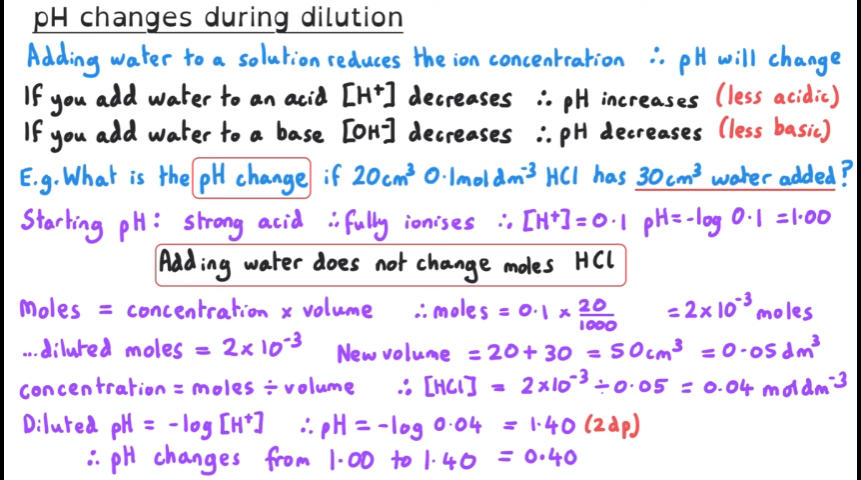
What is the pH change if 20cm$^3$ 0.1 moldm${^3}$ of HCL has 30cm$^3$ of water added.
16
what is the dissociating constant?
ka which is used to describe the strength of an acid.
The stronger the acid the bigger the value.
The stronger the acid the bigger the value.
17
Acid dissociation general equation?
HA ⇋ H$^+$ + A-
HA = undissociated acid
A- = conjugate base
HA = undissociated acid
A- = conjugate base
18
assumptions used to make ka equations?
- [H2O] is a constant
- weak acid so little dissociates so [HA] beginning = [HA] equillibrium
- [H$^+$] = [A$^-$] so combine them to [H$^+$]$^2$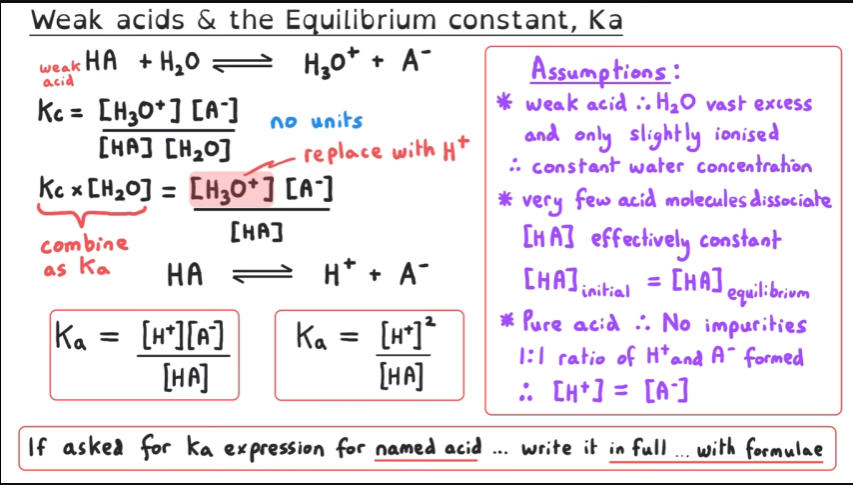
- weak acid so little dissociates so [HA] beginning = [HA] equillibrium
- [H$^+$] = [A$^-$] so combine them to [H$^+$]$^2$
19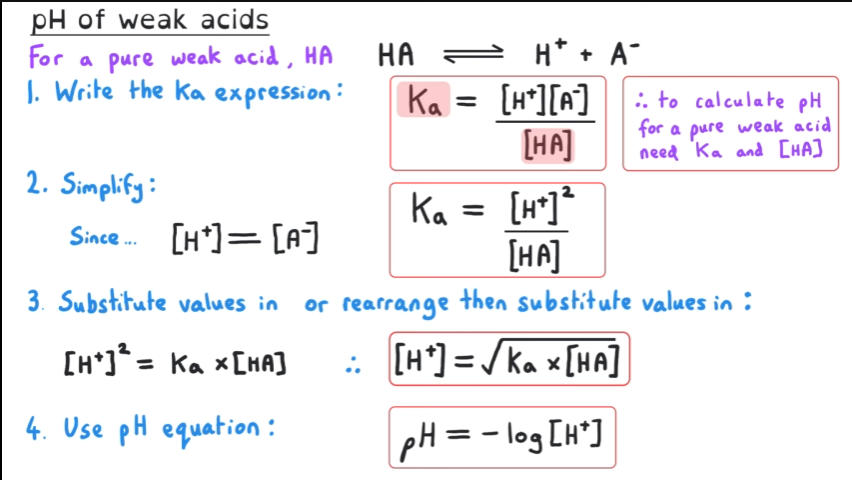
How to calculate pH of pure weak acid
20
how to convert ka to pKa
pKa = -log(ka)
ka = 10$^{-pKa}$
strong acid = big ka = smal pKa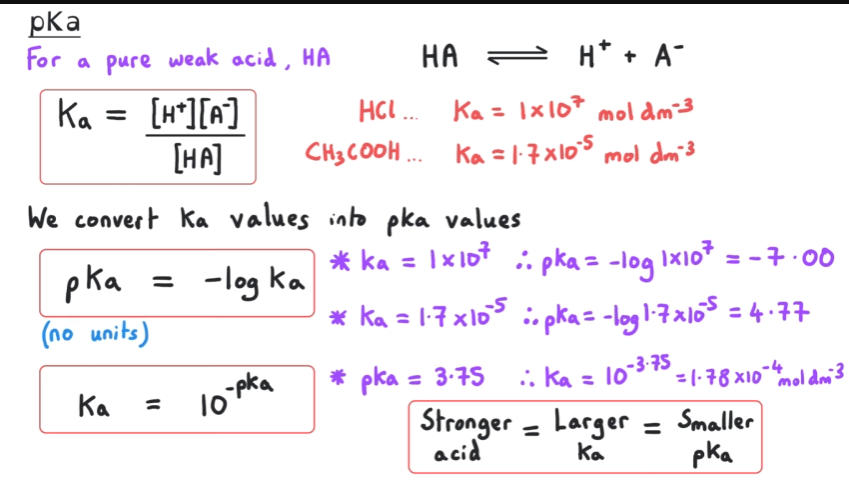
ka = 10$^{-pKa}$
strong acid = big ka = smal pKa
21
Tell me pH curves of adding acids to bases whether weak or not etc
equivalence pt is when moles of H+ = OH-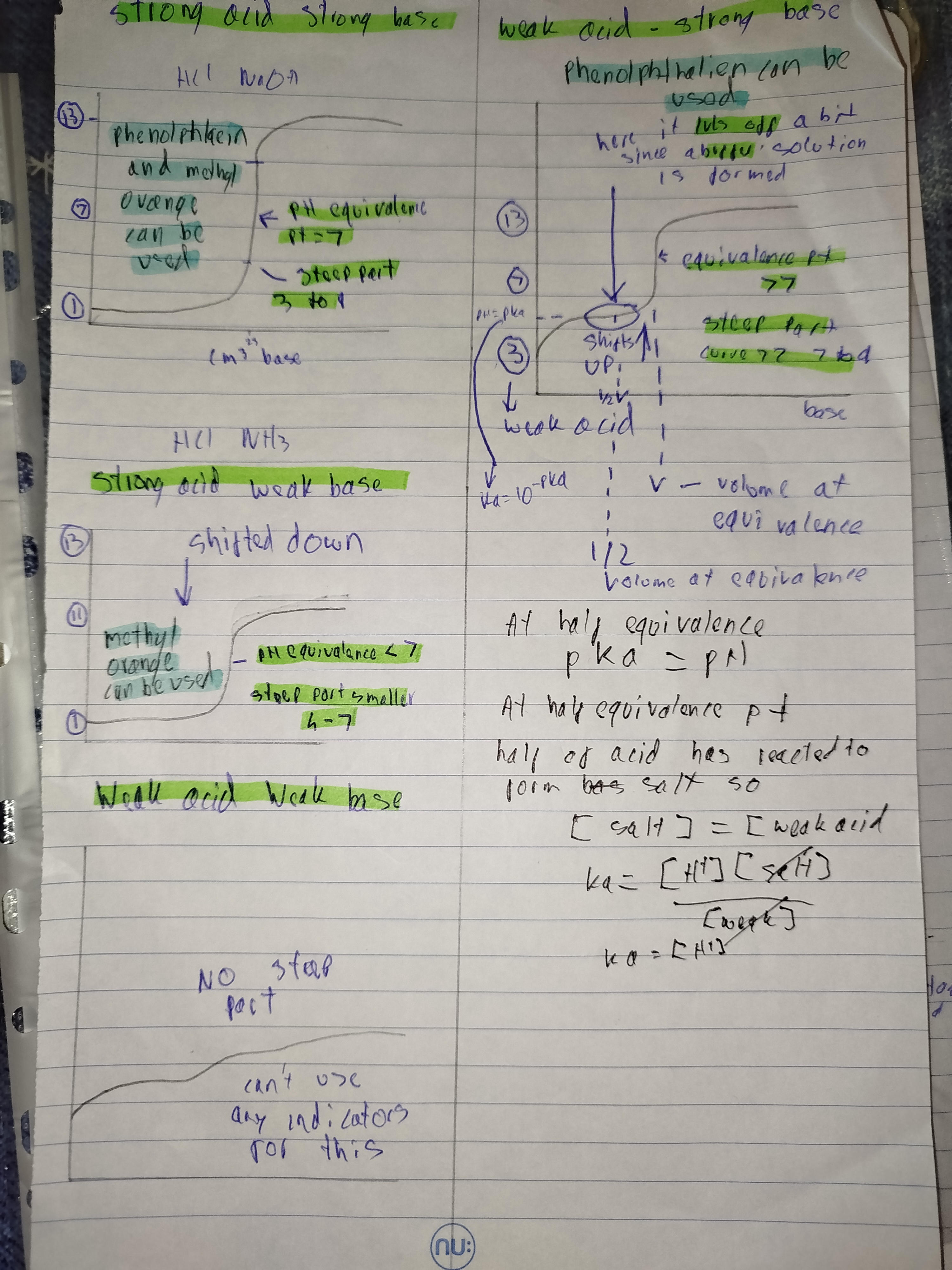
22
How to choose correct indicator for acid base titration?
If indicator colour change is inside range of equivalance steep pH range
23
Whats special about half equivalence point in pH curves?
[HA] = [A$^-$]
so ka = [H$^+$] and pKA =pH
therefore -log(ka) = -log([H+])
this can be used to identify acids as they have specific pKA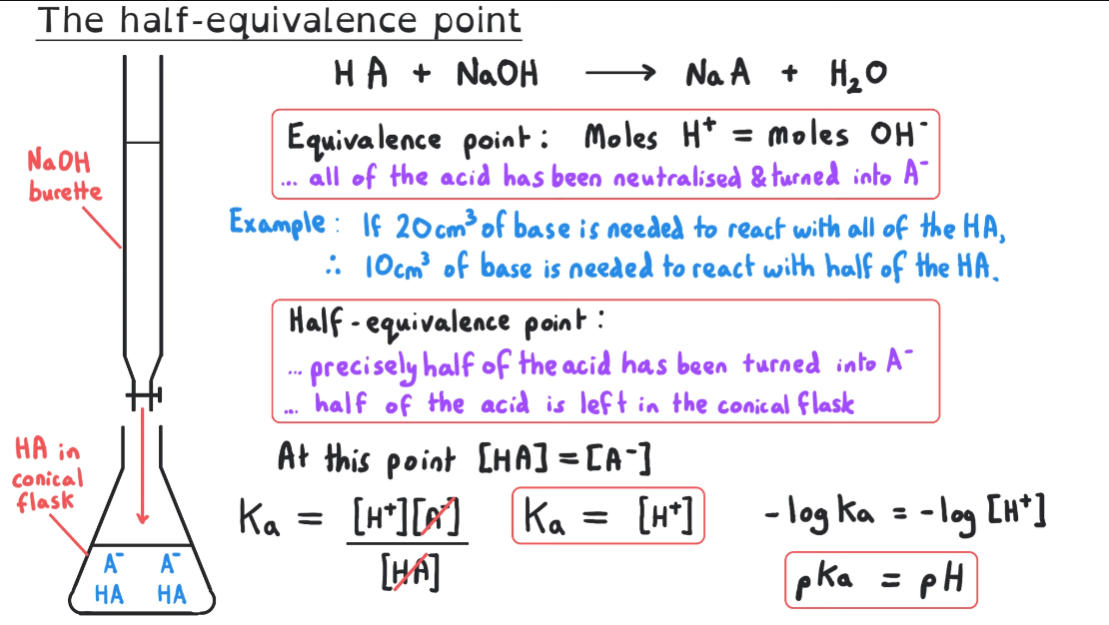
so ka = [H$^+$] and pKA =pH
therefore -log(ka) = -log([H+])
this can be used to identify acids as they have specific pKA
24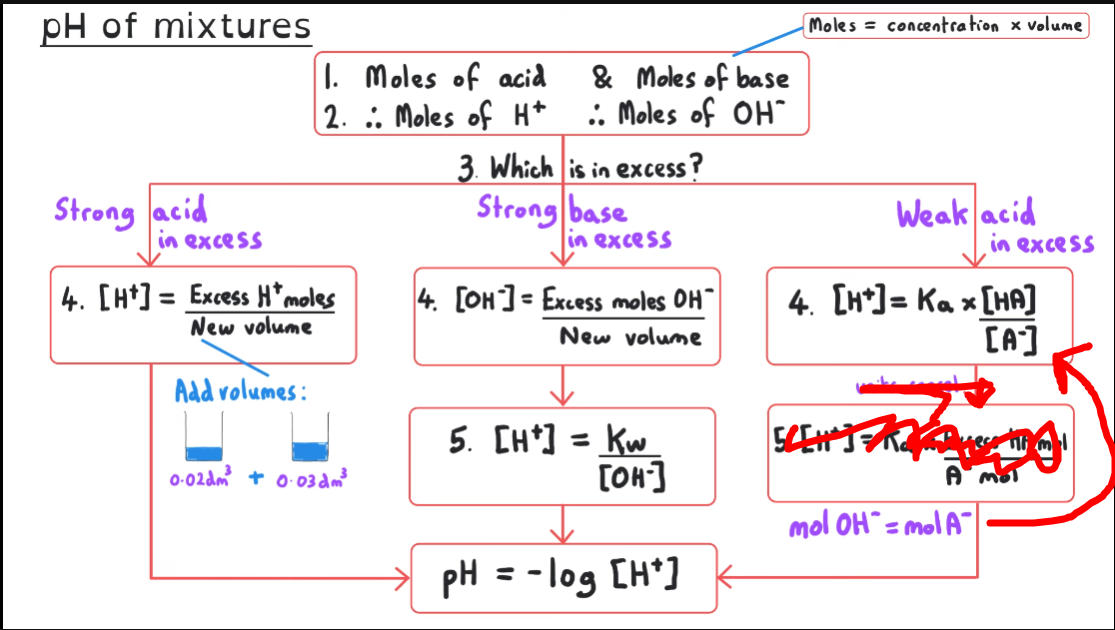
How to calculate pH of acid / base mixtures if strong acid excess/ strong base excess/ weak acid excess
25
Types of buffers?
- Acidic buffer which contains weak acid and salt of weak acid( strong conjugate base) eg CH3COOH and CH3COONa
- basic buffer which contains weak base and salt of weak base(strong conjugate acid)
Both contain a proton acceptor and proton donor
- basic buffer which contains weak base and salt of weak base(strong conjugate acid)
Both contain a proton acceptor and proton donor
26
How does an acidic buffer work
- Any H+ added are removed from dissociated salt (CH3COO-)
- Any OH- are removed from dissociated weak acid (H+) forming water.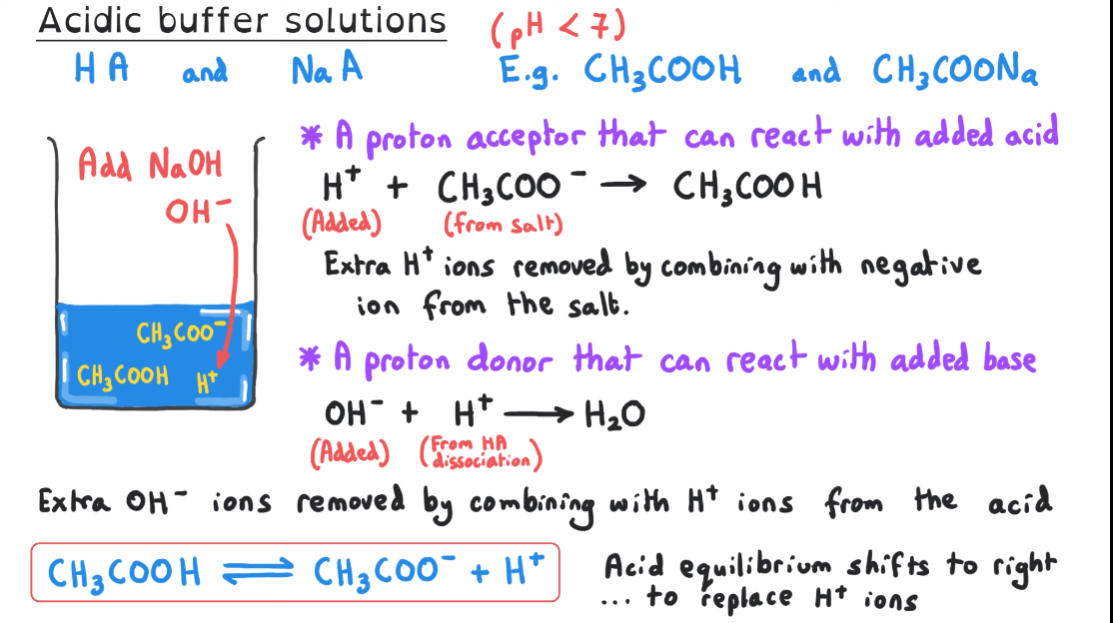
- Any OH- are removed from dissociated weak acid (H+) forming water.
27
WHat happends to the strong salts eg conjugate acid and base
They fully dissociate into ions
28
General equations for how weak acid removes OH- and how strong conjugate base remove H+
OH if added = OH- + H+ -----> H20
H if added = H$^+$ + A$^-$ -----> HA
H if added = H$^+$ + A$^-$ -----> HA
29
equation for how weak base removes H+ and how strong conjugate acid removes OH. Eg if weak base is NH3 and strong conjugate acid is NH4Cl
OH if added = NH4$^+$ + OH- ----> NH3 + H20
H if added = NH3 + H+ -----> NH4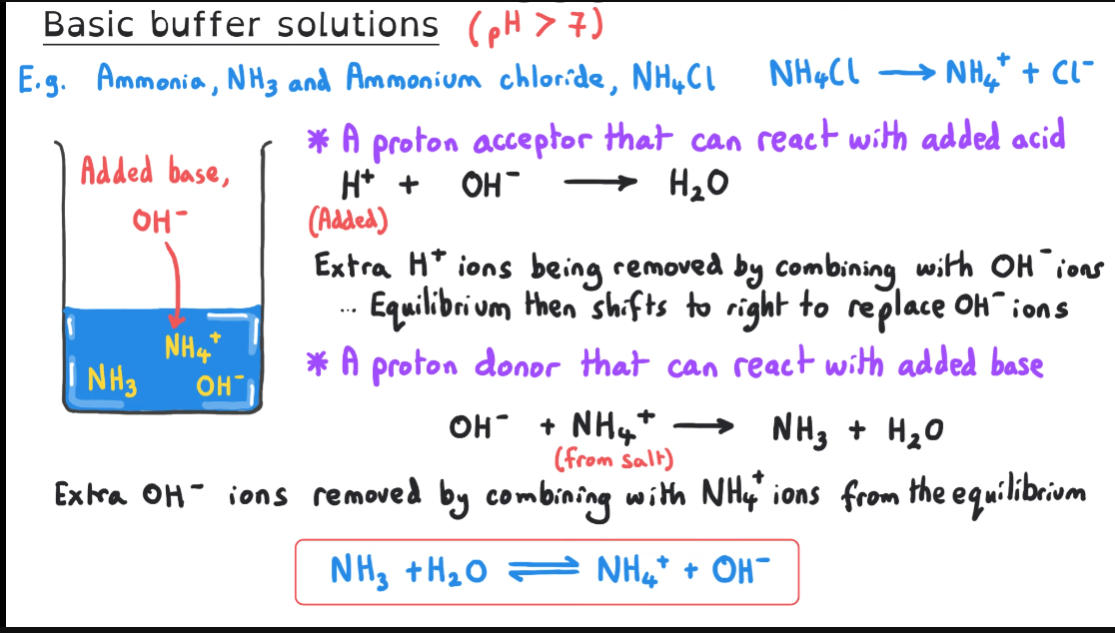
H if added = NH3 + H+ -----> NH4
30
What do you need to take a note off when calculating pH of buffer solutions?
Its NOT a pure acid so [H+] ≠ [A-]
Adding water doesnt change pH as it adds equal mols of H+ and OH-
Adding water doesnt change pH as it adds equal mols of H+ and OH-
31
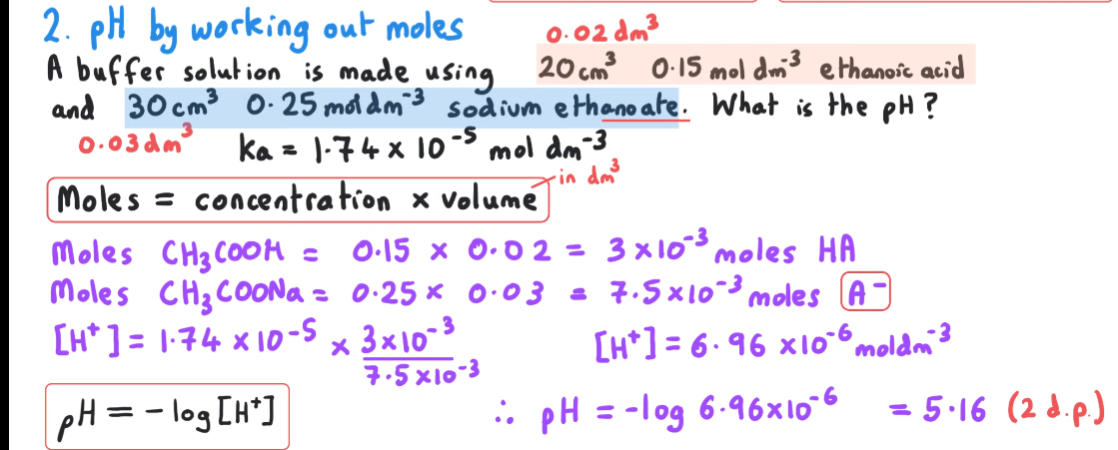
Steps for calculating pH of buffer solution made of weak acid and salt
1) Calculate moles of weak acid and salt
2) Rearrange Ka equation for [H+] and substitute moles number in (concentration cancels out so you can use moles)
3) Use pH = -log([H+])
2) Rearrange Ka equation for [H+] and substitute moles number in (concentration cancels out so you can use moles)
3) Use pH = -log([H+])
32
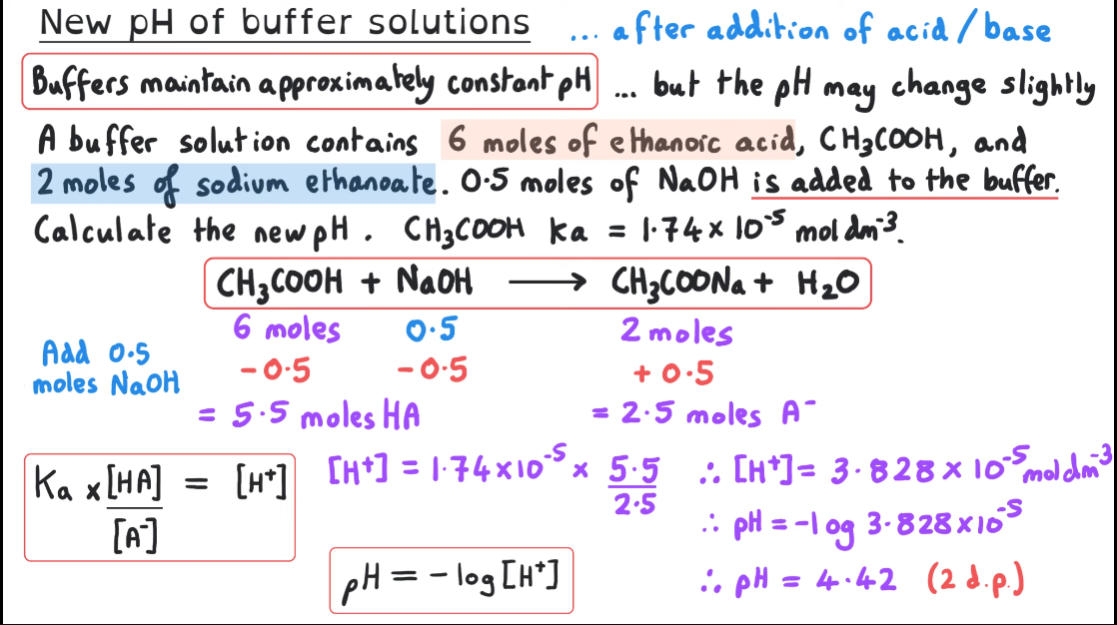
Steps for calculating pH of buffer solution made of weak acid which reacts with strong alkali to make salt
1)Calculate starting moles of weak acid and strong alkali
2)Calculate remaining moles of weak acid after reaction
3)Calculate moles of salt formed( equals to limiting strong alkali)
4)Rearrange Ka equation for [H+] and substitute moles number in (concentration cancels out so you can use moles)
5 Use pH = -log([H+])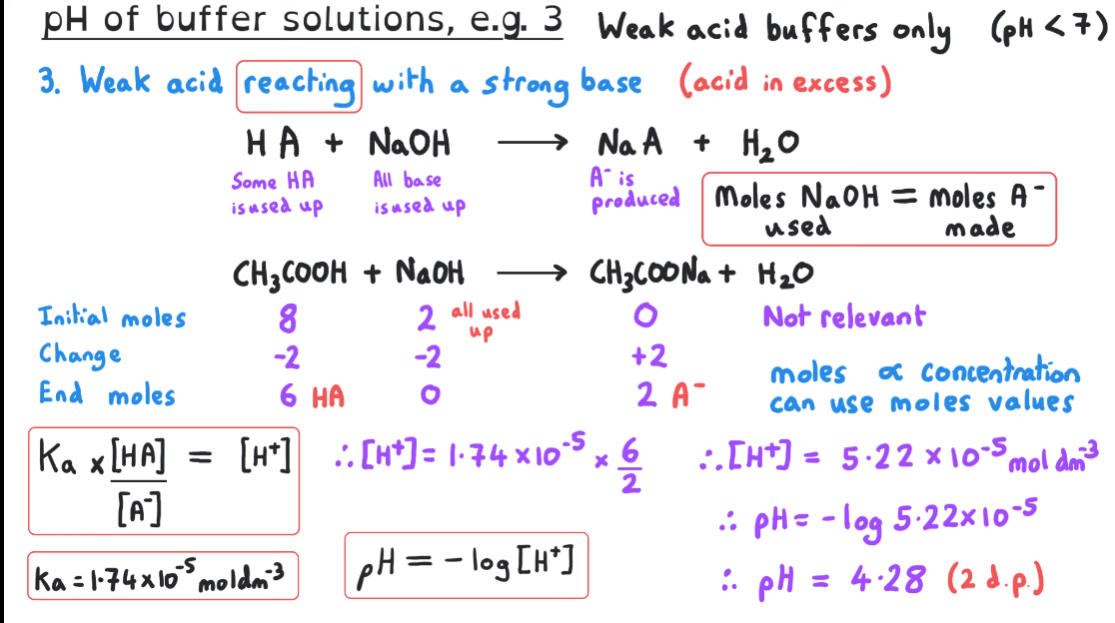
2)Calculate remaining moles of weak acid after reaction
3)Calculate moles of salt formed( equals to limiting strong alkali)
4)Rearrange Ka equation for [H+] and substitute moles number in (concentration cancels out so you can use moles)
5 Use pH = -log([H+])
33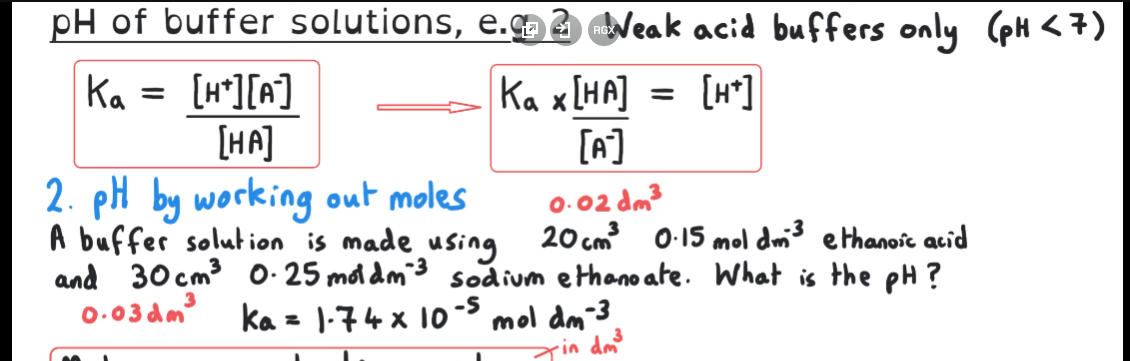
34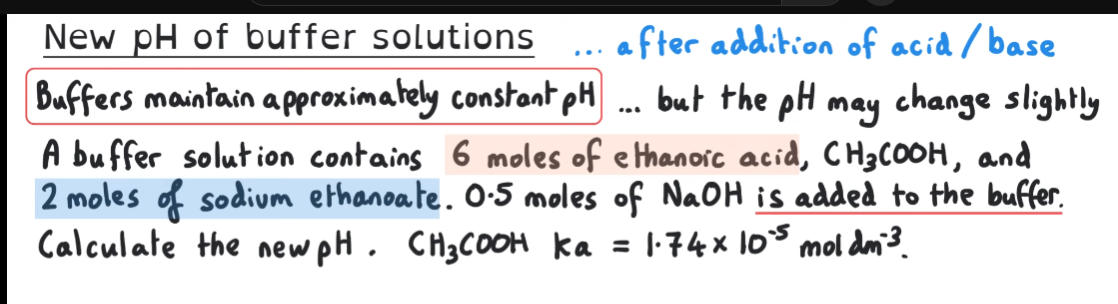
35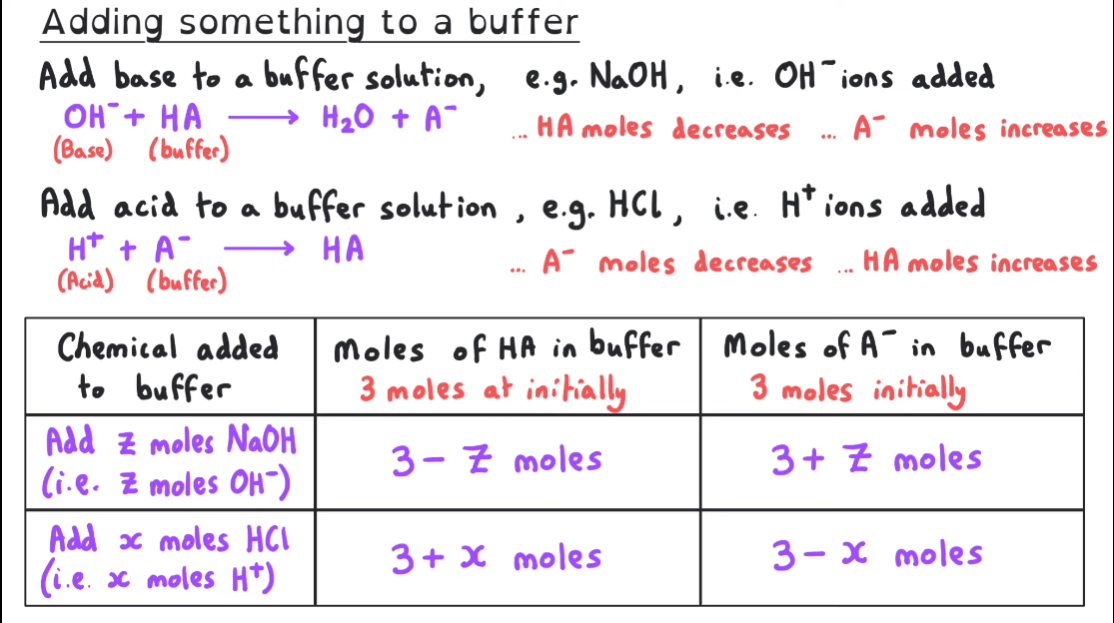
Image occlusion: name the hidden labels
36
How to calculate pH of a buffer solution if small amount of ACID has been added
Since some acid is added some conjugate base will be used and more weak acid is formed
1)Calculate moles of salt and amount of H+ added
2) Calculate moles of salt after (starting moles - moles of H+)
3) Calculate moles of weak acid after (starting moles + mole of H+)
4)Rearrange Ka equation for [H+] and substitute moles number in (concentration cancels out so you can use moles)
5)Use pH = -log([H+])
-DO practically opposite for if small amount of Base has added
1)Calculate moles of salt and amount of H+ added
2) Calculate moles of salt after (starting moles - moles of H+)
3) Calculate moles of weak acid after (starting moles + mole of H+)
4)Rearrange Ka equation for [H+] and substitute moles number in (concentration cancels out so you can use moles)
5)Use pH = -log([H+])
-DO practically opposite for if small amount of Base has added