* CHEMISTRY PRACTICALS
Study these flashcardsFree · spaced repetition · iPhone, Android, Mac & web
All cards
1
Practical 1a: Making volumetric solution
1)Take known volume of powder and add it to a beaker. Wash multiple times weigh boat to beaker to ensure all the measured powder is added.
2)Add more distilled water and swerl it to ensure powder dissolves.
3)Pour beaker contents into volumetic flask and rinse sides of beaker and pour x times for same reason
4)Rinse sides of filter funnel and flask for same reason x times while slightly rotating it.
5)Swerl and invert it multiple times (have the lid on) to mix and dissolve it more.
6)Add distilled water to make it up to miniscus 250cm$^3$
2)Add more distilled water and swerl it to ensure powder dissolves.
3)Pour beaker contents into volumetic flask and rinse sides of beaker and pour x times for same reason
4)Rinse sides of filter funnel and flask for same reason x times while slightly rotating it.
5)Swerl and invert it multiple times (have the lid on) to mix and dissolve it more.
6)Add distilled water to make it up to miniscus 250cm$^3$
2
Practical 1b : Titration?
1)Fill burrette with the volumetric solution( alkali we know its conc)
2)Wash pippette with distilled water and then with acid unknown conc solution into sink
3)Use pippette filler to add 25cm$^3$ to conical flask
4)Add few drops of phenolphthalein(pink to colourless)
5)Slowly add alkali until indicator goes colourless and measure volume of alkali used
2)Wash pippette with distilled water and then with acid unknown conc solution into sink
3)Use pippette filler to add 25cm$^3$ to conical flask
4)Add few drops of phenolphthalein(pink to colourless)
5)Slowly add alkali until indicator goes colourless and measure volume of alkali used
3
Whats a concordant result
results under 0.1 of eachother
4
Practical 2 enthalpy change of hydration purpose?
Calculate the enthalpy change of anhydrated CuSO4 into its hydrated version via indirect path(hess law)
Anhydrated --> normal ---> hydrated
Anhydrated --> normal ---> hydrated
5
Practical 2 enthalpy change steps of hydration? anhydrated to normal
1)Weigh 3.9-4.1 grams in dry stopping weighing bottle.(record)
2) Pour 25 cm³ of deionised water into polystyrene cup, record initial temp, then record per min minute while stirring.
4) Add anhydrous copper at 4th min stir, and record temperatures every minute from the 5th to 15th.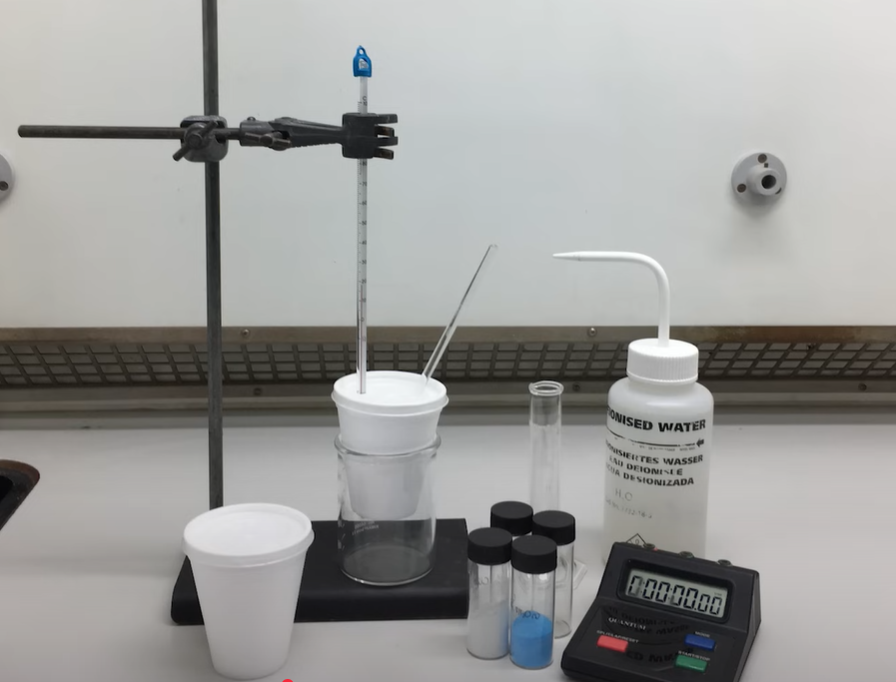
2) Pour 25 cm³ of deionised water into polystyrene cup, record initial temp, then record per min minute while stirring.
4) Add anhydrous copper at 4th min stir, and record temperatures every minute from the 5th to 15th.
6
Practical 2 enthalpy change steps of hydration? hydrated to normal
1) Weigh 6.20 g to 6.30 g of hydrated copper(II) sulfate, record the mass.(add more cause water weight)
2)Repeat same steps as the other one
2)Repeat same steps as the other one
7
graph practical 2
1) Plot temperature against time, draw two best-fit lines before and after adding copper and extrapolate to the fourth minute.
2) Use the graph to find the temperature change at the fourth minute.
3)Use q=mc^t to calculate heat energy in water then calculate ^3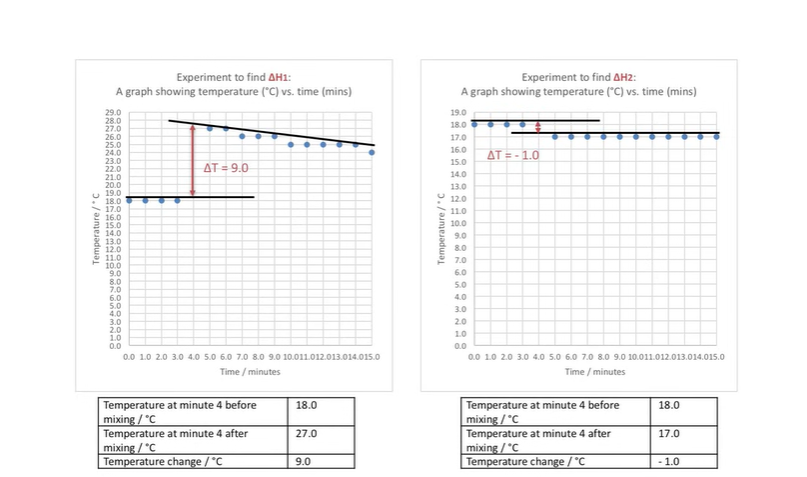
2) Use the graph to find the temperature change at the fourth minute.
3)Use q=mc^t to calculate heat energy in water then calculate ^3
8
Practical 2 enthalpy change of combustion steps?
1)Pour 50 cm3 of water into the calorimeter and record initial temp
3)Weigh the spirit burner with methanol and record its mass.
4)Ensure the calorimeter is positioned above the spirit burner, with the flame touching its bottom, and use a heat shield.
5)Light the spirit burner.
6)Monitor until the temperature rises by 50 °C, then extinguish the flame.
7)Re-weigh the spirit burner and record its new mass.
Repeat with other alcohols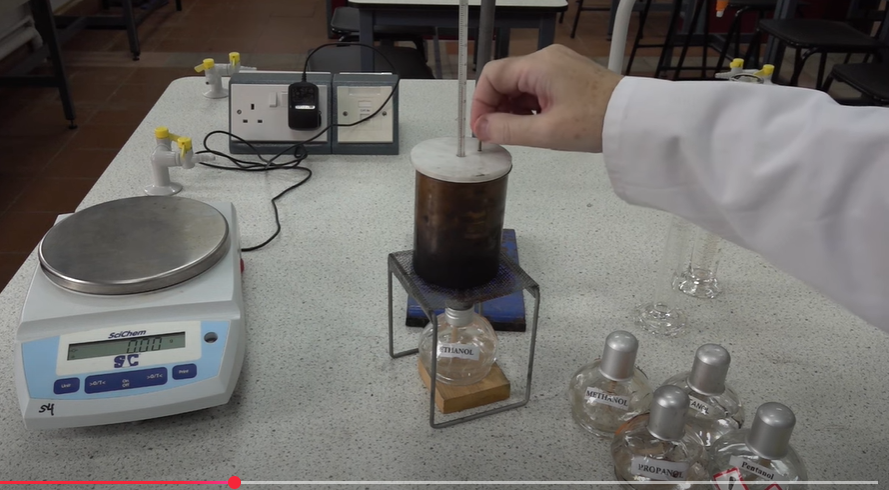
3)Weigh the spirit burner with methanol and record its mass.
4)Ensure the calorimeter is positioned above the spirit burner, with the flame touching its bottom, and use a heat shield.
5)Light the spirit burner.
6)Monitor until the temperature rises by 50 °C, then extinguish the flame.
7)Re-weigh the spirit burner and record its new mass.
Repeat with other alcohols
9
Reasons why enthalpy change of combustion result may be inaccurate?
- Heat transfer to surroundings/apparatus
- Incomplete combustion
-Water in burner or calorimeter evaporates
- Incomplete combustion
-Water in burner or calorimeter evaporates
10
practical 3:Investigation of how the rate of a reaction changes with temperature.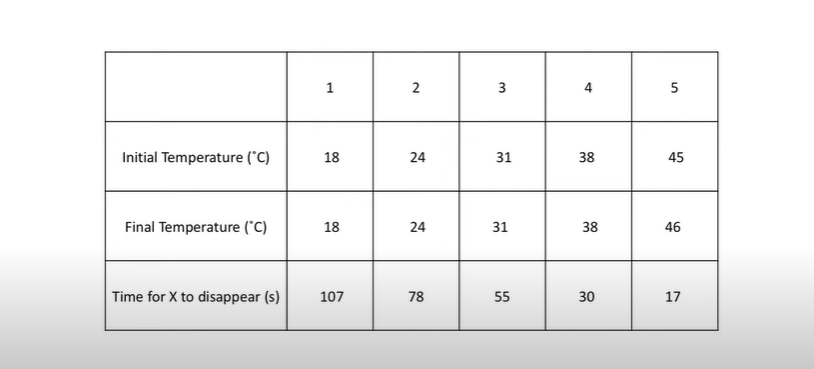
Based on reaction Na2S2O3 + HCl = NaCl + H2O + S + SO2. Sulphur is solid
1)Measure 10cm$^3$ of 1mol/dm HCL via measuring cylinder and then add to test tube WITHOUT X.
2)Measure 10cm$^3$ of 0.05 mol/dm sodium thiosulfate and add it to test tube WITH X.
3)Place thermometer and wait for a bit b4 measuring temp
4)Add 1cm$^3$ of HCL and measure how long it takes for x to disappeare. Also measure final temp
5)Add to sodium carbonate bath to neutralise SO2 gas
DO IT AT VARIAOUS TEMPS EG 20-55
do it at fume board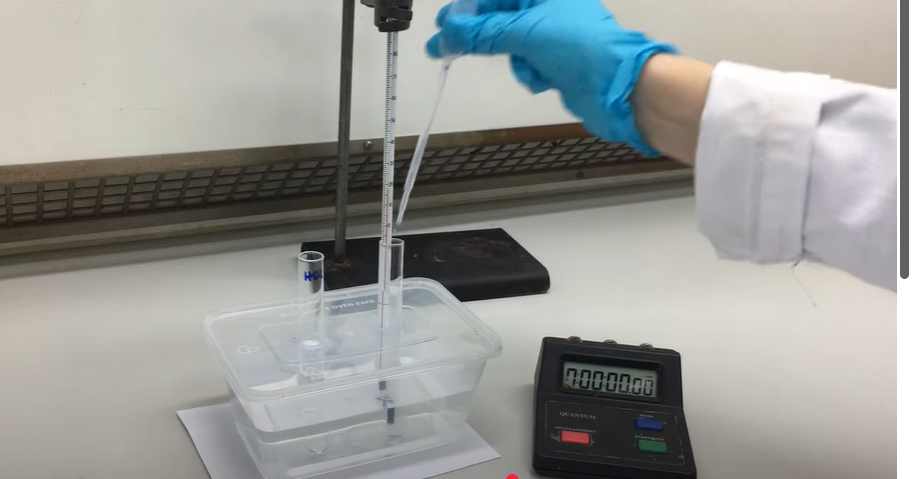
1)Measure 10cm$^3$ of 1mol/dm HCL via measuring cylinder and then add to test tube WITHOUT X.
2)Measure 10cm$^3$ of 0.05 mol/dm sodium thiosulfate and add it to test tube WITH X.
3)Place thermometer and wait for a bit b4 measuring temp
4)Add 1cm$^3$ of HCL and measure how long it takes for x to disappeare. Also measure final temp
5)Add to sodium carbonate bath to neutralise SO2 gas
DO IT AT VARIAOUS TEMPS EG 20-55
do it at fume board
11
Graph? practical 3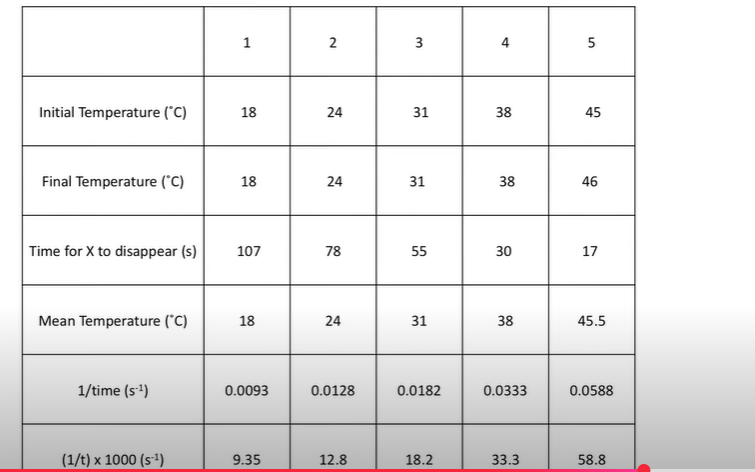
Calculate ROR by 1/t x 1000 and plot it against mean temp
-At higher temps alot more practicals have energy = ea donc ALOT HIGHER ROR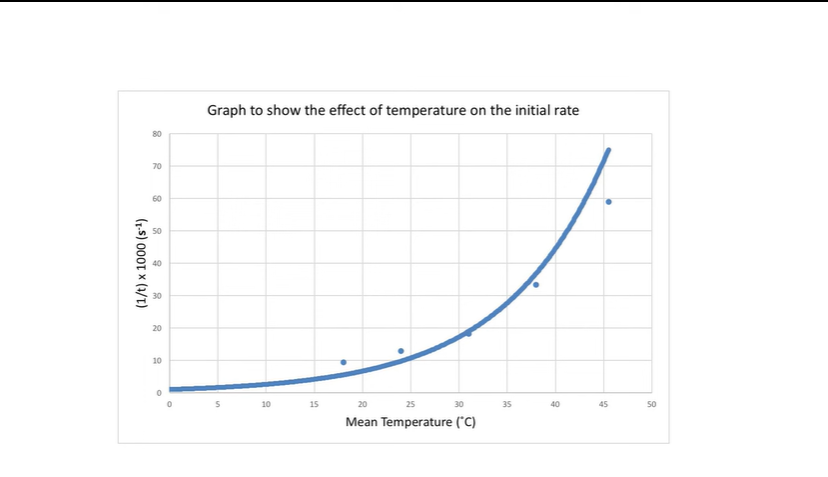
-At higher temps alot more practicals have energy = ea donc ALOT HIGHER ROR
12
Inorganic ions to test for practical 4?
Group 2 cations
Ammonium
Carbonate ions
Sulfate ions
Hydroxide ions
Halide ions
Ammonium
Carbonate ions
Sulfate ions
Hydroxide ions
Halide ions
13
Group 2 cations tests practical 4
Metal hydroxides becomem more soluble down group so we form them:
1)Add some vol of cation(like 10 drops) and see initial observation
2)Add equal vol of NaOH and see observation and note down
3)Add excess NaOH and see observation and note down
we can form sulfates via H2SO4 instead also which solubility decreases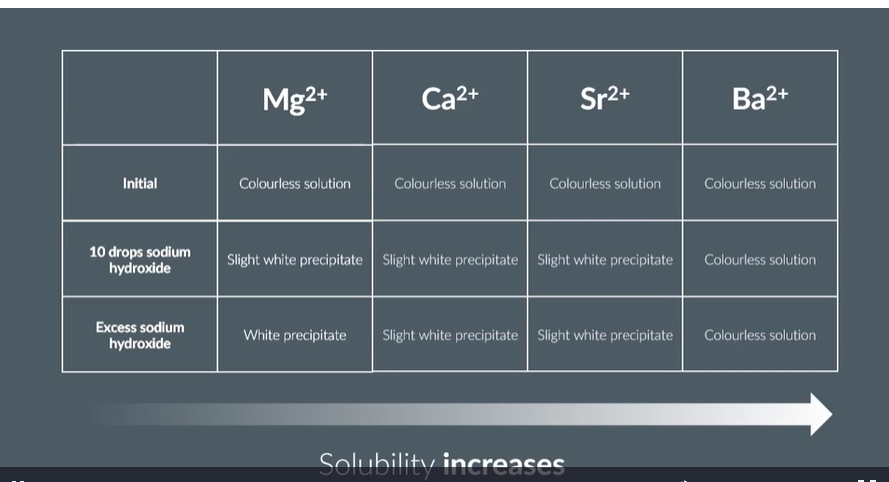
1)Add some vol of cation(like 10 drops) and see initial observation
2)Add equal vol of NaOH and see observation and note down
3)Add excess NaOH and see observation and note down
we can form sulfates via H2SO4 instead also which solubility decreases
14
Ammonium test practical 4
1)Add 10 drops of unknown solution and add equal vol of dilute NaOH
2)Stir mixture and warm gently
3)Using tongs hold a damp red litmus paper on test tube and itll go blue
-Ammonium reacts with OH to form NH3 which then does reverse reaction. Producing OH-(BASE)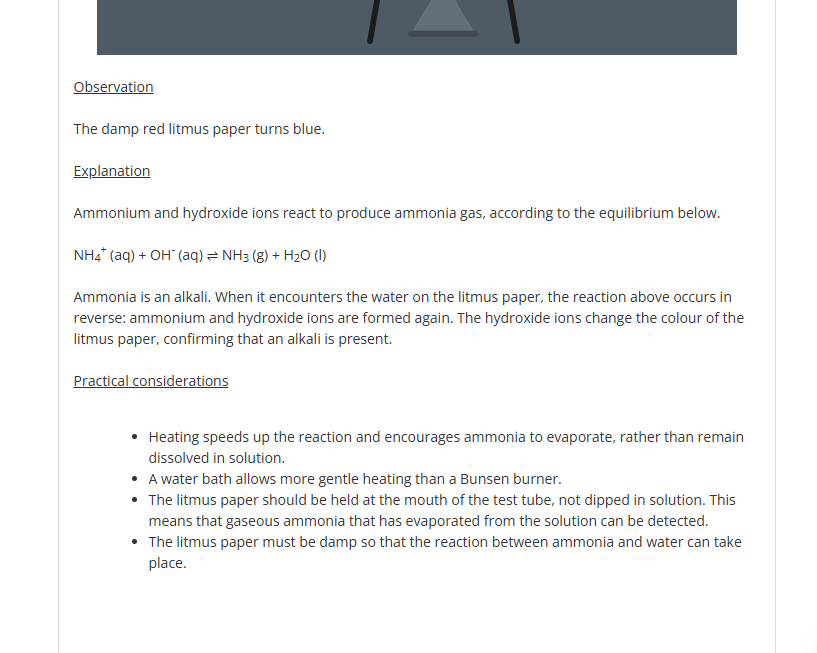
2)Stir mixture and warm gently
3)Using tongs hold a damp red litmus paper on test tube and itll go blue
-Ammonium reacts with OH to form NH3 which then does reverse reaction. Producing OH-(BASE)
15
Test for hydroxide ions? practical 4
1)Add certain volume of solution to test tube
2)Dip red litmus/ universal indicator paper
OH(ALKALI) turns papers blue
2)Dip red litmus/ universal indicator paper
OH(ALKALI) turns papers blue
16
Test for carbonate ions? practical 4
1)Add unknown solution 3 to test tube and connect via delivery tube to a test tube with limewater(CaOH2)
2)Add HCL to test tube with NaCO3
Effervescence occur and limewater turns milky/cloudy
-Carbonates with acid form CO2 and turns limewater into calcium carbonate(white p)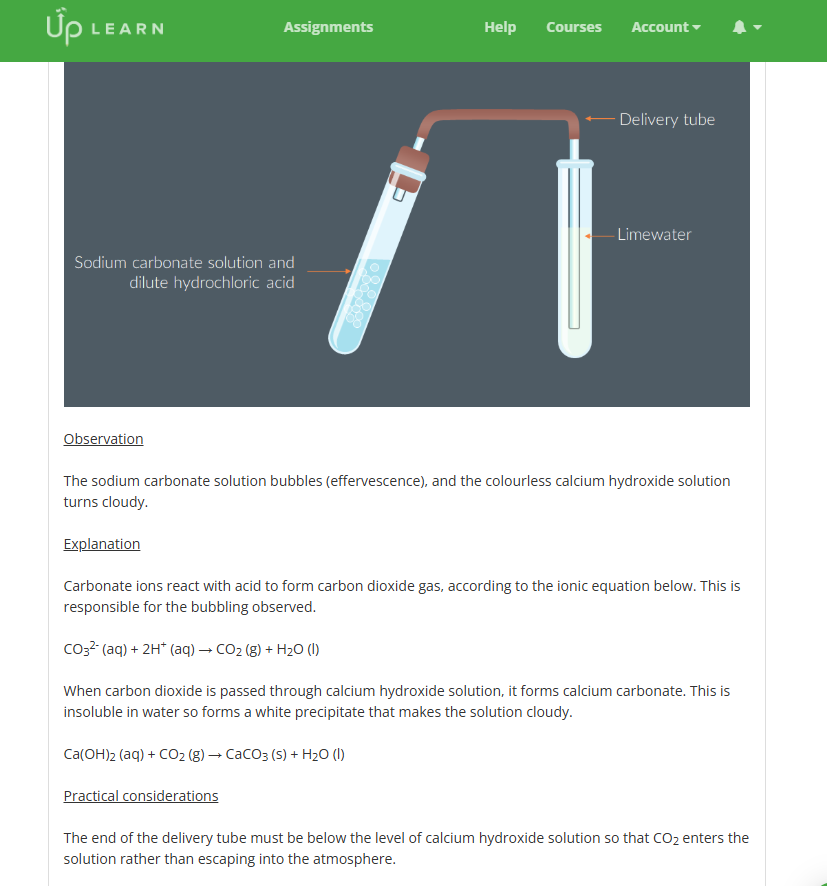
2)Add HCL to test tube with NaCO3
Effervescence occur and limewater turns milky/cloudy
-Carbonates with acid form CO2 and turns limewater into calcium carbonate(white p)
17
Test for sulfate ions(SO42-) practical 4
1)Add unknown solution to test tube
2)Add Dilute HCL and BaCL2
White precipitate forms.
-SO4$^{2-}$ reacts with Ba$^{2+}$ forming BaSO4. Acid is used to remove carbonate ions(white p)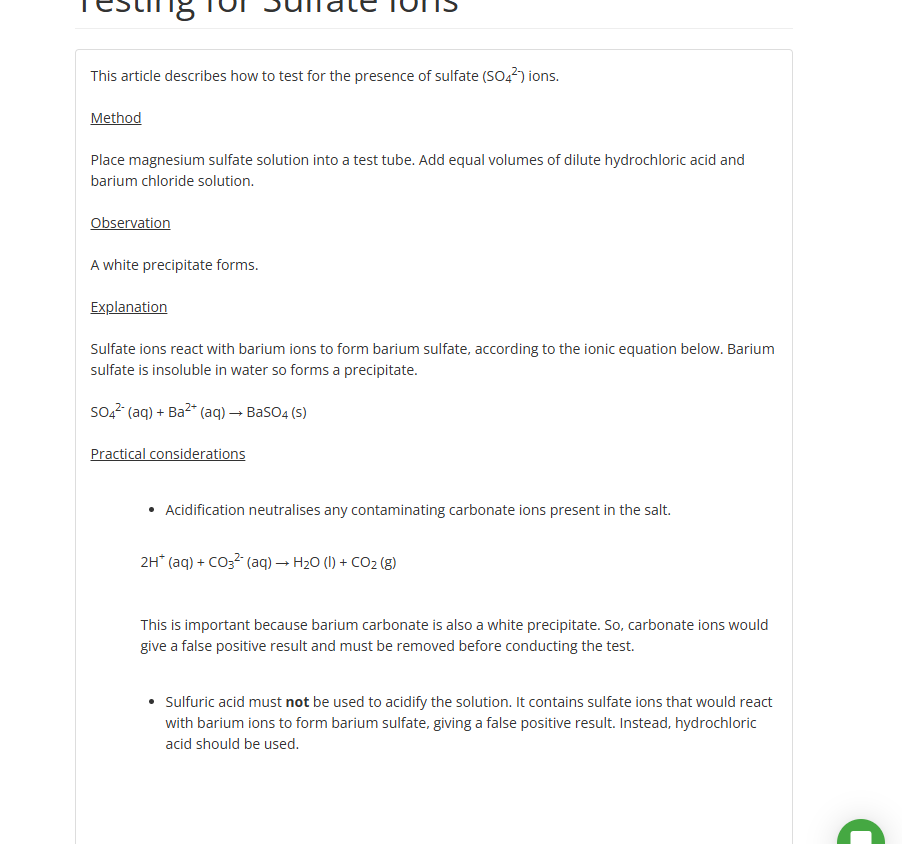
2)Add Dilute HCL and BaCL2
White precipitate forms.
-SO4$^{2-}$ reacts with Ba$^{2+}$ forming BaSO4. Acid is used to remove carbonate ions(white p)
18
Halides test practical 4?
Add dilute nitric acid and then silver nitrate.
Then add dilute ammonia and concentrated iyw to see clearer.
Acid is added to remove carbonates/hydroxide ions which can form white precipitate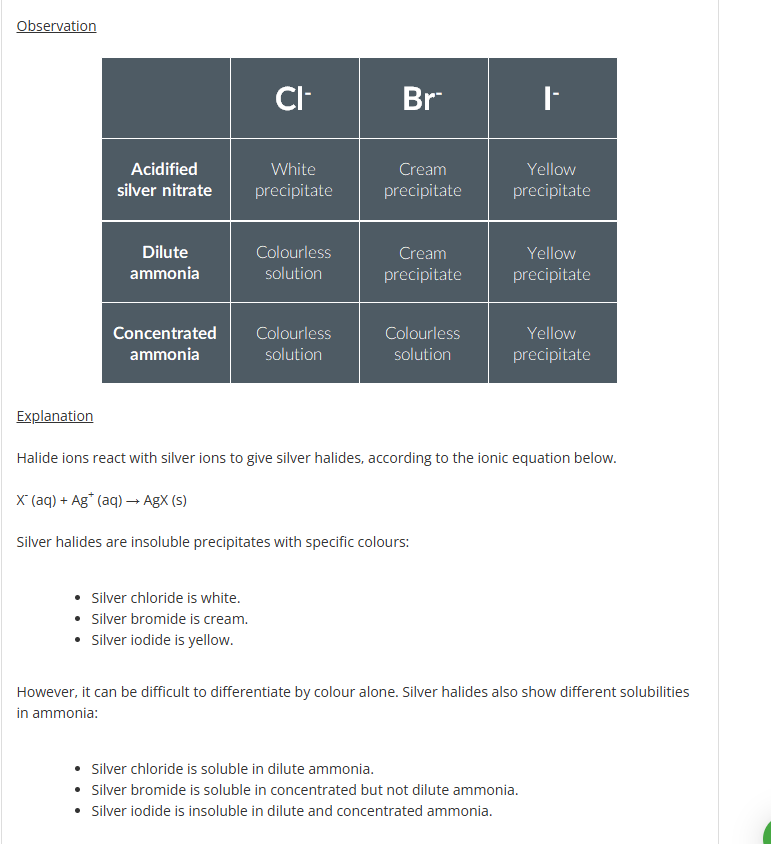
Then add dilute ammonia and concentrated iyw to see clearer.
Acid is added to remove carbonates/hydroxide ions which can form white precipitate
19
Disttilation practical 5(alcohol topic):
1)Add cyclohexanol to pear shaped glass and use paster pipette to add drops of phosphoric acid.
2)Add anti-bumpign granules and connect glass to distillation apparatus.
3)Heat it below >100 and cyclohexene then collects as distillate
4)Pour liquid into separating funnel and ADD sodium carbonate to react with acid. Shake mixture.
5)Cyclohexene less dense so remove bottom layer
6)Add NaCL removes excess water and discard bottom layer again.
7)Add drying agent CaCL and then decant it into clean beaker. We now have cyclohexene in a beaker
-Test it via add bromine water or acidified potassium manganate(purple) both make it go colourless if alkene
2)Add anti-bumpign granules and connect glass to distillation apparatus.
3)Heat it below >100 and cyclohexene then collects as distillate
4)Pour liquid into separating funnel and ADD sodium carbonate to react with acid. Shake mixture.
5)Cyclohexene less dense so remove bottom layer
6)Add NaCL removes excess water and discard bottom layer again.
7)Add drying agent CaCL and then decant it into clean beaker. We now have cyclohexene in a beaker
-Test it via add bromine water or acidified potassium manganate(purple) both make it go colourless if alkene
20
Organic compount tests we need to know practical 6?
Aldehyde
Alcohol
Alkene
Carboxylic acid
Halo alkane
Alcohol
Alkene
Carboxylic acid
Halo alkane
21
Aldehyde testing? practical 6?
1)Add equal volumes of fehlings a and b to one test tube
2)Add 5cm$^3$ to another test tube to 1cm$^3$ of sodium carbonate(need alkaline condition).
3)Add soem bumping granules then 1cm$^3$ of unknown solution
4)Then gently warm it up to higher temps. Red precipitate should form.
2)Add 5cm$^3$ to another test tube to 1cm$^3$ of sodium carbonate(need alkaline condition).
3)Add soem bumping granules then 1cm$^3$ of unknown solution
4)Then gently warm it up to higher temps. Red precipitate should form.
22
Alcohol testing practical 6?
1) Add 2cm$^3$ of unknown solution to 1cm$^3$ of metallic sodium
-Lots of fixing should occur
-Lots of fixing should occur
23
Alkene testing practical 6?
1) Add 2cm$^3$ of unknown solution to 1cm$^3$ of bromine water
- Turns brown/orange to colourless
- Turns brown/orange to colourless
24
Carboxylic acid testing practical 6?
1) Add 2cm$^3$ of unknown solution.
2)Add small spatula of solid sodium hydrogen carbonate.
-Lots of fizzing/effervescence
2)Add small spatula of solid sodium hydrogen carbonate.
-Lots of fizzing/effervescence
25
Haloalkane test practical 6?
1)Add 5 drops of unknown to 1cm$^3$ to NaOH (this releases halide ions) and then warm it up(60)
- Add 2cm dilute nitric then 1cm silver nitrate
- Add 2cm dilute nitric then 1cm silver nitrate
26
Iodine clock test practical 7? (measuring ror in reaction)
1)Add 10cm$^3$ hydrogen peroxide from burette to 1st dry and clean beaker.
2)Add 25cm,$^3$ H2SO4, 5cm$^3$Na2S2O4, 20cm$^3$ water, 5cm$^3$ KI all from burette then 1cm$^3$ starch via pasteur pipette to 2nd dry and clean dry beaker
3)Pour 1st beaker to 2nd beaker and start timer and stir. Suddenly after some time itll change blue black stop timer
REPEAT WITH DIFFERENT VOLUME OF IODINE AND WATER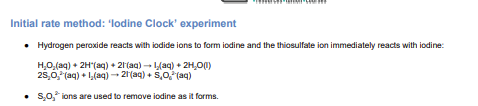
2)Add 25cm,$^3$ H2SO4, 5cm$^3$Na2S2O4, 20cm$^3$ water, 5cm$^3$ KI all from burette then 1cm$^3$ starch via pasteur pipette to 2nd dry and clean dry beaker
3)Pour 1st beaker to 2nd beaker and start timer and stir. Suddenly after some time itll change blue black stop timer
REPEAT WITH DIFFERENT VOLUME OF IODINE AND WATER
27
How to rate from iodine results?
- Volume is proportional to conc and rate is proportional to 1/t so we pretend both of them are conc and rate.
1)Then we compare two sets of values and see how much rate increases by.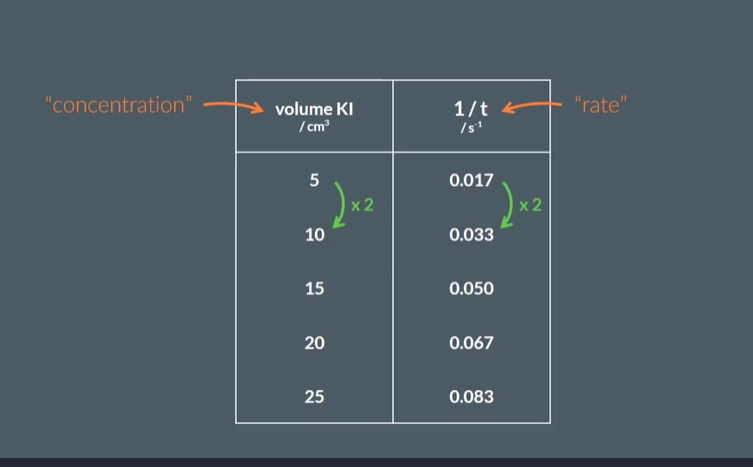
1)Then we compare two sets of values and see how much rate increases by.
28
Continuous method practical 7(Mg + HCL --> MgCL2 + H2(hydrogen gas is used to measure rate))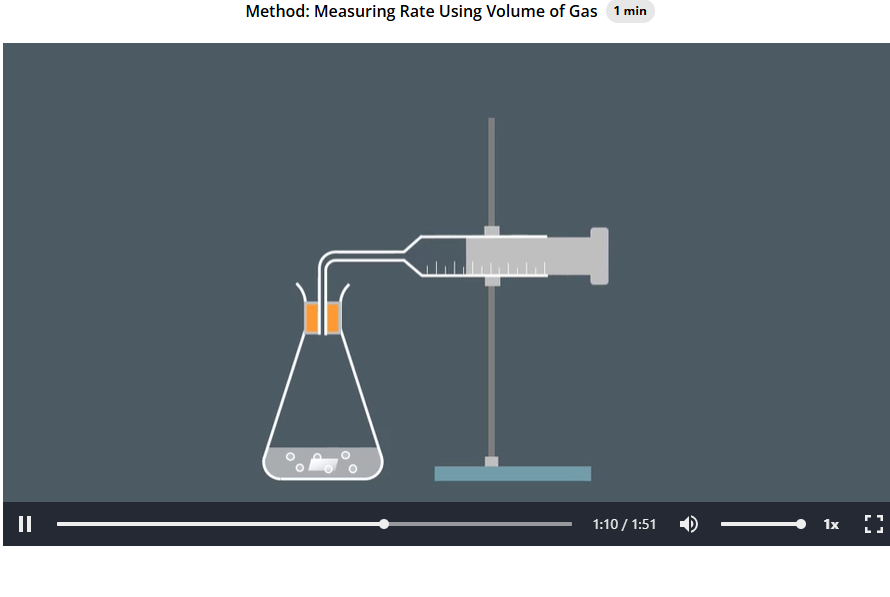
1)Clamp gas syringe and add tubing to connect to conical flask.
2)Add 50cm$^3$ of 0.8mol/dm HCL and then small strip of mg then plug flask with bung. Start timer
- Measure cm$^3$ gas produced per 15s
-Repeat once more with half HCL conc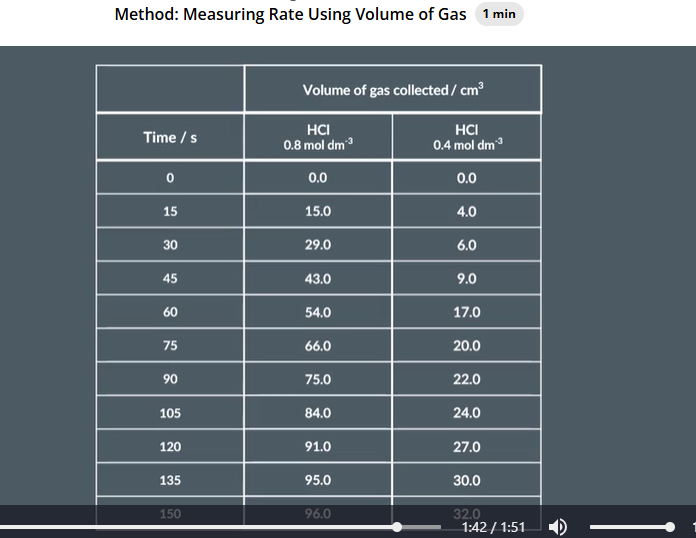
2)Add 50cm$^3$ of 0.8mol/dm HCL and then small strip of mg then plug flask with bung. Start timer
- Measure cm$^3$ gas produced per 15s
-Repeat once more with half HCL conc
29
How to find order of hcl from continous result?
1)Volume is proportional to conc so we use that instead.
2)Plot vol against time for each experiment and make line of best fit
3)Calculate initial rate for both and compare.
2)Plot vol against time for each experiment and make line of best fit
3)Calculate initial rate for both and compare.
30
Practical 8 measuring emf:(done in standard conditions)
1)Clean/scrub piece of copper and zinc with sandpaper
2)Degrease both with wool dipped in some propanone
3)Place zink in 1st beaker with 50cm$^3$ of ZnSO4 solution
4)Place copper in 2ndst beaker with 50cm$^3$ of CuSO4 solution
5) Add NaCl to U-tube enough to it touch slighly the wool ends on either end
6) Add U-tube between half cells and connect zinc to -ve terminal and copper +ve terminal(croc clips)
Measure emf and repeat with out metals
2)Degrease both with wool dipped in some propanone
3)Place zink in 1st beaker with 50cm$^3$ of ZnSO4 solution
4)Place copper in 2ndst beaker with 50cm$^3$ of CuSO4 solution
5) Add NaCl to U-tube enough to it touch slighly the wool ends on either end
6) Add U-tube between half cells and connect zinc to -ve terminal and copper +ve terminal(croc clips)
Measure emf and repeat with out metals
31
Practical 9 Calibrate pH probe:
1)Dip probe in distilled water to wash it and shake it gently
2)Dip probe in ph 4 buffer solution and measure pH detected. Write in a table
3)Dip it in distilled water and repeat with ph 7 and 9.2
Plot calibrartion graph of actual ph against measured pH. Draw line of best fit and this will be used to make more accurate pH measures.
2)Dip probe in ph 4 buffer solution and measure pH detected. Write in a table
3)Dip it in distilled water and repeat with ph 7 and 9.2
Plot calibrartion graph of actual ph against measured pH. Draw line of best fit and this will be used to make more accurate pH measures.
32
Practical 9 acid and base titration( for this weak acid and strong base)
1)Add 20cm$^3$ of weak acid to beaker via burette. Stir and measure pH via probe. At 0cm$^3$ of base added
2)Add 2cm$^3$ of strong base via 2 burette stir and measure pH at that volume.REPEAT UNTIL 18cm$^3$
3)Add 0.2cm$^3$ until 22cm$^3$ then do 2cm$^3$ to 40cm$^3$(excess)
-This is cuz we add equal vols so equivalence pt so rapid pH increase now
2)Add 2cm$^3$ of strong base via 2 burette stir and measure pH at that volume.REPEAT UNTIL 18cm$^3$
3)Add 0.2cm$^3$ until 22cm$^3$ then do 2cm$^3$ to 40cm$^3$(excess)
-This is cuz we add equal vols so equivalence pt so rapid pH increase now
33
Graph explanation ph curve
1)Rapidly increases first but then levels off a bit (a buffer is being produced)
2)Buffer saturates and rapidly increase pH then levels off fully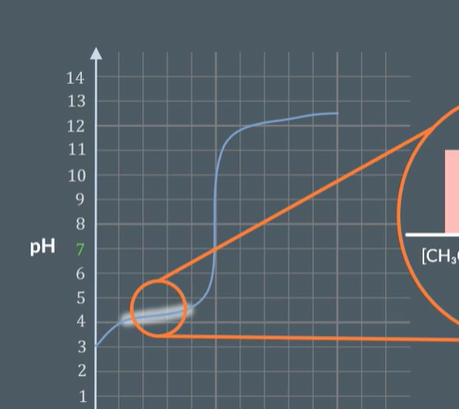
2)Buffer saturates and rapidly increase pH then levels off fully
34
Practical 10a: What are we generally doing?
We are reacting salicylic acid(alcohol) with ethanoic anhydride to form asprin(ester) and ethanoic acid.
Three main steps:
1)Form crude solid(asprin)
2)Purify crude solid via recrystallisation
3)Test purity via determining its mp.
Three main steps:
1)Form crude solid(asprin)
2)Purify crude solid via recrystallisation
3)Test purity via determining its mp.
35
Practical 10a: FORMING CRUDE SOLID ASPIRIN
1)Weigh boat and measure around 6g of salicylic acid on weighing boat weigh it,record and then add all to conical flask clamped
2)Measure weighing boat AGAIN to measure mass of salicylic acid used.
3)Measure 10cm$^3$ of ethanoic anhydride via measuring cylinder and pour it to conical flask.
4)Add a few drops of H2SO4 to act as acid catalyst. Then stir conical flask. clamped
5)Warm flask via gently heating a beaker with water on tripod gauze VIA BUNSERN BURNER BELOW <65 for 20 mins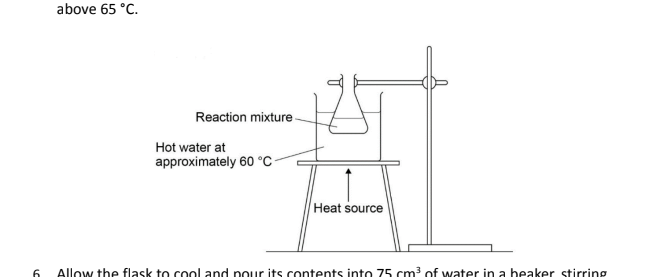
2)Measure weighing boat AGAIN to measure mass of salicylic acid used.
3)Measure 10cm$^3$ of ethanoic anhydride via measuring cylinder and pour it to conical flask.
4)Add a few drops of H2SO4 to act as acid catalyst. Then stir conical flask. clamped
5)Warm flask via gently heating a beaker with water on tripod gauze VIA BUNSERN BURNER BELOW <65 for 20 mins
36
Practical 10a: Purifyign solid compound
1)Allow flask to cool then pour 75cm$^3$ of water 2 flask and stir 2 cause asprin to clump and form precipitate
2)Filter asprin via vacuum filtration(reduced pressure) add contents to on top of filter paper in buchner funnel.
3)Break aspirin clumps down to remove moisture in between via spatula
4)All moisture(h2o etc) is removed and is in buchner flask below
-RECRYSTALLISATION PROCESS
5)Measure 15cm$^3$ of ethanol via m cylinder into test tube. Add crude aspirin to test tube via spatula. Swirl
6)Place test tube in boiling water below 78(alcohol mp) and stir and break small impurity clumps to dissolve. Cause crystals to dissolve
7)Pour contents to 40cm$^3$ of water beaker to cool it slowly. Impurities still dissolved while aspirin crystalises
8)Filter ethanol + h2o via vacuum filtration so pour content to buchner funnel
9)Pour buchner funnel contents into filter paper and let it dry.
2)Filter asprin via vacuum filtration(reduced pressure) add contents to on top of filter paper in buchner funnel.
3)Break aspirin clumps down to remove moisture in between via spatula
4)All moisture(h2o etc) is removed and is in buchner flask below
-RECRYSTALLISATION PROCESS
5)Measure 15cm$^3$ of ethanol via m cylinder into test tube. Add crude aspirin to test tube via spatula. Swirl
6)Place test tube in boiling water below 78(alcohol mp) and stir and break small impurity clumps to dissolve. Cause crystals to dissolve
7)Pour contents to 40cm$^3$ of water beaker to cool it slowly. Impurities still dissolved while aspirin crystalises
8)Filter ethanol + h2o via vacuum filtration so pour content to buchner funnel
9)Pour buchner funnel contents into filter paper and let it dry.
37
Purpose of recrystallisation
Filter out more/less soluble impurities and form pure product:
Less soluble impurities if formed are hot filtered
More soluble impurities are filtered out thru vacuum filtration
Less soluble impurities if formed are hot filtered
More soluble impurities are filtered out thru vacuum filtration
38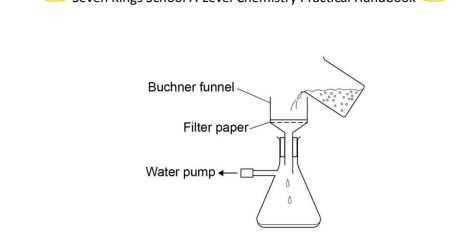
Draw out vacuum filtration:
39
Measuring temp practical 10a
Thats glycerol and capillary tube right beside thermometer
if melt pin point at aspiring mp goud
If melts slowly across temp not goud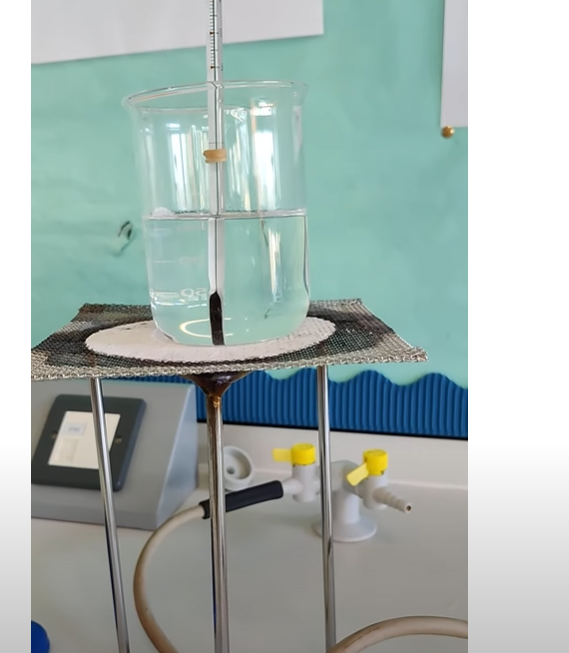
if melt pin point at aspiring mp goud
If melts slowly across temp not goud
40
Practical 10BBB: What are we generally doing?
We react ethanol + ethanoic acid + acid catalyst(H2SO4) to form ethyl ethanoate
tHREE MAIN STEPS:
1)Form crude liquid
2)Purfy crude liquid via solvent extraction
3)Purify liquid via distillation.
tHREE MAIN STEPS:
1)Form crude liquid
2)Purfy crude liquid via solvent extraction
3)Purify liquid via distillation.
41
PRACTICAL 10B FORM CRUDE LIQUID:
1)Add few anti bumping granules
2)In fume board add 10cm$^3$ ethanol, 12cm$^3$ glacial ethanoic acid and 15 drops of concentrated H2SO4
3)Warm pear shaped flask via connecting/clamp it to reflux apparatus in a beaker with water in tripod and gauze via bunsern burner
4)Forms crude ethyl ethanoate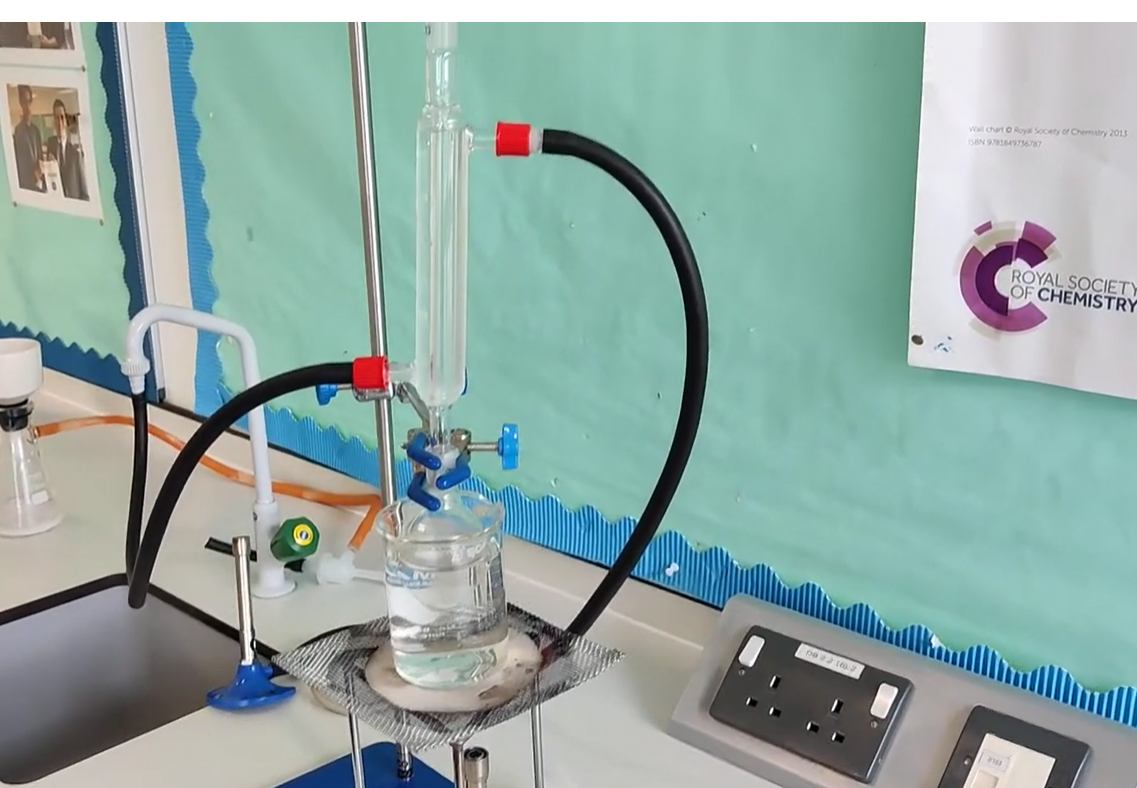
2)In fume board add 10cm$^3$ ethanol, 12cm$^3$ glacial ethanoic acid and 15 drops of concentrated H2SO4
3)Warm pear shaped flask via connecting/clamp it to reflux apparatus in a beaker with water in tripod and gauze via bunsern burner
4)Forms crude ethyl ethanoate
42
PRACTICAL 10B SOLVENT EXTRACTION:
1)Pour both sodium carbonate solution and crude ethyl ethanoate solution to a beaker and stir it.(removes acid)
2)Then transfer it to a separating funnel. Place stopper invert it and release gas via stopcock. Repeat 30x or so
3)Allow layers to separate (ethyl ethanoate less dense then water) remove bottom layer.
4)Pour ethyl ethanote into beaker. Add 1g of anhydrous sodium sulfate (absorbs excess water)
5)Decant ethyl ethanoate only into pear shaped flask (still may contain unreacted reagents so distil next)
2)Then transfer it to a separating funnel. Place stopper invert it and release gas via stopcock. Repeat 30x or so
3)Allow layers to separate (ethyl ethanoate less dense then water) remove bottom layer.
4)Pour ethyl ethanote into beaker. Add 1g of anhydrous sodium sulfate (absorbs excess water)
5)Decant ethyl ethanoate only into pear shaped flask (still may contain unreacted reagents so distil next)
43
PRACTICAL 10B DISTILLATION: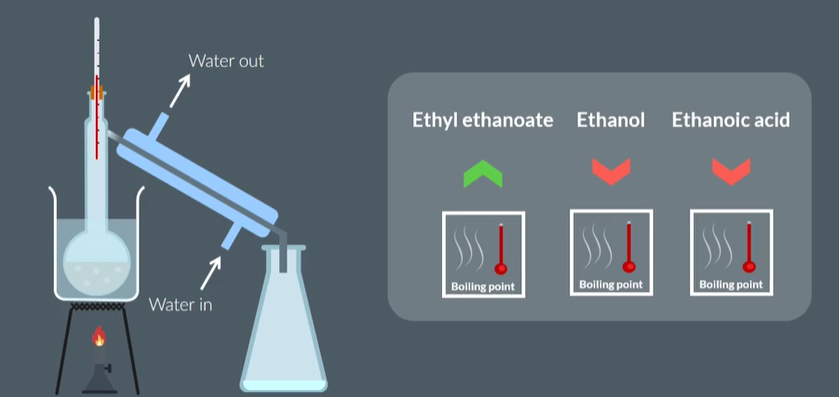
1)Add few bumping granules to pear shaped flask with ethyl ethanoate
2)Set up distillation apparatus. Place flask in beaker below water
3)Weigh and record conical flask mass(we tryna calculate mass of ethyl ethanote)
4)Heat mixture via warm water bath via bunsern burner.
5)Ethyl ethanoate evaporate and then condense into conical flask(record this temp)
6)Stop when no more distillate is formed(there should still be some liquid in pear flask) and reweight conical flask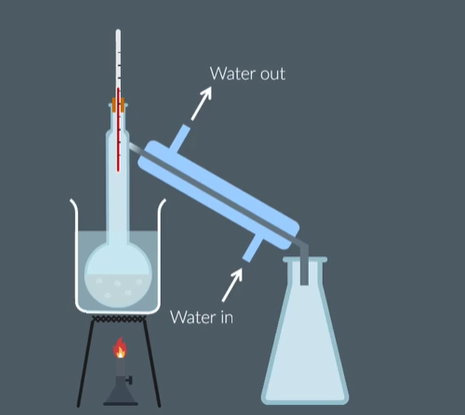
2)Set up distillation apparatus. Place flask in beaker below water
3)Weigh and record conical flask mass(we tryna calculate mass of ethyl ethanote)
4)Heat mixture via warm water bath via bunsern burner.
5)Ethyl ethanoate evaporate and then condense into conical flask(record this temp)
6)Stop when no more distillate is formed(there should still be some liquid in pear flask) and reweight conical flask
44
Practical 12 TLC Chromatography:(seeing which components a combinant drug has being cafferine/para/ibuf/asp)
1)Record masses of tablets and break them down with mortar and pestle. Add to small beaker
2)Add 0.5cm$^3$ of ethanol per 0.1g of tablets to small beaker
3)Draw faint pencil line 1cm above the bottom TLC Silica plate, mark 5 equally spaced each labelled
4)Using capillary tube get small amt of chemical and apply to corresponding x mark. Leave plate to air dry
5)Add around 10cm$^3$ of ethyl ethanoate to beaker(must be below level of TLC marks)
6)Place TLC Plate in beaker and place lid and wait
7)When solvent reaches 1cm below top of TLC plate, remove plate and mark solvent.
8)Leave it to air dry then apply UV light and mark spots with pencil.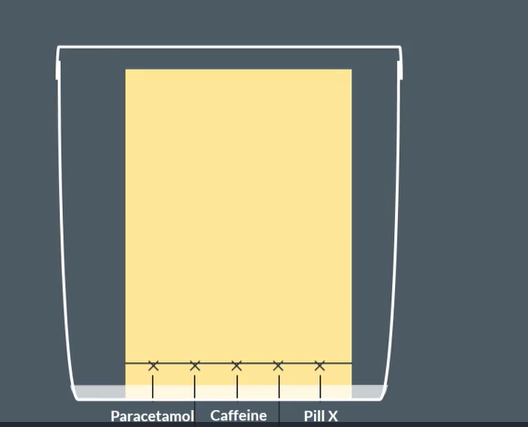
2)Add 0.5cm$^3$ of ethanol per 0.1g of tablets to small beaker
3)Draw faint pencil line 1cm above the bottom TLC Silica plate, mark 5 equally spaced each labelled
4)Using capillary tube get small amt of chemical and apply to corresponding x mark. Leave plate to air dry
5)Add around 10cm$^3$ of ethyl ethanoate to beaker(must be below level of TLC marks)
6)Place TLC Plate in beaker and place lid and wait
7)When solvent reaches 1cm below top of TLC plate, remove plate and mark solvent.
8)Leave it to air dry then apply UV light and mark spots with pencil.
45
PRACTICAL 12 CONSIDERATIONS:
Solvent lvl must be below pencil line otherwise itll dissolve all sample and they cant travel up
If solutions used are concentrated it forms long streaks instead of one spot so harder to calculate rf
If ink used itll dissolve and disrupt results
If solutions used are concentrated it forms long streaks instead of one spot so harder to calculate rf
If ink used itll dissolve and disrupt results