3.2.4 IMMUNITY CELLS AT WORKRK
Study these flashcardsFree · spaced repetition · iPhone, Android, Mac & web
All cards
1
Antigens?
Proteins in the cell surface membrane which triggers an immune response
2
what do lymphocytes attack/detect as non self?
- pathogens
- toxins
- infected cells
- foreign cells
- toxins
- infected cells
- foreign cells
3
How phagocytosis?
1)The phagocyte is attracted to chemicals released by the pathogen and moves along a concentration gradient
2)Receptors on the phagocyte bind to the pathogen.
3) The phagocyte engulfs the pathogen and surrounds it in a phagosome
4)Lysosomes move towards it and fuses into the phagosome
5) The lysosomes release lysozymes which hydrolyse the pathogen.
6)The cytoplasm absorbs the soluble products and presents antigens
2)Receptors on the phagocyte bind to the pathogen.
3) The phagocyte engulfs the pathogen and surrounds it in a phagosome
4)Lysosomes move towards it and fuses into the phagosome
5) The lysosomes release lysozymes which hydrolyse the pathogen.
6)The cytoplasm absorbs the soluble products and presents antigens
4
what happeneds when b cell encounters a pathogen?
1)The cell binds the pathogen with its receptor and engulfs it
2) Then it breaks it down and presents antigen on receptors
3) Helper T cell bind to it and stimulates B cell to clone.
2) Then it breaks it down and presents antigen on receptors
3) Helper T cell bind to it and stimulates B cell to clone.
5
Structure of an antibody
- 4 polypeptide chains
- Two light and two heavy.
- Chains held by disulfide bridges
- Two Antigen binding sites
- Variable and constant regions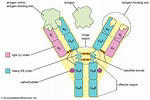
- Two light and two heavy.
- Chains held by disulfide bridges
- Two Antigen binding sites
- Variable and constant regions
6
monoclonal antivbodies?
antibodies with same tertiary structure formed from same cloned b cells.
7
The humoral response?( happeneds in bodily fluids like blod)
1)Naive b cell binds to pathogen via complementary receptors
2) Cell engulfs it and internalises it and presents it in a receptor
3) Helper t cell binds to it and releases chemicals that stimulate b cell to clone
4) B cell starts to clone itself
5) Cells then differentiate into plasma or memory cells.
6) If same pathogen comes again memory cells starts to clone itself and differentiate into memory and plasma cells.
2) Cell engulfs it and internalises it and presents it in a receptor
3) Helper t cell binds to it and releases chemicals that stimulate b cell to clone
4) B cell starts to clone itself
5) Cells then differentiate into plasma or memory cells.
6) If same pathogen comes again memory cells starts to clone itself and differentiate into memory and plasma cells.
8
Job of helpere t cell?
1) Stimulate b cells
2) Activate cytotoxic t cells
3)Stimulates b cells to do phagocytosis
4) Become memory cells
2) Activate cytotoxic t cells
3)Stimulates b cells to do phagocytosis
4) Become memory cells
9
Cell mediated response? (requires help of APC)
1) Naive helper t cell binds to an APC which causes it to clone itself
2) These helper t cells now:
-Stimulates B cells to clone
- Activates cytotoxic t cells
- Stimulates phagocytosis
2) These helper t cells now:
-Stimulates B cells to clone
- Activates cytotoxic t cells
- Stimulates phagocytosis
10
Active immunity?
A form of acquired immunity in which the body produces its own antibodies against disease-causing antigens/pathogens
11
Passive immunity?
the short-term immunity that results from the introduction of antibodies from another person or animal.
12
Ways active immunity can happen?
- Natural
- Vaccine (Artificial)
- Vaccine (Artificial)
13
Ways passive happen?
- Natural (Maternal)
- Artificial
- Artificial
14
Structure of HIV?
- RNA
- Reverse transcriptase
- attachment proteins
- capsid
- matrix
- lipid envelope
- Reverse transcriptase
- attachment proteins
- capsid
- matrix
- lipid envelope
15
How do hiv replicate in helpet t cells
1) Attachment proteins binds to helper t cell
2) HIV protein capsid fuses with t cell and the RNA enters.
3) Reverse transcriptase converts RNA into DNA
4) DNA enters nucleus and becomes integrated in hosts DNA.
5) Cell starts to create viral mRNA which is translated to viral proteins
6) These then assemble HIV clones
2) HIV protein capsid fuses with t cell and the RNA enters.
3) Reverse transcriptase converts RNA into DNA
4) DNA enters nucleus and becomes integrated in hosts DNA.
5) Cell starts to create viral mRNA which is translated to viral proteins
6) These then assemble HIV clones
16
Uses of monoclonal antibodies?
- Uses to target medicine at specific type of cells like cancers.
- Used for medical diagnosis like PSA
- Used for medical diagnosis like PSA
17
Ethical issues of monoclonal antibodies?
-Production of monoclonal antibodies involves the use of mice, which involves deliberately inducing cancer in mice
-Drug trials can be very dangerous and have led to death.
-Drug trials can be very dangerous and have led to death.
18
examples of non specific and specific defenses?
Non-specific:
physical barriers
Phagocytosis
Enzymes in tears
Specific:
T cells
B cell
physical barriers
Phagocytosis
Enzymes in tears
Specific:
T cells
B cell
19
Jobs of antibodies:
Agglutination: Clumps pathogens together
Precipitation: Makes soluble antigens insoluble so easier to kill
Neutralisation
Inflammation and signalling
Precipitation: Makes soluble antigens insoluble so easier to kill
Neutralisation
Inflammation and signalling
20
Direct ELISA test? (all three tests test the antigen)
1)Antigen coated at bottom of well
2)Add antibody with enzyme
3)Wash
4)Add substrate and measure colour
2)Add antibody with enzyme
3)Wash
4)Add substrate and measure colour
21
Indirect ELISA TEST?
1) Antigen coated at bottom of well
2)Add antibody
3)Wash
4) Add antibody (with enzyme) complementary to 1st antibody
5)Wash
6)Add substrate and measure colour
2)Add antibody
3)Wash
4) Add antibody (with enzyme) complementary to 1st antibody
5)Wash
6)Add substrate and measure colour
22
SANDIWCH ELISA TEST?
1)Antibodies coated at bottom of well
2)Add antigen
3)Wash
4)Add antibody(with enzyme) complementary to antigen
5)Add substrate and measure colour
2)Add antigen
3)Wash
4)Add antibody(with enzyme) complementary to antigen
5)Add substrate and measure colour