3.24 PROPERTIES OF PERIOD 3 ELEMNTSSS
Study these flashcardsFree · spaced repetition · iPhone, Android, Mac & web
All cards
1
Reactions of Na and cold water
Vigorous reaction even at cold or room temps with fizzing:
NaOH + H2
NaOH + H2
2
NaOH PH?
13-14
3
Reactions of Mg and cold water?
Very slow reaction:
Mg(OH)2 +H2
Mg(OH)2 +H2
4
pH of Mg(OH)2
9-10 as its less soluble
5
Do the rest of period 3 elements react with cold water?
No apart from CL forming HCLO + HCL
6
Na + O2?
Burns with a bright yellow flame and forms a white powder:
Na2O
Na2O
7
Mg + O2?
Burns with a bright white flame and forms a white powder:
MgO
MgO
8
Al + O2 at high temps?
Burns with bright white flame and forms a white powder:
Al2O3
Al2O3
9
Si +O2 at high temps?
Burns with bright white flame and forms a white powder:
SiO2
SiO2
10
WHITE phosphor reaction with O2 at room temp
Spontaneously ignites with contact with bright white flame and powder and smoke:
P4O10
P4O10
11
Red phosphur with O2 needs higher temp:
Burns with white flame and forms white powder and smoke:
P4O10
P4O10
12
Sulfur reaction with O2 at room temp
Burns with blue flame and forms white liquid and gas with egg smell:
SO3 - liquid
SO2- gas
SO3 - liquid
SO2- gas
13
Na20 structure?
Giant ionic lattice with strong electrostatic attraction between ions due to big electronegativity difference.
1405K melting point
1405K melting point
14
MgO structure?
Same as Na2O but higher melting point due to Mg having higher charge density than Na+ so attracts O2- more strongly
3125K
3125K
15
AL2O3 structure?
Giant ionic lattice- but AL3- has very high charge density and small radius leading it to not only attract O2- but also polarise it leading it to have ionic bonds with covalent character
2345K
2345K
16
SiO2 structure?
Giant covalent lattice with many strong covalent bonds between Si and O.
1883K
1883K
17
P4O10 structure?
Simple molecular substance with weak vaan der waal forces between molecules but due to its size it has lots of VDW forces so its melting point is high
853K
853K
18
SO2/3 structure?
Simple molecular substance but as theyre smaller they have less VDW forces but SO3 has one more oxygen.
SO3 = 287K LIQUID
SO2 = 200K GAS
SO3 = 287K LIQUID
SO2 = 200K GAS
19
Which two P3 oxides dont react/dissolve in water?
Al2O3 and SiO2
20
Reaction of Na2O with water
Forms NaOH
Na2O dissociates into Na+ and O2- in which strongly attracts H+ making 2X OH-
DONC its a basic oxide with 13/14 pH
Na2O dissociates into Na+ and O2- in which strongly attracts H+ making 2X OH-
DONC its a basic oxide with 13/14 pH
21
Reaction of MgO with water
Forms Mg(OH)2
Same as Na20
DONC its a basic oxide BUT its sparingly soluble so 8/9 pH
Same as Na20
DONC its a basic oxide BUT its sparingly soluble so 8/9 pH
22
Reaction of P4O10 with H20
Vigorous reaction forming H3PO4
DONC its an acidic oxide with 0/1 pH
DONC its an acidic oxide with 0/1 pH
23
reaction of SO2/SO3 with H20
SO2 forms H2SO3 Sulfuric(IV) acid with pH of 3
SO3 forms H2SO4 Sulfuric acid(VI) with pH of 1/2
Both are ACIDIC OXIDE
SO3 forms H2SO4 Sulfuric acid(VI) with pH of 1/2
Both are ACIDIC OXIDE
24
what kind of OXIDE is Al2O3
AMPHOTERIC- CAN REACT WITH BOTH BASES AND ACIDS.
25
ION SO2 FORMS?
SULFITE(SULFATE IV) = SO3 2-
26
ION ETHANOIC ACID FORMS?
CH3COO-
27
ION NITRIC ACID MAKES?
NO3 -
28
ION PHOSPHORIC ACID MAKES
PO4 3-
29
ION SO3 MAKES
SULFATE(VI) = SO4 2-
30
ION SiO2 FORMS
SILICATE = SiO3 2-
31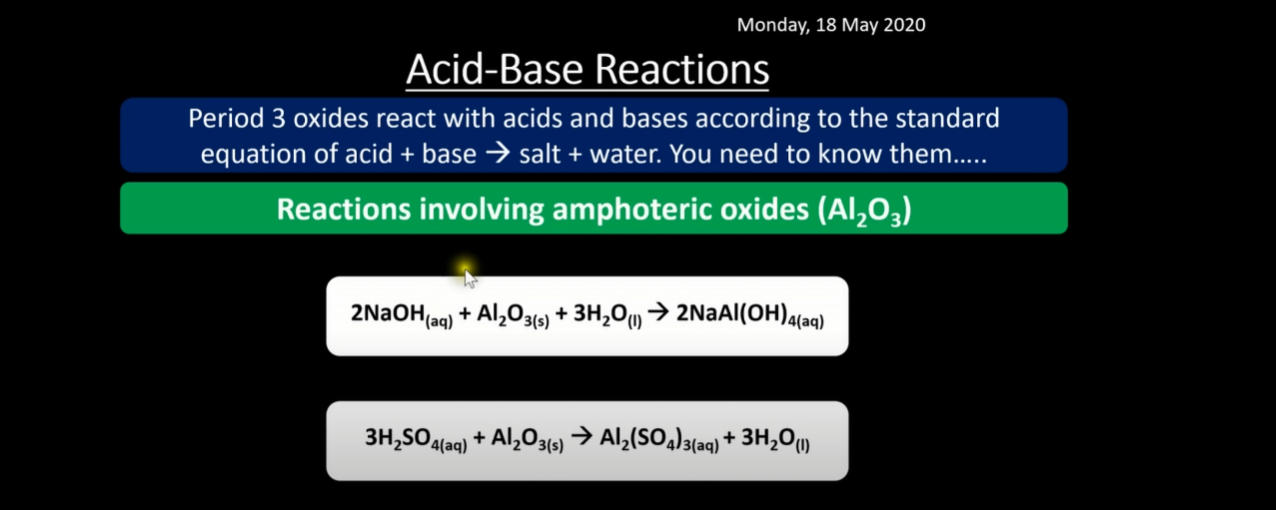
AL2O3 reaction with NaOH +H20? AND REACTION WITH H2SO4?