Organic Chemistry
Study these flashcardsFree · spaced repetition · iPhone, Android, Mac & web
All cards
1
nomenclature
methane, ethane propane, butane, pentane, hexane, heptane, octane, nonane, decane
methyl, ethyl, propyl, isopropyl, butyl, sec-butyl, t-butyl
longest carbon chain, numbered based on lowest carbon substituent or OH, alphabetize substituents (ignore prefixes except iso),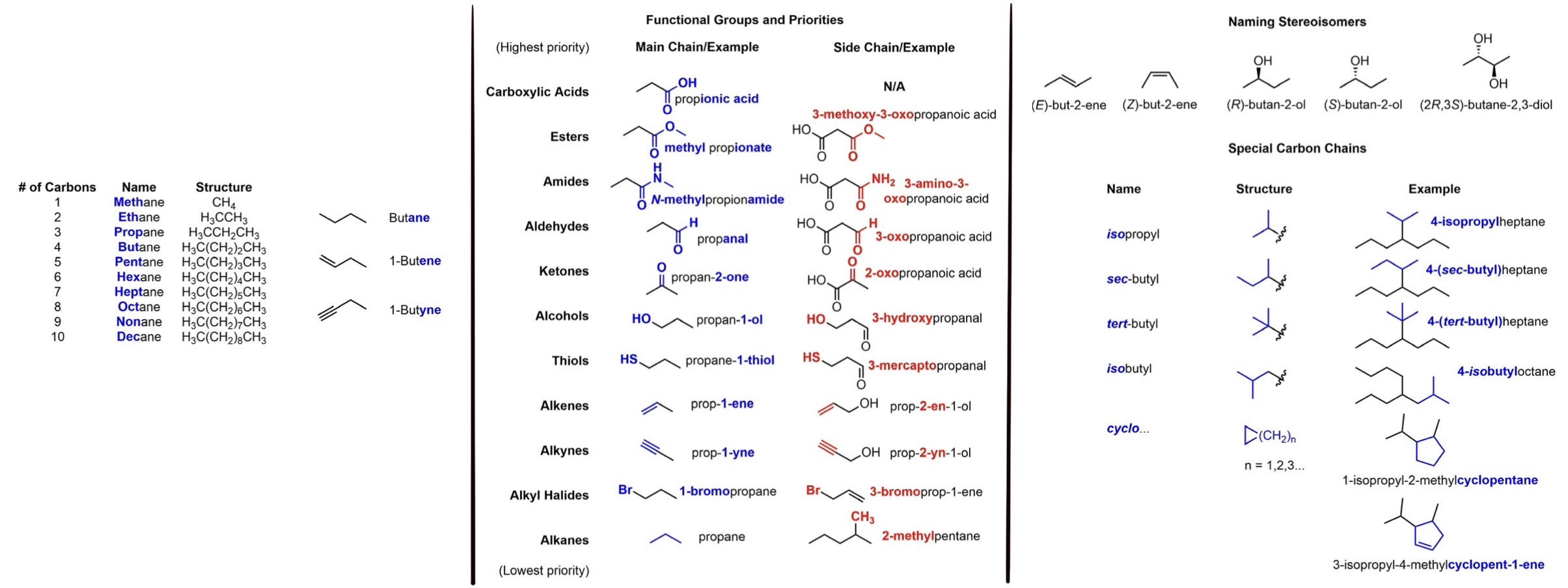
methyl, ethyl, propyl, isopropyl, butyl, sec-butyl, t-butyl
longest carbon chain, numbered based on lowest carbon substituent or OH, alphabetize substituents (ignore prefixes except iso),
2
functional groups
memorize them pg. 34
alkane, alkene, alkyne, alkyl halide
alcohol, phenol, thiol, epoxide, ether
aldehyde, ketone, hemiacetal, acetal, ester
amine, imine, enamine, amide
lactone, lactam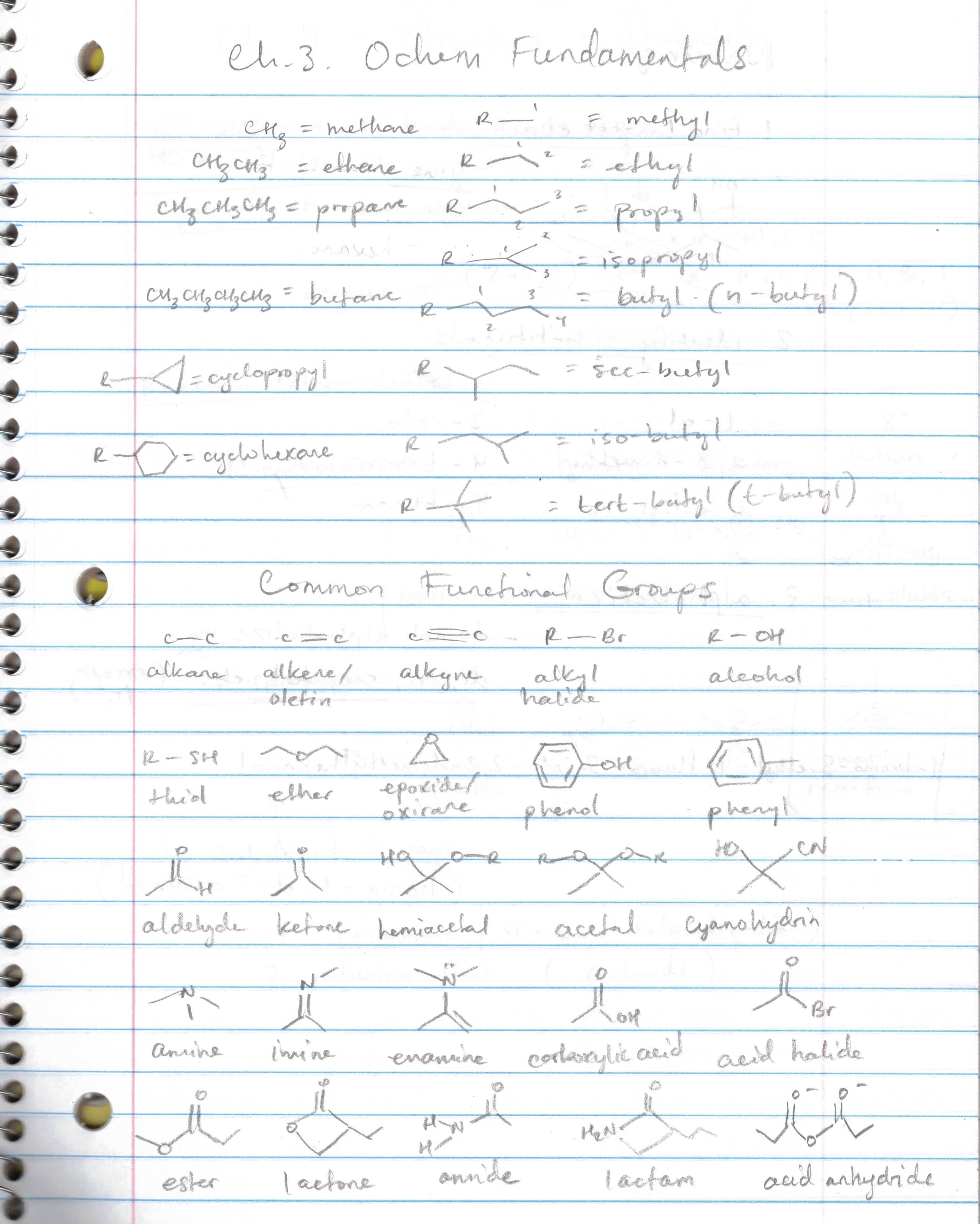
alkane, alkene, alkyne, alkyl halide
alcohol, phenol, thiol, epoxide, ether
aldehyde, ketone, hemiacetal, acetal, ester
amine, imine, enamine, amide
lactone, lactam
3
degree of unsaturation
U = (2C - H + N - X + 2)/2
2 Chicks (2C) went 2gether (+2) to the Nightclub (+N) to forget about (-) their Horrible (H) Exes (X) and was over by 2 (/2)
molecule is saturated if it contains no pi bonds or rings
saturated alkane has formula of CnH2n+2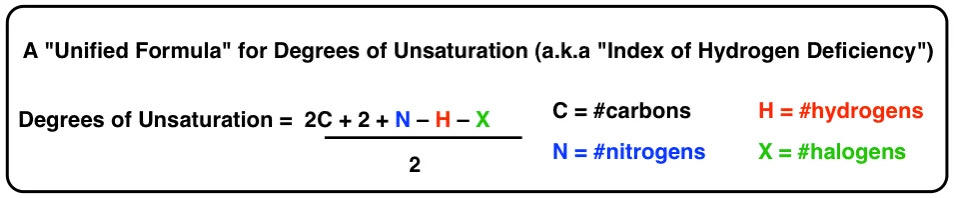
2 Chicks (2C) went 2gether (+2) to the Nightclub (+N) to forget about (-) their Horrible (H) Exes (X) and was over by 2 (/2)
molecule is saturated if it contains no pi bonds or rings
saturated alkane has formula of CnH2n+2
4
ring strain
ideal bond angle is 109.5, ring strain creates reactive molecules with high heats of combustion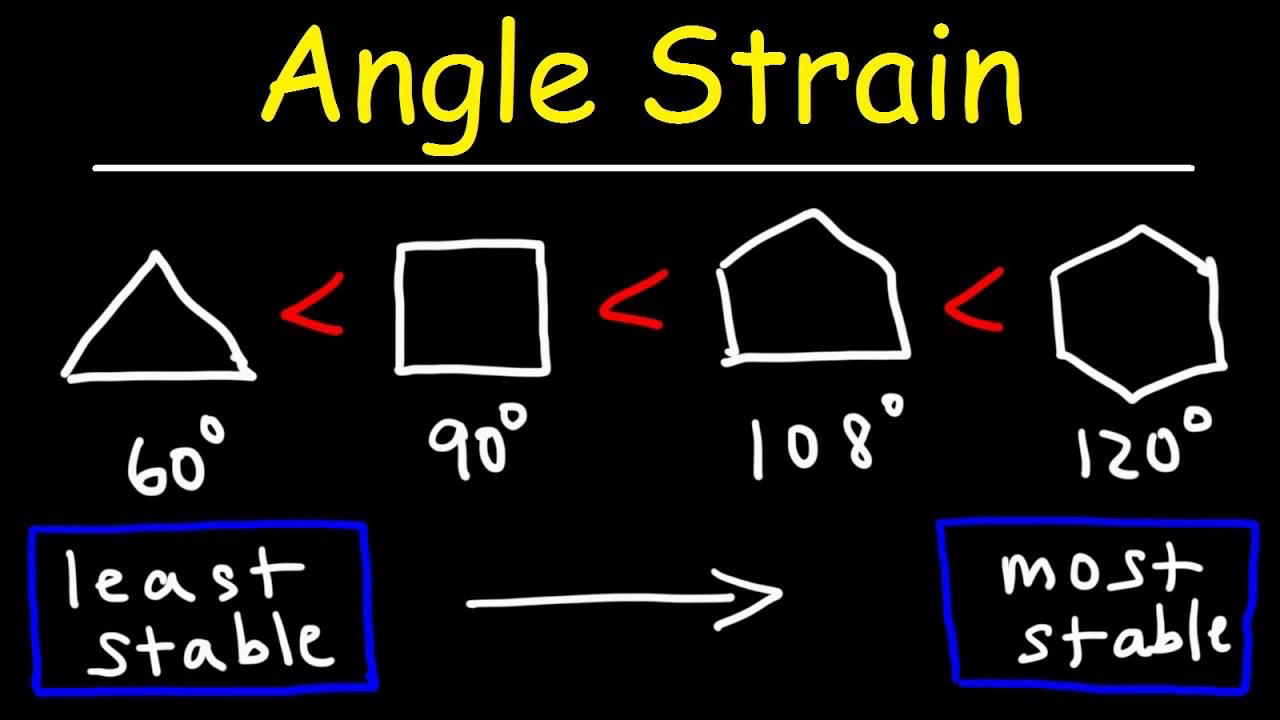
5
carbocations/carbanions
positive/negative charge on carbon
more substituted carbocations are more stable
less substituted carbanions are more stable
since alkyl groups are EDG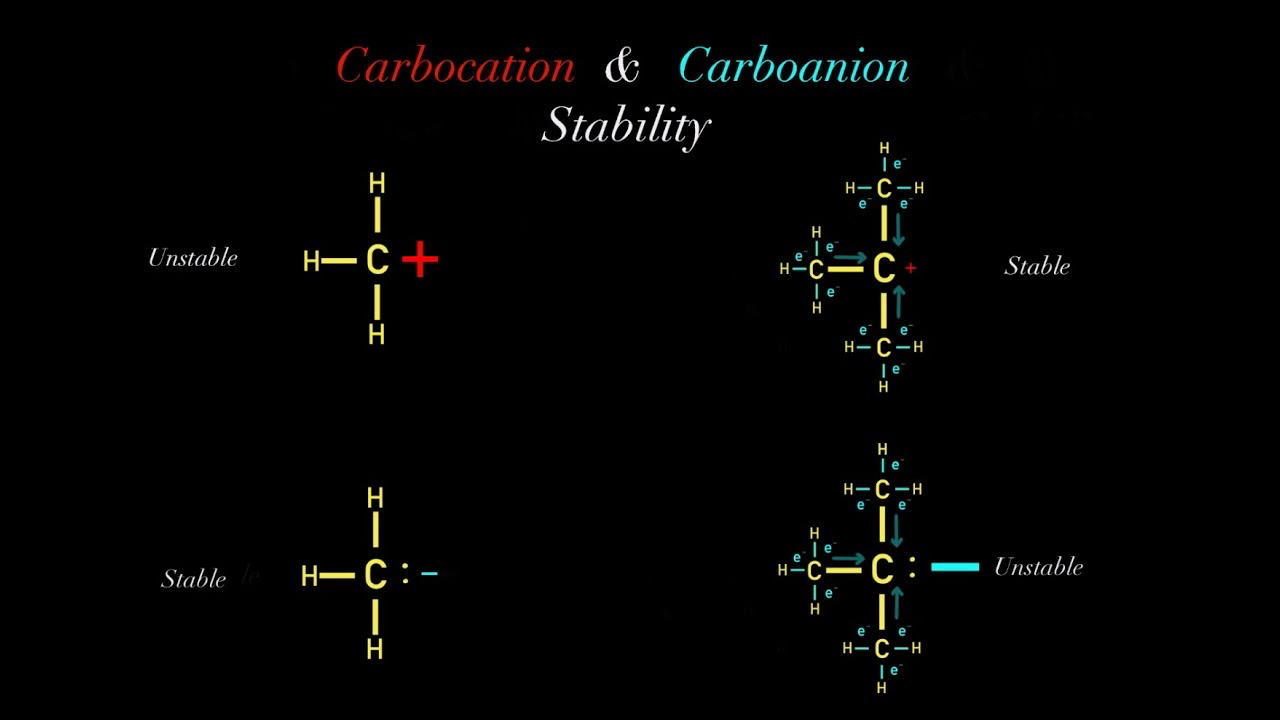
more substituted carbocations are more stable
less substituted carbanions are more stable
since alkyl groups are EDG
6
inductive effect
EDG stabilize carbocations, EWG stabilize carbanions
the stronger acid has the more stable conjugate base, what groups will stabilize the charge?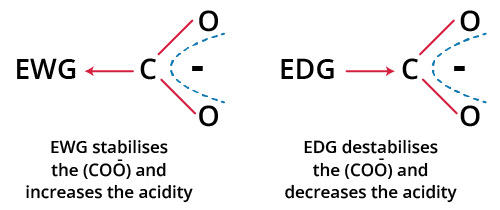
the stronger acid has the more stable conjugate base, what groups will stabilize the charge?
7
resonance stabilization
delocalization- electrons allowed to interact with orbitals on adjacent atoms
conjugated systems give rise to strong colors
electrons in unhybridized p orbitals can participate in resonance, atoms (N) can switch from sp3 to sp2 to free up a p orbital for resonance
major resonance contributor is determined by:
1. octet rule
2. minimized separation of charge
3. charges on electronegative atoms
the stronger acid has the more stable conjugate base, what groups can delocalize the charge?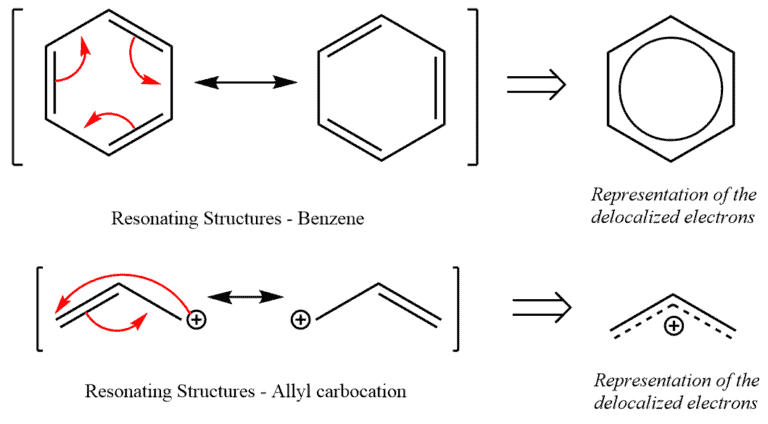
conjugated systems give rise to strong colors
electrons in unhybridized p orbitals can participate in resonance, atoms (N) can switch from sp3 to sp2 to free up a p orbital for resonance
major resonance contributor is determined by:
1. octet rule
2. minimized separation of charge
3. charges on electronegative atoms
the stronger acid has the more stable conjugate base, what groups can delocalize the charge?
8
functional group acidity
strong acids > sulfonic acids > carboxylic acids > phenols > alcohol and water > aldehydes and ketones > sp CH > sp2 CH > sp3 CH (more s character is better at stabilizing conjugate base)
electronegative groups or positive charges can have inductive effect to increase acidity, stronger the close they are to the acidic proton
on benzene rings, para EWG can stabilize conjugate base, para EDG can destabilize conjugate base
acidity determined by stability of conjugate base:
1. electronegativity of adjacent atom
2. resonance stability
3. induction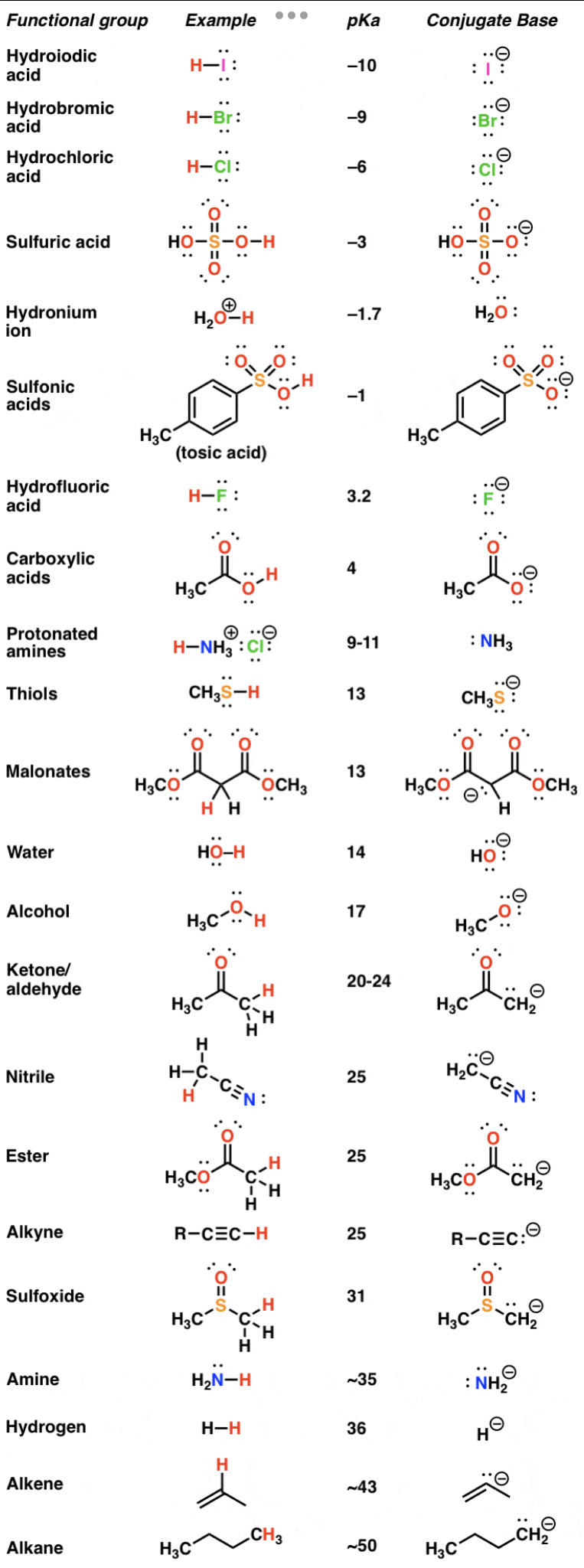
electronegative groups or positive charges can have inductive effect to increase acidity, stronger the close they are to the acidic proton
on benzene rings, para EWG can stabilize conjugate base, para EDG can destabilize conjugate base
acidity determined by stability of conjugate base:
1. electronegativity of adjacent atom
2. resonance stability
3. induction
9
nucleophilicity
increases from top right to bottom left (opposite of electronegativity)
nucleophilicity increases with:
1. increased negative charge
2. going down a group, increased polarizability for larger atoms since they want to donate their electrons
3. going left across a period, decreased electronegativity since less protons means they want to donate their electrons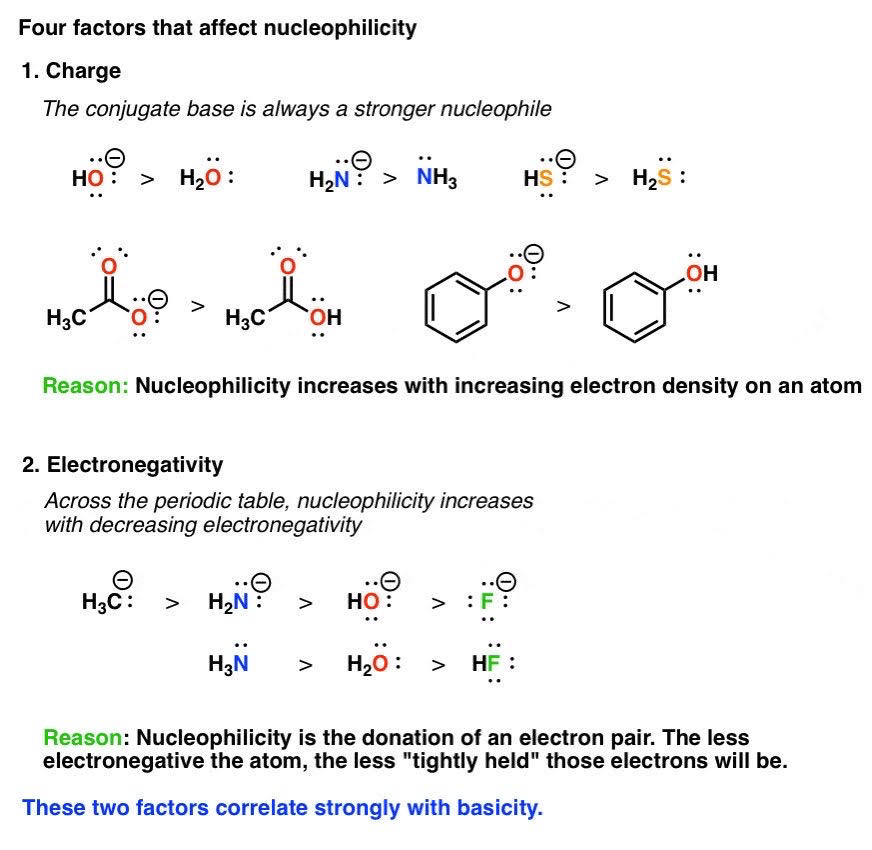
nucleophilicity increases with:
1. increased negative charge
2. going down a group, increased polarizability for larger atoms since they want to donate their electrons
3. going left across a period, decreased electronegativity since less protons means they want to donate their electrons
10
leaving groups
good LGs:
1. resonance stabilized
2. weak bases
3. neutrals (start with positive charge)
bad LGs:
1. strong bases
2. but protonating them can make them good
ugly LGs:
1. hydrogens
2. alkanes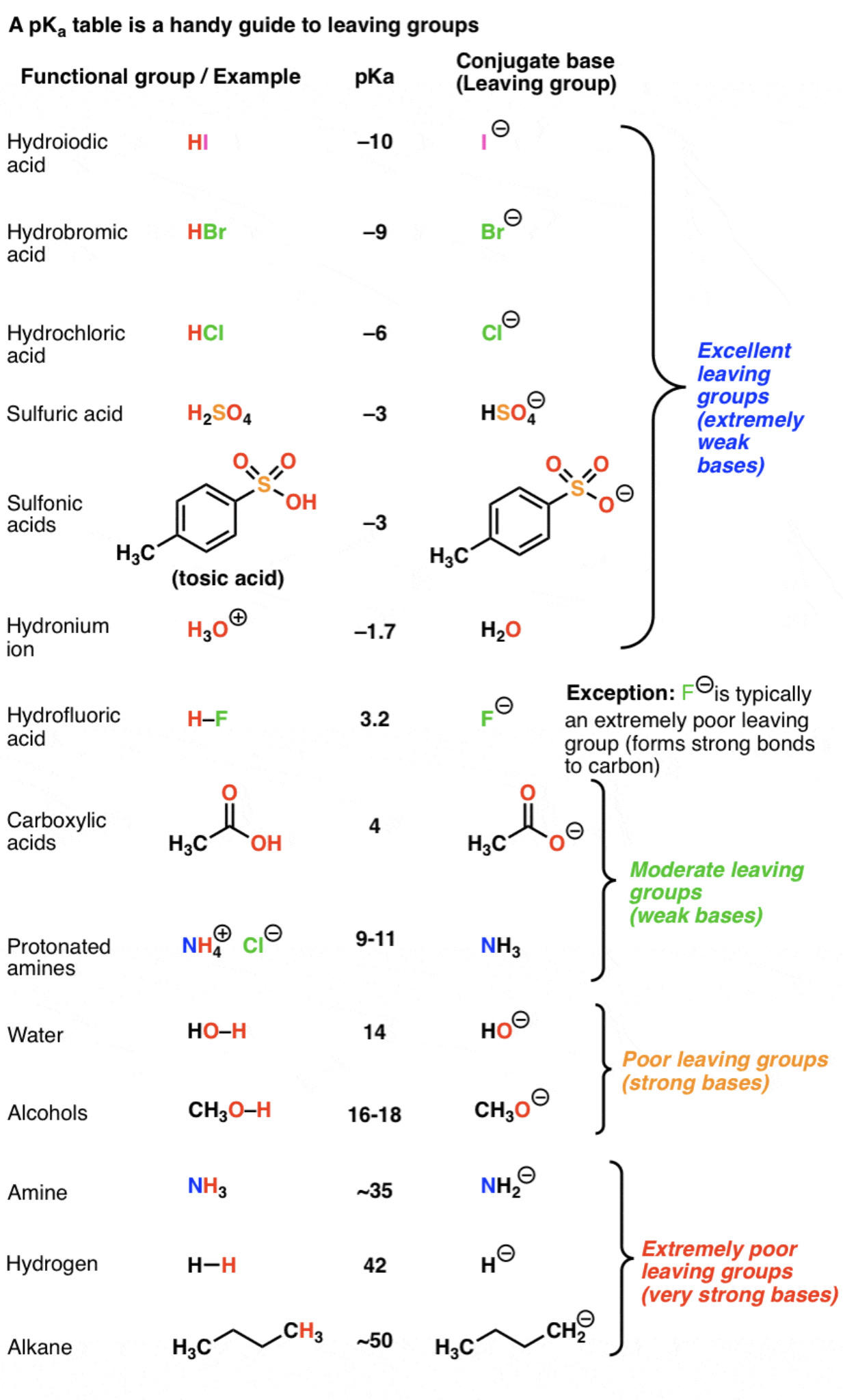
1. resonance stabilized
2. weak bases
3. neutrals (start with positive charge)
bad LGs:
1. strong bases
2. but protonating them can make them good
ugly LGs:
1. hydrogens
2. alkanes
11
constitutional isomers
different atomic connectivity, same molecular formula
different properties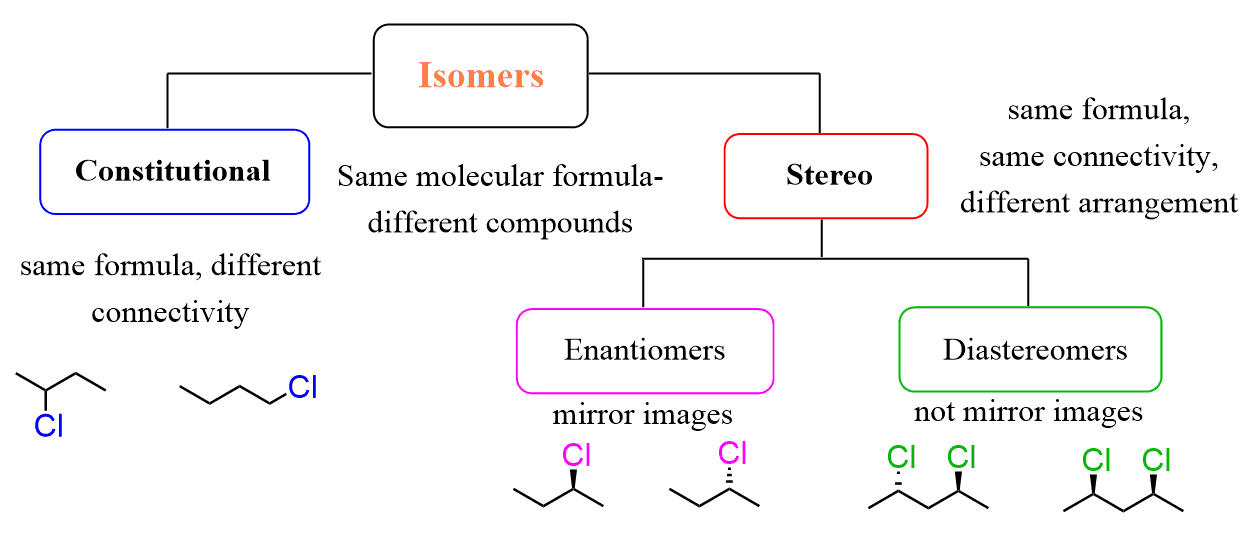
different properties
12
stereoisomers
same molecular formula and atomic connectivity, different spatial orientation
umbrella term for conformational, enantiomers, diastereomers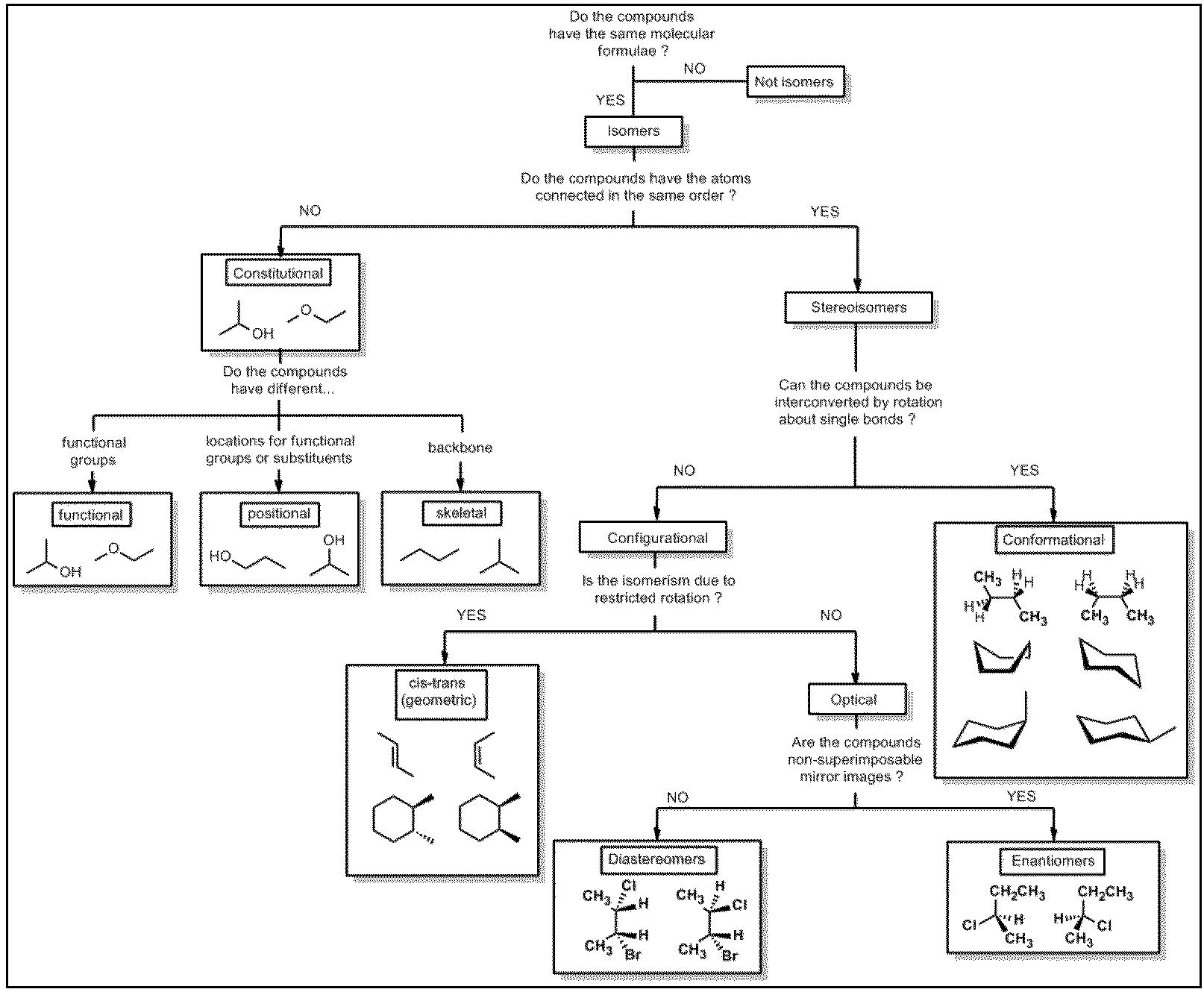
umbrella term for conformational, enantiomers, diastereomers
13
conformational isomers
same atomic connectivity, differ by rotation about sigma bond
identical properties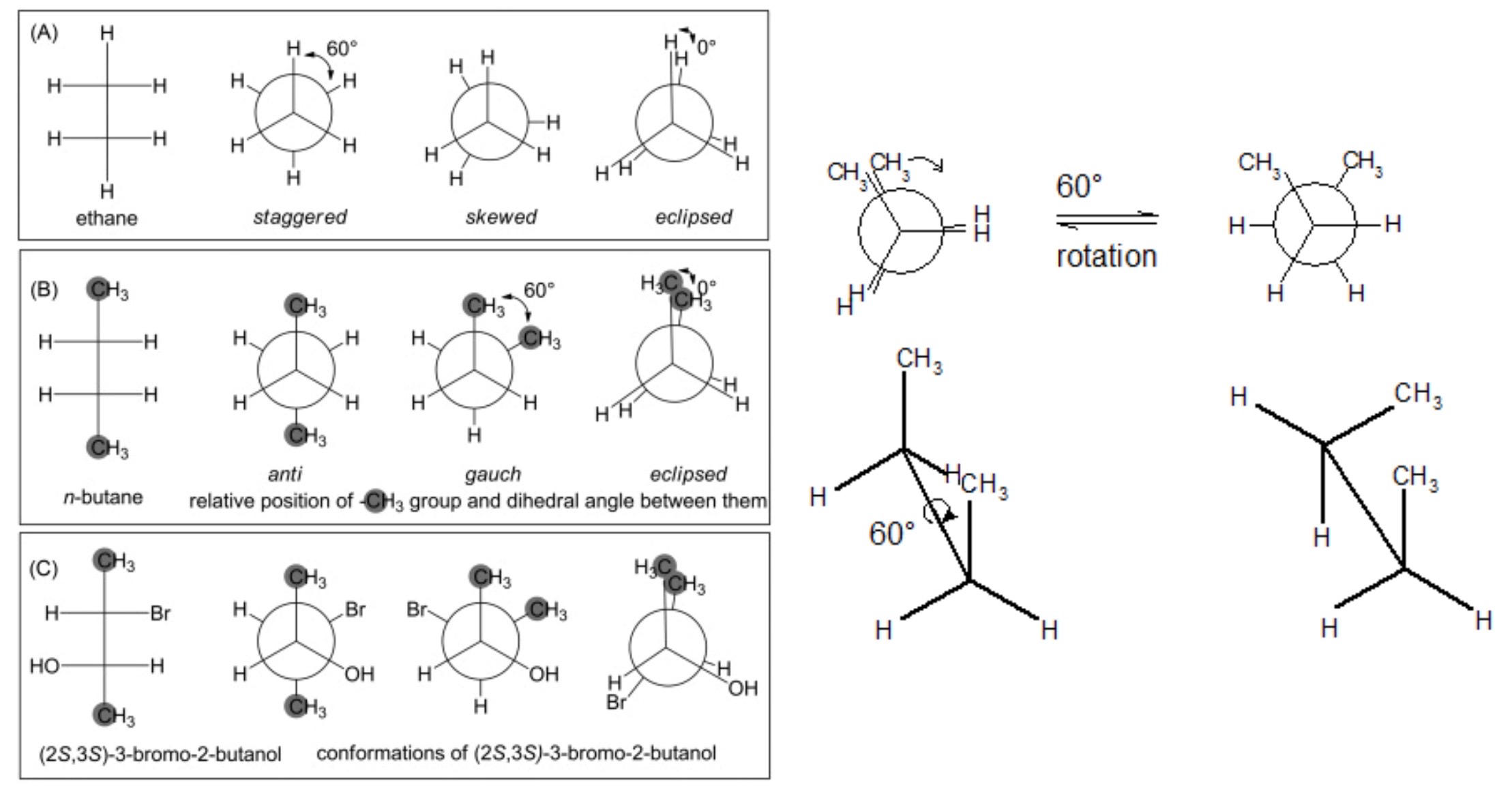
identical properties
14
Newman projection
anti- two groups that are 180 apart
gauche- two groups that are 60 or 120 apart
syn- two groups that are eclipsing each other
anti is lowest energy state, but gauche can be more stable if some hydrogen bonding is going on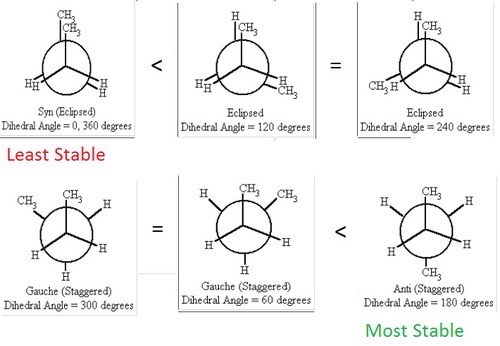
gauche- two groups that are 60 or 120 apart
syn- two groups that are eclipsing each other
anti is lowest energy state, but gauche can be more stable if some hydrogen bonding is going on
15
ring stability
chair is more stable than boat
equatorial position for substituents is more stable than axial position
*1,3-diaxial interactions*- sterics that are less stable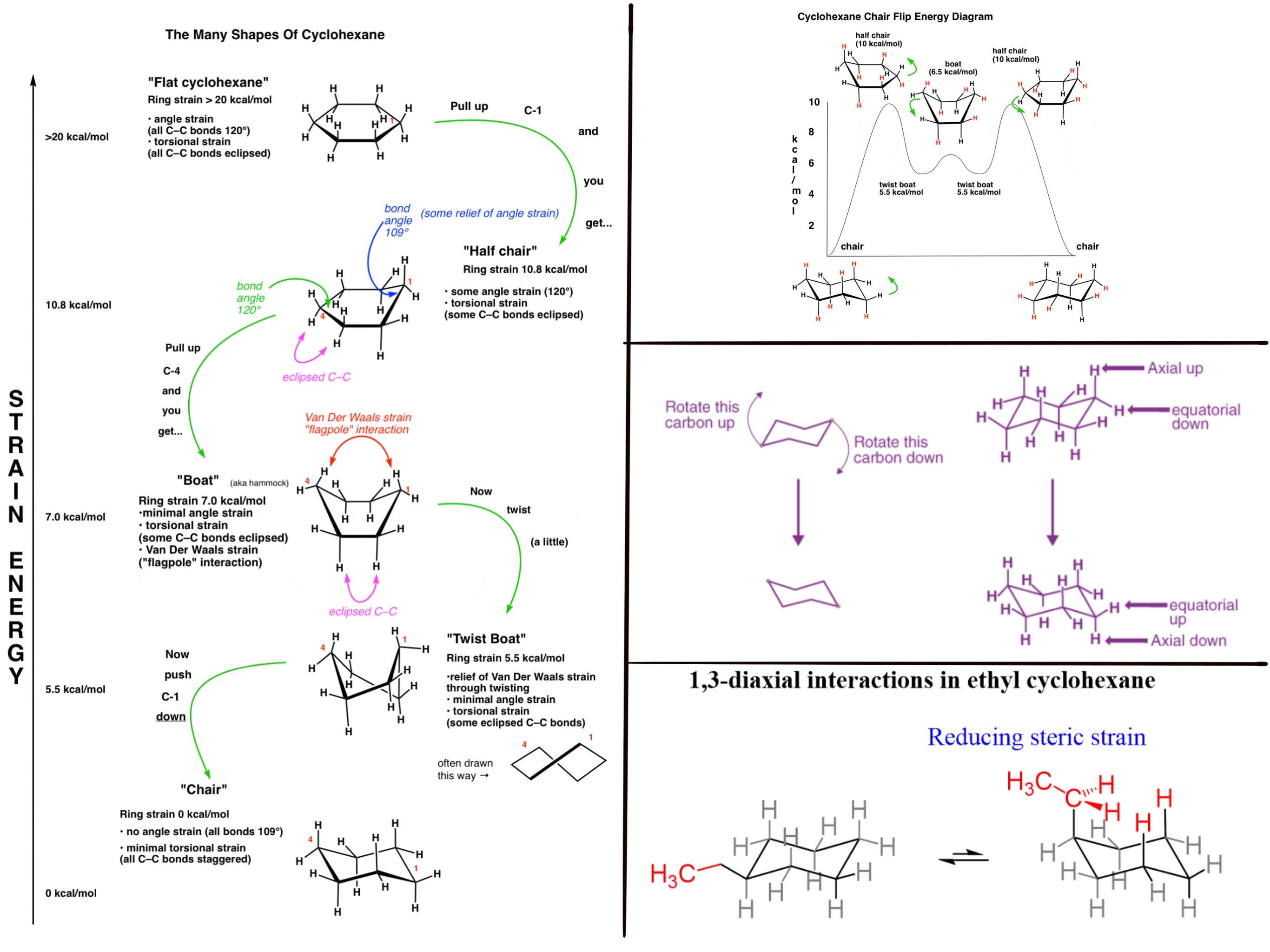
equatorial position for substituents is more stable than axial position
*1,3-diaxial interactions*- sterics that are less stable
16
chiral center
chiral center is a sp3 carbon with four different substituents
# of possible isomers = 2^n, where n = # of chiral centers
chiral molecules are not superimposable on its mirror image, no plane of symmetry
*absolute configuration*- assign priority with lowest in the back, heavier isotopes have higher priority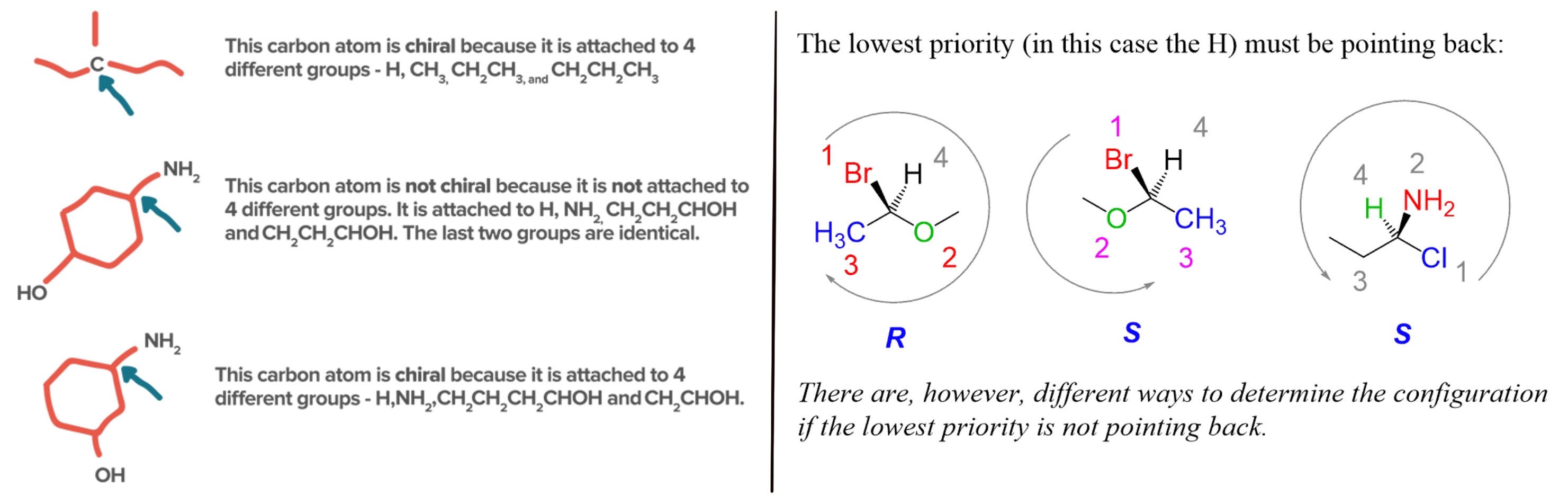
# of possible isomers = 2^n, where n = # of chiral centers
chiral molecules are not superimposable on its mirror image, no plane of symmetry
*absolute configuration*- assign priority with lowest in the back, heavier isotopes have higher priority
17
enantiomers
nonsuperimposable mirror images
opposite configuration at all chiral centers
each enantiomer has optical rotation of equal magnitude, but different signs
all other properties are identical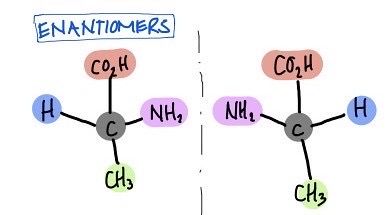
opposite configuration at all chiral centers
each enantiomer has optical rotation of equal magnitude, but different signs
all other properties are identical
18
optical activity
chiral molecules are optically active
d = (+) = dextrorotatory = clockwise
l = (-) = levorotatory = counterclockwise
this cannot be predicted by structure, must be measured by polarimeter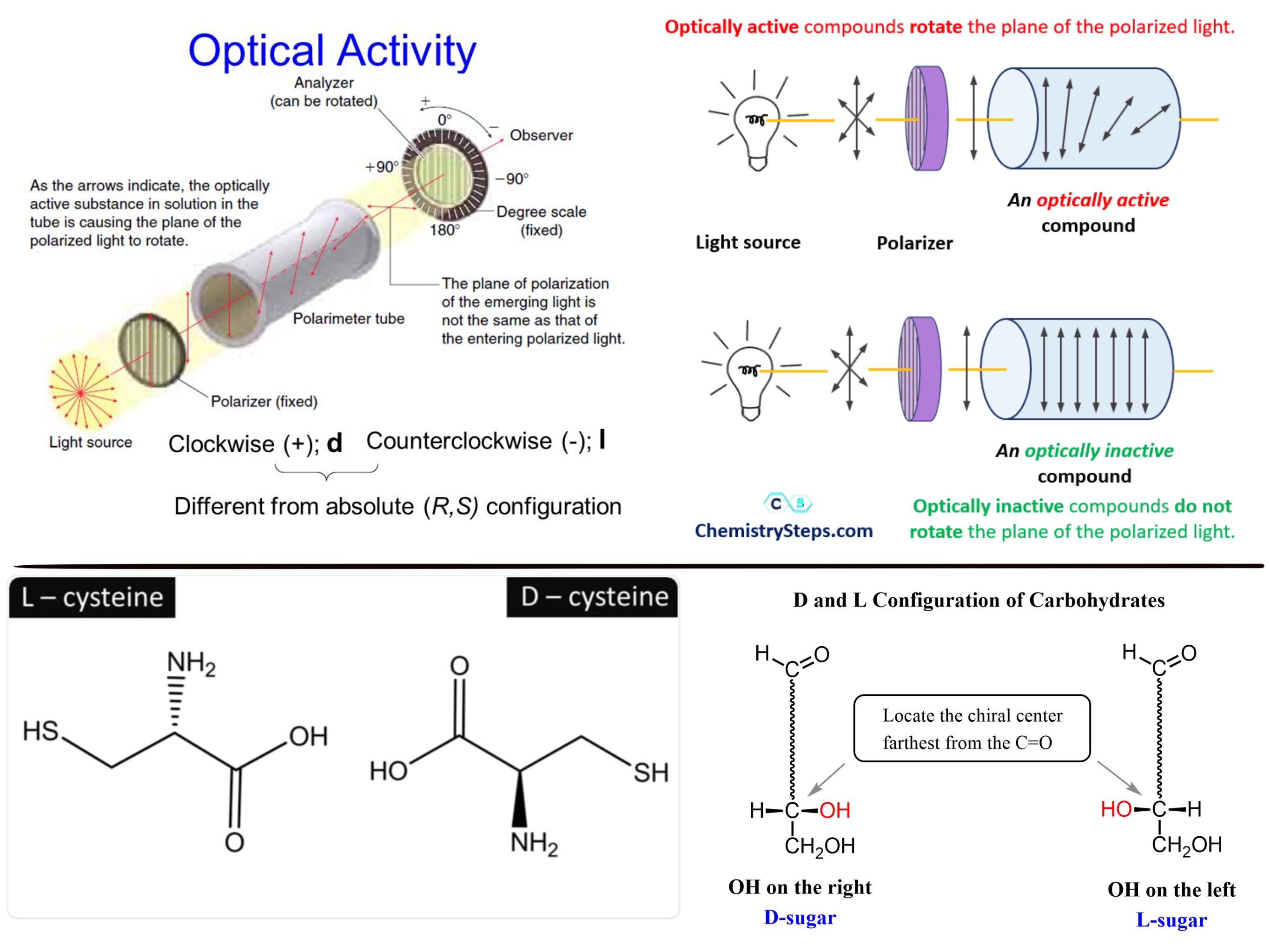
d = (+) = dextrorotatory = clockwise
l = (-) = levorotatory = counterclockwise
this cannot be predicted by structure, must be measured by polarimeter
19
diastereomers
nonsuperimposable nonmirror images, always compares two
opposite configuration at least one chiral center, but not all
unrelated optical activity, different properties, can be physically separated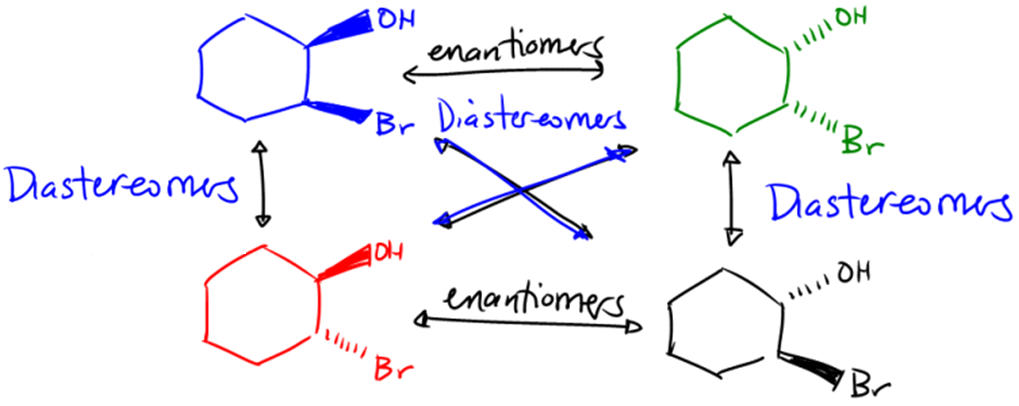
opposite configuration at least one chiral center, but not all
unrelated optical activity, different properties, can be physically separated
20
geometric isomers
subset of diastereomers, restriction in rotation about a double bond or ring
do not require chiral centers, different properties
cis (Z) vs. trans (E) compares the two highest priority groups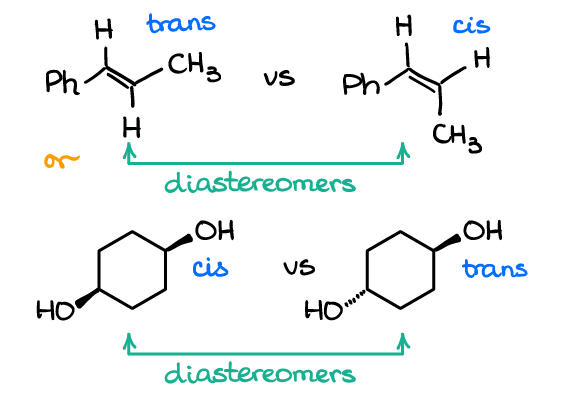
do not require chiral centers, different properties
cis (Z) vs. trans (E) compares the two highest priority groups
21
epimers
subset of diastereomers, differ only at one chiral center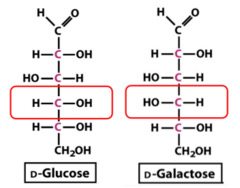
22
anomers
subset of epimers that are sugars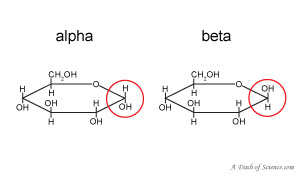
23
meso compounds
symmetrical chiral centers have opposite R/S
achiral overall (therefore optically inactive), have internal plane of symmetry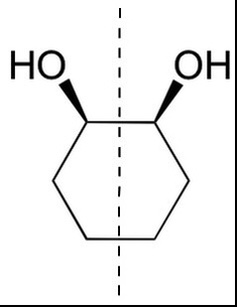
achiral overall (therefore optically inactive), have internal plane of symmetry
24
chromatography vs. spectroscopy
*chromatography* is used to separate compounds (including distillation and resolution as well)
*spectroscopy* is used to analyze compounds (including MS and polarimetry)
*spectroscopy* is used to analyze compounds (including MS and polarimetry)
25
chromatography
stationary phase supports the mixture and retains compounds
mobile phase carries mixture while traveling
two big questions:
1. what's the best way to separate two compounds?
2. what compound will be isolated first?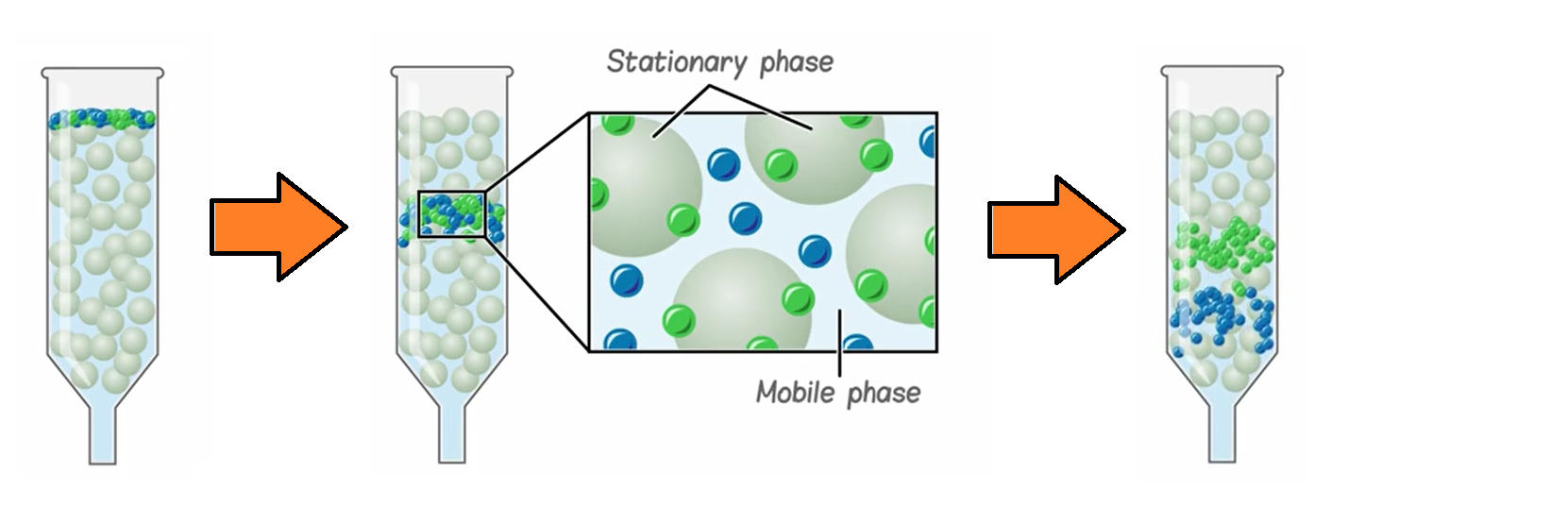
mobile phase carries mixture while traveling
two big questions:
1. what's the best way to separate two compounds?
2. what compound will be isolated first?
26
size-exclusion chromatography
porous beads, smaller compounds enter beads and elute last
separate proteins from peptide fragments
can be used to estimate molecular mass
exclusion limit- compounds with sizes too large will all pass through at the same time
longer column leads to better separation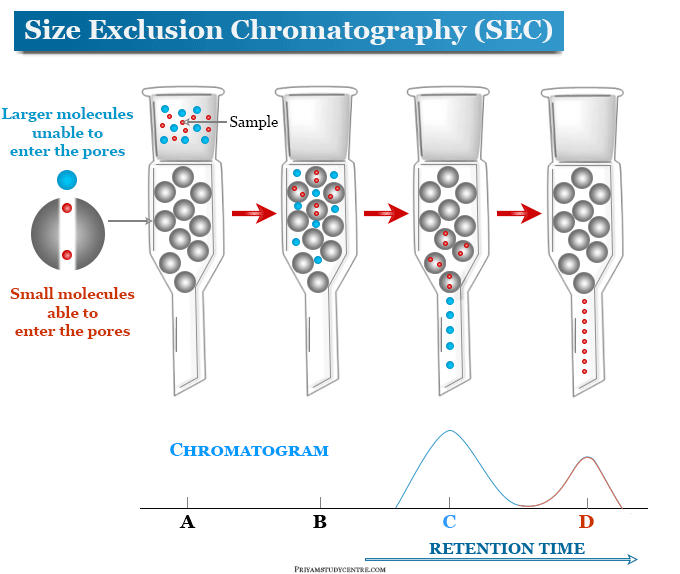
separate proteins from peptide fragments
can be used to estimate molecular mass
exclusion limit- compounds with sizes too large will all pass through at the same time
longer column leads to better separation
27
TLC
stationary phase is polar (paper), so polar travels slower
mobile phase is solvent bath in development chamber, can be polar or non-polar
moves from down to up
retention factor (Rf) = spot distance/solvent distance
eluting strength- how strong the mobile phase is at pulling stuff away from the stationary phase, the more polar the solvent, the stronger its eluting strength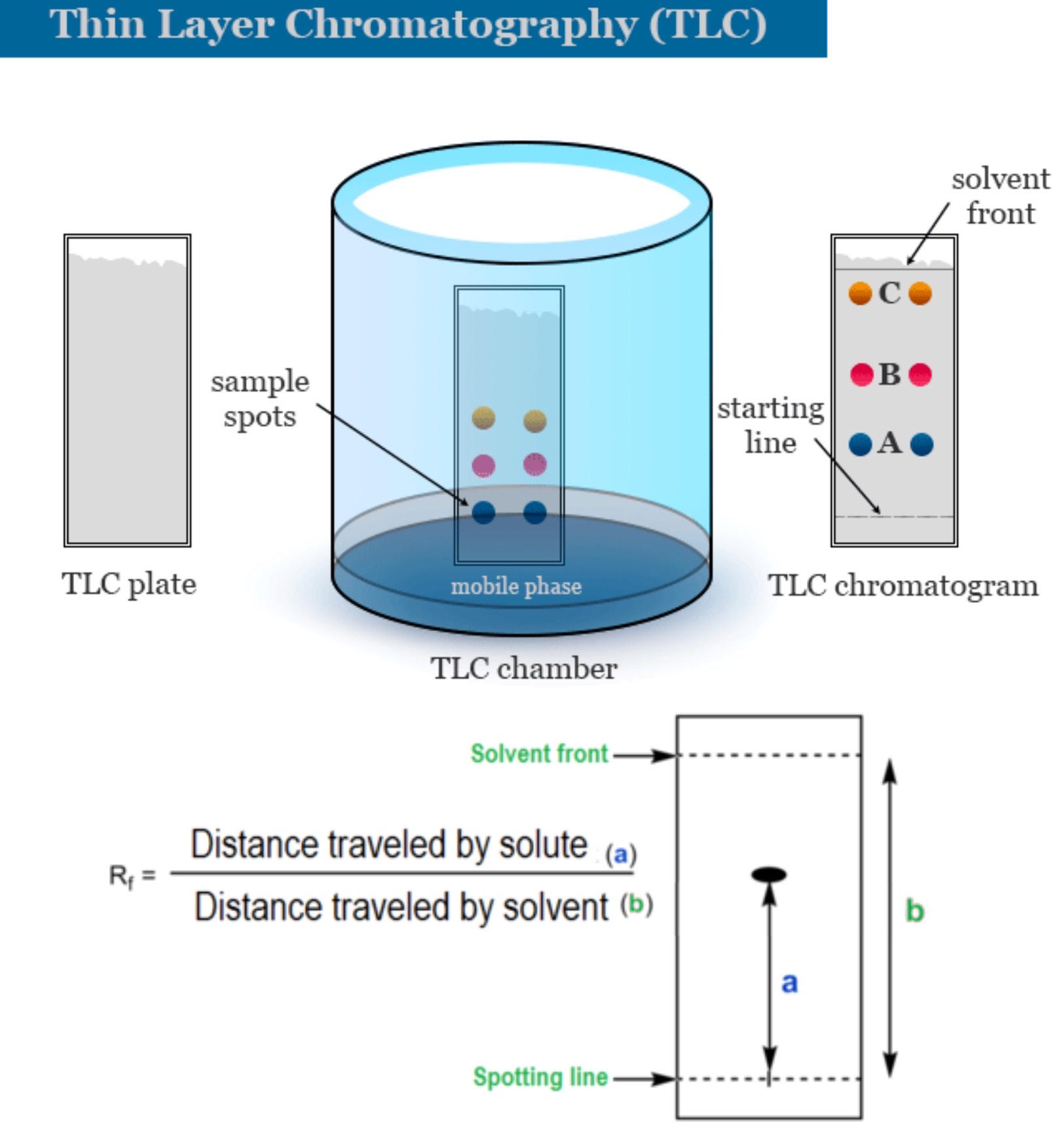
mobile phase is solvent bath in development chamber, can be polar or non-polar
moves from down to up
retention factor (Rf) = spot distance/solvent distance
eluting strength- how strong the mobile phase is at pulling stuff away from the stationary phase, the more polar the solvent, the stronger its eluting strength
28
column chromatography
stationary phase is polar (silica gel), so polar elutes last
same as TLC, but upside down
move from up to down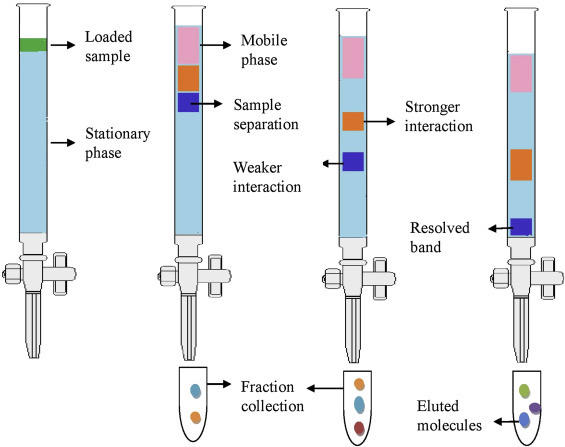
same as TLC, but upside down
move from up to down
29
HPLC
most common form is reverse phase, stationary phase is nonpolar, so nonpolar elutes last
moves from left to right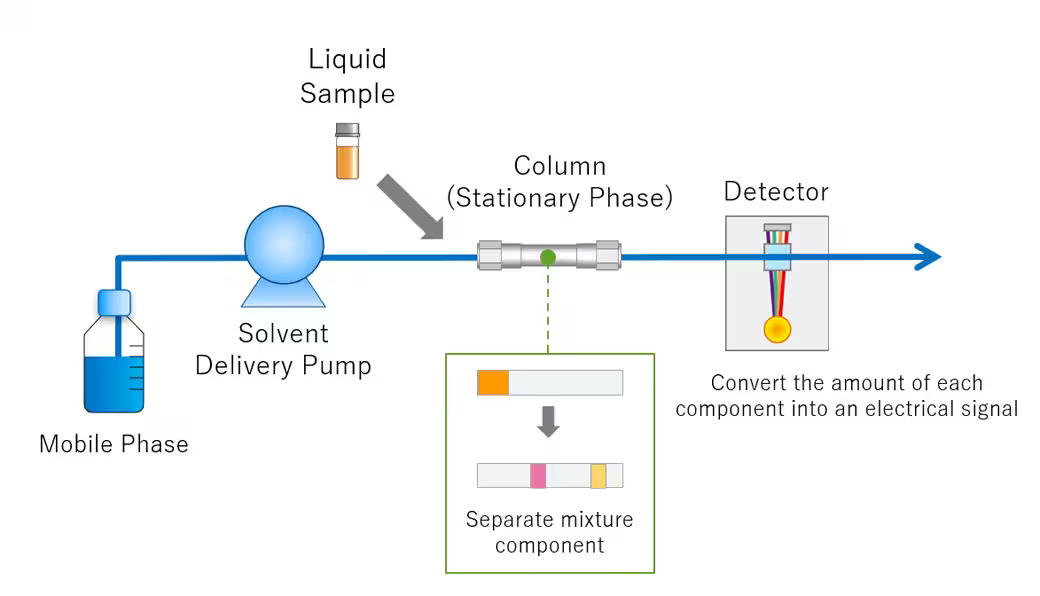
moves from left to right
30
ion exchange chromatography
separates based on overall net charge, stationary phase is anionic/cationic resin, with counterions attached
mobile phase is buffer solution, keeps pH constant
cation exchange retains cations (positive charge)
need to be flushed out by high concentration of counterions or to change the pH of the solution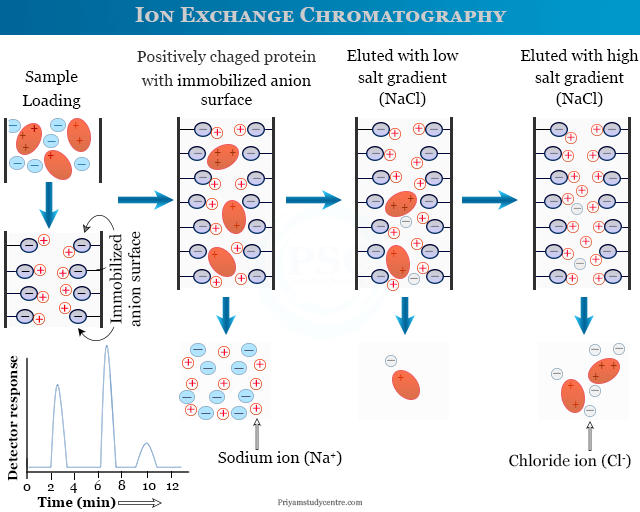
mobile phase is buffer solution, keeps pH constant
cation exchange retains cations (positive charge)
need to be flushed out by high concentration of counterions or to change the pH of the solution
31
affinity chromatography
stationary phase is resin linked to antibody-binding protein
elute target protein with competitive antibody-binding protein
separate proteins from cell lysate or blood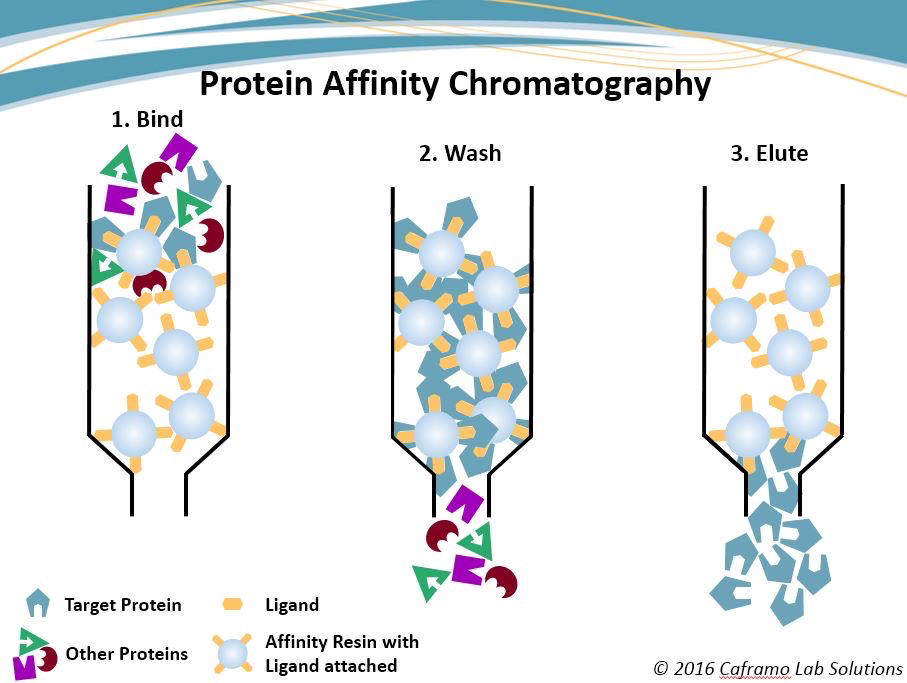
elute target protein with competitive antibody-binding protein
separate proteins from cell lysate or blood
32
metal ion affinity chromatography
stationary phase is resin linked to Ni2+ ions
mobile phase is protein tagged with his-tag, which binds Ni
elute target protein by changing pH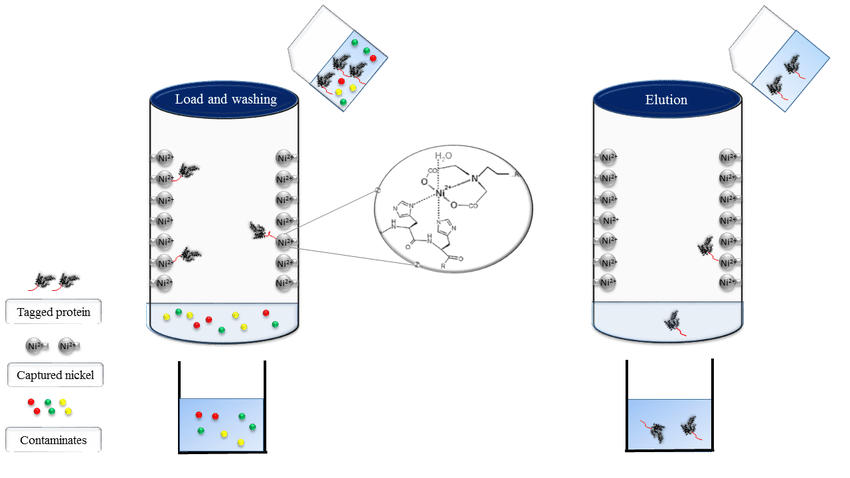
mobile phase is protein tagged with his-tag, which binds Ni
elute target protein by changing pH
33
gas chromatography
separates based on boiling point
gas chromatogram- plot of intensity over time
3 pieces of information:
1. number of compounds is number of peaks
2. relative quantity of each compound is determined by area each peak
3. higher BP compound (lower volatility) will elute later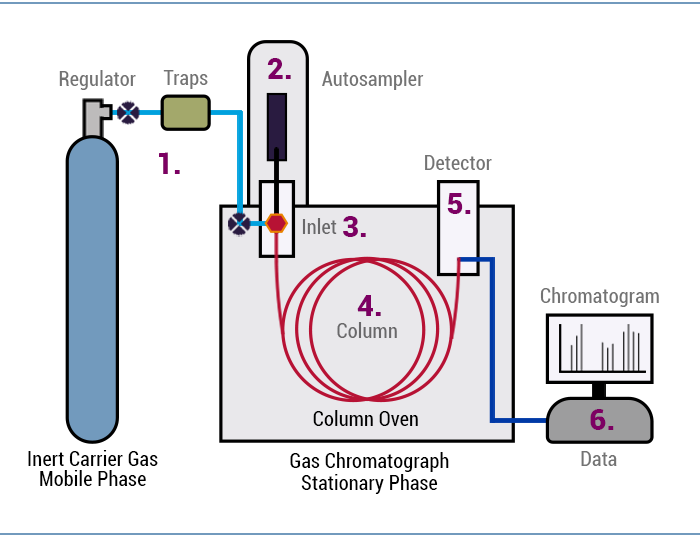
gas chromatogram- plot of intensity over time
3 pieces of information:
1. number of compounds is number of peaks
2. relative quantity of each compound is determined by area each peak
3. higher BP compound (lower volatility) will elute later
34
distillation
separate large amounts based on boiling point
boiling chips- provide nucleation sites for bubbles to prevent superheating
two methods:
1. simple distillation- remove impurities, difference in BP is > 30 C
2. fractional distillation- separate diastereomers, difference in BP is < 30 C
vacuum distillation- lower Patm to lower boiling points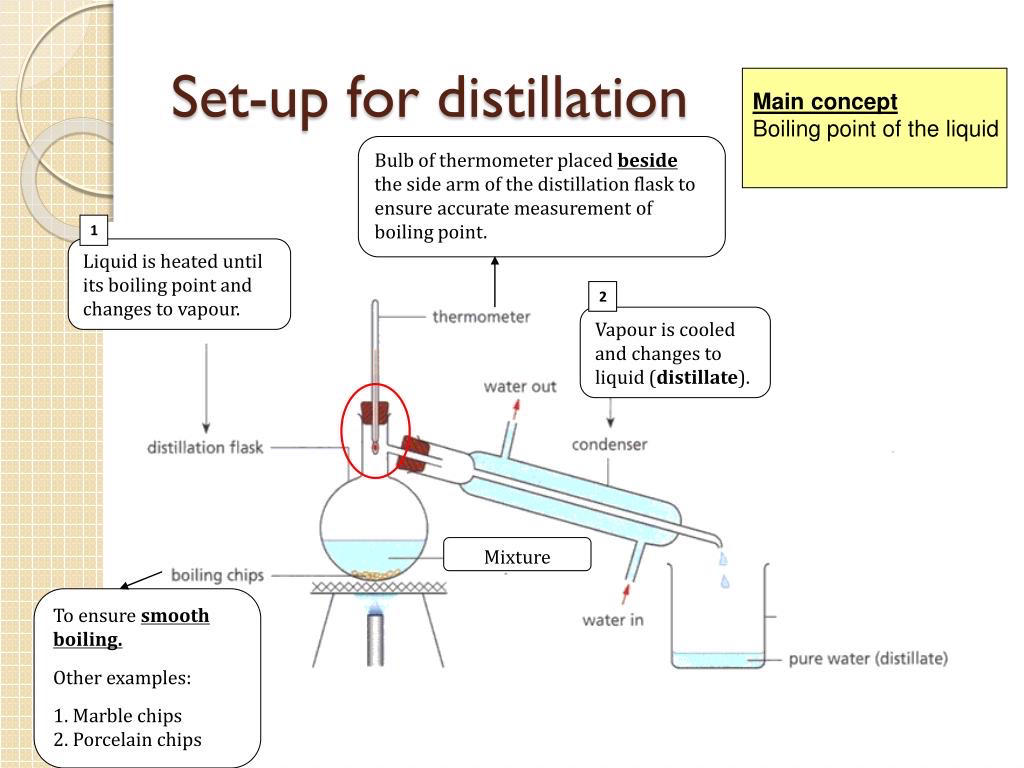
boiling chips- provide nucleation sites for bubbles to prevent superheating
two methods:
1. simple distillation- remove impurities, difference in BP is > 30 C
2. fractional distillation- separate diastereomers, difference in BP is < 30 C
vacuum distillation- lower Patm to lower boiling points
35
boiling point
higher BP molecules:
1. are larger and heavier (more IMFs)
2. have less branching (more compact)
determined generally by 3 intramolecular forces: H-bonds, dipole-dipole, Van der Waals
1. are larger and heavier (more IMFs)
2. have less branching (more compact)
determined generally by 3 intramolecular forces: H-bonds, dipole-dipole, Van der Waals
36
solubility in water
factors that determine solubility:
1. polar dissolves in polar, nonpolar dissolves in nonpolar (organic)
2. compounds with less than 5 carbons and a polar group are water soluble (exception, sugars are water soluble)
3. charged functional groups are soluble in water
1. polar dissolves in polar, nonpolar dissolves in nonpolar (organic)
2. compounds with less than 5 carbons and a polar group are water soluble (exception, sugars are water soluble)
3. charged functional groups are soluble in water
37
separatory funnel, extraction
aqueous layer and organic layer (contains compounds you want to separate, use an ether)
*organic layer*- ether is not very polar, so amides and other ethers will go there
*aqueous layer*- water is polar, so carboxylic acids, amines, and alcohols will be there
1. to extract amine: add strong acid to protonate amine and turn into a salt to extract
2. to extract carboxylic acid or phenol: add weak base to deprotonate carboxylic acid or phenol and turn into a salt to extract
add weak acid to extract strong base
add strong acid to extract weak base
add weak base to extract strong acid
add strong base to extract weak acid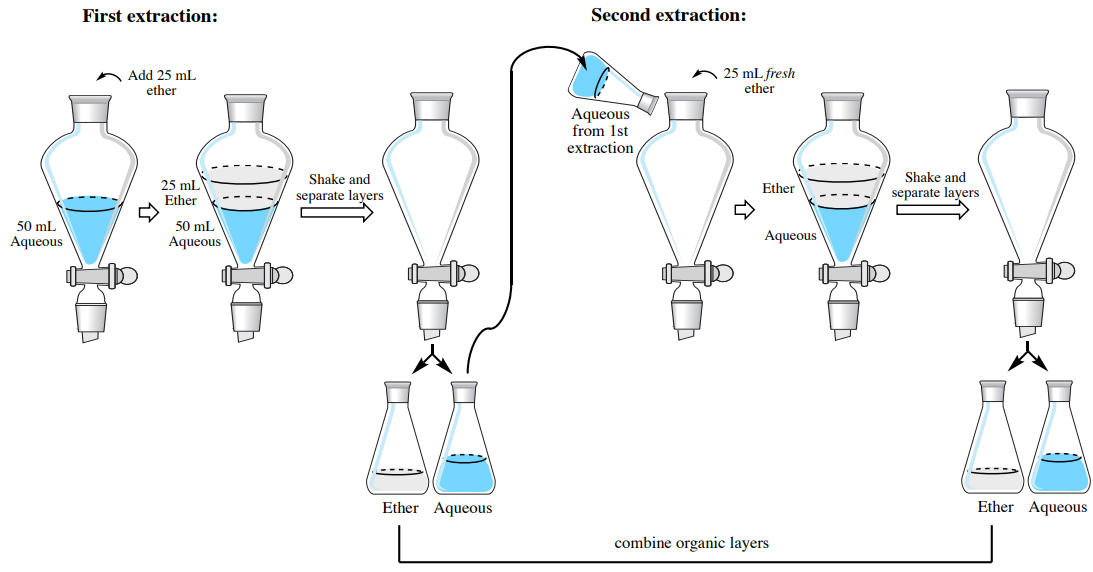
*organic layer*- ether is not very polar, so amides and other ethers will go there
*aqueous layer*- water is polar, so carboxylic acids, amines, and alcohols will be there
1. to extract amine: add strong acid to protonate amine and turn into a salt to extract
2. to extract carboxylic acid or phenol: add weak base to deprotonate carboxylic acid or phenol and turn into a salt to extract
add weak acid to extract strong base
add strong acid to extract weak base
add weak base to extract strong acid
add strong base to extract weak acid
38
resolution
enantiomers have same physical and chemical properties, separate racemic mixture
1. add a chiral resolving agent (*acid*) to convert enantiomers to diastereomer salt
2. separate with regular means (recrystallization, distillation)
3. revert salt to enantiomers by adding a *base*
make sure they don't become meso compounds!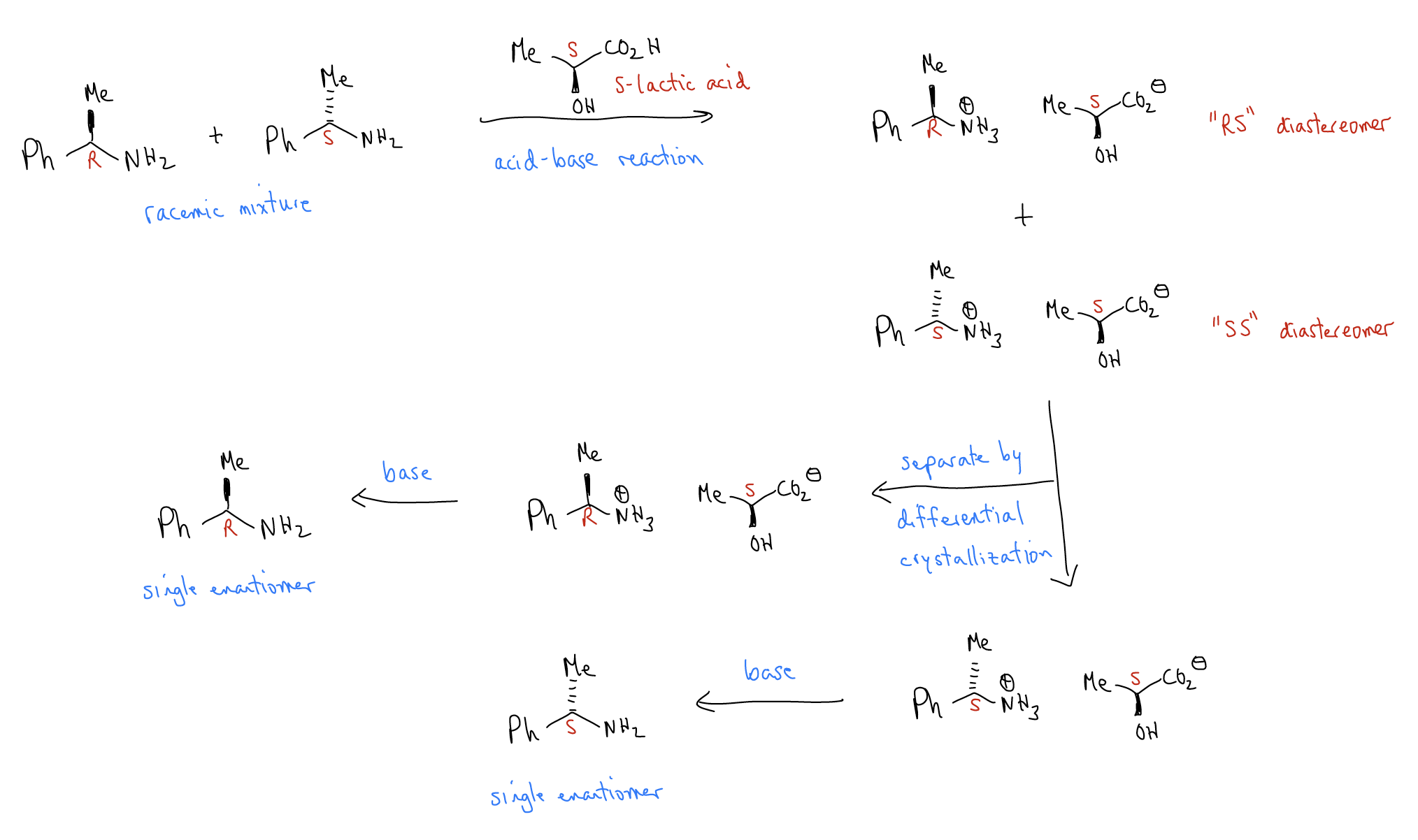
1. add a chiral resolving agent (*acid*) to convert enantiomers to diastereomer salt
2. separate with regular means (recrystallization, distillation)
3. revert salt to enantiomers by adding a *base*
make sure they don't become meso compounds!
39
mass spectrometry
determine the molecular weight of compounds, determines elemental and isotopic composition
cannot separate isomers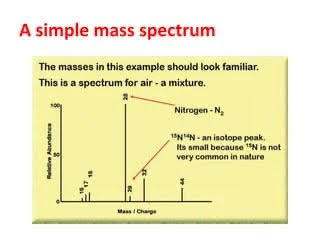
cannot separate isomers
40
UV/Vis spectroscopy
indicates presence of conjugated pi system
red shift- more resonance means more red
complementary wavelength- wavelength absorbed is opposite the one that is perceived (*Christmas, Tangled, Frosted Flakes*)
red is 700 nm, violet is 300 nm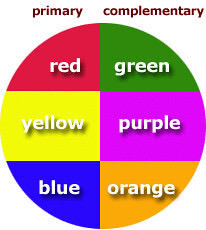
red shift- more resonance means more red
complementary wavelength- wavelength absorbed is opposite the one that is perceived (*Christmas, Tangled, Frosted Flakes*)
red is 700 nm, violet is 300 nm
41
IR spectroscopy
IR light causes bonds to vibrate at different frequencies, shows which functional groups are present
peaks expressed as wavenumbers (cm-1)
does not show where the functional group is or how many, good for separating constitutional isomers but not stereoisomers
O-H is 3200-2600
C=O is 1700
C=C is 1600
CN/alkyne is 2100-2260
C-H appearance/disappearance does not help!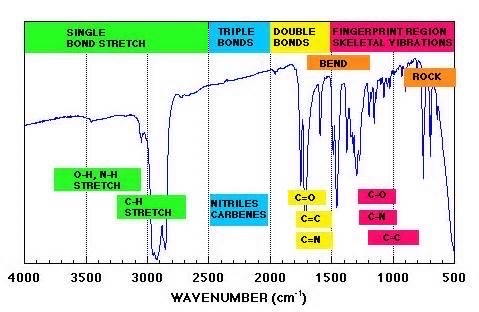
peaks expressed as wavenumbers (cm-1)
does not show where the functional group is or how many, good for separating constitutional isomers but not stereoisomers
O-H is 3200-2600
C=O is 1700
C=C is 1600
CN/alkyne is 2100-2260
C-H appearance/disappearance does not help!
42
NMR spectroscopy
Hs are equivalent when there is free rotation or symmetry, each set of non-equivalent Hs give one NMR signal
splitting pattern indicate number of Hs on adjacent carbons, subtract one
multiplet for multiple splitting patterns
integration indicates number of equivalent Hs represented by peak, can be a multiple of the number of Hs
chemical shift is in ppm:
1. *EDG shifts right*/ upfield/low ppm (alkyl groups)
2. *EWG shifts left*/downfield/high ppm (halogen, vinyl, aromatic, aldehyde, etc.)
common NMR peaks:
1. carboxylic acid- 11 ppm
2. aldehyde- 9 ppm
3. aromatic- 7 ppm
4. vinyl- 5 ppm
5. alcohol/halide/ketone- 3 ppm
6. alkyl- 1 ppm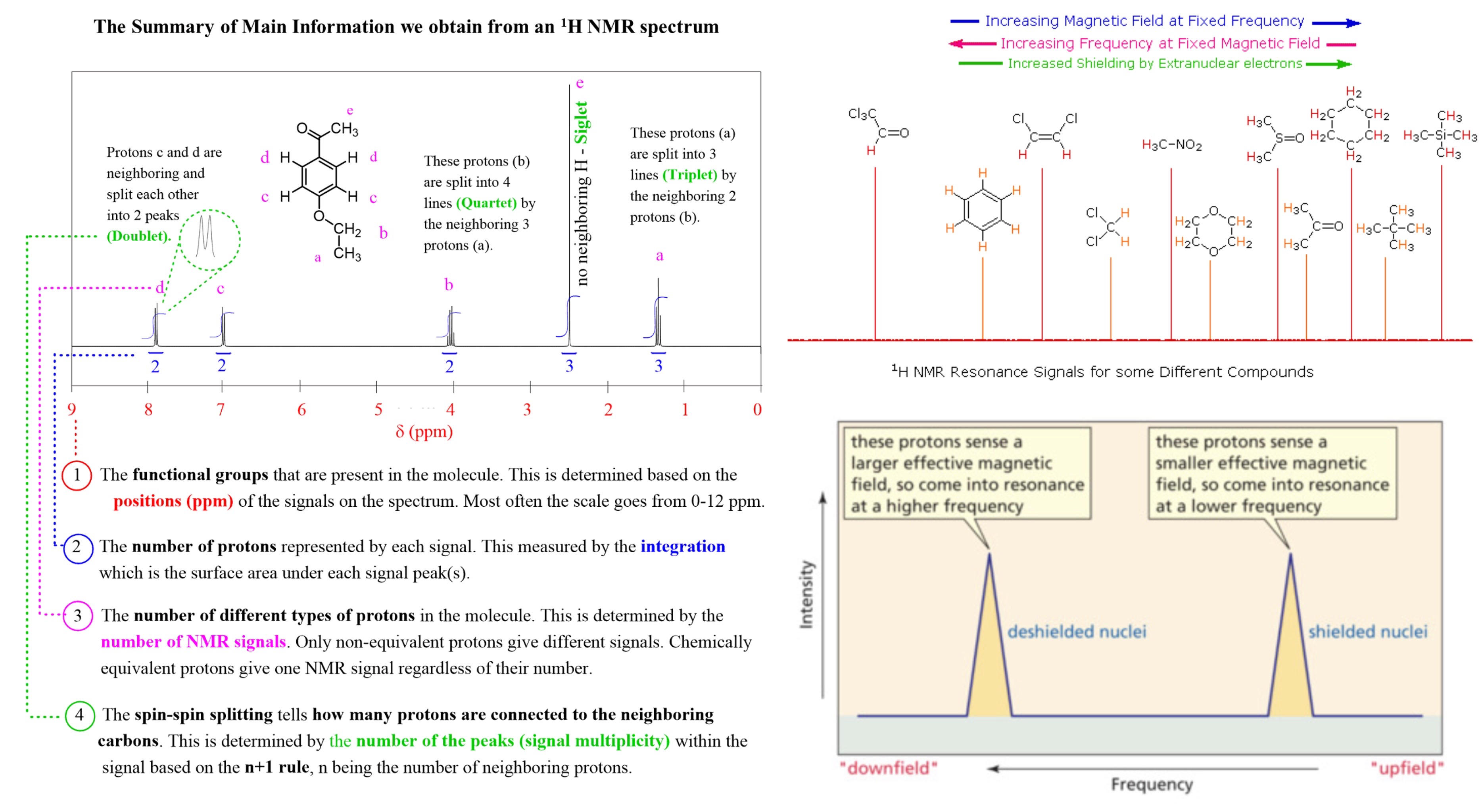
splitting pattern indicate number of Hs on adjacent carbons, subtract one
multiplet for multiple splitting patterns
integration indicates number of equivalent Hs represented by peak, can be a multiple of the number of Hs
chemical shift is in ppm:
1. *EDG shifts right*/ upfield/low ppm (alkyl groups)
2. *EWG shifts left*/downfield/high ppm (halogen, vinyl, aromatic, aldehyde, etc.)
common NMR peaks:
1. carboxylic acid- 11 ppm
2. aldehyde- 9 ppm
3. aromatic- 7 ppm
4. vinyl- 5 ppm
5. alcohol/halide/ketone- 3 ppm
6. alkyl- 1 ppm
43
SN1/SN2
• SN1 involves carbocation formation (unimolecular rate) which is the rate-limiting step, nucleophile can attack on either plane of sp2 C, so both enantiomers can form
• SN1 on 2/3 degree carbons only (carbocation stability!)
• SN1 considerations:
1. doesn't consider nucleophile size/conc. in rate law
2. *polar, protic solvent*
3. 2/3 degree carbons only
• SN2 involves backside attack, so inversion of configuration with pentavalent transition state
• SN2 on 0/1/2 degree carbons only
• SN2 like *polar, aprotic solvents*: acetone, DMF, DMSO
alcohols and ethers undergo substitution only with an acid catalyst or conversion to a better leaving group (something resonance stabilized maybe)
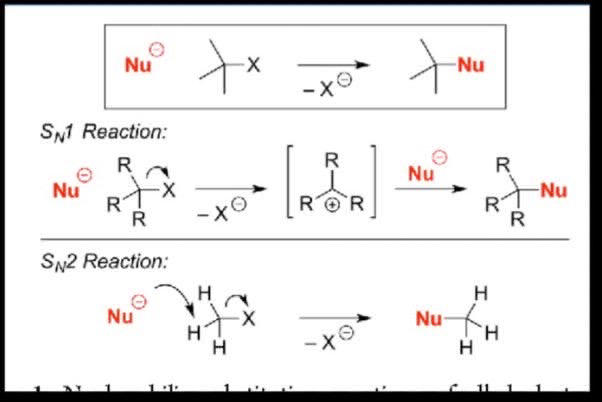
• SN1 on 2/3 degree carbons only (carbocation stability!)
• SN1 considerations:
1. doesn't consider nucleophile size/conc. in rate law
2. *polar, protic solvent*
3. 2/3 degree carbons only
• SN2 involves backside attack, so inversion of configuration with pentavalent transition state
• SN2 on 0/1/2 degree carbons only
• SN2 like *polar, aprotic solvents*: acetone, DMF, DMSO
alcohols and ethers undergo substitution only with an acid catalyst or conversion to a better leaving group (something resonance stabilized maybe)
44
tautomerism
keto form to enol form, goes through enolate, tautomers are *constitutional isomers*
keto form is more stable
since tautomerism occurs, adding D2O will cause deuterium exchange until all Hs are Ds, no signal on NMR, this shows that those Hs are acidic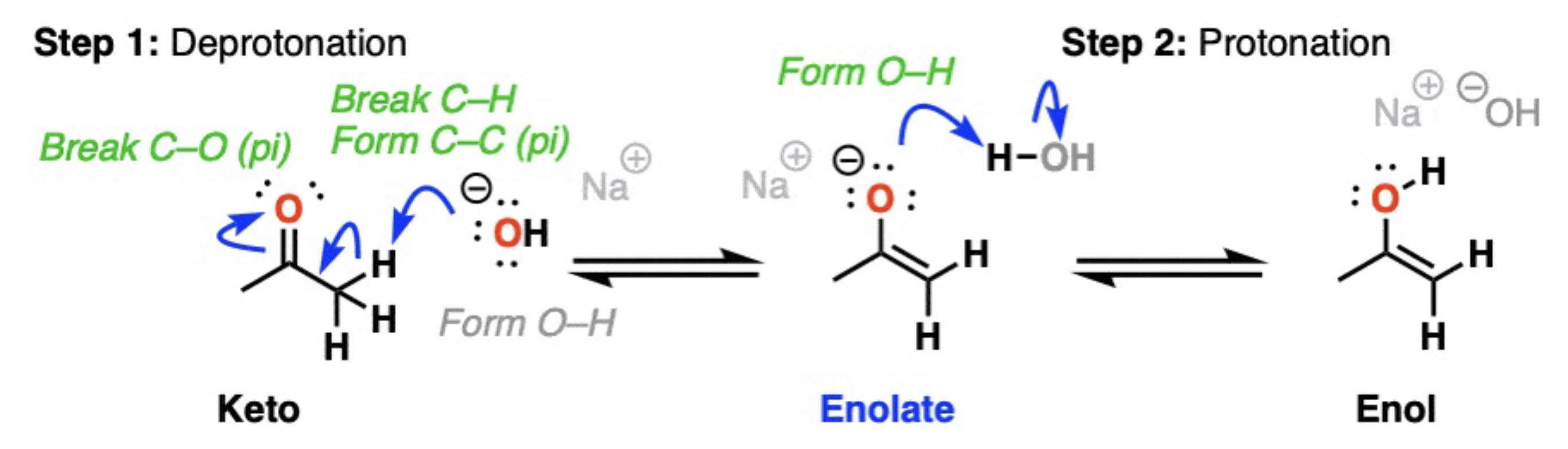
keto form is more stable
since tautomerism occurs, adding D2O will cause deuterium exchange until all Hs are Ds, no signal on NMR, this shows that those Hs are acidic
45
carbonyl chemistry
carbonyl carbon is electrophilic
alpha hydrogen is acidic
resonance can occur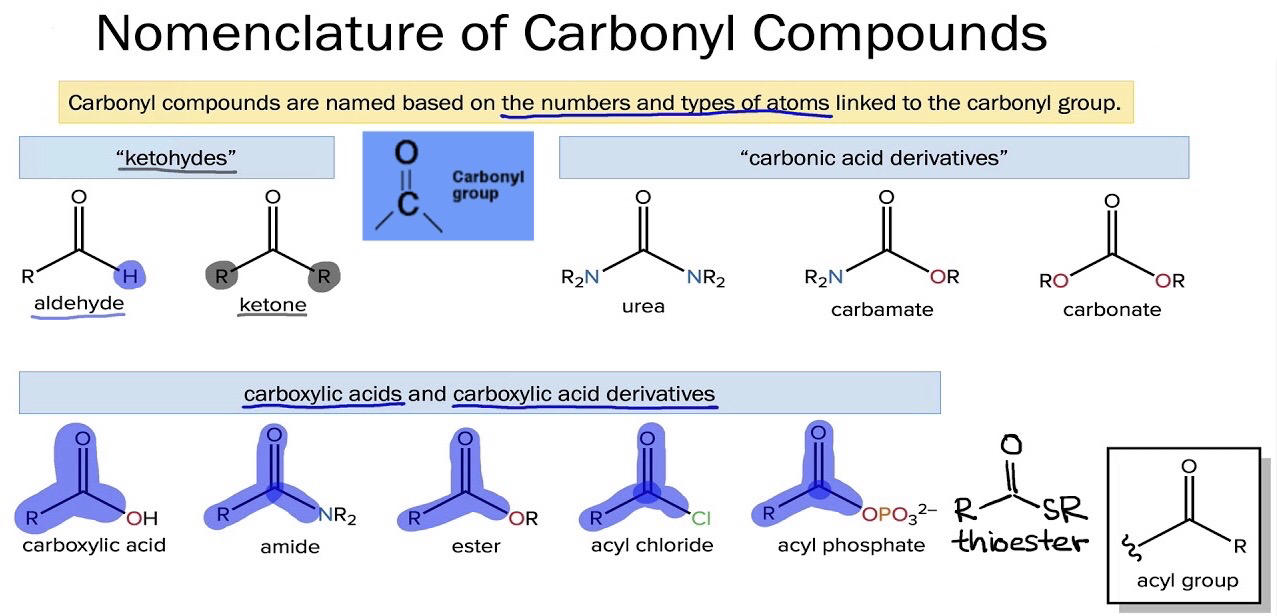
alpha hydrogen is acidic
resonance can occur
46
nucleophilic addition
weak nucleophile needs an acid catalyst to make the carbonyl C more electrophilic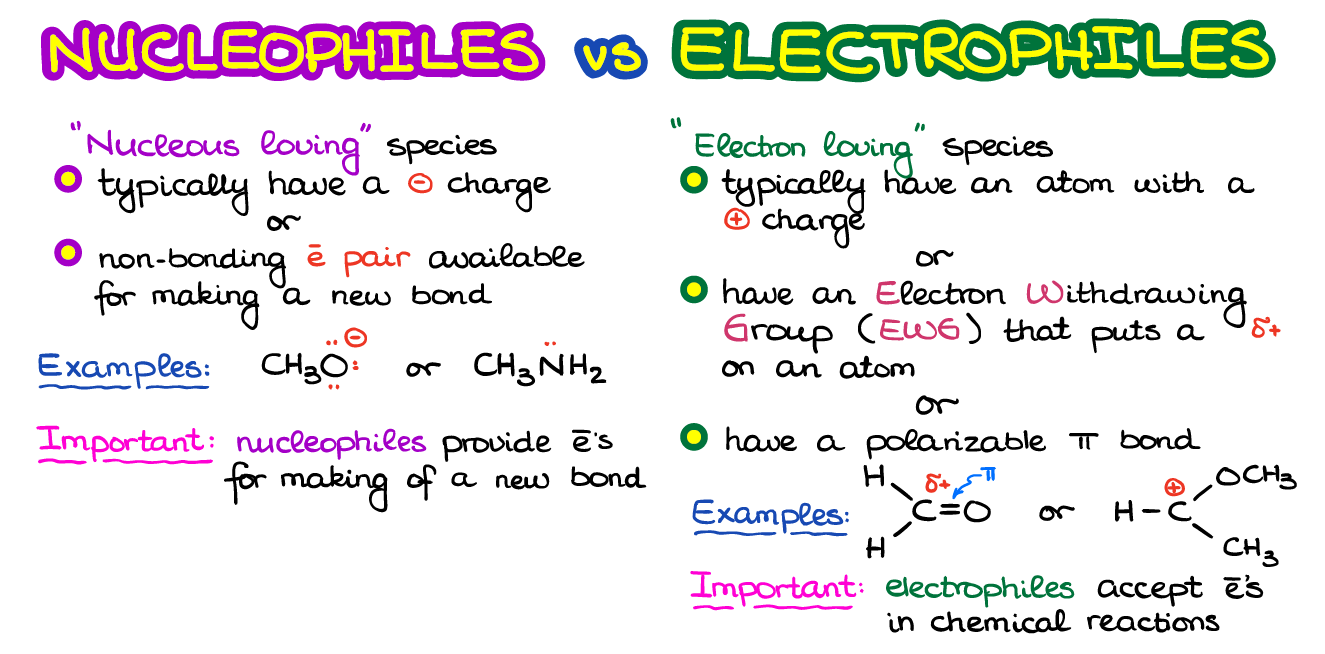
47
hydride reduction (nucleophilic addition)
NaBH4 or LiAlH4 are reducing agents that donate an H to attack a carbonyl, reducing it to an alcohol
cannot produce tertiary alcohols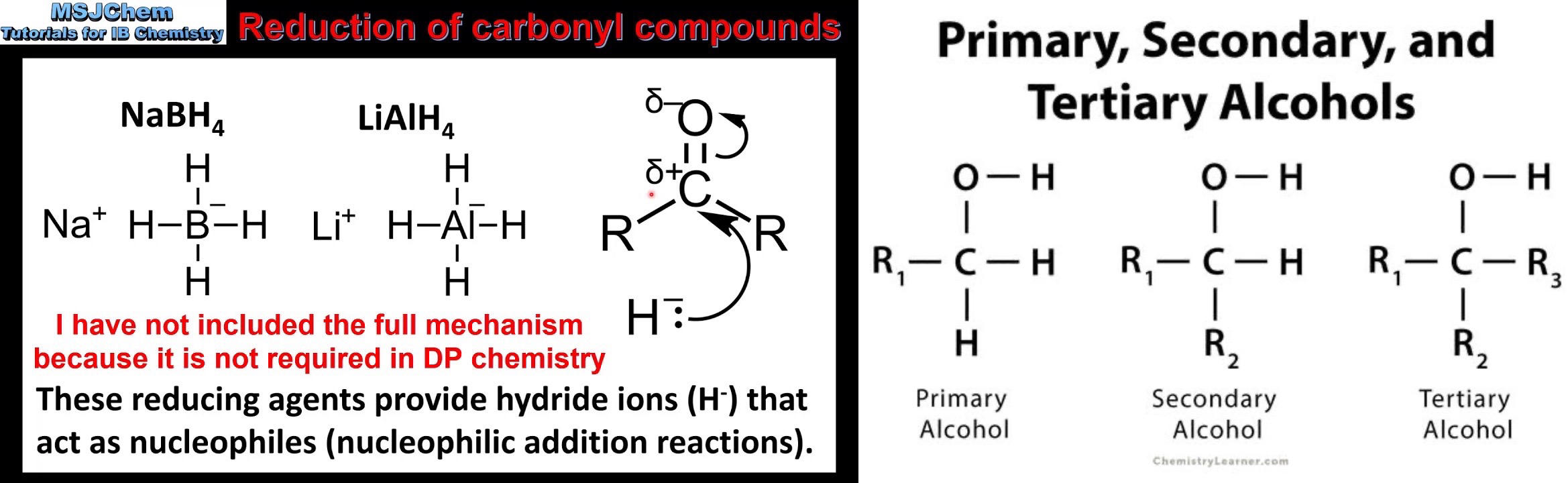
cannot produce tertiary alcohols
48
organometallic reagents (nucleophilic addition)
act as carbanions to attack a carbonyl, grignard reagent uses a halide with essentially a carbanion next to it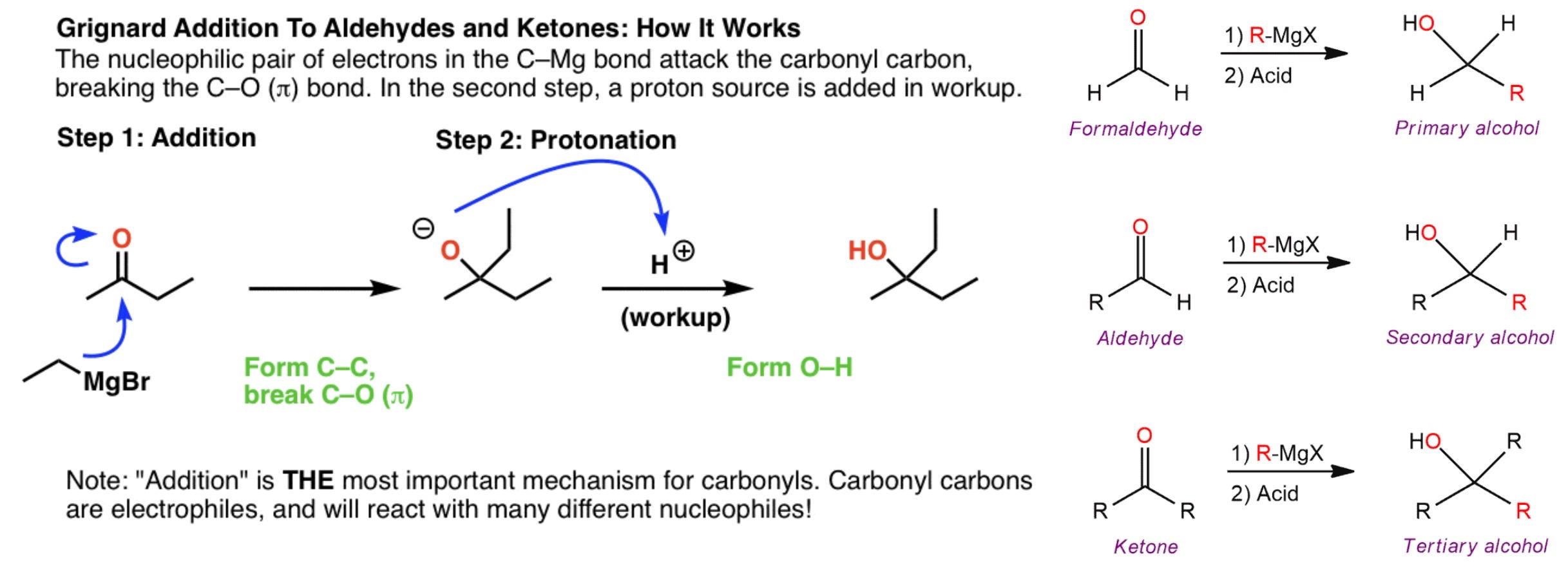
49
hemiacetals/acetals (nucleophilic addition)
alcohol is nucleophile, forms hemiacetal first (with one alcohol one ether group), then forms acetal (two ether groups)
acid catalyst for both steps so weak nucleophile can attack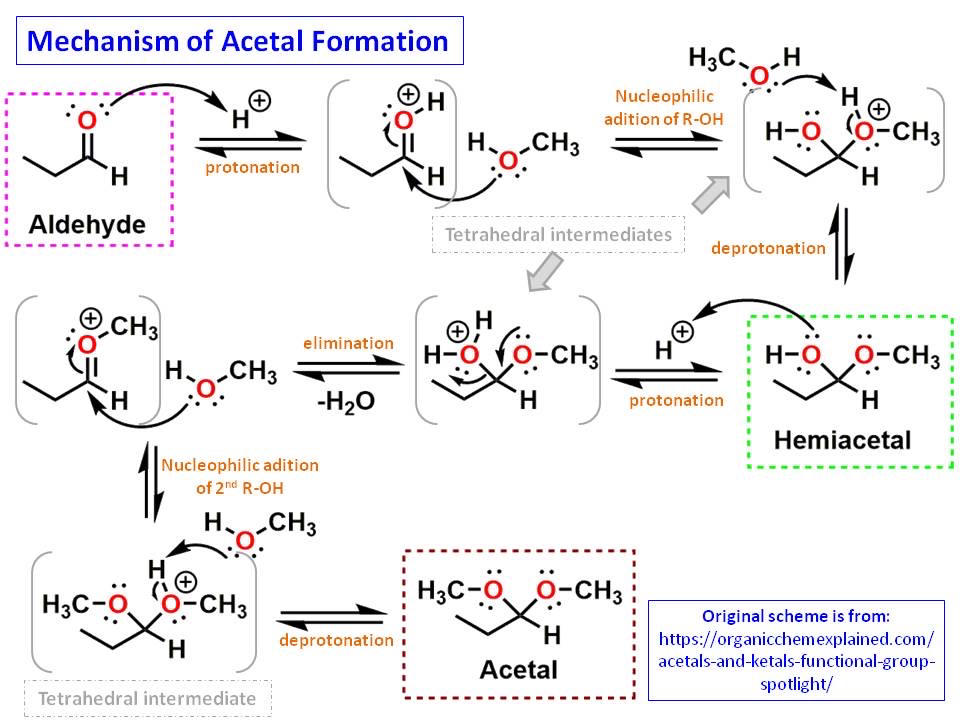
acid catalyst for both steps so weak nucleophile can attack
50
imine/enamine formation (nucleophilic addition)
*primary amine* is nucleophile, reaction is similar to acetal formation, except instead of 2 attacks, carbonyl C is just double bonded to N to form imine
*secondary amine* is nucleophile, positive charge is left on N, so alpha H is eliminated to form an enamine
enamines are nucleophilic at their alpha-carbon, can do SN2 reaction to add something to the alpha position
adding H2O to enamine will reform carbonyl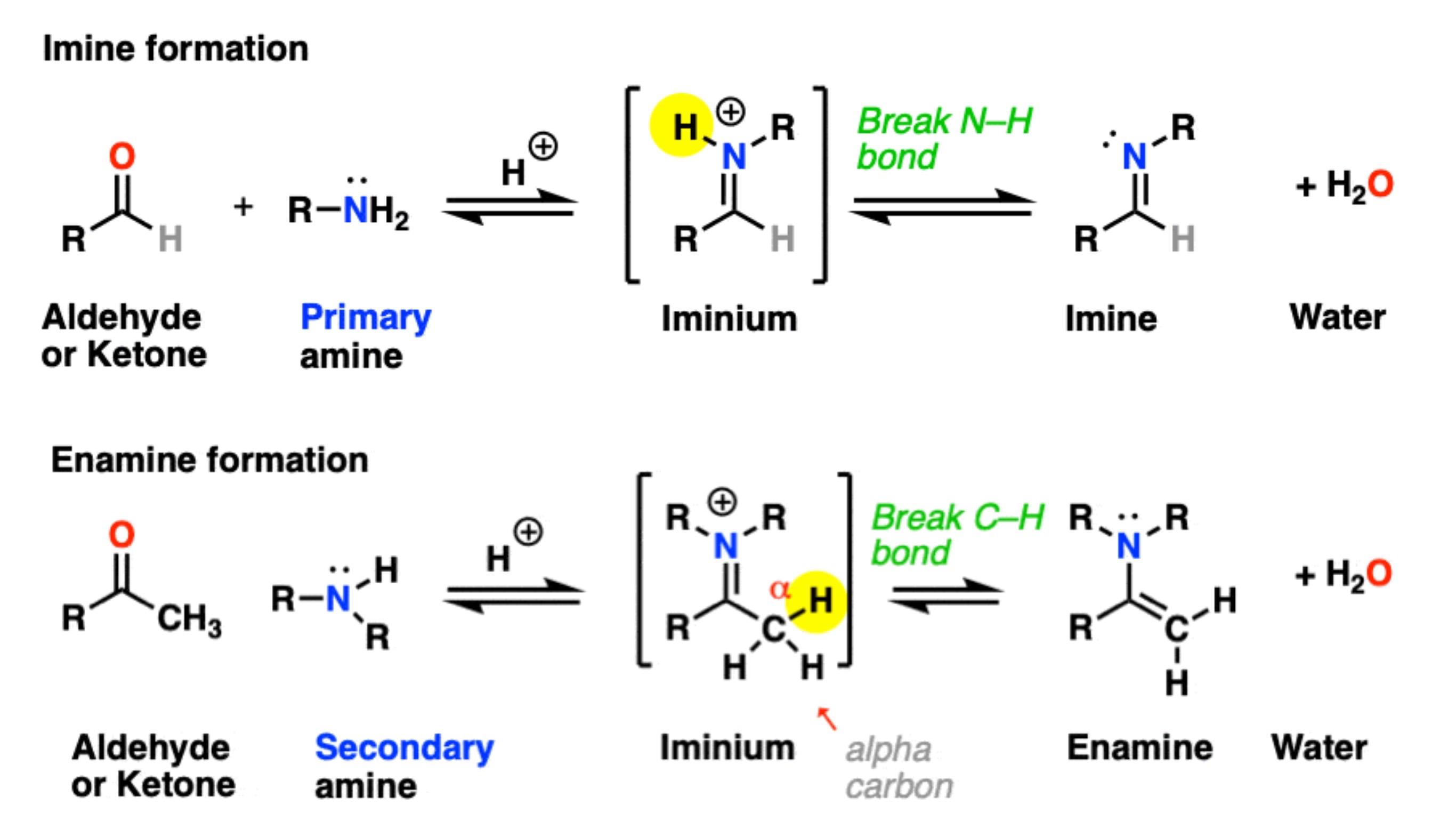
*secondary amine* is nucleophile, positive charge is left on N, so alpha H is eliminated to form an enamine
enamines are nucleophilic at their alpha-carbon, can do SN2 reaction to add something to the alpha position
adding H2O to enamine will reform carbonyl
51
aldol condensation (nucleophilic addition)
enolate reacts with ketone or aldehyde
SN2 reaction to add at alpha carbon of enolate
elimination to form double bond on newly attached ketone or aldehyde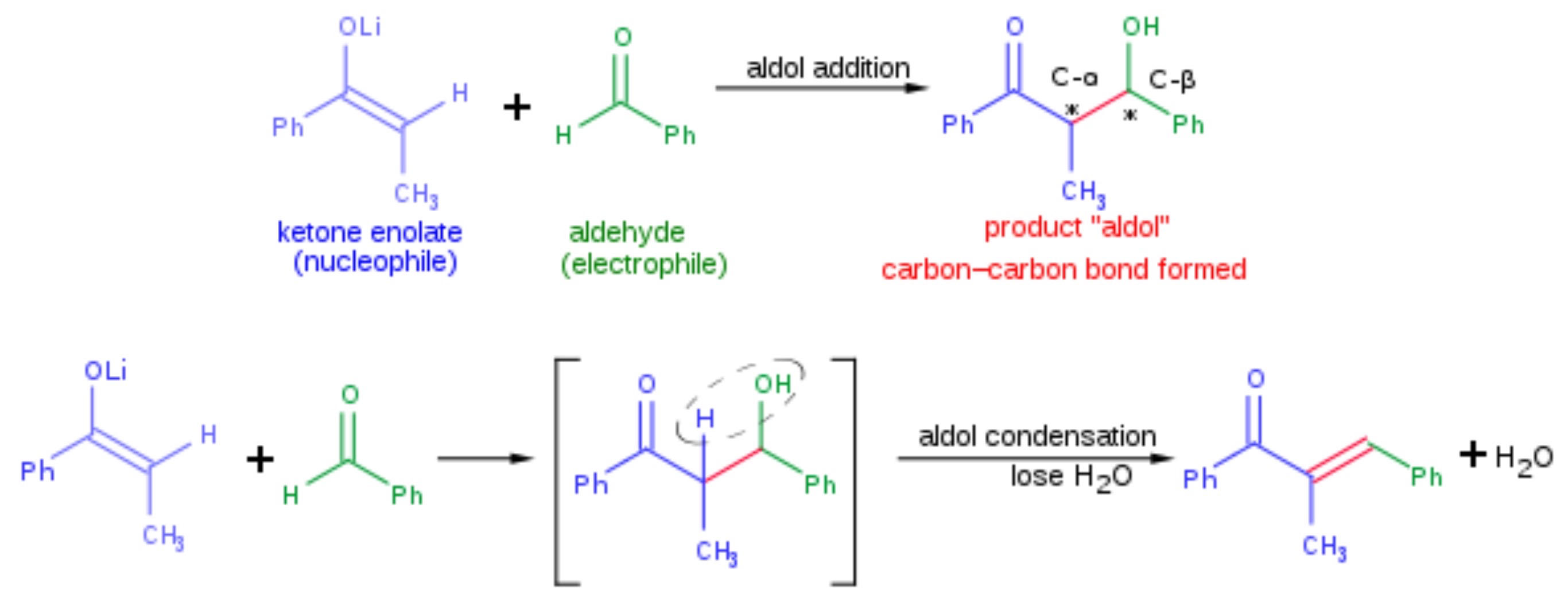
SN2 reaction to add at alpha carbon of enolate
elimination to form double bond on newly attached ketone or aldehyde
52
enolates (kinetic vs. thermodynamic)
use a base on a ketone, which alpha proton will be taken to form which enolate?
kinetic enolate- forms faster, less steric hindrance for accessing the acidic H
you can *select the kinetic enolate using a bulky base* (LDA) and cold temperatures (-78 C)
thermodynamic enolate- forms more substituted double bond, more stable
*select thermodynamic enolate using small base* (MeOH) and high temperatures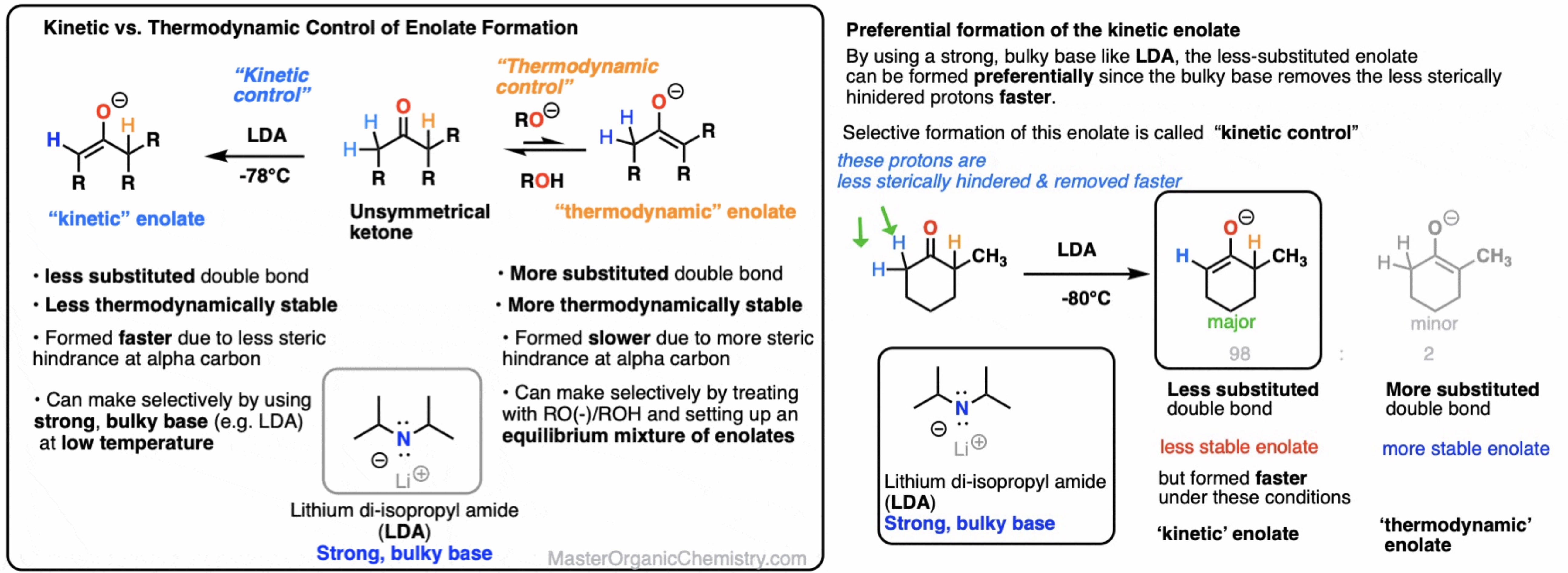
kinetic enolate- forms faster, less steric hindrance for accessing the acidic H
you can *select the kinetic enolate using a bulky base* (LDA) and cold temperatures (-78 C)
thermodynamic enolate- forms more substituted double bond, more stable
*select thermodynamic enolate using small base* (MeOH) and high temperatures
53
carboxylic acids
3 quick points:
1. highly polar, form many hydrogen bonds
2. can be reduced to primary alcohol by LiAlH4
3. reactions involve nucleophilic addition-elimination with a tetrahedral intermediate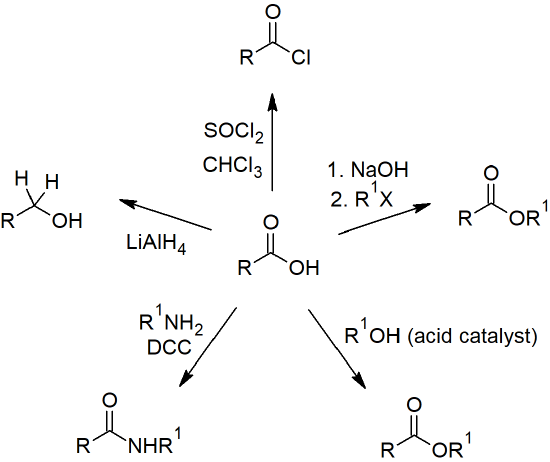
1. highly polar, form many hydrogen bonds
2. can be reduced to primary alcohol by LiAlH4
3. reactions involve nucleophilic addition-elimination with a tetrahedral intermediate
54
esterification (ester formation)
1. alcohol attacks carbonyl carbon on carboxylic acid
2. proton transfer
3. eliminate OH, form ester
a compound with both carboxylic acid and alcohol groups can form a cyclic ester if the ring is stable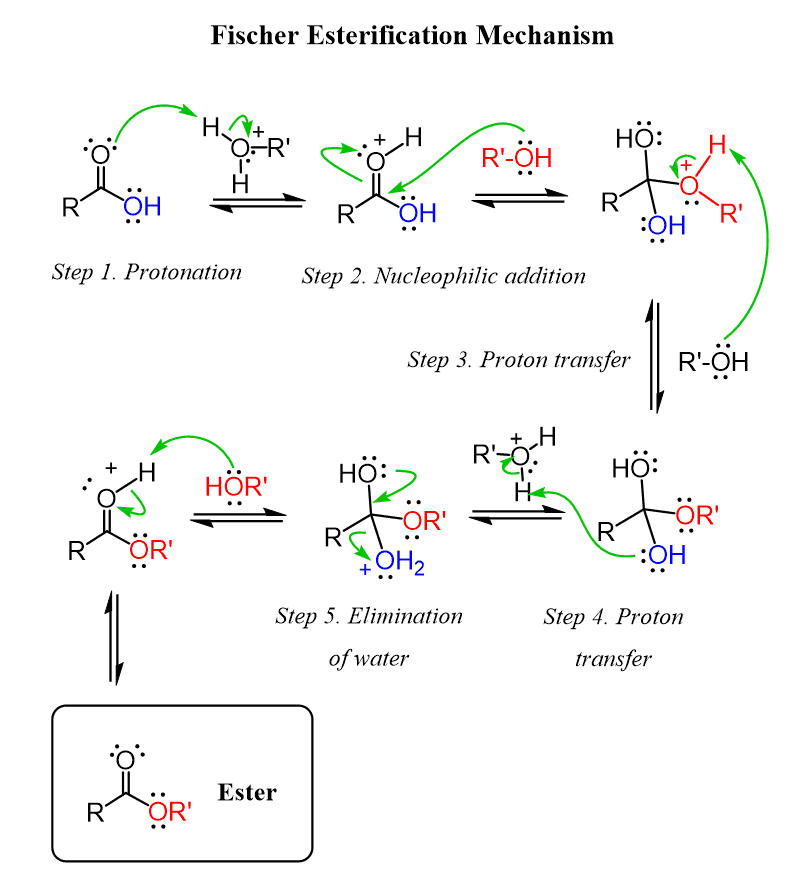
2. proton transfer
3. eliminate OH, form ester
a compound with both carboxylic acid and alcohol groups can form a cyclic ester if the ring is stable
55
saponification (ester hydrolysis)
1. OH attacks ester
2. ester piece is eliminated, nabs an H before leaving
3. form carboxylate anion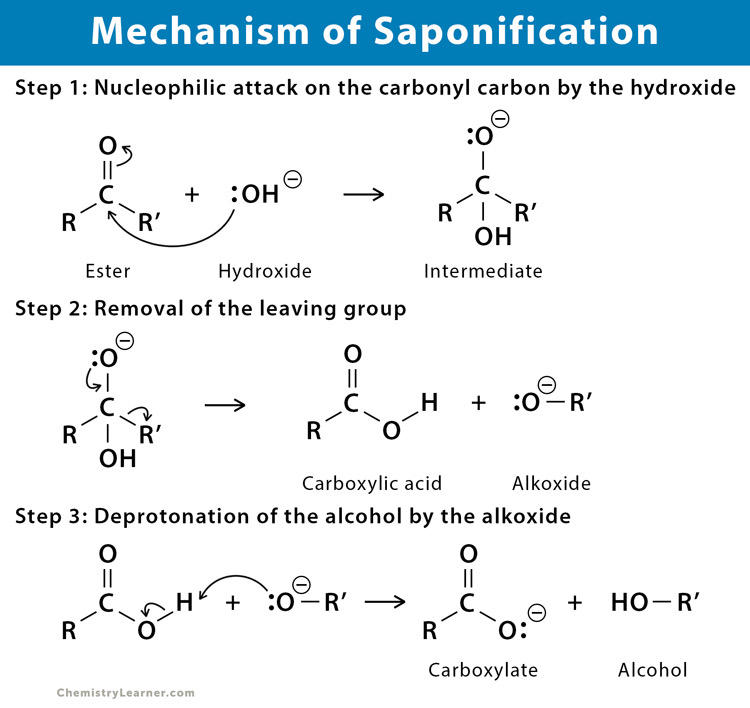
2. ester piece is eliminated, nabs an H before leaving
3. form carboxylate anion
56
hydrolysis
cyanohydrins are prone to hydrolysis
ATP -> ADP + P hydrolysis can either activate or inactivate the enzyme its bound to
pretty much everything can be broken down with hydrolysis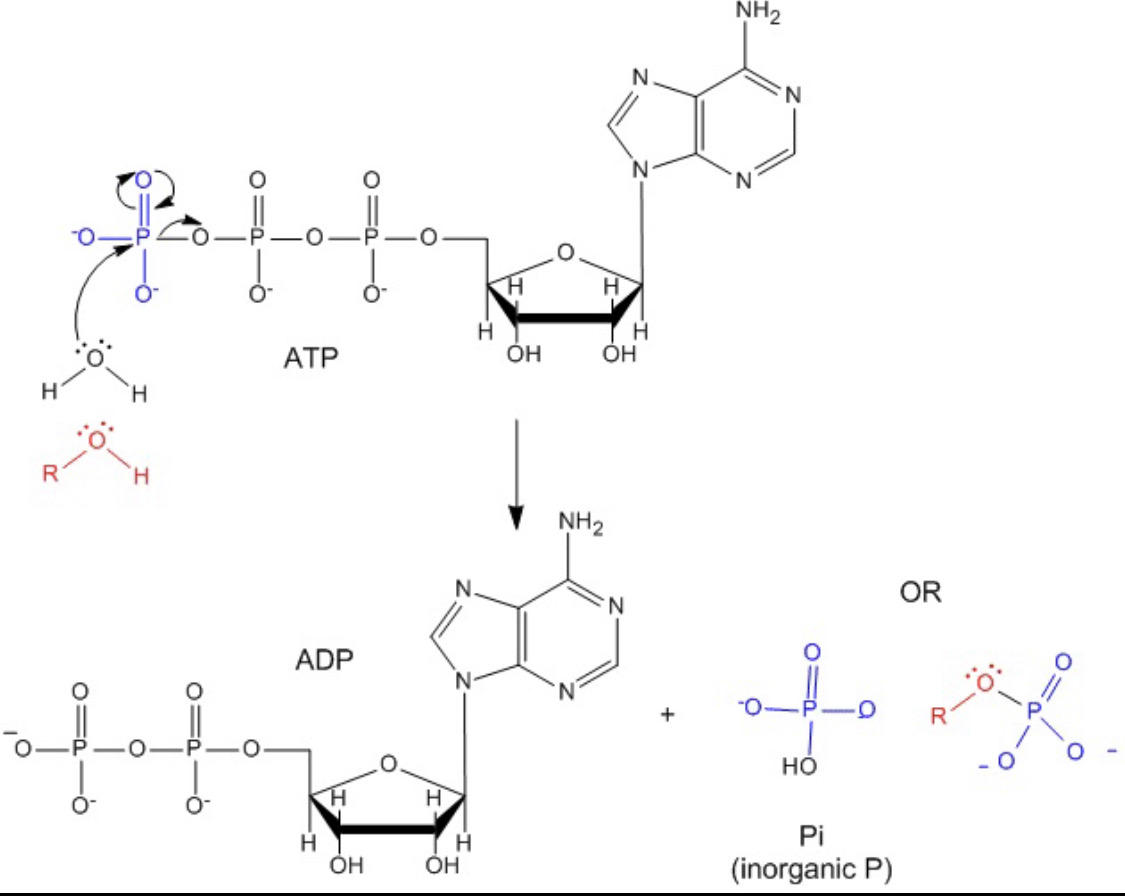
ATP -> ADP + P hydrolysis can either activate or inactivate the enzyme its bound to
pretty much everything can be broken down with hydrolysis
57
carboxylic acid derivatives
derivatives from most reactive to least:
1. acid halide (add SOCl2 or PBr3 to carboxylic acid)
2. acid anhydride (add another carboxylic acid)
3. ester (add an alcohol)
4. carboxylic acid
5. amide (cannot be made, adding amine to carboxylic acid just does a little proton transfer lol)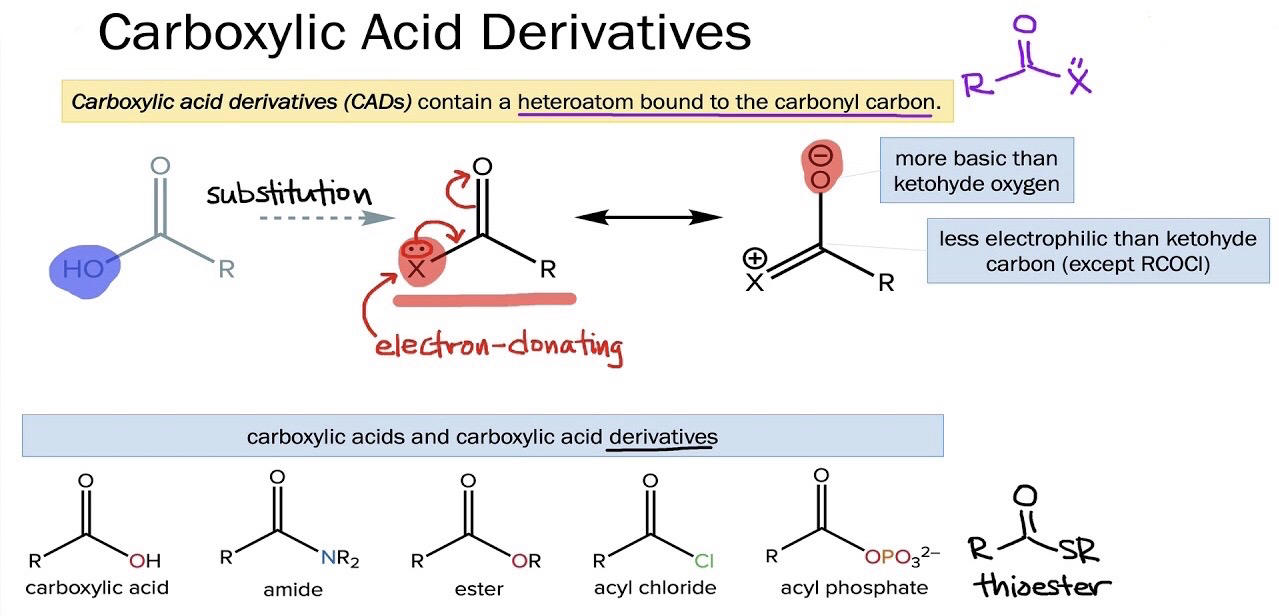
1. acid halide (add SOCl2 or PBr3 to carboxylic acid)
2. acid anhydride (add another carboxylic acid)
3. ester (add an alcohol)
4. carboxylic acid
5. amide (cannot be made, adding amine to carboxylic acid just does a little proton transfer lol)
58
Strecker amino acid synthesis
1. imine formation from aldehyde and NH4Cl
2. nucleophilic addition by KCN
3. convert to carboxylic acid with acid
nonstereoselective!
simpler than gabriel synthesis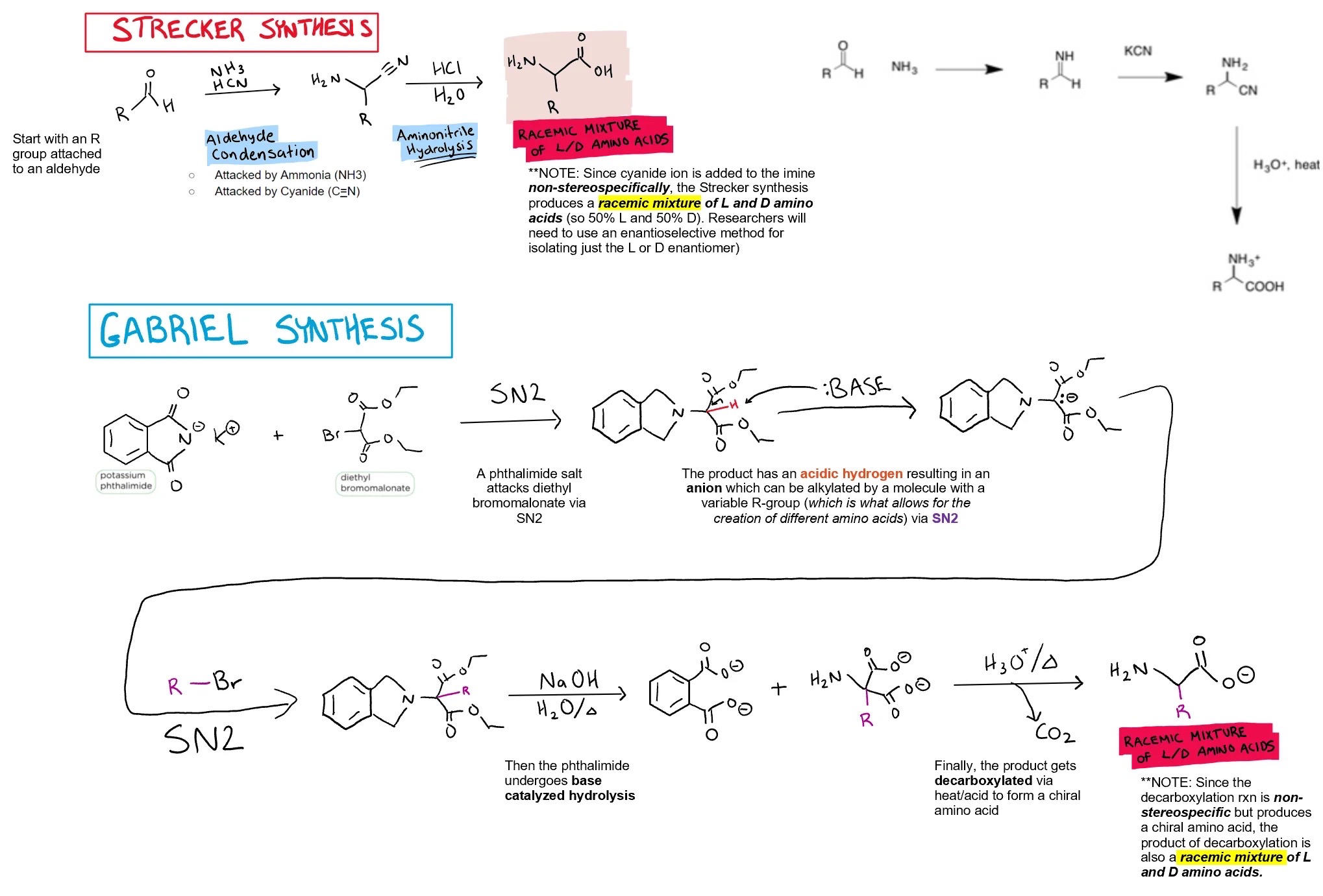
2. nucleophilic addition by KCN
3. convert to carboxylic acid with acid
nonstereoselective!
simpler than gabriel synthesis
59
Gabriel malonic ester synthesis
1. deprotonate phthalimide with KOH
2. SN2- phthalimide attacks alpha carbon in malonic ester
3. deprotonate center carbon and attack a new alkyl halide (which will have the desired R group)
4. hydrolysis of esters and imide with acid
5. decarboxylation with heat
nonstereoselective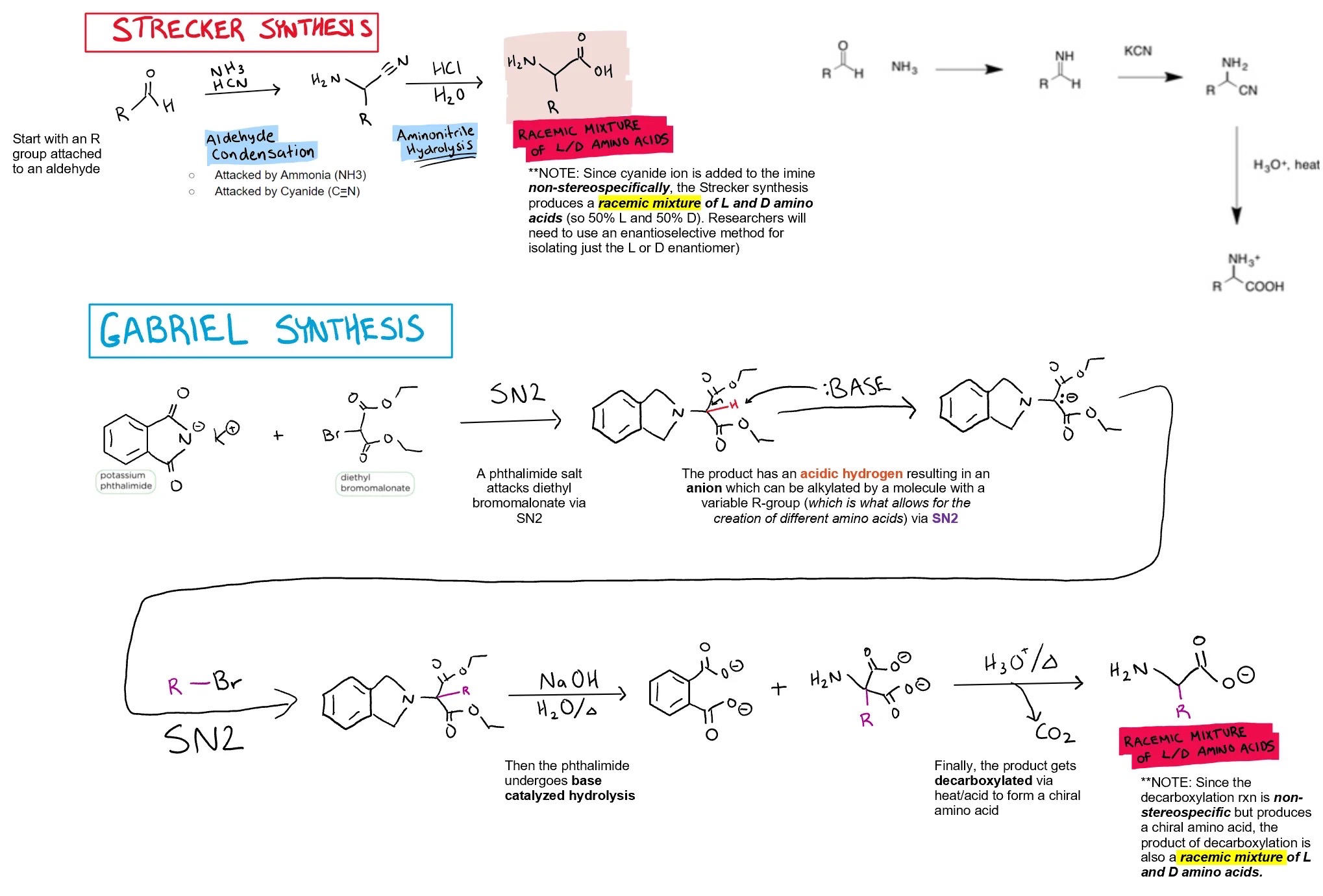
2. SN2- phthalimide attacks alpha carbon in malonic ester
3. deprotonate center carbon and attack a new alkyl halide (which will have the desired R group)
4. hydrolysis of esters and imide with acid
5. decarboxylation with heat
nonstereoselective
60
charge on amino acids
when pH > pKa, group is more than 50% deprotonated
when pH > pI, the amino acid is net negative
1. pI is the isoelectric point, zwitterion
2. pI = the pH at which amino acid has no net charge
3. average the two nearby pKas
pI help you determine amino acid separation in a gel
when pH > pI, the amino acid is net negative
1. pI is the isoelectric point, zwitterion
2. pI = the pH at which amino acid has no net charge
3. average the two nearby pKas
pI help you determine amino acid separation in a gel
61
peptide bond formation
amide bond formed by amino group attacking carboxyl group and eliminating the OH
non-spontaneous process that needs enzymes!
characteristics of peptide bond:
1. planar and cannot rotate!
2. partial double bond character due to resonance
3. amide H slightly acidic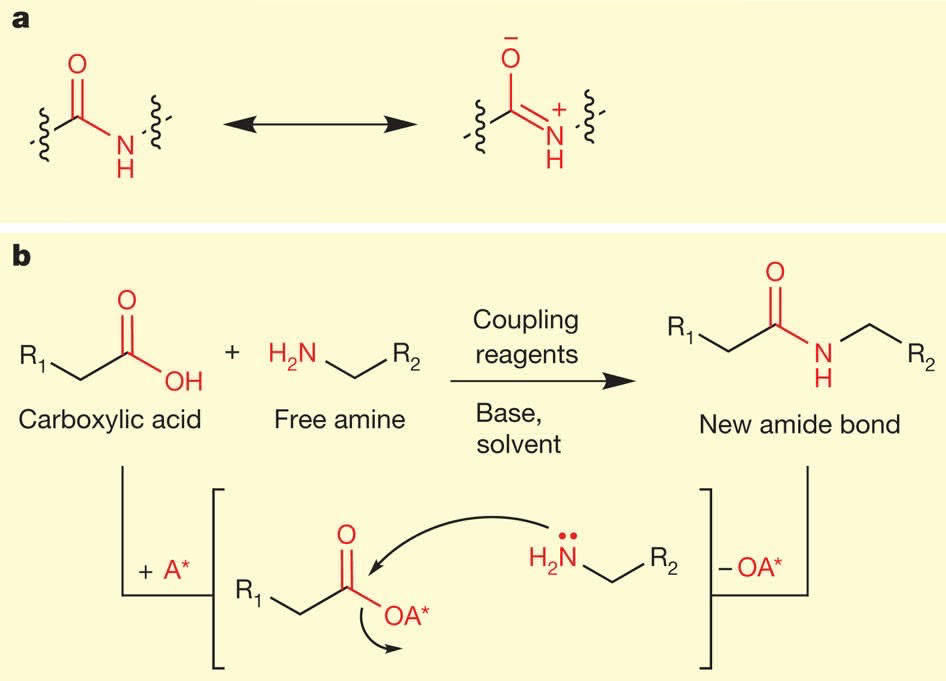
non-spontaneous process that needs enzymes!
characteristics of peptide bond:
1. planar and cannot rotate!
2. partial double bond character due to resonance
3. amide H slightly acidic
62
peptide bond hydrolysis
also non-spontaneous process that needs proteases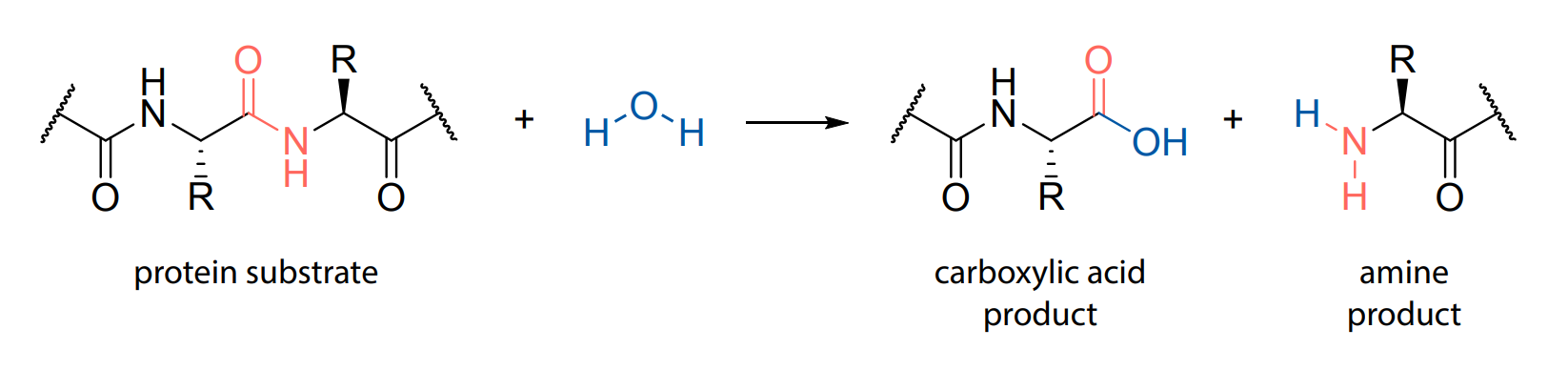
63
denaturation
changes 3D structure without breaking peptide bonds
denaturing agents:
1. high temperature
2. high/low pH
3. changing salt concentration
4. urea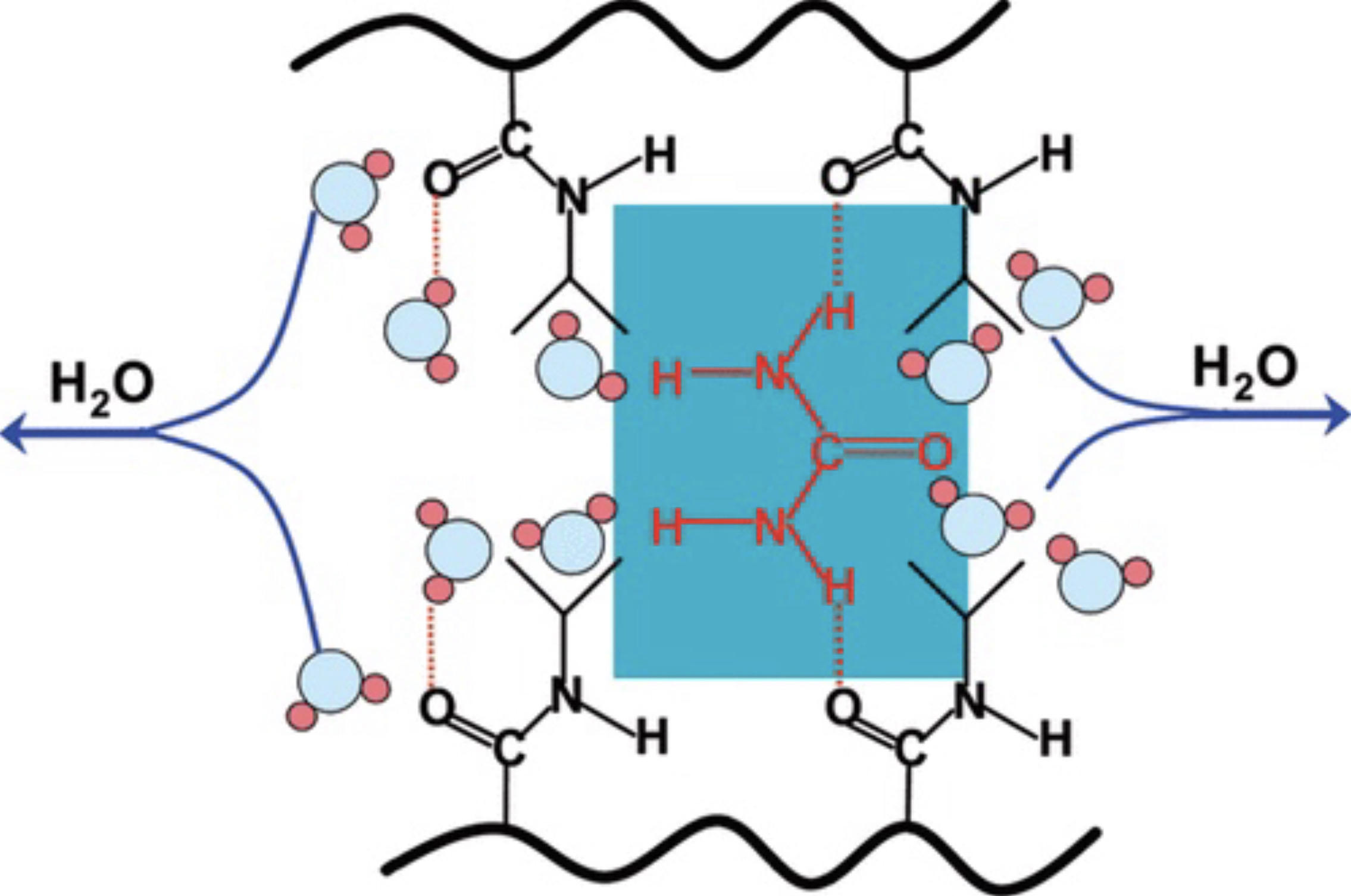
denaturing agents:
1. high temperature
2. high/low pH
3. changing salt concentration
4. urea
64
carbohydrate nomenclature
In Fischer projection (horizontal is out of page, vertical in into page, end OH is at the bottom):
OH on the right- D (+), penultimate carbon is R
OH on the left- L (-), penultimate carbon is S
penultimate carbon- second carbon from the end OH
anomeric carbon- carbonyl carbon, alpha/ beta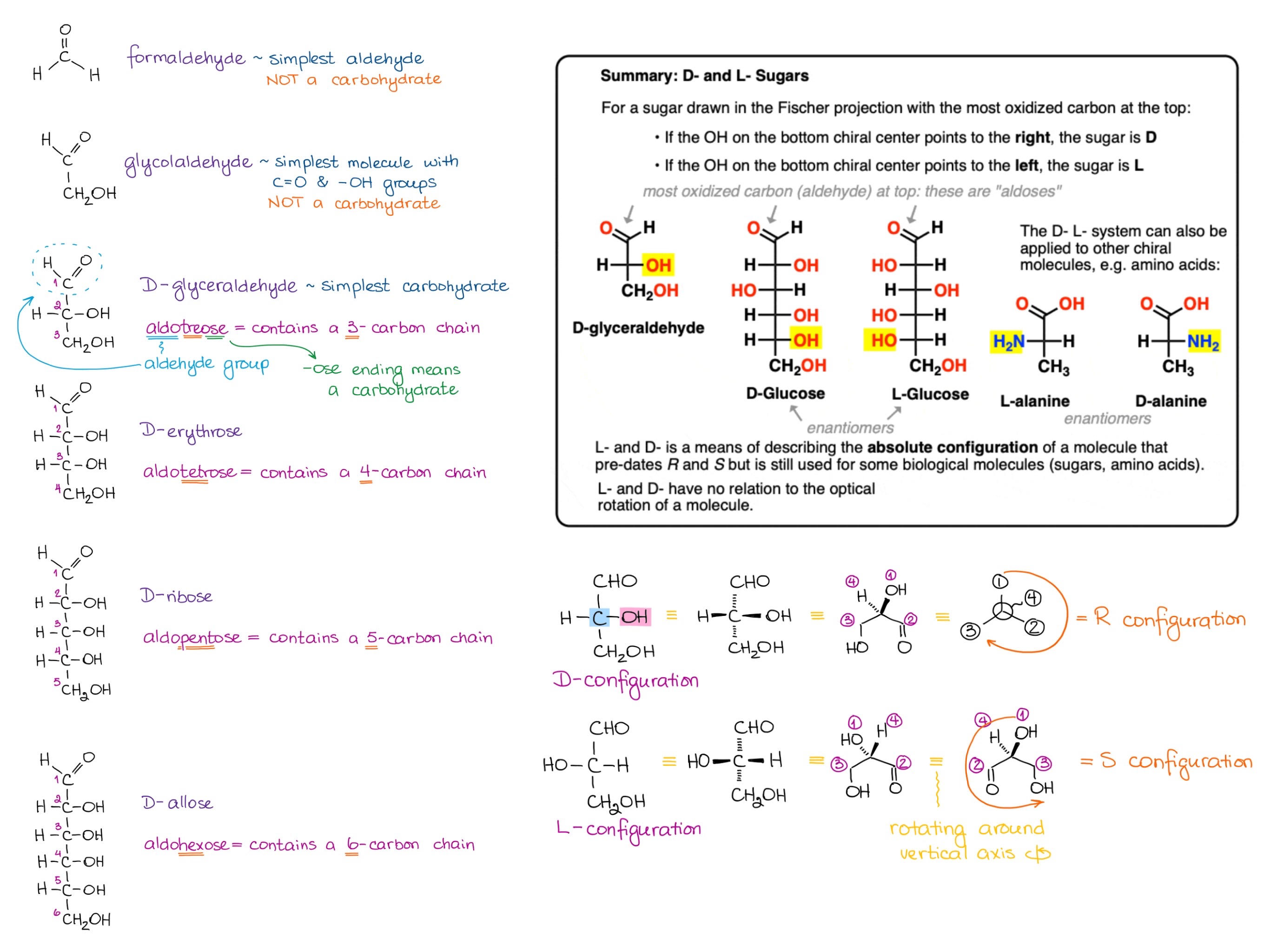
OH on the right- D (+), penultimate carbon is R
OH on the left- L (-), penultimate carbon is S
penultimate carbon- second carbon from the end OH
anomeric carbon- carbonyl carbon, alpha/ beta
65
carbohydrate cyclization (mutarotation)
OH on penultimate carbon attacks anomeric carbon
alpha anomer- OH on anomeric carbon is down
beta anomer- OH on anomeric carbon is up
these are epimers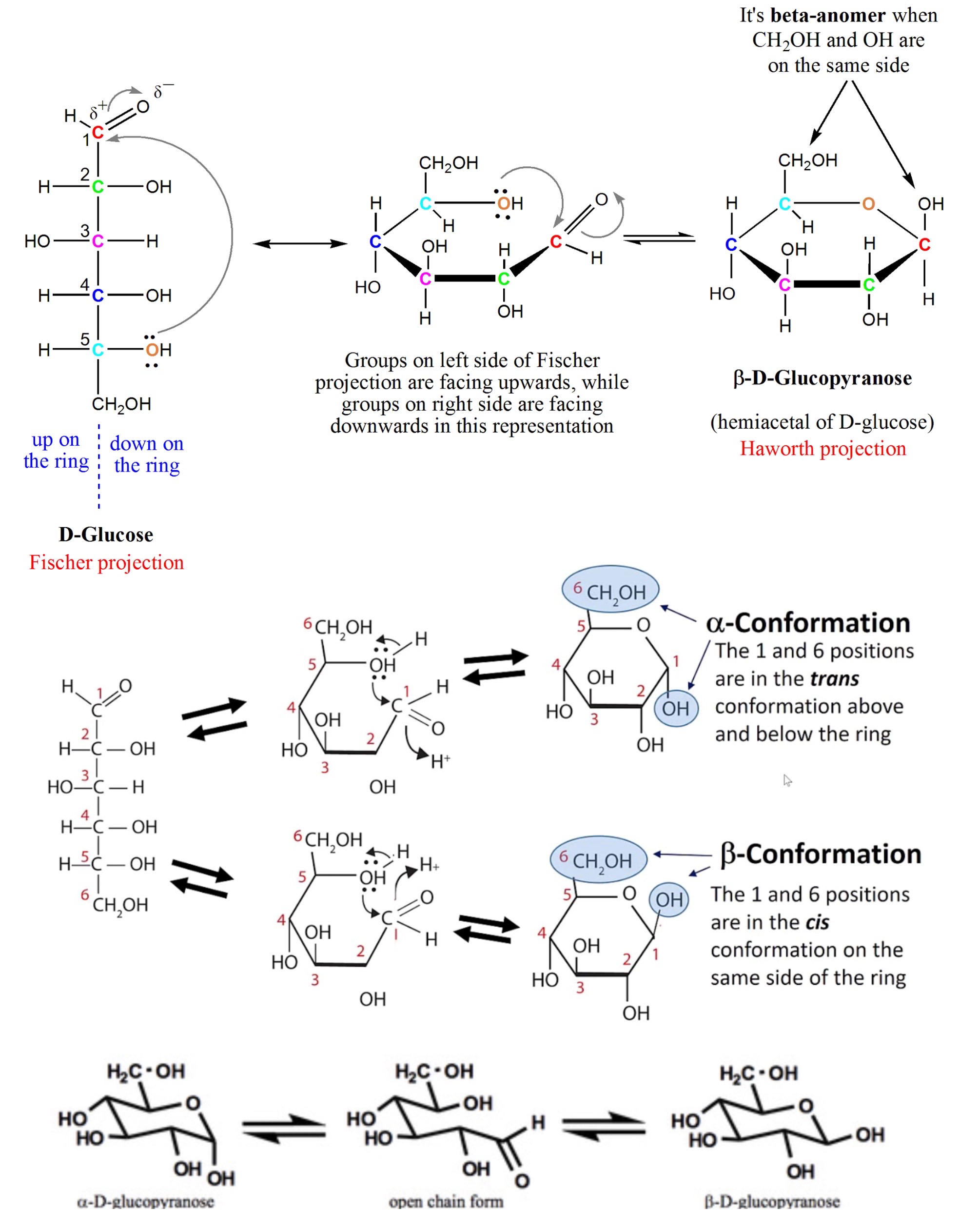
alpha anomer- OH on anomeric carbon is down
beta anomer- OH on anomeric carbon is up
these are epimers
66
Benedict's test, Tollen's test, silver deposition (mutarotation)
positive test (red, silver deposited) indicates reducing sugar present (hemiacetal/aldehyde present, all monosaccharides have hemiacetals)
negative test (no precipitate, no silver) indicates no reducing sugar (disaccharides usually have acetals)
maltose is a reducing sugar
sucrose is a nonreducing sugar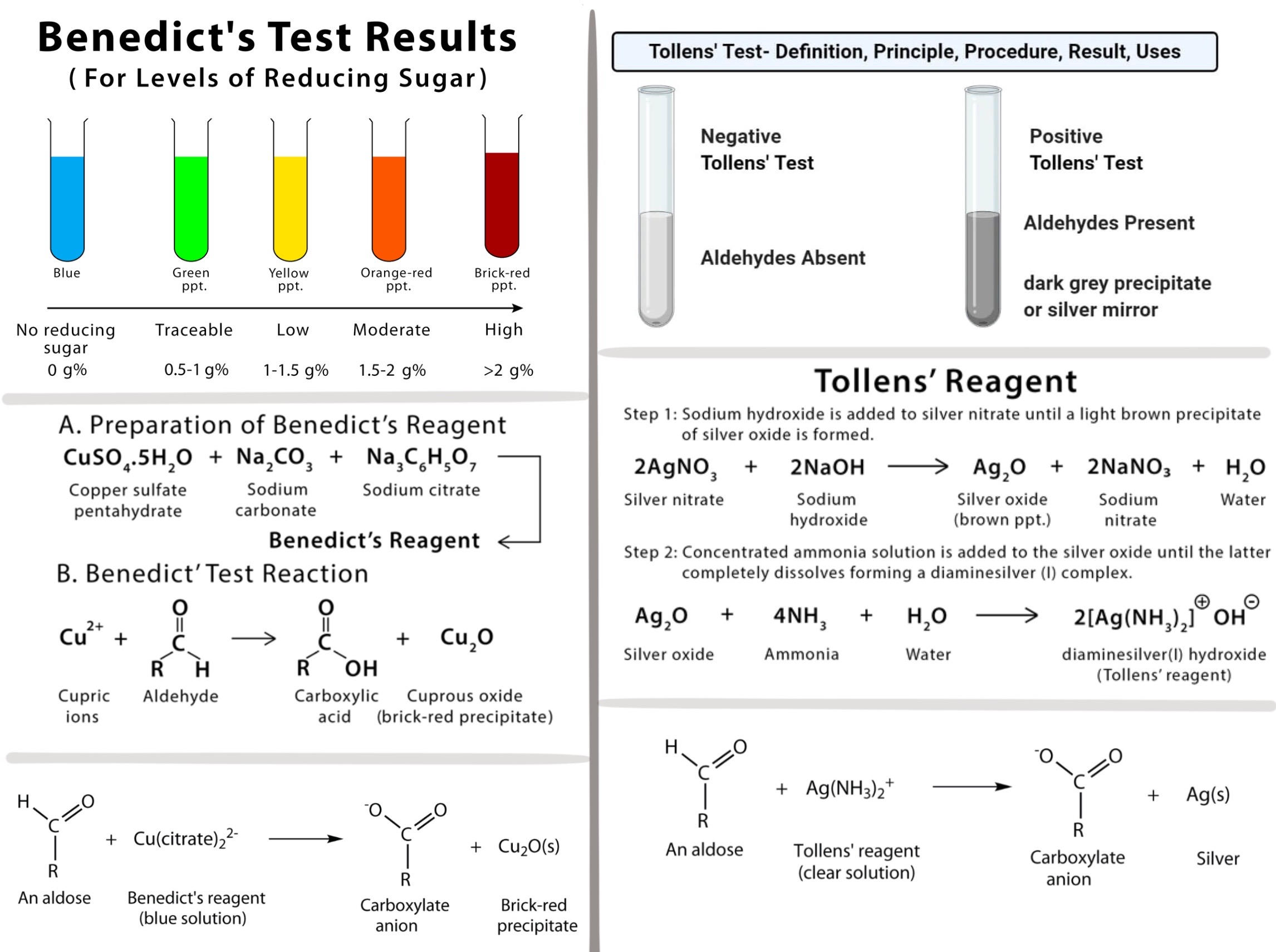
negative test (no precipitate, no silver) indicates no reducing sugar (disaccharides usually have acetals)
maltose is a reducing sugar
sucrose is a nonreducing sugar
67
glycosidic linkage
acetals connecting two sugars
glycogen usually has an *alpha-1,4-glycosidic bonds*
but branching of glycogen occurs with *alpha-1,6-glycosidic bonds*
notation involves alpha/ beta of left most sugar and carbon numbers
change in alpha/ beta tells you an SN2 reaction occurred at the anomeric carbon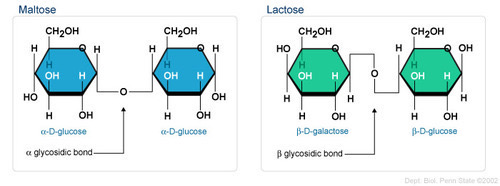
glycogen usually has an *alpha-1,4-glycosidic bonds*
but branching of glycogen occurs with *alpha-1,6-glycosidic bonds*
notation involves alpha/ beta of left most sugar and carbon numbers
change in alpha/ beta tells you an SN2 reaction occurred at the anomeric carbon
68
fatty acids
fat fun facts:
1. triacylglycerol can be converted to glycerol and 3 fatty acids by saponification
2. fatty acids are amphipathic, forming micelles in aqueous environment
3. phospholipids have two hydrophobic tails with a hydrophilic head, form lipid bilayers
4. saturated fatty acids pack better (form solids)
5. unsaturated fatty acids increase fluidity (form liquids)
1. triacylglycerol can be converted to glycerol and 3 fatty acids by saponification
2. fatty acids are amphipathic, forming micelles in aqueous environment
3. phospholipids have two hydrophobic tails with a hydrophilic head, form lipid bilayers
4. saturated fatty acids pack better (form solids)
5. unsaturated fatty acids increase fluidity (form liquids)