Biological Lab Techniques
Study these flashcardsFree · spaced repetition · iPhone, Android, Mac & web
All cards
1
freeze drying/lyophilization
proteins can be stored by freezing
reduce pressure to trigger sublimation to remove water
heating proteins will denature them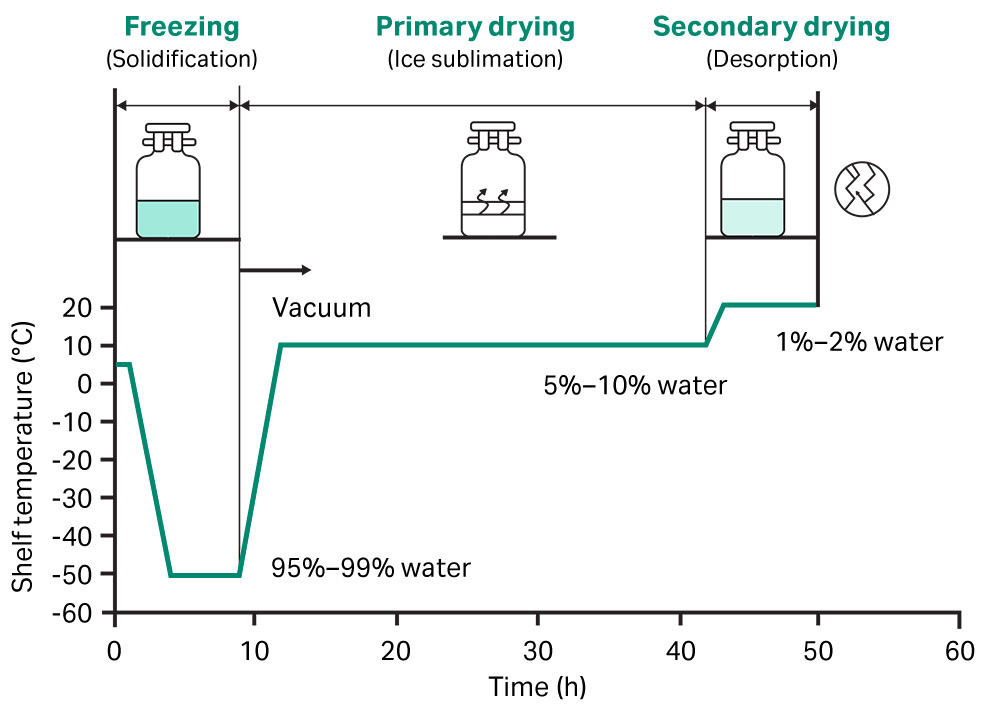
reduce pressure to trigger sublimation to remove water
heating proteins will denature them
2
ELISA
enzyme-linked immuno-sorbent assay
looks for specific antibodies or antigens
ex: used to screen for anti-HIV antibodies
method:
1. wells coated with specific antibody/antigen
2. sample added, antibodies bind to antigen
3. everything else washed away
4. detection enzyme-linked antibody added
5. solution added that changes color if enzyme present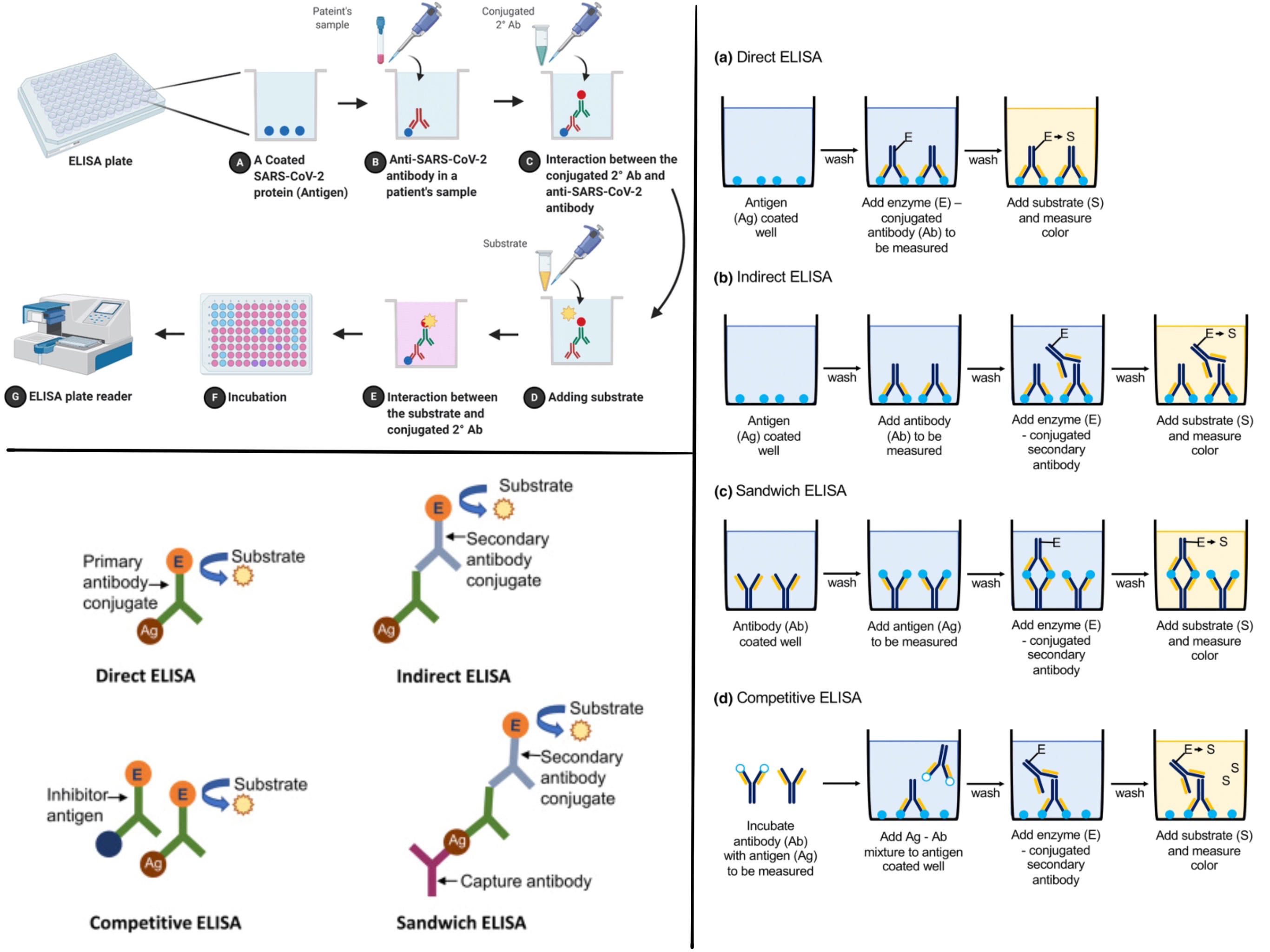
looks for specific antibodies or antigens
ex: used to screen for anti-HIV antibodies
method:
1. wells coated with specific antibody/antigen
2. sample added, antibodies bind to antigen
3. everything else washed away
4. detection enzyme-linked antibody added
5. solution added that changes color if enzyme present
3
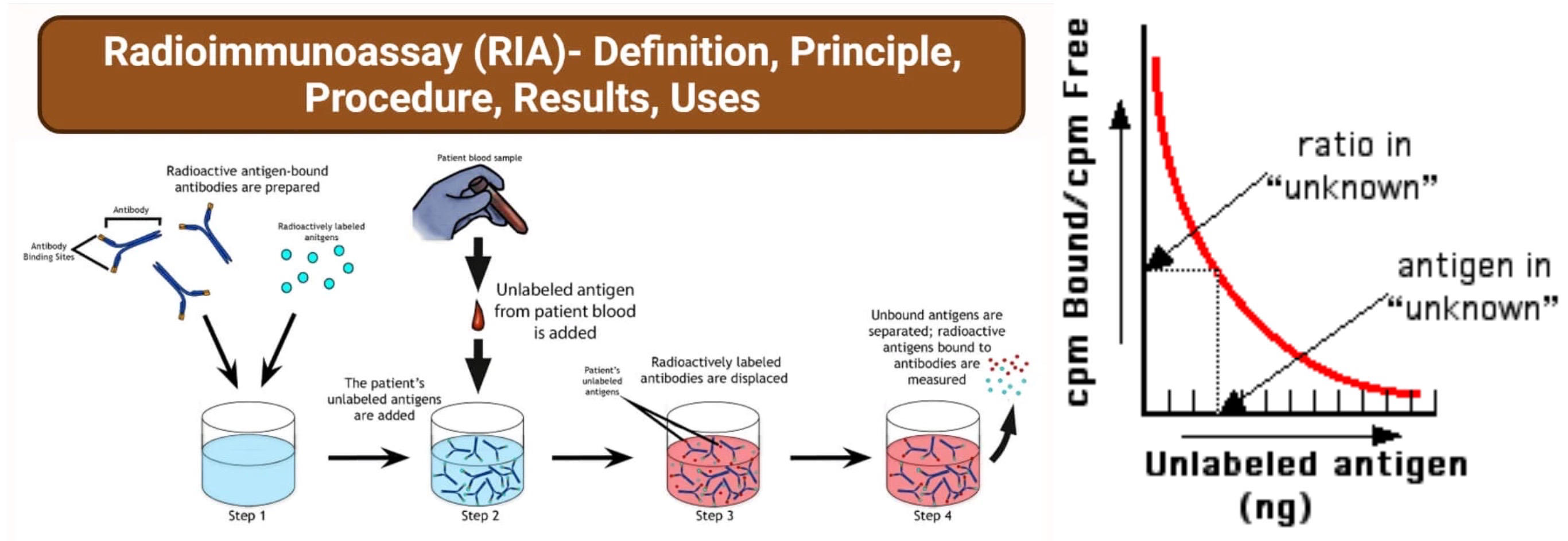
RIA
radioimmunoassay
looks for specific antigens
similar to ELISA, but uses radiolabelled antibodies rather than enzyme-linked antibodies
ex: used to measure amount of hormones
method:
1. radiolabelled antigen is mixed with antibody
2. radioactivity is measured
3. unlabelled antigen (cold) is added to compete off the radiolabelled antigen (hot) to make a standard curve
4. last step is repeated with sample instead of unlabelled antigen to measure amount of antigen
looks for specific antigens
similar to ELISA, but uses radiolabelled antibodies rather than enzyme-linked antibodies
ex: used to measure amount of hormones
method:
1. radiolabelled antigen is mixed with antibody
2. radioactivity is measured
3. unlabelled antigen (cold) is added to compete off the radiolabelled antigen (hot) to make a standard curve
4. last step is repeated with sample instead of unlabelled antigen to measure amount of antigen
4
gel electrophoresis
separate nucleic acids or proteins by size or charge
negatively charged samples migrate towards positive terminal (anode), small things migrate faster
method (for DNA):
1. add restriction enzymes to cut up DNA (at palindromes)
2. add loading dye to samples
3. run electrical current
4. compare distance sample migrated to ladder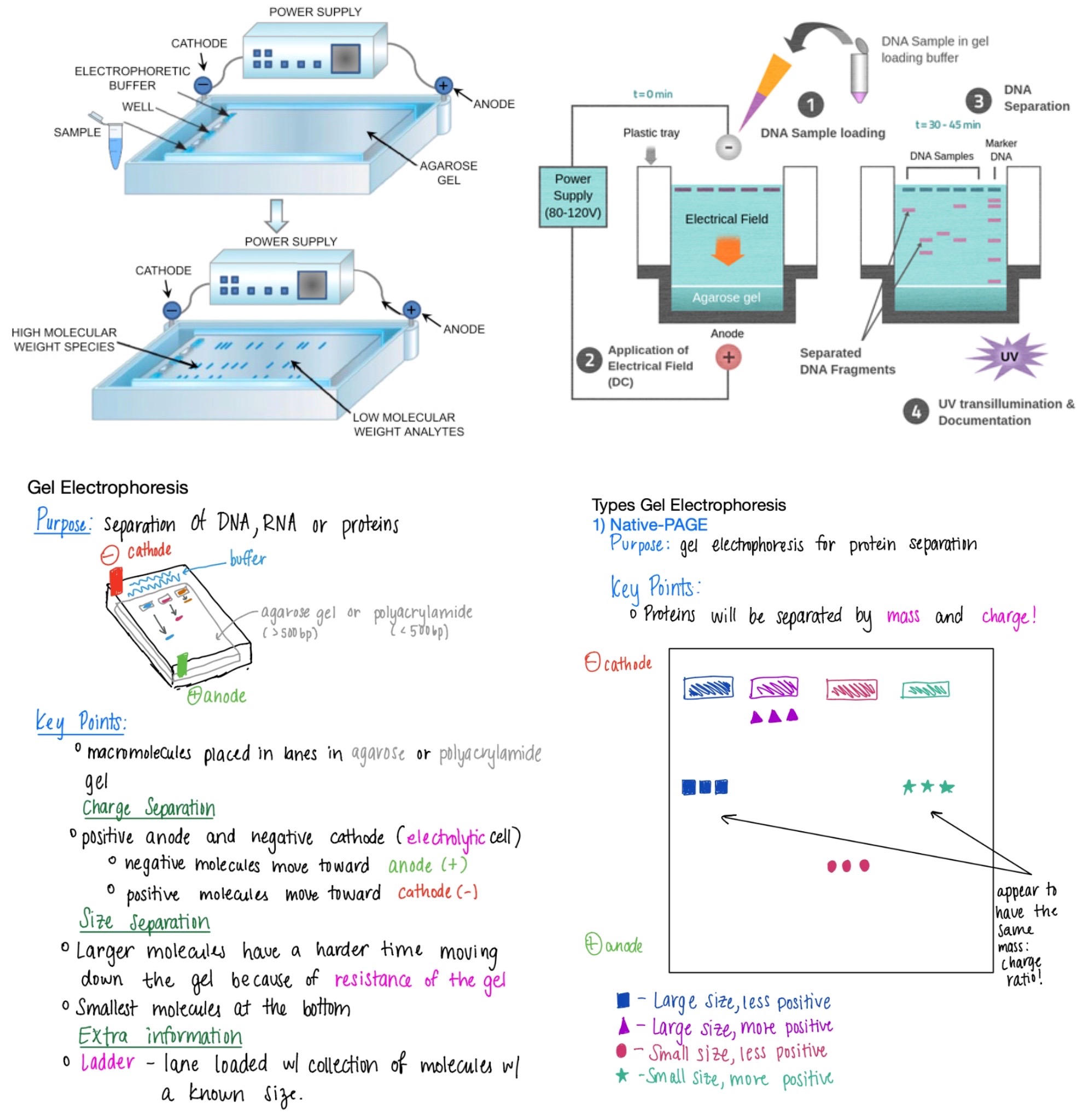
negatively charged samples migrate towards positive terminal (anode), small things migrate faster
method (for DNA):
1. add restriction enzymes to cut up DNA (at palindromes)
2. add loading dye to samples
3. run electrical current
4. compare distance sample migrated to ladder
5
SDS-PAGE
denatures the proteins (but keeps disulfide bridges) and masks the native charge (makes them all negative since sds is negative) so that comparison of size is more accurate, but the functional protein cannot be recaptured from the gel
reducing conditions (for Reducing SDS-PAGE) break disulfide bonds and break up dimers/trimers
separates by molar mass, smaller things migrate faster through the gel matrix
a protein with excessive positive charge may travel a shorter distance that expected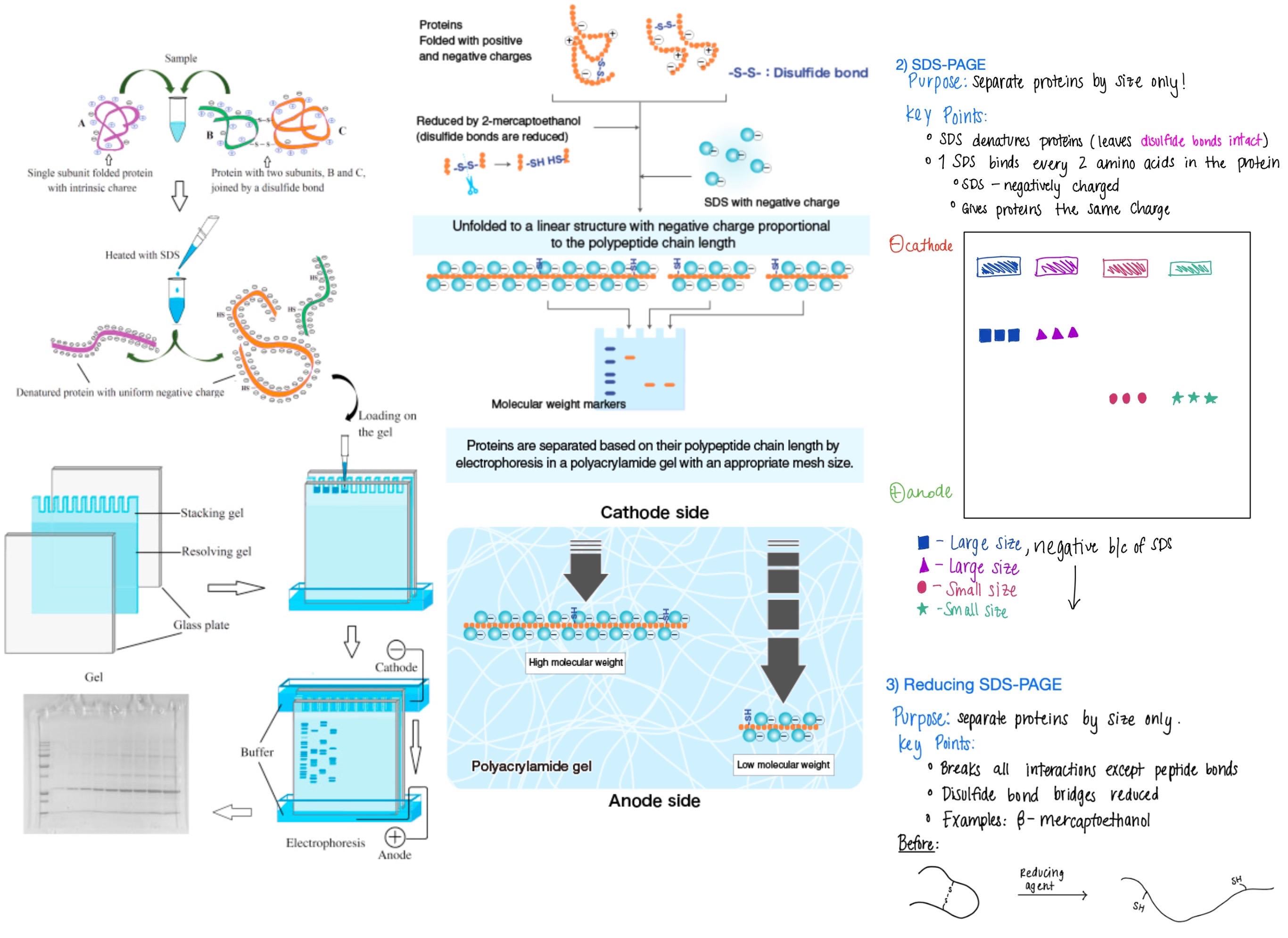
reducing conditions (for Reducing SDS-PAGE) break disulfide bonds and break up dimers/trimers
separates by molar mass, smaller things migrate faster through the gel matrix
a protein with excessive positive charge may travel a shorter distance that expected
6
southern blotting
looks for specific DNA sequences
ex: used to monitor mutations
method:
1. add restriction enzymes (they like palindromes)
2. run DNA gel electrophoresis
3. transfer to nitrocellulose paper
4. ss hybridization probes added, complementary to target
5. probes have radiolabeled nucleotides for visualizing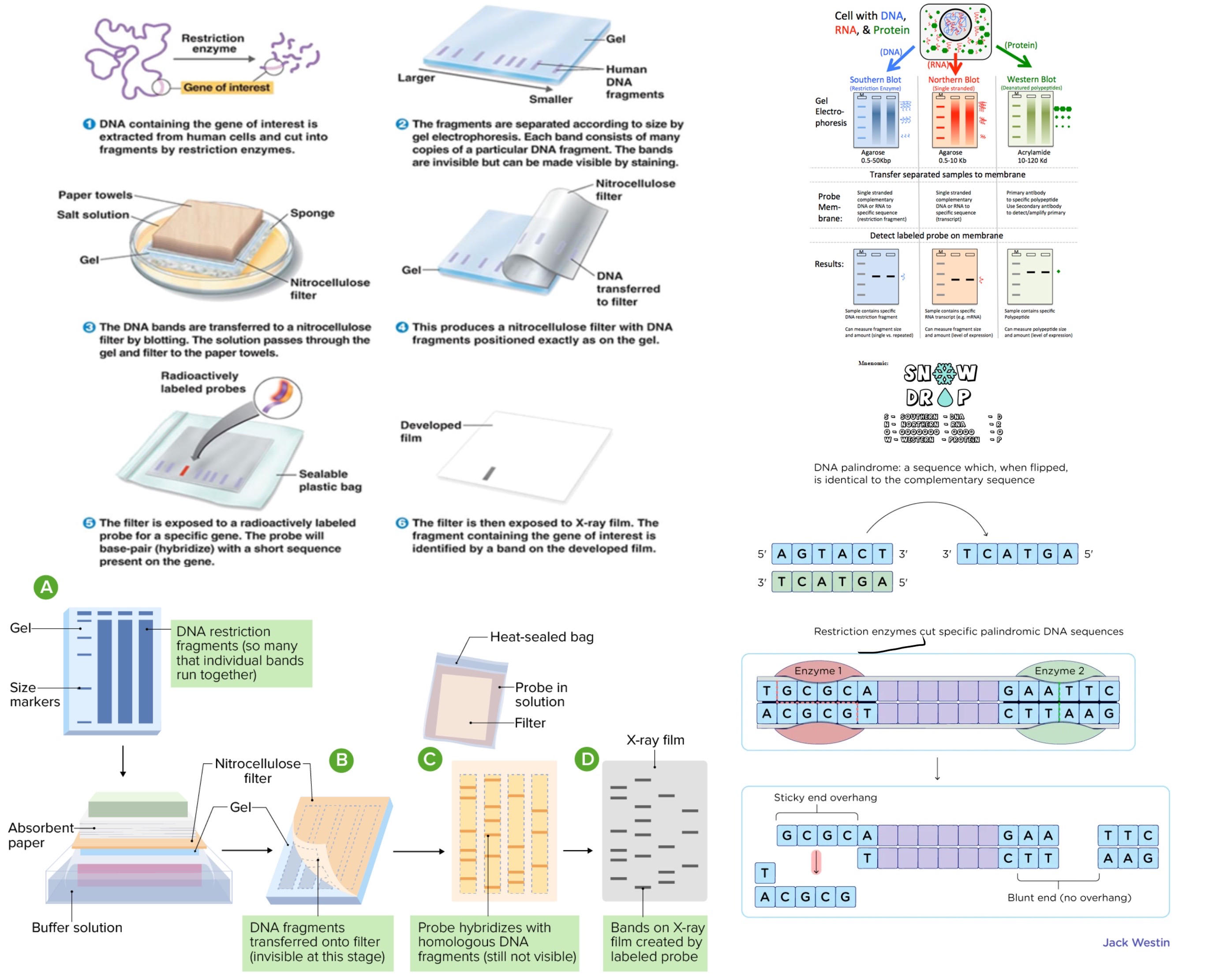
ex: used to monitor mutations
method:
1. add restriction enzymes (they like palindromes)
2. run DNA gel electrophoresis
3. transfer to nitrocellulose paper
4. ss hybridization probes added, complementary to target
5. probes have radiolabeled nucleotides for visualizing
7
northern blotting
southern blotting except with RNA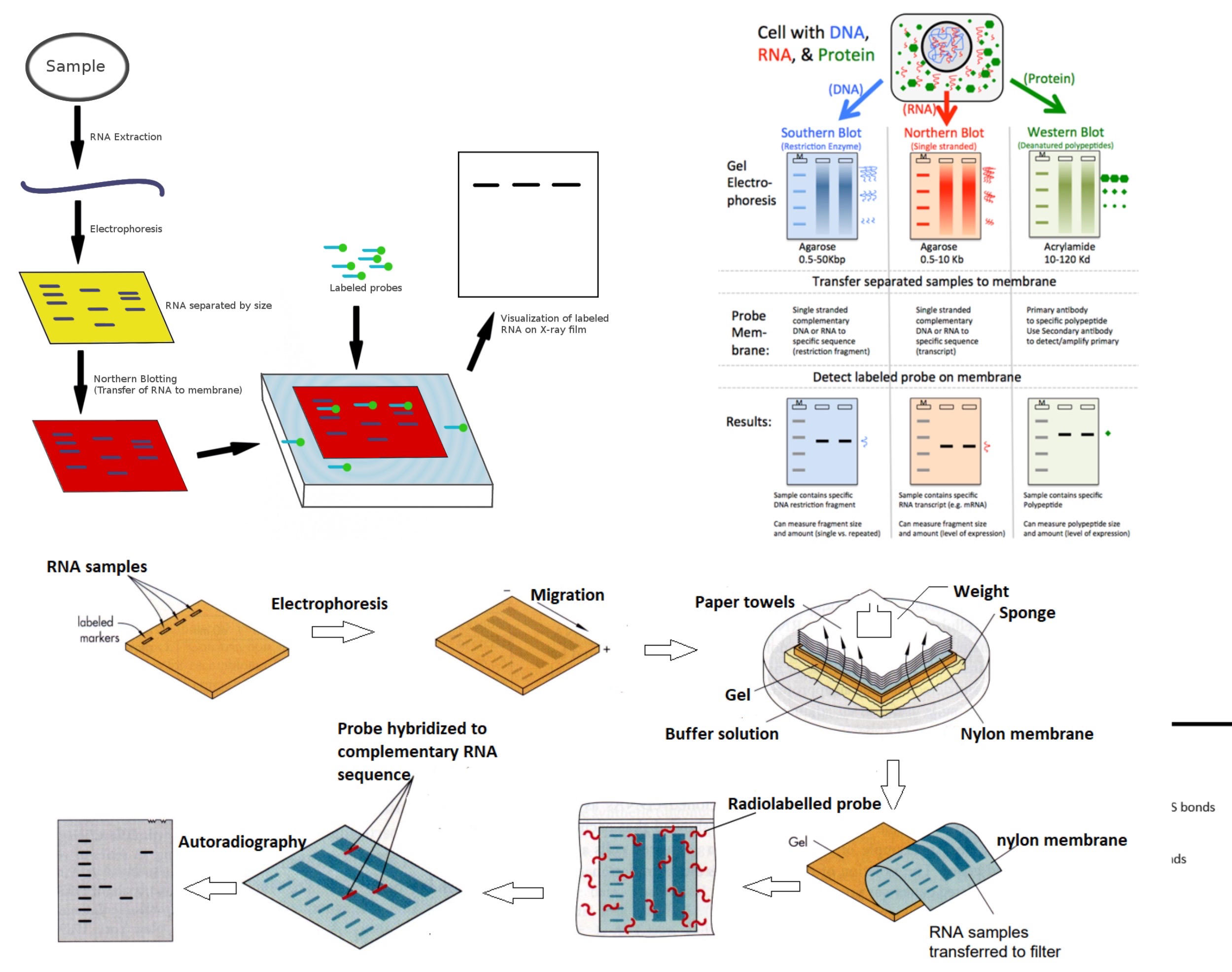
8
western blotting
looks for specific proteins
native gel- run without denaturing / reducing to retain protein structures
1. lysate is denatured, SDS to make negatively charged
2. run gel electrophoresis
3. transfer to nitrocellulose paper
4. primary antibody added
5. secondary antibody added, enzyme-linked to fluoresce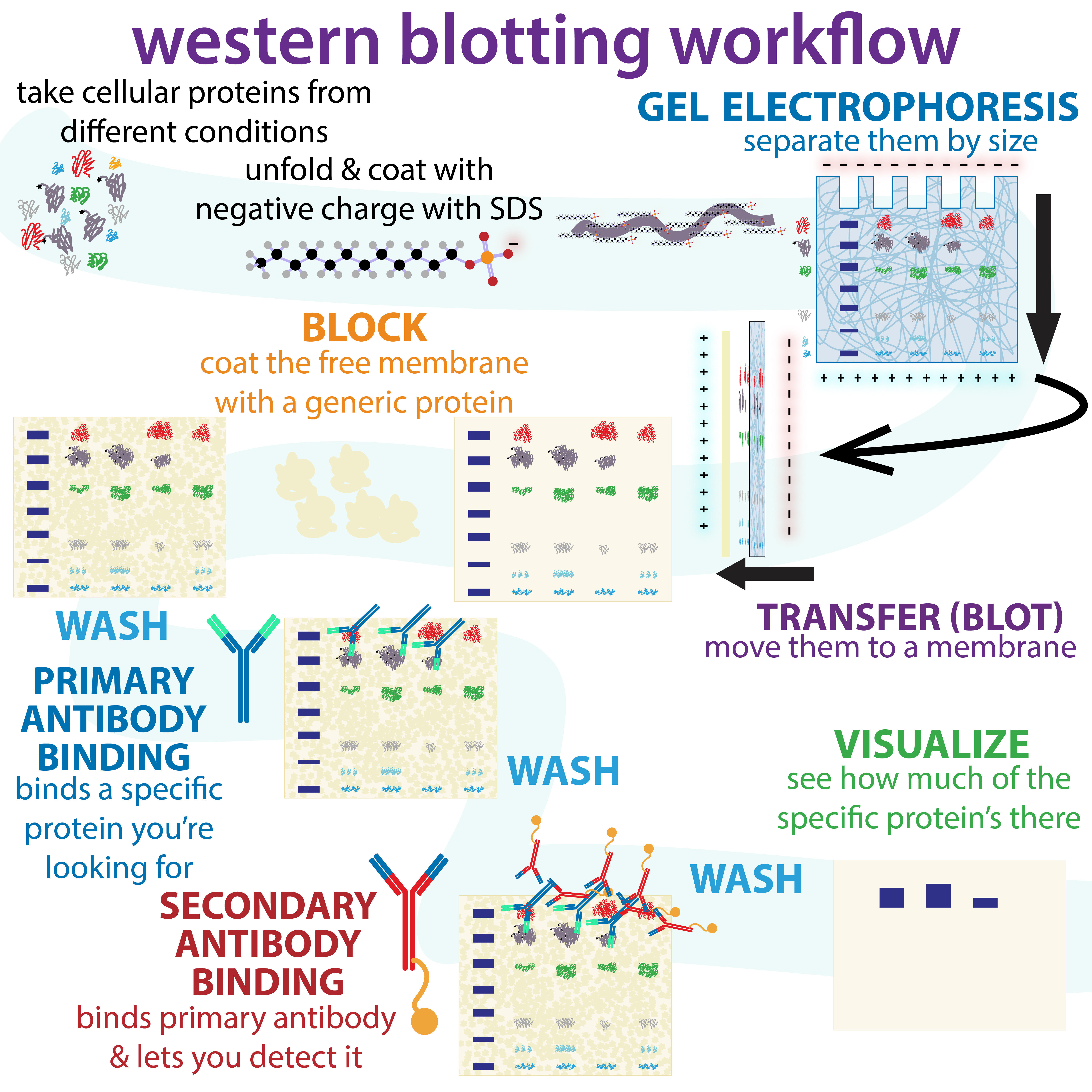
native gel- run without denaturing / reducing to retain protein structures
1. lysate is denatured, SDS to make negatively charged
2. run gel electrophoresis
3. transfer to nitrocellulose paper
4. primary antibody added
5. secondary antibody added, enzyme-linked to fluoresce
9
eastern blotting
looks at post-translational modification of peptides
10
isoelectric focusing
separate proteins based on pI
set up pH gradient in gel, then run electrophoresis
proteins move to the pH that equals their pI (where they have 0 net charge, and are not attracted to electrode)
2D gel can be run to separate by pI and molecular weight on two different axis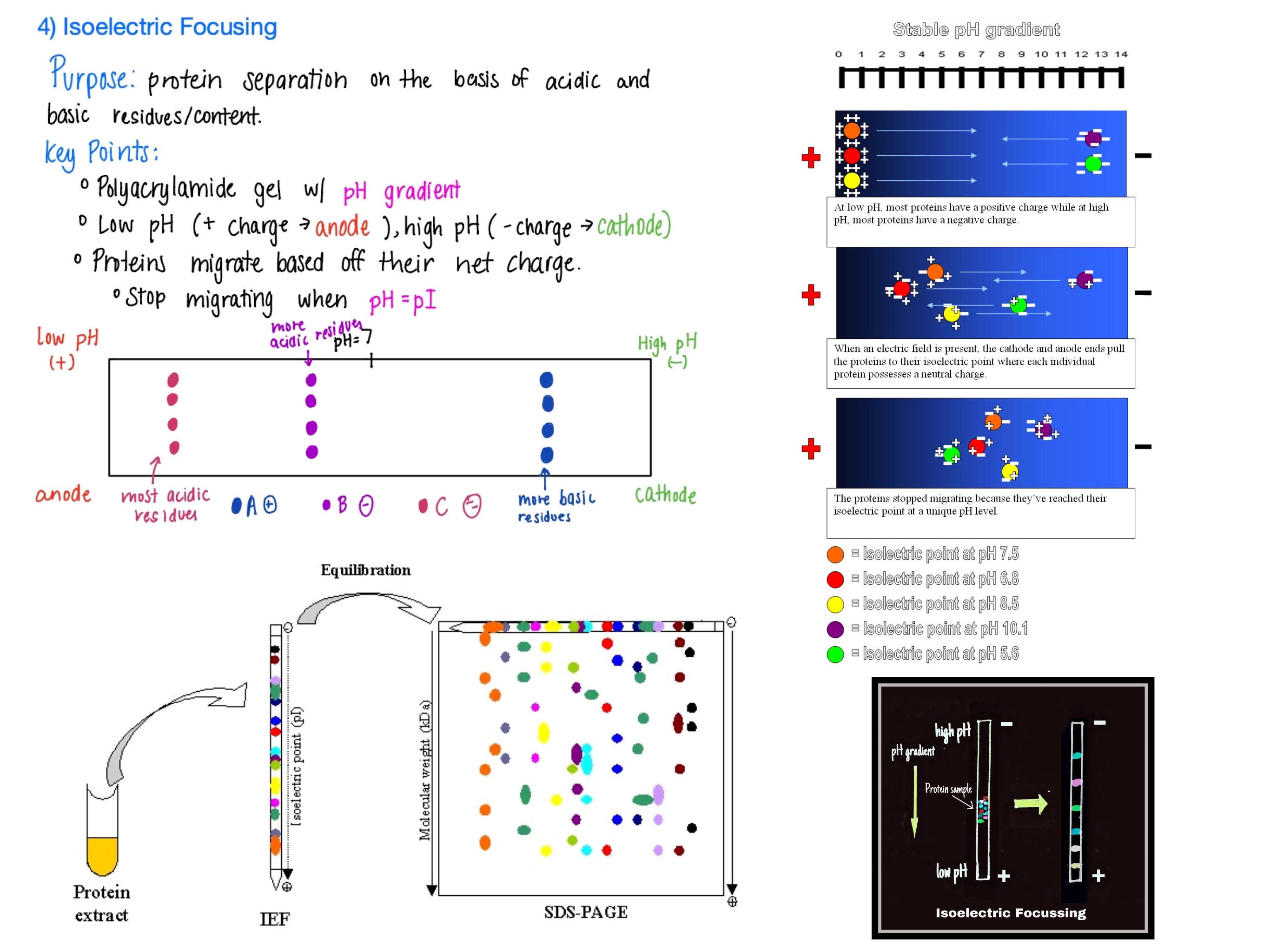
set up pH gradient in gel, then run electrophoresis
proteins move to the pH that equals their pI (where they have 0 net charge, and are not attracted to electrode)
2D gel can be run to separate by pI and molecular weight on two different axis
11
recombinant DNA
DNA is transcribed/translated in a different organism
restriction endonucleases- bacterial enzymes that cut specific sequences of DNA, creates sticky ends
restriction sites are usually palindromes
DNA fragment can be inserted in a plasmid that was also treated with the same restriction enzyme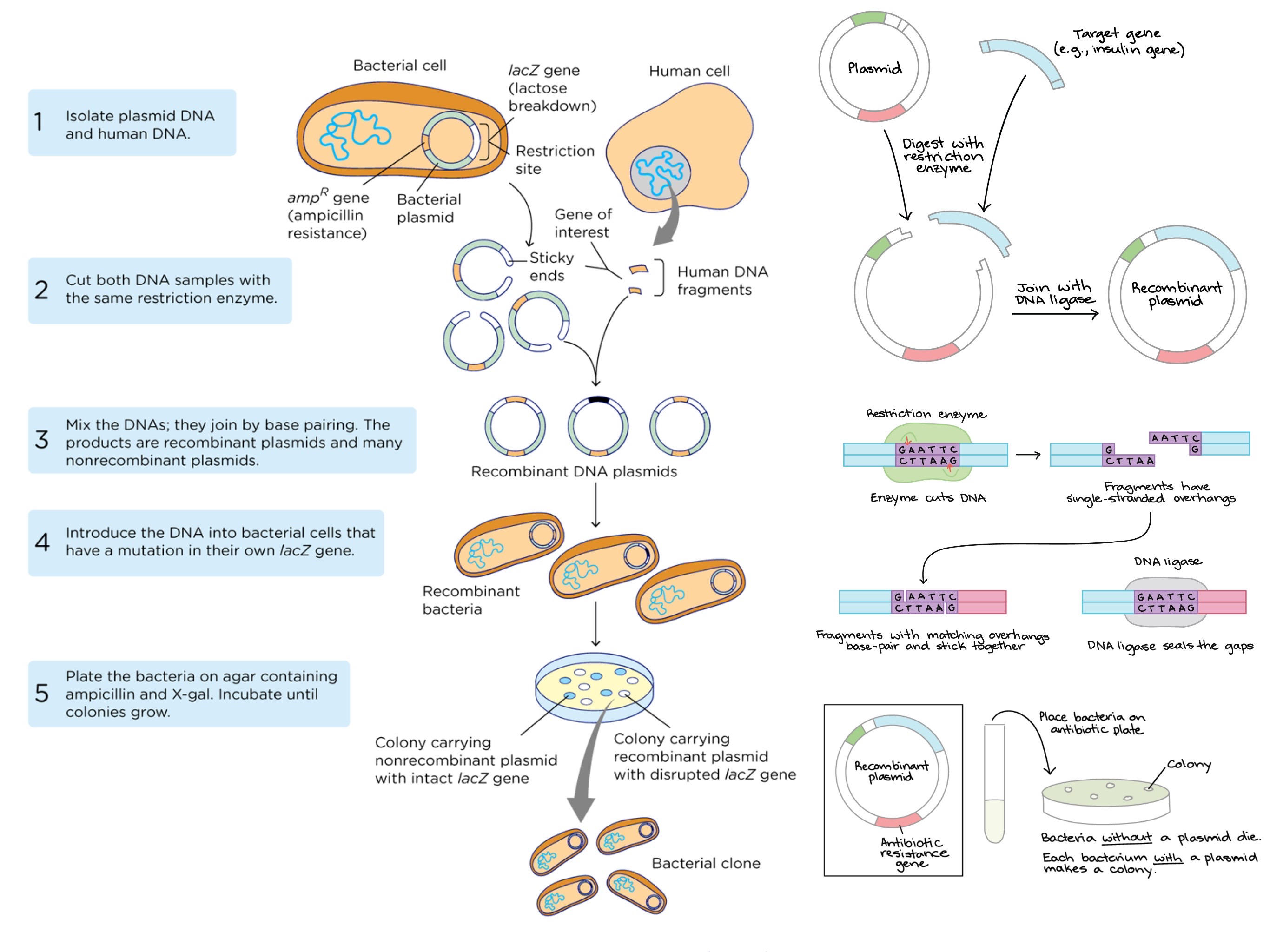
restriction endonucleases- bacterial enzymes that cut specific sequences of DNA, creates sticky ends
restriction sites are usually palindromes
DNA fragment can be inserted in a plasmid that was also treated with the same restriction enzyme
12
plasmids
circular ds-DNA in bacteria with autonomous replication
elements:
origin of replication- determines number of copies
cloning site- for restriction enzymes
resistance genes- for plasmid selection
uses:
1. transformation- plasmid enters bacteria, uses host machinery for transcription/translation, can integrate too!
2. cDNA- introns are a problem, so use reverse transcriptase to generate cDNA from mRNA then insert
3. artificial chromosomes- bigger, better than plasmids
4. transfection- eukaryotic plasmids into mammal cells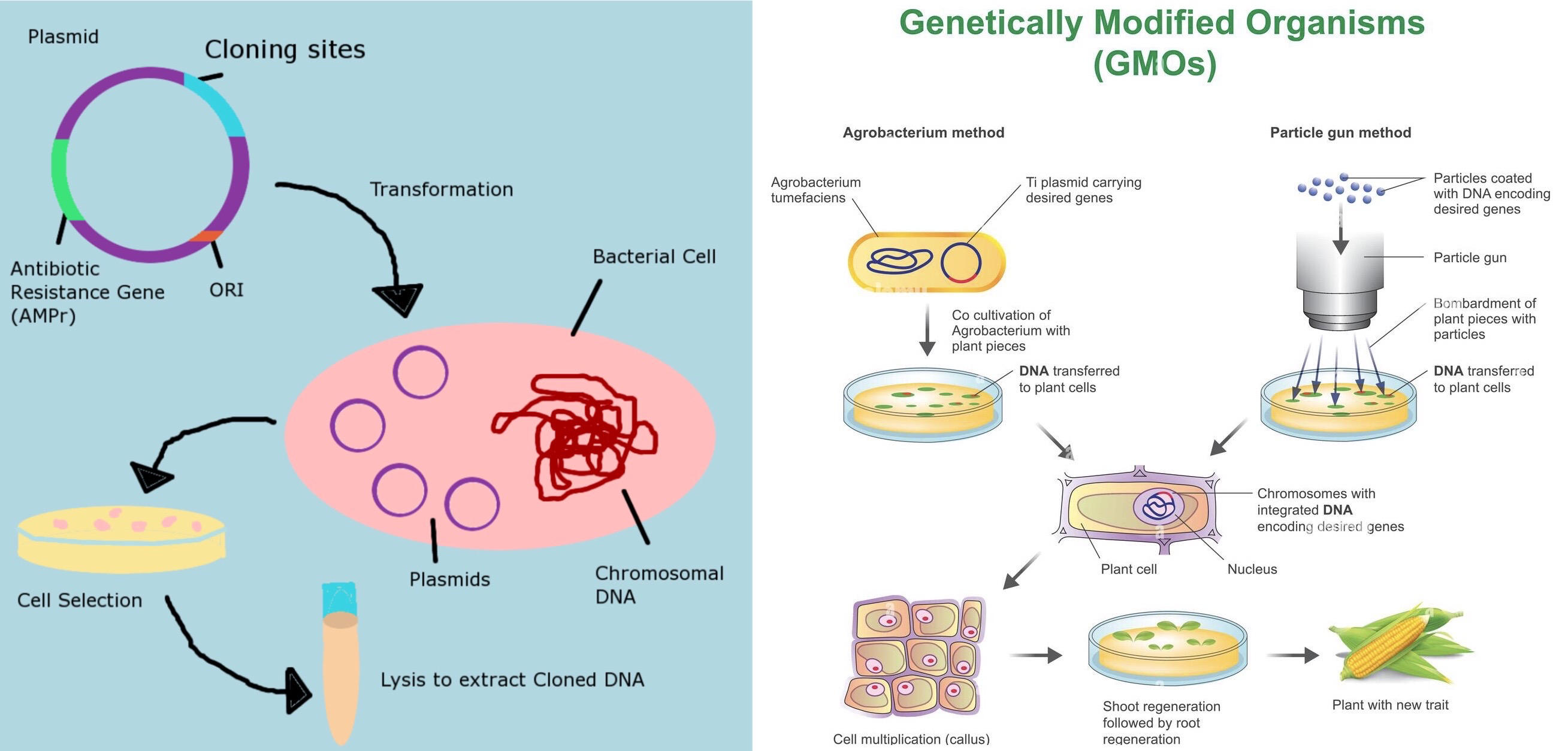
elements:
origin of replication- determines number of copies
cloning site- for restriction enzymes
resistance genes- for plasmid selection
uses:
1. transformation- plasmid enters bacteria, uses host machinery for transcription/translation, can integrate too!
2. cDNA- introns are a problem, so use reverse transcriptase to generate cDNA from mRNA then insert
3. artificial chromosomes- bigger, better than plasmids
4. transfection- eukaryotic plasmids into mammal cells
13
PCR
polymerase chain reaction
amplifies and looks for specific DNA sequences
ex: screening for hereditary diseases
method:
1. DNA, primers, nucleotide bases, DNA polymerase added
2. denaturation- sample heated, open DNA strands
3. annealing- sample cooled, primers attach
4. extension- sample heated, replication
5. repeat for 30 cycles
6. visualize with electrophoresis
primers should have high GC content, especially at the two ends, to ensure strong binding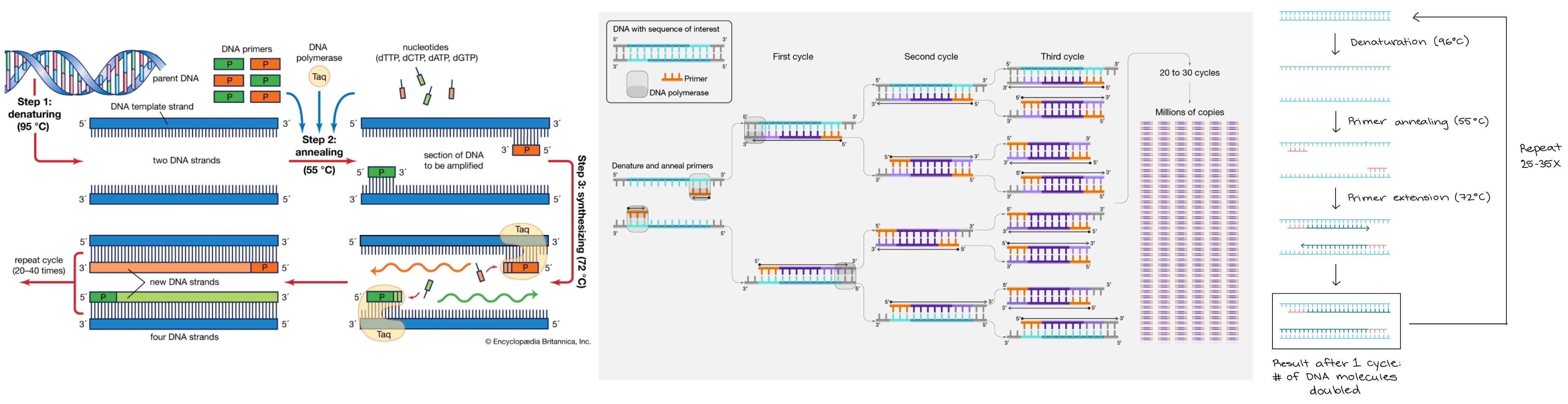
amplifies and looks for specific DNA sequences
ex: screening for hereditary diseases
method:
1. DNA, primers, nucleotide bases, DNA polymerase added
2. denaturation- sample heated, open DNA strands
3. annealing- sample cooled, primers attach
4. extension- sample heated, replication
5. repeat for 30 cycles
6. visualize with electrophoresis
primers should have high GC content, especially at the two ends, to ensure strong binding
14
RT-PCR
reverse transcriptase-polymerase chain reaction
looks for specific mRNA sequences
method:
1. all mRNA isolated and converted to cDNA with reverse transcriptase
2. PCR
3. visualize with electrophoresis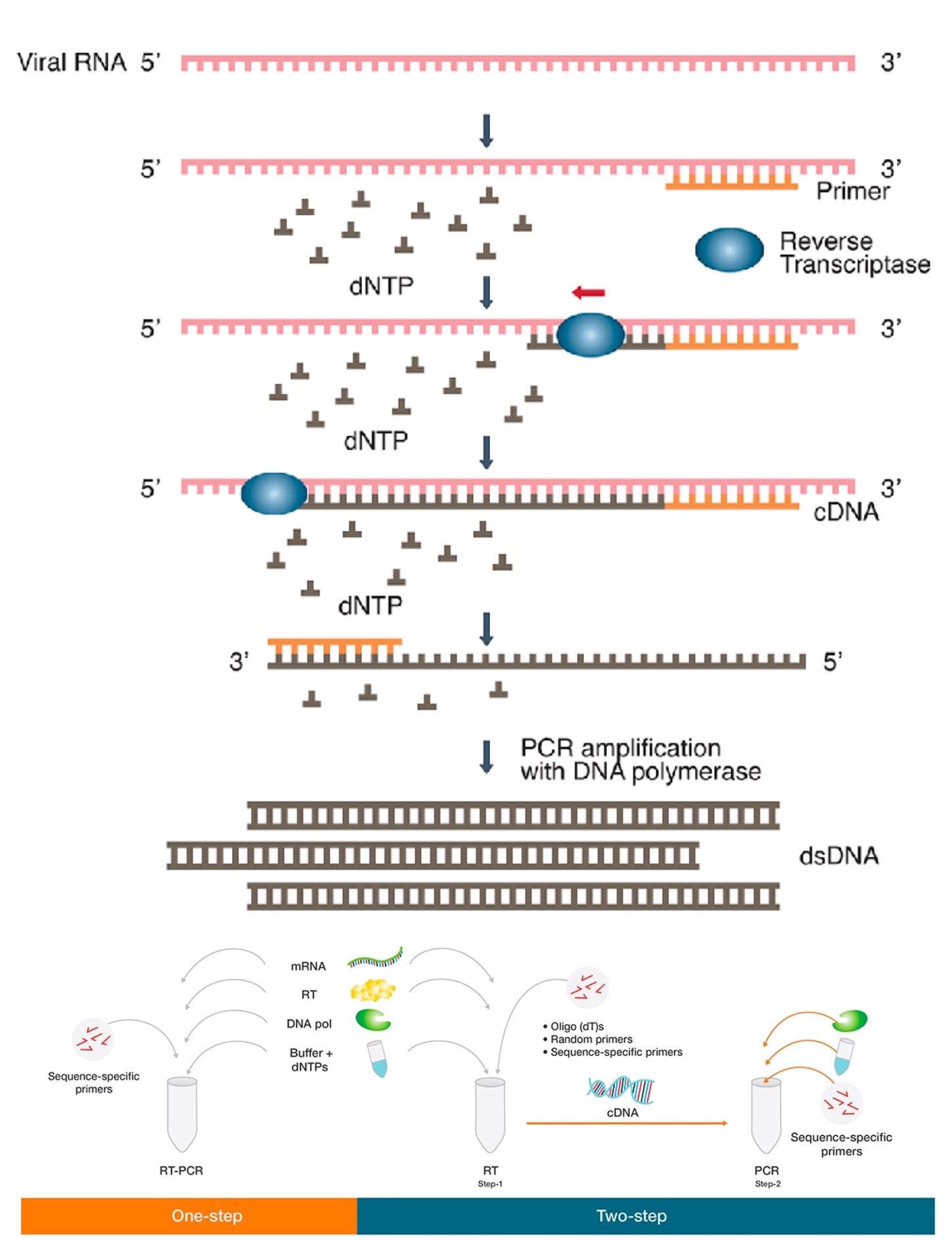
looks for specific mRNA sequences
method:
1. all mRNA isolated and converted to cDNA with reverse transcriptase
2. PCR
3. visualize with electrophoresis
15
qPCR
quantitative or real-time polymerase chain reaction
looks for amount of DNA sequence (PCR), gene expression (RT-PCR)
DNA amount measured each cycle with fluorescent probe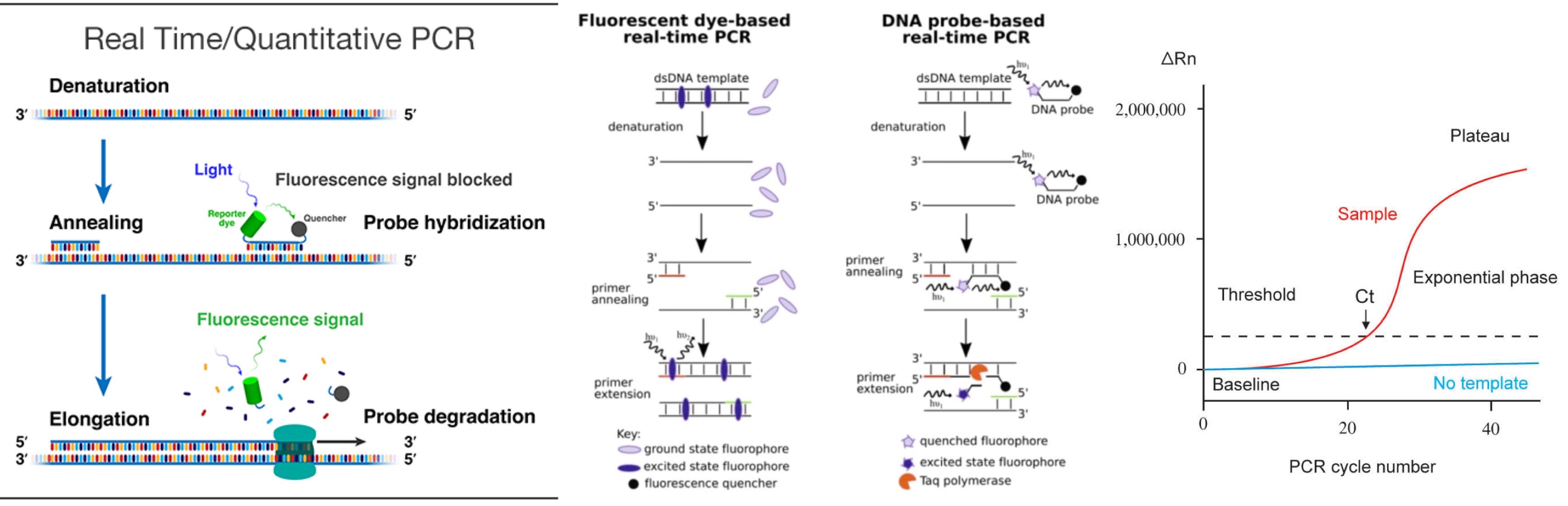
looks for amount of DNA sequence (PCR), gene expression (RT-PCR)
DNA amount measured each cycle with fluorescent probe
16
DNA sequencing
determine entire genome
DNA sequence can be read from bottom of gel to top, after extrapolating the sequence of the template strand
ex: constructing primers
Sanger technique:
1. dNTPs need OH on C3 to link together
2. modified dNTPs that lack C3 OH to terminate elongation
3. denature DNA into single strands
4. radiolabeled primers to show you where it starts
5. mix with dNTPs and some modified dNTPs of A only that randomly insert to generate a variety of fragments
6. repeat with C, G, T modified dNTPs
7. visualize with electrophoresis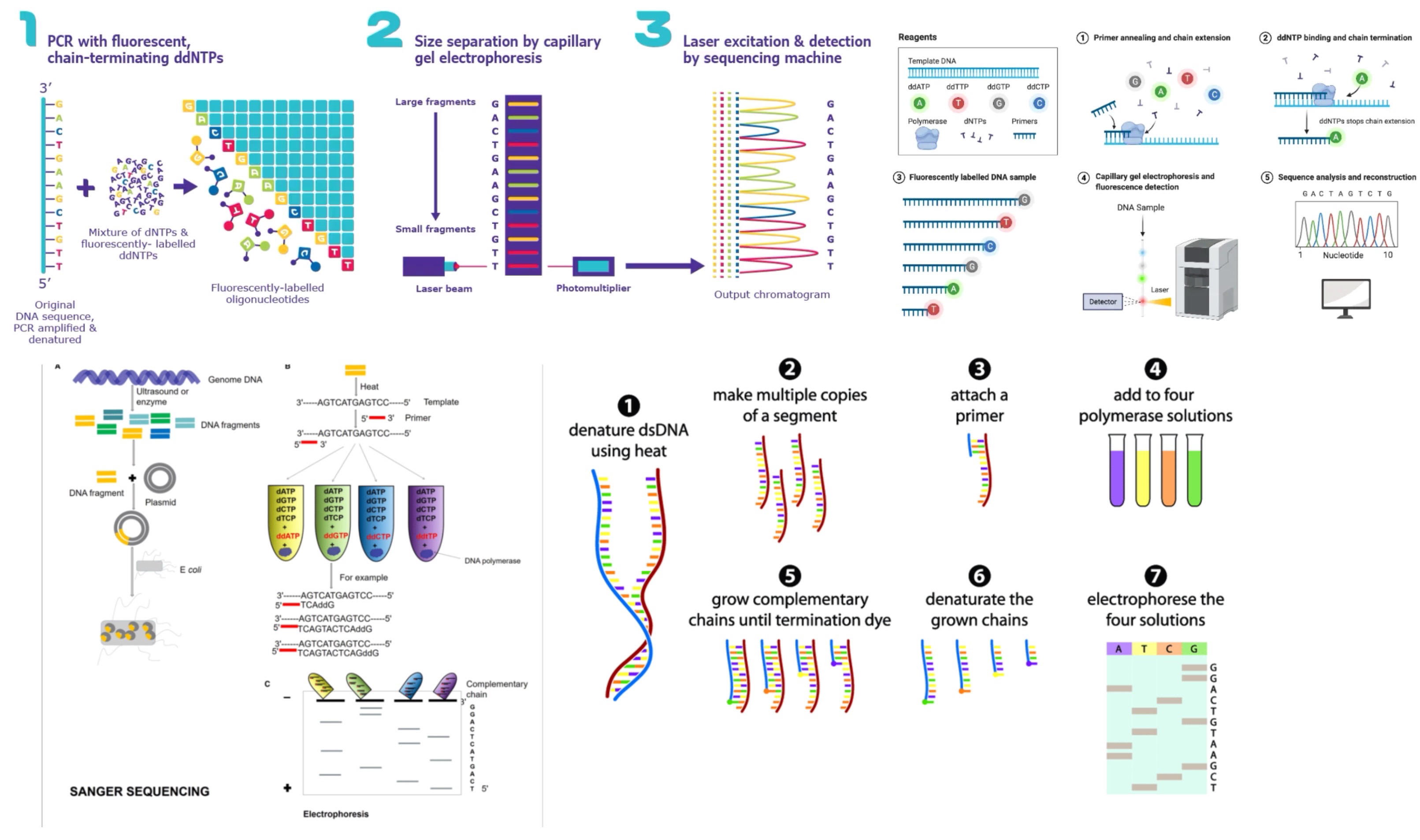
DNA sequence can be read from bottom of gel to top, after extrapolating the sequence of the template strand
ex: constructing primers
Sanger technique:
1. dNTPs need OH on C3 to link together
2. modified dNTPs that lack C3 OH to terminate elongation
3. denature DNA into single strands
4. radiolabeled primers to show you where it starts
5. mix with dNTPs and some modified dNTPs of A only that randomly insert to generate a variety of fragments
6. repeat with C, G, T modified dNTPs
7. visualize with electrophoresis
17
genomic sequencing
genetic linkage map- hundreds of markers per chromosome, create BAC libraries with chromosomal fragments, fragments are separately sequenced
shotgun approach- chromosomes cut into fragments, cloned, sequenced, use computer to align fragments
goals:
1. where genes are located, organized
2. genetic variation across species
3. cancer genome
shotgun approach- chromosomes cut into fragments, cloned, sequenced, use computer to align fragments
goals:
1. where genes are located, organized
2. genetic variation across species
3. cancer genome
18
DNA fingerprinting
restriction fragment length polymorphism (RFLP) analysis:
1. polymorphisms- highly variable DNA
2. restriction enzymes to cut up polymorphic DNA
3. separated with gel electrophoresis
4. southern blotting to look for specific sequences
short tandem repeat (STR) analysis:
1. PCR to amplify small stretches of polymorphisms
2. gel electrophoresis, south blotting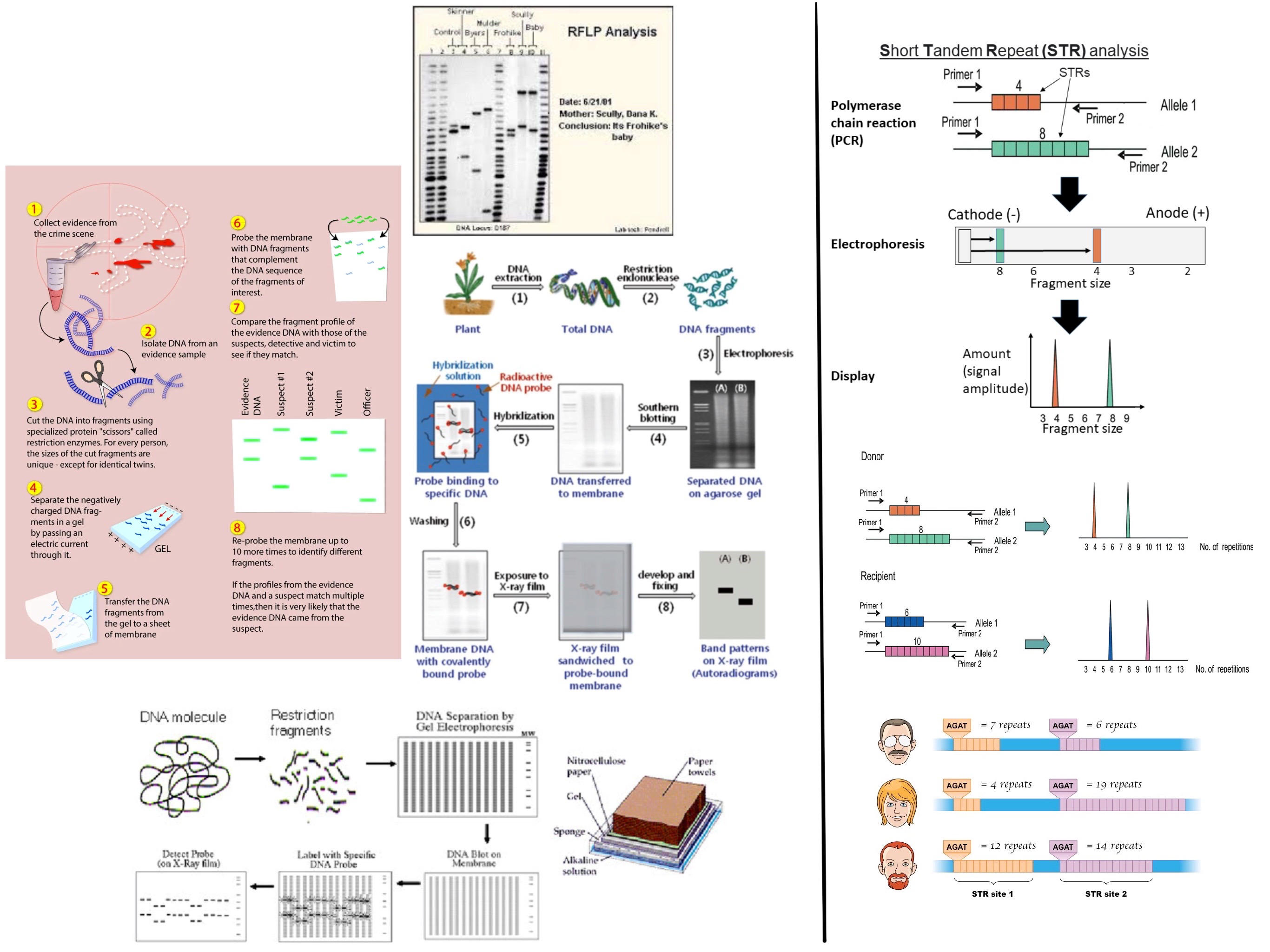
1. polymorphisms- highly variable DNA
2. restriction enzymes to cut up polymorphic DNA
3. separated with gel electrophoresis
4. southern blotting to look for specific sequences
short tandem repeat (STR) analysis:
1. PCR to amplify small stretches of polymorphisms
2. gel electrophoresis, south blotting
19
other methods for studying genome
exome sequencing- target certain regions for sequencing
karyotyping- staining whole chromosomes for major genetic changes, aneuploidy, some insertions/deletions
fluorescence in situ hybridization (FISH)- use fluorescent probes to find specific DNA sequences on chromosomes, used to study translocations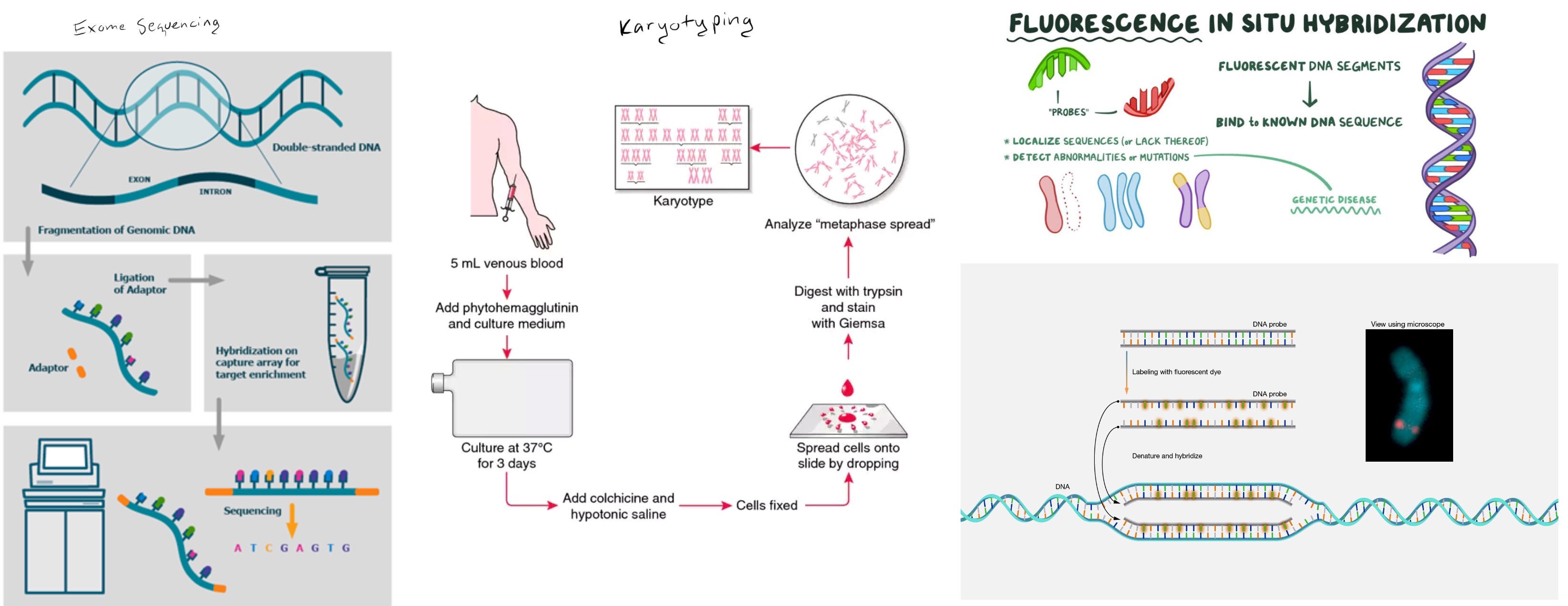
karyotyping- staining whole chromosomes for major genetic changes, aneuploidy, some insertions/deletions
fluorescence in situ hybridization (FISH)- use fluorescent probes to find specific DNA sequences on chromosomes, used to study translocations
20
microarrays
looking at relative RNA amounts
ex: comparing transcriptional profile of two people
method:
1. RNA samples are mixed with a fluorescent dye
2. applied to an array chip that has binding sites for many different genes
3. lights up as dye color if that gene is present
4. quantify based on color intensity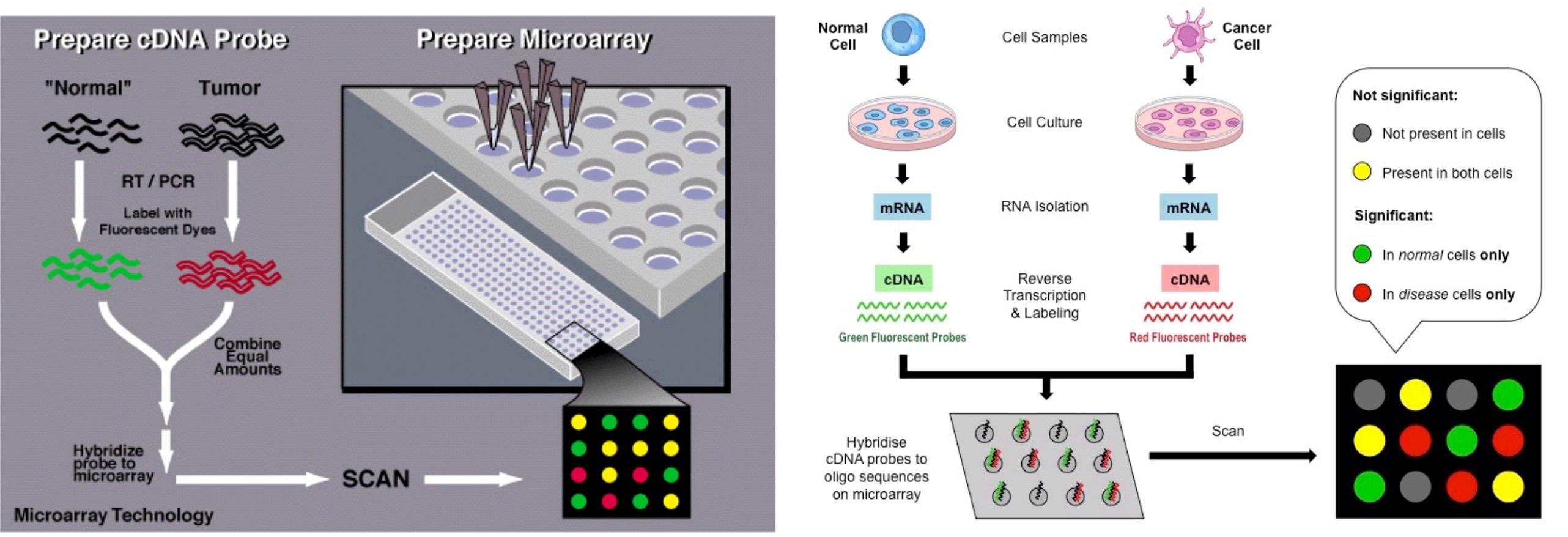
ex: comparing transcriptional profile of two people
method:
1. RNA samples are mixed with a fluorescent dye
2. applied to an array chip that has binding sites for many different genes
3. lights up as dye color if that gene is present
4. quantify based on color intensity
21
ISH
in situ hybridization
looking at location of gene expression in tissue sample
method:
1. tissue sample is fixed to slide
2. labelled probe is added for DNA/RNA of interest
3. enzyme-linked antibody is added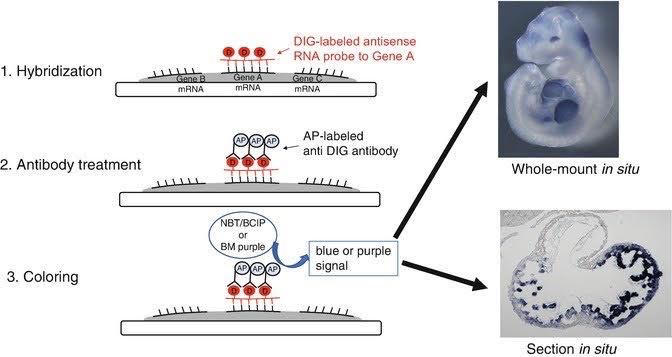
looking at location of gene expression in tissue sample
method:
1. tissue sample is fixed to slide
2. labelled probe is added for DNA/RNA of interest
3. enzyme-linked antibody is added
22
IHC
immunohistochemistry
looking at location of protein in tissue sample
ex: stain for estrogen receptor to help breast cancer pts
1. primary antibody specific for target protein is added
2. secondary antibody is added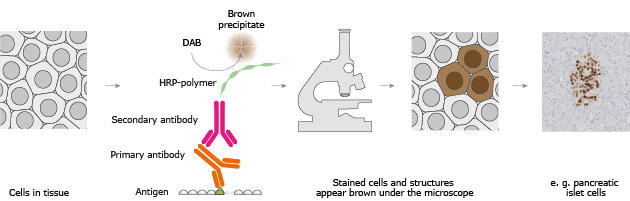
looking at location of protein in tissue sample
ex: stain for estrogen receptor to help breast cancer pts
1. primary antibody specific for target protein is added
2. secondary antibody is added
23
flow cytometry
looking at number of cells expressing markers
ex: separate T cell populations using CD4/CD8 markers
method:
1. cells are stained with antibodies linked to fluorescent tag
2. cells passed through beam of light one at a time
3. light scattering and light emission is measured
4. fluorescence-activated cell sorting (FACS)- sort cells based on expression of markers
ex: separate T cell populations using CD4/CD8 markers
method:
1. cells are stained with antibodies linked to fluorescent tag
2. cells passed through beam of light one at a time
3. light scattering and light emission is measured
4. fluorescence-activated cell sorting (FACS)- sort cells based on expression of markers
24
protein quantification
use different techniques to quantify protein over time, location, in different environments, drugs, etc.
Bradford quantification- Coomassie blue stains proteins, UV-vis spectrophotometer to determine protein quantity
Bradford quantification- Coomassie blue stains proteins, UV-vis spectrophotometer to determine protein quantity
25
simple distillation
seperating a liquid from a solution with different boiling points
condenser cools vapor down into liquid due to water cooling, in order to be collected into beaker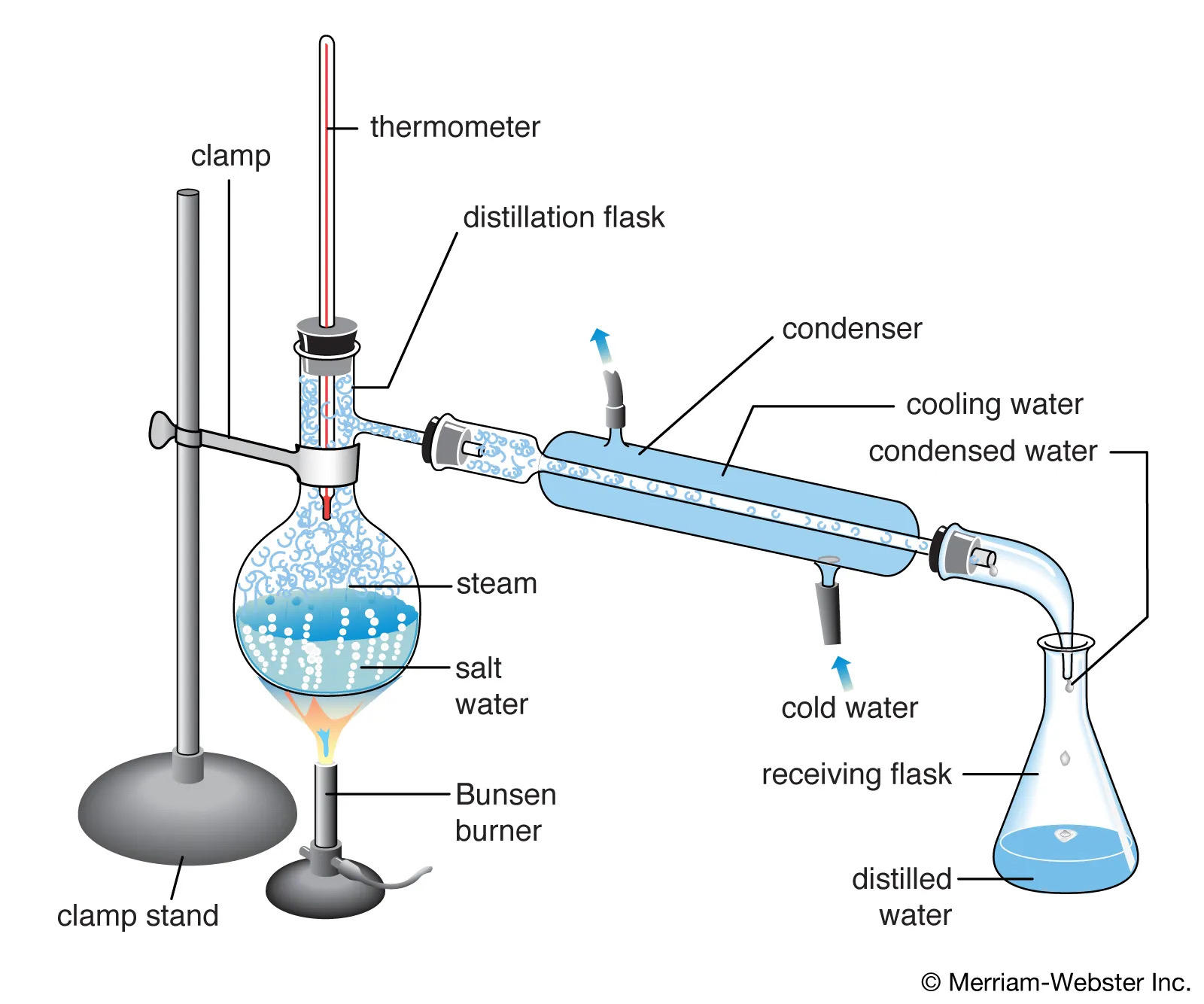
condenser cools vapor down into liquid due to water cooling, in order to be collected into beaker
26
fractional distillation
separating mixtures of liquids with different boiling points that vary by only a few degrees
ex: methanol (65°C), ethanol (78°C), propanol (97°C)
1. do lowest boiling point first (most volatile)
2. methanol will rise first and condense into liquid in condenser to be collected in a beaker
3. any other chemical will condense back into liquid and fall back down fractionating column (temp cooler at top than bottom)
4. increase your temp and repeat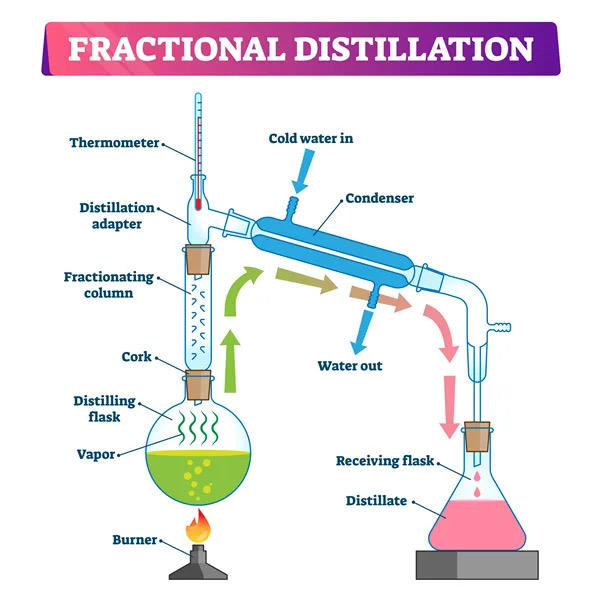
ex: methanol (65°C), ethanol (78°C), propanol (97°C)
1. do lowest boiling point first (most volatile)
2. methanol will rise first and condense into liquid in condenser to be collected in a beaker
3. any other chemical will condense back into liquid and fall back down fractionating column (temp cooler at top than bottom)
4. increase your temp and repeat
27
vacuum distillation
if you have compounds with very high and inconvenient boiling points, it can be difficult to distill
vacuum adapter lowers the pressure of the entire system, making it easier to vaporize substances
at low pressure, there isn’t much of a force pushing back down on the liquid (easier to vaporize upwards into gas phase)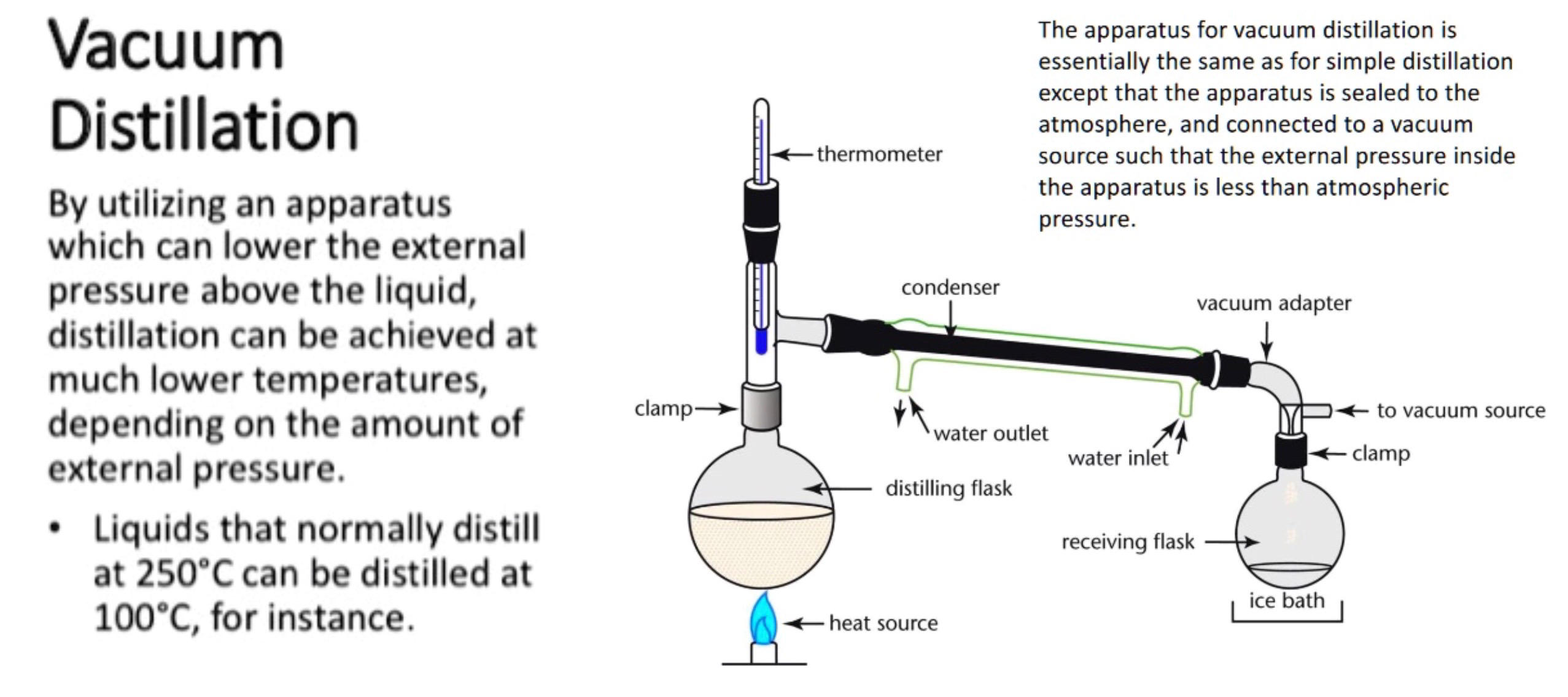
vacuum adapter lowers the pressure of the entire system, making it easier to vaporize substances
at low pressure, there isn’t much of a force pushing back down on the liquid (easier to vaporize upwards into gas phase)
28
litmus test
blue litmus paper turns red under acidic conditions
red litmus paper turns blue under alkaline (basic) conditions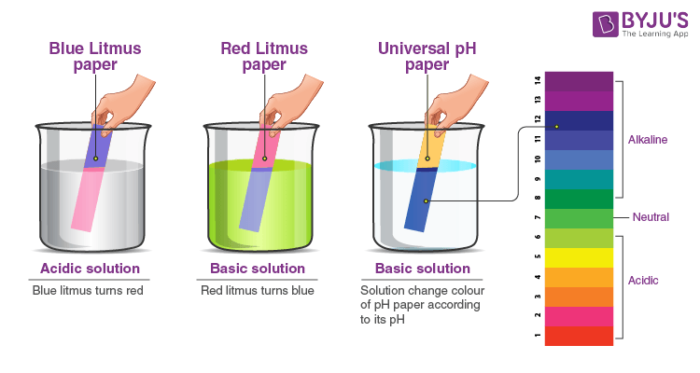
red litmus paper turns blue under alkaline (basic) conditions