CELL BIO UNIT 3 QUESTIONS
Study these flashcardsFree · spaced repetition · iPhone, Android, Mac & web
All cards
1
A GAP…
A. Stimulates the exchange of bound GDP for GTP- D. Is a factor without which monomeric GTPase cannot hydrolysis GTP
- B.Enhances the GTP hydrolysis rate of mono Eric GTPases
- C. Inhibits the GTPase activity of monomeric GTPase
2
An extracellular signal that is in the vicinity of the cell that secretes it and thereby activates signaling in the surrounding cells is classified as...
- D.Synaptic
- B.Endocrine
- C.Autocrine
- A. Paracrine
3
Endocytosis of receptors followed by degradation in lysosomes in response to a signal is a mode of...
- B. Positive feedback mechanism
- C.Receptor desensitization
A. Receptor activation
4
Which of these domains bind to proline rich sequences?
- D. SH2 domain
- C.PH domain
- B.PTB domain
- A. SH3 domain
5
Which of these is not a type of receptor?
- B. GPCRs.
- A. Ligand gated ion channels
- C.Monomeric G Protiens
6
Which of these responses to a signal are likely to occur in seconds?
- C. Protein phosphorylation
- B. Transcription
- D. Altered cell growth
- A. Translation
7
Which of these is false?
- B. Serine specific kinases or threonine specific kinases are common types of protein kinases
- C. For activation of GTP binding proteins, the GDP is exchanged for GTP
- A. Phosphatases catalytically remove the phosphate from GTP in GTP binding proteins
8
______ cells in select tissues release hormones that are distributed to the rest of the body
- C.Endocrine
A. Paracrine- D.Local Mediators
- B.Autocrine
9
Among which of these signaling molecules move farthest away from cells that release them?
- C. Contact dependent
- B.Neuronal
- D.Autocrine
- A. Paracrine
10
Which of these are secreted extra cellular signaling molecules that work only in the neighborhood they are released in?
- B.Local Mediators
- C. Receptors
- A. Hormones
11
Electrical impulses sent along a neuronal axon reaches the synapse and triggers secretion of a chemical called...
- A. Neurotransmitter
- C. receptors
- B.Nucleotides
- D. GTPases
12
Charged phosphoinositides are recognized and bound by
- A. SH2 domains
- C. SH3 domain
- B. Pleckstrin homology domain
- D. PTB domain
13
Scaffold proteins affect amplification and speed of signal by
- A. Limiting amplification but improving speed
- C. Limiting amplification and speed
- B. Enhancing amplification similar to diffusible messengers and enhancing speed
- D. Enhancing amplification but limiting speed
14
Sec homology domains (SH2) bind to which of these residues on activated receptors?
- C.Phosphorylated tyrosine
- B.Arginine
- D.Uniquinated Lysine
- A. Serine
15
Activation of which of these proteins leads to the activation of a monomeric GTPase by releasing GDP and binding GTP?
- C. Scaffold Protien
- A. GEF
- B.GAP
- D.Adaptor
16
Which of these enzymes Phosphorylate a protein by transferring the terminal phosphate from ATP onto a serine, threonine, or tyrosine molecule?
- D. Ligase
- C. Monomeric GTPase
- A. Kinase
- B.Phosphatase
17
A signaling molecule can generate a strong signaling response that persists even after the signaling molecule is removed and this can be due to
- C. No feedback
- A. Positive feedback
- B. Negative Feedback
18
Amplification of response to a signal can be generated when receptor activation leads to generation of a large number of intracellular signaling molecules called...
- D. Secondary messengers
- A. Kinases
- B.First Messengers
- C. Intracellular receptors
19
α subunit of G-protein is bound to _____________, that is replaced with __________________ upon activation of GPCR.
- D. GDP, GTP
A. ADP, ATP- B. ATP, ADP
- C. GTP, GDP
20
cAMP is synthesized from ATP by............
- C. GPCR
- D. Adenyl cylcase
- B. cGMP phosphodiesterase
- A.cAMP phospodiesterase
21
Response to a signal reaches a maximum level before it shuts itself off followed by another pulse of maximal response even in the presence of the signaling molecule leading to an oscillatory response due to............
- A. Negative feedback with a long delay
- C. Lack of feedback
- B. Persisting positive feedback
22
PKA is activated by binding of cAMP to the .........
- A. Both regulatory and catalytic subunits
- D. Regulatory subunits
- C. cAMP phosphodiesterase
- B. Catalytic subunits
23
Which type of mutation in the regulatory subunits of PKA would lead to a permanently inactive state?
- B. Mutation in the cAMP binding site in the regulatory subunits that results in the permanent binding of cAMP
- C. Mutation in the regulatory subunits that prevents them from binding to the catalytic subunits
A. Mutation in the regulatory subunits that prevents the release of the catalytic subunits
24
NO produced in endothelial cells diffuses across the membranes into smooth muscle cells to stimulate synthesis of cGMP by binding to.....
- A. Adenylyl cyclase
- B. CGMP phosphodiesterase
- D. Protein kinase
- C. Guanylyl cyclase
25
NOS catalyzed deamination of which of these amino acids produces NO?
- D. Tyrosine
- A. Serine
- B. Arginine
- C. Threonine
26
Cholera toxin activates the alpha subunit of Gs by ADP ribosylation, which.........
- C. Inhibits adenylyl cyclase activity
- D. Activates GDP binding to alpha subunit
- B. Activates the GTP hydrolysis activity of alpha subunit
- A. Inhibits the GTP hydrolysis activity of alpha subunit
27
Increase in cAMP levels by extracellular signals can be balanced by breakdown of cAMP by enzyme.........
- D. Protein kinase
- C. CAMP phosphodiesterase
- A. Adenylyl cyclase
- B. Guanylyl cyclase
28
Activation of phospholipase C by G protein leads to .......
- B. Cleavage of inositol phospholipids
- A.Not this
- C. Inhibition of calcium release from ER
29
Exposure of target cells to prolonged signals can lead to desensitization of GPCR by...................
- C. Continued interaction with G protein
- B. Dephosphorylation of GPCR
- A. Binding of arrestin to phosphorylated GPCR
30
IP3 produced by phospholipase C activation binds to IP3 receptors and leads to .......
- C. An inhibition of Ca release from ER
- B. A drop in cytosol if calcium levels
- D. Release of Ca from ER into cytosol
- A. A rise in Mg levels
31
During nervous-system development in Drosophila, the membrane-bound protein Delta acts as an inhibitory signal to prevent neighboring cells from developing into neuronal cells. Delta is involved in ______________ signaling.
- A. Endocrine
- C. Synaptic
- D. Contact dependent
- B. Paracrine
32
If signaling molecules act on the same cells that release them, it is an example of _____ signaling
- B. Autocrine
- D. Contact dependent
- A. Endocrine
- C. Synaptic
33
Monomeric GTPases are in an "ON state" upon binding to
- C. ADP
- B. GTP
- A. GDP
- D. ATP
34
Which of these occur more rapidly in response to a signal
- A. Changes in protein phosphorylation
- B. Changes in mRNA synthesis
35
In the following graphs, the cellular response, as measured in real time by the concentration of a certain active effector protein, is plotted over time for five cell types (A to E) that are treated with three different concentrations of a signal molecule. During the time period indicated by the horizontal gray bar, the signal molecule is present in the culture media at a concentration of 1 nM (dotted curve), 5 nM (gray curve), or 25 nM (solid curve). Answer the following question(s) based on these graphs; Which of the cell types A to E shows the fastest signal adaptation?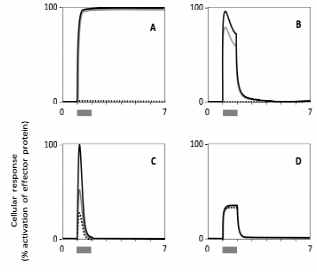
- D
- B
- C
- A
36
In the following graphs, the cellular response, as measured in real time by the concentration of a certain active effector protein, is plotted over time for five cell types (A to E) that are treated with three different concentrations of a signal molecule. During the time period indicated by the horizontal gray bar, the signal molecule is present in the culture media at a concentration of 1 nM (dotted curve), 5 nM (gray curve), or 25 nM (solid curve). Answer the following question(s) based on these graphs; Which cell type shows a response with highest persistence?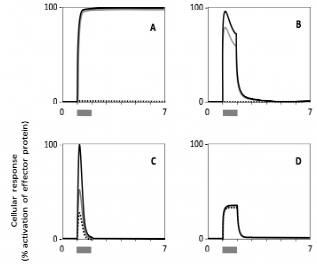
- A
- D
- B
- C
37
Which of these best describe the GPCRs?
- B. Alter the membrane potential directly by changing the permeability of the plasma membrane
- C. Must be coupled with intracellular monomeric GTP binding proteins
- A. All receptors of this class are polypeptides with seven transmembrane segments
38
The length of time a G protein will signal is determined by ____
- B. The activity of phosphatases that turn GTP into GDP
- C. The GTPase activity of G-alpha
- A. The activity of phosphatases that turn off G proteins by dephosphorylating G alpha
39
Which of these statements about nuclear receptors are true?
- C. They can activate or repress transcription based on the type of receptor
- B. They always activate transcription upon bind to ligands in the nucleus
- A. They only enter the nucleus after binding to ligand
40
Mutations that disrupt the tyrosine 1009 and 1021 residues in PDGF receptor.............................
- D. Alter the conformation of SH2 domains in phospholipase C-gamma
- A. Disrupt the recognition and binding of SH3 domains
- C. Disrupt the binding of SH2 domains in phospholipase C-gamma
- B. Disrupt the binding of SH2 domains in PI 3 kinase subunit
41
PI 3 kinase....
- D. Removes phosphatase groups from serine or threonine residues
- C. Is only known to be activated by receptor tyrosine kinases
- B. Is counteracted by PTEN phosphatase
- A. Activates PDK1 by phosphorylation g a serine residue on the protein
42
Which of these do NOT describe notch?
- C. Activated by proteolytic processing that involves a series of cleavage steps
- B. Is released to activate translation
- A.It is a cell surface receptor
43
Mutations that disrupt the protease activity of gamma-secretase will...................
- B. Activate transcription of notch target genes
- A. Inhibit recognition of notch by delta
- D. Activate migration of notch into nucleus
- C. Inhibit transcription of notch target genes
44
Mutations in the SH2 domains of the Grb2 adaptor that inhibit recognition of RTKs will lead to.....................
- A. Activation of SOS-GEF
- C. Exchange of GDP for GTP in Ras
- B. Inhibition of GTP binding to Ras
45
Activation of the EGF receptor includes which of these mechanisms?
- B. Conformational change in the receiver
- D. Monomerization of the receptors upon binding to EGF
A. Phosphorylation by the activator and the receiver- C. Phosphorylation of both the monomers by only the activator
46
In reference to AKT-dependent regulation of Bad, select the statement that is false?
- A. In the absence of a survival signal, bad is phosphorylated
- B. In the absence of a survival signal, bad inhibits the cell death inhibitor protein Bcl2
- D. In the presence of a survival signal, the cell death inhibitory protein in Bcl2 is active
- C. In the presence of a survival signal, Akt is phosphorylated
47
AKT and ERK activate mTORC1 activity by directly phosphorylating and inhibiting which of these GAPs?
- D. TSC
- B. Gator1
- A. RGS
- C. Ras GAPs
48
Upon activation of Ras, the final kinase activated in the MAP Kinase module is...........
- B. Erk
- C. Raf
- A. Mek
- D. MAPKKK
49
What of these statements about mTORC1 or mTORC2 are true?
- B. MTORC1 complex activates AKT directly
- A. MTORC2 is sensitive to drug rapamycin
- C. MTORC1 is sensitive to rapamycin
- D. MTORC2 activity is dependent on Rag
50
The GEF that activates Rag GTPase is..............
- C. Rheb
- A. Gator1
- B. MTORC1
- D. Ragulator
51
Mutations that inhibit TSC activity leads to the disease- Tuberous Sclerosis that has benign tumors and giant cells and this is due..............
- C. Inhibition of AKT
- D. Increased Rheb GTPase activity
- A. High MTORC1 activity
- B. Inhibition of MTORC1 activity
52
Enhancement of Gator1 GAP activity will lead to.................
- C. Inhibition of MTORC2 activity
- D. Activation of MTORC2 activity
- A. Inhibition of MTORC1 activity
- B. Activation of mTORC1 activity
53
In the absence of a Wnt signal.............
- A. Beta catenin is stabilized
- D. LEF1/TCF transcription regulator is activated
- Beta catenin accumulates and traslocates to nucleus
- B. Beta catenin is degraded
54
Degradation of Beta-Catenin by the proteasome is stimulated by..................
- D. Inhibition of GSK3 CK1 kinases
- C. Dephosphorylation of beta catenin
- B. Phosphorylation of beta catenin by GSK3 and CK1
- A. Disassembly of the APC/Axin degradation complex
55
Which of these events are likely to occur if Beta-Catenin is unable to bind to LEF1/TCF in the presence of Wnt signal?
- D. Groucho will be displaced from LEF1/TCF
- B. LEF1/TCF will activate the transcription of Wnt target genes
- A. Wnt target genes will be turned ON constitutively
- C. Groucho will remain bound to LEF1/TCF
56
A receptor tyrosine kinase-A (RTK-A) is activated by binding to a growth factor (GF). Which type of mutation is likely to inhibit the dimerization of RTK.
- C. mutation of tyrosines in RTK that inhibit trans-autophosphorylation.
- B. A mutation that prevents RTK-A from binding to GF
- D. mutation in the SH2 domain of intracellular signaling factor that recognizes phosphotyrosines in RTK.
- A. A mutation that increases the affinity of RTK-A for GF
57
The two monomers in a TRK dimer phosphorylate each other and the process is called
- A. Nucleotide exchange
- B. ubiquination
- C. Serine phosphorylation
- D. Trans auto phosphorylation
58
Which of the following mechanisms is not directly involved in inactivation an activated RTK
A. Dephosphorylation by serine/threonine phosphatases- D. Digestion of the RTK in lysosomes
- B. Dephosphorylation by protein tyrosine phosphatases
- C. Removal of the RTK from the plasma membrane by endocytosis
59
Activation of notch is irreversible
- B. False
- A. True
60
All GPCRs act by increasing cAMP?
- A. True
- B.False
61
What domain of son of sevenless (Sos) recruits it to the plasma membrane so that it gets in close proximity to Grb2?
- D. PH
- B. SH3
- A. PTB
- C. SH2
62
Mutations altering the GPCR binding interface in arrestin are likely to..................
- D. Inhibit G protein activation
- B. Inhibit phosphorylation by GCPR kinases
- A. Inhibit GCPR signaling
- C. Prevent desensitization of GCPR's
63
For Notch to be recognized by Delta, it has to be transported to the..............
- C. Endoplasmic reticulum
- D. Nucleus
- A. Golgi lumen
- B. Plasma membrane
64
PI3 Kinase primarily phosphorylates...............
- B. Serine residues
- C. Threonine residues
- D. Phospholipids
- A. Tyrosine residues
65
Which of these enzymes is bound to the cytosolic side of the plasma membrane and converts PI(4,5)P2 to IP3 and diacylglycerol?
- A. PKA
- B. Adenylyl cyclase
- D. PI 3- kinase
- C. Phosplipase C-beta
66
Why doesn't the beta subunit of the trimeric G-protein need a lipid anchor like the alpha and gamma subunits?
- B. It does not need to be near the plasma membrane
- A. It effectively uses the alphas anchor
- C.It uses a PH domain to bind a phosphoinotiside docking site
67
Select the mechanism of activation of AKT by PI-3K ?
- B. It activates the receptor tyrosine kinase activity to directly phosphorylate AKT
- D. It creates DAG and IP3 that activate AKT
- C. It is a kinase that directly phosphorylates AKT
- A. It phosphorylates lipids that create a docking site for AKT
68
G-proteins are bound to GPCRs......................
- B. At the intracellular side of the plasma membrane
- D. Buried fully within the lipid bilayer
- A. At the extracellular surface of the plasma membrane
- C. Deep within the alpha helical pocket in the GCPR's
69
Mutations in Ras are found in a majority of cancers. Which of these mutations will lead to permanent activation of Ras-signaling?
- B. Mutations that activate Ras GAP
- C. Mutations that inhibit Ras GEF activity
- A. Mutations that inhibit Ras GTPase activity
- D. Mutations that inhibit Ras activity
70
Which of these kinases is activated by binding to diacylglycerol that is released by breakdown of PI(4,5)P2?
- C. Protein kinase C
- Protein kinase A
- B. Adenylyl cyclase
- D. Phosplipase
71
Which of these factors belong to a family of local mediators that were originally identified as the gene important for wing development in Drosophila?
- A. Wnt
- B. Beta catenin
- C.Raf
- C. Ras
72
Which mechanism is NOT likely to sharpen the cellular response to a signal?
- B. Sharper responses occur if target activation requires more than one phosphate
- D. Activating enzymes for the forward and back reactions sharpens the response
- A. A positive feedback of moderate strength sharpens the response to the signal
- C. Sharper responses occur if more than one signal molecule binds to the target
73
DNA replication is initiated by____________.
- D. Geminin
- C. Nucleoside
- B. Cohesin
- A. S-Cdk
74
M-Cdk complex is activated by_______.
- A. Inhibition of CAK phosphorylation
- D. Inhibition of cyclin binding
- B. Phosphorylation by Wee1 kinase
- C. Dephosphorylation by CDC25 phosphatase
75
CKIs such as p27 ____________.
- D. Inhibit cyclic binding to Cdk
- B. Activate the cyclin Cdk complex
- A. Inhibit the cyclin Cdk complex
- C. Activate the catalytic activity of Cdk
76
Cdk activity is stimulated by phosphorylation of the T-loop by ________.
- C. cyclin
- B. APC
- C. CDC25
- A. CAK
77
EdU incorporation marks cells in..........
- B. G1 phase
- D. M phase
- C. S phase
- A. Start phase
78
M-cyclin _______________.
- D. Is inhibited by M-Cdk
- C. Is induced by phosphorylation of cyclin
- B. Levels rises markedly during G1 phase
- A. levels fall toward the end of M phase as a result of ubiquitylation and degradation.
79
Which of these techniques can be used to separate cells rapidly based on their fluorescence signal corresponding to their DNA content?
- A. Phase contrast microscopy
- B. Flow cytometry
- C. Agarose gel electrophoresis
- D. Western blotting
80
Cdk activity fluctuates during the cell cycle, partly because ________________.
- B. Cdks are rapidly degraded
- D. Levels of Cdks fluctuate throughout the cell cycle
- A. Cyclin levels change during the cycle
- C. The Cdks inactivate the cyclins
81
Which of these statements about Cdc25 phosphatase is true?
- B. Cdc25 maintains Wee1 phosphorylation of Cdk
- C. Cdc25 prevents cyclin binding to Cdk
- A. Cdc25 increases Cdk activity
82
One half of a duplicated chromosome at the end of S phase is called
- C. Securin
- D. Condensin
- A. Sister chromatid
- B. Kinetochore
83
A key control system crucial for triggering cytokinesis is.............
- A. Start transition
- C. Metaphase to anaphase transition
- B. G2/M transition
84
If cell cycles were repeated with only the S phase and M phases, what is likely to occur?
- C. The mitotic spindle could not assemble
- B. Cell would get larger and larger
- A. The cells produced would get smaller and smaller
- D. Cell would not be able to replicate their DNA
85
Which of these fluorescently-tagged proteins can be used to monitor G2 phase in live cells?
- C. S-Cdk
- A. Cdt1
- B. APC/C
- D. Geminin
86
Which of these factors inactivates Cdks by adding phosphates on specific sites on Cdks?
- B. Wee1
- A. Cdc25
- D. Ensa
- C. Great Wall kinase
87
Activation of Greatwall kinase...........
- A. Activates PP2A-B55
- B. Inhibits PP2A-B55
- C. Inhibits M-Cdk substrate phosphorylation
88
Mutations in Ensa that prevents its binding to PP2A-B55 will...........
- D. Keep PP2A-B55 active in early mitosis
- A. Activate greatwall kinase
- C. Lead to constitutive phosphorylation of M-Cdk substrates
- B. Inhibit PP2A-B55 activity in early mitosis
89
Which of these mechanisms serve as positive feedback to activate M-Cdks?
- B. Inhibition of Cdc25 activity
- A. Addition of phosphates on M-Cdk by Wee1
- D. Activation of PP2A-B55
- C. Inhibition of wee1 by M-Cdk
90
CAK-dependent phosphorylation of M-Cdk is sufficient to fully activate M-Cdk activity even in the presence of Cdk phosphorylation by Wee1?
- B. False
- A. True
91
Which of the following events does not usually occur during interphase?
- C. DNA is replicated
- B. The nuclear envelope breaks down
- A. Cells grow in size
- D. The Centrosomes are duplicated
92
Progression through the cell cycle requires a cyclin to bind to a Cdk because________.
- C. Cyclin binding inhibits Cdk activity until the appropriate time in the cell cycle
- A. The cyclins are the molecules with the enzymatic activity in the complex
- B. The binding of a cyclin to Cdk is required for Cdk enzymatic activity
93
Substrate specificity is highly dependent on which of these submits of PP2A phosphatase?
- B. Regulatory Subunit
- C. Catalytic Subunit
- A. Scaffold Subunit
94
Cdt1 is activated by ____________.
- A. APC/C induced destruction of Geminin
- C. Destruction of CDC6
- D. Binding of Geminin
- B. Accumilation of geminin
95
During metaphase..................
- C. Chromosome attach to spindle microtubules for the first time
- B. Nuclear envelope re assembles
- D. Chromosomes align at the spindle equator
- A. Nuclear envelope breaks down
96
Condensins ________________.
- B. Are made of the exact same protein subunits as cohesins
- D. Bind to DNA in G1 phase
- A. Compact chromosomes when phosphorylated my M-Cdk
- C. Are involved in keeping the sister chromatids apart
97
Cdc20-APC and Cdh1-APC complexes are similar because........................
- B. They both inhibit M Cdk activity
- A. They are both active throughout interphase
- D. They are both activated suddenly at the onset of mitosis
- C. They are both inactivated soon after anaphase
98
ORC is phosphorylated in which phase?
- D. Mitosis
- A. S phase
- C. G2 phase
- B. G1 phase
99
DNA helicase deposition on DNA at the replication origins occurs mainly in which phase of cell cycle?
- A. G1 phase
- D. Mitosis
- C. G2 phase
- B. S phase
100
At the beginning of S phase in a cycling cell, which of these events are likely to occur?
- A. Activation of Cdh1-APC/C
- D. Activation of M-Cdk
- B. Activation of Cdc20
- C. Activation of geminin
101
In the metaphase to anaphase transition, activation of which of these factors is important?
- B. Cdh1-APC/C complex
- C. Helicase
- D. S Cdk
- A. Cdc20-APC/C complex
102
Which of these complexes keep M-cyclin levels low in G1 phase of cell cycle?
- D. Ch1-APC/C
- A. Cdc20-APC/C
- B. Skp2-SCF
- C. P27-Cdk
103
S-cdk ensures that replication happens only once per cell cycle- how?
- C. It phosphorylates and inactivates DNA helicases
- A. It promotes the assembly of a pre replication complex
- B. It phosphorylates the cdc6 protein, marking it for destruction
- D. It blocks the rise of cdc6 concentrations early in G1
104
If a cell in G1 phase and another cell in G0 phase are induced to pass the restriction point by the addition of a signaling molecule, but the signal is then immediately removed, what is likely to occur?
- C. Only the G0 cell will replicate its DNA
- D. Neither of the cells will replicate their DNA
- A. Both cells will replicate their DNA
- B. Only the G1 cell will replicate its DNA
105
Disassembly of nuclear envelope marks which phase of mitosis?
- D. Prophase
- A. Metaphase
- C. Prometaphase
- B. Anaphase
106
Which statement is false?
A. CDC25 activity is further stimulated by M Cdk phosphorylation, which creates a positive feedback for M Cdk activity
B. Wee1 activity is inhibited by M Cdk phosphorylation, which creates a positive feedback for M Cdk activity
C. Activation of M CDK activates PP2A-B55
A. CDC25 activity is further stimulated by M Cdk phosphorylation, which creates a positive feedback for M Cdk activity
B. Wee1 activity is inhibited by M Cdk phosphorylation, which creates a positive feedback for M Cdk activity
C. Activation of M CDK activates PP2A-B55
- A. CDC25 activity is further stimulated by M Cdk phosphorylation, which creates a positive feedback for M Cdk activity
- C. Activation of M CDK activates PP2A-B55
- B. Wee1 activity is inhibited by M Cdk phosphorylation, which creates a positive feedback for M Cdk activity
107
Which complex of APC/C is active in early G1
- A. APC/C-Cdc20
- B. APC/C-Cdh1
108
Activation of APC/C is important for..
- C. G2 to M transition
- A. Metaphase to anaphase transition
- B. Entry into prophase
109
Activation of which of these factors inhibit MCM2 loading onto DNA?
- A. Cdt1
- D. S Cdk
- C. ORC
- B. CDC6
110
At the end of DNA replication, the sister chromatids are held together by the...
- D. Histones
- C. Cohesins
- B. Securing
- A. Kinetochores
111
The concentration of M cyclin _________
- B. Falls toward the end of M phase as a result of ubiquitylation and degradation
- C. Is highest in G1 phase
- A. Remains constant throughout cell cycle
112
Which of these statements about APC is false?
- B. APC is phosphorylated by the (mitotic) Cdk1-cyclinB and binds its activator Cdc20 to become active in metaphase.
- D. APC is a protease and promotes anaphase by degradation of securin, the protein that holds sister chromatids together.
- A. APC is also active in ensuring exit from mitosis.
- C. APC is an ubiquitin ligase and promotes anaphase by ubiquitin mediated degradation of securin.
113
Which of these proteins play a direct role in anaphase B?
- C. Kinesin-5 on interpolar microtubules and dynein on kinetochore microtubules
- A,Kinesin-5 on interpolar microtubules and dynein on astral microtubules
- D. Kinesin-5 on interpolar microtubules and kinesins 4 on interpolar and astral microtubules
- B. Kinesin-13 on kinetochore microtubules and dynein on astral microtubules
114
Which of these motor proteins are minus-end directed motors that cross link interpolar microtubules and pull the poles together?
- D. Kinesin 4
- B. Kinesin 14
- C. Kinesin 10
- A. Kinesin 5
115
Duplication of centrosomes occurs in ________.
- D. G2 phase
- A. S Phase
- C. M phase
- B. G1 phase
116
Polar ejection force that pulls chromosomes to the spindle equator is mediated by ______.
- D.Kinesin 5
- A. Dyenin
- C. Kinesin 14
- B. Kinesin 4
117
The polar ejection force does which of the following?
- C. Pushes the chromosome arms towards the poles with the help of kinesin-5
- B. Pushes the chromosome arms away from the spindle poles with the help of kinesin-4 and 10
- A. Pulls the microtubules towards the spindle poles by microtubule flux
- D. Pulls the kinetochore towards the poles by plus-end depolymerization
118
Which of the following statements is TRUE?
- A. The mitotic spindle is largely made of intermediate filaments.
- B. The mitotic spindle helps segregate the chromosomes to the two daughter cells.
- D. The contractile ring formation is inhibited by RhoA signaling.
- C. The contractile ring is made largely of actin filaments.
119
Some cell types in animals do not have centrosomes and therefore they do not have....
- A. Astral microtubules
- C. Inter polar MT
- D. Kinetochore MT
- B. Chromatids
120
The plus ends of these microtubules are attached to large protein structures at the centromeres and they are called..............
- B. Interpolar MT
- C. Astral MT
- A. Kinetochore MT
121
Proper bi-orientation of the sister-chromatid pair on the spindle generates a tension that is sensed by_____.
- B. Aurora B kinase
- D. Kinesin 5
- C. Cohesins
- A. Centrioles
122
Degradation of securin is important for ________.
- A. Activation of Cdc20-APC/C complex
- C. Inactivation of separase
- D. Separation of sister chromatids
- B. Formation of Spindle
123
The length of a kinetochore microtubule does not change much during metaphase because there is no addition or removal of tubulin subunits
- B. False
- A. True
124
Which statement about centrosomes is TRUE?
- A. Centrosomes are not duplicated during cell cycle.
- D. Centrosomes are replicated multiple times during a cell cycle.
- C. Centrosomes are duplicated once per cell cycle similar to DNA.
- B. Centrosomes are duplicated once per cell cycle unlike DNA.
125
Contractile ring is made of ________.
- D. Astral MT
- B. Nuclear lamina
- C. Kinetochore MT
- A. Actin and myosin filaments
126
Disassembly of the nuclear envelope ________________.
- D. must occur for kinetochore microtubules to form in animal cells.
- A. is triggered by the phosphorylation of integrins.
- C. causes the inner nuclear membrane to separate from the outer nuclear membrane.
- B. results in the conversion of the nuclear envelope into protein-free membrane vesicles.
127
Which statement about kinetochores is true?
- C. Kinetochores assemble onto chromosomes during late prophase.
- D. Kinetochores contain DNA-binding proteins that recognize sequences at the telomere of the chromosome.
- B. Kinetochore proteins bind to the tubulin molecules at the minus end of microtubules.
- A. Kinetochores assemble on chromosomes that lack centromeres.
128
Which event indicated below happens before the nuclear envelope is re-assembled in M phase?
- A. Decondensation of chromosomes
- B. Assembly of contractile ring
- D. Completion of telophase
- C. Reassembly of the nuclear lamina
129
Which statement about drugs targeting microtubules is FALSE?
- B. Drugs that stabilize microtubules such as Taxol inhibit mitosis.
- A. Drugs that stabilize microtubules such as Taxol promote mitosis by stabilizing the spindle.
- C. Drugs such as colchicine that inhibit microtubule polymerization, inhibit mitosis.
130
Consider the centrosome duplication cycle and in relation to replication, is centrosome duplication:
- B. Semi conservative
- A. conservative
131
For MT organization in mitosis chromosomes are not as important as centrosome
- A. True
- B. False
132
Centriole tether is broken at what phase?
- Entry into G2 phase
- Entry into G1 phase
- Entry into S phase
- Entry into M phase
133
Separase is kept inactive due to:
- C. Degradation of securin
- B. Binding of securin
- A. Activation of APC/C-Cdc20
134
Actin and myosin filaments are also main components of mitotic spindle
- A. True
- B. False
135
What are mitogens?
- D. They are produced by mitotic cells to keep nearby neighboring cells from dividing.
- A. They are extracellular signals that stimulate cell division.
- B. They are transcription factors that induce cell death.
- C. They are kinases that inhibit cell proliferation.
136
DNA damage induced checkpoint response in G1 ________________.
- A. involves the inhibition of cyclin-Cdk complexes by p21.
- C. involves the degradation of p53.
- D. is activated by inhibition of ATM.
- B. causes cells to proceed through S phase more quickly.
137
UV exposure can cause DNA damage. Which of the following would you NOT expect to occur as a result of genomic damage?
- A. Activation of the protein kinase ATR
- D. Binding of p53 to Mdm2
- C. Inactivation of the protein phosphatase Cdc25
- B. Activation of the protein kinase Chk1
138
Which event contributes to helping the cells progress from G1 to S phase?
- C. Phosphorylation of Rb by G1-Cdk, G1/S-Cdk, and S-Cdk
- A. Activation of E2F gene expression
- D. All of the above
- B. Destruction of CKIs that target S-Cdks
139
Which of these is an immediate early gene whose expression is triggered by Ras activation to promote cell cycle entry?
- D. Ubiquitin ligase
- A. MTORc
- C. S-cyclin
- B. Myc
140
ATM and ATR kinases phosphorylate Ser-15 residue in p53 which________.
- D. Inhibits p21
- B. Enhances its interaction with Mdm2
- C. Stabilizes p53
- A. Inhibits p53
141
G1/S Cdk also phosphorylates and inactivates APC/C towards end of G1 phase, which directly helps in accumulation of ..................
- D. ATR
- A. Rb
- B. S cyclin
- C. P53
142
Retinoblastoma is caused by excessive proliferation of some cells in retina that is induced by ..................
- A. High Rb activity
- D. High p53 activity
- C. High E2F activity
- B. High CKI activity
143
The Chk1-mediated checkpoint response to DNA damage can arrest cells in G2/M phase by inhibiting which of these factors?
- C. Cdc25
- B. ATR
- D. Rb
- A. ATM
144
Which of these is the purpose of activating cell cycle checkpoint responses to DNA damage?
- D. All of the above
- C. halt cell cycle to suppress accumulation of mutations.
- A. promote cell death if damage is excessive.
- B. halt cell cycle to facilitate DNA repair.
145
p53 expression is often lost in early stages of cancer development, and in the absence of p53, which of these factors serve to initiate key cell cycle checkpoint-response to DNA damage? (see lecture-8 ppt.)
- D. Wnt
- C. Chk1
- B. 14-3-3 sigma
- A. P21
146
A regulator critical for enhancing cell growth through stimulation of protein synthesis rates is ...........
- A. MTORC1
- D. chk1
- B. TSC
- C. Gator1
147
Metastasis is...
- D. the portion of the cancerous tumor that displays genetic instability.
- A. distant settlement of cancer cells in another organ away from site of origin.
- C. a part of the primary tumor that has invaded the adjacent tissue.
- B. a cell that is dividing in defiance of normal constraints.
148
The rate at which mutations occur in the cells within a tumor is most likely.....
- A. Affected by genome instability within the tumor cells.
- D. A and B
- B. More frequent than in normal cells of that tissue type.
- C. The same as in normal cells of that tissue type.
149
Epigenetic silencing includes
- A. deletions in the DNA sequence
- D. insertion of a stop codon
- B. missense mutations
- C. methylation changes in CG sequences
150
Tumor cells contain mutations that are not derived from germ cells and they are called..................
- A. Translocations
- B. Germline mutations
- D. Somatic mutations
- C. Epigenetic changes
151
Somatic mutations are not as prevalent in cancers compared to inherited mutations.
- A. True
- B. False
152
Which statement about cell cycle mutations is TRUE?
- A. In an environment free of chemical carcinogens, spontaneous mutations arise during cell division but at a very low rate.
- B. In an environment free of chemical carcinogens, cell cycle progresses without accumulation of any mutations.
- C. In an environment free of chemical carcinogens, spontaneous mutations arise during cell division at a very high rate.
- D. No spontaneous mutations arise during cell division as cells are protected by checkpoint mechanisms.
153
Incidence of cancers rises steeply with age because....................
- B. a random set of driving mutations accumulate over the course of years.
- A. cell cycle checkpoints do not function well as we get older.
- C. cells increase their division rates as we age.
- D. cell death increases with age.
154
Which of these statements about tumor-stroma relationship is FALSE?
- C. Stromal cells secrete signal proteins to stimulate the growth of surrounding cancer cells.
- D. As cancer progresses, cancer cells secrete signal proteins that modify the surrounding stroma.
- A. Continued growth and progression of tumors is independent of the surrounding stroma.
- B. Experiments on transplanted carcinomas indicate that normal stroma is unable to support tumor growth.
155
Contact inhibition is a feature where...................
- B. normal cells are inhibited from dividing when the culture reaches confluence.
- A. cancer cells are inhibited from dividing when the culture reaches confluence.
- D. normal cells grow on top of each other.
- C. cancer cells grow on top of each other.
156
Extensive chromosomal rearrangement and DNA damage in the chromosome of micronuclei is called.......
- A. Aneuploidy
- D. Spindle assembly checkpoint
- C. Cytokinesis
- B. Chromothripsis
157
Which statement about cancer stem cells is FALSE?
- D. Cancer stem cells give rise to transit amplifying cells.
- A. Cancer stem cells constitute most of the tumor.
- B. Cancer stem cells can propagate a new tumor.
- C. Cancer stem cells are capable of self-renewal.
158
Which statement is TRUE with regards to Warburg effect in cancers?
- A. Cancers generate energy mainly through glycolysis even when cells receive sufficient oxygen.
- D. Uptake of glucose is much lower levels in cancer cells in comparison to normal cells.
- C. Compared to normal cells, cancers are more efficient in energy metabolism and produce 36 molecules of ATP for every glucose molecule metabolized.
- B. Cancer cells generate ATP mainly through oxidative phosphorylation.
159
Tumor cells bypass replicative cell senescence by.................
- A. Inactivating telomerase
- D. Triggering p53 dependent DNA damage response
- B. Shortening their telomeres
- C. Reactivating telomerase
160
Replicative senescence involves______.
- B. the inactivation of p53-dependent cell cycle arrest.
- A. the shortening of telomeres with every cell division.
- D. the protection of protein caps at the end of chromosomes.
- C. the activation of telomerase.
161
About half of all cancers are thought to arise by infection with viruses, bacteria, or parasites.
- B. False
- A. True
162
An enzyme that normally suppresses PI3K acttivity is inactivated. This is expected to lead to_____.
- D. Inhibition of AKT activity
- C. Inhibition of TOR activity
- B. Decreased cell growth
- A. Excessive cell growth
163
Complete loss of function of Rb by just one somatic event is seen in _____________.
- B. Hereditary retinoblastoma
- C. Normal and healthy individuals
- D. Heredity familial adenomatous polyposis coli
- A. No Hereditary Retinoblastoma
164
What is Src?
- C. A proto oncogene
- A. Functions as a tumor suppressor
- B. It's loss drives cancer growth
- D. Inactivated through viral dna integration
165
Which of the following proteins is NOT encoded by a proto-oncogene?
- D. Myc
- C. EGF receptor
- A. Ras
- B. PTEN
166
Which of these mutations lead to cancer?
- A. Inactivating mutations in tumor suppressor
- B. Inactivating mutations in proto-oncogene
- C. Inactivating mutations in oncogene
- D. Passenger mutations
167
Which of the following stressors can lead to p53 stabilization and activation?
- A. Hypoxia
- B. DNA damage
- D. All
- C. Telomere loss
168
The similarity between Apc in colon cancers and Rb in retinoblastomas is that both ________.
- D. All
- A. are mutated in at least one gene copy in patients with a hereditary form of the cancer.
- C. should be activated in both copies to cause the nonhereditary form of the cancer.
- B. are activated by missense mutations in both hereditary and nonhereditary forms of cancer.
169
Mutation in which of the following genes is most prevalent in a rare hereditary form of colorectal cancer ?
- D. APC
- C. Rb
- B. K-Ras
- A. Beta-catenin
170
Mutations in p53 and Rb contribute to many cancers. What type of mutations are these?
- B. Loss-of-function mutation in p53 and gain-of-function mutation in Rb
- D. Gain-of-function mutations in both genes
- A. Loss-of-function mutations in both genes
- C. Gain-of-function mutation in p53 and loss-of-function mutation in Rb
171
Cancer-inducing mutations in these genes are commonly seen in the form of nonsense (truncating) mutations that abort protein synthesis. What are these genes likely to be?
- A. Tumor suppressors
- D. Passenger mutants
- C. Proto oncogenes
- B. oncogenes
172
Genetically knocking out both copies of the p53 gene in rats ...
- A. is embryonic lethal.
- D. does not have any effect on the rats.
- B. increases cell death by apoptosis, leading to developmental defects.
- C. leads to higher cancer rates but normal development is mostly unaffected.
173
Which of these mutations occur as a result of genomic instability but are not primary regulators of tumor development?
- B. Passenger mutations
- D. activating mutations in an oncogene
- C. inactivating mutations in a tumor suppressor
- A. Driver mutations
174
Which of the following is an epigenetic change that coud inactivate a tumor suppressor?
- C. Missense mutations that lead to codon changes
- A. Packing gene into heterochromatin
- B. Gene amplification
175
Which statement about Cancers is FALSE?
- C. The earlier a cancer is diagnosed, the better the chances are for a cure.
- B. Most cancers originate from a single aberrant cell.
- A. Cancer can be induced by infectious agents such as viruses.
- D. Cancers become less heterogenous as they develop
176
Which of the following sequential barriers to metastasis is the easiest to overcome for cancer cells in general?
- D. Persistence of growth in the remote site
- A. Vessel entry through acquisition of local invasiveness
- B. Exit from the blood into a remote tissue or organ
- C. Initial growth of cells in the foreign tissue
177
Which group would you expect to have loss-of-function mutations in the DNA mismatch repair system genes MSH2 and MLH1 as their primary driver mutations?
- B. non-HNPCC, which has a grossly abnormal karyotype
- D. FAP, which has a grossly abnormal karyotype
- C. FAP, which has an almost normal karyotype
- A. HNPCC, which has an almost normal karyotype
178
Cancer-inducing mutations in these genes include gene duplications and these genes are likely to be...............
- B. Tumor suppressors
- A. Cdk inhibitors
- D. Oncogenes
- C. Cells cycle inhibitors
179
Bioluminescence imaging can track cancer cells in mice by capturing the activity of which of the following proteins?
- C. Luciferase
- D. Tumor suppressor
- B. Luciferin
- A. Tyrosine kinase
180
Which of the following is NOT a consequence of high AKT activity?
- C. Increased cell death
- D. Increased cell growth
- A. Increased protein synthesis
- B. Increased lipid synthesis
181
Abl kinase is made hyperactive in CML by which of the following mechanisms?
- D. Substitution of Abl C-terminus with Bcr C-terminus.
- C. Replacement of most of Bcr C-terminus with Abl.
- A. Deletion of the C-terminus of Abl
- B. Substitution of N-terminus of Abl with Bcr fragment.
182
Secondary mutations in the kinase domain of Bcr-Abl that prevent the binding of Imatinib......
- A. Lead to better treatment
- B. Lead to resistance to imatnib
- C. lead to inactivation of Bcr-Abl kinase activity.
- D. Prevent cancer recurrence
183
Which statement is false?
- C. Colorectal cancers are usually diagnosed later in life.
- A. Observation of polyps in the colon epithelium of a patient is an indication of a malignant carcinoma.
- D. Invasive colorectal cancer cells usually metastasize to lymph nodes via lymphatic vessels and then into the bloodstream.
- B. Progression of colorectal cancer is very slow and normally takes over 10 years to turn into malignancy.
184
The progression from early adenoma to intermediate adenoma in most cases of colorectal cancers is caused by...........
- D. Activation of MutS
- C. Loss of beta catenin
- B. Activation of Ras
- A. Loss of APC
185
Most DNA tumor viruses inhibit these protein products ____.
- D. Ras and PI3K
- C. Brca1 and APC
- B. APC and Rb
- A. P53 and Rb
186
Which of these statements about Human Papilloma Virus is FALSE?
- C. It can stay in a latent phase as a plasmid for a long time.
- A. It remains as extra chromosomal plasmid till a genetic event causes certain viral genes to integrate into the host chromosome.
- D. It is a DNA virus that causes benign warts in the outer layers of cervical epithelium.
- B. As soon as it enters human cells it has to be integrated into the host chromosome.
187
In Ames test, the potential mutagen is metabolically activated by mixing it with____.
- A. Rat liver extract
- D. Culture medium containing histidine
- C. Culture medium lacking histidine
- B. Specifically designed test bacteria
188
Imatinib has been used to treat patients with CML with much success by targeting____
- B. oncogenic H-Ras signaling.
- D. the ATP-binding pocket of a specific fusion protein.
- C. the antigenic proteins on the surface of leukemia cells.
- A. anti-apoptotic proteins.
189
Development of drugs to target cancers can be aided by understanding the molecular mechanisms that underlie the respective cancers. Which of the following is NOT true regarding such drugs.
- D. The success of imatinib relies on the phenomenon of oncogene dependence in cancer cells.
- A. The drug imatinib (Gleevec®) can inhibit the chimeric tyrosine kinase Bcr-Abl in chronic myelogenous leukemia (CML).
- C. Protein kinases have turned out to be good targets to inhibit with small molecules.
- B. Imatinib is most effective in treating chronic myelogenous leukemia (CML) in its acute blast-crisis phase.
190
For Ames test, special bacteria that lack the ability to grow in the absence of histidine were cultured in media that lacked histidine. However, even after treatment with chemical X, the bacteria were unable to grow in media lacking histidine. The results of the Ames test suggest which of the following:
- B. Chemical X is not mutagenic under conditions tested.
- A. Chemical X is highly mutagenic.
191
Cancer epithelial cells lose their polarity and adhesiveness and become more invasive. This process is called............
- B. EMT
- D. Mitotic recombination
- C. Apoptosis
- A. epigenetic change
192
Which statement about cancer gene alterations is FALSE?
- A. Mutations only in the coding regions for genes can drive cancers.
- B. Mutations in the regulatory regions outside of the gene coding regions can also alter gene product.
- D. Gene amplification can enhance normal protein production.
- C. Chromosomal rearrangements can also alter protein levels and/or activity.
193
A malignant tumor is more dangerous than a benign tumor because
- B. It causes neighboring cells to mutate
- A. It's cells are proliferating faster
- C. It's cells attack and phagocytoses neighboring normal tissue cells
- D. It's cells invade surrounding tissue
194
A single mutation is enough to convert a normal cell to a cancer cell
- A. True
- B. False
195
A great deal of lactate is produced in tumor cells even in the presence of oxygen
- A. True
- B. False
196
The surrounding network of connective tissue that supports the tumor is called
- B. Stroma
- C. CTCs
- A. Lumen
197
Inhibition of Rb activity by mutation in just one allele is sufficient to cause retinoblastoma
- A. True
- B. False
198
Some genes are important for normal growth but they can have gain of function mutations that make them cancer drivers. These genes before they gain such mutations are called
- C. Tumor suppresor
- B. Oncogene
- A. Proto oncogene
- D. Receptor tyrosine kinases
199
Which of the following leads to hyper activation of PI3K signaling?
- C. Mutation that disrupts mTOR activity
- A. Mutation that inhibits its lipid kinase activity
- B. Loss of expression of PTEN
200
The loss of p53 protein makes some cancer cells less sensitive to irradiation and to some anti cancer drugs, which would otherwise destroy tumors by inducing cell death or by inducing cell cycle arrest
- A. True
- B. False
201
Immediate results of the Ames test will identify:
A. Cancer river mutations
B. Tumor suppresor genes
C. Oncogenes
D. Mutagenic nature of chemicals
A. Cancer river mutations
B. Tumor suppresor genes
C. Oncogenes
D. Mutagenic nature of chemicals
- D. Mutagenic nature of chemicals
- B. Tumor suppresor genes
- A. Cancer river mutations
- C. Oncogenes