All cards
1
What does HDFN stand for?
Hemolytic disease of the fetus & newborn
2
What is HDFN?
Definition: Incompatibility of maternal antibody(ies) towards fetal RBCs
3
What do the maternal Ab's do to the fetal RBCs in HDFN?
the maternal Ab(s) DESTROY fetal RBCs - aka Erythroblastosis Fetalis (EF)
4
Can HDFN occur BOTH in-utero & ex-utero?
YES
5
What is the cause of HDFN?
Fetal RBCs (which leak from placenta into mothers blood system) have antigens that the mothers blood recognizes as foreign, and therefore attacks
6
What is the severity of HDFN?
can be MILD to SEVERE - ranges
7
Which antibody class is the cause of concern for HDFN?
IgGs!
8
Why are IgGs such a cause of concern in HDFN?
- IgGs can CROSS the placenta!
- IgMs are NOT an issue since they're huge
- IgMs are NOT an issue since they're huge
9
What are the effects of EF towards the baby?
- they develop a condition called Hydrops Fetalis (HF)
- anemia,
- possible edema
- possible cardiac failure
- up to fetal death
- anemia,
- possible edema
- possible cardiac failure
- up to fetal death
10
What is Hydrops Fetalis (HF)?
a serious condition that causes a buildup of fluid in a fetus or newborn's organs and tissues, resulting in swelling
11
What are the 2 conditions of HDFN?
1. IN-utero / Prepartum (early)
2. POSTpartum (Late)
2. POSTpartum (Late)
12
What are the 3 classifications of HDFN?
1. ABO
2. Rh
3. "other"
2. Rh
3. "other"
13
What is the ABO Classification of HDFN?
- It is caused by the mothers ABO incompatiability with baby
- e.g. Mother is O and baby is A - MOST common
- e.g. Mother is O and baby is A - MOST common
14
What is the Rh classification of HDFN?
- anti-D usually or may may be accompanied by other Rh antibodies => anti-C, -c, -E, or -e; common
15
What is the "other" classification of HDFN?
- unexpected immune antibodies besides Rh
- like Jk, K, Fy, S, etc
- these are RARE
- like Jk, K, Fy, S, etc
- these are RARE
16
What is the Rh(D) HDFN Development?
Usually this occurs: negative mother with positive baby
1st pregnancy - first exposure of Rh+ antigens to mother - she develops Abs
Between pregnancies - Anti-Rh antibodies developed
2nd pregnancy - second expure of Rh+ antigens from baby - mothers anti-Rh antibodies attack the fetus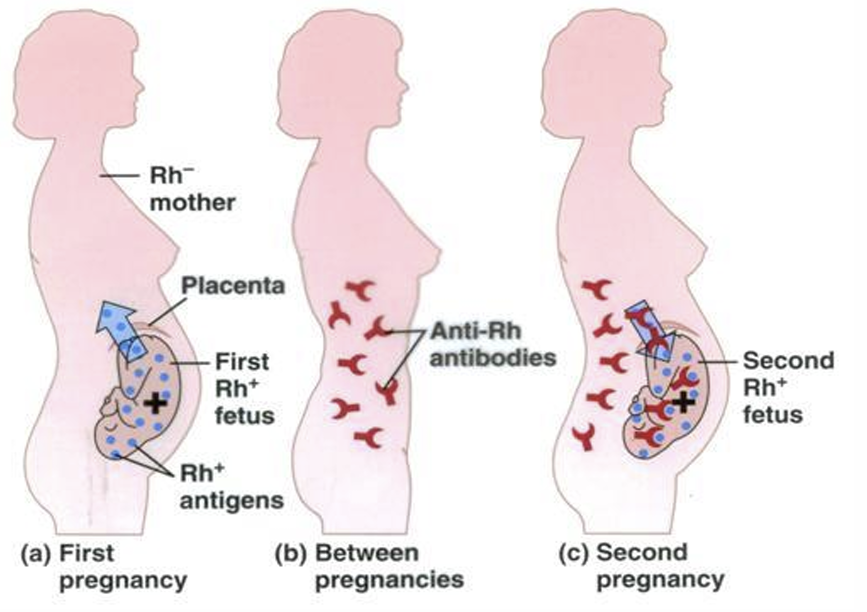
1st pregnancy - first exposure of Rh+ antigens to mother - she develops Abs
Between pregnancies - Anti-Rh antibodies developed
2nd pregnancy - second expure of Rh+ antigens from baby - mothers anti-Rh antibodies attack the fetus
17
Which OTHER antibodies are usually the immune allo Abs that cause HDFN?
anti-E, -c, -Kell, -Kidd, or -Duffy
18
What happens with an anti-K exposure?
- can be mild to severe
- SECOND most common form of severe HDFN
- SECOND most common form of severe HDFN
19
How do mothers usually develop an anti-K?
Over half of them developed anti-K due to previous multiple blood transfusions
20
What is the major antibody to cause severe HDFN?
anti-D, then anti-D AND others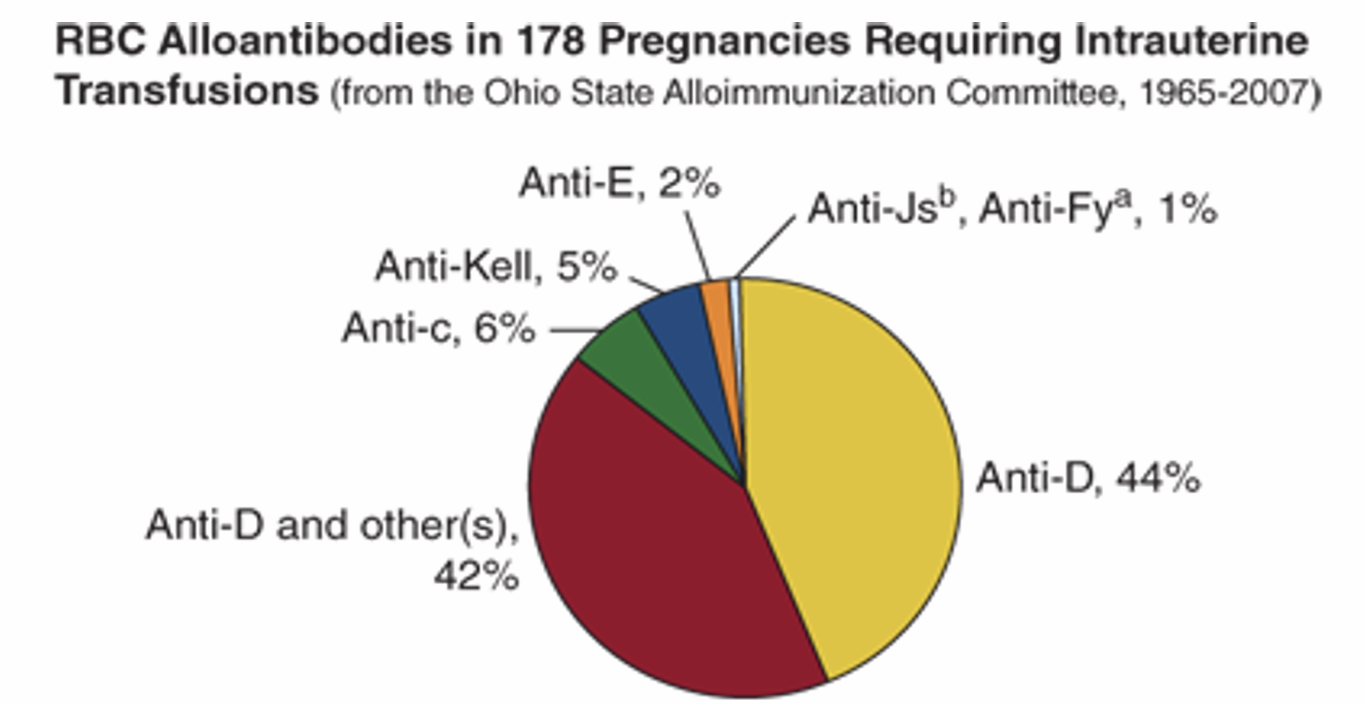
21
What are the dangers of HDFN IN-UTERO / PREPARTUM?
❑ Fetal Severe Anemia
❑ Fetal Heart Failure
❑ Fetal Death
❑ Fetal Heart Failure
❑ Fetal Death
22
IN-UTERO, Hydrops Fetalis(HF) can develop, and what else?
fetal anemia - due to maternal Ab attacking fetal RBCs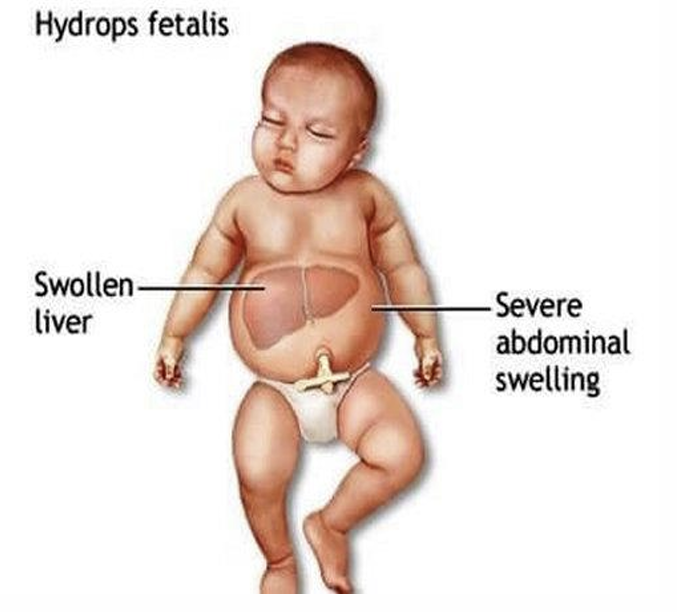
23
What results due to the destroyed fetal RBCs?
UNCONJUGATED / INDIRECT bilirubin is released into the fetal baby which can be very detrimental to the fetus in high amounts
24
What organ processes UNCONJUGATED / INDIRECT bilirubin into conjugated?
the liver! - it helps to conjugate bilirubin
25
IN-UTERO the baby is usually ok with the unconjugated biliruben, why?
The mothers liver helps process the unconjugated biliruben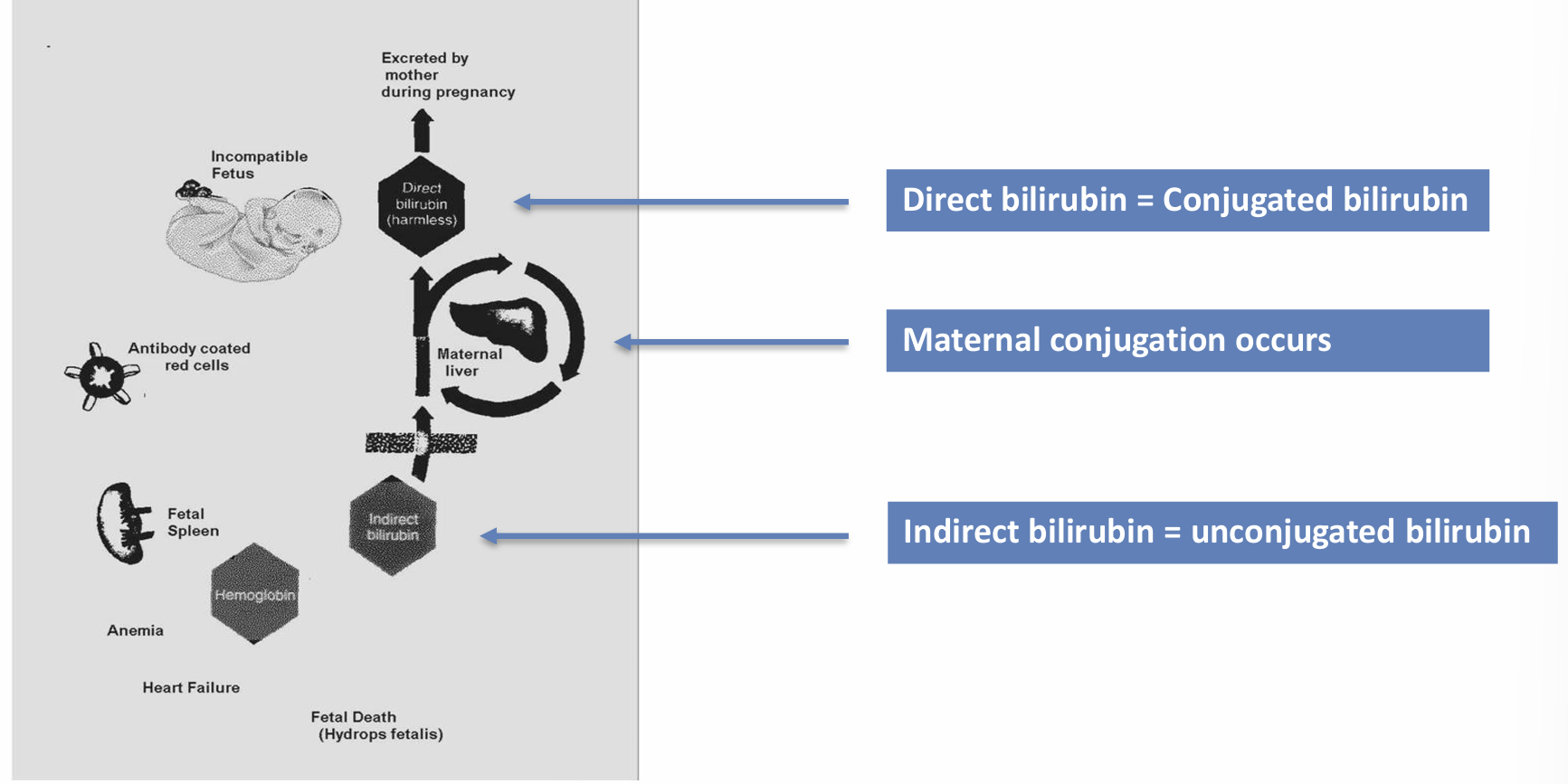
26
What is the proper mdical care during pregnancy under the guidance of an Obstetrician?
Prenatal Care
27
Which tests are performed on the 1st Obstetrical visit?
- ABO, Rh (including Du), and ABS tests
28
What happens with the ABS results from the first prenatal care visit?
❑ If Ab screen negative, repeat at 24 weeks
❑ If Ab screen is positive, perform Ab ID & Ab Titer, if Ab is IgG
➢ Retain all maternal samples
➢ Periodically, perform Ab titer to check for increase in titration (> 1:32 is
significant); Must run previous titer sample in parallel with current titer
sample
❑ If Ab screen is positive, perform Ab ID & Ab Titer, if Ab is IgG
➢ Retain all maternal samples
➢ Periodically, perform Ab titer to check for increase in titration (> 1:32 is
significant); Must run previous titer sample in parallel with current titer
sample
29
In prenatal care, if the Ab titer is high what can happen?
The higher the Ab titer, the higher the risk for HDFN
30
What may the physician test if the maternal serum Ab titer is high?
amniocentesis fluid for presence of ag (amniocytes)
31
What is amniocentesis?
Amniocentesis is the procedure of obtaining a sample of amniotic fluid from the womb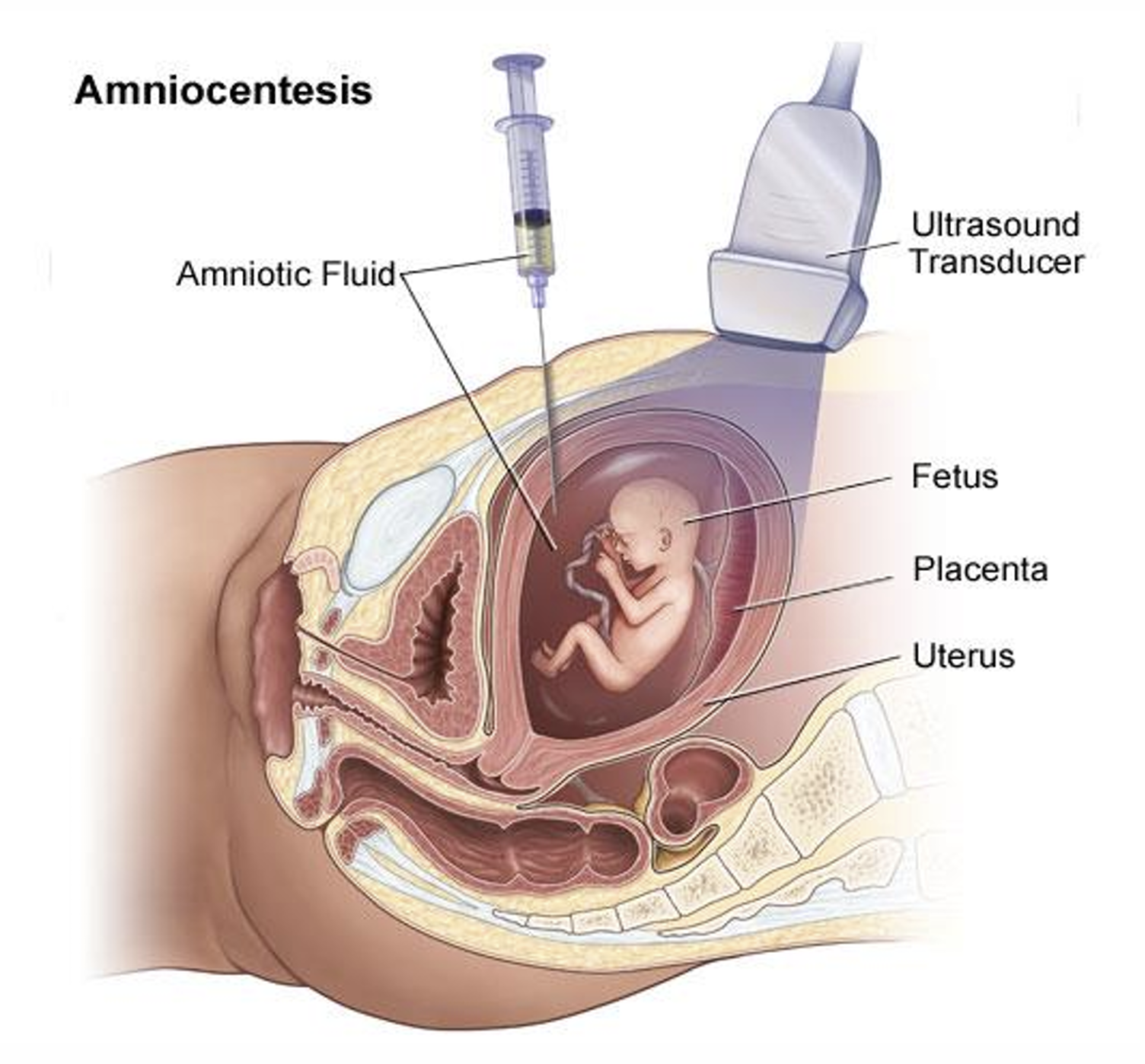
32
What can amniotic fluid detect in amniocenetisis?
amniotic fluid bilirubin is a direct indicator of severity of HDFN
33
How does amniocentesis work?
- the fluid is scanned in a spectrophotometer at increasing wavelengths to determine change in OD when 450 nm is reached (absorbance of bilirubin)
- if OD increases at a later scan, bilirubin levels are increasing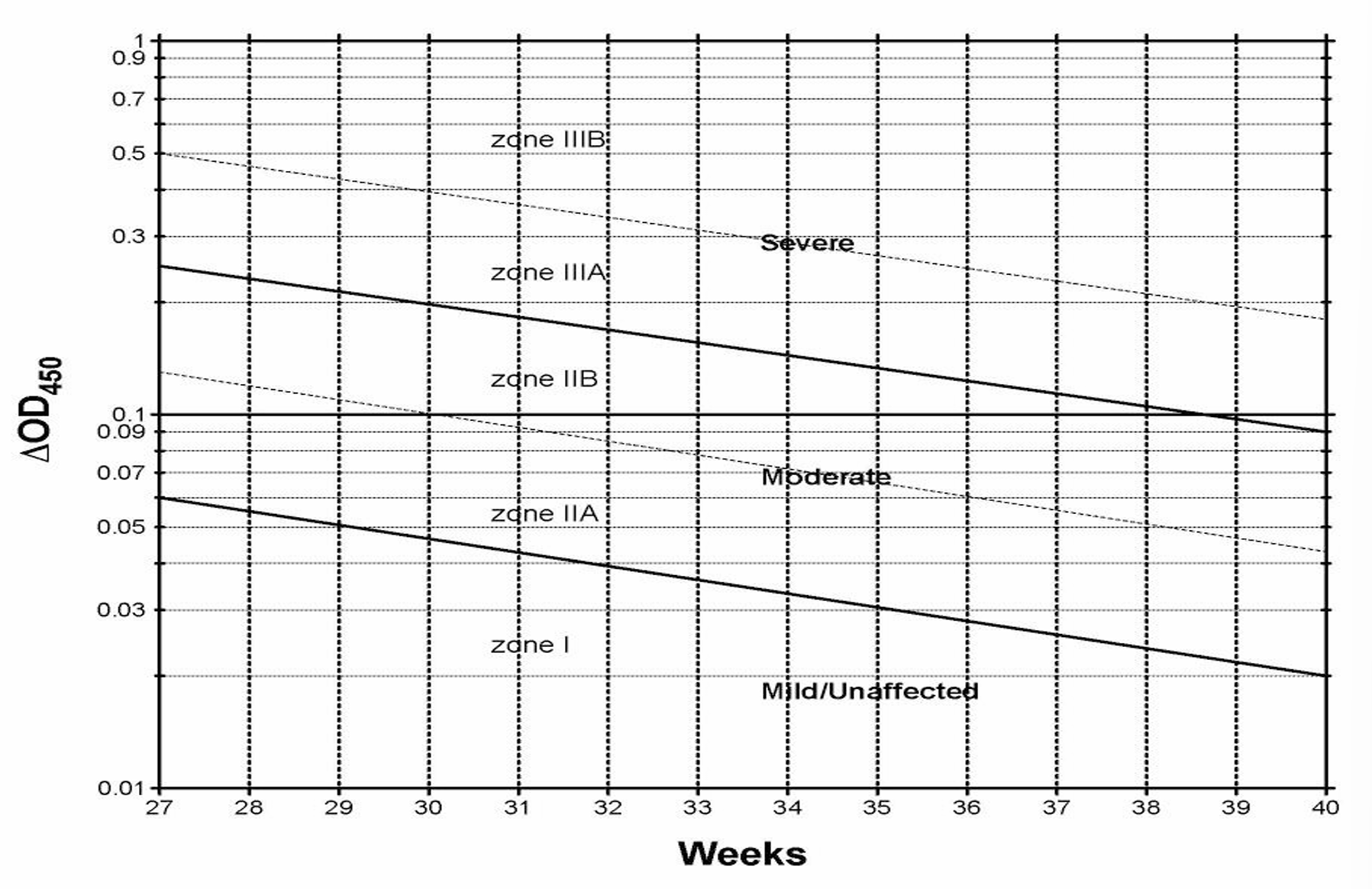
- if OD increases at a later scan, bilirubin levels are increasing
34
What is intrauterine transfusion?
a procedure that involves injecting red blood cells from a donor into a fetus to treat anemia or other conditions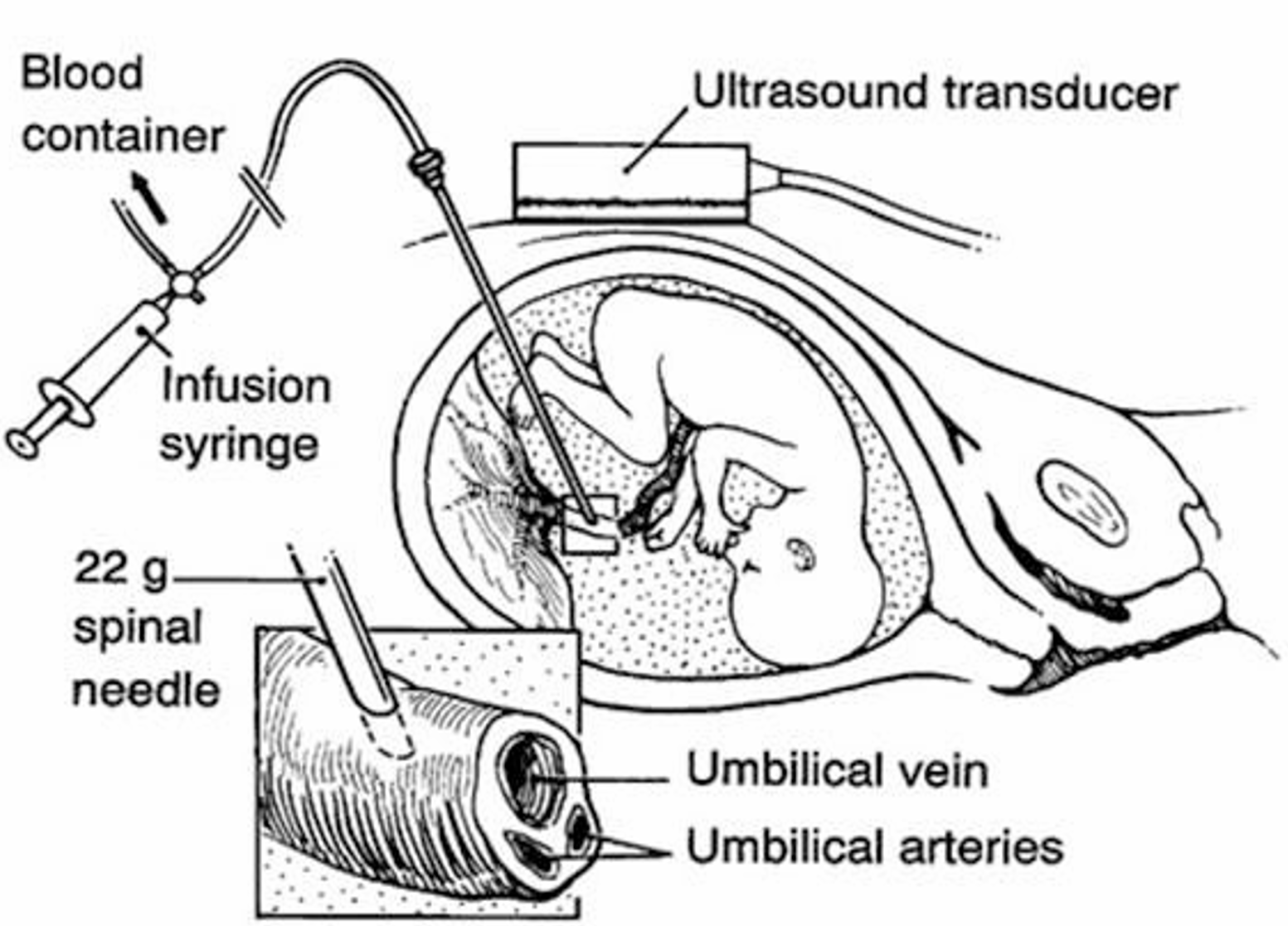
35
What are the criteria for intrauterine transfusion? ( when one or more of the following conditions exist)
❑ MCA-PSV (Middle Cerebral Arterial-Peak Systolic Velocity) indicates anemia when using an Ultrasound Transducer device
❑ Fetal hydrops can be detected on ultrasound examination
❑ Fetal Hgb level is less than 10 g / dL (severe anemia)
❑ Amniotic fluid ∆OD 450 nm results are high (hyperbilirubinemia)
Risks and benefits of intrauterine transfusion must be weighed and evaluated.
❑ Fetal hydrops can be detected on ultrasound examination
❑ Fetal Hgb level is less than 10 g / dL (severe anemia)
❑ Amniotic fluid ∆OD 450 nm results are high (hyperbilirubinemia)
Risks and benefits of intrauterine transfusion must be weighed and evaluated.
36
What are the intrauterine blood requirements? ALWAYS
❑ RBCs
➢ < 5 days old
➢ CPDA-1 or AS-3 (lacks mannitol which is a diuretic; do not give diuretics to a neonate)
➢Ag negative to a corresponding maternal allo Ab(s), if present
❑ O Neg
❑ CMV neg, if tested OR product is leuko-reduced
❑ Hgb S negative (sickle cell)
❑ Irradiated (no cyto T cell rxn)
➢ < 5 days old
➢ CPDA-1 or AS-3 (lacks mannitol which is a diuretic; do not give diuretics to a neonate)
➢Ag negative to a corresponding maternal allo Ab(s), if present
❑ O Neg
❑ CMV neg, if tested OR product is leuko-reduced
❑ Hgb S negative (sickle cell)
❑ Irradiated (no cyto T cell rxn)
37
Does the maternal Ab(s) continue to destroy fetal RBCs postpartum?
YES! The antibodies continue postpartum which develops certain signa and symptoms
38
What are the dangers of HDFN POSTPARTUM?
- Anemia
- hepatomegaly
- splenomegaly
- Jaundice
- Kernicterus
- hepatomegaly
- splenomegaly
- Jaundice
- Kernicterus
39
What can happen if the baby has anemia with HDFN postpartum?
Gross anemia can cause fetal cardiac failure
40
Why does jaundice occur during HDFN postpartum?
The newborns immature liver CANT conjugate bilirubin effectively
Before, the mothers blood was able to process it
- an accumulation of unconjugated / indirect bilirubin (TOXIC) occurs leading to jaundice
Before, the mothers blood was able to process it
- an accumulation of unconjugated / indirect bilirubin (TOXIC) occurs leading to jaundice
41
What is Kernicterus and how is it assocaited with postpartum HDFN?
- a severe condition where there is an untreated buildup of unconjugated bilirubin, which crosses the blood-brain barrier which causes brain damage or fetal death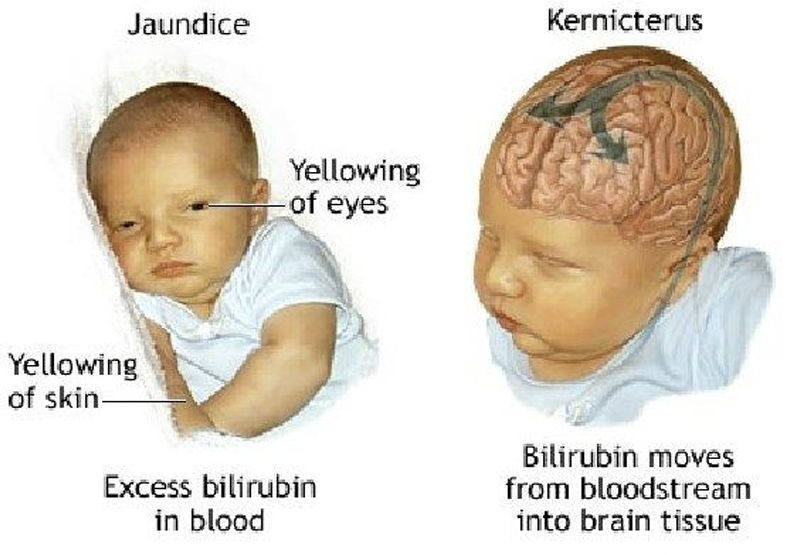
42
What are the HDFN: Neonatal Treatment optons Postpartum?
1. Phototherapy
2. Exchange transfusion
2. Exchange transfusion
43
What is phototherapy?
- light wavelength is set at 460 to 490 nm
- unconjugated / indirect bilirubin is sensitive to strong light
- used to change the unconjugated / indirect bilirubin to isomers which are less lipophilic and less toxic to the brain
- unconjugated / indirect bilirubin is sensitive to strong light
- used to change the unconjugated / indirect bilirubin to isomers which are less lipophilic and less toxic to the brain
44
What are some indications needed for an exchange transfusion?
➢ Hgb is < 10 g / dL
➢ Bilirubin level is ≥ 20 mg / dL
➢ Bilirubin level is ≥ 20 mg / dL
45
What is the most common form/cause of HDFN?
ABO HDFN
46
Is prior exposure needed for ABO HDFN?
NO! This can occur at the FIRST preganancy and pregnancies after
47
What is an example of ABO HDFN?
Commonly seen in an "O" mother (with IgG form of Anti-A,B) delivering an "A" neonate; "B" type neonate is less common
48
Does the baby develop jaundice from ABO HDFN?
It can! Can have mild to moderate jaundice
49
Is ABO more severe than Rh HDFN?
Usually it is LESS severe than Rh HDFN
50
Can Prenatal testing predict ABO HDFN?
it is usually NOT predictive of ABO HDFN Developmnt
51
What testing is done on the mother postpartum, CORD BLOOD WORKUP?
Repeat ABO / Rh and ABS (usually performed at hospital admission prior to
delivery)
delivery)
52
What testing is done on the baby partpartum, CORD BLOOD WORKUP?
➢ Determine ABO / Rh (including weak D)
➢ Perform DAT
✓ If baby IgG DAT is positive, may perform elution procedure
✓ To determine ABO HDFN, test eluate against A1 & B cells
➢ Perform DAT
✓ If baby IgG DAT is positive, may perform elution procedure
✓ To determine ABO HDFN, test eluate against A1 & B cells
53
What is an elution procedure?
- it uses baby RBCs and a supernatant media. The elution is performed using heat or chemical to "dissociate" the Ab off the baby's RBC.
- The Ab is contained in the supernatant media where Ab ID can be performed
- Ab found in eluate is of maternal origin
- The Ab is contained in the supernatant media where Ab ID can be performed
- Ab found in eluate is of maternal origin
54
Why do some hospitals not perform the elution test on babies?
Some hospitals may not perform an elution on the baby RBCs (for allo Ab ID) because of the large amount of blood needed to perform the elution. Removing too much blood for lab tests can cause a condition called, iatrogenic anemia*, in the patient.
55
How is ABO HDFN prevented?
It is NOT preventable (as in Rh0(D) HDFN)
56
What is the treatment for ABO HDFN?
- Hyperbilirubinemia / jaundice is commonely treatable using only phototherapy
- when serum bilirubin result reaches ≥ 20 mg / dL, an exchange transfusion is indicated
- when serum bilirubin result reaches ≥ 20 mg / dL, an exchange transfusion is indicated
57
Which is the most severe form of HDFN?
Rh HDFN
58
What can occur in Rh HDFN?
❑ Severe anemia may occur resulting in severe hyperbilirubinemia / jaundice
❑ Kernicterus could result
❑ Usually affects only 2nd or subsequent pregnancies* (mother alloimmunized at delivery of 1st pregnancy)
❑ Kernicterus could result
❑ Usually affects only 2nd or subsequent pregnancies* (mother alloimmunized at delivery of 1st pregnancy)
59
Does the mother have developed antibodies in subsequent pregnancies?
YES! - pre-formed Abs from the first pregnancy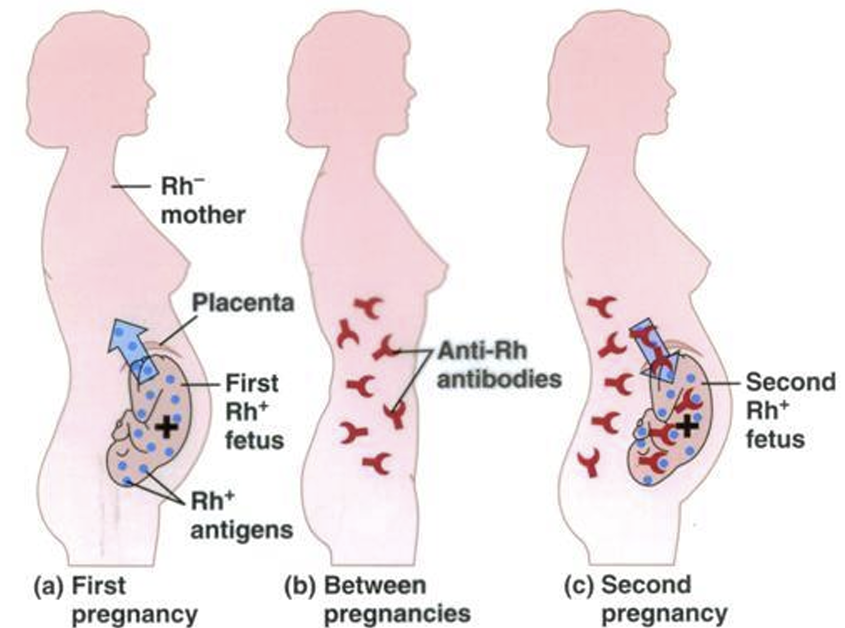
60
What are the most common Rh antibodies against which antigens?
More common is Ab directed to D Ag, but Abs to C, c, E, e antigens are seen, also
61
Which is the most common antibody in Rh HDFN?
anti-D
can be mild to severe
can be mild to severe
62
What about anti-E in Rh HDFN?
mild disease
63
What about anti-c in Rh HDFN?
Anti-c can range from a mild to severe disease - is the third most
common form of severe HDFN
common form of severe HDFN
64
What about anti-e in Rh HDFN?
rare
65
What about anti-C in Rh HDFN?
rare
66
What about Ab combinations in Rh HDFN?
- (i.e., anti-c and anti-E Abs occur together) - can be severe
67
What prenatal testing is the mother tested for in Rh HDFN?
➢ ABO & Rh including Du test
➢ ABS
➢ ABS
68
If the ABS is positive for the mother in prenatal testing (Rh HDFN)?
➢ Ab ID & Ab Titer
➢ Ag status of the father, optional
➢ Ig subclass of the maternal Ab, if indicated
❑ Determine initial Ab titer, then repeat approximately every 4 weeks. Run parallel testing on the last previous sample with current sample.
➢ Ag status of the father, optional
➢ Ig subclass of the maternal Ab, if indicated
❑ Determine initial Ab titer, then repeat approximately every 4 weeks. Run parallel testing on the last previous sample with current sample.
69
In prenatal testing, if the anti-D (or other Rh ab) riter reaches > 1:32, what further testing is done?
❑ Middle Cerebral Artery-Peak Systolic Velocity (MCA-PSV) - color Doppler / Ultrasound Transducer
❑ Amniocentesis
❑ Amniocentesis
70
What is MCA-PSV?
measurement of the fetal MCA-PSV can be done with the ultrasound to detect anemia in the fetus
71
What is amniocentesis?
INVASIVE procedure where the amniotic fluid is tested
- The concentration of bilirubin pigment in the amniotic fluid measured by the ∆OD 450 nm procedure as pregnancy proceeds predicts worsening of the fetal hemolytic disease
- The concentration of bilirubin pigment in the amniotic fluid measured by the ∆OD 450 nm procedure as pregnancy proceeds predicts worsening of the fetal hemolytic disease
72
What testing is done postpartum for the mother, aka cord blood workup?
❑ Repeat ABO / Rh and ABS tests
❑ If Ab screen is positive, must do Ab ID procedure
❑ If Ab screen is positive, must do Ab ID procedure
73
What happens if a Ab screen is positive?
➢ If a weak anti-D is present, it may be due to the administration of an antepartum Rh Immune Globulin shot. Check patient's OB history with RN or physician's office.
➢ If the weak anti-D Ab is due to the Rh Immune Globulin shot, the Ab ID report should state presence of a "passive" anti-D…not as an "allo" anti-D.
➢ If the weak anti-D Ab is due to the Rh Immune Globulin shot, the Ab ID report should state presence of a "passive" anti-D…not as an "allo" anti-D.
74
What testing is done postpartum for the baby?
❑ Determine ABO / Rh (including weak D)
❑ Perform DAT
❑ Enumerate # of fetal cells present in mother's blood
❑ Fetal Hgb Screen Test / Rosette Test
❑ Perform DAT
❑ Enumerate # of fetal cells present in mother's blood
❑ Fetal Hgb Screen Test / Rosette Test
75
What happens if DAT is positive for the baby?
➢ If baby DAT is positive, may perform elution
➢ To determine Rh HDFN (or any other allo Ab HDFN), use eluate against Ab ID panel cells
➢ To determine Rh HDFN (or any other allo Ab HDFN), use eluate against Ab ID panel cells
76
Why do some hospitals not perform the elution on babies RBCs?
It can create iatrogenic anemia - which is anema caused by medical procedures
77
What is the Fetal HgB Screen Test / Rosette Test?
It is a qualitative test (Screening) which demonstrates smal number of D-positive cells in mothers D-negative cell suspension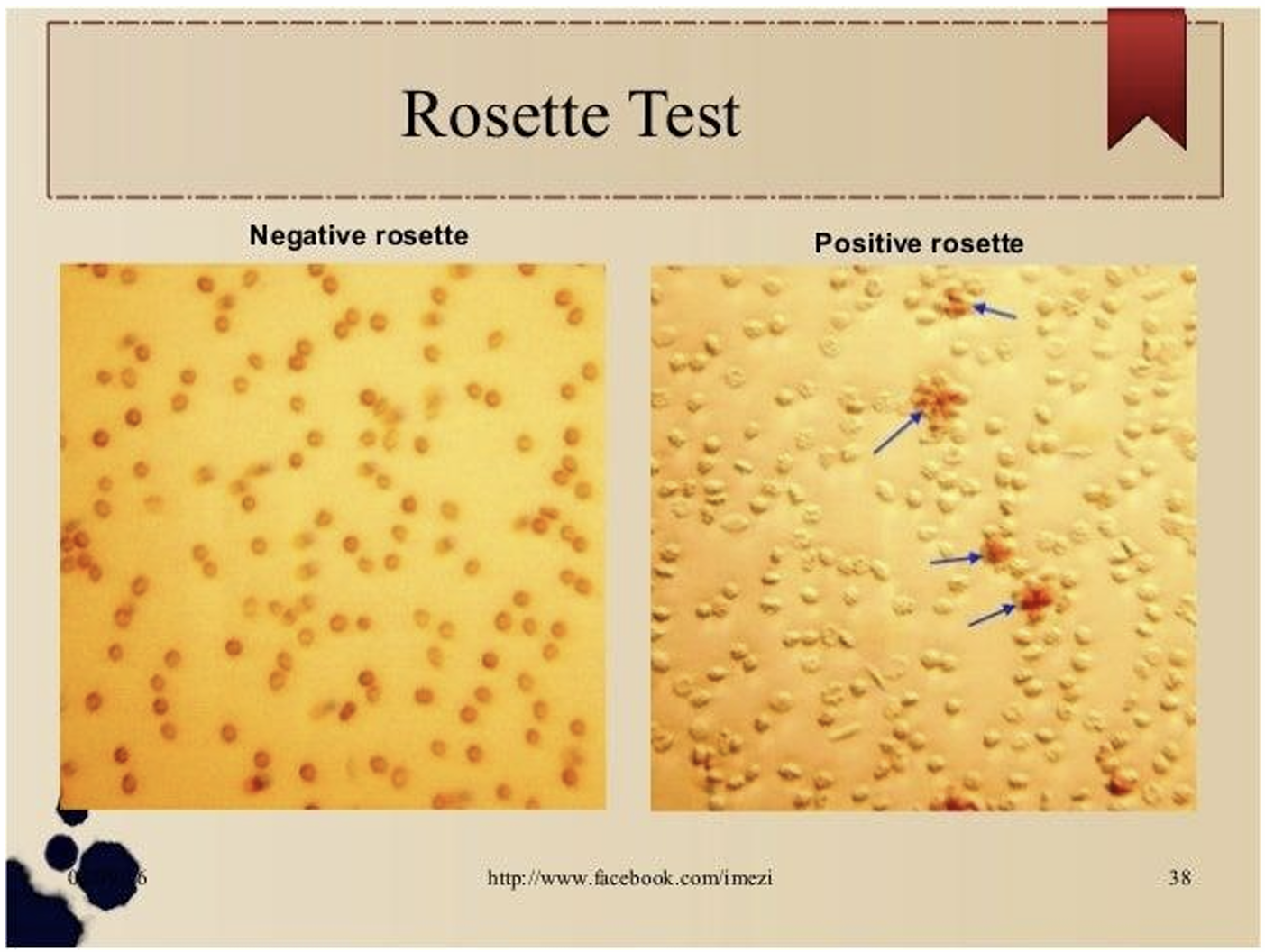
78
What is the Kleihauer-Betke (KB) test?
A quantitative blood test that measures the amount of fetal hemoglobin in a mother's blood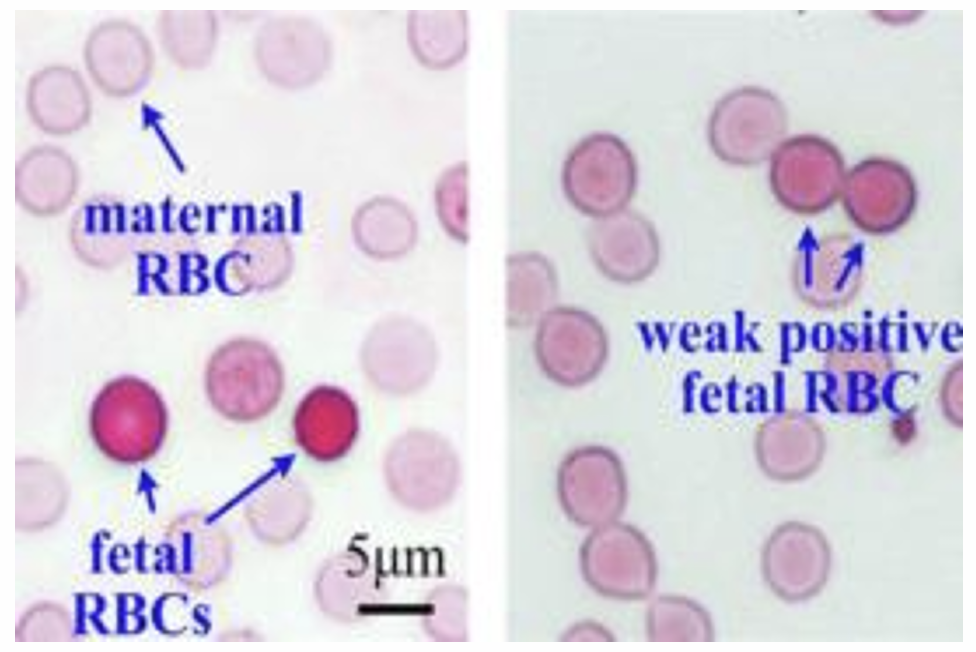
79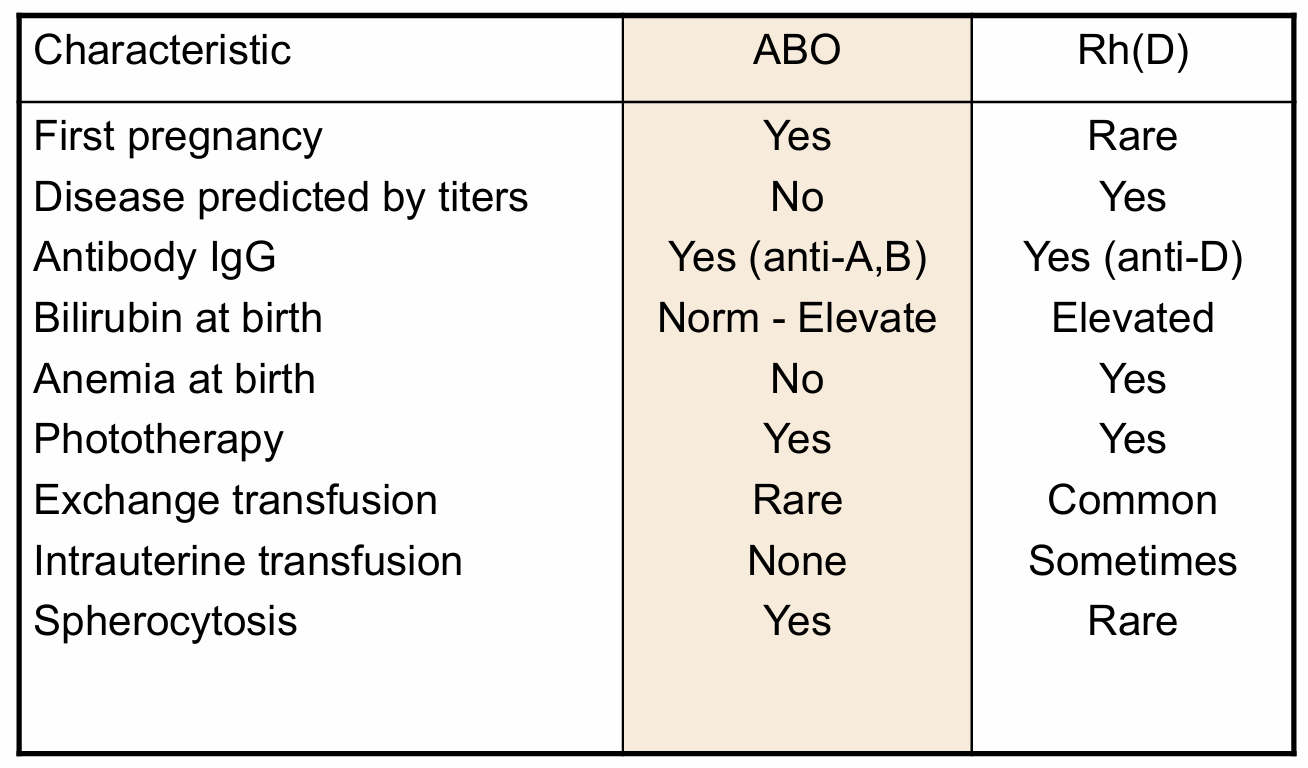
What are the differences between ABO and RH(D) HDFN?
80
What is exchange transfusion?
a medical procedure that involves replacing a patient's blood with donated blood or plasma
- occurs after birth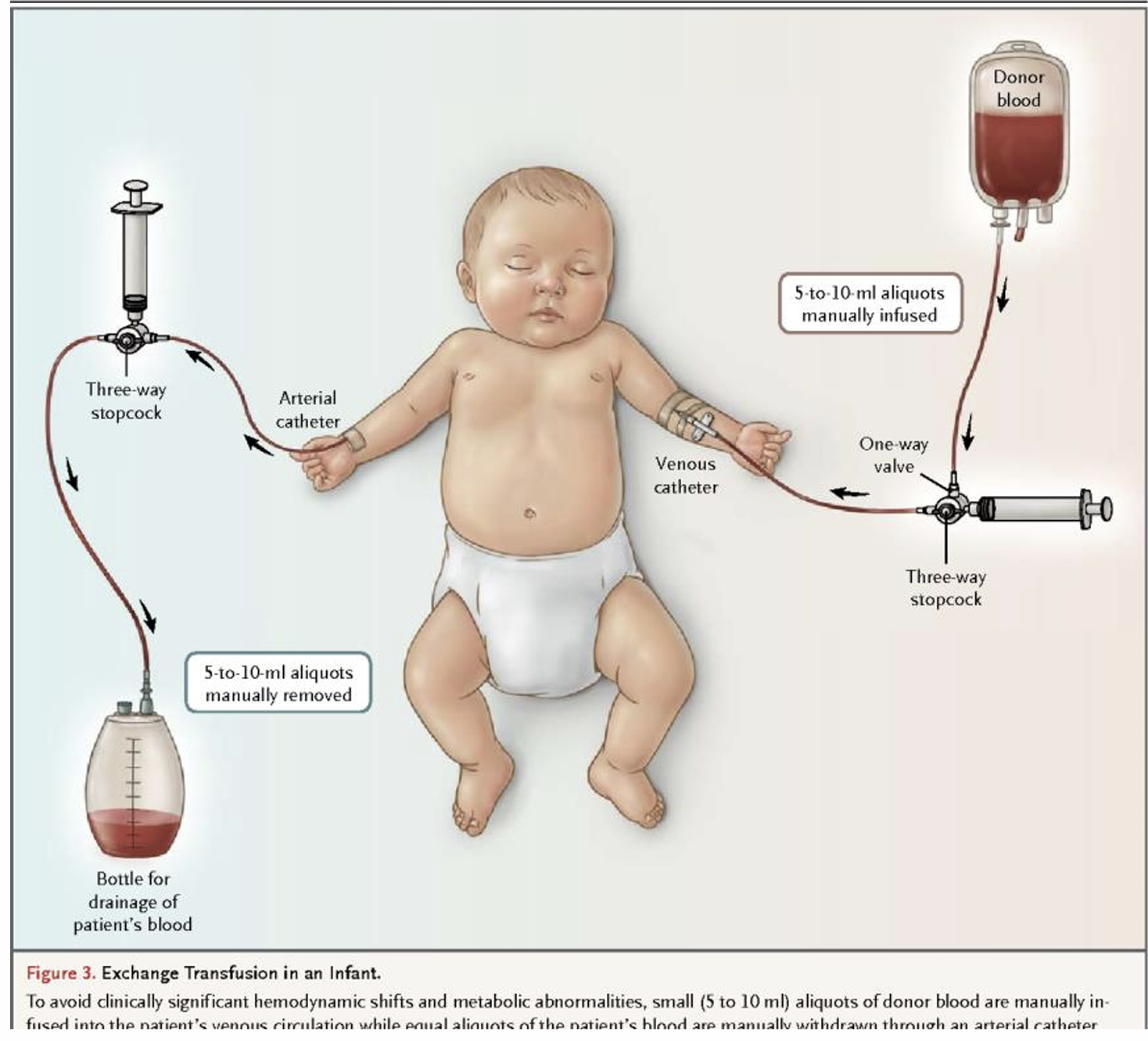
- occurs after birth
81
When is exchange transfusion chosen as the treatment?
1. When phototherapy is unsuccessful in reducing the rise of the bilirubin level and hyperbilirubinemia from unconjugated / indirect bilirubin is still present, the second choice of treatment is the Exchange Transfusion.
2. If maternal Ab is causing rapid destruction of fetal RBCs, Exchange
Transfusion is performed, instead of phototherapy.
2. If maternal Ab is causing rapid destruction of fetal RBCs, Exchange
Transfusion is performed, instead of phototherapy.
82
What are the conditions for Exchange Transfusion?
➢ Hgb < 10 g / dL
➢ Bilirubin level is ≥ 20 mg / dL
➢ Bilirubin level is ≥ 20 mg / dL
83
Where can exchange transfusions occur on the body?
Dependent on the age of the newborn, transfusion can occur either via the umbilical cord entry or extremities entry
84
What are the RBC donor requirements for exchange transfusions?
- < 5 days old
- CPDA-1 or AS-3 (lacks mannitol - a diuretic)
- RBCs must also be ag negative to a corresponding allo Ab present
- O negtive
- CMV negative, OR leuko-reduced
- HgB S negative
- Irradiated
- CPDA-1 or AS-3 (lacks mannitol - a diuretic)
- RBCs must also be ag negative to a corresponding allo Ab present
- O negtive
- CMV negative, OR leuko-reduced
- HgB S negative
- Irradiated
85
What type of plasma should be used for exchange transfusions?
- plasma MUST be AB - lacks anti-A and anti-B
- Rh can be disregarded - no RBCs here
- doesnt need to be irradiated - no WBCs here
- Rh can be disregarded - no RBCs here
- doesnt need to be irradiated - no WBCs here
86
What are the beneficial effects of a 2-volume exchange transfusion?
1. Removes 50% of the bilirubin
2. Removes 80-90% of the infant's sensitized RBCs
3. Removes 80-90% maternal incompatible antibody
4. Replacement of incompatible RBCs with compatible RBCs
2. Removes 80-90% of the infant's sensitized RBCs
3. Removes 80-90% maternal incompatible antibody
4. Replacement of incompatible RBCs with compatible RBCs