Lecture 5 - Complement System (cont.), Immune Response in Inflammation/Infection
Study these flashcardsFree · spaced repetition · iPhone, Android, Mac & web
All cards
1
As a Rule of Thumb in the complement system, explain the difference between "a" and "b" components?
suffix "a" - smaller fragement and released into circulation (biologic function)
Suffix "b" - larger fragment is membrane bound (part of MAC)
Suffix "b" - larger fragment is membrane bound (part of MAC)
2
What is MASP?
MBL-Associated Serine Proteases
MASP-1, 2, 3, 4
MASP-2 is the most important
MASP-1, 2, 3, 4
MASP-2 is the most important
3
Which complement pathway is activated by antigen-antibody complex?
The Classical Pathway
4
Does the lectin pathway need antibody to activate?
No, the Lectin Pathway does not need antibodies to activate it
5
What activates The Lectin Pathway?
when pattern-recognition molecules (PRMs) bind to carbohydrates or acetylated residues on the surface of pathogens or damaged host cells
- MBL
- ficolins
- collectin 11
- MBL
- ficolins
- collectin 11
6
What is the overview of The Lectin Pathway?
PRMS bind to target surface---> activates MBL/ficolin/collectin-11 associated serine proteases (MASPs) ----> activate other complement components ----> elimination of pathogen
7
What is the function of The Alternative Pathway?
AMPLIFIER
- if we don't have pathway
- fxns independently
- NO antibody needed
- if we don't have pathway
- fxns independently
- NO antibody needed
8
What initiates each pathway?
Classical - Antigen-antibody immune complexes
Lectin - PAMP recognition by lectins
Alternative - Sponataneous hydrolysis or pathogenic surfaces
Lectin - PAMP recognition by lectins
Alternative - Sponataneous hydrolysis or pathogenic surfaces
9
Which complement fragments lead to inflammation?
C4a
C3a
C5a
C3a
C5a
10
Which complement fragement is associated with opsonization?
C3b
11
Which complement fragment is associated with lysis?
C5b
12
What are the outcomes of complement activation?
• Opsonization
• Inflammation
• Cytolysis
• Inflammation
• Cytolysis
13
What occurs in opsonization?
enhancement of phagocytosis by coating with C3b
14
What occurs in inflammation in the complement system?
increase of blood vessel permeability and chemotactic attraction of phagocytes
15
What occurs in cytolysis in the complement system?
bursing of microbe due to inflow of extracellular fluid through transmembrance channel formed by membrane attack complex (MAC)
16
What complements is MAC composed of?
C5b-6, 7, 8, and several C9 (C5b-9)
17
What is sC5b-9?
- the complements MAC is composed of, but soluble in plasma
- it is used to measure the amount of termination activity
- it is used to measure the amount of termination activity
18
Memorize this chart
- opsonization
- inflammation
- cytolysis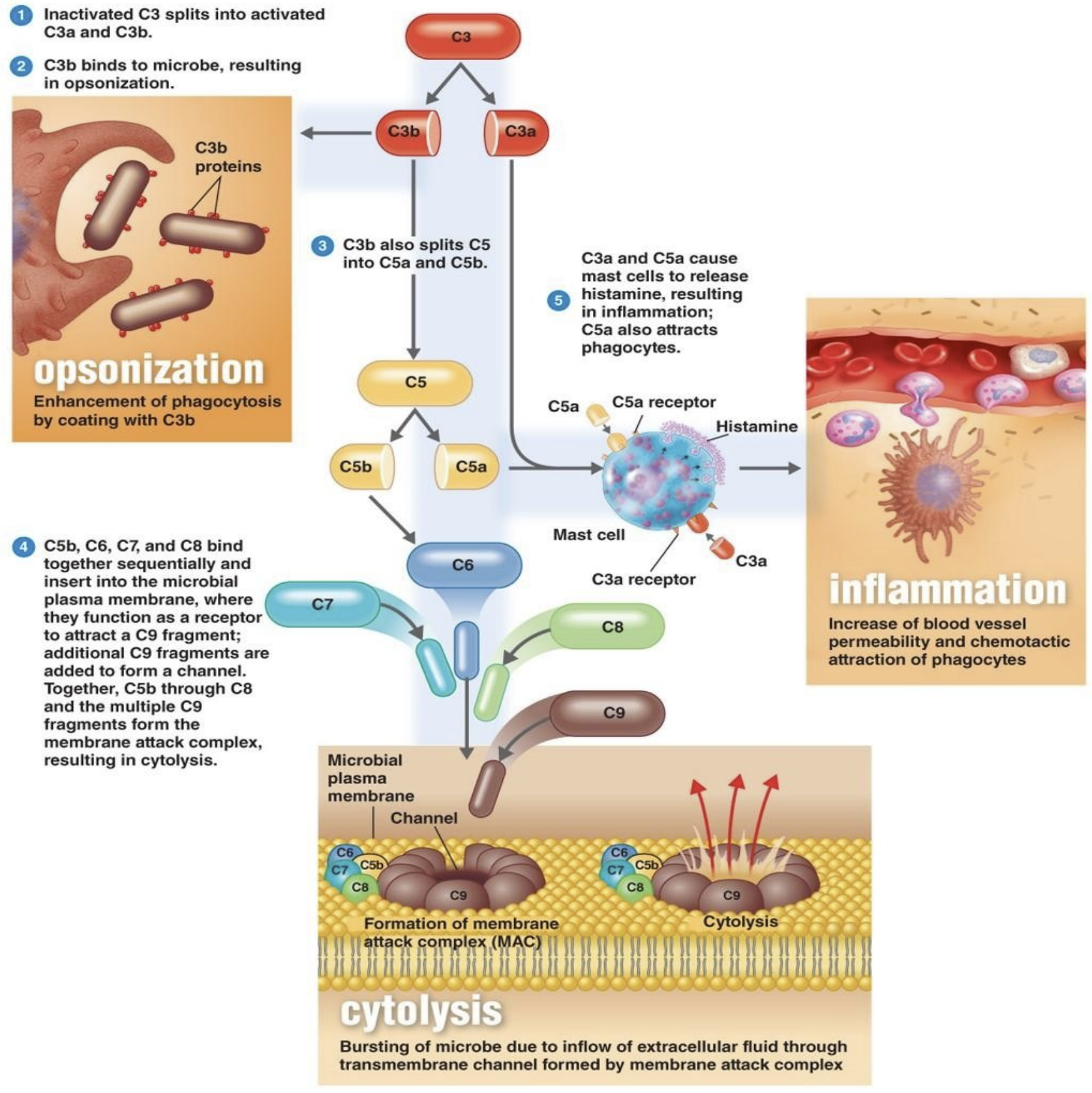
- inflammation
- cytolysis
19
What are the steps for opsonization in the complement system?
1. inactivated C3 splits into activated C3a and C3b
2. C3b binds to microbe, resulting in opsonization
3. C3b also splits C5 into C5a and C5b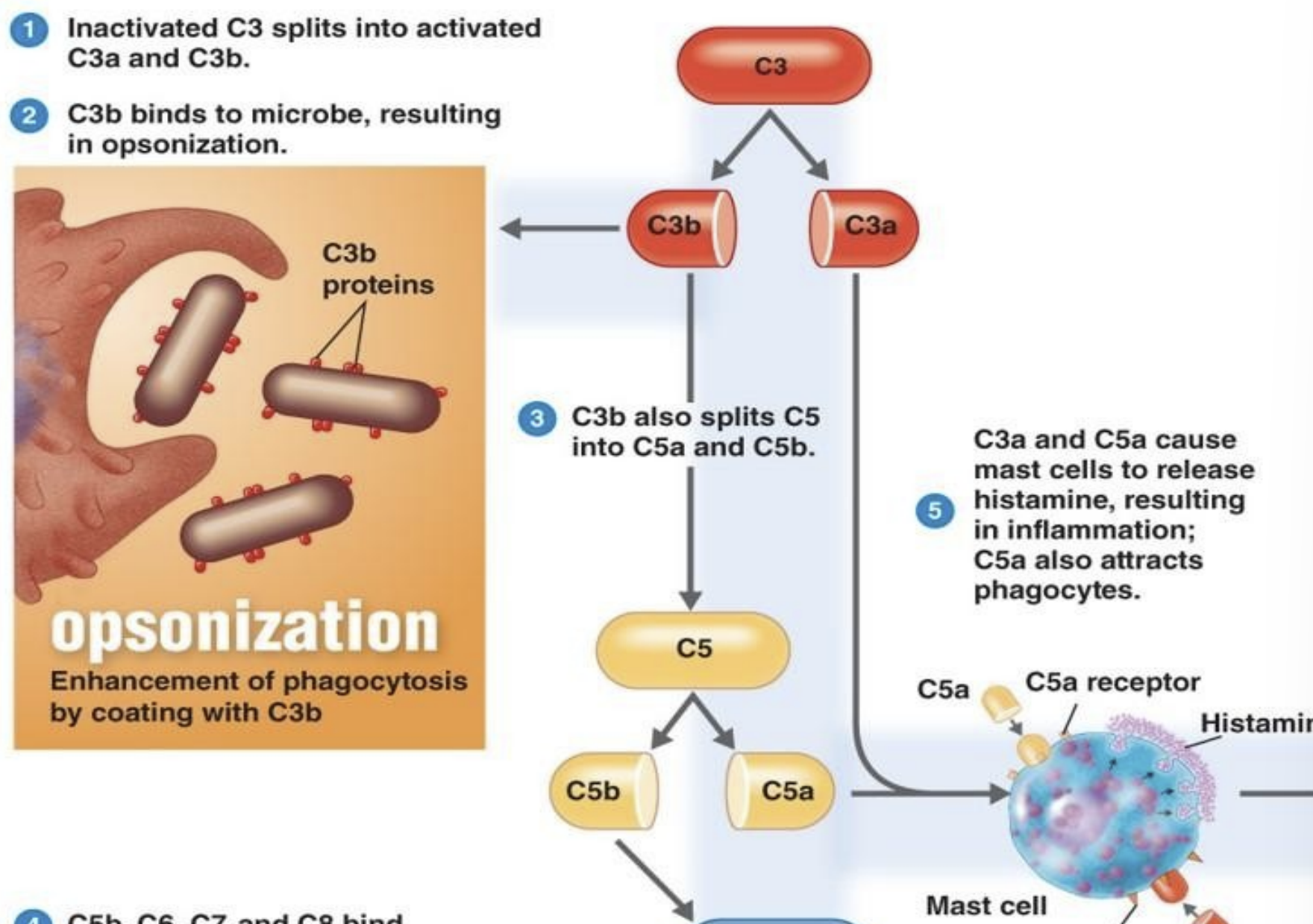
2. C3b binds to microbe, resulting in opsonization
3. C3b also splits C5 into C5a and C5b
20
What are the steps for cytolysis ---> MAC?
4. C5b, C6, C7, and C8 bind together sequentially and insert into the microbial plasma membrane, where they fxn as a receptor to attract a C9 fragment: additional C9 fragments are added to form a channel. Together, C5b through C8 and the multiple C9 fragments form the MAC ---> cytolysis 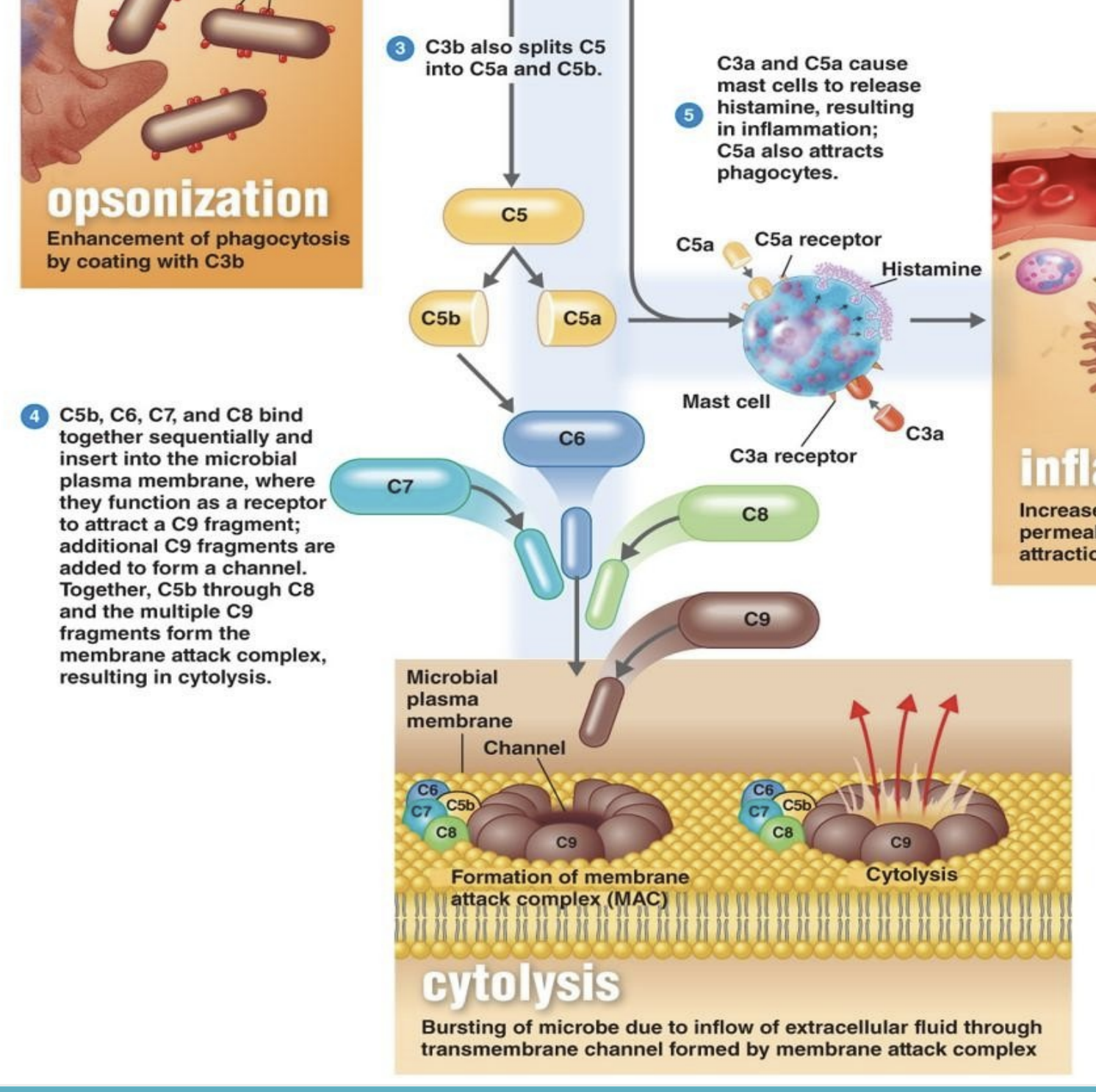
21
What are the steps for inflammation from the complement system?
3. C3b also splits C5 into C5a and C5b
5. C3a and C5a cause mast cells to release histamine, resulting in inflammation: C5a also attracts phagocytes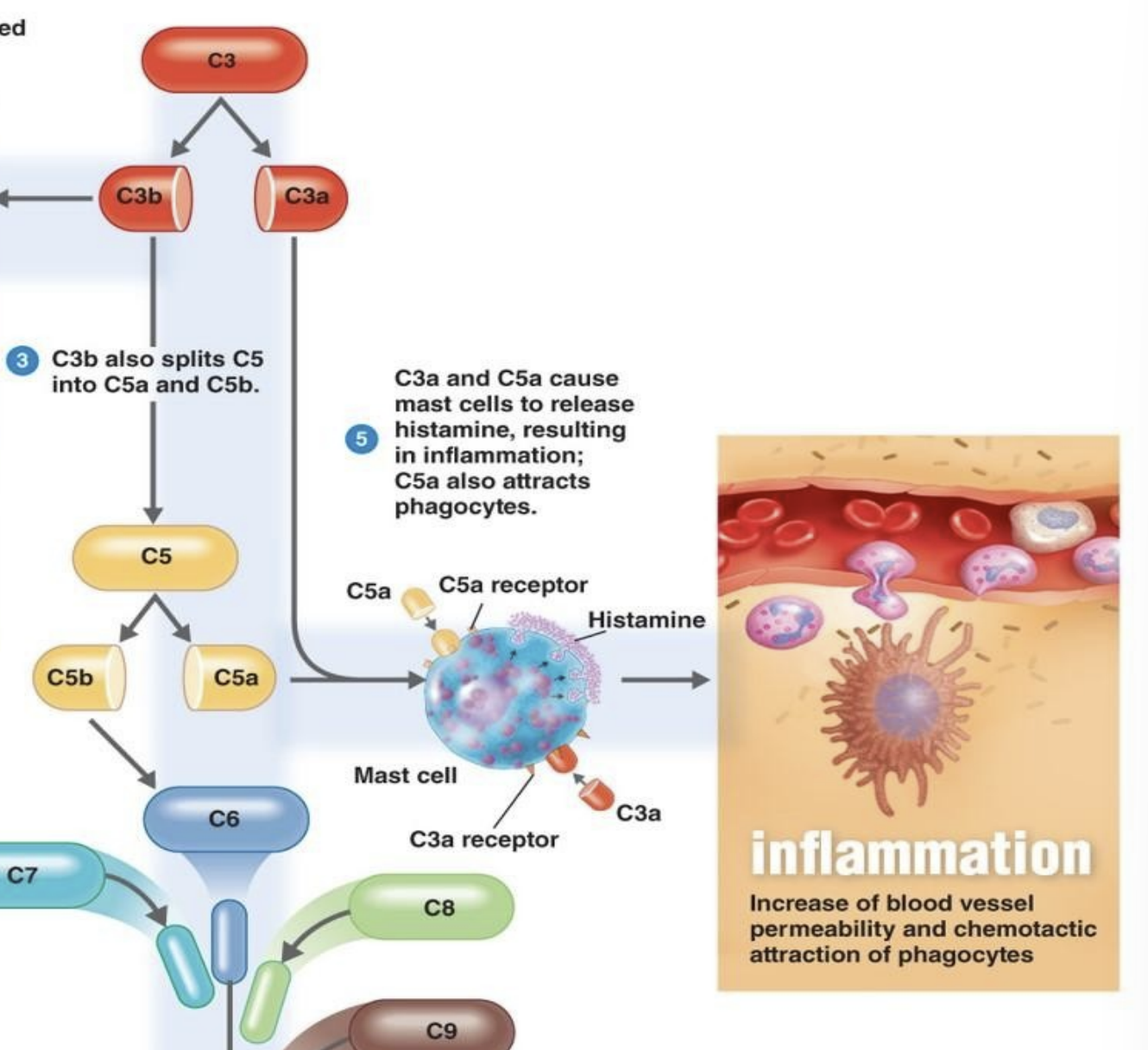
5. C3a and C5a cause mast cells to release histamine, resulting in inflammation: C5a also attracts phagocytes
22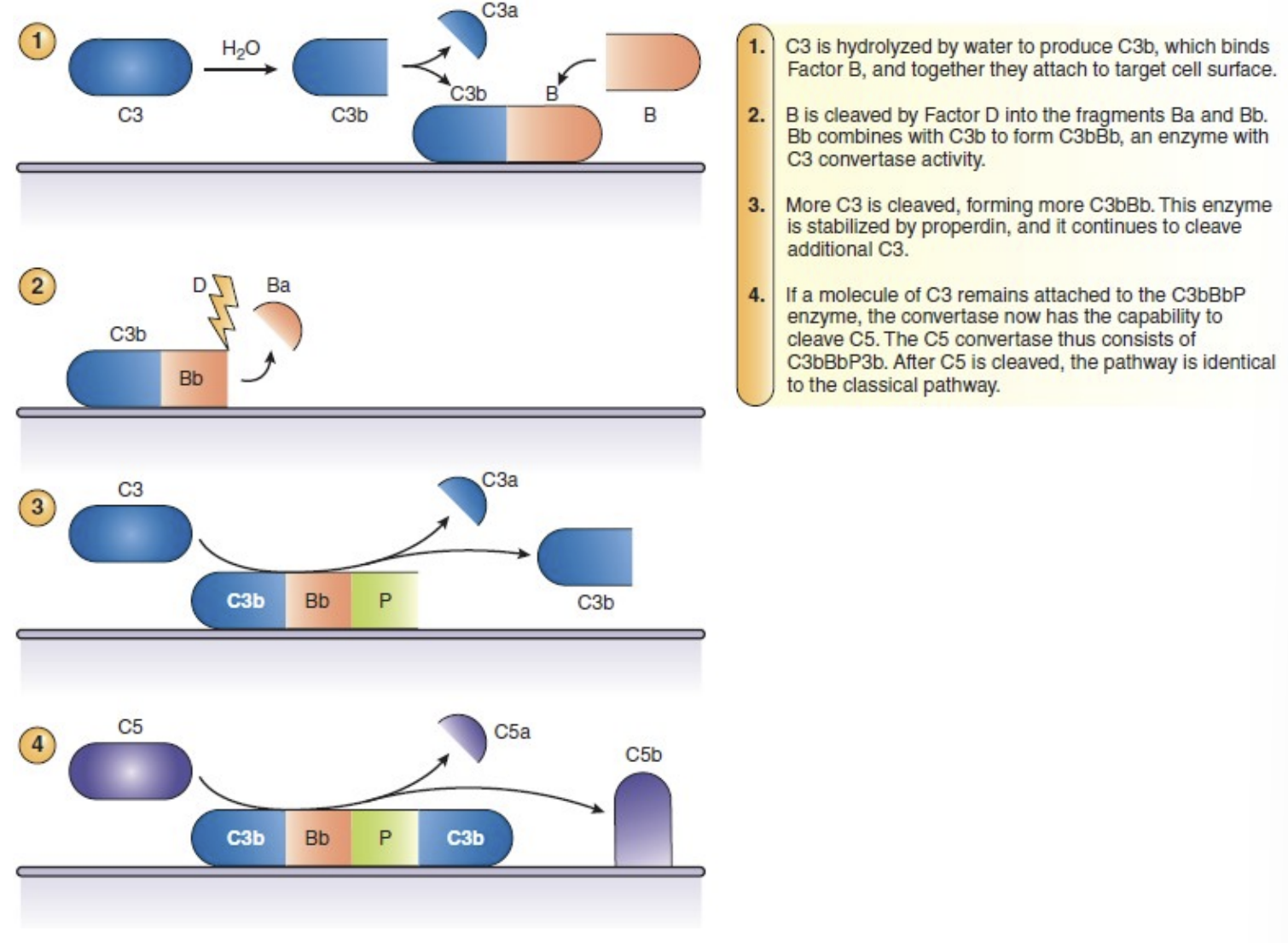
What are the steps in the alternative pathway?
23
How can the alternative pathway be activated?
- Can be activated on its own by bacterial or fungal cell walls, viruses, tumor cells, or some parasites: serve as sites for binding the complex C3bBb
- doesn't require any signals from other pathways
- doesn't require any signals from other pathways
24
What is the main function of the alternative pathway?
acts mainly as an amplification loop for classical or lectin pathways
25
Wht are some other characteristics of the alternative pathway?
• Is continuously active at a low level (it must be kept in check): native C3 not stable in plasma, hydrolyzed by H2O, forms C3b, binds to Factor B
• Cleaved by Factor D (serine protease) into Ba and Bb
• Bb remains attached to C3b
• Additional C3bBb stabilized by Properdin (Factor P)
• If C3b attached to C3bBbP, C5 convertase generated–can cleave C5
• Cleaved by Factor D (serine protease) into Ba and Bb
• Bb remains attached to C3b
• Additional C3bBb stabilized by Properdin (Factor P)
• If C3b attached to C3bBbP, C5 convertase generated–can cleave C5
26
What activates the classical pathway?
Binding of C1qrs to 2 antibody molecules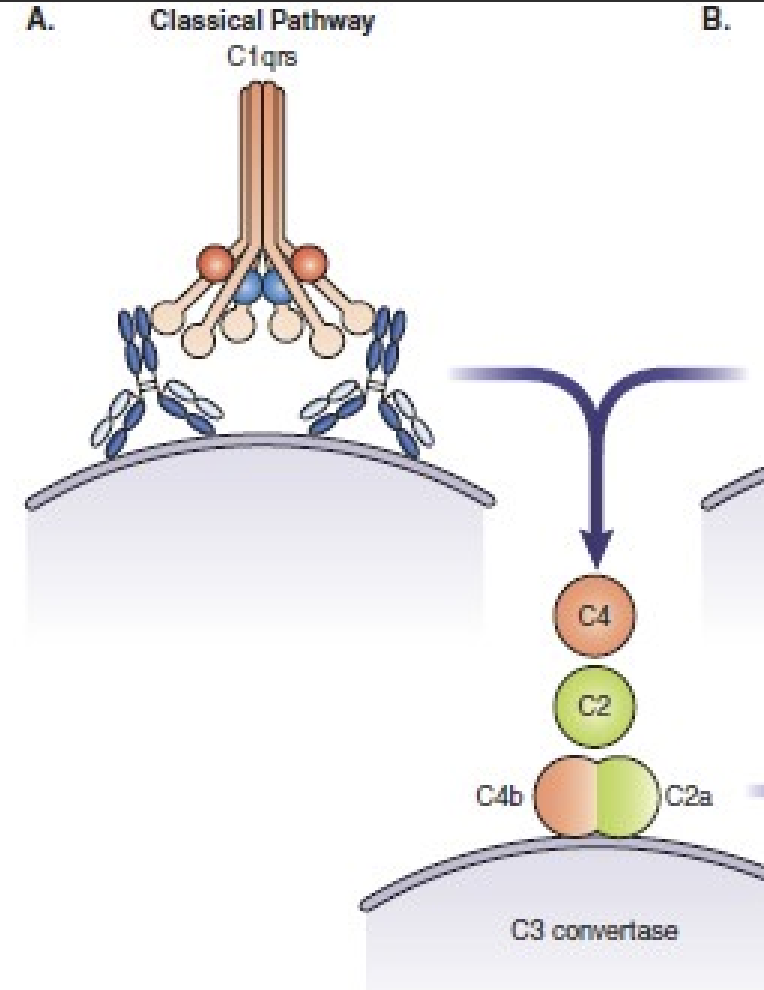
27
What activates the lectin pathway?
is triggered by binding of MBP to mannose on bacterial cell walls.
MASP-1, MASP-2, and MASP-3 bind to form an activated C1-like complex
MASP-2 cleaves C2 and C4 and proceeds like the classical pathway
MASP-1, MASP-2, and MASP-3 bind to form an activated C1-like complex
MASP-2 cleaves C2 and C4 and proceeds like the classical pathway
28
What activates the alternative pathway?
hydrolysis of C3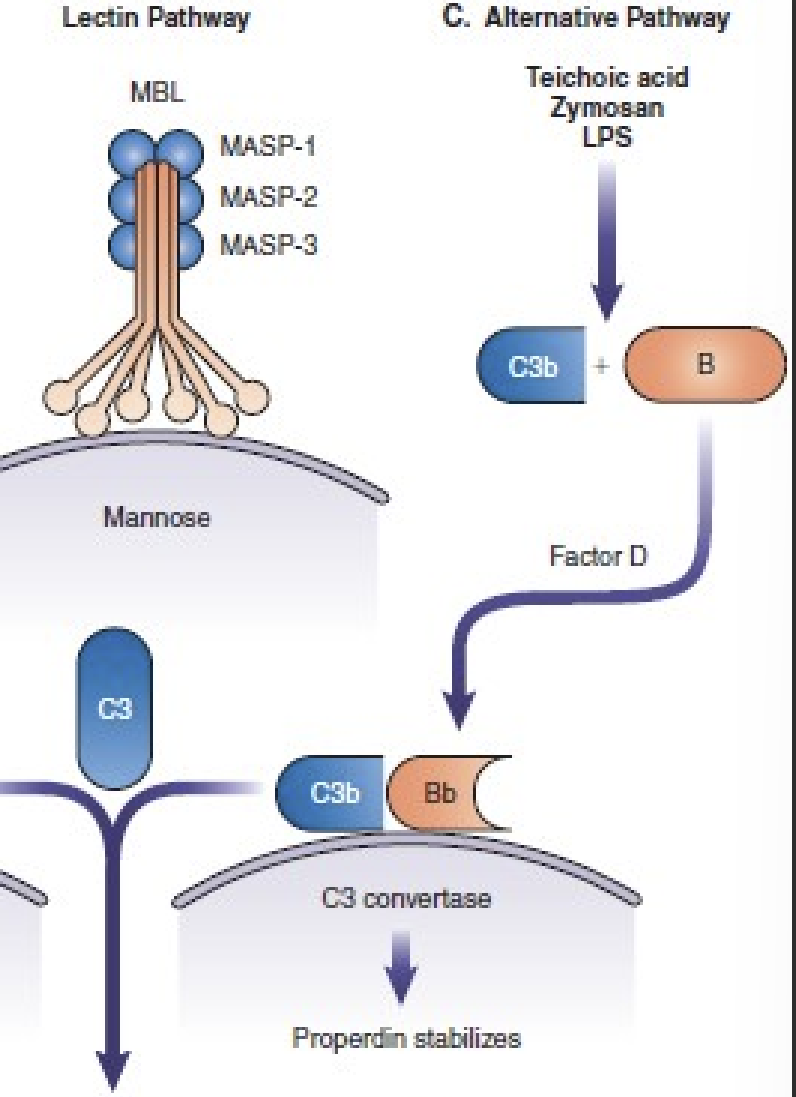
29
Which pathway uses Factor B and Factor D?
alternative pathway
30
Which convertase is common in ALL pathways?
C3 convertase - formed differently but C3 is key component
C5 is slightly different
C5 is slightly different
31
How ic C5 convertase different in each pathway?
• C5 convertase in the alternative pathway consists of C3bBb3bP
• In the classical and lectin pathways, C5 convertase is made up of C4b2a3b
• In the classical and lectin pathways, C5 convertase is made up of C4b2a3b
32
After which molecule is cleaved, is the pathway common to all?
After C5 is cleaved, the pathway is the same
33
Immunohematology reactions are mediated by which pathway and why?
classical pathway, since the RBC is the target
34
What needs to combine with C5 in order to proceed to lysis?
large amounts of C3b must be generated in order to combine with C5
35
What are examples of IgM antibodies?
anti-A in a B group
36
What are examples of IgG antibodies?
Rh
Kidd
Duffy
Lutheran systems
Kidd
Duffy
Lutheran systems
37
In immunohematology, what can IgM antibodies activate?
they will activate complement to MAC formation leading to IV hemolysis
38
What is IV hemolysis?
Intravascular (IV) hemolysis is the process of red blood cells being destroyed within blood vessels, releasing their contents into the plasma. This can lead to elevated levels of plasma hemoglobin or hemoglobin in the urine.
39
In immunohematology, can IgG activate full complement to MAC?
it may not generate large amount of C3b on the RBCs
40
Why can't IgM generate large amount of C3b on RBCs?
low affinity for C1q
not sufficient antigenic sites on RBCs
not sufficient antigenic sites on RBCs
41
If they can't generate large amounts of C3b, then what can IgG antibodies do?
They coat RBCs with C3b and/or IgG which will mark them for EXTRAVASCULAR destruction in the reticuloendothelial system (RES)
42
Where do IgGs primarily coat RBCs with C3b and/or IgG?
primarily in the spleen and liver
by the action of Factor I - C3b will de degraded to C3c and C3dg - degrades further to C3d and C3g
by the action of Factor I - C3b will de degraded to C3c and C3dg - degrades further to C3d and C3g
43
What is DAT in immunohematology?
Direct antiglobulin test (DAT)
- a blood test that determines if red blood cells (RBCs) are covered with antibodies that destroy them.
- A DAT may be used to diagnose hemolytic anemia, hemolytic disease of the newborn (HDN), or investigate a blood transfusion reaction.
- a blood test that determines if red blood cells (RBCs) are covered with antibodies that destroy them.
- A DAT may be used to diagnose hemolytic anemia, hemolytic disease of the newborn (HDN), or investigate a blood transfusion reaction.
44
What is the order of tests for DAT in blood bank using anti-human globulin (AHG)?
Poly-specific AHG: anti-IgG+anti-C3d (IF POSITIVE, continue to Mono-specific)
Mono-specific AHG: anti-IgG or anti-C3d
Mono-specific AHG: anti-IgG or anti-C3d
45
What happens if complement is not regulated?
large amounts of tissue damage could be devastating
46
What do complement regulators do?
Soluble and membrane-bound complement regulators protect cells and tissues from unintended complement-mediated injury
47
What can plasma proteins do in regards to complement system regulation?
plasma proteins act as system regulators to ensure that infectious agents, not self-antigens, are destroyed and that the reaction remains localized
48
What is the main function for complement system regulation?
most control proteins are aimed at halting accumulation of C3b
49
What are the 6 plasma complement regulators and where are they found?
- they are all serum proteins
1. C1 inhibitor (C1-INH)
2. Factor I
3. Factor H
4. C4-binding protein (C4BP)
5. S protein (vitronectin)
1. C1 inhibitor (C1-INH)
2. Factor I
3. Factor H
4. C4-binding protein (C4BP)
5. S protein (vitronectin)
50
What is the function of C1-INH and the disease associated?
- complement regulator that dissociates C1r and C1s from C1q
- hereditary angioedema
- hereditary angioedema
51
What is the function of Factor I and the disease associated?
- complement regulator that cleaves C3b and C4b
- aHUS or C3G: AMD with gain of fxn
- aHUS or C3G: AMD with gain of fxn
52
What is the function of Factor H and the disease associated?
- complement regulator that acts as a cofactor with I to inactivate C3b; prevents binding of B to C3b
- aHUS or C3G; AMD wiht gain of fxn
- aHUS or C3G; AMD wiht gain of fxn
53
What is the fxn of C4-binding protein (C4BP) and the disease associated?
- complement regulator that acts as a cofactor with I to inactivate C4b
- atypical morbus, Behcet's disease, angioedema, protein S deficit
- atypical morbus, Behcet's disease, angioedema, protein S deficit
54
What is the function of S protein (vitronectin) and the disease associated?
- complement regulator that prevents attachment of the C5b67 complex to cell membranes
- no disease associated?
- no disease associated?
55
What are some receptors on Cell Membranes for complement components?
1. CR1 (CD35)
2. CR2 (CD21)
3. DAF (CD55)
4. MIRL (CD59)
5. MCP (CD46)
2. CR2 (CD21)
3. DAF (CD55)
4. MIRL (CD59)
5. MCP (CD46)
56
What is a ligand?
Ligands act as the "signal" that tells the complement system to activate, often by binding to a specific pattern on a pathogen surface or an antibody-antigen complex.
57
Which ligands are associated with CR1 (CD35) and what is its fxn?
C3b, iC3b, C4b
- cofactor for Factor I; mediates transport of immune complexes
- cofactor for Factor I; mediates transport of immune complexes
58
Which ligands are associated with CR2 (CD21) and what is its fxn?
C3dg, C3d, iC3b
- B cell co-receptor for antigen with CD19
- B cell co-receptor for antigen with CD19
59
Which ligands are associated with DAF (CD55) and what is its fxn?
C3b, C4b
- dissociates C2b or Bb from binding sites, thus preventing formation of C3 convertase
- dissociates C2b or Bb from binding sites, thus preventing formation of C3 convertase
60
Which ligands are associated with MIRL (CD59) and what is its fxn?
C8
prevents insertion of C9 into cell membrane
prevents insertion of C9 into cell membrane
61
Which ligands are associated with MCP (CD46) and what is its fxn?
C3b, C4b
- cofactor for Factor I cleavage of C3b and C4b
- cofactor for Factor I cleavage of C3b and C4b
62
What is the fxn of the C1-inhibitor?
• C1-inhibitor binds to the serine proteases in both the Classical and Lectin pathways Cr, Cs and MASP2, respectively, prevents the cleavage of C2 and C4, stopping the formation of the classical C3 convertase (C4b2a)
• Also inactivates MASP-2 binding to the MBL-MASP complex, (Lectin Pathway)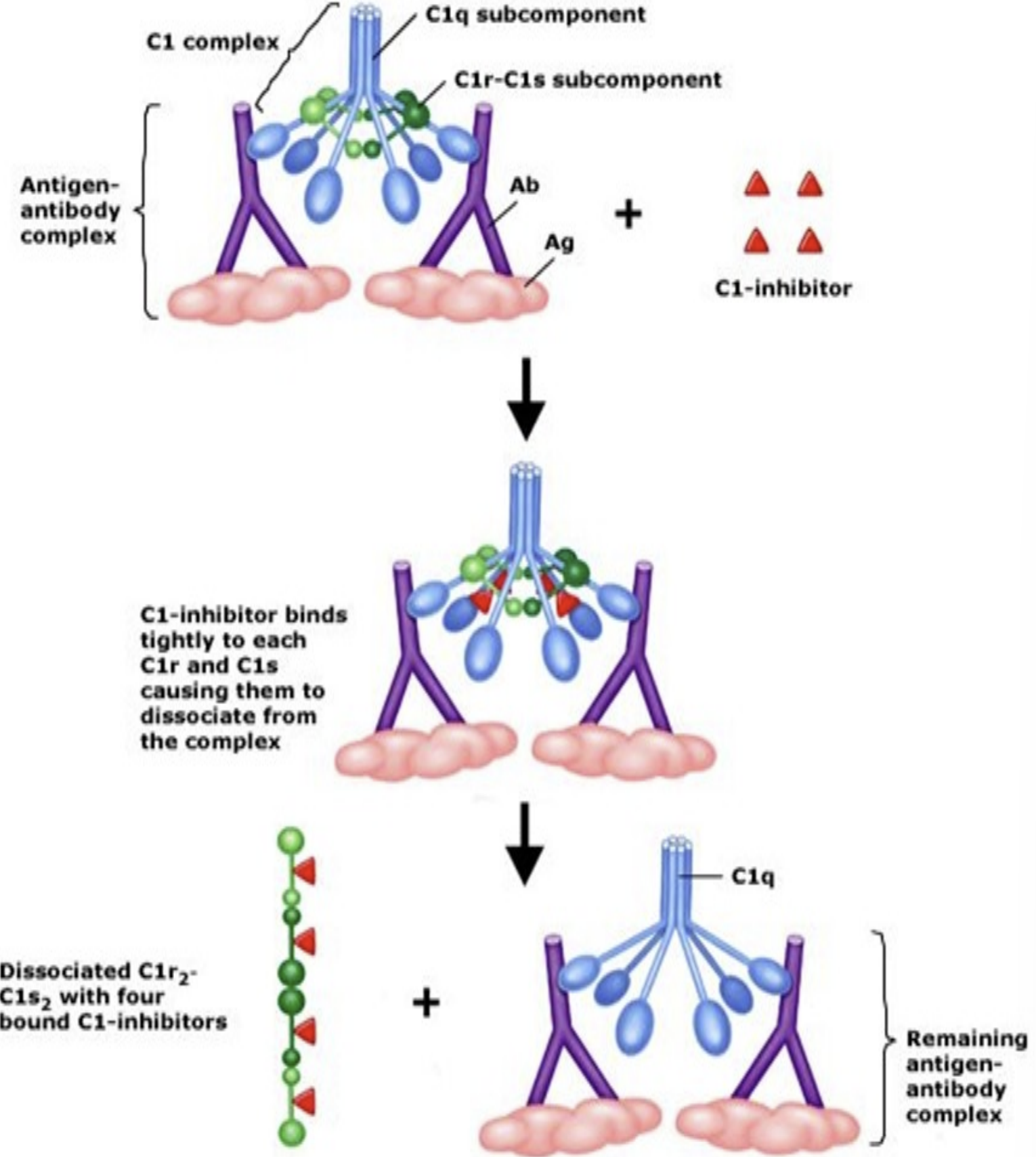
• Also inactivates MASP-2 binding to the MBL-MASP complex, (Lectin Pathway)
63
Where is C1-INH synthesized?
liver
64
What 4 ways are used to inhibit formation of C3 convertase, which all function in concert with Factor I?
1. C4BP
2. CR1
3. MCP (CD46)
4. DAF (CD59)
2. CR1
3. MCP (CD46)
4. DAF (CD59)
65
How does C4BP inhibit formation of C3 formation?
binds to C4b, therefore C4b cannot bind to C2a OR it can dissociate C4bC2a complex 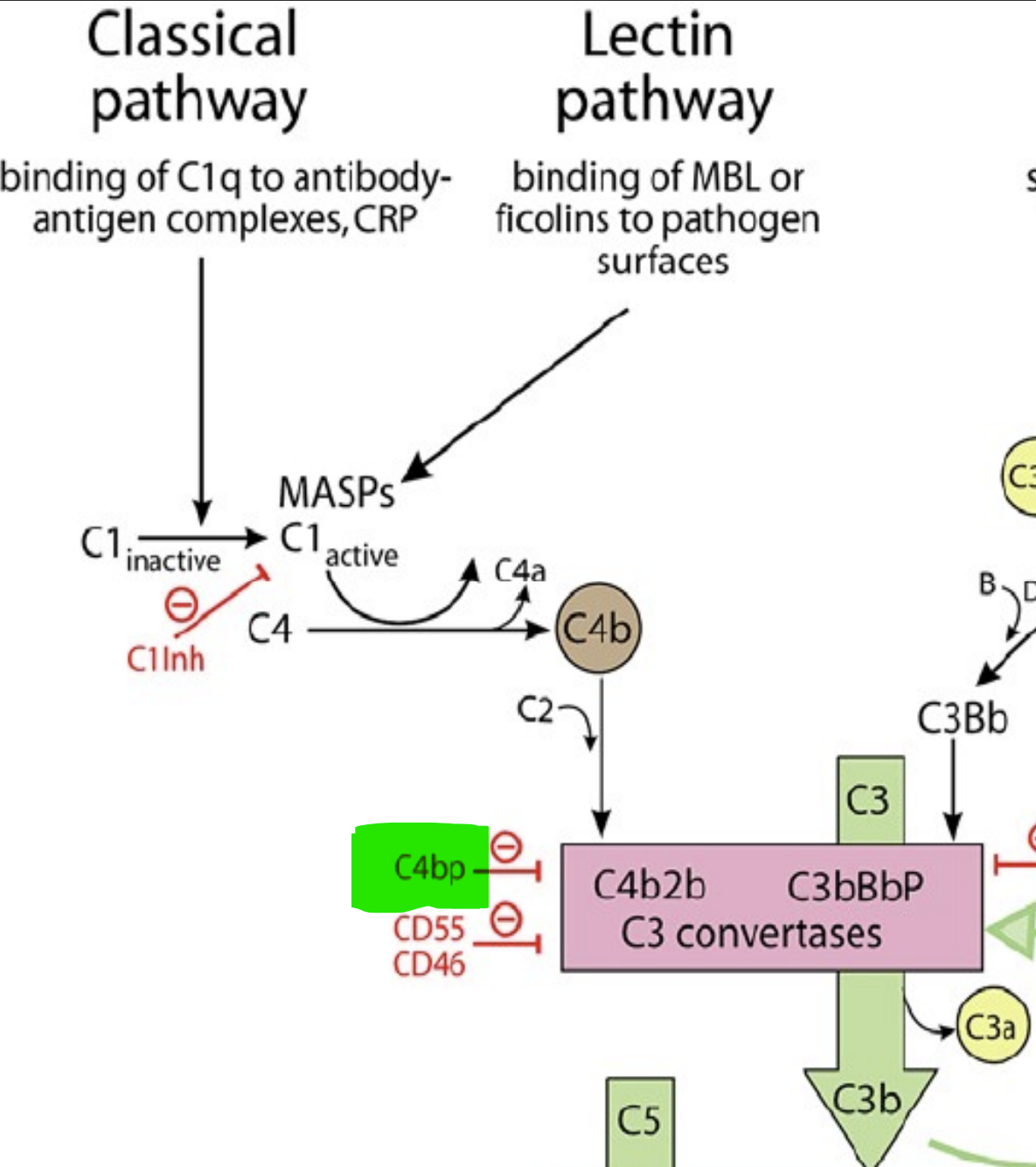
66
How does CR1 inhibit formation of C3 convertase?
- can bind to C3b or C4b then Factor I degrades either C4b or C3b
- Also, CR1 on PLT and RBC-transport C3b immune complex to liver and spleen (immune adherence: ability of immune cells to bind complement-coated particles)
- Also, CR1 on PLT and RBC-transport C3b immune complex to liver and spleen (immune adherence: ability of immune cells to bind complement-coated particles)
67
How does MCP (CD46) inhibit formation of C3 convertase?
– most efficient cofactor for Factor I-mediated cleavage of C3b
- also, in the alternative pathway, it inhibits binding of Factor B to C3b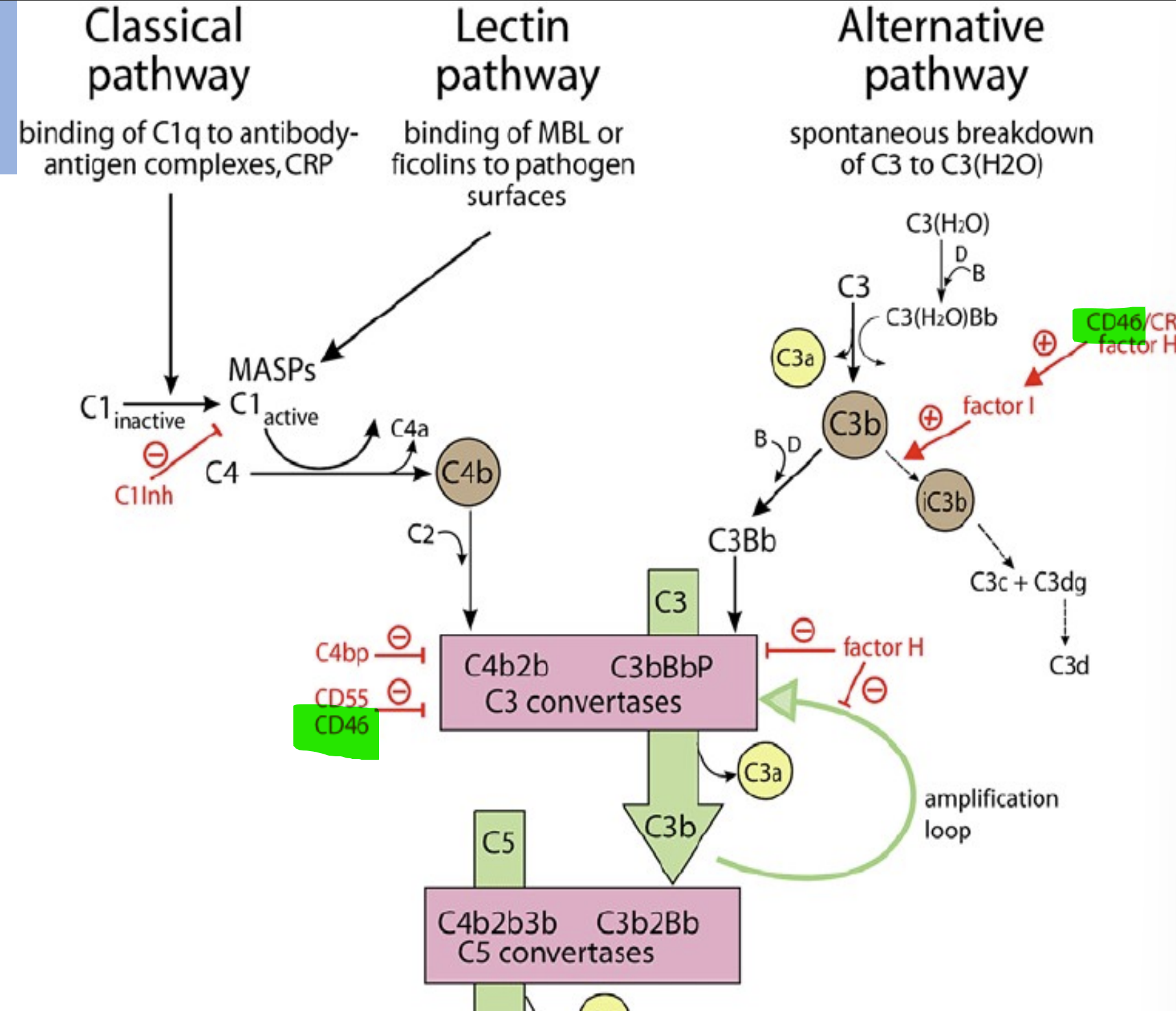
- also, in the alternative pathway, it inhibits binding of Factor B to C3b
68
How does DAF (CD55) inhibit formation of C3 convertase?
- dissociates C3 convertase
- Classical (DAF) - cooperates to accelerate the breakdown of the C4b2a into separate components, enzymatically active c2a diffuses away and the bound C4b is degraded by Factor I (by binding to) and Alternative Pathway (by binding to Bb) disassociates C3b from binding to Bb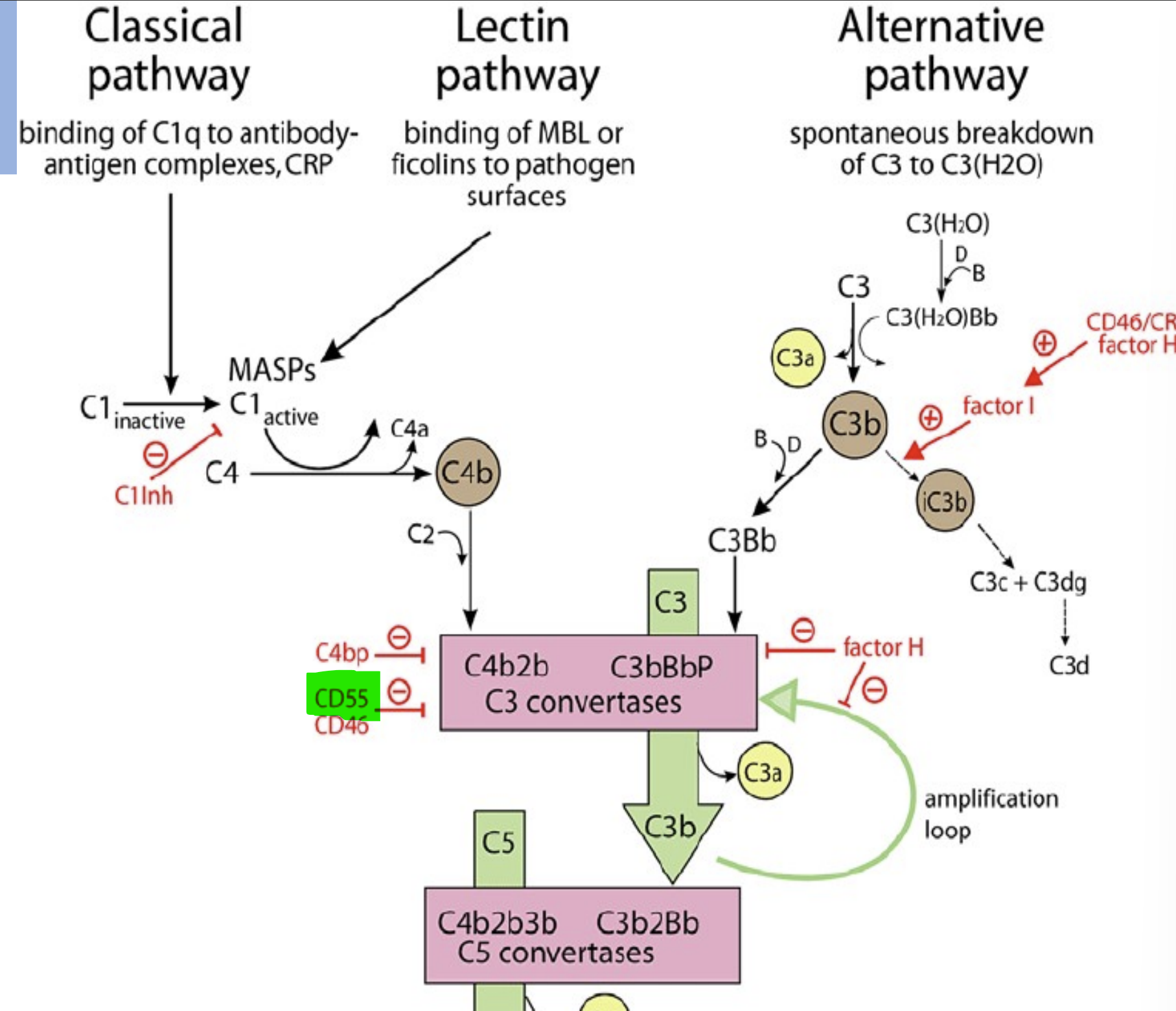
- Classical (DAF) - cooperates to accelerate the breakdown of the C4b2a into separate components, enzymatically active c2a diffuses away and the bound C4b is degraded by Factor I (by binding to) and Alternative Pathway (by binding to Bb) disassociates C3b from binding to Bb
69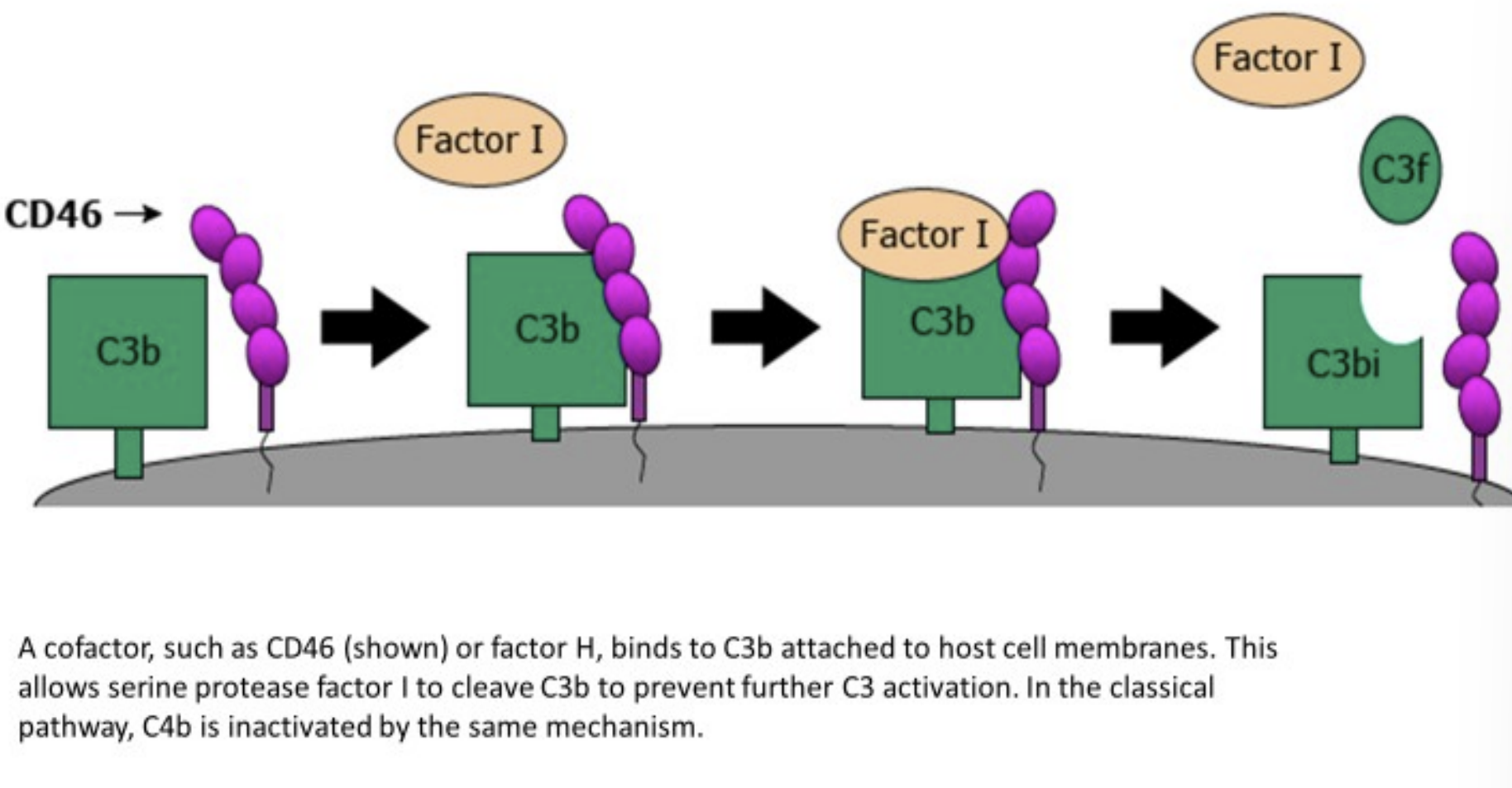
What is an example of MCP (CD46) or Factor H process to prevent further C3 activation?
70
What are some terminal component regulators?
- S protein (vitronectin)
- MIRL (CD59)
- MIRL (CD59)
71
How does S protein (vitronectin) regulate the complement pathways?
- Interacts with CD5-CD7 complex and prevents binding to cell membrane
- Binding of C8 and C9 still proceeds, but polymerization of C9 does not occur; therefore, the complex is unable to insert itself into the cell membrane or to produce lysis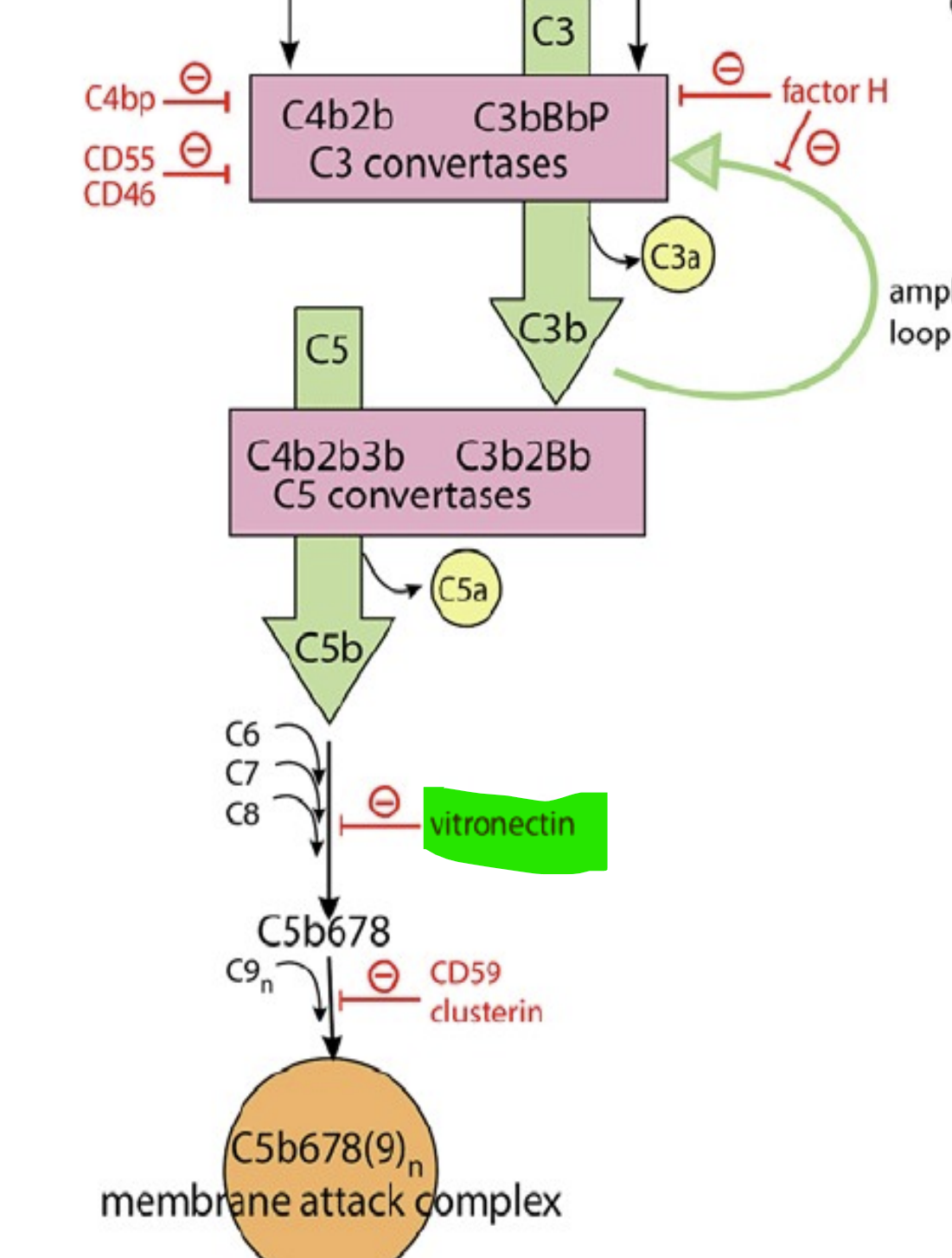
- Binding of C8 and C9 still proceeds, but polymerization of C9 does not occur; therefore, the complex is unable to insert itself into the cell membrane or to produce lysis
72
How does MIRL (CD59) regulate the complement pathways?
blocks formation of MAC (prevents insertion of C9) 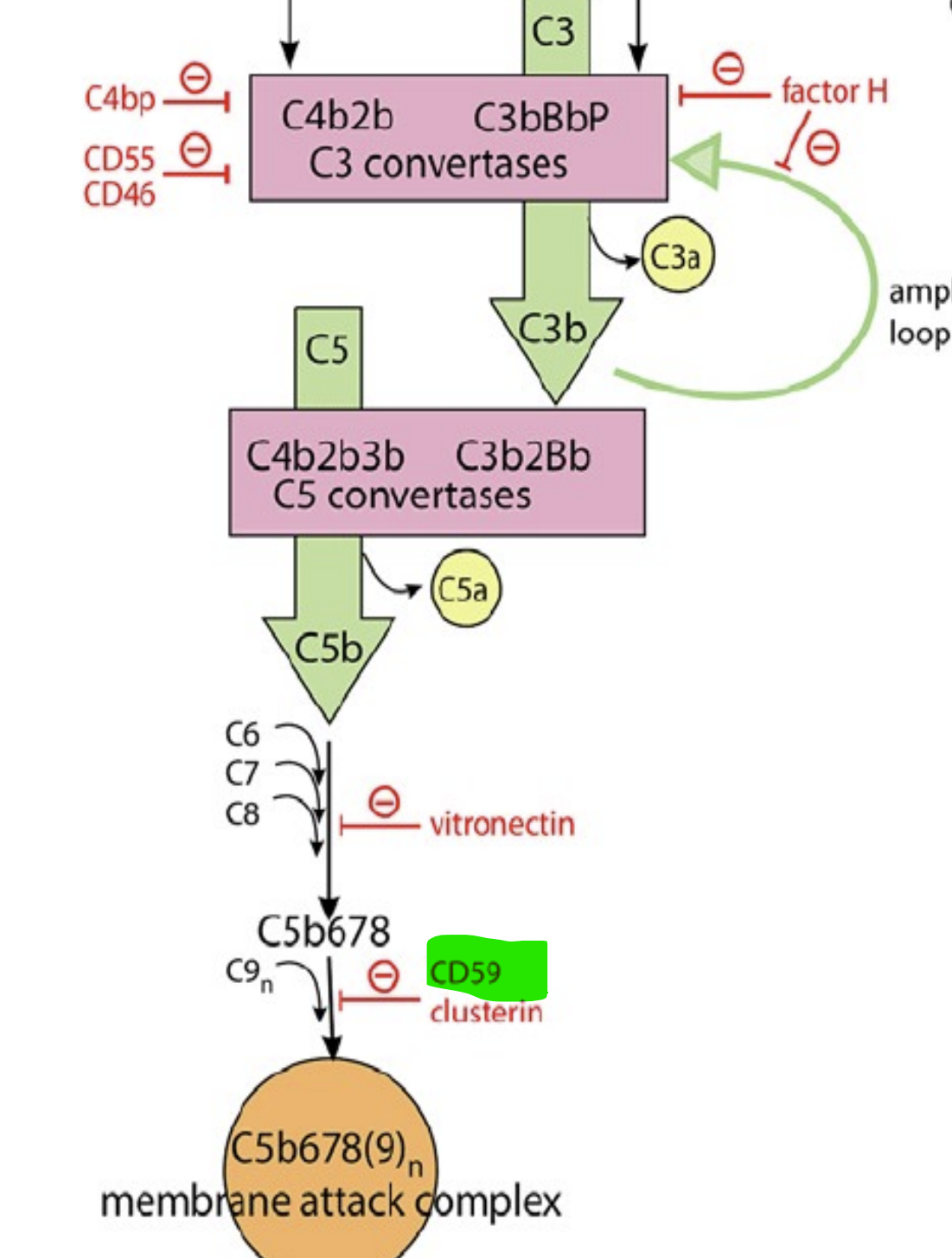
73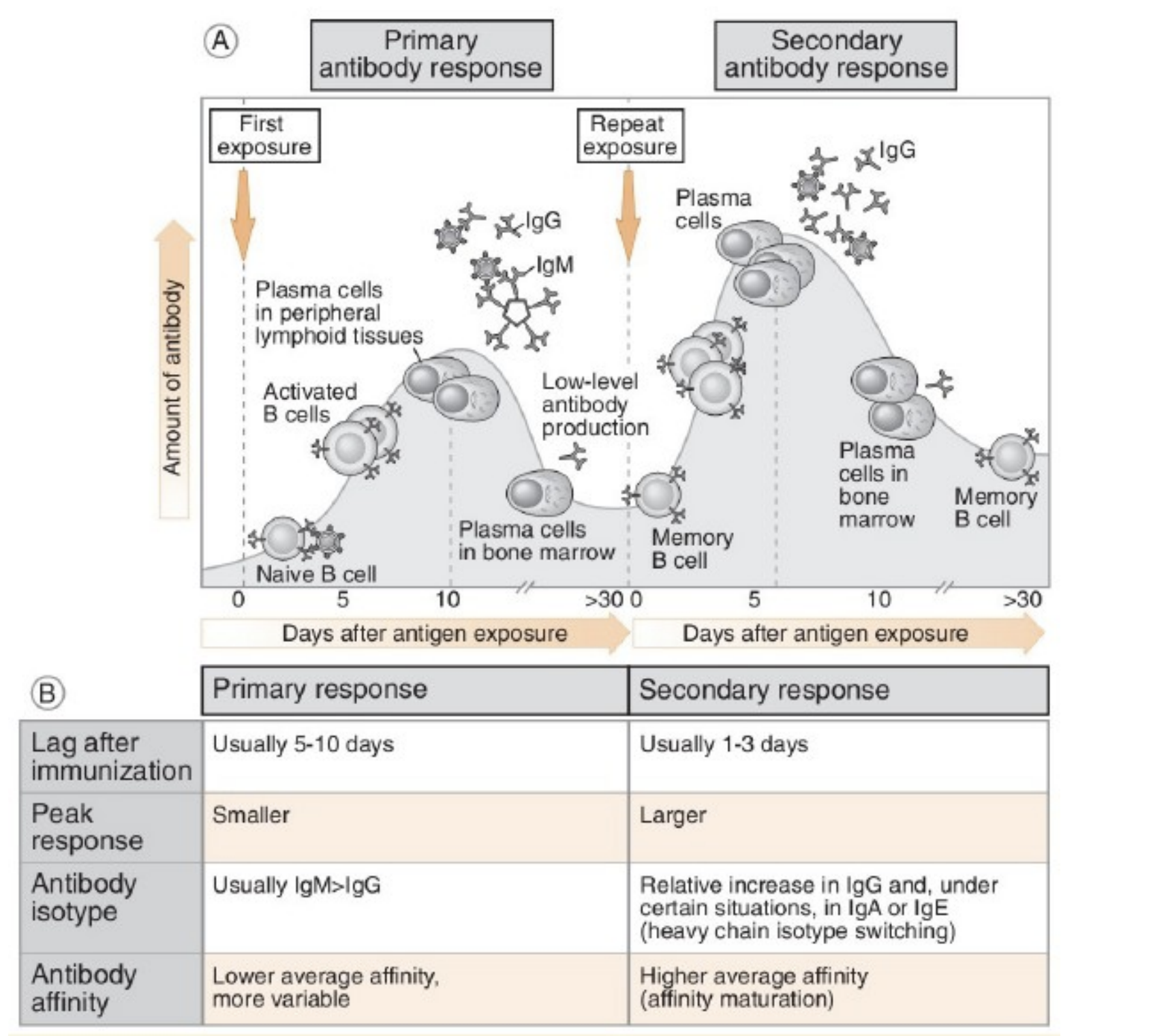
Understand the primary and secondary antibody response!
74
How long is the primary response for lag after immunization?
5 - 10 days
75
How long is the secondary response for lag after immunization?
1-3 days
76
Is the peak response smaller or larger for primary response?
smaller
77
Is the peak response smaller or larger for secondary response?
larger
78
For primary response, what is the antibody isotype?
usually IgM > IgG
79
For secondary response, what is the antibody isotype?
- relative increase in IgG
- certain situations - relative increase in IgA or IgE (heavy chain isotype switching)
- certain situations - relative increase in IgA or IgE (heavy chain isotype switching)
80
For primary response, what is the antibody affinity?
lower average affinity, more variable
81
For secondary response, what is the antibody affinity?
higher average affinity (affinity maturation)
82
For the immune response wrap-up, what are the main steps?
---> antigen exposure
---> antigen processing/presentation
---> immune cell activation
---> B cell activation / response
---> Outcome: bacterial opsonization, inflammation and MAC
---> antigen processing/presentation
---> immune cell activation
---> B cell activation / response
---> Outcome: bacterial opsonization, inflammation and MAC
83
What is the overview of antigen processing / presentation?
APCs (macrophage, DC) process peptide Ag and present it within MHC molecules to T cells, MHC-I to CD8 T cells (CTLs), MHC-II to CD4 T cells
84
What is the overview of immune cell activation?
• CTLs directly kill their target through cytotoxicity
• Th cells may differentiate (or be polarized) into one of the effector T cell types depending on the nature of the Ag (EC or IC) and type of cytokines produced by the activated APC
• Th cells may differentiate (or be polarized) into one of the effector T cell types depending on the nature of the Ag (EC or IC) and type of cytokines produced by the activated APC
85
Depending on cytokines produced by the APCS, which T helper cells are stimulated?
• If APCs produce IFN-y and IL-12: Th1
• If APCs produce IL-6 or IL-23: Th17
• If APCs produce TGF-b: Treg (immune tolerance)
• If APCs produce IL-4: Th2
• If APCs produce IL-6 or IL-23: Th17
• If APCs produce TGF-b: Treg (immune tolerance)
• If APCs produce IL-4: Th2
86
What is the overview of B cell activation / response?
• Follicular B cell respond to native proteins (Tdependent) marginal zone B cells respond to polysaccharides (T-independent)
• For native proteins, plasma cells or memory B cells produced (also isotype switching and affinity maturation)
• For polysaccharides, no memory, isotype switching or affinity maturation
• Also, in T-independent response, TLRs on B cells will be activated which enhances B cell differentiation to plasma cells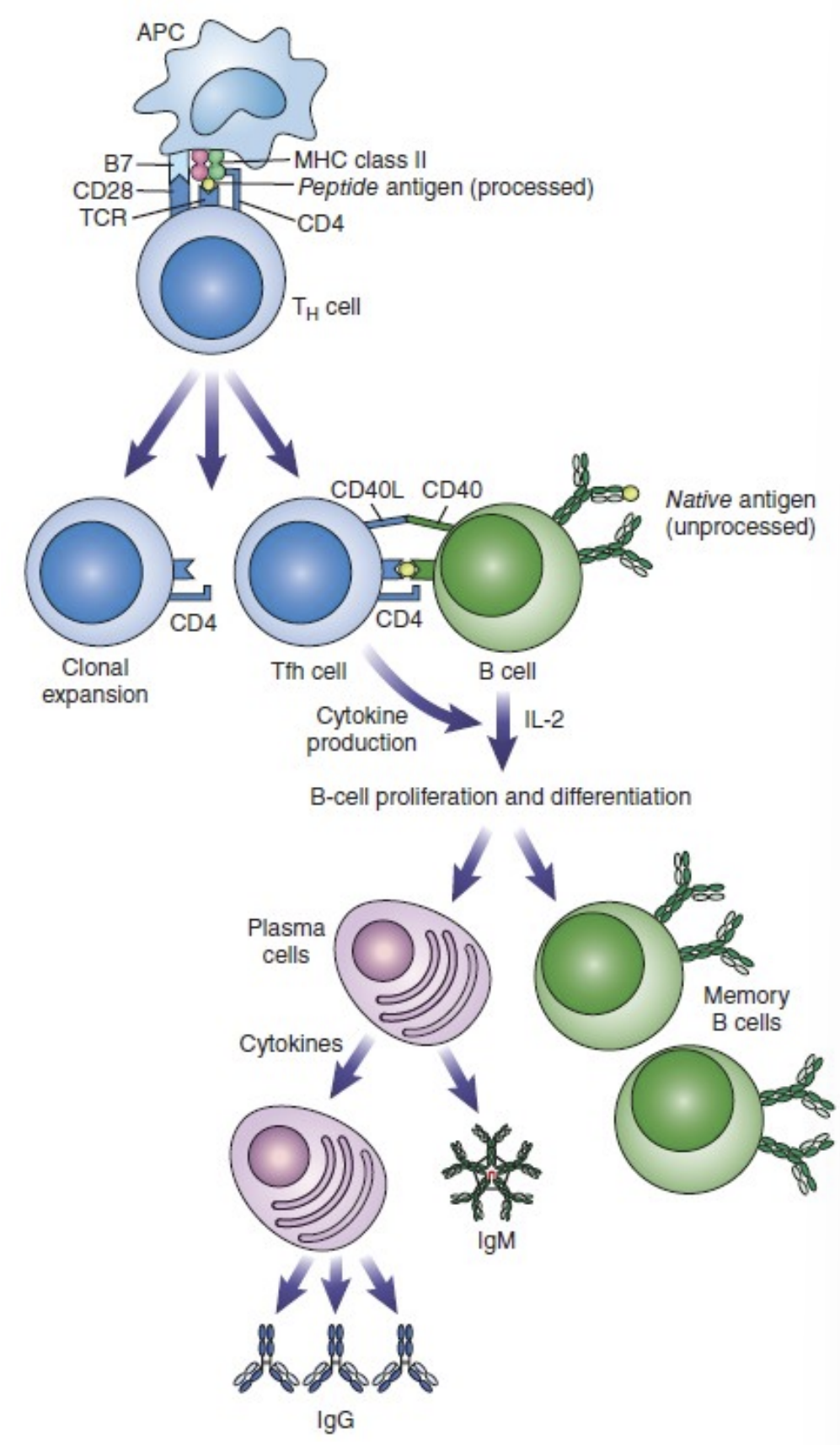
• For native proteins, plasma cells or memory B cells produced (also isotype switching and affinity maturation)
• For polysaccharides, no memory, isotype switching or affinity maturation
• Also, in T-independent response, TLRs on B cells will be activated which enhances B cell differentiation to plasma cells
87
How is the classical pathway initiated?
Ag-Ab complex (or bacteria coated with IgG or IgM)
88
How is the lectin pathway initiated?
Carbohydrate moieties on bacteria can bind to MBL
89
How is the alternative pathway initiated?
recognizing the microbial cell wall (LPS) and amplify responses of other two
pathways
pathways
90
What are the outcomes of Complement Pathway activation?
1. bacterial opsonizatio (by C3b)
2. enhance phagocytosis by phagocytes
3. inflammation (C5a)
4. target lysis (by MAC)
2. enhance phagocytosis by phagocytes
3. inflammation (C5a)
4. target lysis (by MAC)