Lecture 6 - Genetic Concepts: Application in HLA and Blood Group Typing, and Flow Cytometry Overview
Study these flashcardsFree · spaced repetition · iPhone, Android, Mac & web
All cards
1
What is a gene?
• Mendelian definition: basic unit of heredity
• Molecular definition: a specific sequence of DNA which is transcribed to produce a protein (and will be passed on to different generations of cells during mitosis)
• Molecular definition: a specific sequence of DNA which is transcribed to produce a protein (and will be passed on to different generations of cells during mitosis)
2
What is a locus?
a specific location of a gene on c chromosome (ex. RHD gene locus - on chrom. 1, and ABO locus is on chrom. 19)
3
What is a genotype?
- combination of alleles for a specific trait (inherited)
- ex, AA, AO, BB, AB genotypes for ABO blood groups
- ex, AA, AO, BB, AB genotypes for ABO blood groups
4
What is a phenotype?
anything that is produced by the genotype, could be an enzyme to control a blood group, or a protein to regulate RBC production, etc..
• Best examples: AA genotype produces N-acetyl-D galactosaminyltransferase which produces A antigen (A blood group), BB genotype produces D-galactosyltransferase which produces B antigen (B blood group)
• Best examples: AA genotype produces N-acetyl-D galactosaminyltransferase which produces A antigen (A blood group), BB genotype produces D-galactosyltransferase which produces B antigen (B blood group)
5
What is an allele?
different forms (variations) of a gene at the same locus, e.g., ABO alleles, H and h alleles
6
What is autosomal?
the chromosomes with number (1-22) are autosomes, every individual has 22 pairs of autosomal chromosomes and one pair of sex chromosomes, any trait /phenotype carried on any of the 22 pairs will have an autosomal pattern of inheritance
7
What is X-linked?
any trait carried on X chromosome (e.g., hemophilia A)
8
What is homozygous?
if a person inherits the same (equal) alleles, he/she will be homozygous for that trait, e.g., AA, BB, OO, HH, hh
9
What is heterzygous?
if a person inherits different alleles, he/she will be heterozygous for that trait, e.g., AO, BO, Hh,
10
What is a dominant gene or allele?
it will be expressed in both homozygous and heterozygous states, in AA and AO, A will be expressed (A and B are dominant over O), usually denoted by capital letter (H vs h)
11
What is a recessive gene or allele?
usually denoted by lowercase, for instance h is recessive vs H, it can be expressed only in homozygous state (hh, OO).
12
What is an Amorph?
- gene is inherited but cannot produce any product
- O gene in the ABO system is amorph
- O gene in the ABO system is amorph
13
What is hemizygous?
- one allele is normal the other one is mutated or deleted
- in XY (males) with hemophilia A (FVIII deficiency), chromosome X carries
the mutated allele
- in XY (males) with hemophilia A (FVIII deficiency), chromosome X carries
the mutated allele
14
What is Co-dominant?
- BOTH alleles inherited from both parents will be expressed (produce product)
- one gene is not dominant over the other
- most blood group antigens (ABO, Rh, Kell, Kidd, etc.) are inherited in a co-dominant fashion (each gene produces its product), best example: AB genotype, both A and B antigens will be expressed on RBCs
- one gene is not dominant over the other
- most blood group antigens (ABO, Rh, Kell, Kidd, etc.) are inherited in a co-dominant fashion (each gene produces its product), best example: AB genotype, both A and B antigens will be expressed on RBCs
15
What are antithetical antigens?
- a pair or more of antigens that are encoded by different alleles of the same gene.
- In other words, a protein can only present one of the antithetical antigens.
• As an example, in the Kidd blood group system the alleles JK*A and JK*B encode the Jka and Jkb antigens, respectively.
• Jka and Jkb are considered antithetical antigens.
- In other words, a protein can only present one of the antithetical antigens.
• As an example, in the Kidd blood group system the alleles JK*A and JK*B encode the Jka and Jkb antigens, respectively.
• Jka and Jkb are considered antithetical antigens.
16
Describe the positions of alleles depending on which chromosome they are on:
- when alleles are carried on the same chromosome they are in cis position
- when alleles found on opposite chromosomes of a homologous pair are in trans position
- when alleles found on opposite chromosomes of a homologous pair are in trans position
17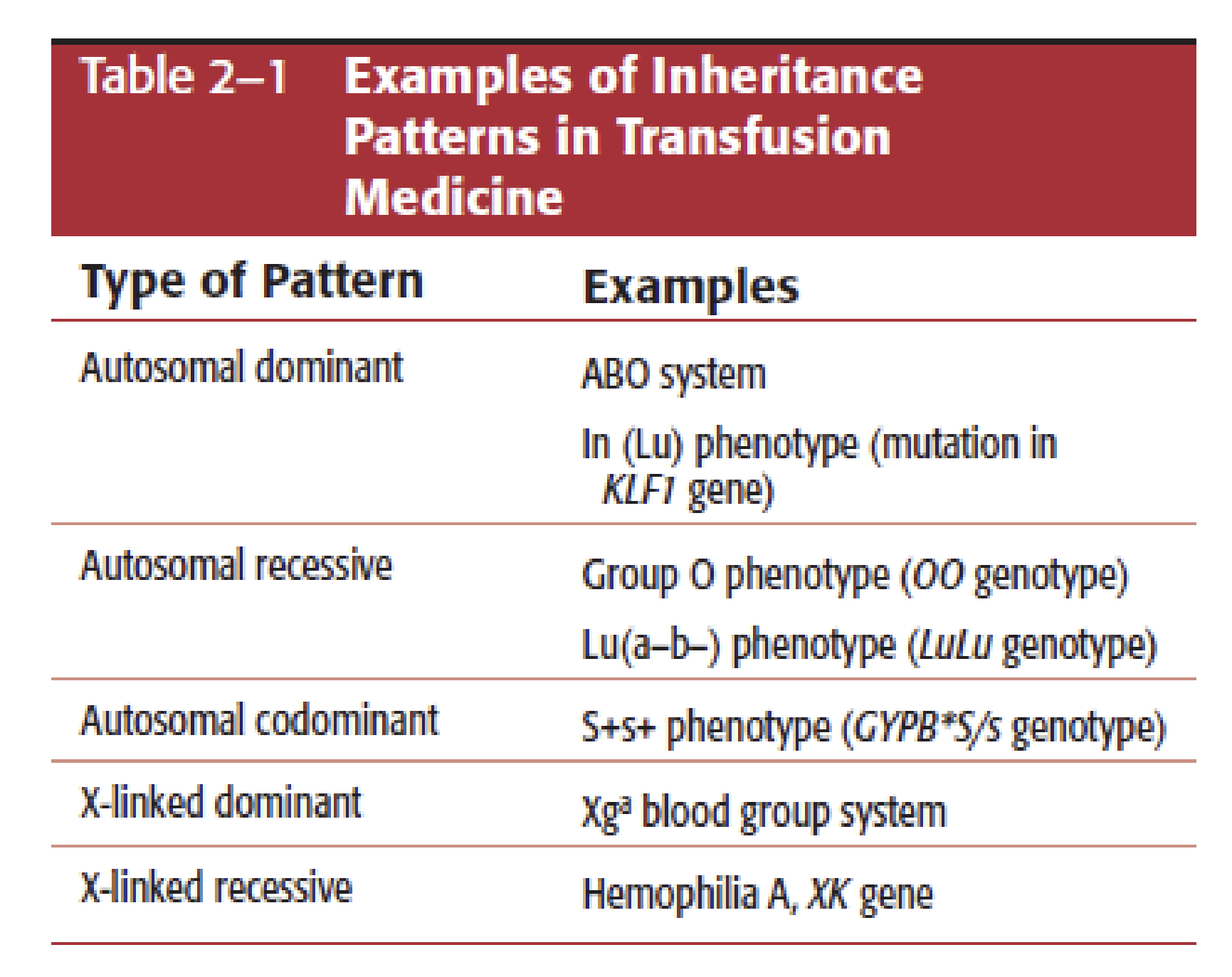
What are some examples of inheritance patterns in transfusion medicine?
18
Which blood group cannot be inherited by any of offspring of parents with AA and BO genotypes?
O - recessive
19
If the father’s blood group is O, what is his most likely genotype?
OO - recessive
20
If a person inherits K and k alleles (Kell blood group system), what antigens will be expressed on their RBCs?
Both! They are co-dominant
21
Where are the genes encoding HLA antigens located?
Genes encoding HLA antigens are part of major histocompatibility complex (or MHC) gene system located on chromosome 6
22
What are the roles of MHC?
• The recognition of self and non-self
• The coordination of cellular and humoral immunity
• Immune response to antigens
• The coordination of cellular and humoral immunity
• Immune response to antigens
23
What is the inheritance of HLAs? - MHC genes are divided into 3 classes:
1. class I: A, B, C loci
2. class II: DR, DP, and DQ loci
3. class III: code for complement proteins and cytokines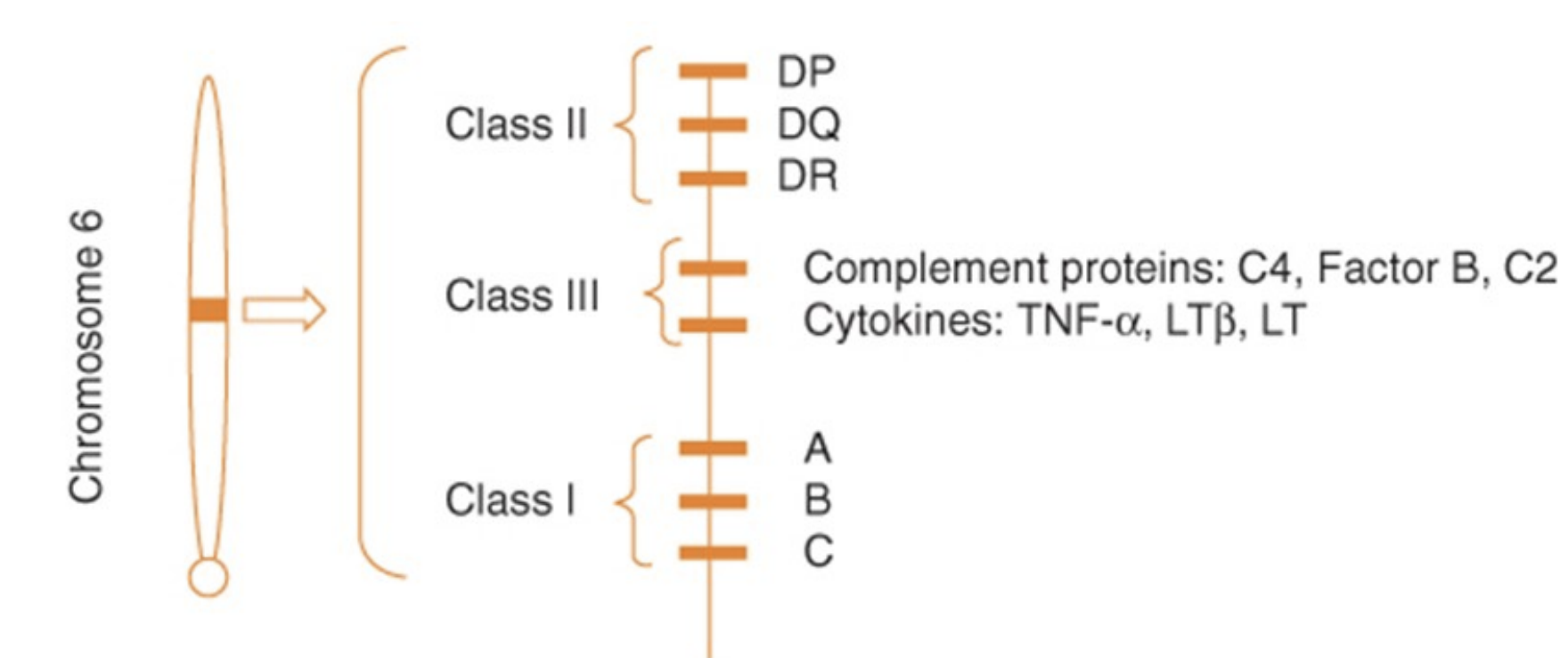
2. class II: DR, DP, and DQ loci
3. class III: code for complement proteins and cytokines
24
HLA genes are:
• Closely linked
• Inherited as one haplotype from each parent
• Both haplotypes are expressed by offspring
• Inherited as one haplotype from each parent
• Both haplotypes are expressed by offspring
25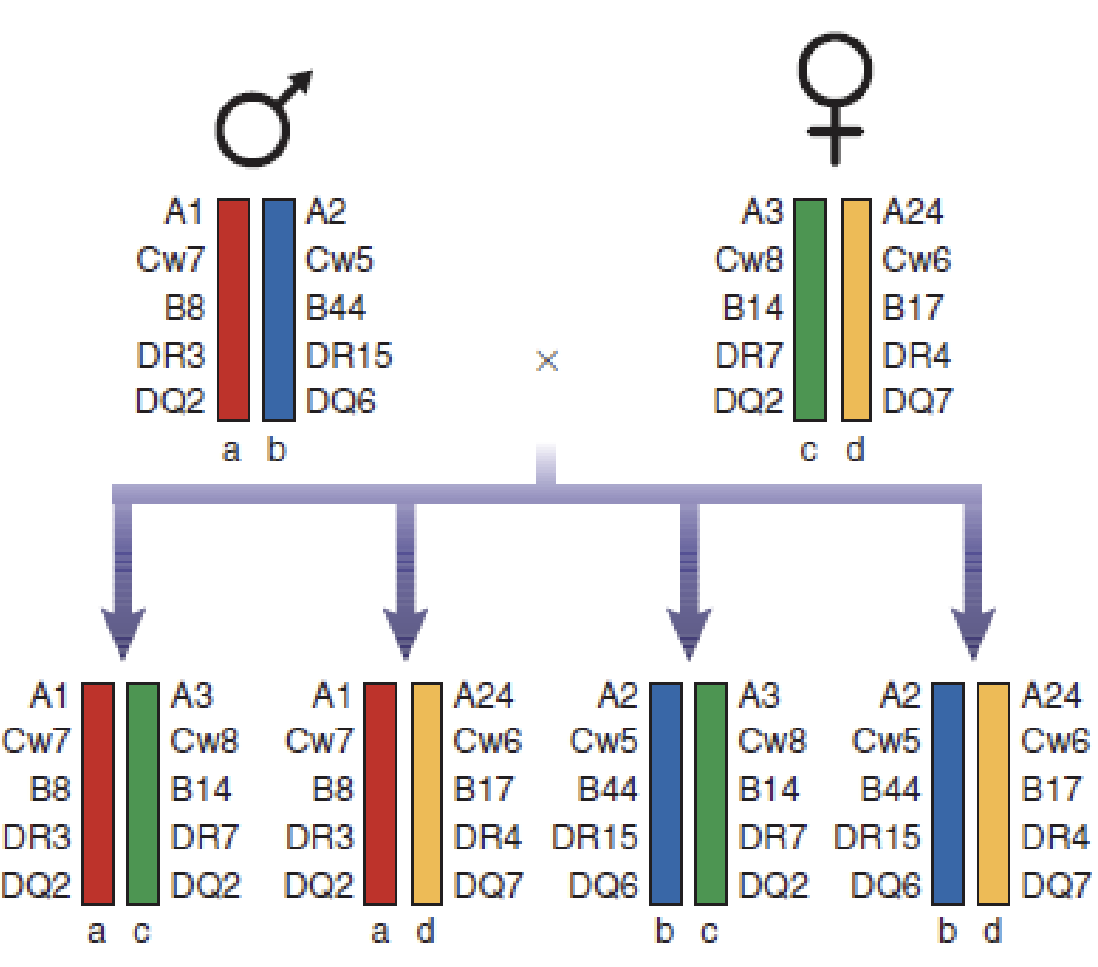
This is an example of Class I and II HLA inheritance with 4 possible children:
26
How many variations of HLA genes are there?
100s of possible variations of each gene, called alleles, at each locus
27
How are the HLA antigens determined?
Each antigen with unique number determined by either serologic (antigen-antibody reactions) or molecular methods
28
What is the most polymorphic system of genes in humans?
MHC region: most polymorphic system of genes in humans, many possible alleles at each location
29
What is the probability that 2 individuals will express the same HLA antigens?
Extremely low
30
What is the HLA nomeclature for the HLA antigens?
- Letter designating the locus (e.g. A, B, C, DR, DQ and DP)
- Number indicating the antigen (e.g. A2, B27, Cw7, DR1, DQ5)
- At C locus: “w” is included in the nomenclature to distinguish HLA C-locus antigens from complement components
- Number indicating the antigen (e.g. A2, B27, Cw7, DR1, DQ5)
- At C locus: “w” is included in the nomenclature to distinguish HLA C-locus antigens from complement components
31
Why did HLA nomenclature begin?
HLA nomenclature began when the only test method was the serological lymphocytotoxicity assay
32
What organization standardizes the HLA nomenclature?
World Health Organization
• For example, using the correct nomenclature (January 2010): A2 is expressed as:
• A2 for antigen level resolution determined by serologic testing
• HLA-A*02 for low-resolution typing
• HLA-A*02:01 for high-resolution testing
• For example, using the correct nomenclature (January 2010): A2 is expressed as:
• A2 for antigen level resolution determined by serologic testing
• HLA-A*02 for low-resolution typing
• HLA-A*02:01 for high-resolution testing
33
HLA class I antigens are found?
on surface of platelets, leukocytes, and most nucleated cells
34
Do RBC's have HLA antigens?
Mature RBCs lack HLA antigens but reticulocytes express HLA class I antigens
35
HLA class II antigens are found?
on antigen-presenting cells (APCs) e.g. macrophages, dendritic cells, and B cells
36
In circulation, the number of cells expressing which class type antigens is greater than the othe?
- Class I > Class II
- the number of cells expressing class I antigens is greater than the number of cells with class II antigens.
- the number of cells expressing class I antigens is greater than the number of cells with class II antigens.
37
Is it necessary to match class II to platelets?
Because class II antigens are not found on platelets, it is not necessary to match class II antigens when HLA-compatible platelets are requested.
38
Describe the lymphocytotoxicity test method?
• Suspension of B or T cells (from patient) is incubated with specific antibodies in micro-titer plates (96-well), each Ab is specific to an HLA Ag.
• Complement from rabbit serum is added and incubated again, followed by addition of a vital exclusion dye
• If Ab-Ag reaction occurs, activation of complement lyses the cell, and it takes the dye in (the cell will be stained)
• Each well is scored (based on the reaction intensity) and a pattern is reported for HLA typing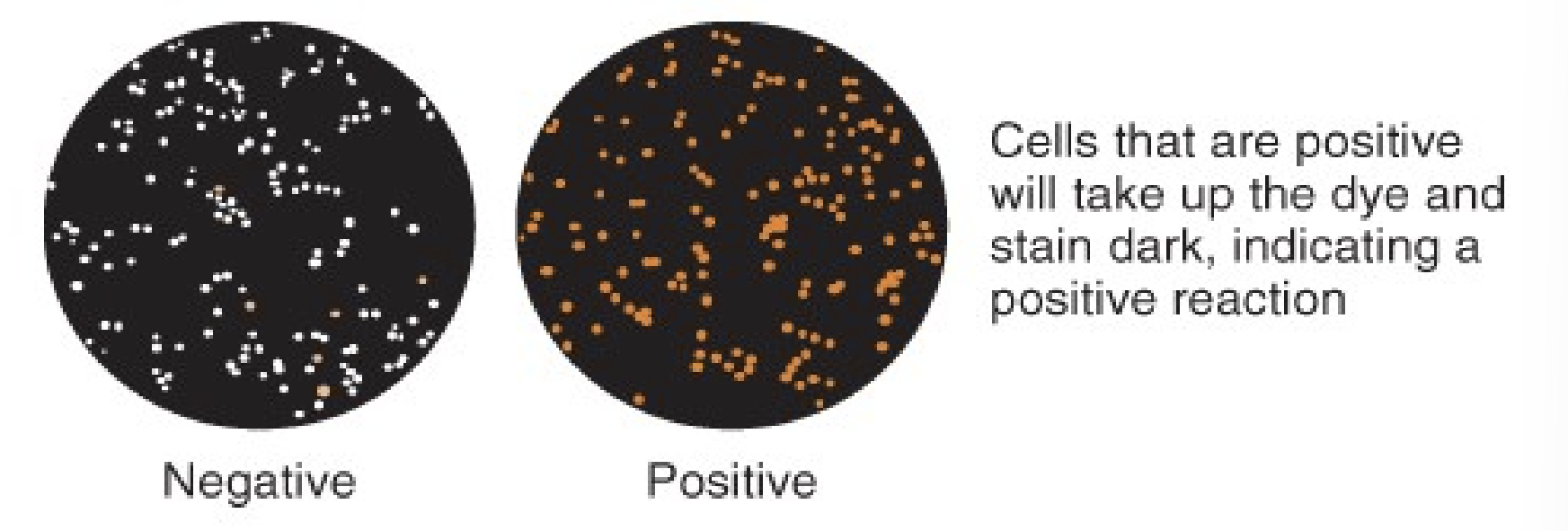
• Complement from rabbit serum is added and incubated again, followed by addition of a vital exclusion dye
• If Ab-Ag reaction occurs, activation of complement lyses the cell, and it takes the dye in (the cell will be stained)
• Each well is scored (based on the reaction intensity) and a pattern is reported for HLA typing
39
Serologic typing of HLA antigens are being replaced by molecular methods because:
antibodies can react to more than one epitope (or cross-reactive antibodies), and specific antibodies have not been developed to recognize many different HLA antigens
40
What is needed for successful (viable) transplant e.g. kidney, heart, and lung?
• ABO compatibility
• Careful matching of HLA antigens in patients with existing (preformed) antibodies
• Careful matching of HLA antigens in patients with existing (preformed) antibodies
41
Patients may become sensitized to HLAs by what exposures?
1. Pregnancy: 30% to 50% of women (3 or more pregnancies) develop HLA antibodies, antibodies present for weeks to months or possibly many years
2. Blood transfusions: about 50% of patients receiving multiple blood transfusions develop antibodies, leukocyte-reduced RBC product: decreases chances for patient sensitization to donor HLA antigens
3. Previous transplant: about 90% of patients develop HLA antibodies within 2 weeks of failed graft
2. Blood transfusions: about 50% of patients receiving multiple blood transfusions develop antibodies, leukocyte-reduced RBC product: decreases chances for patient sensitization to donor HLA antigens
3. Previous transplant: about 90% of patients develop HLA antibodies within 2 weeks of failed graft
42
What testing for HLA antibodies prior to organ transplant is needed?
1. Serologic tests on microtiter trays of panel of common antigens (30-60 Ags)
2. %Panel-reactive antibody (PRA): the proportion of lymphocytes in the panel that are killed by the patient’s serum (or the number of Abs)
2. %Panel-reactive antibody (PRA): the proportion of lymphocytes in the panel that are killed by the patient’s serum (or the number of Abs)
43
What happens with a high PRA result?
High PRA: recipient has many reactions (HLA antibodies) = less likely
compatible with available donor organs
compatible with available donor organs
44
What is the CPRA?
- Calculated panel-reactive antibody (CPRA)
- newer solid-phase method/ more sensitive and specific/ determines probability of compatibility to donor organ
- newer solid-phase method/ more sensitive and specific/ determines probability of compatibility to donor organ
45
What does the CPRA help with?
• CPRA number based on antigens that the organ candidate is reactive against, called unacceptable antigens
• CPRA number provides a statistical guide for determining reactivity within the general donor population
• Helps to rank the recipient on the waitlist for available organs.
• CPRA number provides a statistical guide for determining reactivity within the general donor population
• Helps to rank the recipient on the waitlist for available organs.
46
What are graft classifications?
Transplantation of cells or tissues is classified by the genetic relatedness
of the donor and the recipient
of the donor and the recipient
47
What are the 4 graft classifications?
1. Autograft
2. Allograft
3. Syngeneic graft (aka isograft)
4. Xenograft
2. Allograft
3. Syngeneic graft (aka isograft)
4. Xenograft
48
What is an autograft?
Transfer of tissue from one area of the body to another of the same individual
49
What is an allograft?
Transfer of cells or tissue between two genetically disparate individuals of the same species
50
What is a syngeneic graft (isograft)?
Transfer of cells or tissues between individuals of the same species who are genetically identical, for example, identical twins
51
What is a xenograft?
Transfer of tissue between two individuals of different species
52
What is graft rejection?
- the HLA disparity between donor and recipient that occurs with allografts and xenografts will result in a vigorous cellular and humoral immune response to the foreign MHC antigens
- this response is the primary stimulus of graft rejection.
- this response is the primary stimulus of graft rejection.
53
For allorecognition, the immune system of the recipient recognizes foreign HLA proteins (on donor’s tissue/cells) via two distinct mechanisms:
- direct allorecognition
- indirect allorecognition
- indirect allorecognition
54
What happens in direct allorecognition?
Cytotoxic T cells from the host bind directly to foreign HLA (MHC I) proteins on graft cells (MLR in the lab).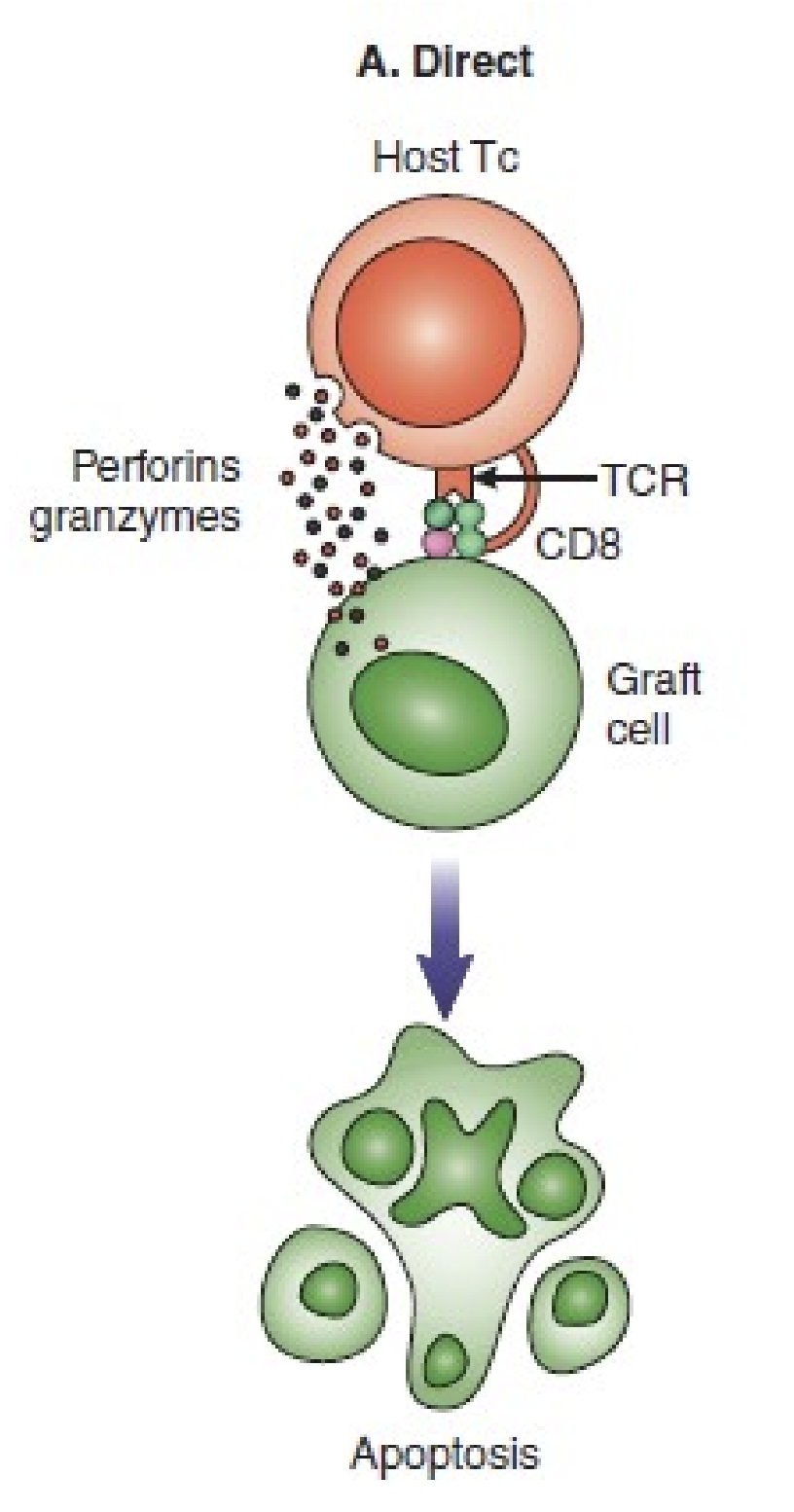
55
What happens in indirect allorecognition?
APCs from the host present foreign MHC I or MHC II antigens to CD4+ Th cells, which produce cytokines that stimulate graft rejection.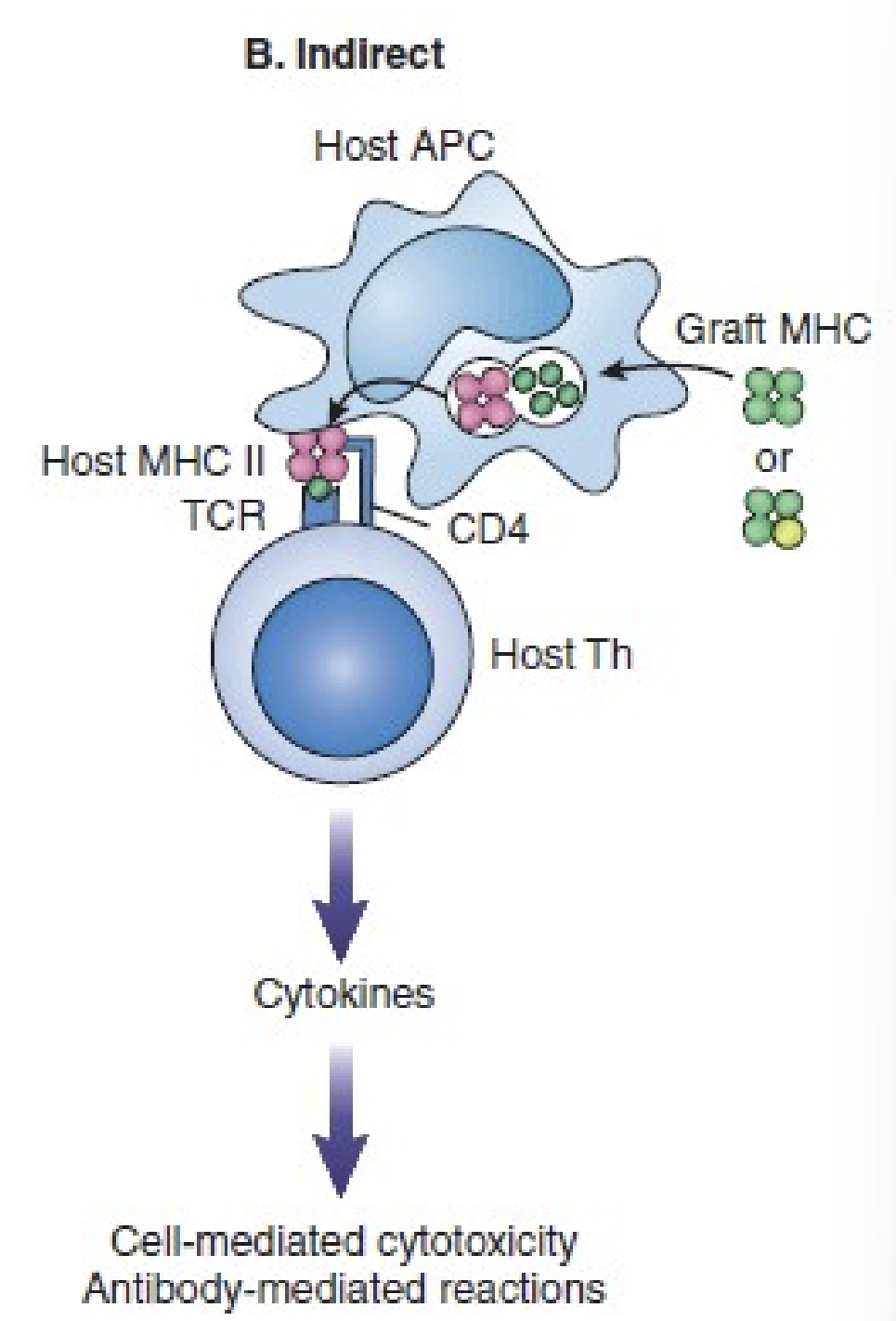
56
What is the mixed lymphocyte reaction (MLR) assay?
- in vitro assay
• Patient’s lymphocytes are incubated with “potential” donor’s lymphocytes that have been inactivated so they cannot proliferate.
• If the HLA-D antigens (class II antigens) of these two cell populations differ, patient’s T cells proliferate in response to foreign HLA-D Ags, which can be quantitated by incorporation of radio-labeled (3H) thymidine into the DNA of the proliferating cells.
• Thus, a high level of radioactivity indicates such a donor would be more likely to stimulate graft rejection
• Patient’s lymphocytes are incubated with “potential” donor’s lymphocytes that have been inactivated so they cannot proliferate.
• If the HLA-D antigens (class II antigens) of these two cell populations differ, patient’s T cells proliferate in response to foreign HLA-D Ags, which can be quantitated by incorporation of radio-labeled (3H) thymidine into the DNA of the proliferating cells.
• Thus, a high level of radioactivity indicates such a donor would be more likely to stimulate graft rejection
57
What is possible for kidney and pancreas transplants, but not heart and lung transplants?
Crossmatching recipient serum with the T cells and B cells from the potential donor to avoid rejection caused by antibodies to the donor tissue
58
What is the mixed lymphocyte culture (MLC) crossmatch?
• Cells from one individual are tested in vitro against MHC antigens on leukocytes from another individual
• MLC measures response of HLA class II differences between donor and recipient cells through radioactive measurements of DNA synthesis
• Historically used for compatibility and D (class II) antigen typing
• Immuno-fluorescent flow cytometry techniques have now replaced MLC
• MLC measures response of HLA class II differences between donor and recipient cells through radioactive measurements of DNA synthesis
• Historically used for compatibility and D (class II) antigen typing
• Immuno-fluorescent flow cytometry techniques have now replaced MLC
59
What happens in hematopoietic progenitor cell (HPC) transplants?
• HPCs can be obtained from bone marrow, peripheral blood, and cord blood, used to treat diseases: e.g. aplastic anemia, leukemia, lymphoma, and Hodgkin’s disease
• HLA matching at the allelic level is important to avoid rejection and graft-versus-host disease (GVHD)
• Preformed HLA antibodies and ABO compatibility less important in HPC transplants compared with solid-organ transplants
• HLA matching at the allelic level is important to avoid rejection and graft-versus-host disease (GVHD)
• Preformed HLA antibodies and ABO compatibility less important in HPC transplants compared with solid-organ transplants
60
What happens in graft-versus-host disease (GVHD)?
• Occurs when grafted immunocompetent cells from donor mount immune response against host tissue
• Can occur in any organ transplant e.g. kidney, bone marrow
• Recipients of HPC transplants often become immunosuppressed to allow for donor cell growth: GVHD more likely to occur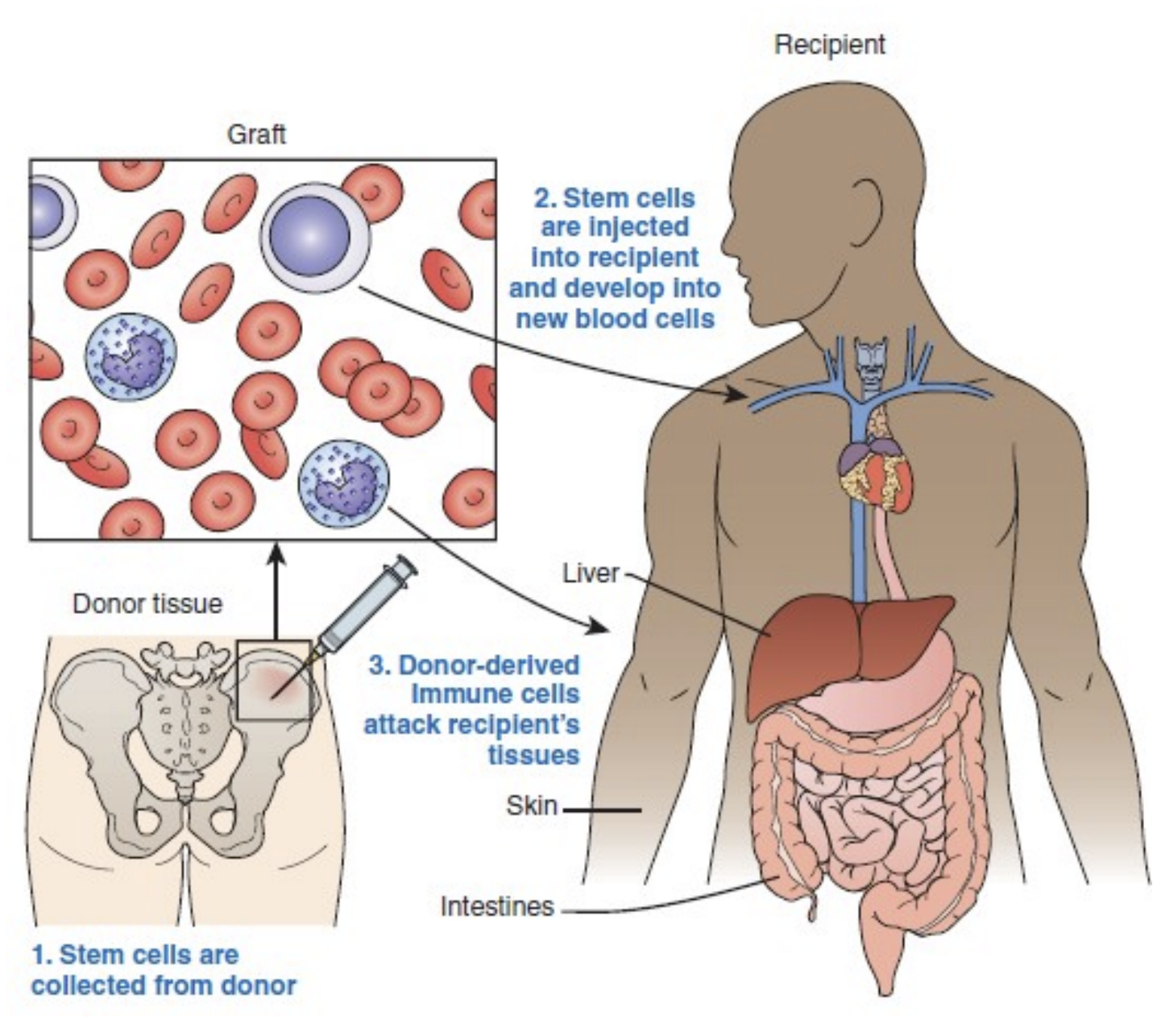
• Can occur in any organ transplant e.g. kidney, bone marrow
• Recipients of HPC transplants often become immunosuppressed to allow for donor cell growth: GVHD more likely to occur
61
Case 1: HLA Graft/Donor Selection
A patient who is not responding to platelet transfusions requires an HLA matched platelet transfusion. The patient’s HLA type is determined and is reported as A2, A11, B8, B35. No report of the HLA C antigens is given. A donor with a compatible type is called on to donate for this patient.
Question:
Why were the HLA class II antigens not considered for matching?
A patient who is not responding to platelet transfusions requires an HLA matched platelet transfusion. The patient’s HLA type is determined and is reported as A2, A11, B8, B35. No report of the HLA C antigens is given. A donor with a compatible type is called on to donate for this patient.
Question:
Why were the HLA class II antigens not considered for matching?
Platelets contain class I HLA antigens, which include A, B, and
C antigens. Platelets do not contain class 2 HLA antigens.
The C (or Cw antigens) are not usually considered when
selecting platelets, because they are not normally involved in
an immune response that would cause refractoriness to platelet
transfusions.
C antigens. Platelets do not contain class 2 HLA antigens.
The C (or Cw antigens) are not usually considered when
selecting platelets, because they are not normally involved in
an immune response that would cause refractoriness to platelet
transfusions.
62
Case 2: HLA Graft/donor selection
Parents of a kidney transplant candidate were tested for a potential compatible kidney match within the family because the patient had produced HLA antibodies. The patient’s HLA antigens were typed and found to be A1, A2, B27, B50, DR11, DR17. Antibodies identified were specific for A3, B18, and DR7 antigens.The mother’s HLA typing is A1, A3, B35, B27, DR4, DR11.
The father’s typing is A2, A24, B50, B44, DR1, DR17.
Questions:
1.What HLA antigens did the father contribute?
2.List the probable HLA types of the candidate’s three siblings.
3.Select the sibling kidney with the best match.
Parents of a kidney transplant candidate were tested for a potential compatible kidney match within the family because the patient had produced HLA antibodies. The patient’s HLA antigens were typed and found to be A1, A2, B27, B50, DR11, DR17. Antibodies identified were specific for A3, B18, and DR7 antigens.The mother’s HLA typing is A1, A3, B35, B27, DR4, DR11.
The father’s typing is A2, A24, B50, B44, DR1, DR17.
Questions:
1.What HLA antigens did the father contribute?
2.List the probable HLA types of the candidate’s three siblings.
3.Select the sibling kidney with the best match.
1. What HLA antigens did the father contribute?
Mother: A1, A3, B35, B27, DR4, DR11
Child (patient): A1, A2, B27, B50, DR11, DR17
Father: A2, A24, B50, B44, DR1, DR17
The father contributed A2, B50, and DR17
2. List the probable HLA types of the candidate’s three siblings.
Sibling 1. A1, A24, B27, B44, DR11, DR1 (BEST CANDIDATE)
Sibling 2. A3, A2, B35, B50, DR4, DR17
Sibling 3. A3, A24, B35, B44, DR4, DR1
3. Select the sibling kidney with the best match.
Because of the specificity of the antibody, the sibling with the best match is sibling 1 (A1, A24,
B27, B44, DR11, DR1).
Mother: A1, A3, B35, B27, DR4, DR11
Child (patient): A1, A2, B27, B50, DR11, DR17
Father: A2, A24, B50, B44, DR1, DR17
The father contributed A2, B50, and DR17
2. List the probable HLA types of the candidate’s three siblings.
Sibling 1. A1, A24, B27, B44, DR11, DR1 (BEST CANDIDATE)
Sibling 2. A3, A2, B35, B50, DR4, DR17
Sibling 3. A3, A24, B35, B44, DR4, DR1
3. Select the sibling kidney with the best match.
Because of the specificity of the antibody, the sibling with the best match is sibling 1 (A1, A24,
B27, B44, DR11, DR1).
63
What is flow cytometry?
- Flowcytometry is measuring (metry) the physical and chemical properties of cells (cyto) which are flowing in a stream of fluid
- This flow system delivers the cells singly past a point of measurement (a laser beam) at a speed of several thousands /sec
- It measures above properties based on lights scattered and the fluorescence emitted by the cells/particles
- Flow cytometry is not for measuring cells only, it can also measure particles, from a bacterium (0.2µm) to human blastocyst (100µm), and even chromosomes and proteins
- This flow system delivers the cells singly past a point of measurement (a laser beam) at a speed of several thousands /sec
- It measures above properties based on lights scattered and the fluorescence emitted by the cells/particles
- Flow cytometry is not for measuring cells only, it can also measure particles, from a bacterium (0.2µm) to human blastocyst (100µm), and even chromosomes and proteins
64
What are the FCM components?
1. Fluidics (sheath fluid tank, flow cell)
2. Optics (lasers, filters)
3. Detectors (FSC, SSC and FL detectors)
4. Electronics (ADC system, data processing system)
2. Optics (lasers, filters)
3. Detectors (FSC, SSC and FL detectors)
4. Electronics (ADC system, data processing system)
65
What does CD stand for and what is the fxn?
• CD stands for “cluster of differentiation”
• Cell surface markers useful for the identification and characterization of leukocytes.
• mAbs conjugated with FL used to detect CD markers
• Cell surface markers useful for the identification and characterization of leukocytes.
• mAbs conjugated with FL used to detect CD markers
66
What are the CD markers for T cells?
CD3
CD4
CD8
CD4
CD8
67
What are the CD markers for T helper cells?
CD3
CD4
CD4
68
What are the CD markers for B cells?
CD19
CD20
CD20
69
What are the CD markers for dendritic cells?
CD11c
CD123
CD123
70
What are the CD markers for NK cells?
CD16
CD56
CD56
71
What are the CD markers for HSCs?
CD34 - HSC ONLY
72
What are the CD markers for Macrophages/monocytes?
CD14
CD33
CD33
73
What are the CD markers for granulocytes?
CD66b
74
What are the CD markers for platelets?
CD41
CD61
CD62
CD61
CD62
75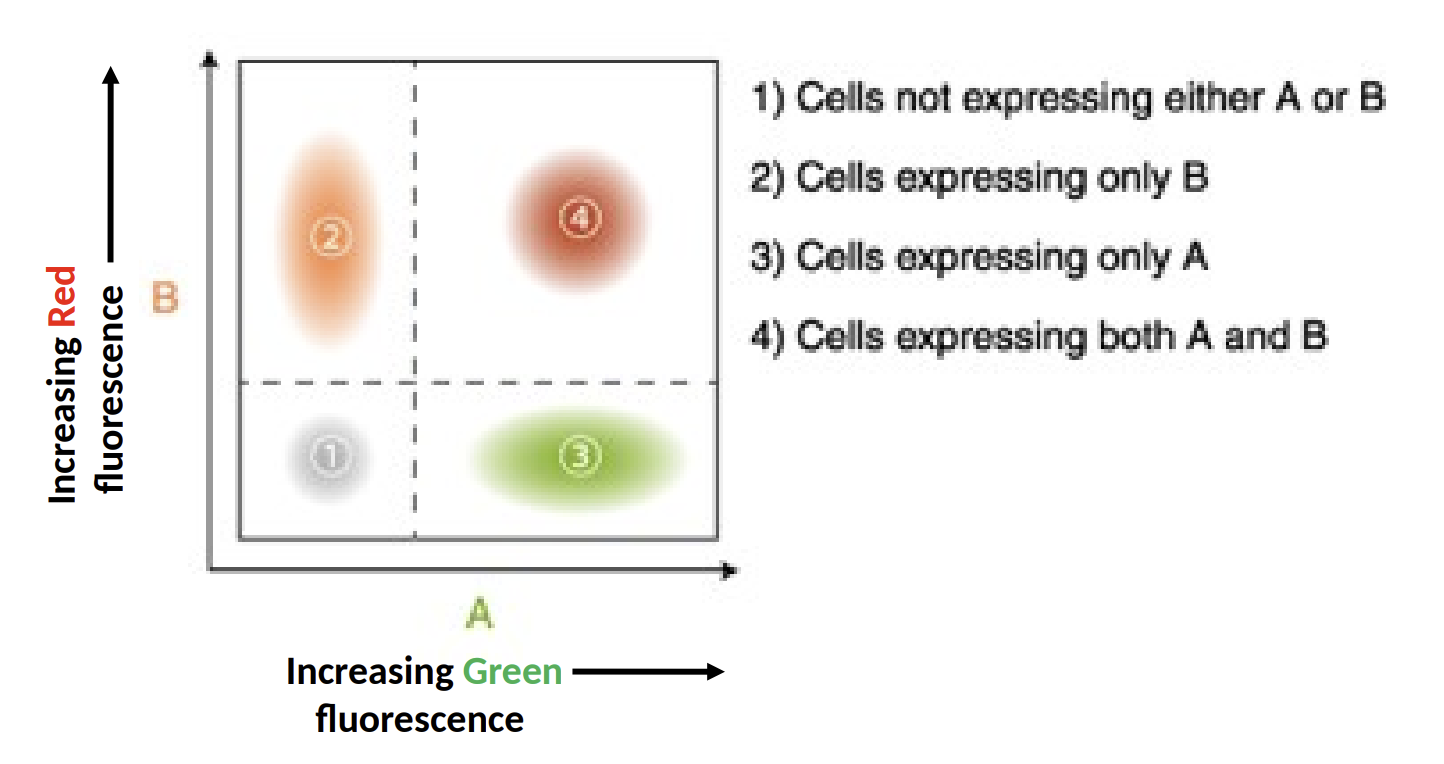
What a bi-variate scatter plot tells us
76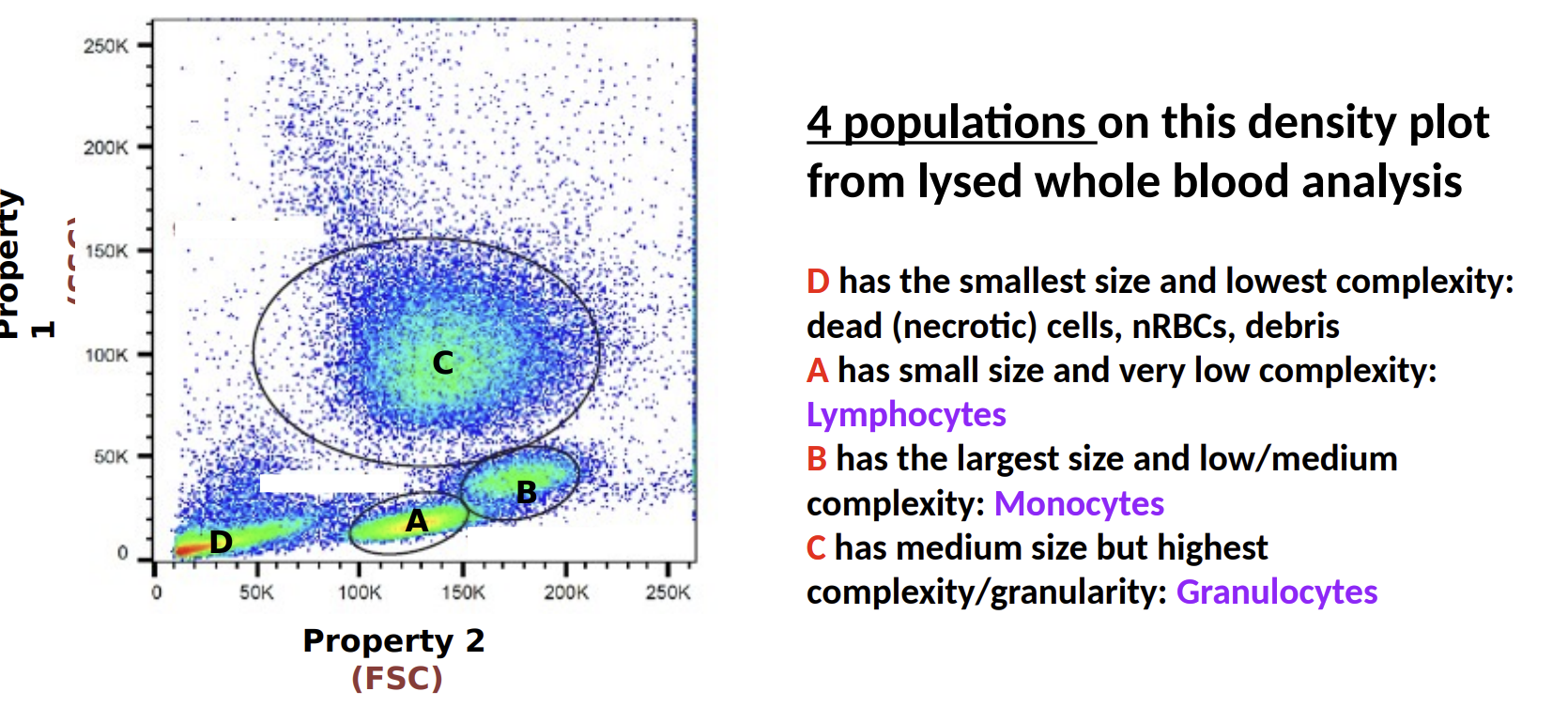
What an SC vs FSC bi-variate scatter plot tells us
77
What are the granulocytic/monocytic lineage markers?
CD33
CD13
CD14
CD15
CD19
CD13
CD14
CD15
CD19
78
What are the B lymph lineage markers?
CD19
CD20
CD22
CD20
CD22
79
What are the T lymph lineage markers?
CD2
CD3
CD4
CD7
CD8
CD3
CD4
CD7
CD8
80
What are some other applications of FC in hematology?
• Immune deficiency (SCID, HIV, ……)
• Stem cell enumeration (CD34)
• PNH (CD55, CD59)
• Reticulocytes (RNA binding dyes, e.g. TO)
• FMH (Ab against HbF, RhD, or both, or CA)
• Cell cycle analysis (DNA content)
• Transplantation (HLA, flow cross match)
• Stem cell enumeration (CD34)
• PNH (CD55, CD59)
• Reticulocytes (RNA binding dyes, e.g. TO)
• FMH (Ab against HbF, RhD, or both, or CA)
• Cell cycle analysis (DNA content)
• Transplantation (HLA, flow cross match)
81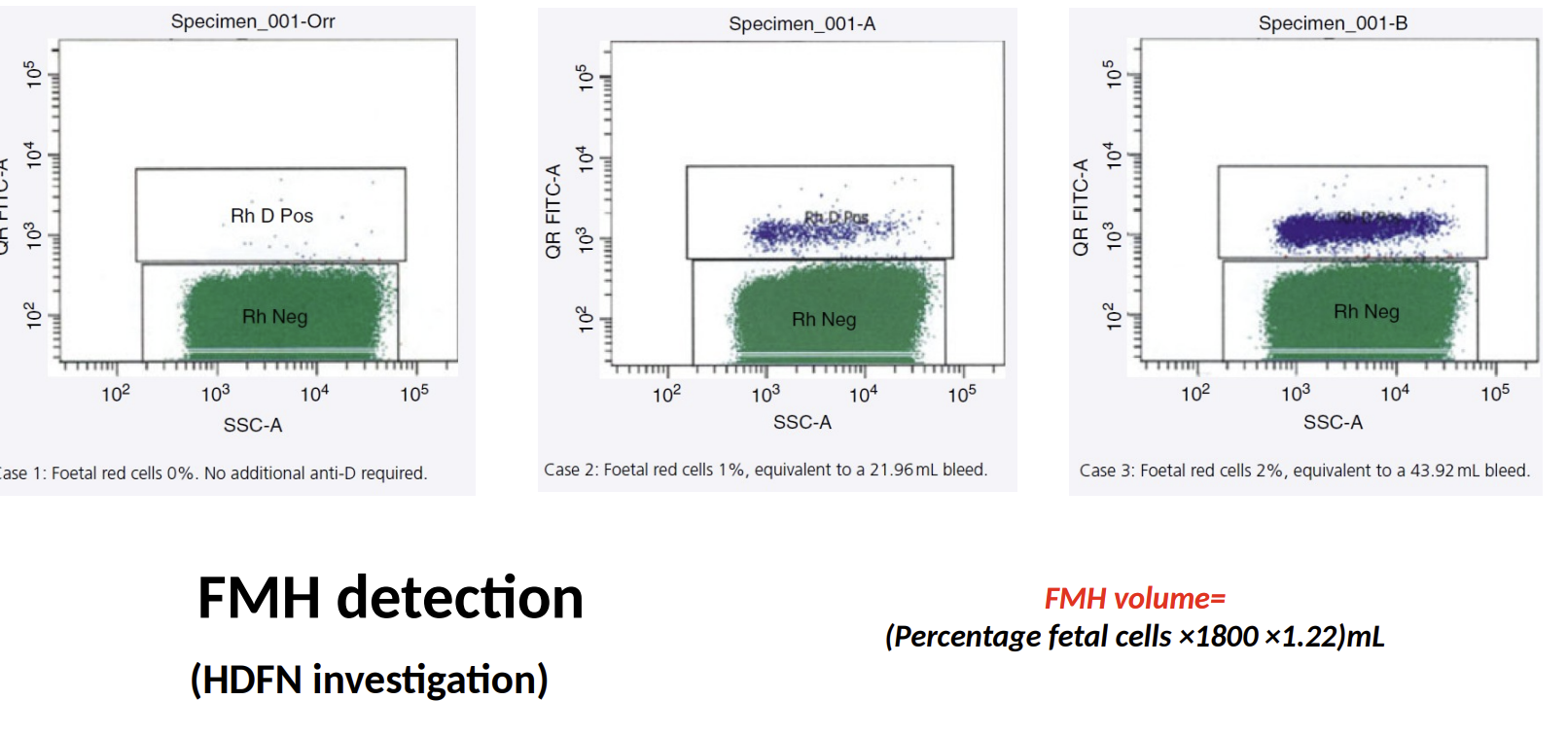
What does the FMH detection look like in FC?
82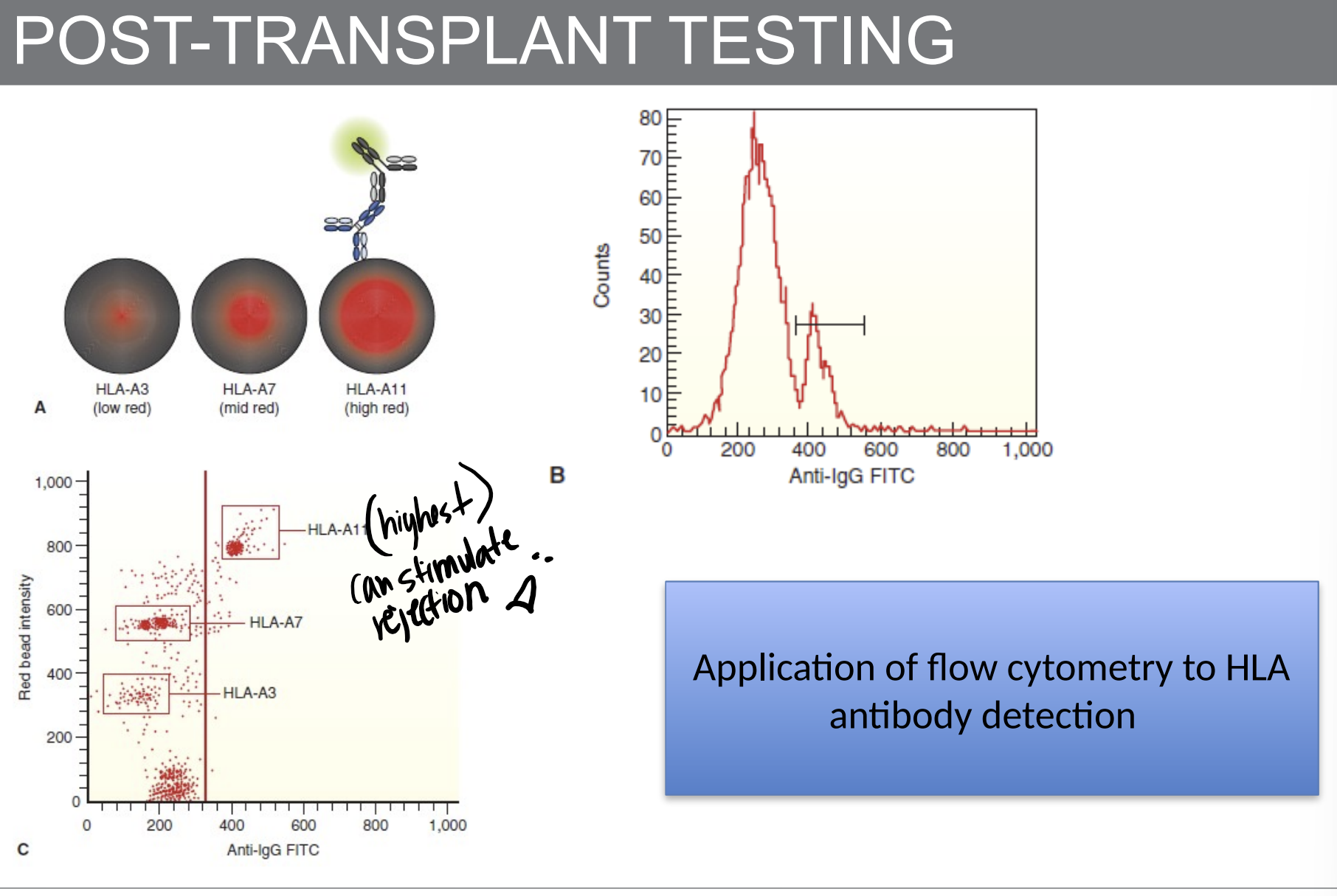
What does the application of flow cytometry to HLA antibody detection look like?
83
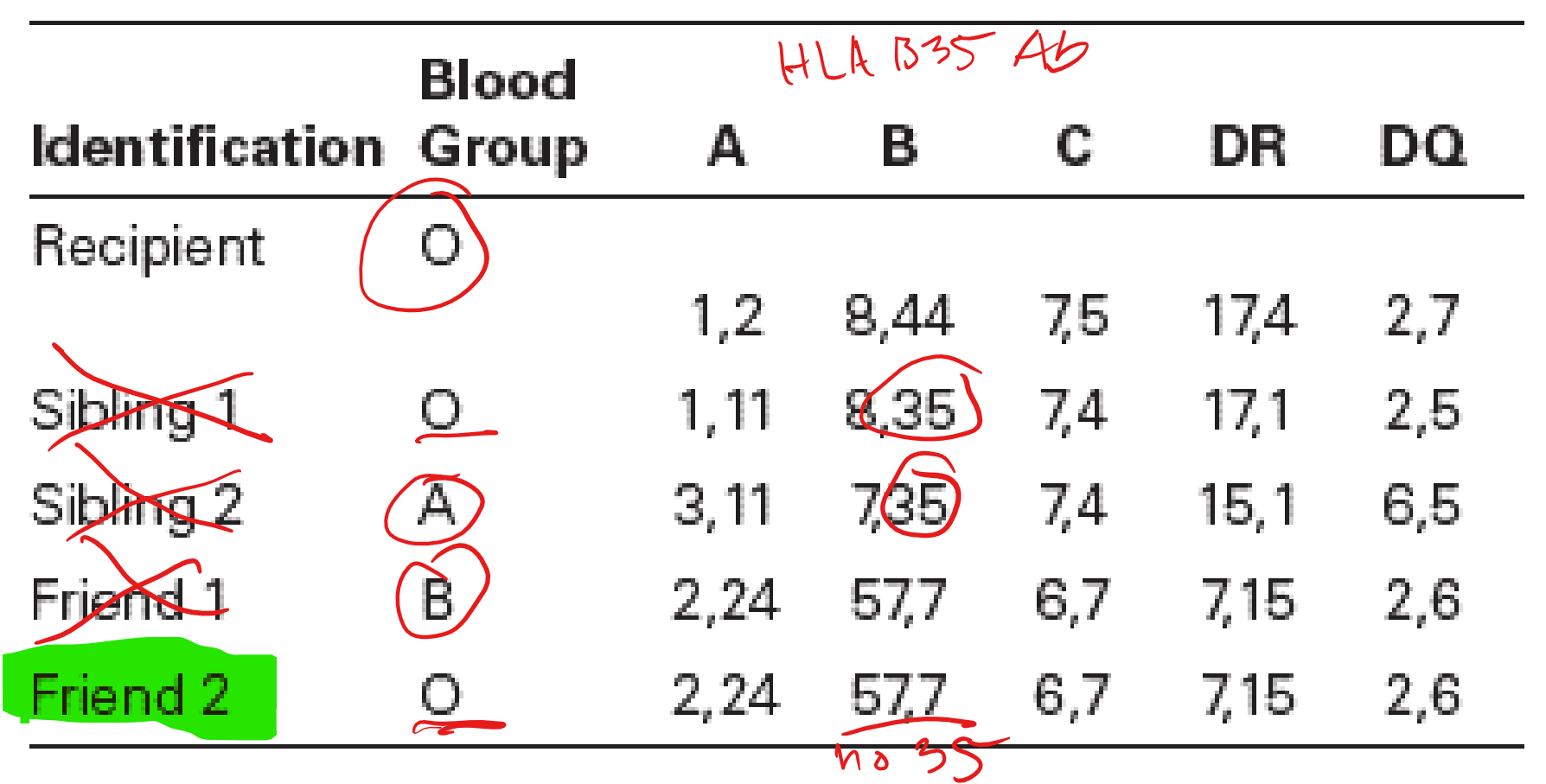
Case Study:
A 40-year-old mother of three needs to have a second kidney transplant. Her first transplant was lost because of chronic rejection. The mother’s HLA type, HLA antibodies, and ABO blood group status were determined. The patient was found to have antibodies to HLA-B35 by flow cytometric testing with HLA-B35–coated beads. The HLA type and blood group were also determined for two of her siblings and two close friends who are interested in donating a kidney to the patient.
Question: From the available donors, who would likely be the most compatible with this patient?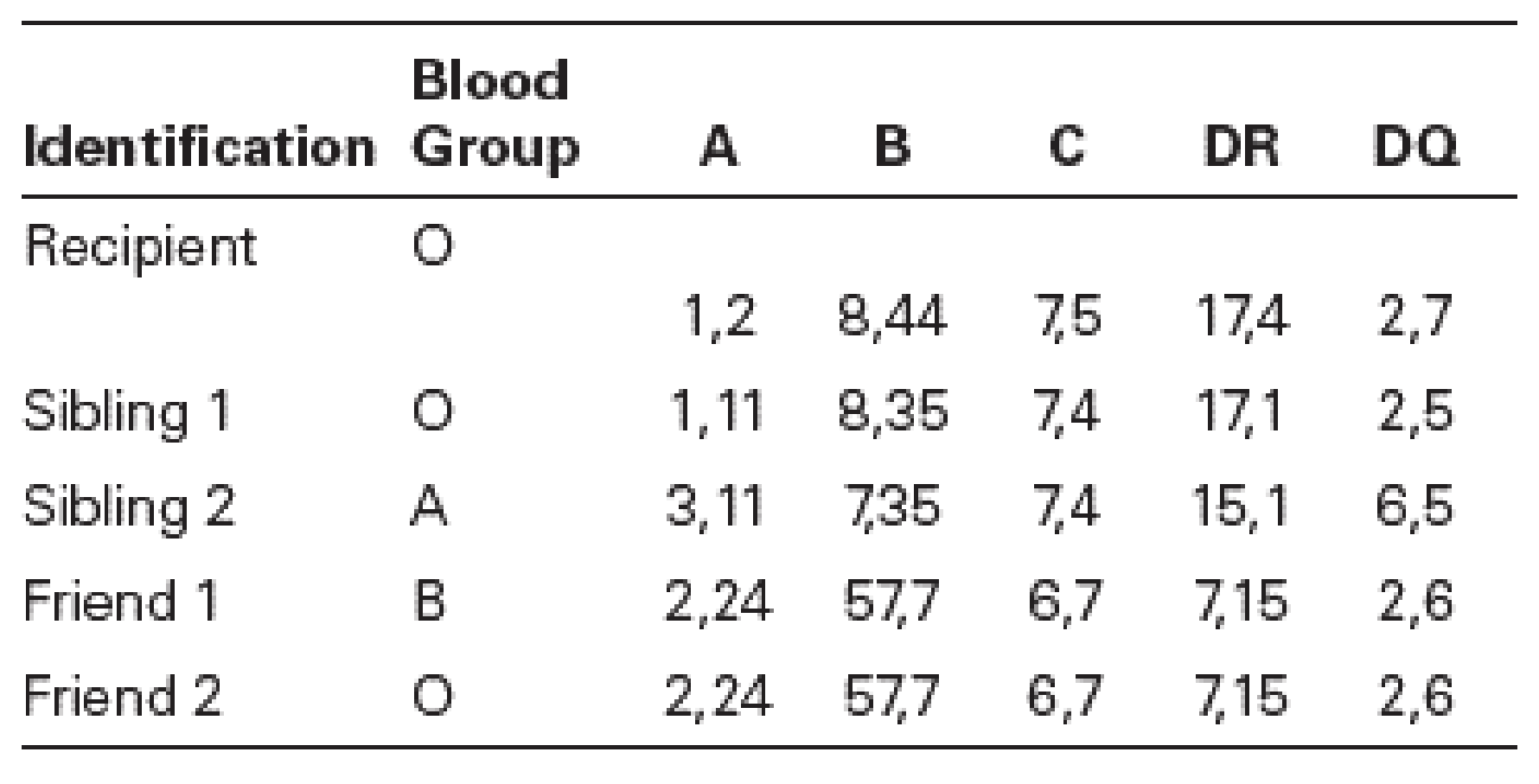
A 40-year-old mother of three needs to have a second kidney transplant. Her first transplant was lost because of chronic rejection. The mother’s HLA type, HLA antibodies, and ABO blood group status were determined. The patient was found to have antibodies to HLA-B35 by flow cytometric testing with HLA-B35–coated beads. The HLA type and blood group were also determined for two of her siblings and two close friends who are interested in donating a kidney to the patient.
Question: From the available donors, who would likely be the most compatible with this patient?
Friend 2 since they are also O blood group, they do not have HLA B35 (patient has antibodies AGAINST B35), and does match for A2, C7, DQ2?