All cards
1
How are viruses classified?
DNA vs RNA
2
Label this Diagram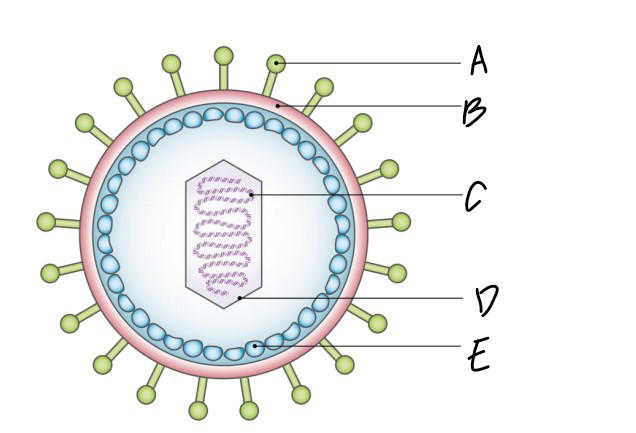
A. envelope protein
B. envelope
C. Viral genome
D. nucleocapsid
E. viral tegument
B. envelope
C. Viral genome
D. nucleocapsid
E. viral tegument
3
Describe DNA viruses
1. not transient/labile
2. reside in cell nucleus
3. viral DNA resembles host DNA for transcription and replication and interact with host machinery
4. many establist persistent infections
2. reside in cell nucleus
3. viral DNA resembles host DNA for transcription and replication and interact with host machinery
4. many establist persistent infections
4
Describe RNA viruses
1. labile and transient
2. prone to mutation
3. most replicate in cytoplasm
4. must code for own RNA polymerase (transcribes DNA sequence into RNA sequence) / carry polymerases
2. prone to mutation
3. most replicate in cytoplasm
4. must code for own RNA polymerase (transcribes DNA sequence into RNA sequence) / carry polymerases
5
Which is more sturdy in the environment, enveloped or non-enveloped?
non-enveloped are hardier (more resistant to temp, acid, proteases, detergents, drying)
6
What are the steps of viral replication?
1. recognition & attachment to target cell
2. penetration
3. uncoating
4. transcription
5. synthesis (translation) and assembly
6. release
2. penetration
3. uncoating
4. transcription
5. synthesis (translation) and assembly
6. release
7
What are the basic steps in viral disease?
1. acquisition
2. infection at primary site
3. incubation period
4. replication in target tissue
5. host response
6. viral production in tissue
7. Resolution vs Persistent / Chronic infection
2. infection at primary site
3. incubation period
4. replication in target tissue
5. host response
6. viral production in tissue
7. Resolution vs Persistent / Chronic infection
8
Label Steps in viral disease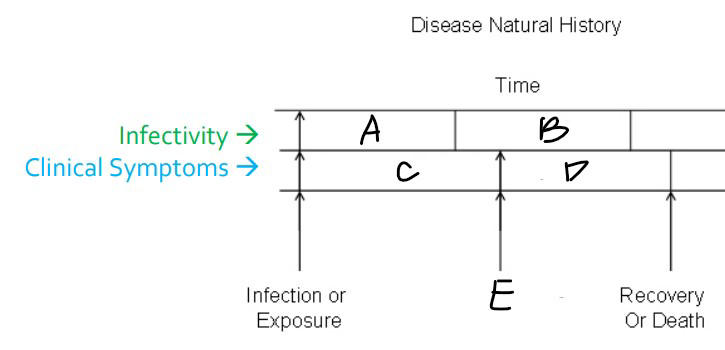
A. latent period
B. infectious period
C. incubation period
D. symptomatic
B. infectious period
C. incubation period
D. symptomatic
9
What is important from looking at the viral disease progression?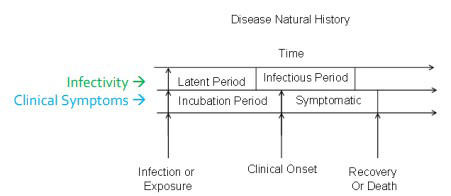
Infectious period begins during the incubation period, so you can spread before you're symptomatic
10
What is the difference between incubation period and prodromal period?
incubation : no signs or symptoms
prodromal : mild signs or symptoms
prodromal : mild signs or symptoms
11
Which period of disease has the most severe signs and symptoms?
period of illness
12
What kind of virus is HIV?
enveloped, single stranded RNA retrovirus
13
What does RNA virus require?
reverse transcriptase
14
What does HIV infect?
CD4-positive cells, CD4+ T cells, monocytes, mq, dendritic cells, microglial brain cells
15
What ability does HIV have?
can lie dormant in CD4 memory cells
16
Which HIV type has worldwide distribution?
HIV-1
17
What is p24?
core protein;
predominant capsid protein
predominant capsid protein
18
How do HIV strains enter cells?
CCR5
19
What are latent / asymptomatic infections?
Immune cells infected with HIV virus but not actively producing new HIV infected cells
Can become 'activated' when encounter infectious agent
Can become 'activated' when encounter infectious agent
20
What cells become infected with HIV?
Brain
Lymph nodes / thymus
Blood, semen, vaginal fluids
Bone marrow
Skin (CD4 lymphocytes)
Colon, duodenum, rectum
Lung
Lymph nodes / thymus
Blood, semen, vaginal fluids
Bone marrow
Skin (CD4 lymphocytes)
Colon, duodenum, rectum
Lung
21
What cells are the most important cells in adaptive immunity?
Helper T cells
22
What is clinical latency in the lab?
1. gradual decline in CD4 cells in blood stream
2. viral load declines
2. viral load declines
23
What is clinical latency clinically?
asymptomatic
replication continues in infected CD4 cells; virus released which then can infect other CD4 cells
replication continues in infected CD4 cells; virus released which then can infect other CD4 cells
24
When is HIV diagnosed as AIDS?
must have AIDS defining condition OR
*CD4 count less than 200 cells/mm3
*CD4 count less than 200 cells/mm3
25
How is stage 3 HIV diagnosed?
<200 cells/mm3
<14% CD4
documentation of AIDS-defining conditions
<14% CD4
documentation of AIDS-defining conditions
26
What does a decline of CD4 mean?
more opportunistic infections occur
(CD4=marker of immunologic damage)
(CD4=marker of immunologic damage)
27
What is Pre-Exposure Prophylaxis?
medication that PREVENT HIV infection
for HIV-NEGATIVE, high risk individuals
for HIV-NEGATIVE, high risk individuals
28
What do Hepatitis viruses target?
all HEPATOCYTES (liver cells)
29
What are other viruses that can also cause hepatitis?
EBV, CMV, HSV, VZV, yellow fever
30
How is HAV transmitted?
fecal-oral
31
What is the genetic material of HBV?
DNA
32
What is the chronicity of HCV?
60-85%
33
What is unique about HDV?
exists as a CO-INFECTION to HBV
can replicate ONLY with HBV
can replicate ONLY with HBV
34
What is the transmission of HEV?
fecal-oral
35
How is hepatitis A virus (HAV) transmitted?
fecal-oral acquisition: HAV replicates int he liver and is shed in stool
36
Is HAV vaccine preventable?
Yes
37
How is Hepatitis V virus (HBV) transmitted?
bloodborne pathogen (blood, semen, and other body fluids)
38
Is HBV vaccine preventable?
yes
39
Label HBV structure 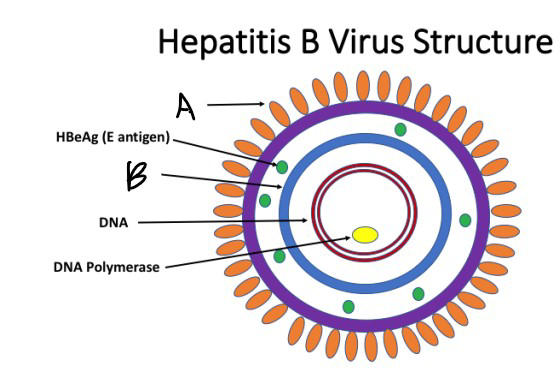
A. HBsAg (surface antigen)
B. HBcAg (core antigen)
B. HBcAg (core antigen)
40
What is HBsAg?
Lipoprotein envelope containing the hepatitis surface antigen
41
What is HBc?W
double-stranded DNA surrounded by nucleocapsid composed of core protein
42
Label this diagram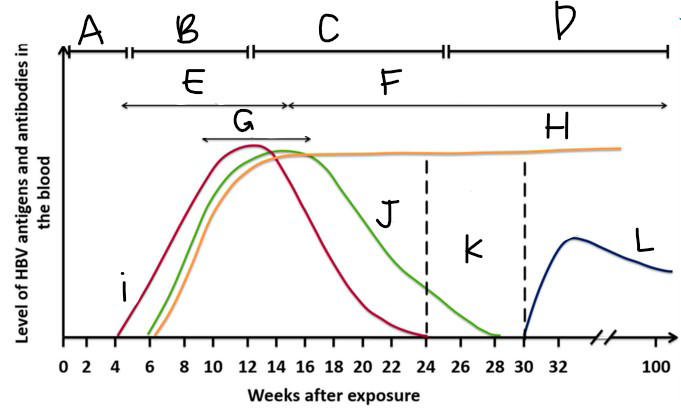
A. incubation
B. Acute phase
C. early recovery
D. Recovery
E. HBeAg
F. Anti-HBe
G. HBV symptoms
H. Total Anti-HBc
I. HBsAg
J. IgM anti-HBc
K. window period
L. Anti-HBVs
B. Acute phase
C. early recovery
D. Recovery
E. HBeAg
F. Anti-HBe
G. HBV symptoms
H. Total Anti-HBc
I. HBsAg
J. IgM anti-HBc
K. window period
L. Anti-HBVs
43
During HBV incubation and acute phase, what antigens/antibodies are increasing?
HBsAg
IgM anti-HBc
Anti-HBc
IgM anti-HBc
Anti-HBc
44
What are the antigens / antibodies declining in early recovery of HBV?
HBsAg and IgM anti-HBC
(total Anti-HBc remains the same)
(total Anti-HBc remains the same)
45
What antibodies do you see an increase of during recovery of HBV?
Anti-HBVs
46
When does HBV become chronic?
persistence of HBsAg for >6 months
47
What should susceptible HBV serologic results look like?
no HBsAg
no Anti-HBs (Abs)
No Anti-HBc
no Anti-HBs (Abs)
No Anti-HBc
48
What should vaccinated/immune HBV serologic results look like?
no HBsAg
YES Anti-HBs (Abs)
No Anti-HBc
YES Anti-HBs (Abs)
No Anti-HBc
49
What should post infection/immune HBV serologic results look like?
no HBsAg
YES Anti-HBs (Abs)
YES Anti-HBc
YES Anti-HBs (Abs)
YES Anti-HBc
50
What does acute infection of HBV look like in serologic results?
+ HBsAg and IgM+ Anti-HBc
51
What does chronic infection of HBV look like in serologic results?
+ HBsAg and IgG+ Anti-HBc
52
How is HCV spread?
bloodborne pathogen (blood & body fluids)
53
What is HCV a high risk of?
devloping a chronic infection
54
Is HCV vaccine preventable?
NO!
55
What is an acute HCV infection?
first 6 months of infection
56
What is unqiue of HDV?
ONLY occurs in people who are also infected with Hep B virus
57
What is a co-infection?
can become infected with both HBV and HDV at the same time
58
What is a superinfection?
gets HDV AFTER first being infected with HBV (worse prognosis)
59
Is there a vaccine for HDV?
No but protection against HBV will protect against future HDV infection
60
What does HDV require for infection?kind of virus i
HDV uses HBV surface ag (HBsAg) as envelop protein; needs HBV to be present to replicate
61
How is HEV (hepatitis E virus) spread?
fecal-oral
62
What are the gastrointestinal viruses?
calcivirus (norovirus)
HAV
Rotavirus
Poliovirus
HAV
Rotavirus
Poliovirus
63
What kind of virus is norovirus?
RNA, SS, NONENVELOPED
highly infectious
highly infectious
64
What is the main clinical presentation of norovirus?
dehydration!
65
What kind of virus is rotavirus?
RNA, DS, NONENVELOPED
Highly infectious
Highly infectious
66
How is rotavirus spread?
fecal-oral, person-person
67
Is rotavirus preventable?
yes, vaccine-preventable
68
Who is commonly at risk of rotavirus?
children 4-36 months of age
69
What causes diarrhea in rotavirus?
NSP4 rotavirus ENTEROTOXIN induces secretory diarrhea without any structural organ damage
70
What kind of virus is poliovirus?
RNA, SS, NONENVELOPEDD
71
What does the poliovirus infect?
human (poliovirus) receptor (PVR) = CD155
72
Where is CD155 expressed?
intestinal epithelial cells and M cells on Peyer's Patches
73
How is poliovirus transmitted?
fecal-oral
74
When is the infectious period for poliovirus?
7-10 days before showing symptoms
75
Is poliovirus vaccine preventable?
YES
76
What is the pathogenesis of poliovirus?
1. alimentary phase
2. lymphatic phase
3. viremic phase
4. neurologic phase
2. lymphatic phase
3. viremic phase
4. neurologic phase
77
What is the alimentary phase of poliovirus?
virus replicates in oropharyngeal and intestinal mucosa
78
What is the lymphatic phase of poliovirus?
virus spreads to tonsils and multiplies in Peyer's patches, cervical, and mesenteri lymph nodes
79
What is the viremic phase of poliovirus?
virus enters bloodsrtream and spreads to lymph nodes and organs
80
What is the neurologic phase of poliovirus?
virus spreads to spinal cord and brain, destroying nerves
(can result in paralysis <1%)
(can result in paralysis <1%)
81
What is the oral polio vaccine?
Sabin vaccine (OPV) protects from poliomyelitis BUT can regain neurvirulence
82
Which vaccine is better for herd immunity? Why?
OPV bc it sheds in poop and can get passed to those around them
83
What is the different from OPV and IPV?
OPV: mixture of live, weakened poliovirus
IPV: mixture of inactivated, killed strain of poliovirus types
IPV: mixture of inactivated, killed strain of poliovirus types
84
Which vaccine for polio has been used in the US? Why?
IPV
to eliminate risk of vaccine-derived poliovirus that can occur with OPV
and decrease risk of wild poliovirus being brought into the country
to eliminate risk of vaccine-derived poliovirus that can occur with OPV
and decrease risk of wild poliovirus being brought into the country
85
Which influence causes pandemics?
infuenza A
86
What kind of virus is influenza?
RNA, SS, ENVELOPED
87
How do we classify influenzas?
HA: hemagglutinin
NA: neuraminidase
NA: neuraminidase
88
What is the difference between a drift and a shift?
Drift: small genetic mutations
Shift: abrupt, major change (in flu A virus)
Shift: abrupt, major change (in flu A virus)
89
Which one causes pandemics? drift or shift?
shift
90
Who gets affected by respiratory syncytial virus (RSV)?
infants and young children
91
What is the human parainfluenze virus a major cause of?
major cause of croup in infants and young children
92
What is the genus of Rhinovirus?
Enterovirus
93
What virus is a common cause of the common cold?
rhinovirus
94
Is there a vaccine for rhinovirus?
no
95
What is another name for measles?
rubeola
96
What is Measles transmission route?
airborne
97
Is measles vaccine preventable?
yes!
98
What is the main clinical presentation of measles?
Rash
Koplik spots (inside of mouth)
Koplik spots (inside of mouth)
99
What are the severe complications of measles?
encephalitis that can lead to deafness and intelectual disability
death
death
100
Are the mumps vaccine preventable?
YES
101
What is the main clinical presentation of mumps?
swollen salivary grands (in 2/3rd of cases)
102
What are the complications of mumps?
deafness
swelling of ovaries / testicles
pancreatitis, meningitis, encephalitis
swelling of ovaries / testicles
pancreatitis, meningitis, encephalitis
103
What happens to mumps in pregnant women?
increased risk of spontaneous abortion during 1st trimesster of pregnancy
104
What is another name for Rubella?
German Measles
105
Who is susceptible for rubella?
pregnant women
106
Is Rubella vaccine preventable?
Yes
107
What can Rubella in pregnant women lead to?
congenital rubella syndrome (CRS)
108
What kind of virus is adenovirus?
DNA, DS, NONENVELOPED
109
What is teh main complication of adenovirus?
respiratory
110
What is the main complication of enterovirus?
acute flaccid paralysis (enterovirus D68)
(also noted, viral conjunctivitiy, hand/food/mouth disease)
(also noted, viral conjunctivitiy, hand/food/mouth disease)
111
What is the main concern of enterovirus D68?
association with acute flaccid paralysis
112
What are the infections caused by herpes virus?
laten infection and lytic infections
113
What is latent infection (herpes)?
asymptomatiaclly persist in cell/host
114
What is lytic infection (herpes)?
the virus destroys/kills the cell upon release of new virions
115
List the viruses in herpesviridae family
herpes simplex (HSV 1,2)
varicella zoster virus (VZV)
Epstein-Barr virus (EBV)
Cytomegalovirus (CMV)
varicella zoster virus (VZV)
Epstein-Barr virus (EBV)
Cytomegalovirus (CMV)
116
Are herpesviridae family enveloped or nonenveloped?
enveloped
117
What does primary non-genital herpes infect?
oral (small red/white bumps in mouth)
118
Where does HSV-1 infection reactive to?
trigeminal sensory ganglia, affecting facial, oral, labial, oropharyngeal, and ocular mucosa (necrotizing lesions)
119
How does ocular herpes simplex happen?
(often pediatric)
Oral HSV-1 infections reactivate from trigeminal sensory ganglia
Oral HSV-1 infections reactivate from trigeminal sensory ganglia
120
What are teh complications of genital herpes?
increase risk of acquiring HIV
*neonatal herpes
*neonatal herpes
121
What can neonatal herpes cause?
severe, acute, fatal, liver diseases and CNS involvement (lasting neurological impairment)
122
What disease does Varicella Zoster Virus (VZV) cause?
primary: Chicken pox
reactivated: Shingles
reactivated: Shingles
123
Is VZV vaccine preventable?
yes
124
How can you get congenital varicella syndrome?
when mother experiences primary infection (chicken pox) during 1st or 2nd trimester of pregnancy
125
What is shingles 'Zoster'?
recurrent / latent VZV infection
(reactivation)
(reactivation)
126
What are one of the main triggers of shingles?
stress
127
How are shingle rashes developed?
by following dermatome pathway
(dermatome: area of skin where sensory nerves derive from single spinal nerve root)
(dermatome: area of skin where sensory nerves derive from single spinal nerve root)
128
What is Epstein-Barr virus implicated in?
infectious mononucleosis
129
What cells does EBV infect?
B lymphocytes, epithelial cells, and natural killer / T cells
cell receptor CD21
cell receptor CD21
130
What is seen in characteristic peripheral blood smear of infectious mononucleosis?
reactive, atypical lymphocytosis
131
What is the transmission of primary CMV infection?
Body fluids
132
What does latent CMV infect?
macrophages
133
Who is the main concern for recurrent CMV?
transplant patients
134
What is post-transplant CMV? (PT-CMV)
NOT reactivation!
transmission/acquisition from infected organ
transmission/acquisition from infected organ
135
What is a concern for congenital CMV?
longterm neurological health problems
136
What are TORCH infections (defined)?
infections acquired in utero or during the birth process that are associated with miscarriage/congenital abnormalities
137
List TORCH infections
T: toxoplasmosis
O: other agents (syphilis, parvovirus, VZV, listeria)
R: Rubella
C: CMV
H: HSV
O: other agents (syphilis, parvovirus, VZV, listeria)
R: Rubella
C: CMV
H: HSV
138
What kind of fever does dengue caust?
Breakbone fever (bc of severe muscle, joint, bone pain)
139
When does dengue become more severe?
after repeat infections
(death due to dengue hemorrhagic fever)
(death due to dengue hemorrhagic fever)
140
What is the main concern of zika virus?
congenital zika syndrome
141
What can congenital zika syndrome lead to?
microcephaly
severe fetal brain defects
severe fetal brain defects
142
What is the leading cause of mosquito borne disease in the US?
West Nile Virus
143
What is the primary reservoir for west nile virus (WNV)?
birds
144
What is the main concern of west nile virus?
CNS involvement*
encephalitis, meningitis. flaccid paralysis
encephalitis, meningitis. flaccid paralysis
145
At what stage of progression is the west nile virus most dangerous?
when it crosses the blood brain barrier, infecting neurons
146
What is the main concern for yellow fever?
Liver damage (virus replicates in liver)
hepatocyte apoptosis and lytic necrosis
hepatocyte apoptosis and lytic necrosis
147
What does hepatocyte apoptosis/jaundice/ reduced clotting factors lead to?
cytokine dysregulation
and disseminated intravascular coagulation
and disseminated intravascular coagulation
148
What happens in disseminated intravascular coagulation?
too much clotting (organ ischemia)
or too little clotting (bleeds with little injury)
or too little clotting (bleeds with little injury)
149
What cells does ebola affect?
endothelial cells
*macrophages
dendritic cells
*macrophages
dendritic cells
150
What does ebola lead to (generally)?
Blood vessel and blood infection leading to hemorrhagic fever
151
What are transmission routes for ebola?
animal to animal transmission (bats/apes/monkeys/anteplopes)
spillover event
human-to-human transmission
spillover event
human-to-human transmission
152
What is the mortality rate of Marburg virus?
high as 90%
153
What is the reservoir of Lassa fever?
multimammate rate
154
What are the two kinds of hantavirus?
Hantavirus pulmonary syndrome (HPS) NEW WORLD (Americas)
Hemorrhagic fever with renal syndrome (HRFS) OLD WORLD (Europe/Asia)
Hemorrhagic fever with renal syndrome (HRFS) OLD WORLD (Europe/Asia)
155
What hantavirus do we see in the US?
Hantavirus pulmonary syndrome (Sin Nombre Virus) caused by deer mouse
156
What was the first vaccination used for smallpox?
cowpox virus
157
What does rabies attack?
attacks CNS and causes fatal encephalitis
158
What is the pathogenesis of rabies?
1. viral inculation from rabid animal bite
2. virus replicates in muscle
3. virus binds to nicotinic acetylcholine receptors at NMJ
4. virus travels within axons in peripheral nerves through axonal transport
5. replications take place in the motor neuron of spinal cord and ganglia travels to brain
6. infections of brain neurons lead to inflammation
7. virus enters salivary glands and other organs of victim
2. virus replicates in muscle
3. virus binds to nicotinic acetylcholine receptors at NMJ
4. virus travels within axons in peripheral nerves through axonal transport
5. replications take place in the motor neuron of spinal cord and ganglia travels to brain
6. infections of brain neurons lead to inflammation
7. virus enters salivary glands and other organs of victim
159
What are the 3 highly pathogenic coronaviruses?
1. MERS-CoV (Middle East Resp Syndrome)
2. SARS-CoV (Severe acute resp syndrome)
3. SARS-CoV-2
2. SARS-CoV (Severe acute resp syndrome)
3. SARS-CoV-2
160
What is MERS-CoV associated with?
direct contact with infected CAMELS
161
What does MERS-CoV lead to?
acute respiratory failure/death
162
What is the key reagent for direct/indirect fluorescent ab stain?
fluorescently-labeled monoclonal abs
163
What are the reagents for enzyme immunoassays?
monoclonal abs, enzyme, substrate
164
What are the 3 different molecular amplification?
PCR
RT-PCR
qPCR
RT-PCR
qPCR
165
What viruses do you use PCR?
DNA viruses
direct amplification of DNA
direct amplification of DNA
166
What viruses do you use RT-PCR?
RNA viruses
(added step of reverse transcription)
(added step of reverse transcription)
167
What is qPCR?
REAL-TIME PCR
fluorescence is measured after each cycle
fluorescence is measured after each cycle
168
What is Ct?lowe
Cycle number at which the same crosses threshold and can be detected above background signal
169
How does Ct change with more target (virus) in sample?
The more virus, the lower the Ct
170
What does a lower Ct value mean?
higher amount of targeted nucleic acid sample
171
What does a higher Ct value mean?
Lower amount of sample containing target nucleic acid