All cards
1
Steatorrhea due to malabsorption may result from:
A. Pancreatic cancer
B. Celiac disease
C. Ileal resection
D. Bile duct obstruction
A. Pancreatic cancer
B. Celiac disease
C. Ileal resection
D. Bile duct obstruction
B. Celiac disease
2
Steatorrhea is primarily characterized by feces that are:
A. Charcoal colored
B. Small and round
C. Greasy and spongy
D. Foamy and floating
A. Charcoal colored
B. Small and round
C. Greasy and spongy
D. Foamy and floating
C. Greasy and spongy
3
Which of the following is not present in amniotic fluid?
a. blood
b. hormones
c. electrolytes
d. enzymes
a. blood
b. hormones
c. electrolytes
d. enzymes
a. blood
4
As the ΔA450 of amniotic fluid increases:
a. the concentration of bilirubin increases.
b. the level of fetal RBC hemolysis decreases.
c. fetal lung maturity increases.
d. fetal health improves.
a. the concentration of bilirubin increases.
b. the level of fetal RBC hemolysis decreases.
c. fetal lung maturity increases.
d. fetal health improves.
a. the concentration of bilirubin increases.
5
Testing for the presence of bilirubin in amniotic fluid is:
a. time sensitive.
b. light sensitive.
c. temperature sensitive.
d. All of the above
a. time sensitive.
b. light sensitive.
c. temperature sensitive.
d. All of the above
d. All of the above
6
Amniocentesis is performed in late pregnancy to assess:
a. neural tube defects.
b. chromosomal aberrations.
c. fetal status with regard to toxemia.
d. metabolic disorders.
a. neural tube defects.
b. chromosomal aberrations.
c. fetal status with regard to toxemia.
d. metabolic disorders.
c. fetal status with regards to toxemia
7
All of the following guaiac-based fecal occult blood test (gFOBT) results are correctly paired except:
a. false-negative—cantaloupe.
b. false-positive—red or rare meat.
c. false-negative—ascorbic acid.
d. false-positive—broccoli.
a. false-negative—cantaloupe.
b. false-positive—red or rare meat.
c. false-negative—ascorbic acid.
d. false-positive—broccoli.
a. false-negative -- cantaloupe
8
The presence of any pale pink to red color in amniotic fluid requires which immediate action for the specimen?
a. Refrigeration
b. Protection from light
c. Placement in a 37 °C water bath
d. Centrifugation
a. Refrigeration
b. Protection from light
c. Placement in a 37 °C water bath
d. Centrifugation
d. Centrifugation
9
Which of the following color/condition pairs is incorrectly matched with regard to amniotic fluid?
a. Dark green/ biliverdin
b. Green/meconium
c. Yellow/normal
d. Red/ blood
a. Dark green/ biliverdin
b. Green/meconium
c. Yellow/normal
d. Red/ blood
c. Yellow/normal
10
Specimen collection and handling of amniotic fluid includes all of the following except:
a. transfer to a sterile glass container.
b. protection from light.
c. aseptic handling.
d. use of a series of numbered syringes
a. transfer to a sterile glass container.
b. protection from light.
c. aseptic handling.
d. use of a series of numbered syringes
a. transfer to a sterile glass container
11
Which biochemical markers are used to identify neural tube defects?
a. Phosphatidylglycerol and lecithin
b. Meconium and sphingomyelin
c. Lamellar bodies and phospholipids
d. Alpha-fetoprotein and acetylcholinesterase
a. Phosphatidylglycerol and lecithin
b. Meconium and sphingomyelin
c. Lamellar bodies and phospholipids
d. Alpha-fetoprotein and acetylcholinesterase
d. Alpha-fetoprotein and acetylcholinesterase
12
Bleeding in the lower GI tract may result in the presence of:
a. melena in the feces.
b. bright red blood in the feces.
c. mahogany-colored stool.
d. black, tarry stool.
a. melena in the feces.
b. bright red blood in the feces.
c. mahogany-colored stool.
d. black, tarry stool.
b. bright red blood in the feces.
13
A 65-year-old woman presents to the clinic with a chief complaint of diarrhea for the past month. Previous bacterial, ova, and parasitic testing was negative. Fecal osmolality testing is performed, and the result is 330 mOsm/kg. The fecal sodium is 75 mEq/L, and the fecal potassium is 103 mEq/L. The patient is suffering from:
a. secretory diarrhea.
b. intestinal hypermotility.
c. osmotic diarrhea.
d. steatorrhea.
a. secretory diarrhea.
b. intestinal hypermotility.
c. osmotic diarrhea.
d. steatorrhea.
osmotic diarrhea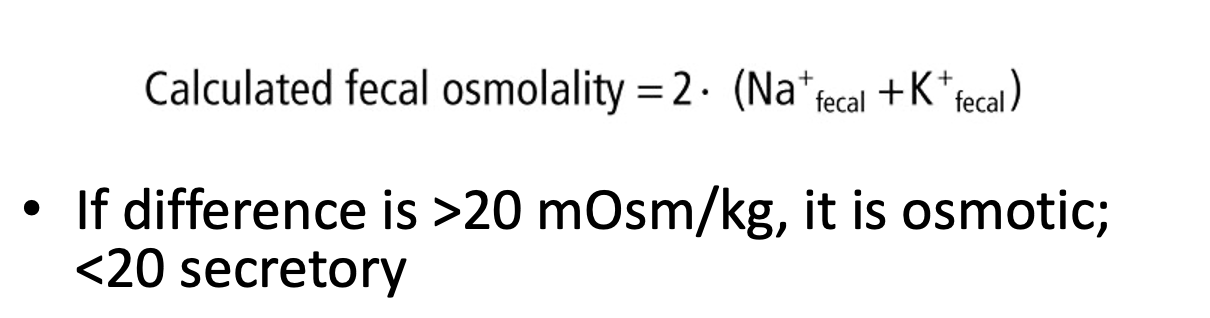
14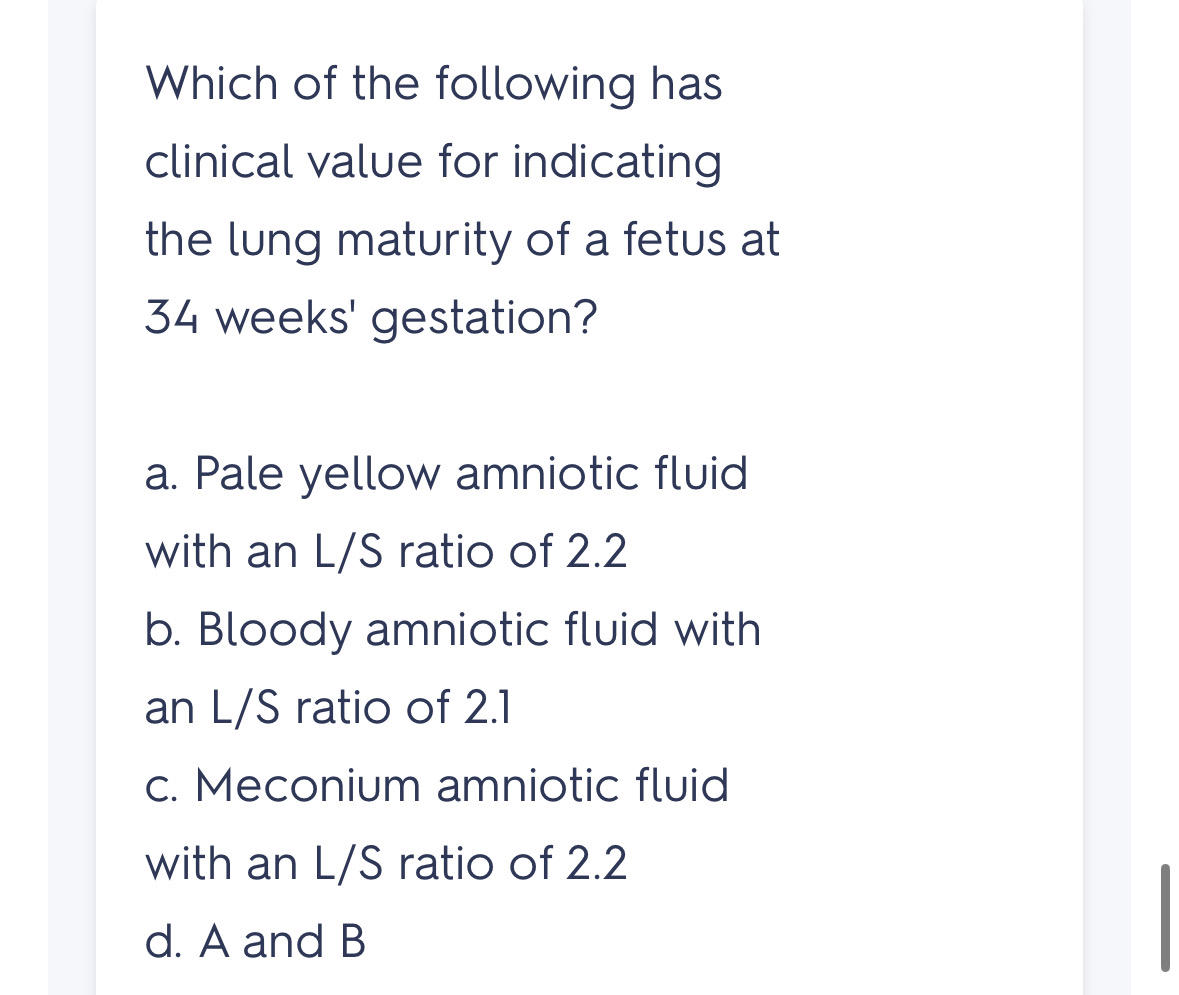
A. pale yellow amniotic fluid with an L/S ratio of 2.5
15
A. amniotic fluid has a higher level of creatinine than does urine.
16
An increase in the number of cells in CSF is referred to as:
a. leukocytosis
b. histiocytosis
c. pleocytosis
d. erythrocytosis
a. leukocytosis
b. histiocytosis
c. pleocytosis
d. erythrocytosis
C. pleocytosis
17
If tuberculous meningitis is suspected, which type of stain is ordered?
a. Gram stain
b. Acid-fast stain
c. India ink
d. Eosin stain
a. Gram stain
b. Acid-fast stain
c. India ink
d. Eosin stain
B. acid-fast stain
18
The physician performs a spinal tap and hands you the first tube. You note that it is extremely bloody. The second and third tubes are equally bloody. The technologist surmises that the presence of blood is most likely due to:
a. a subarachnoid hemorrhage.
b. bacterial meningitis.
c. encephalitis.
d. a traumatic tap.
a. a subarachnoid hemorrhage.
b. bacterial meningitis.
c. encephalitis.
d. a traumatic tap.
A. a subarachnoid hemorrhage
19
CSF cell counts are usually performed on tube #:
a. 1.
b. 2.
c. 3.
d. 4.
a. 1.
b. 2.
c. 3.
d. 4.
c. 3
20
All CSF specimens are processed STAT because a delay in testing may result in:
a. decreased cell counts.
b. decreased lactate levels.
c. increased glucose levels.
d. increased microbial growth.
a. decreased cell counts.
b. decreased lactate levels.
c. increased glucose levels.
d. increased microbial growth.
a. decreased cell counts
21
A 5-year-old female presents to the ED with a fever of 102.8 °F, confusion, and sleepiness. The mother reports that the child had been feeling nauseous and had vomited yesterday but not today. The examination further reveals that the child has photosensitivity. A lumbar puncture is performed, and the test results are as follows:
Color: Colorless
Clarity: Cloudy (2+)
Gram stain: Negative
Culture: Pending
Leukocyte count: 5500 cells/mL
Differential count:
Monocytes: 5%
Lymphocytes: 5%
Neutrophils: 90%
Total protein: 100 mg/dL
Glucose: 35 mg/dL
Lactate: 50 mg/dL
Based on the CSF report and the clinical symptoms, the physician suspects the child has:
a. bacterial meningitis.
b. viral stomach flu.
c. Reye's syndrome.
d. viral meningitis.
Color: Colorless
Clarity: Cloudy (2+)
Gram stain: Negative
Culture: Pending
Leukocyte count: 5500 cells/mL
Differential count:
Monocytes: 5%
Lymphocytes: 5%
Neutrophils: 90%
Total protein: 100 mg/dL
Glucose: 35 mg/dL
Lactate: 50 mg/dL
Based on the CSF report and the clinical symptoms, the physician suspects the child has:
a. bacterial meningitis.
b. viral stomach flu.
c. Reye's syndrome.
d. viral meningitis.
a. bacterial meningitis
22
The physician removes 1 mL of CSF from a 2-year-old patient and immediately puts it into a properly labeled, single sterile tube. The technologist delivers the STAT specimen to:
a. immunology.
b. hematology.
c. chemistry.
d. microbiology.
a. immunology.
b. hematology.
c. chemistry.
d. microbiology.
d. microbiology
23
Cerebrospinal fluid formation, circulation, and reabsorption into the blood is a dynamic process in which how many milliliters of CSF are turned over per hour?
a. 10
b. 20
c. 85
d. 150
a. 10
b. 20
c. 85
d. 150
b. 20
24
What color does xanthochromia appear as in the supernatant of CFS?
a. Yellow
b. Orange
c. Pink
d. All of the above
a. Yellow
b. Orange
c. Pink
d. All of the above
d. all of the above
25
The CSF/serum albumin index is useful in determining which of the following?
a. Albumin gradient between blood plasma and CSF
b. Breach in the blood-brain barrier
c. Presence of bacteria in the meninges
d. Normal production of CSF
a. Albumin gradient between blood plasma and CSF
b. Breach in the blood-brain barrier
c. Presence of bacteria in the meninges
d. Normal production of CSF
b. Breach in the blood-brain barrier