Lecture 8 - Fecal
Study these flashcardsFree · spaced repetition · iPhone, Android, Mac & web
All cards
1
What are the fecal analysis uses? what is it used to detect?
-bleeding in gastrointestinal tract
-differential diagnosis of diarrhea
-Steatorrhea, malabsorption, maldigestion
-Hepatic (liver), biliary, and pancreatic diseases
-Bacterial, viral, or parasitic infestation
-differential diagnosis of diarrhea
-Steatorrhea, malabsorption, maldigestion
-Hepatic (liver), biliary, and pancreatic diseases
-Bacterial, viral, or parasitic infestation
2
How many mL of liquid enters intestines each day?
9000 mL
3
How many mL of liquid exits each day? What is the weight in grams?
150 mL; 100 to 200 g of feces / day
4
What is the small intestine used for?
Digestion and absorption
5
What is the large intestine used for?
Absorption of water, sodium (Na), chloride (Cl)
6
When does diarrhea develop?
If water absorption is inhibited or there inadequate time allowed for absorption.
7
What causes constipation?
Results from stationary bowel contents or decreased intestinal motility.
8
The main role of the large intestine is to absorb various substances, except for:
A) Potassium.
B) Water.
C) Chloride.
D) Sodium.
A) Potassium.
B) Water.
C) Chloride.
D) Sodium.
A) Potassium.
9
Which organ secretes bile?
gallbladder
10
What is the function of bile?
break down lipids
11
What is the function of lipase?
break down triglycerides and fatty acids
12
What happens if theres an obstruction in the common bile duct?
The bile and also the enzyme from pancreas can not enter the duodenum, so lipids in the feces will increase! bc the bile from the gallbladder won't be able to travel to the duodenum
13
When there's no bile in the feces, what color are the feces?
pale color!
14
Can bile cause a change in skin color, and if so, what is this condition called?
Yes, bile can cause a change in skin color, leading to a yellow discoloration known as jaundice. This occurs when there is an excess of bilirubin, a pigment found in bile, in the bloodstream. The bilirubin deposits in the skin, causing a yellow tint to both the skin and the whites of the eyes. Jaundice is typically a sign of liver problems.
15
How is diarrhea classified as?
Increased volume, liquidity, and frequency of bowel movements compared with individual's normal pattern.
16
What are the 3 different types of diarrhea?
1. Secretory
2. Osmotic
3. Intestinal hypermotility
2. Osmotic
3. Intestinal hypermotility
17
What is secretory diarrhea?
Increased solute secretions by intestine draws water and electrolytes into intestine
18
What is osmotic diarrhea?
Increased osmotically active solutes draw water and electrolytes into intestine.
19
What is intestinal hypermotility diarrhea?
-decreases time available for absorption; can occur alone or with secretory or osmotic
- laxatives, stress, drugs, other diarrheas
- laxatives, stress, drugs, other diarrheas
20
What are the differences between secretory and osmotic diarrhea?
Secretory is severe and a lot of water and electrolytes enter the lumen of the GI tract. (associated with bacteria and malignant cancer); >1L/day; body/ blood has low electrolyes; fasting doesn't help; osmolality gap is <20 mOsm/kg
Osmotic is ordinary, and a person loses a lot of water. (associated with lactos intolerance; sugar in lumen so it influxes the water within); <1L/day; fasting helps; osmolality gap is >20 mOsm/kg
Osmotic is ordinary, and a person loses a lot of water. (associated with lactos intolerance; sugar in lumen so it influxes the water within); <1L/day; fasting helps; osmolality gap is >20 mOsm/kg
21
what are some examples that cause secretory diarrhea?
-Enterotoxin-producing organisms
-Damage to mucosa due to drugs or disease
-Damage to mucosa due to drugs or disease
22
what are some examples that cause osmotic diarrhea?
-maldigestion
-malabsorption
-malabsorption
23
What happens to the feces when fasting during osmotic diarrhea?
diarrhea stops
24
What happens to the feces when fasting during secretory diarrhea?
diarrhea continues
25
To differentiate between secretory vs. osmotic diarrhea, what is measured?
fecal osmolality, sodium (Na), and potassium (K)

26
Example: is sodium if 60 mOsm/kg and postassium is 100.
Measured osmolality is 330 (will be given on exam)
Measured osmolality is 330 (will be given on exam)
2* (60 + 100) ; THEN SUBSTRACT BY 330.
Ans: 10 <- SECRETORY!! (BC <20 mOsm/kg)
Ans: 10 <- SECRETORY!! (BC <20 mOsm/kg)
27
How many mOsm/kg determines if diarrhea is osmotic or secretory?
>20 = osmotic
<20 = secretory
<20 = secretory
28
What type of container is generally acceptable for fecal specimen collection?
Clear instructions to patient critical
Clean, sealable, leakproof containers
Amount needed and dietary restrictions depend on test ordered
Avoid contamination of fecal specimen with urine, toilet tissue, or toilet water
Open closed containers of feces with disposable covering to prevent splatters from gas formation
Clean, sealable, leakproof containers
Amount needed and dietary restrictions depend on test ordered
Avoid contamination of fecal specimen with urine, toilet tissue, or toilet water
Open closed containers of feces with disposable covering to prevent splatters from gas formation
29
What pigment gives the normal brown color of poop? and where does it come from?
from bile pigments (stercobilin) that are orange-brown
30
What can cause unusual colors in feces?
foods, medicine, or blood
31
What condition is indicated by pale or clay-colored stools?
post-hepatic obstructions
32
Black feces results from??
blood from upper GI tract
33
Red feces results from??
blood from lower GI tract
34
What do normal feces form?
Cylindrical masses
May be bulky due to undigested foodstuffs or increased gas
Soft stools indicate water content
May be bulky due to undigested foodstuffs or increased gas
Soft stools indicate water content
35
Is mucus normally present in feces?
NO
36
What is mucus in feces associated with?
with many conditions
Ex: tuberculosis
Ex: tuberculosis
37
Why does normal poop smell?
normal odor comes from metabolic by-products of the intestinal flora bacteria
38
What causes a change in poop odor?
normal flora disrupted or a change in foods
39
What are indoles?
breakdown products of the amino acid tryptophan; give poop its odor
40
Are WBCs in the feces normal? What does the presence of fecal neutrophils typically indicate?
NO! it may indicate inflammation in the intestines; even a small number indicates invasive or inflammatory condition of intestinal wall
41
Which stain is used to ID fats in fecal specimen?
Qualitative orange-red staining of neutral fats with Sudan III, Sudan IV, or Oil Red O
42
What are meat fibers?
refer to undigested muscle fibers from meat that are visible in a person's feces. INCREASE IS ABNORMAL; can be seen on fecal fat slides
43
What is occult blood?
blood not visually apparent
44
What can fecal blood be an early symptom of?
colorectal cancer
45
What is this?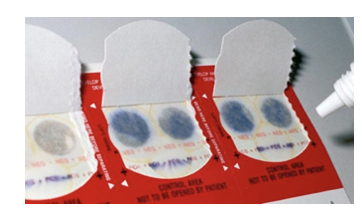
Fecal Occult Blood Test; blue means positive for occult blood
46
What is steatorrhea?
condition characterized by the presence of excess fecal fat in the stool; >7g/day commonly seen in malabsorption syndromes
47
What characterizes the appearance of fecal specimens in steatorrhea?
feces are pale, greasy, spongy or pasty and very foul smelling
48
Is diarrhea and steatorrhea the same?
No! both can occur together tho; good patient history is valuable
49
what is quantitative fecal fat?
Definitive test for steatorrhea; tells you how much fat there is, but doesn't tell you the cause
50
How often are the feces collected for quantitative fecal fat test?
2 to 3 days
51
How is the fecal fat measured?
on well-mixed aliquot by gravimetric, titrimetric, or nuclear magnetic resonance (NMR) spectroscopy
52
How is fecal fat reported? (units)
grams of fat per day (g/Day)
Normal adults excreting 2 to 7 g/day
Normal adults excreting 2 to 7 g/day
53
What are fecal carbohydrated?
Undigested carbohydrates in stool result in bloating, flatulence, and explosive diarrhea due to fermentation by normal flora
54
what is the stool pH when fecal carbohydrates are present?
pH 5 to 6; normal is >7
55
What are clinitest tablets based on?
copper reduction principle; can detect reducing sugars and other reducing substances (sucrose not detected)
56
Which enzyme is responsible for breaking down carbohydrates?
amylase
57
What test is used for fetal hemoglobin?
APT test
58
What is the APT test used to differentiate between? and is it quantitative or qualitative?
fetal and maternal blood in a newborn's stool; qualitative test! (based on alkaline resistance of fetal hemoglobin)
59
What is the specimen diluted with for the APT test?
Dilute sodium hydroxide (NaOH) will degrade maternal but not fetal hemoglobin
60
How would you read the results for the APT test?
If blood degrades, from mother (right pic)
If blood does not degrade, its from baby. (baby)
If blood does not degrade, its from baby. (baby)
61
What would result in a false positive result for an APT test?
False positive result: if an old sample of fetal blood is tested. (bc it naturally darkens)