Chapter 1
Study these flashcardsFree · spaced repetition · iPhone, Android, Mac & web
All cards
1
Which of the following microorganisms are NOT eukaryotic?
A. Bacteria
B. Yeasts
C. Molds
D. Protozoa
A. Bacteria
B. Yeasts
C. Molds
D. Protozoa
A. Bacteria
2
(True/False) The bacterial cell wall is composed of peptidoglycan.
True
3
Viruses are ______
A. Prokaryotic
B. Eukaryotic
C. Neither
A. Prokaryotic
B. Eukaryotic
C. Neither
C. Neither
4
(True/ false) Molds make their own food, like plants.
False
5
What term describes the idea that "living organisms can come from non living substances?
Spontaneous generation
6
The investigations of which researcher finally disproved that living organisms can come from nonliving substances?
A. Koch
B. Pasteur
C. Spallanzani
A. Koch
B. Pasteur
C. Spallanzani
B. Pasteur
7
Which researcher ultimately gave us a method for proving that a particular microbe causes a particular disease?
A. Pasteur
B. Gram
C. Koch
A. Pasteur
B. Gram
C. Koch
C. Koch
8
Which researcher developed a widely used staining technique in microbiology?
A. Hesse
B. Gram
C. Semmelweis
A. Hesse
B. Gram
C. Semmelweis
B. Gram
9
Who was the first person to observe microorganisms?
Antoni Van Leeuwenhoek
10
Who developed the first taxonomic system?
Carolus Linnaeus
11
What are the main organisms that are covered in this class?
Bacteria
Fungi
Protozoa
Viruses
Fungi
Protozoa
Viruses
12
What are the 3 domains of life?
Bacteria
Archaea
Eukarya
Archaea
Eukarya
13
Which domains of life are considered prokaryotes?
Bacteria and Archaea
14
What organisms fall under the eukarya domain?
Fungi
Protozoa
Plants
Animals
Protozoa
Plants
Animals
15
What are some characteristics of prokaryotes?
Unicellular and lack a true nucleus
Reproduce asexually aka binary fission
Peptidoglycan cell walls
Smaller than eukaryotic cells
Found places w/ sufficient moisture
Mostly beneficial, some cause disease
Reproduce asexually aka binary fission
Peptidoglycan cell walls
Smaller than eukaryotic cells
Found places w/ sufficient moisture
Mostly beneficial, some cause disease
16
Are fungi eukaryotes or prokaryotes?
Eukaryotes
17
What are some characteristics of fungi?
Obtain food from other organisms
Have cell walls!!
Have cell walls!!
18
What are 2 different types of microscopic fungi?
Molds and Yeasts
19
What are molds?
Multicellular
Grow as long filaments
Reproduce by sexual and asexual spores.
Grow as long filaments
Reproduce by sexual and asexual spores.
20
What are yeasts?
Unicellular
Reproduce asexually by budding
Some produce sexual spores
Reproduce asexually by budding
Some produce sexual spores
21
What structure does this mold (Penicillium chrysogenum) have?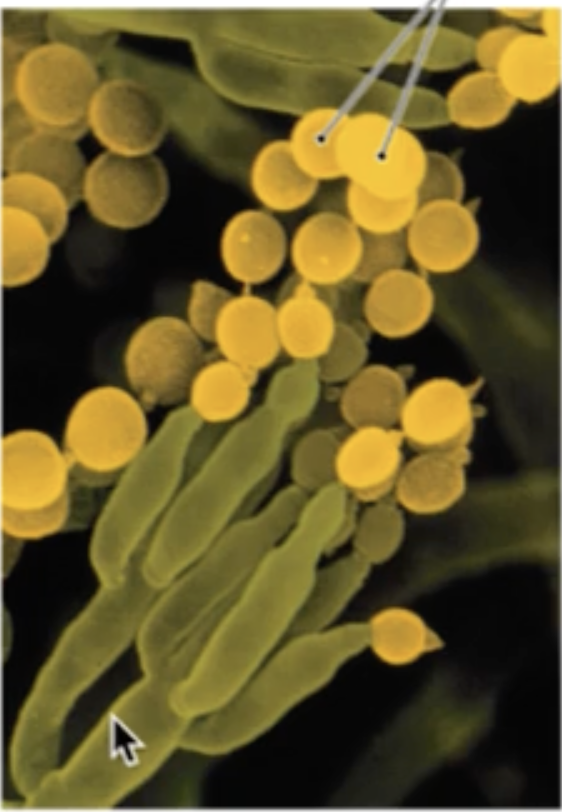
Chains of spores
22
What structure does this yeast (Saccharomyces cerevisiae) have?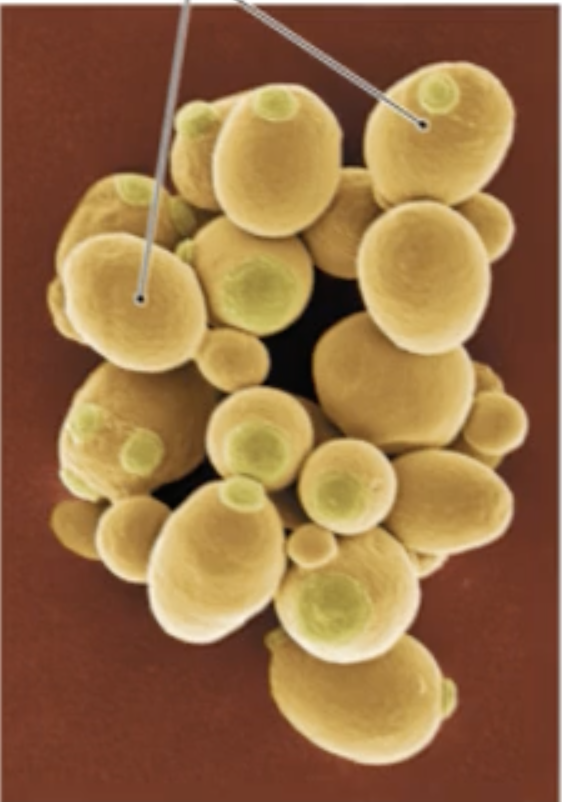
Budding cells
23
Which yeast is used to make bread?
Saccharomyces cerevisiae
24
How is the genus and species written?
Genus: Capitalized
species: lowercase
& italicized or underlined.
species: lowercase
& italicized or underlined.
25
What domain do Protozoa fall under?
Eukaryotes
26
What are some characteristics of protozoa?
Single-cells organisms
Similar to animals in nutritional needs and no cell walls
Most live freely in water
Asexual (mostly) and sexual reproduction
Most are capable of locomotion: pseudopods, cilia, and flagella.
Similar to animals in nutritional needs and no cell walls
Most live freely in water
Asexual (mostly) and sexual reproduction
Most are capable of locomotion: pseudopods, cilia, and flagella.
27
What are some characteristics of viruses?
Neither prokaryotic or eukaryotic
Acellular, NON-LIVING, particles
Observed using electron microscopy.
Use the host to grow and reproduce/inert outside host.
Composed of a DNA or RNA core surrounded by a protein coat.
Acellular, NON-LIVING, particles
Observed using electron microscopy.
Use the host to grow and reproduce/inert outside host.
Composed of a DNA or RNA core surrounded by a protein coat.
28
What's an example of a DNA virus?
Herpes virus family
29
What's an example of a RNA virus?
Sars COV-2 or influenza virus
30
What is it called when viruses infect bacteria?
bacteriophages or phages
31
What does the "Spontaneous Generation" state?
Living organisms can arise spontaneously from non-living matter.
32
Who proposed the "Spontaneous Generation"?
Artistotle
33
Who did experiments using "swan-necked" flasks?
Pasteur
34
What did pasteur's experiments consist of?
When flasks remained upright -> no microbial growth appeared
When flasks were tilted -> microbes within a day
When flasks were tilted -> microbes within a day
35
Who disproved Spontaneous Generation?
Pasteur
36
What did the spontaneous generation lead to?
Development of the scientific method
37
What are the 4 main steps of the scientific method?
Observations
Question
Hypothesis
Experiment (including control groups)
Observations
Question
Hypothesis
Experiment (including control groups)
Observations
38
What is the Germ Theory of Disease?
Diseases are caused by microoganisms
39
What are the Koch Postulates?
1. Suspected agents must be present in every case
2. Agent must be isolated and grown outside the host
3. Host should get the disease when introduced with the agent.
4. Same agent must be found in the host
2. Agent must be isolated and grown outside the host
3. Host should get the disease when introduced with the agent.
4. Same agent must be found in the host
40
What are some exceptions to the Koch postulates?
Some pathogens can't be cultured
Diseases can be caused by a combination of pathogens and other co-factors.
Ethical reasons
Disease may be caused by more than one pathogen
Confusion with natural microbiota.
Diseases can be caused by a combination of pathogens and other co-factors.
Ethical reasons
Disease may be caused by more than one pathogen
Confusion with natural microbiota.