Lecture 4 - Renal Function
Study these flashcardsFree · spaced repetition · iPhone, Android, Mac & web
All cards
1
Why do normal ranges for urine composition vary?
Because urine volume and solute composition can vary greatly depending on :
Diet
Physical acitivity
Health
Diet
Physical acitivity
Health
2
Kidneys are the principal organ for regulating what?
body fluid composition
3
What is the primary renal excretion?
elimation route of soluble metabolic wastes
4
How is kidney function assessed?
By wastes excreted by kidneys (creatinine, urea)
5
What % of urine has water? what % of urine is solute?
94% (water)
6% (solute)
6% (solute)
6
What is urine?
Ultrafiltrate of plasma
7
What is osmolality?
the concentration of dissolved particles in a fluid, such as blood or urine.
8
How is osmolality measured? (what are the units)
Osmoles per kilogram (Os/kg)
9
What is osmolality affected by?
Solute number
10
What part of the tubules is accounted for to determine the final osmolality?
Distal and collecting tubules when antidiuretic hormone (ADH) is present.
11
What is the normal urine osmolality compared to plasma?
1 to 3 times that of plasma
12
What does specific gravity equate to?
Express solute concentration
13
What is specific gravity? (in urine)
Comparision of density of urine to that of water
14
What are the normal ranges of specific gravity of urine?
1.002 to 1.035
15
what does specific gravity depend on ?
The number of particles and mass (how big is it?)
16
Which one has a higher osmolality?
1st tube: NA+
2nd tube: NaCl
3rd tube: Na2Cl2
4th tube: Na2Cl2 + Glucose + glucose
5th tube: Na2Cl2 + Glucose CaCl3
1st tube: NA+
2nd tube: NaCl
3rd tube: Na2Cl2
4th tube: Na2Cl2 + Glucose + glucose
5th tube: Na2Cl2 + Glucose CaCl3
5th tube because it has a higher number of molecules/particles.
17
If the range is lower than 1.002, how much solute is there?
Less solute
18
If there is a high specific gravity, what does that mean?
urine is very concentrated (ex:High glucose in urine)
19
How many osmoles does Cl2 have?
2 osmoles
20
What happens to the solute concentration in some chronic renal diseases?
Concentrating ability slowly diminishes until specific gravity or osmolality are unchanging (hypertension & diabetes)
21
Urine concentration is the same as ultrafiltrate (true/false)
true
22
A specific gravity of 1.010 in urine roughly corresponds to an osmolality of around?
~300 mOsm/kg
23
What is polyuria?
a condition where the body produces more urine than normal (>3L/day)
24
What is Glycosuria?
is a term that defines the presence of reducing sugars in the urine
25
What is diabetes mellitus?
a chronic disease that occurs when the body can't control blood sugar levels. sugar levels are too high!
26
What is diabetes insipidus?
a rare condition that causes the body to produce too much urine and feel excessively thirsty. Water can't be reabsorbed
27
What also can cause polyuria?
drinking too much water
pregnancy
pregnancy
28
What happens when urine osmolality is <200 mOs/kg?
Conditions with water diuresis
ADH secretion inadequate or receptors ineffective
ADH secretion inadequate or receptors ineffective
29
What happens when urine osmolality is >=300 mOs/kg?
Conditions with solute diuresis
No common feature, but involve glucose, urea, or sodium
No common feature, but involve glucose, urea, or sodium
30
What is oliguria and what is the urine volume?
low urine output; less than 400 mL/day
31
What is nocturia and what another term for it?
when you pee too much at night; "bed wetting"
32
What causes nocturia?
Urinary obstruction, tubular dysfunction, fluid loss
33
What is anuria?
No urine produced
34
What causes anuria?
progressive renal disease or renal failure
35
How is Renal concentrating ability tested and why is it preferred?
Osmolality bc it is more accurate reflection of kidney's concentrating ability, since only solute number affects it
36
What are the 3 most prevalent solutes in renal concentrating ability?
Urea
Chloride
Sodium
Chloride
Sodium
37
What are the most common causes of polyuria aka increased urine?
DIABETES MELLITUS OR DIABETES INSIPIDUS
38
What are other causes of polyuria?
Drugs (diuretics, e.g. Lasix), almost any kind of kidney failure, pregnancy, cold exposure, congestive heart failure, Cushing's Addison's, liver disease, and simply drinking too much water.
39
What are 3 tests done to help with the diagnosis of polyuria?
DDAVP
Water deprivation test
Hypertonic saline infusion
Water deprivation test
Hypertonic saline infusion
40
According to the chart, what is checked first to diagnose polyuria?
Urine osmolality;
If < 750 mOsm/kg = Plasma osmolality
If > 750 mOsm/kg = NO ABNORMALITY IN URINE CONCENTRATIN ABILITY
If < 750 mOsm/kg = Plasma osmolality
If > 750 mOsm/kg = NO ABNORMALITY IN URINE CONCENTRATIN ABILITY
41
After the urine osmolality is checked, what is checked?
plasma osmolality
42
What are the parameters analyzed in plasma osmolality?
If > 300 mOsm/kg = diabetes insipidus
If < 300 mOsm/kg = water deprivation test
If < 300 mOsm/kg = water deprivation test
43
If the water deprivation test is positive, then what is the diagnosis?
Diabetes insipidus
44
If the water deprivation test is equivocal, then what test is done?
Hypertonic saline infusion
45
What does a negative and what does a positive test for hypertonic saline infusion result in?
Negative = psychogenic polydipsia
Postivei = Cranial diabetes insipidus
Postivei = Cranial diabetes insipidus
46
Once diabetes insipidus is diagnosed, what test is performed?
DDAVP
47
After DDAVP, what is tested again?
urine osmolality
48
If theres is no urine concentration after DDAVP was administered, what is the diagnosis?
nephrogenic diabetes insipidus
49
if there is urine concentration after DDAVP was administered, what is the diagnosis?
Cranial diabetes insipidus
50
What is cranial diabetes?
problem in the brain
51
What is nephrogenic?
problem in the kidney
52
If a person is normal, ADH is secreted, so the osmolality (urine) is high or low?
high
53
If a person is diagnosed in diabetes insipidus, is the osmolality (urine) high or low?
low
54
To figure out where the problem is in diabetes insipidus (high plasma osmolality), what do you administer?
Desmopressin (synthetic ADH)
55
Nephrogenic diabetes insipidus is due to?
lack of renal response to ADH
56
Neurogenic diabetes insipidus is due to?
antidiuretic hormone (ADH)
57
What is the patient intructed to do before the fluid deprivation tests?
water consumption restricted
58
When is the urine specimen checked for fluid deprivation test?
12 hrs later
59
What happens if the urine is concentrated in fluid deprivation test?
test ends
60
What happens if the urine is NOT concentrated in fluid deprivation test?
test continues
61
What other tests are continued after fluid deprivation tests?
can compare with plasma concentration or administer ADH to see if that helps
62
If body hydration is high, ADH and urine volune are (high or low)?
ADH is low
Urine is high
Urine is high
63
If body hydration is low, ADH and urine volune are (high or low)?
ADH is high
Urine volume is low
Urine volume is low
64
What is the renal clearance test done for?
measures the rate at which a specific substance is cleared from the blood by the kidneys
65
What is the formual used to calculate for renal clearance (C)?
U= urine concentration
V = volume of urine
P = plasma concentration of substance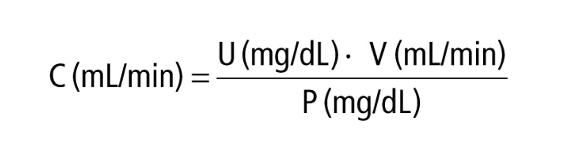
V = volume of urine
P = plasma concentration of substance
66
Volume of plasma filtered directly affects volume and composition of urine excreted (true / false)
true
67
What does the renal clearance calculate?
Volume of plasma in milliliters that is completely cleared of a substance per unit of time.
68
What substances are used to test for GFR? (gold standard)
Inulin
69
What is creatinine?
Waste product in muscles, produced at a relatively constant rate
70
What type of specimen is required for creatinine?
timed specimen (usually 24-hr urine) creatinine (U), and serum creatinine (P) drawns sometimes during urine collection period, urine volume (V), and an estimate of body surface area (from height and weight)
71
Plasma and urine creatinine tests are easily performed (true/false)
true
72
What % of creatinine is secreted by tubules?
7%-15%
73
Secretion of creatinine causes an increase of what?
Urine concentration of creatinine
74
There’s a patient with average size and weight. 0 creatinine is 12 mg/dL. Urine concentration is 550 mg/dL. Urine volume is 3 mL/min. Calculate creatinine to see if the kidney is functioning.
137.5 mL/min
75
What is the creatinine clearance formula including BSA?
76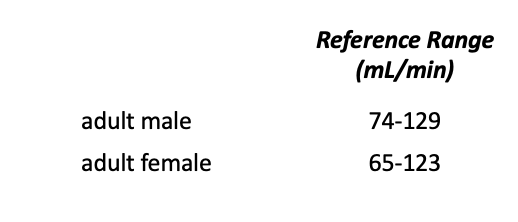
What are the reference ranges for adult male and femal for creatinin clearance in mL/min?
77
what group of people contain lower values for creatinine clearance?
older people
78
What is the normal reference range of plasma creatinine?
0.5 to 1.5 mg/dL
79
What does BSA stand for?
body surface area
80
What is the constant for body surface area?
1.73
81
Problem:
Urine concentration = 120 mg/dL
Urine volume = 1520 mL/24 hrs
Plasma concentration = 1.5 mg/dL
BSA = 1.6
What is the creatinine clearance?
Urine concentration = 120 mg/dL
Urine volume = 1520 mL/24 hrs
Plasma concentration = 1.5 mg/dL
BSA = 1.6
What is the creatinine clearance?
91.3 mL/min
82
With renal impairment, what goes up and what goes down?
UP: serum creatinine
down: urinary clearance
down: urinary clearance
83
what are these?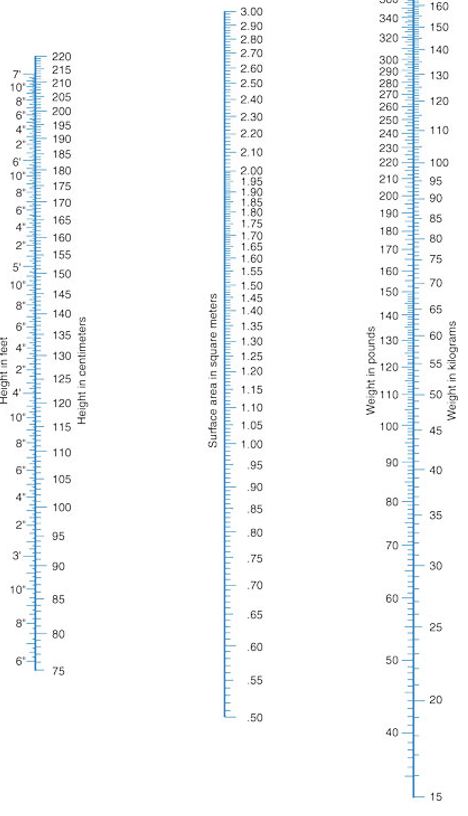
Normograms
84
What is Beta2-microglobulin?
a low-molecular-weight protein found on surface of nucleated cells and shed into plasma
85
Which tubules reabsorb beta2-microglobulin?
Proximal tubules
86
Where does beta2-microglobulin go when it sheds from nucleated cells?
passes through the glomeruli and 99% is reabsorbed by proximal tubules.
87
What is Beta2-microglobulin a marker of?
Reduced tubular function when it increases in urine
88
What is beta2-microglobulin used clinically for?
To identify early kidney transplant rejection
Differentiate tubular and glomerular diseases
Differentiate tubular and glomerular diseases
89
How can beta2-microglobulin be identified with?
Electrophoresis - different protein identifications (spikes/peaks)
90
What is the order of gel electrophoresis from positive end to negative end.
Albumin, alpha 1, alpha 2, beta, gamma
91
How do you know when theres is a problem in tubular or transplant rejection?
Beta2-microglobulin increases in the urine!!!
92
What is albuminuria?
the presence of albumin in the urine, typically as a symptom of kidney disease.
Appears early in diabetic nephropathy!!
Appears early in diabetic nephropathy!!
93
What causes the presence of albumin in urine?
increased glomerular permeability
94
When is intervention needed for early detection of albuminuria?
when low level of albumin are presence in the urine (microalbuminuria)
95
The single most important change associated with glomerular proteinuria is?
hyperglycemia
96
What is the charge on albumin and its size?
negative and very small
97
what are the most commonly used tests for evaluating renal function?
Creantinine clearance
Urine osmolality
Urine protein
Plasma creatinine
Urine osmolality
Urine protein
Plasma creatinine
98
what is creatinine clearance used for?
assessment of glomerular filtration rate (GFR)
99
what is urine osmolality used for?
tubular concentrating ability
100
what is urine protein electrophoresis used for?
to evaluate glomerular permeability to plasma proteins
101
Label the electrophoresis spikes. (left to right; positive to negative) 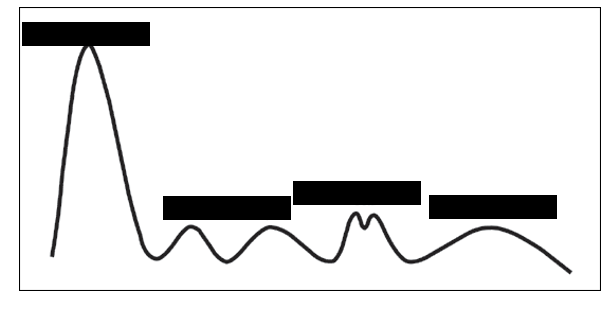
Albumin, alpha-1, alpha-2, beta-globulin, gamma globulin
102
What is Alpha-2 related to?
Inflammation
103
what does albumin do?
this protein transports substances and plays a role in tissue growth and repair.
104
what does Alpha-1 globulins do?
aka alpha-1-antitrypsin, is produced by the lungs and liver and increases with inflammatory diseases
105
what does Alpha-2 globulins do?
has many functions in the body and is involved in inflammation
106
what do Beta globulins do?
proteins move substances, support immunity, and increase in number in multiple myeloma and conditions like high chloesterol and atherosclerosis.
107
what do gamma globulins do?
support the immune system and are increased in multiple myelome, as well as some autoimmune conditions like rheumatoid arthritis and systemic lupus erythematosus.
108
Which is normal and which is multiple myeloma?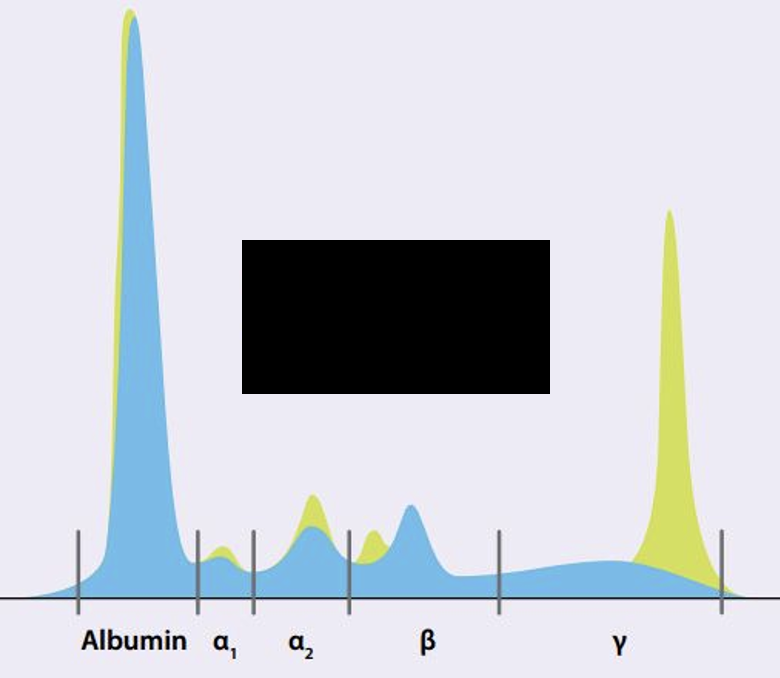
Blue: normal
Green: multiple myeloma
Green: multiple myeloma
109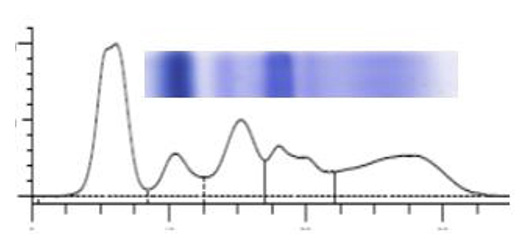
Prominent alpha-2 band
110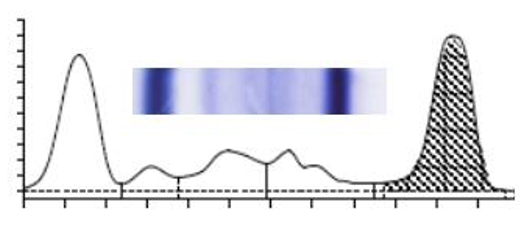
Gamma globulin - multiple myeloma
111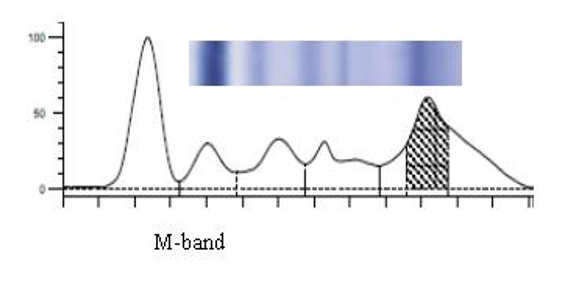
M-band
112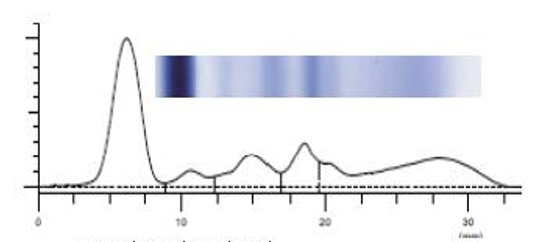
Prominent beta band