Routine - 3 Stago Basic Operating Principles & Instrument Description.pdf
Study these flashcardsFree · spaced repetition · iPhone, Android, Mac & web
All cards
1
Q: What does the chronometry principle measure in the STA-R Max?
A: Changes in the oscillation amplitude of the ball inside the cuvette, using electromagnetic sensors
2
Q: How does the ball in the cuvette obtain its pendulum-like motion?
A: From the two curved rail tracks at the cuvette bottom and an alternating electromagnetic field generated by two independent drive coils
3
Q: What happens to oscillation amplitude when medium viscosity increases?
A: The oscillation amplitude decreases
4
Q: What coils are used in detecting clot formation?
A: An emitter coil (produces electromagnetic field) and a receiver coil (detects ball position)
5
Q: How are clotting times determined in the chronometry principle?
A: An algorithm calculates oscillation amplitude changes from magnetic field variations
6
label 1, 2, 3, 4,and 5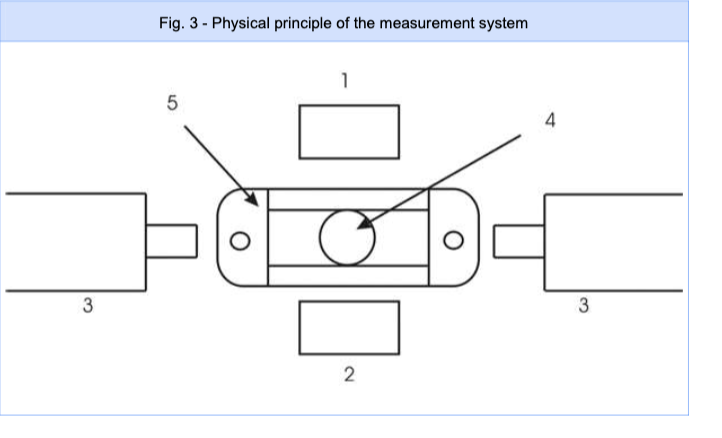
1. Emitter measurement coil
2. Receiver measurement coil
3. Drive coils
4. Ball
5. Cuvette
2. Receiver measurement coil
3. Drive coils
4. Ball
5. Cuvette
7
Q: What does the intensity of the magnetic field depend on in the STA-R Max?
A: The analyses being carried out (e.g., PT, APTT) and the type of clot expected.
8
Q: What components detect changes in oscillation amplitude?
A: Two measurement coils (emitter and receiver).
9
Q: What does the emitter coil do?
A: Emits an electromagnetic field.
10
Q: What does the receiver coil do?
A: Receives a signal that depends on the position of the ball inside the cuvette.
11
Q: How are clotting times precisely determined?
A: An algorithm calculates oscillation amplitude from magnetic field changes.
12
label 1& 2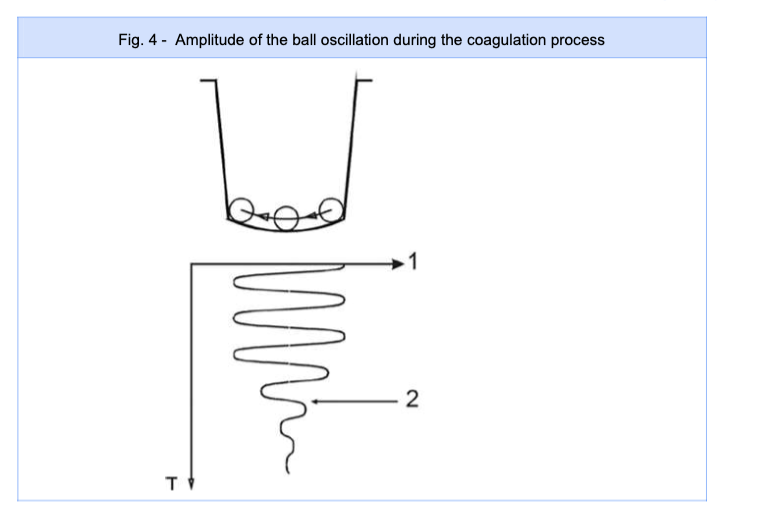
1. Ball oscillation amplitude
2. Coagulation
2. Coagulation
13
Q: On what principle is photometric detection based?
A: Absorbance (optical density) of monochromatic light (405 nm or 540 nm) passing through a cuvette during a reaction
14
Q: How is stray light (Ip) eliminated in photometry?
A: By taking two transmitted light measurements: one with incident light + stray light (I1), and one blocking incident light (I2 = stray). Subtracting I2 from I1 yields I (true incident light)
15
Q: What formula is used to calculate absorbance?
A: A = -log(I/I0) (log base 10)
16
Q: What law is applied in photometric measurement?
A: Beer-Lambert law: A = ε × l × C (Absorbance = molar extinction coefficient × optical path length × concentration)
17
Q: How is plasma first pipetted in STA-R Max?
A: By needle #1, with or without diluent, then into a cuvette at the sample stop
18
Q: What happens if intermediate reagents are required?
A: Shuttle stops at reagent stop, reagents added by needle #2, then cuvette moved to incubation area
19
Q: Which needle pipettes reagents after incubation?
A: Needle #3 (mainly the start reagent)
20
Q: How are reagents preheated if required?
A: Maintained at 37°C for ~2 seconds in needle #3’s heating tube before distribution
21
Q: What happens after measuring is finished?
A: Suction cup arm disposes of the cuvette into the waste bin
22
Q: How are primary tubes prepared for STA-R Max?
A: Loaded into 5-tube racks after centrifugation, then placed in a tray for the loading/ unloading area
23
Q: How does the analyzer identify samples?
A: Reads rack barcode, then tube barcodes (rotates tubes if needed); this locates any tube inside analyzer
24
Q: What is the immediate pipetting capacity of the analyzer?
A: 28 racks can be directly pipetted; others stored
25
Q: Which pediatric tubes can be loaded?
A: Becton Dickinson 1.8 mL citrate pediatric tubes (ref 368927) and 2 mL dry pediatric tubes (ref 366653)
26
Q: What products are loaded in the Blue R0 area (left)?
A: Calibrators, controls, diluents, decontaminating solution
27
Q: What products are loaded in the Gray R1 zone (middle)?
A: Reagents before first incubation and decontaminating solution
28
Q: What products are loaded in the Blue R2 area (right)?
A: Reagents after first incubation (mainly start reagents) and decontaminating solution
29
Q: How is product vial position recognized?
A: By barcode scanning + Positive Identification system
30
Q: What is the product storage temperature?
A: +15°C to +19°C via air conditioning system
31
Q: At what temperature is the incubation-measurement block maintained?
A: 37°C ± 0.5°C via laminar resistor system
32
Q: How are cuvettes loaded and moved?
A: Loaded in rolls of 1,000, distributed into shuttles by double belt conveyor; can stop at stations for plasma/ reagents/incubation
33
Q: What is needle #1 used for?
A: Sample plasmas, control plasmas, and calibration plasmas
34
Q: What is needle #2 used for?
A: Reagents distributed before the first incubation
35
Q: What is needle #3 used for?
A: Reagents distributed after the first incubation
36
Q: What feature does each needle have to prevent contamination?
A: Liquid level detection system and rinsing (inside/outside) between each cycle