Lecture 3 - Superficial and Cutaneous Mycoses
Study these flashcardsFree · spaced repetition · iPhone, Android, Mac & web
All cards
1
What is another name for ringworm?
Dermatophytosis or tinea
2
What are the 5 different superficial and cutaneous mycoses "infections" you can get?
Ringworm
Piedra
Thrush
Pityriasis/Tinea versicolor
Tinea nigra
Piedra
Thrush
Pityriasis/Tinea versicolor
Tinea nigra
3
What is dermatophytosis?
Infection of the outermost layers of the skin or hair
4
What is keratinophilic fungi? (know this for the exam)
fungi that love keratin
5
What are the causative agents of dermatophytosis? (i.e where do people get this)
geophilic (in the soil)
humans (anthropophilic)
animals (zoophilic)
humans (anthropophilic)
animals (zoophilic)
6
What is ringworm?
a skin fungus
7
Why is it called ring worm if there's no worm?
Because the fungi causes a circular rash (shaped like a ring)
8
Common symptoms of ringworm
Itchy and redness
9
What type of fungi is ringworm caused by? (in general)
Dermatophytes (trichophyton, microsporum, epidermophyton)
10
How do dermatophytes invade the epidermis?
dermatophytes release enzymes (llike keratinases) which invade the skin
11
What is this?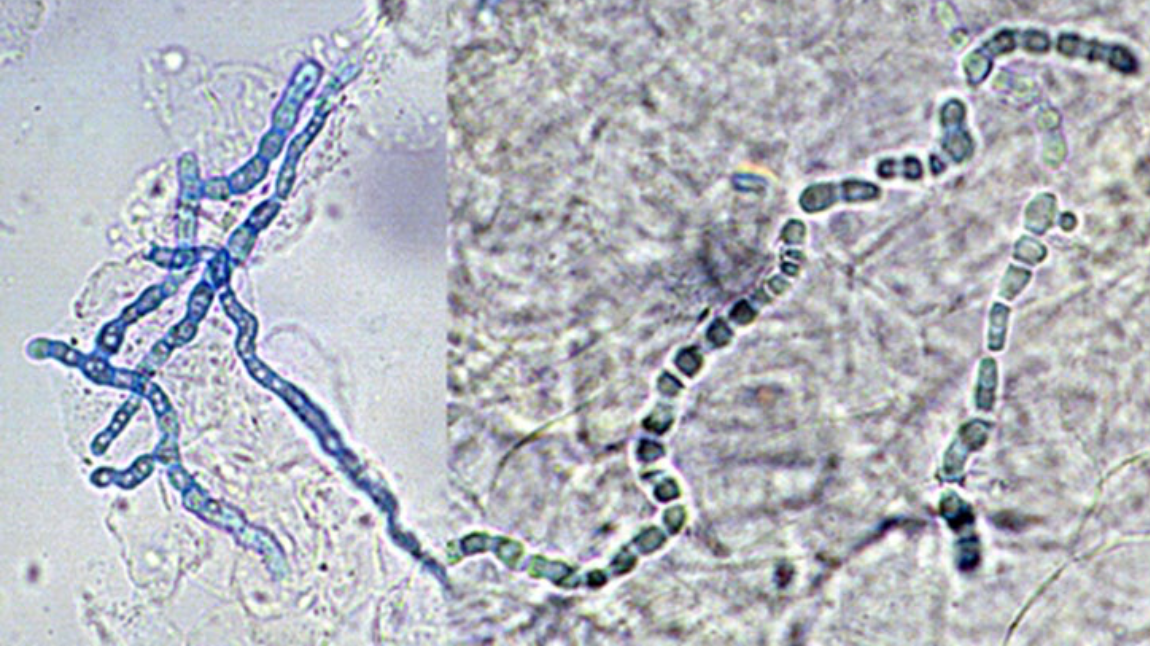
arthroconidia from dermatophytes
12
What does the hyphae of dermatophytes look like?
Septate, branches
Often fragment into chains of arthroconidia
Often fragment into chains of arthroconidia
13
Do hyphae of dermatophytes invade the hair shaft?
they may or may not
14
What is tinea?
ringworm
15
What is dermatophytosis?
ringworm
16
What is this skin condition?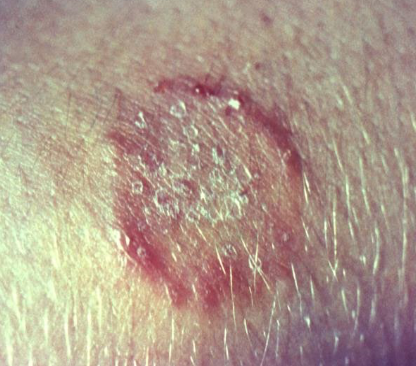
ring worm
17
What is it called when arthroconidia grows on the outside of the hair shaft?
Ectothrix
18
What is it called when arthroconidia grows on the inside of the hair shaft?
Endothrix
19
What is it called when arthroconidia grows on the inside and outside of the hair shaft?
Ecto-endothrix
20
What is the severe invasion of the hair shaft called?
Favus
21
What is an ID for favus?
honeycomb; can see yellow crusting around the hair. clusters of hyphae at the base of the hairs, with air spaces in the hair shafts.
22
What causes favus?
T. schoenleinii
23
What is expected when ectothrix is seen under Wood's lamp? (know this for the exam)
+
24
What is expected when endothrix is seen under Wood's lamp?
-
25
Is the cuticle of the hair shaft destroyed in endothrix?
NO
26
What type of hair invasion is this?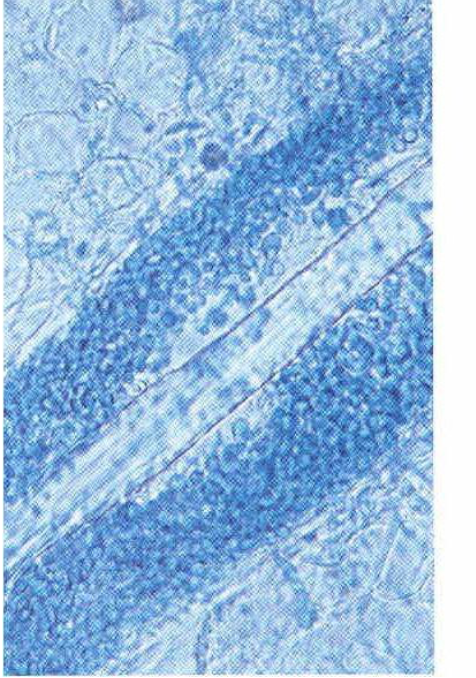
Extothrix
27
What type of hair invasion is this?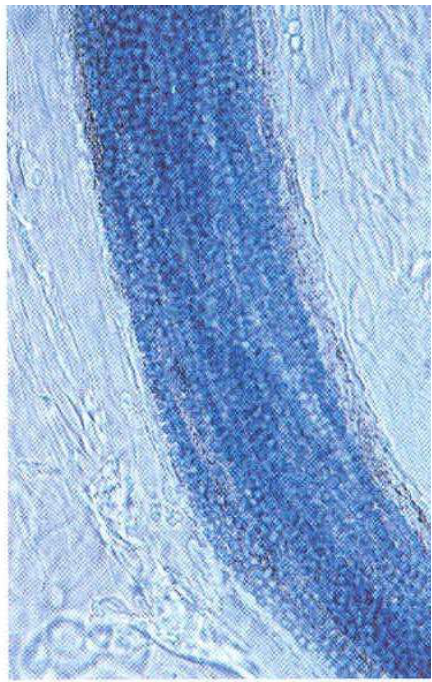
Endothrix
28
What is the site of infection for Tinea capitis?
HEAD
29
What is the site of infection for Tinea pedis?
FEET
30
What is the site of infection for Tinea manuum?
HANDS
31
What is the site of infection for Tinea cruris?
GROIN
32
What is the site of infection for Tinea barbae?
BEARD/MUSTACHE
33
What is the site of infection for Tinea unguium?
FINGERNAILS/TOENAILS
34
What is the site of infection for Tinea corporis?
BODY
35
What body parts are T. rubrum commonly seen at?
FEET, HANDS, GROIN, BEARD/MUSTACHE, FINGERNAILS/TOENAILS,
36
What is another name for scalp ringworm?
Tinea capitis
37
What does capitis mean? (know this for the exam)
Head
38
Is this a non-inflammatory or inflammatory reaction to ring worm?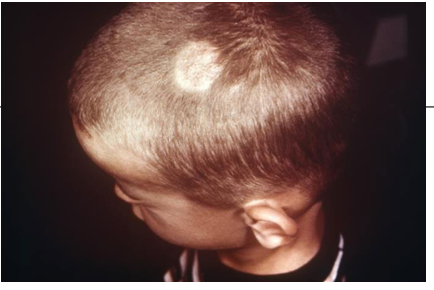
Non-inflammatory
39
Is this a non-inflammatory or inflammatory reaction to ring worm?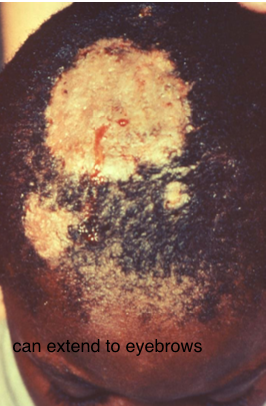
Inflammatory
40
Is Tinea capitis or scalp ringworm contagious?
YES! person-to-person, mostly common in toddlers, school-aged children.
41
What are treatments for scalp ringworm?
Oral antifungus (griseofulvin)&
medicated shampoos
medicated shampoos
42
What are the 3 different types of contact transmission to human of scalp ringworm?
• Human to human: skin-to-skin contact
• Animal to human: touching infected cats, dogs, cows, goats, pigs, horses
• Fomite to human: inanimate object recently touched by infected person or animal
• Animal to human: touching infected cats, dogs, cows, goats, pigs, horses
• Fomite to human: inanimate object recently touched by infected person or animal
43
What is the common cause of scalp ringworm/ Tinea capitis? (know this for the exam)
T. tonsurans
44
What layer of the skin does T. tonsurans invade in scalp ringworm?
Stratum corneum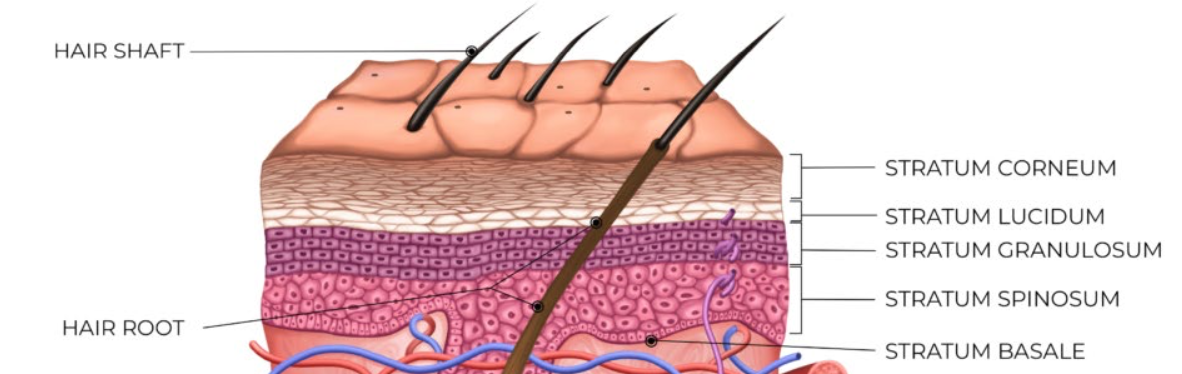
45
What fungi causes Favus?
T. schoenleinii
46
What is the Rx for Favus?
Griseofulvin
47
Is favus common in the U.S?
NO; associated with areas of poverty and neglect :(
48
What is another name for ringworm of the feet?
Tinea pedis aka athlete's foot
49
What does pedis mean?
FOOT
50
When does Tinea pedis often occur?
When feet get sweaty and are confined in hot, tight-fitting shoes &
Exposure to contaminated towels, floors, shoes
Exposure to contaminated towels, floors, shoes
51
What are the symptoms of Tinea pedis?
Red, peeling, itchy skin
52
What is the Rx for Tinea pedis?
topical antifungals
53
Is Tinea pedis common?
YES! VERY COMMON
54
What is ringworm of the hands called?
Tinea manuum
55
What does manuum stand for? (know this for the exam)
thumb
56
What is the primary cause of Tinea manuum? (know this for the exam)
Trichophyton rubrum
57
What does Trichophyton rubrum frequently coexit with?
Tinea pedis
58
What is the most common clinical presentation for Tinea mannum? saying
"TWO-FOOT, ONE HAND SYNDROME"
59
Who is at risk for Tinea manuum?
Male, diabetes mellitus, immunosuppression, farmworker, pet owners (guinea pigs, hedgehogs), recurrent occuptional trauma to hands (mechanic, chemical exposure)
60
What is the function of mannan glycoproteins in the infection process of Trichophyton rubrum?
A. They enhance the immune response by activating lymphocytes.
B. They help the fungus invade the bloodstream by breaking down blood vessels.
C. They mediate adherence to keratin-containing epithelial tissue and suppress lymphocyte response.
D. They cause direct damage to skin cells by producing toxins.
A. They enhance the immune response by activating lymphocytes.
B. They help the fungus invade the bloodstream by breaking down blood vessels.
C. They mediate adherence to keratin-containing epithelial tissue and suppress lymphocyte response.
D. They cause direct damage to skin cells by producing toxins.
C. They mediate adherence to keratin-containing epithelial tissue and suppress lymphocyte response.
61
What is the treatment for Tinea manuum?
Topical antifungal treatment usually applied for 4-6 weeks.
62
What is ringworm of the groin/pubic called? (know this for the exam)
Tinea cruris
63
What does Cruris stand for? (know this for the exam)
leg
64
What's another name for Tinea cruris, besides ringworm of the groin? (know this for the exam)
Jock itch
65
Where is the ring located for Tinea cruris? (know this for the exam)
genital, pubic, perineal, and perianal skin
66
What does Tinea cruris dermatophyte affect specifically?
Keratinized structures such as hair and the epidermis' stratum corneum
67
Why is the groin a very hospitable environment for dermatophytes?
Sweating, moisture and alkaline pH in the area
68
What are the know risk factors for Tinea cruris?
Contact sports, diabetes mellitus, excessive perspiration, tight clothing, inadequate hygiene
69
Who is more suseptibly to Tinea cruris? (know this for the exam)
Adolescents and adult males
70
What is autoinfection?
infection by an organism that is already present in the body.
71
What is the most common fungi which causes Tinea cruris? (know this for the exam)
Trichophyton rubrum
72
What is the pathophysiology of Tinea cruris?
NOT WELL KNOWN, but proteinases suspected to digest keratin found in the skin's stratum corneum that leads to infection.
73
What is the treatment for Tinea cruris?
Over-the-counter topical antifungals; may need prescription strenght antifungal medications, topical or oral.
74
What is Tinea Barbae? (know this for the exam)
Beard ringwom
75
What does Barbae stand for? (know this for the exam)
beard
76
What is another name for Tinea barbae, besides beard ringworm?
Barber's itch
77
What is the pathophysiology for Tinea barbae?
Inoculation of the arthroconidia (spores) to the keratinized tissue, fungus anchors to keratinocytes, germinate, and spread.
78
What are the common exposures to beard ringworm?
farm/domestic animals, human to human (Rarer), autoinoculation (foot-to-face)
79
Is beard ringworm common or rare infection?
rare
80
What is the treatment for beard ringworm?
oral antifungal therapy (4-12 weeks)
81
What is Tinea unguium?
Ringworm of the nails
82
What does unguium stand for?
nails
83
What is ringworm of the nails?
an infection of the nail or nail bed by a dermatophyte, specifically
84
What is another name for Tinea unguium, besides ringworm of the nails
Onychomycosis
85
Who is at risk for Tinea unguium?
Older age, males, humid/moist environment, peripheral vascular disease (no good blood flow), immunocomprimised, infection with tinea pedis/tinea manuum (spreads to nails)
86
What are typical symptoms of Tinea unguium?
White or yellow nail discoloration, thickening of the nail, and separation of the nail from the nail bed.
87
Is Tinea unguium difficult to treat?
YES
88
What is the best treatment for Tinea unguium?
Oral antifungals (not 100% effective tho) for 3-6 months.
Topical antifungals should be used for 6-12 months
Topical antifungals should be used for 6-12 months
89
Are toenails harder to treat than fingernails or vise versa?
Toenails are harder to treat because of the thickness.
90
Name the types of fungal infection. dont need to know this
1. mold fungal infection
2. yeast fungal infection
3. tinea unguium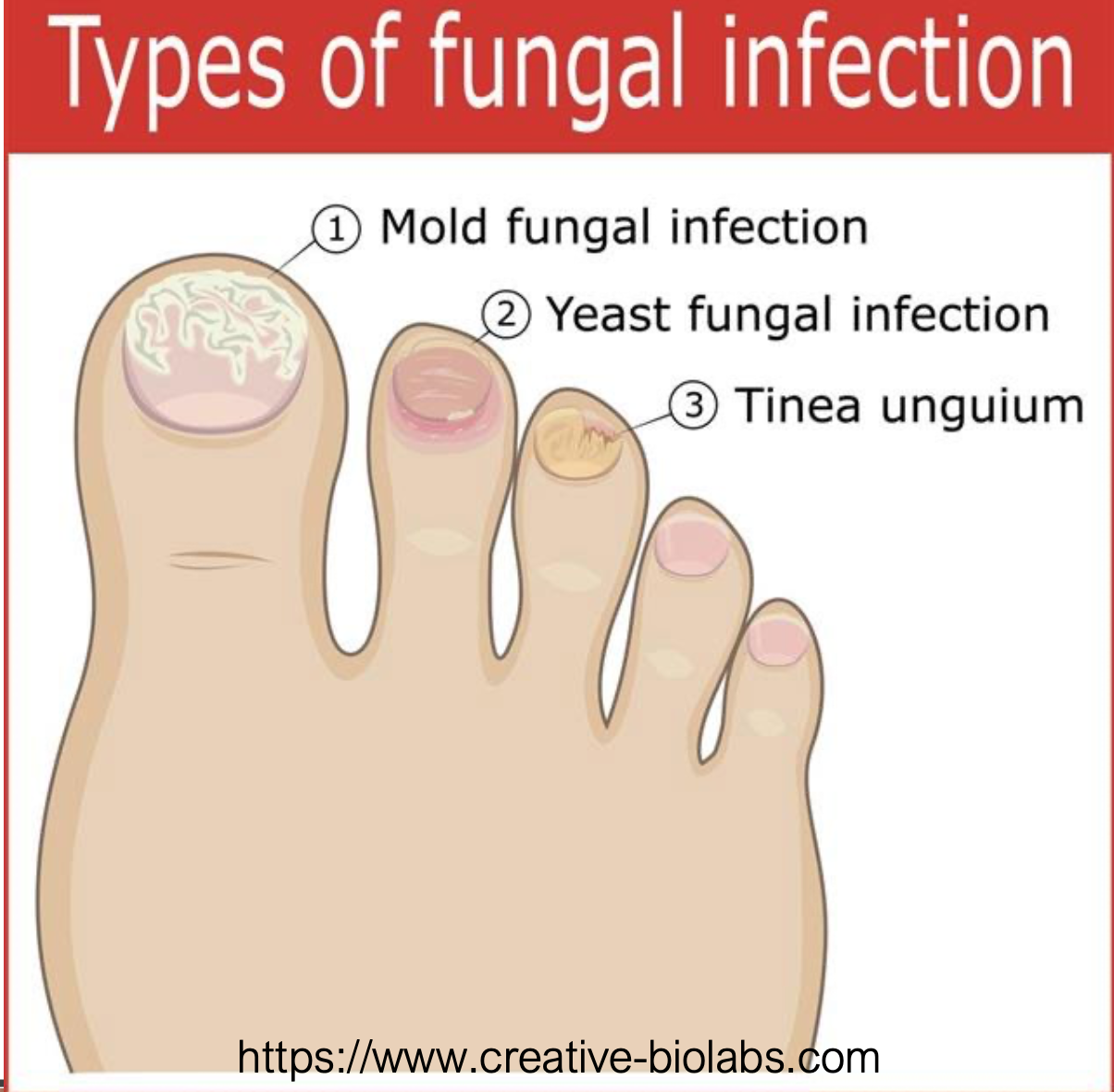
2. yeast fungal infection
3. tinea unguium
91
What type of ringworm is this?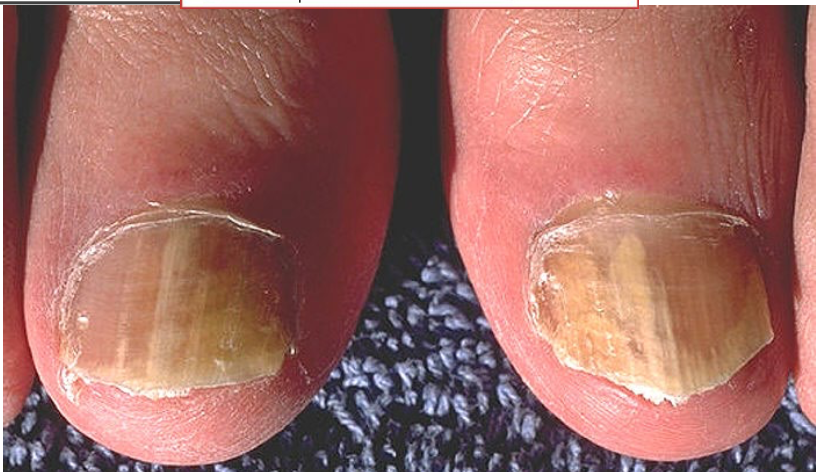
Ringworm of the nails. tinea unguium
92
What type of ringworm is this?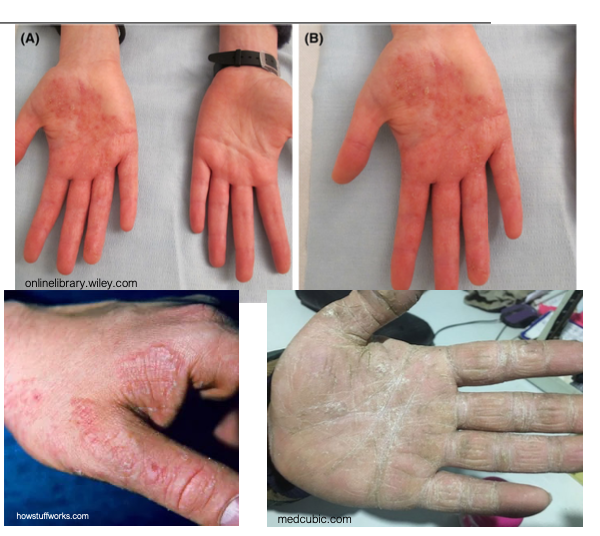
Ringworm of the hands. Tinea manuum
93
What type of ringworm is this?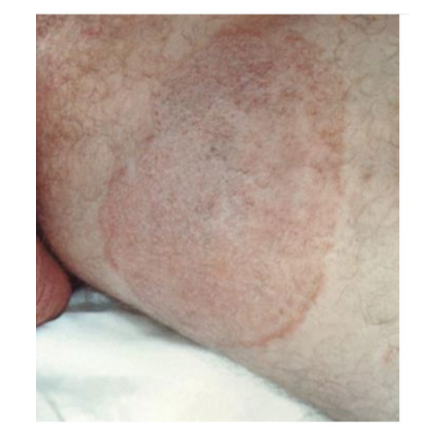
Ringworm of the groin/pubic. Tinea cruris
94
What type of ringworm is this?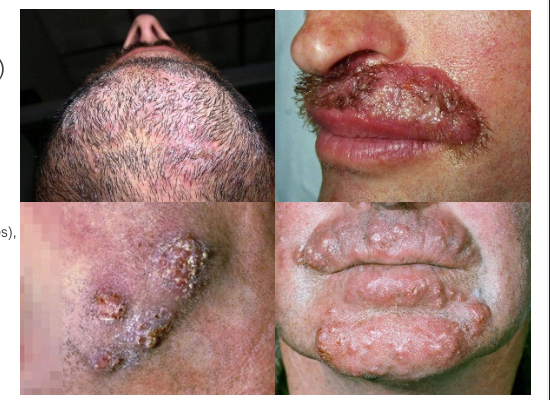
Ringwork of the beard/mustache. Tinea barbae
95
What type of ringworm is this?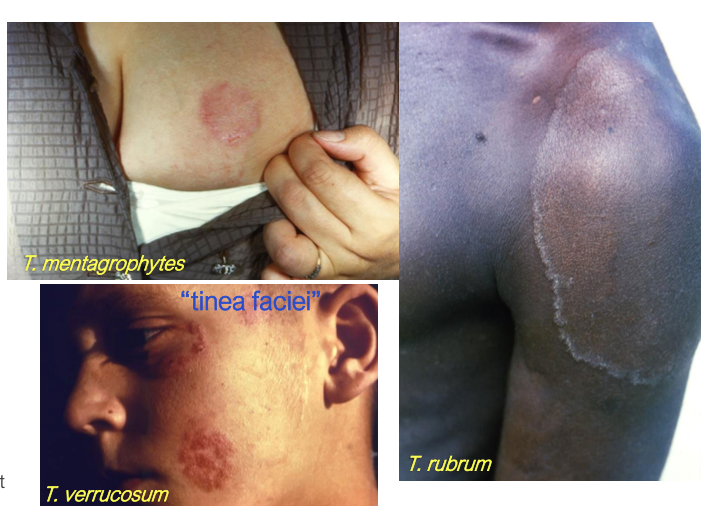
Ringworm of the body. Tinea corporis
96
What does corporis stand for?
Body
97
What is Tinea corporis?
infection of the exposed skin. with an itchy, circular rash
98
What is the most common strain that causes Tinea corporis?
T. rubrum
99
What is the means of exposure for Tinea corporis?
Soil
Animas: dogs & cats (M. canis likely)
Humans: skin to skin contact
Animas: dogs & cats (M. canis likely)
Humans: skin to skin contact
100
What is the name of Tinea corporis in wrestlers?
"Tinea corporis gladiatorum"
101
What is the most common isolate in US for tinea capitis? (what strain) need to know this!!!
T. tonsurans likely
102
Who is at increased risk for Tinea corporis?
Children, excessive heat, high humidity, tight clothes, immunocompromised (may develop deeper folliculitis infection: Majocchi granuloma), genetic predisposition, diabetes mellitus.
103
What is the treatment for Tinea corporis?
1-2 weeks topical antifungal; oral antifungal if fail topical treatment
104
What is the most common cause of ringworm in the world called? (strain)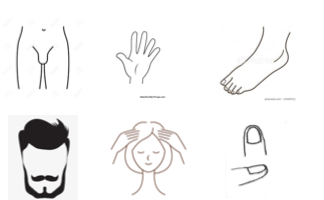
Trichophyton rubrum
105
Whom does T. rubrum affect?
Humans only
106
What type of dermatophyte is this? know this 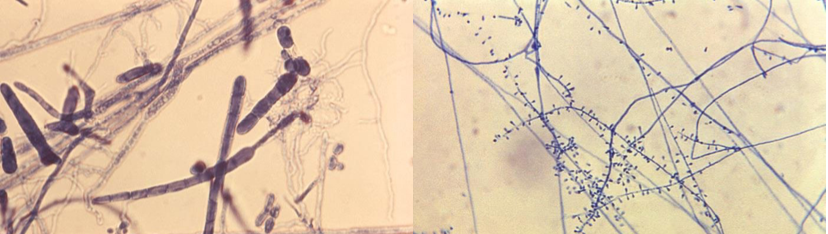
Trichophyton rubrum
107
Which is the macroconidia and which is the microconidia?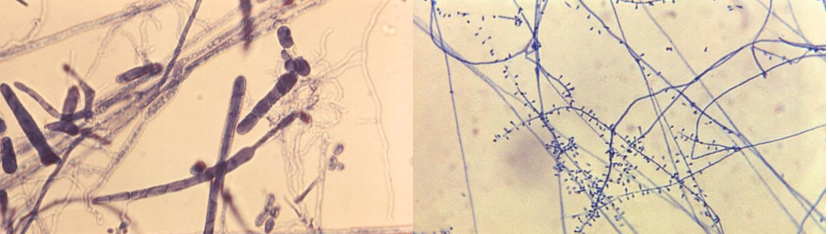
left macro
right micro
right micro
108
what is a phrase that is used to identify microconidia sprouting individually, in a perpendicular fashion?
birds on a wire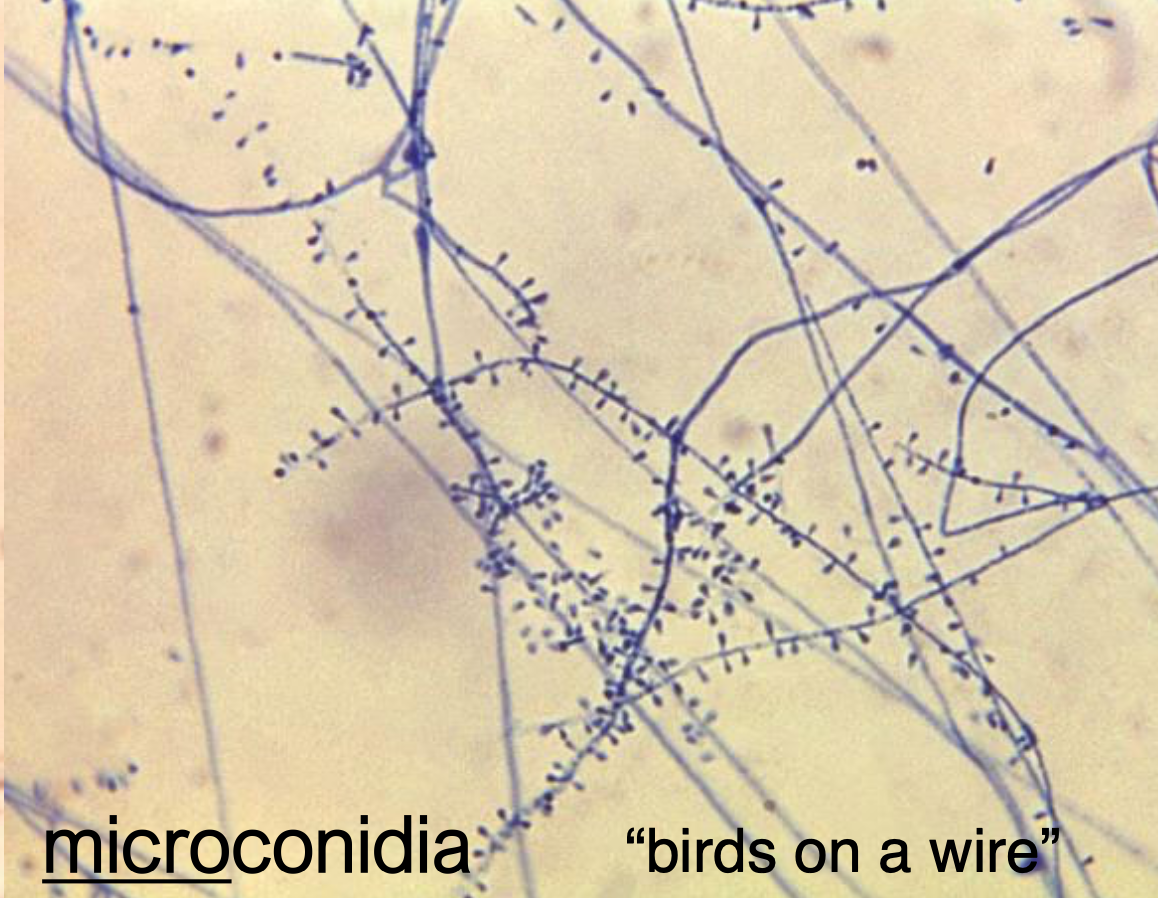
109
What is Trichophyton mentagrophytes and who predominantly is exposed to?
Fungi that is predominantly zoophilic exposure (dogs, cats, rabbits, guinea pigs)
110
What does the microscopy of Trichophyton mentagrophytes look like?
Abundant microsporidia, some macroconidia, spiral hyphae. 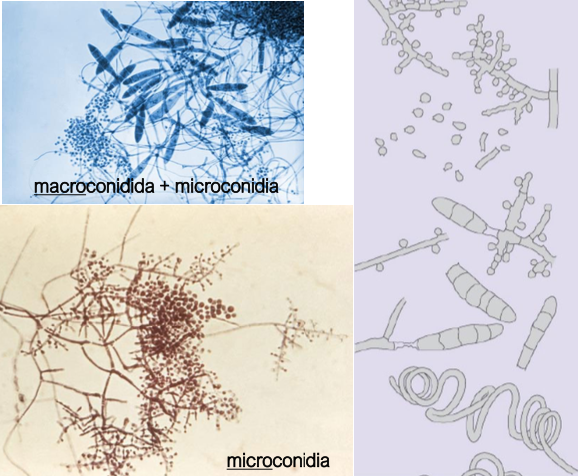
111
What is this?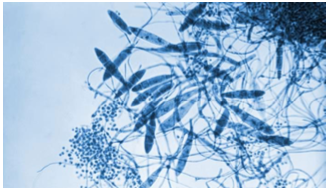
Trichophyton mentagrophytes - macroconidia + microconidia
112
Where does trichophyton mentagrophytes invade in the hair?
Ecto-endothrix: inside and outside of the hair shaft.
113
Is trichophyton rubrum Urease neg/pos?
NEG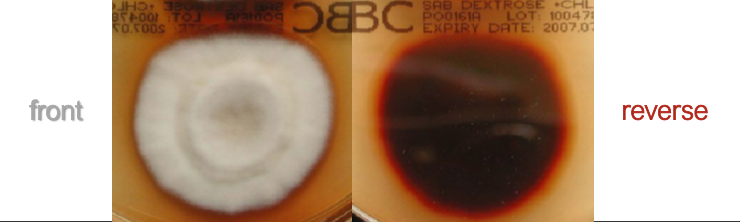
114
Is trichophyton mentagrophytes Urease neg/pos?
POS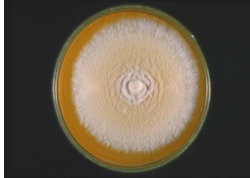
115
What is seen under wood's lamp for Trichophyton mentagrophytes?
NO FLUORESCENCE.
116
What fungi is this?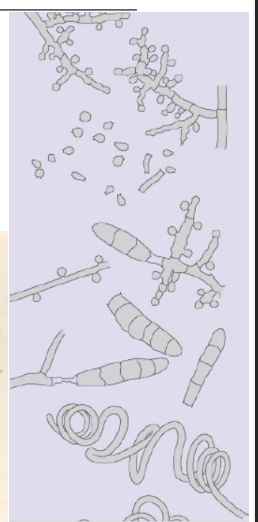
Trichophyton mentagrophytes
117
Trichophyton tonsuranas invade which part of the hair shaft?
inside so Endothrix
118
what is this?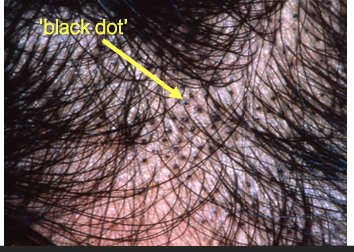
Black-dot tinea capitis
119
What does Trichophyton tonsurans look like microscopically?
abundant microconidia, chlamydospores
Sparse, irregular, macroconidia, may become distorted with age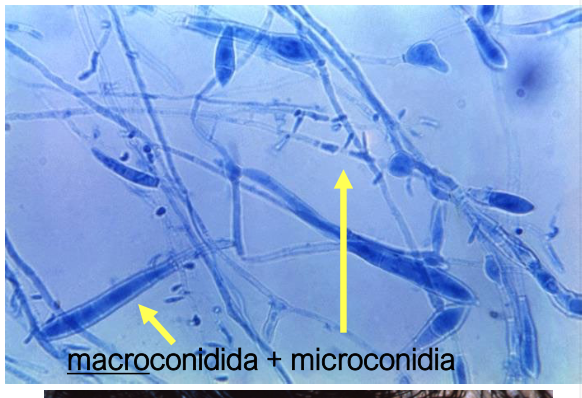
Sparse, irregular, macroconidia, may become distorted with age
120
Which one is the chlamydospore?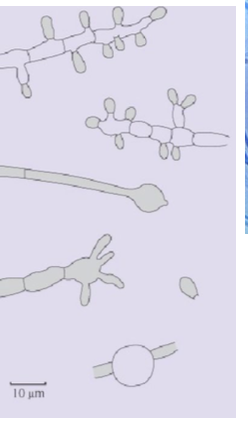
Bottom
121
How is Trichophyton tonsurans spread?
Direct human-human contact, pets, or contaminated fomites (pillows, rugs, rouches)
Asymptomatic carriers a possibility.
Asymptomatic carriers a possibility.
122
What fungi is this?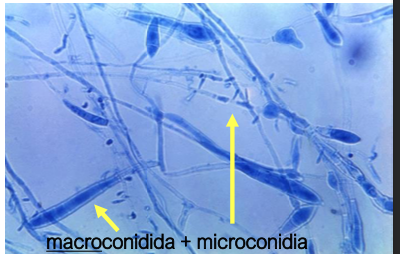
Trichophyton tonsurans
123
Trichophyton mentagrophytes can be seen in which site of infections?
HANDS, FINGERNAILS, FEET, HAIR, BEARD/MUSTACHE, GROIN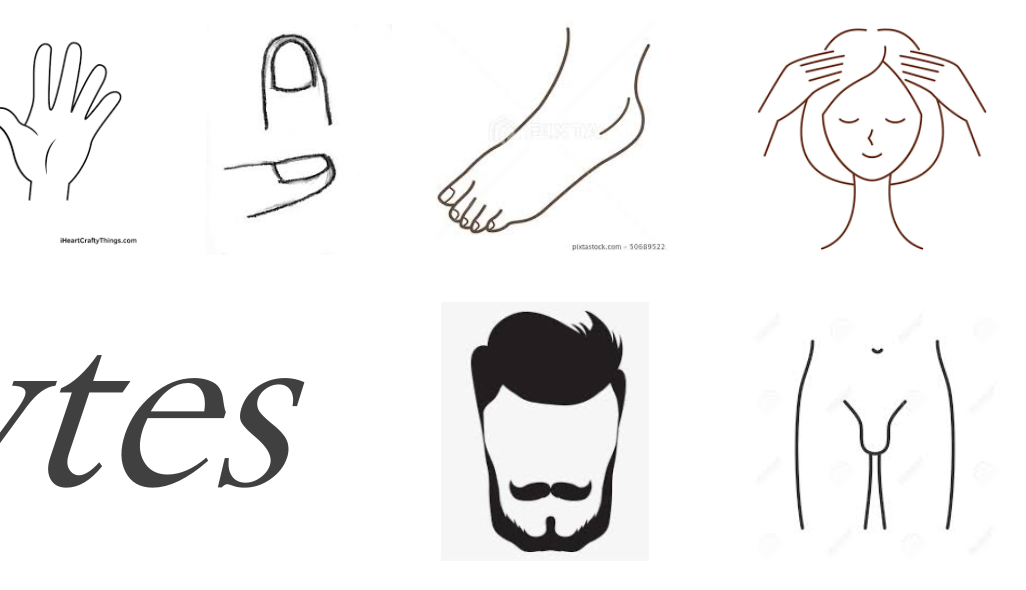
124
Trichophyton tonsurans can be seen in which site of infections?
FOOT, HAIR, BODY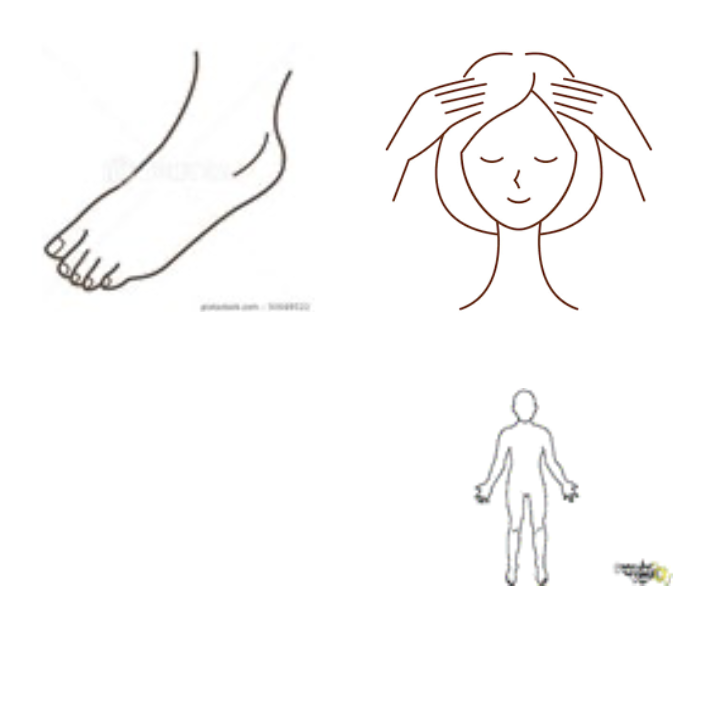
125
What is Microsporum canis?
is the most frequent cause of ringworm in kittens and puppies.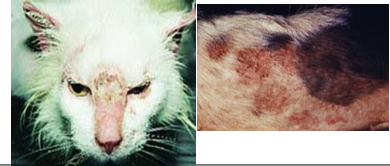
126
What is the microscopy of Microsporum canis?
Spindle-shaped macroconidia with roughened surface.
Narrow and club-shaped microconidia, borne along the sides of hyphae.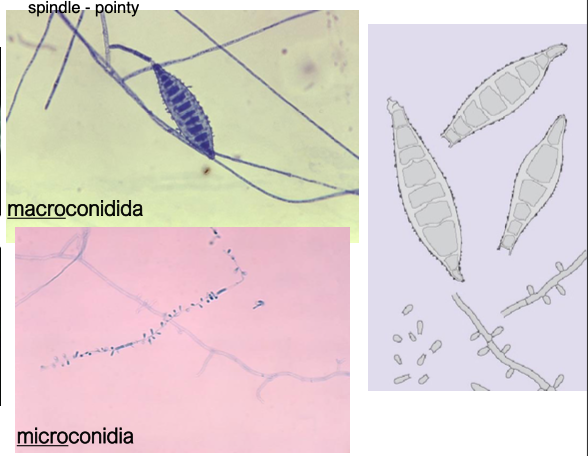
Narrow and club-shaped microconidia, borne along the sides of hyphae.
127
What fungi is this?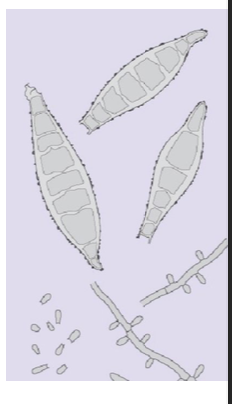
Microsporum canis
128
Is this macroconidia or microconidia?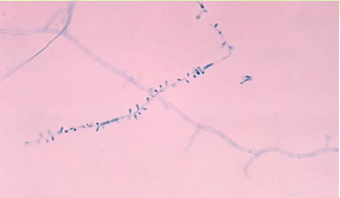
Microconidia
129
Is this macroconidia or microconidia?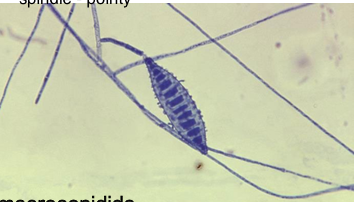
Macroconidia
130
What type of invasion of the hair shaft does Microsporum canis perform?
Ectothrix
131
How is microsporum canis usually spread?
Zoophilic: predominantly spread through animals (Cats, dogs, many others); most often its cat
132
What animal is the most frequent natural host for Microsporum canis?
Domestic cats
133
Who else is associated with Microsporum canis?
Children
134
What type of fluorscence does Microsporum canis show under Wood's lamp?
Blue-green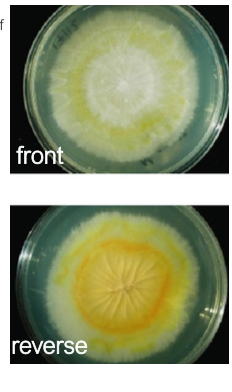
135
What is the treatment for Microsporum canis?
Topical then oral.
Need to treat human as well as reservoir (ex: pet cat), wash/disinfect formited (linens)
Need to treat human as well as reservoir (ex: pet cat), wash/disinfect formited (linens)
136
What body part does Microsporum canis usually infection?
BEARD, HAIR, BODY, HANDS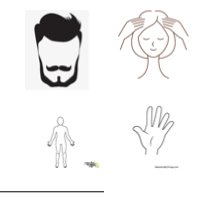
137
What is Microsporum gypseum?
soil-associated dermatophyte that occasionally is known to colonise and infect the upper dead layers of the skin of mammals.
138
What is the microscopy of Microsporum gypseum?
Symmetrical, sometimes broad, 4-6 compartmented macroconidia, with sometimes rounded ends.
Microconidia usually sparse and borne along the sides of hyphae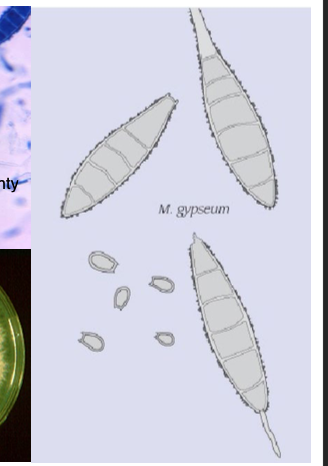
Microconidia usually sparse and borne along the sides of hyphae
139
What does Microsporum gypseum usually like?
Geophilic - likes earth; usually found in contaminated soil
140
Besides soil, where else can Microsporum gypseum be usually found?
Dogs, cats, other animals exposed to dirt (ex: horses)
141
Which fungi is the rarer of the dermatophytes found in human infection?
Microsporum gypseum
142
What type of hair invasion is Microsporum gypseum?
Ecto-endothrix hair invasion
143
Is there fluorescence for Microsporum gypseum?
Posssibly.
144
What is the treatment for Microsporum gypseum?
Topical then oral antifungals
145
What fungi is this?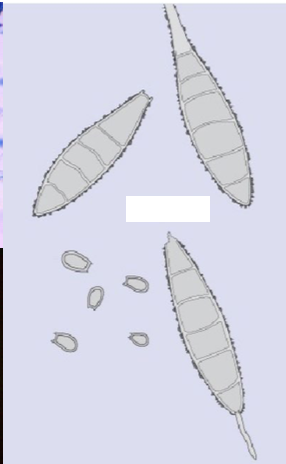
Microsporum gypseum
146
What fungi is this?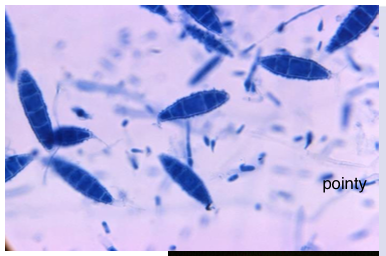
Microsporum gypseum
147
What fungi is this?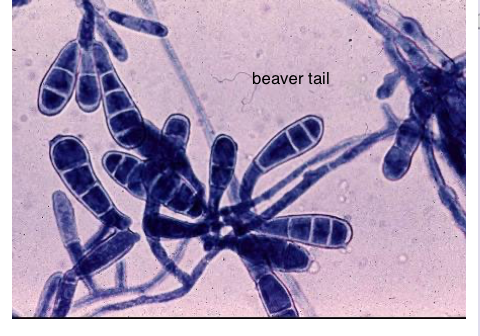
Epidermophyton floccosum
148
Describe Epidermophyton floccosum.
Club-shaped, 'beaver tail', macroconidia
149
Does Epidermophyton floccosum have microconidia?
No , but can form chlamydospores
150
What does Epidermophyton floccosum infect?
Humans only
151
Does Epidermophyton floccosum infect hair?
DOES NOT INVADE HAIR
152
What body parts does Epidermophyton floccosum invade?
Groin, feets, fingernails, hands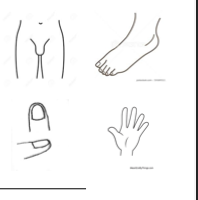
153
What is wood's lamp?
a medical device that emits ultraviolet (UV) light to help diagnose skin conditions.
154
What does Wood's lamp identify?
Can help ID ectothrix infections
155
What dermatophyte mainly fluoresce under UV light? What about rare?
MAINLY: Microsporum spp.
RARELY: Trichophyton spp.
RARELY: Trichophyton spp.
156
What is this?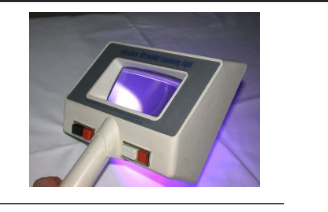
Wood's lamp
157
What is Piedra?
Superficial fungal infection of the hair shaft
158
What does Piedra look like?
Small nodules stick onto the hair (scalp, facial, pubic hair)
159
Is piedra asymptomatic or symptomatic?
Asymptomatic
160
Is piedra chronic or acute infection?
CHRONIC
161
What is Piedra associated with?
Excessive use of hair oils
162
Is piedra a slow or fast grower?
Slow
163
What is the treatment for Piedra?
Cut or shave off hair followed by topical antifungals
164
What does Piedra stand for?
stone
165
What type of Piedra is this?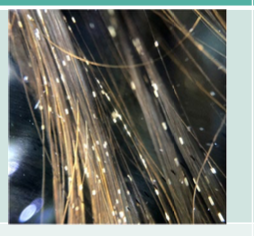
White Piedra
166
What type of Piedra is this?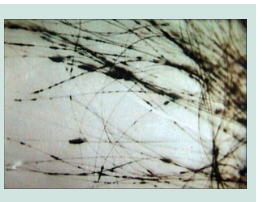
Black Piedra
167
What type of Piedra is this?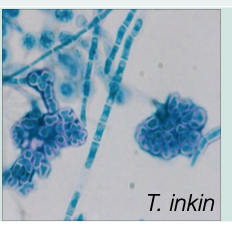
White Piedra
168
What type of Piedra is this?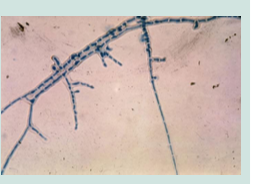
Black Piedra
169
What type of asexual spore is this?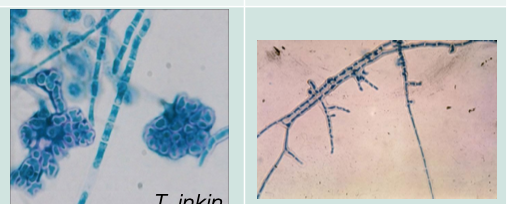
Arthroconidia
170
What is Thrush?
yeast infection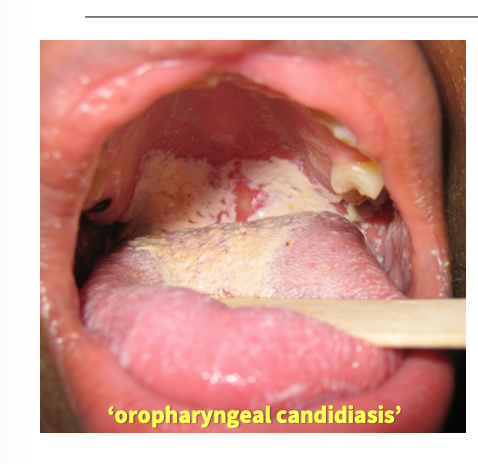
171
What is Thrush caused by?
Overgrowth of Candida spp.
172
What are common symptoms of Thrush?
Mouth pain, redness, loss of taste, cotton mouth
173
What is the more severe form of thrush? (Where is it clinically seen)
Esophagus
174
What test is used to diagnose thrush?
Endoscopy
175
What is Thrush associated with? (who gets affected the most) know this for exam!!
Immunosuppressed/HIV (can disseminate)
Babies (breastfeeding: can spread from baby to mom or mom to baby) <- treated at same time
Babies (breastfeeding: can spread from baby to mom or mom to baby) <- treated at same time
176
What is the treatment for Thrush?
Antifungal treatment (few weeks)
Mild/moderate: clotrimazole, micronazole, or nystatin, applied inside mouth
Sever: fllucuonazole, either orally or IV
Mild/moderate: clotrimazole, micronazole, or nystatin, applied inside mouth
Sever: fllucuonazole, either orally or IV
177
What is Tinea nigra?
Yeast-like fungus; superficial mycosis caused by Hortaea wernickii
178
What does Tinea nigra look like?
Conidia branches off hyphae
179
How is Tinea nigra clinically seen?
Hyperpigmented (dark) patch of infected skin, normally on the palm of the hand or soles of the feet.
180
What fungi is this?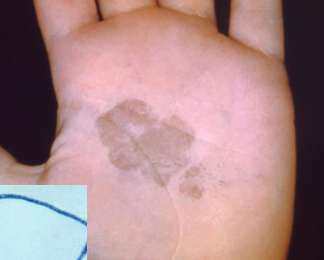
Tinea nigra
181
Is Tinea nigra asymptomatic or symptomatic?
Asymptomatic, but will remain (chronic), if left untreated.
182
Is the incubation period long or short?
Long incubation period: will not see evidence of infection until weeks after exposure.
183
Is Tinea nigra common in the US?
NO; it is uncommon.
184
What conditions. would a person be at risk for Tinea nigra?
Excessive sweating, live near ocean (H. wenickii likes a salty environment)
185
What is the treatment for Tinea nigra?
Topical antifungals (2-4 weeks of application)
186
What is this?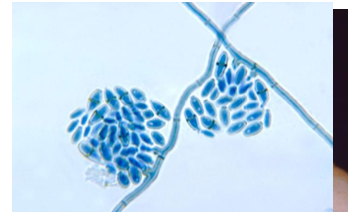
Yeast-like fungus.
187
What is this?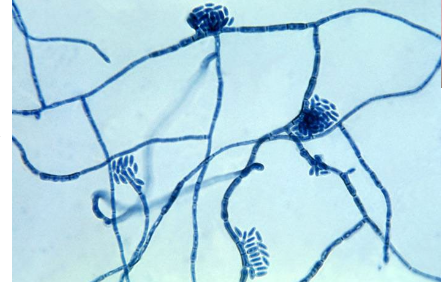
Yeast-like fungus. Tinea nigra
188
What is Malassezia furfur?
Commensal yeast on human skin (stratum corneum)
189
What age range is more susceptible to Malassezia furfur?
20-50 most common, both sexes (males more common)
190
Where is Malassezi furfur mostly found and proliferates in?
Lipid-dependent (oil-producing sebaceous glands; face, scalp, back)
191
What environmental conditions does Malassezia furfur thrive in?
Sumer and tropical areas (heat/humidity/sweat)
192
What other coniditions are associated with Malassezia furfur?
Seborrheic dermatitis
Pityriasis/Tinea versicolor
Malassezia folliculitis
Pityriasis/Tinea versicolor
Malassezia folliculitis
193
What is Seborrheic dermatitis?
Erythematous, greasy, flaking plaques that predominantly affects the scalp, nasolabial folds, eyebrows, and chest; 'cradle cap')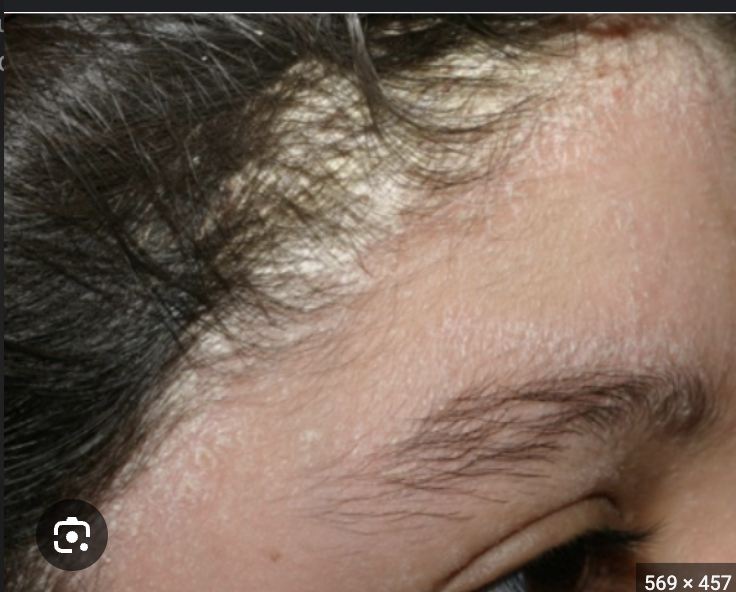
194
What is Pityriasis/Tinea versicolor? 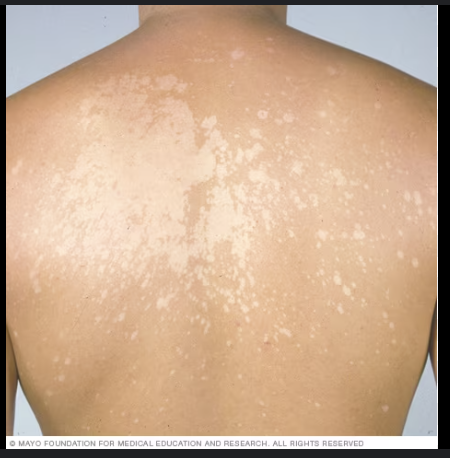
Patches, or plaques that vary in color; lesions may show scaling and prutitis. 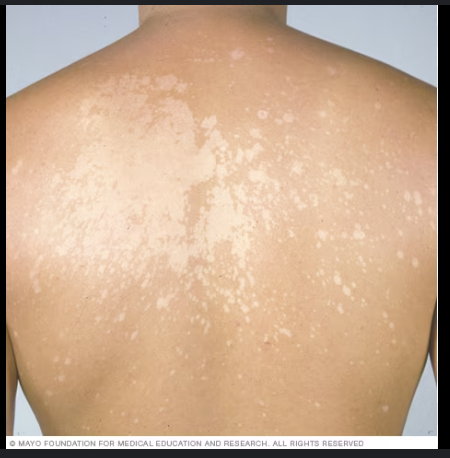
195
What is Malassezia folliculitis?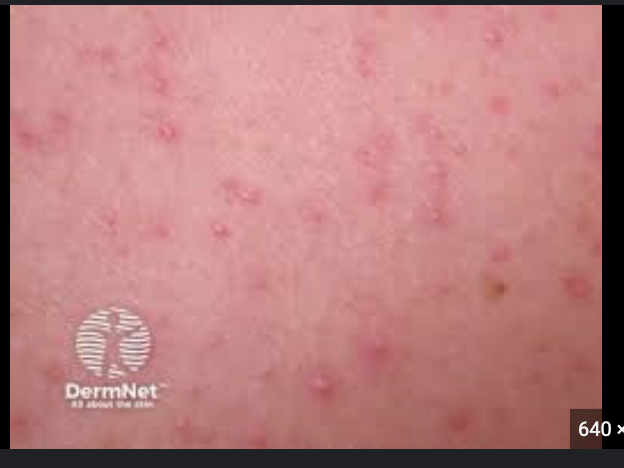
Similar to acne; ertyhematous papules/pustules with or without pruritis
196
why is Malassezia furfur opportunistic?
Can cause severe cutaneous and systemic infections in immunocompromised hosts
197
What yeast is this?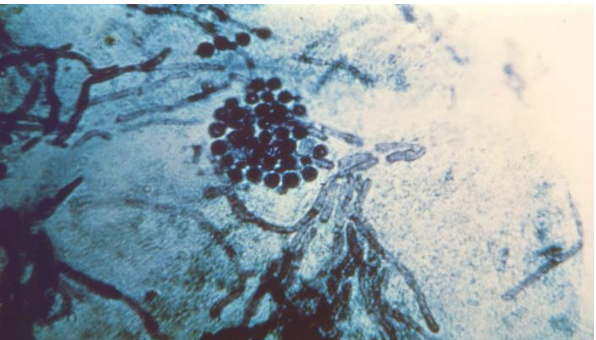
Malassezia furfur
198
Describe this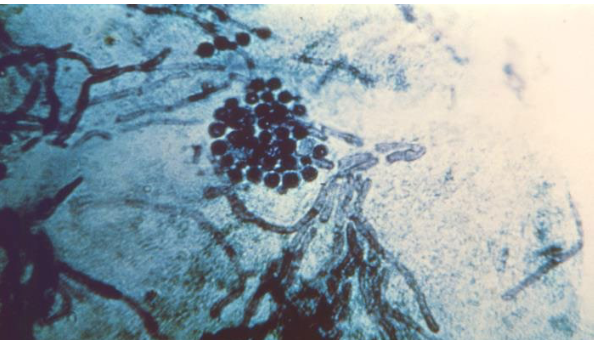
spherical, yeast-like fungal cells, and short hyphae