Lecture 3 - The Kidney
Study these flashcardsFree · spaced repetition · iPhone, Android, Mac & web
All cards
1
What is a kidney?
filtration system that secretes out waste. removes waste from body.
2
Are proteins seen in urine?
NO
3
Do we see WBC in pee?
NO
4
Is there fat in urine?
NO
5
Label the white boxes (from top to bottom) 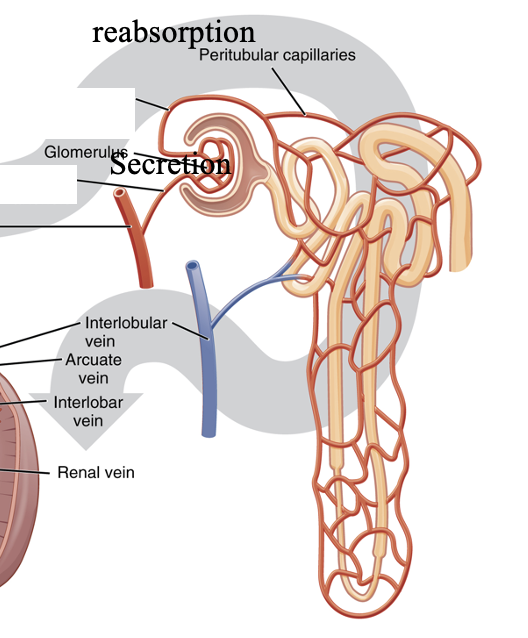
TOP: Efferent arteriole
BOTTOM: Afferent arteriole
BOTTOM: Afferent arteriole
6
Where does secretion happen in the kidneys?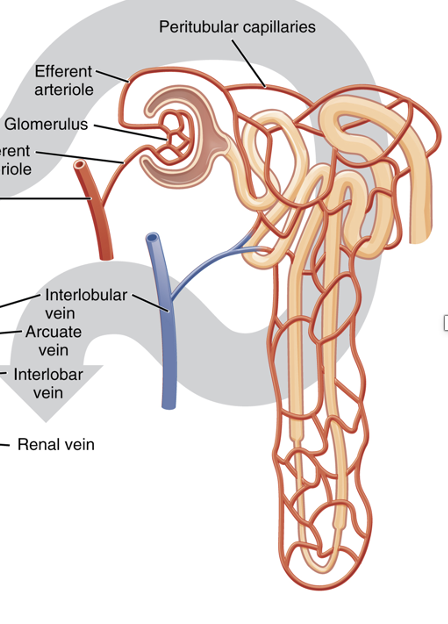
Glomerulus
7
What arteriole brings blood in from renal artery?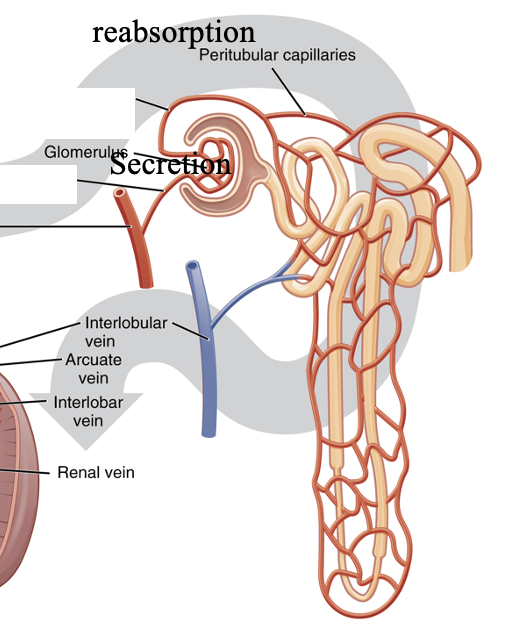
Afferent arteriole
8
What arteriole takes blood out to the body?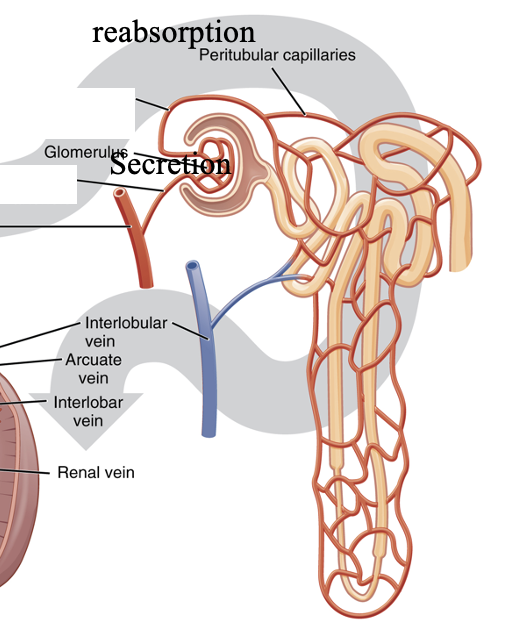
Efferent arteriole
9
Where does reabsorption occur in the kidneys?
Peritubular capillaries
10
How many pyramids does each kidney have?
6-8
11
Which tubes carry contents back into the blood?
Peritubular capillaries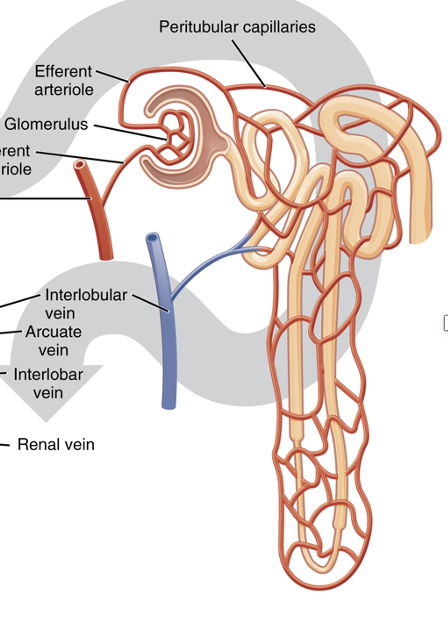
12
Which arteriole is thicker and why?
Afferent because it needs a lot of pressure.
13
How much pressure and what kind of pressure is needed in the afferent?
55 mmHg - hydrostatic pressure.
14
label the numbers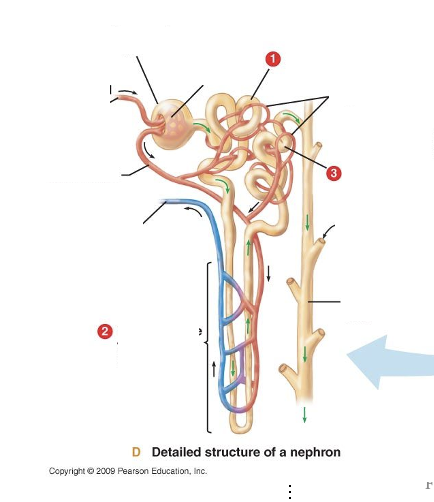
1. Proximal tubules
2. Distal tubule
3. Loop of Henle with capillary network
2. Distal tubule
3. Loop of Henle with capillary network
15
Label the rest of the structure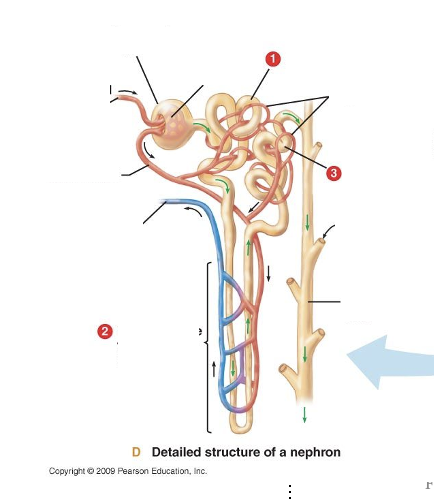
(clockwise starting from capillaries)
Capillaries
From another nephron
Collecting duct
Branch of renal vien
Arteriole from glomerulus
Arteriole from renal artery
Bowman's capsule
Glomerulus
Capillaries
From another nephron
Collecting duct
Branch of renal vien
Arteriole from glomerulus
Arteriole from renal artery
Bowman's capsule
Glomerulus
16
The nephorn is separated into 2 sections. what are they called?
Renal cortex (top)
Renal medulla (bottom)
Renal medulla (bottom)
17
What is the pressure in the Bowman's capsule?
-10mmHg (doesn't let filtration occur)
18
Where does the blood go after the bowman's capsule?
Efferent arteriole
19
What is the oncotic presure?
-35 mmHg
20
What is the total net filtration pressure in mmHg?
10
21
What is the filtration rate of blood in the kidney? mL/min
125 mL/min.
22
What is GFR?
Glomerular filtration rate (GFR)
23
What is the normal GFR value? L/day
180 L/day
24
What is the % of cardiac output that flows to the kidney per minute?
20%
25
What substances return back to the blood?
Amino acids (proteins), water, vitamins, WBC, RBC, fat
26
What gets secreted from the kidneys?
Creatinine, waste
27
What surrounds the kidney?
Adipose tissue and a capsule
28
Where are most of the nephrons located?
Renal cortex
29
Where is the Juxtaglomerular apparatus located?????
in the renal cortex, specifically near the border between the cortex and the medulla,
30
What happens to the waste after is passes through the collecting duct?
Goes to renal pelvis, then ureter, then bladder. and then pee it out.
31
Each pyramid has a duct that enter a ____?
Calyx
32
Label the black box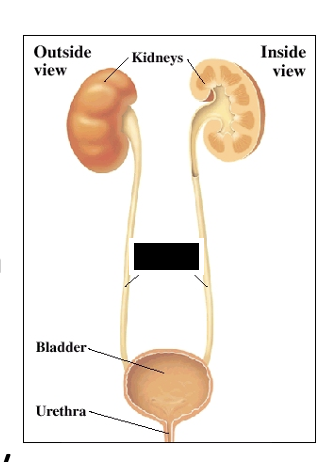
Ureters
33
Where is urine stored?
Bladder
34
How much urine is needed for the body to have the urge to urinate?
150 mL
35
How is pee released from the bladder?
Bladder contracts and the urinary sphincter relaxes which pushing the urine to the urethra and outside the body.
36
How many nephrons are in a kidney?
1.3 million.
37
What are the 5 distinct areas in a Nephron?
Glomerulus, proximal convoluted tubule, loop of Henle, Distal convoluted tubule, and collecting duct
38
Where do golmerular capillaries arise from?
Afferent arteriole and form a ball
39
What structure controls the afferent arteriole diameter?
Macula densa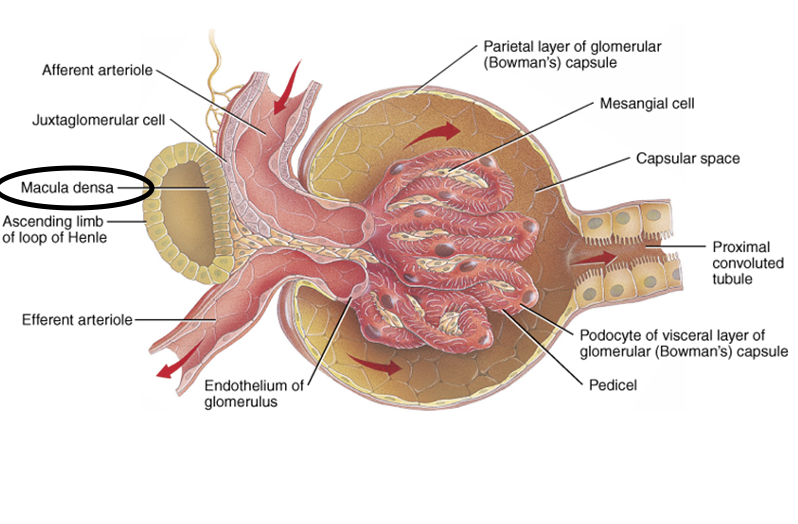
40
What is renin?
an enzyme produced by the kidneys that helps regulate blood pressure
41
Where is renin located in the kidney? (specifically)
Juxtaglomerular apparatus, which are found in the walls of the afferent arterioles at the entrance to the glomeruli. Between afferent and distal tubes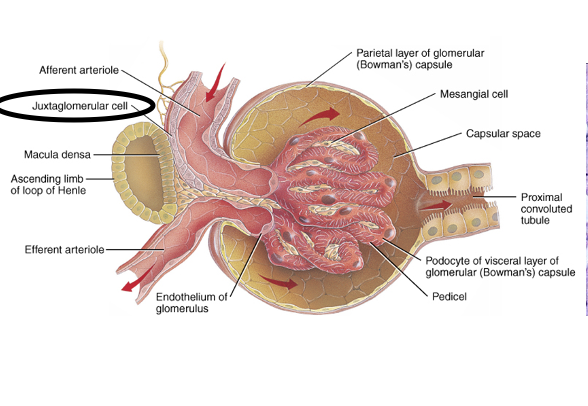
42
When is renin released from the juxtaglomerular apparatus?
Decreased arterial blood pressure
Decreased sodium (Na) or increased potassium (K)
Vascular hemorrhage (low volume)
Decreased sodium (Na) or increased potassium (K)
Vascular hemorrhage (low volume)
43
What does renin cause to happen?
angiotensin formation and aldosterone secretion
44
What does Aldosterone cause?
Kidneys retain sodium and water
45
Does aldosterone increase or decrease blood pressure?
Increases blood pressure
46
What converts angiotension 1 into angiotension 2?
ACE (angiotensin converting enzyme)
47
Where does angiotensinogen come from?
released from the liver; always in blood
48
What does angiotensin do?
Releases aldosterone from adrenal gland (top of kidney)
49
What other hormone is released when angiotensin II is released?
Antidiuertic hormone (ADH) from pituitary gland.
50
How much plasma is filtered each day? mL
180,000 mL
51
What is the filtrate rate in kidneys? L/day
180 L/day
52
What are 3 main roles of the kidneys?
Removal of metabolic wastes
Regulation of water and electrolytes
Maintenance of body's acid-base equilibrium.
Regulation of water and electrolytes
Maintenance of body's acid-base equilibrium.
53
Name the 3 black boxes 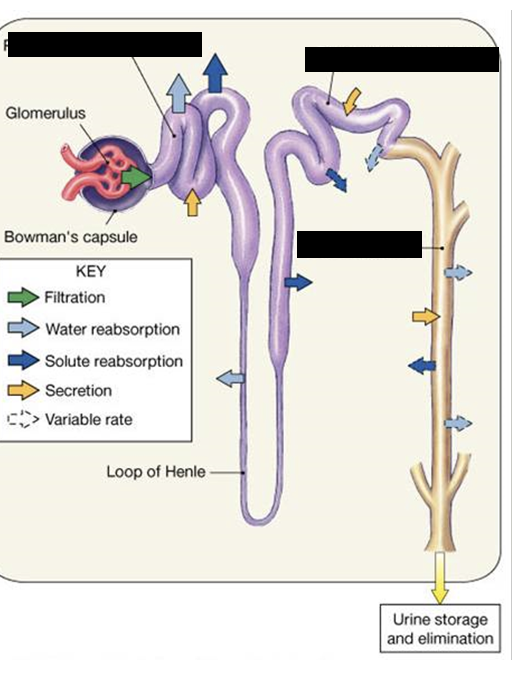
Left to right
Proximal convoluted tubule, distal convoluted tubules, collecting duct
Proximal convoluted tubule, distal convoluted tubules, collecting duct
54
What are the 3 structures of golmerular fitration barrier?
Capillary endothelium with its large open pores
Trilayer basement membrane
Filtration diaphragms located between podocytes of Bowman's space.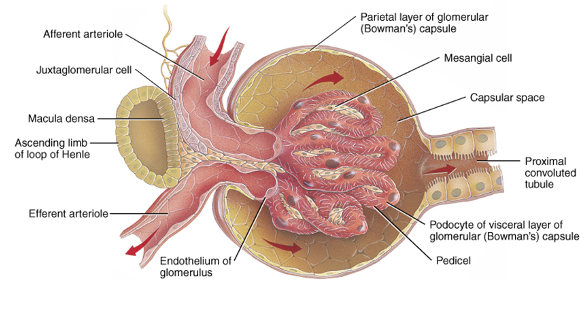
Trilayer basement membrane
Filtration diaphragms located between podocytes of Bowman's space.
55
What are podocytes?
cells in Bowman's capsule in the kidneys that wrap around capillaries of the glomerulus.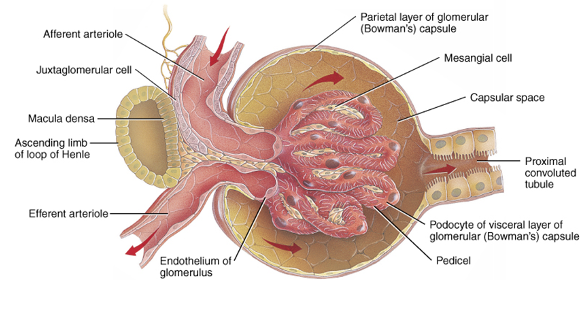
56
What are pedicels?
finger-like extensions of podocytes that wrap around the capillaries in the kidney
57
What does active transport mean?
requires energy
58
What does passive transport mean?
movement from high to low concentration.
59
If blood is acidic, the kidney secrets what?
Hydrogen ion (H+)
60
If blood is basic, the kidney secrets what?
bicarbonate via collecting duct
61
what is the normal pH range for blood?
7.34-7.45
62
What are the 3 body symptoms involved in mainenance of pH?
Blood buffer systems
Pulmonary system
Renal system
Pulmonary system
Renal system
63
What does the blood buffer system prevent?
pH from changing
64
What does the pulmonary system do for pH?
Lungs can exhale or retain carbon dioxide (an acid)
65
What does the renal system do in pH maintenance?
increases or decreases excretion of hydrogen (H) ions
Increases or decreases formation of ammonia
Increases or decreases reabsoption of bicarbonate.
Increases or decreases formation of ammonia
Increases or decreases reabsoption of bicarbonate.
66
What is another name for antidiuretic hormone (ADH)?
Vasopressin
67
What does ADH do?
controls water reabsoption in collecting tubules and distal convoluted tubule
68
Where is ADH produced?
In hypothalamus BUT released from posterior pituitary gland
69
When blood pressure is low, what does the hypothalamus release?
ADH and has an affect on kidneys
70
What happens in the collecting tubules when the ADH is released?
Aquaporins open up and reabsorbs water.
71
What is diabetes insipidus relation to ADH?
Lack of ADH
72
What is released when blood passes through the proximal convoluted tubules?
Water, Na+, Cl - , glucose, and amino acids
73
What is released when blood passes through the descending limb?
H2o, Urea (in and out) , H20
74
What is released when blood passes through the ascending limb?
Cl-, Na+, Urea (in and out)
75
What is released when blood passes through the distal convoluted tubules?
H2O (in presence of ADH), and Na+ (in presence of aldosterone)
76
What is released when blood passes through the collecting duct?
water (H2O) in the presence of ADH
77
What does ADH do to the body? (in general)
increases urine osmolality. pee less. dehydration. body is retain more water.
78
What is the most important measure of ADH effect?
urine osmolality
79
Which scenario happens when there is a presence of ADH?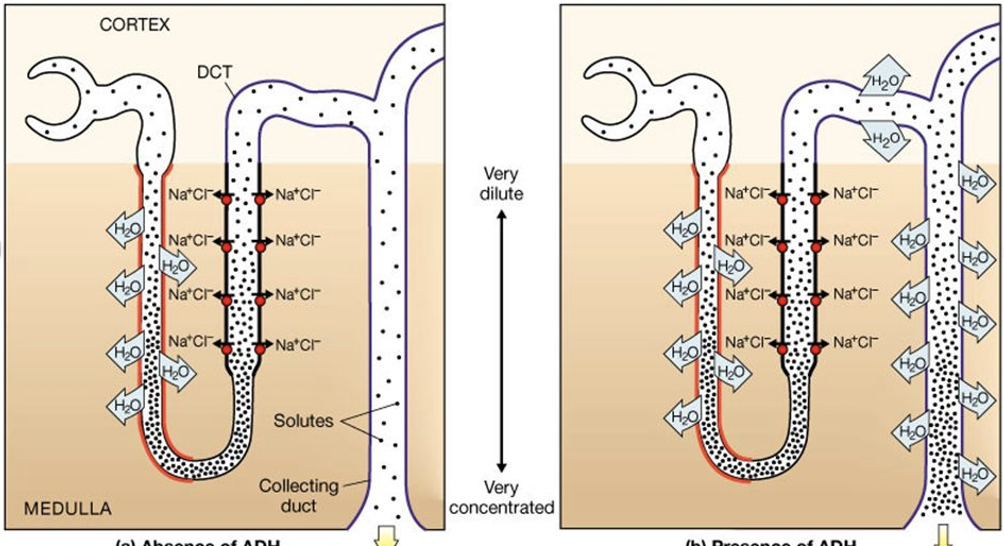
Right
80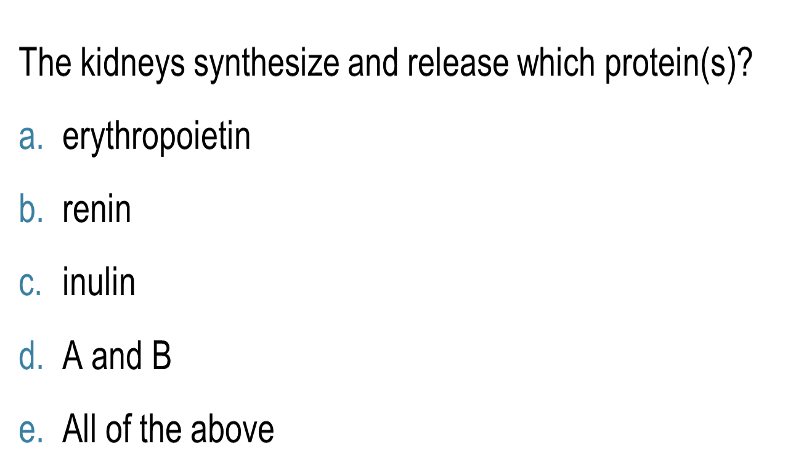
D
81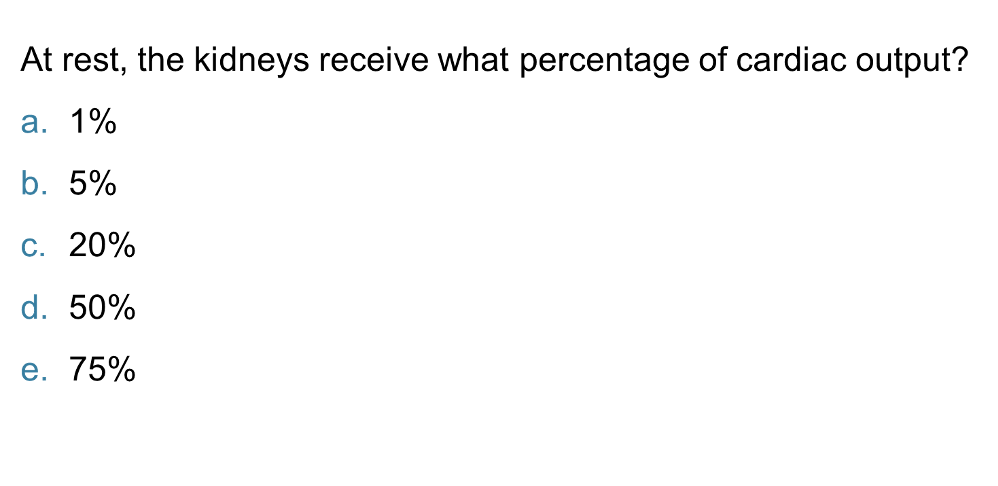
C
82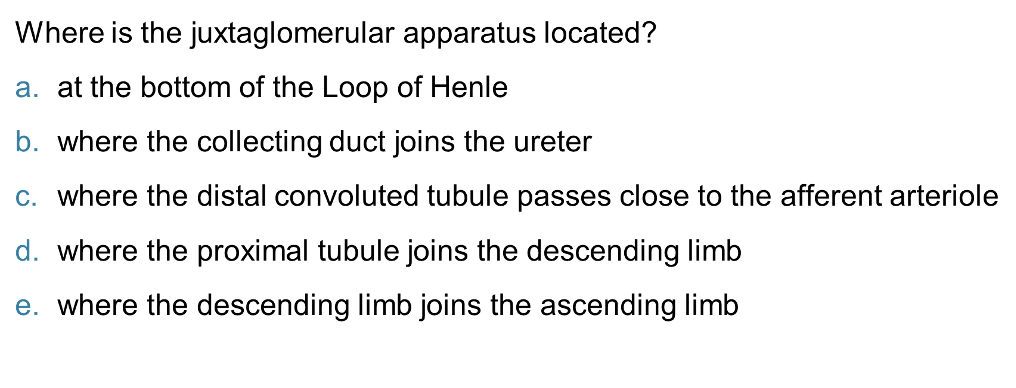
C
83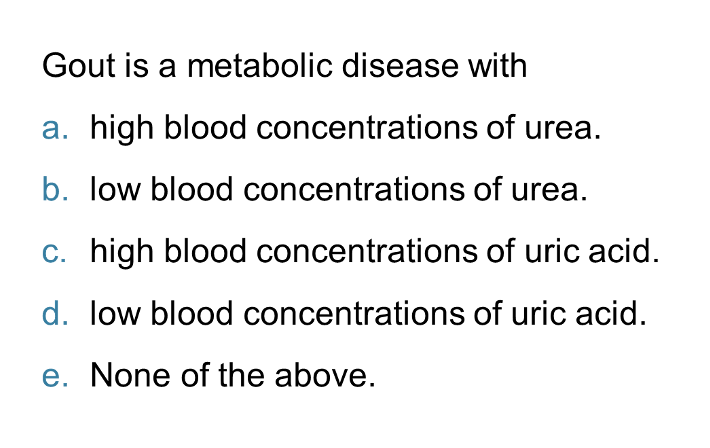
C
84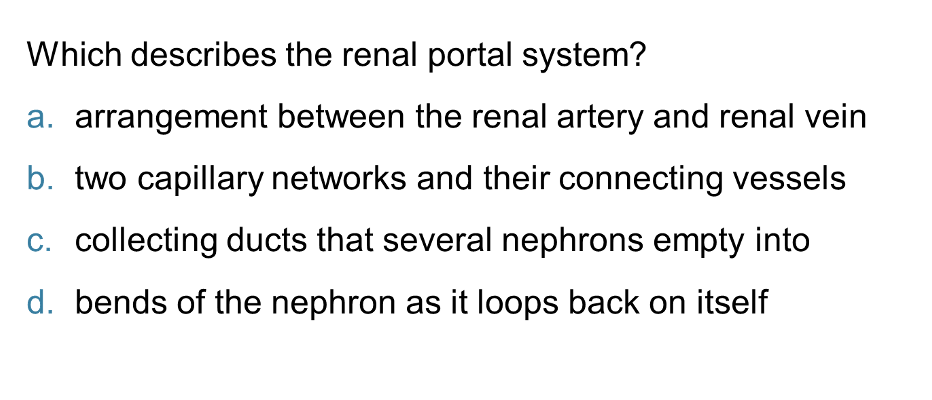
B.
85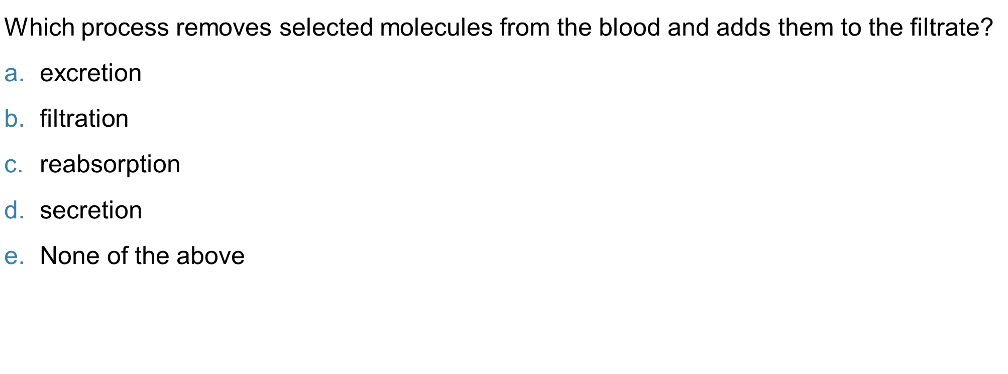
D
86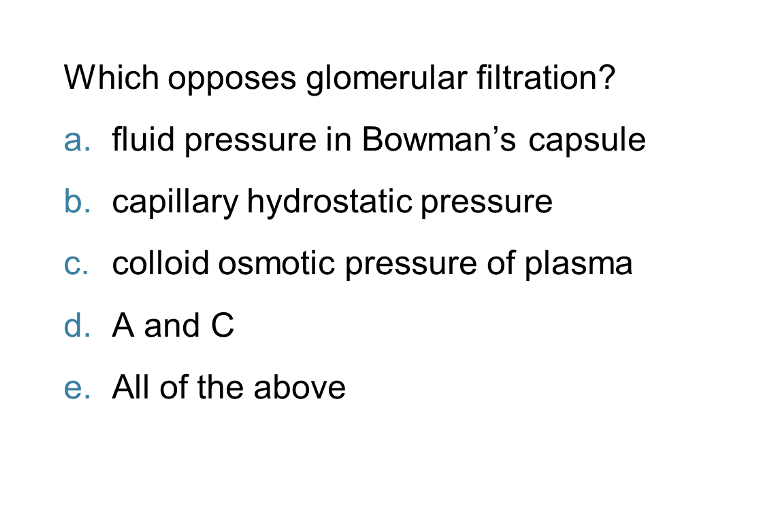
D
87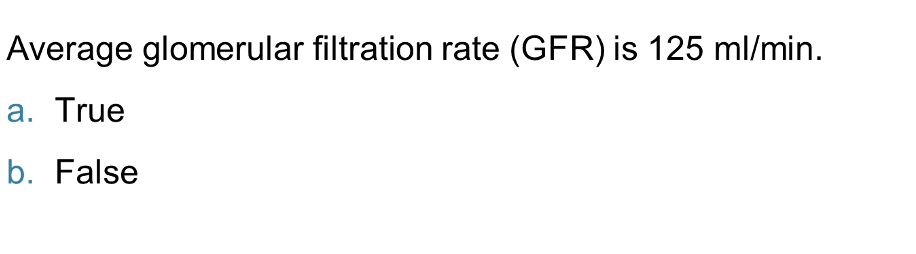
A
88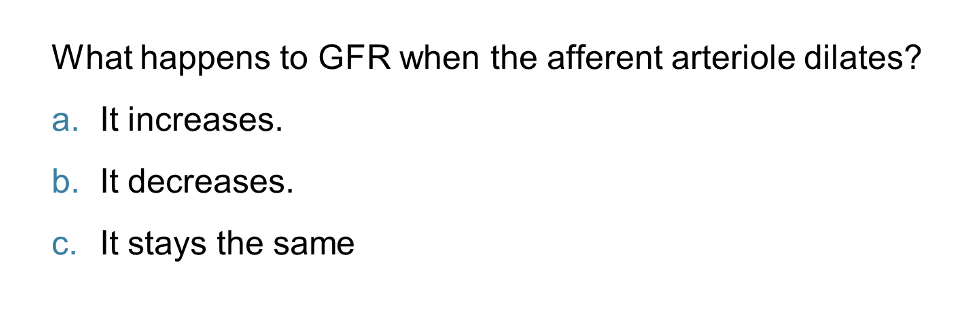
A
89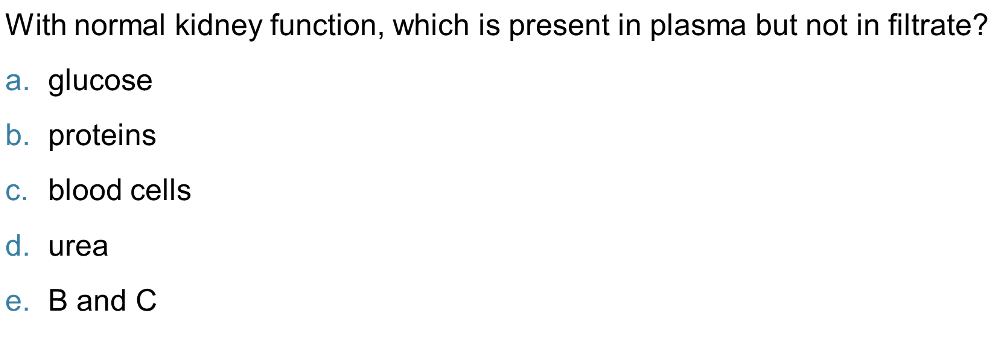
e
90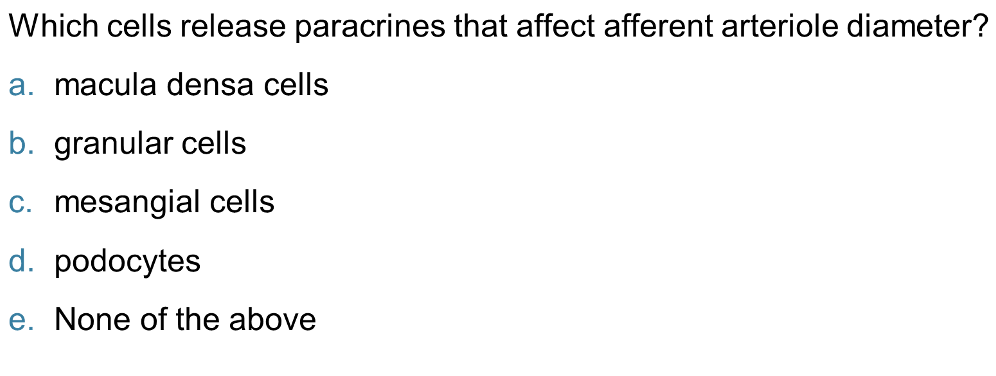
A.