Lecture 3 - Immunopathy
Study these flashcardsFree · spaced repetition · iPhone, Android, Mac & web
All cards
1
What are the 2 different immune responses?
Natural (primitive) immunity
Acquired (specfici) immunity
Acquired (specfici) immunity
2
What is natural (primitive) immunity?
antigen unspecific. ex: neutrophils phagocytes any foreign substances
3
What ia acquired (specfici) immunity?
Antigen specific (ex: T-cells/B-cells)
4
What is the first antibody produced during infection?
IgM
5
What does IgE activate?
Macrophages and basophils which release histamine
6
Which is the smallest antibody?
IgG
7
Which is the largest antibody?
IgM
8
What are the 5 classes of immunoglobulins?
IgG
IgM
IgA
IgE
IgD
IgM
IgA
IgE
IgD
9
What is an IgG composed of?
light chains and heavy chains
2 Fab regions and 1 Fc domain
2 Fab regions and 1 Fc domain
10
Where on the IgG do bacteria atttach to?
Fab region
11
What is major histocompatibility complex (MHC)?
a coding region for surface proteins like HLA (human leukocyte antigen)
12
What are the 2 groups of MHCs?
Type I
Type II
Type II
13
What is MHC Class I/Type I associated with?
Cytotoxic T-Cells (CD8)
14
What is MHC Class II/Type II associated with?
Helper T- Cells (CD4)
15
If a person has HIV, what are the CD4 levels?
less than 1 (<1)
16
When do antibodies activate the complements?
high titer (2 Fc domains close to eachother)
17
How many types of hypersensitivity reactions are there?
4
18
What are the 4 types of hypersensitivity reactions?
Type 1: anaphylactic
Type 2: cytotoxic antibody mediated
Type 3: immune complex mediated
Type 4: cell mediated, delayed hypersensitivity reaction
Type 2: cytotoxic antibody mediated
Type 3: immune complex mediated
Type 4: cell mediated, delayed hypersensitivity reaction
19
What is type 1 hypersensitivity reaction?
immediate reaction and involves immunoglobulin E (IgE) mediated release of antibodies against the soluble antigen
20
How do you neutralize histamine in allergies?
Anti-histamines like benadryl
21
What are examples of type 1 hypersensitivity reaction?
Hay fever
Asthma
Atopic dermatitis
Anaphylactic shock
Asthma
Atopic dermatitis
Anaphylactic shock
22
what is hay fever?
allergic rhinitus
23
What is atopic dermatitis?
eczema; a condition that causes itchy, dry, and inflamed skin
24
What protein is impaired in eczema?
Filaggrin
25
What is anaphylactic shock?
a severe allergic reaction that can be life-threatening
26
What is type II hypersensitivity?
an antibody-mediated immune response that causes tissue damage or destruction
27
What are examples of type II hypersensitivity?
Hemolytic anemia
Goodpasture's syndrome
Graves' disease
Myasthenia gravis
Goodpasture's syndrome
Graves' disease
Myasthenia gravis
28
what is goodpasture syndrome?
a rare autoimmune disease that causes the body's immune system to attack the lungs and kidneys. Blood in sputum and urine
29
What is graves disease?
an autoimmune disorder that causes the thyroid gland to produce too much thyroid hormone. (Patients eats a lot and doesn't gain weight). ~ hyperthyroidism
30
What is myasthenia gravis?
a rare, chronic autoimmune disorder that causes weakness in the body's voluntary muscles.
31
What is type III hypersensitivity?
an abnormal immune response to an antigen (free-floating) that causes tissue damage and inflammation.
32
What are examples of type III hypersensitivity?
Systemic lupus erythematosus (SLE)
Poststreptococcal glomerulonephritis
Polyarteritis nodosa
Poststreptococcal glomerulonephritis
Polyarteritis nodosa
33
What is systemic lupus erythematosus (SLE)?
autoimmune disease in which the immune system attacks its own tissues,
34
What is Poststreptococcal glomerulonephritis?
a rare kidney disease that occurs after an infection with certain strains of streptococcus pyogenes.
35
what is polyarteritis nodosa?
rare disease that causes inflammation of small and medium-sized arteries, damaging them and causing them to swell.
36
What is this arthus phenomenon?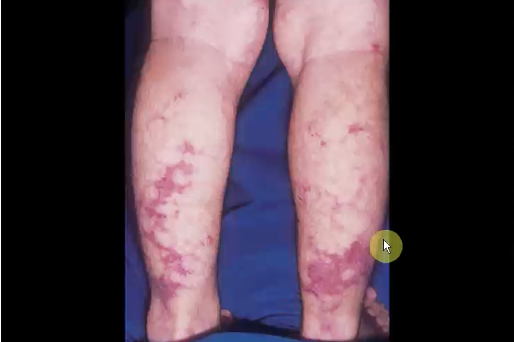
Polyarteritis nodosa
37
What is type IV hypersensitivity?
a type of delayed-type immune response, in which the immune system responds to an antigen several hours or days after exposure. *granuloma formations*
38
What are examples of type IV hypersensitivity reaction?
Infections with Mycrobacterium tuberculosis, mycobacterium leprae, fungi (histoplasma capsulatum)
Reaction to tumors
Sarcoidosis
Contact dermatitis
Reaction to tumors
Sarcoidosis
Contact dermatitis
39
What is sarcoidosis?
condition that causes lumps or nodules (granulomas) to form in your lungs, lymph nodes, skin, eyes and other parts of your body.
40
What is contact dermatitis?
a skin disease that causes inflammation, redness, or soreness after direct contact with a substance.
41
What are the different types of transplantation?
Autograft - self
Isograft - identical twins
Homograft (allograft) - donor
Xenograft - pig valves
Isograft - identical twins
Homograft (allograft) - donor
Xenograft - pig valves
42
What is hyperacute reaction in transplantations?
immeditately rejection!!
43
What it acute reaction?
Happens in 2-3 weeks.
44
What is chronic transplant rejection?
an occur weeks, months or years after transplantation.
45
What is the difference between hydrops fetalis vs erythroblastosis fetalis?
hydrops - non immune
erythroblastosis - immune mediated
erythroblastosis - immune mediated
46
What is icterus gravis neonatorum?
a term used to describe severe jaundice in newborn infants
47
What is kernicterus?
untreated jaundice in babies that causes brain damage
48
what is a haplotype?
a group of genes within an organism that was inherited together from a single parent.
49
What are some reasons for autoimmune diseases?
Genetic
Certain HLA
Sex differences
Certain HLA
Sex differences
50
How are immunodeficiency diseases separated into?
Primary (EX: CONGENITAL Di George syndrome)
Secondary (EX: ACQUIRED; AIDS)
Secondary (EX: ACQUIRED; AIDS)