Lecture 7 - Physical and chemical exmination of urine
Study these flashcardsFree · spaced repetition · iPhone, Android, Mac & web
All cards
1
Q: What is the major organic solute in urine?
A: Urea, which results from protein and amino acid breakdown.
2
Q: What is isothenuria?
A: The inability of the kidneys to change the specific gravity of plasma ultrafiltrate (1.010), often seen in chronic renal disease.
3
Q: How does unpreserved urine change in color and clarity?
A: Color darkens due to oxidation or reduction of metabolites, and clarity decreases due to bacterial growth and precipitation.
4
Q: What does the presence of stable white foam in urine indicate?
A: Large amounts of albumin in the urine.
5
Q: What conditions can cause a fruity or sweet-smelling urine?
A: The presence of ketones, often seen in uncontrolled diabetes or starvation.
6
Q: What are normal urine osmolality values?
A: 275 to 900 mOsm/kg, depending on diet, fluid intake, and physical activity.
7
Q: What is the principle behind reagent strip tests for specific gravity?
A: The strip releases protons proportional to ionic concentration, causing a color change on the pad.
8
Q: What does a positive ictotest for bilirubin show?
A: A purple color, indicating the presence of bilirubin.
9
Q: How do "nitrate"-reducing bacteria affect urine?
A: They convert "nitrATE to nitriITE, which can be detected on a reagent strip as a sign of infection (e.g., with E. coli).
10
Q: What is the significance of glucose in the urine?
A: It indicates that plasma glucose levels have exceeded the renal threshold (160-180 mg/dL).
11
Q: What does a positive test for ketones in urine indicate?
A: The breakdown of fatty acids, often seen in diabetes or fasting, confirmed by the Acetotest
12
Q: What condition can cause dark yellow or brown urine?
A: The presence of bilirubin due to liver disease or biliary obstruction.
13
Q: What is the principal use of osmolality in urine testing?
A: To evaluate the kidney's ability to concentrate urine and to diagnose causes of polyuria.
14
Q: What does the presence of leukocyte esterase in urine indicate?
A: A pathological process, such as a urinary tract infection (UTI), indicated by white blood cells releasing this enzyme.
15
Q: What is the most common method for chemical testing of urine?
A: The use of reagent strips, which change color based on the urine's chemical composition.
16
what is the major organic solute in urine? and how much does it approximatel take up in urine?
Urea & 1/2
17
What is urea in urine?
nitrogenous breakdown product of protein metabolism
18
What else can you find in urine? (inorganic material)
inorganic chloride, sodium and potassium
19
What substances are used to identify a fluid as urine?
urea and creatinine
20
If the urine contains cels, crystals, mucus, and bacteria, what is this an indication of?
increases indicative of disease
21
Urine volume is determined by it's state of what?
body's state of hydration
22
What is the normal urine volume per day?
600 to 1800 mL/day
23
What happens to the amount of water required when the body needs to excrete more solutes?
As the amount of solutes the body needs to excrete increases, the amount of water required to excrete them also increases. This is because the body uses water to flush out the solutes.
24
What is isothernuria?
inability of kidneys to change specific gravity of plasma ultrafiltrate (which is 1.010).
25
What does isothernuria an indication of?
chronic renal disease; kidney isn't able to concentrate the urine so specific gravity of urine and plasma is the same at 1.010.
26
What are all the changes in unpreserved urine?
Color, clarity, odor, pH, glucose, ketones, bilirubin, urobilinogen, nitrite, (rbcs, wbcs and casts), bacteria, trichomonas
27
What is the change and cause of urine COLOR?
CHANGE: modified/darkened
CAUSE: Oxidation or reduction of metabolites
CAUSE: Oxidation or reduction of metabolites
28
What is the change and cause of urine CLARITY?
CHANGE: DECREASED
CAUSE: BACTERIAL GROWTH AND PRECIPITATION OF AMORPHOUS MATERIAL
CAUSE: BACTERIAL GROWTH AND PRECIPITATION OF AMORPHOUS MATERIAL
29
What is the change and cause of urine ODOR?
CHANGE: INCREASED
CAUSE: BACTERIAL MULTIPLICATION CAUSING BREAKDOWN OF UREA TO AMMONIA
CAUSE: BACTERIAL MULTIPLICATION CAUSING BREAKDOWN OF UREA TO AMMONIA
30
What is the change and cause of urine pH?
CHANGE: INCREASED
CAUSE: BREAKDWON OF UREA TO AMMONIA BY UREASE-PRODUCING BACTERIA/LOSS OF CO2.
CAUSE: BREAKDWON OF UREA TO AMMONIA BY UREASE-PRODUCING BACTERIA/LOSS OF CO2.
31
What is the change and cause of urine GLUCOSE?
CHANGE: DECREASED
CAUSE: GLYCOLYSIS AND BACTERIAL USE
CAUSE: GLYCOLYSIS AND BACTERIAL USE
32
What is the change and cause of urine KETONES?
CHANGE: DECREASED
CAUSE: VOLATILIZATION AND BACTERIAL METABOLISM
CAUSE: VOLATILIZATION AND BACTERIAL METABOLISM
33
What is the change and cause of urine BILIRUBIN?
CHANGE: DECREASED
CAUSE: EXPOSURE TO LIGHT/PHOTOOXIDATION TO BILIVERDIN
CAUSE: EXPOSURE TO LIGHT/PHOTOOXIDATION TO BILIVERDIN
34
What is the change and cause of urine UROBILINOGEN?
CHANGE: DECREASED
CAUSE: OXIDATION TO UROBILIN
CAUSE: OXIDATION TO UROBILIN
35
What is the change and cause of urine NITRITE?
CHANGE: INCREASED
CAUSE: MULTIPLICATION OF NITRATE-REDUCING BACTERIA
CAUSE: MULTIPLICATION OF NITRATE-REDUCING BACTERIA
36
What is the change and cause of urine RBCs, WBCs, and casts?
CHANGE: DECREASED
CAUSE: DISINTEGRATION IN DILUTE ALKALINE URINE
CAUSE: DISINTEGRATION IN DILUTE ALKALINE URINE
37
What is the change and cause of urine BACTERIA?
CHANGE: INCREASED
CAUSE: MULTIPLICATION
CAUSE: MULTIPLICATION
38
What is the change and cause of urine TRICHOMONAS?
CHANGE: DECREASED
CAUSE: LOSS OF MOTILITY, DEATH
CAUSE: LOSS OF MOTILITY, DEATH
39
How do you know when E. coli is present in the urine?
Nitrite positive (+)
40
What are the 4 preservatives used for urine?
Refrigeration, boric acid, formalin (formaldehyde), and sodium fluoride
41
What are the advantages/disadvantages of urine refigeratiion?
Advantage: does not interfere with chemical tests
Disadvantage: precipitates amorphous phosphates and urates
Disadvantage: precipitates amorphous phosphates and urates
42
How long does refrigeration prevent bacterial growth?
24 hrs
43
What are the advantages/disadvantages of boric acid preservative?
Advantage: prevents bacterial growth and metabolism
Disadvantage: interferes with drug and hormone analyses
Disadvantage: interferes with drug and hormone analyses
44
At what pH does boric acid preservative keep urine at? and what can this preservative be used for?
6.0; urine culture transport
45
What are the advantages/disadvantages for formalin (formaldehyde) preservative?
Advantage: excellent sediment preservative
Disadvantage: Acts as a reducing agent, interfering with chemical tests for glucose, blood, leukocyte esterase and copper reduction
Disadvantage: Acts as a reducing agent, interfering with chemical tests for glucose, blood, leukocyte esterase and copper reduction
46
Why is the specimen container rinsed with formalin?
to preserve cells and casts
47
What are the advantages/disadvantages for sodium fluoride preservatives?
Advantages: is a good preservative for drug analyses
disadvantages: inhibits reagent strip tests for glucose, blood, and leukocytes
disadvantages: inhibits reagent strip tests for glucose, blood, and leukocytes
48
What is the color of urine?
Yellow
49
Why is urine yellow?
Urochrome
50
What does it mean when the urine is dark yellow?
concentrated urine
51
What does it mean when the urine is pale yellow?
dilute urine
52
What is urochrome?
a lipid-soluble pigment in plasma excreted in urine
53
What does the amber color in urine mean?
dehyration
54
What does the red color in urine mean?
blood or blueberries
55
What does the brown color in urine mean?
injury/myoglobin (skeletal muscles, cardiac muscles) in urine
56
What are the substances that change urine color?
Blood or myoglobin
Bilirubin
Porphyrins
Melanin
Indican (tryptophan)
Homeogentistic acid
Ingested substances (medications, dyes, vitamins, pigmented foods)
Bilirubin
Porphyrins
Melanin
Indican (tryptophan)
Homeogentistic acid
Ingested substances (medications, dyes, vitamins, pigmented foods)
57
What does fizzy urine indicate?
Normal, excess protein, kidney problem
58
What does transparent yellow indicate?
normal
59
What does dark yellow indicate?
normal, but in need of water soon
60
What does brown color indicate?
severly dehydrated, liver disease
61
What does pink/ red urine indicate?
eaten beets, blueberries rhubarb, blood in urine
62
What does clear indicate?
excess water
63
What does pale straw yellow indicate?
healthy
64
What does honey/amber indicate?
dehydrated
65
What does orange urine indicate?
dehydrated, liver/ bile duct condition, food dye
66
What does blue/ green indicate?
rare genetic disease, bacteria or medication, food dye
67
include flashcards for table in book
68
Is foam normally included on the report?
No
69
What happens when urine is shaken?
produces white foam that rapidly dissipates
70
What happens when there's stable white foam after shaken?
indicates large amounts of albumin in urine
71
What is yellow foam caused from?
increased bilirubin
72
What does clarity of urine mean?
describes the cloudiness of urine caused by suspended particulate matter that scatters light.
73
What does the clarity look like when urine is normal?
clear
74
What are some causes of cloudiness in urine?
1. Contamination from skin or vaginal secretions, bacterial growth, or fecal material
2. Precipitation of dissolved solutes, x-ray contrast media.
3. Red blood cells (RBCs), white blood cells (WBCs), epithelial, clots, bacteria, casts pathogenic
2. Precipitation of dissolved solutes, x-ray contrast media.
3. Red blood cells (RBCs), white blood cells (WBCs), epithelial, clots, bacteria, casts pathogenic
75
What are examples of nonpathogenic cloudiness in urine?
powder, lotion, semen, epithelial cells
76
If the precipitation is pink, what is the pH of the urine?
ACIDIC
77
If the precipitation is white, what is the pH of the urine?
ALKALINE/BASIC
78
Why can the urine be acidic?
the crystals could be acidic; like amorphous urate when the urine is pink
79
Why can the urine be alkaline/ basic?
decreased salts aka amorphous phosphate
80
What does urine (normal) smell like?
aromatic odor
81
Why does urine which was left out for a while become odorous?
bacterial conversion of urea to ammonia
82
What are 2 reasons urine can come out smelling odorous?
ingestion of certain fods or drugs change odor.
83
What are some unusual odors of some metabolic disorders?
1. ketones produce sweet or fruity smell
2. amino acid disorders often produce odd odors.
2. amino acid disorders often produce odd odors.
84
When will a person produce a sweet or fruity urine due to ketones?
when someone has diabetes and body can't break down glucose so body starts to break down the fat, releasing ketones in the urine.
- also seen in fasting individuals
- also seen in fasting individuals
85
add flashcards for odor table in book
86
What happens in MSUD (maple syrup urine disease)?
no BCKAD enzyme which is used to break down isoleucine, leucine, and valine.
87
What does concentration in the urine refer to?
to the amount of solutes present in volume of water excreted
88
What is the precentage of water and solutes in normal urine?
95% water
5% solutes
5% solutes
89
What are the solute types in urine?
vary with patient's diet, physical activity, and health.
90
What does the color of urine indicate about its concentration?
The color of urine is a crude indicator of its concentration. Darker urine generally suggests higher concentration, while lighter urine indicates it’s more diluted.
91
What is an expression of concentration in terms of density?
An expression of concentration in terms of density refers to specific gravity, which compares the density of a substance (like urine) to the density of water. It reflects how concentrated or diluted a solution is.
92
What does "mass of solutes present per volume of solution" refer to?
"Mass of solutes present per volume of solution" refers to the concentration of a solution, where the amount of solute (solid particles like salts or waste) is measured relative to the total volume of the solution, such as in urine.
93
What is the ratio of urine density to the density of an equal volume of pure water under specific conditions?
The ratio of urine density to the density of an equal volume of pure water under specific conditions is called specific gravity. It measures how concentrated the urine is compared to pure water.
94
How do both the number of solute particles and molecular size affect specific gravity?
Both the number of solute particles and their molecular size affect specific gravity because the more particles and larger molecules present in a solution, the higher its density will be, which increases the specific gravity value.
95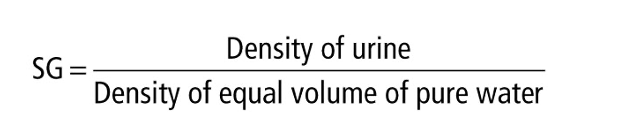
What is the formula for SG?
96
Does molecular weight affect osmolality?
no
97
What does osmolality in urine mean?
concentration of a solution expressed in terms of osmoles of solute particles per kilogram (kg) of water
98
What is the unit used for osmolality?
mOsm most often used for convenience due to low osmolality of biological solutions
99
What are the normal urine values in mOsm??
275 to 900 mOsm/kg
100
What are the normal serum values in mOsm??
275 to 300 mOsm/kg
101
What are the ranges for osmolality in serum?
relatively constant!!!
102
What is the principal uses of osmolality?
1. evaluate renal concentrating ability of kidneys
2. monitor renal disease
3. monitor fluid and electrolyte balance
4. differentially diagnose cause of polyuria
2. monitor renal disease
3. monitor fluid and electrolyte balance
4. differentially diagnose cause of polyuria
103
How is osmolality determined/measured?
by measuring a colligative property of solution such as freezing point depression or vapor pressure depression.
104
What is this?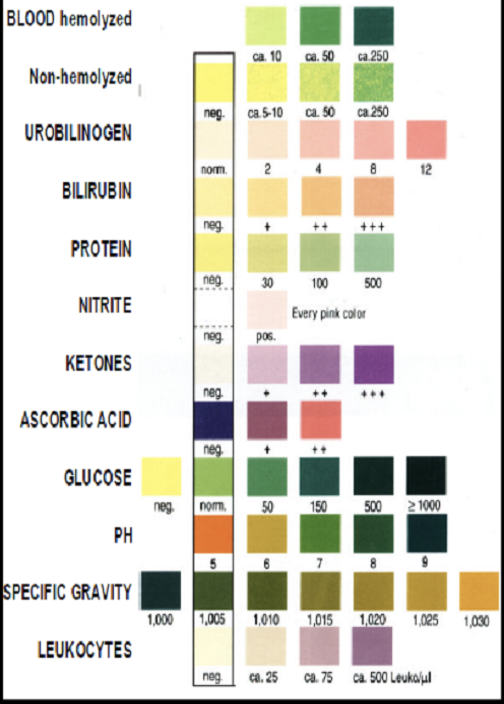
urine test strip; reagent strips
105
What is the most common method for chemical testing?
reagent strips; urine test strip
106
What is a urine test strip?
plastic strip with reagent-impregnated pads which are dipped in urine resulting in a visual color change.
107
Are urine test strips qualitative or quantitative?
Qualitative results based on color change.
108
What is an interfering substance that can affect urine test strip results?
ascorbic acid (vitamin C)
109
How are reagents strips used?
fluorescent lighting; avoid direct sunlight; urine specimen at room temperature
1. using uncentrifuged urine, mix specimen well.
2. Dip reagent strip briefly into urine wetting all reaction pads and start timing device.
3. Remove excess urine by drawing edge of strip against rim of container or by blotting strip edge on aborbent paper.
4. At the appropriate times, read results of each reaction pad using the color chart on the container.
5. Discard strip into biohazard waste.
1. using uncentrifuged urine, mix specimen well.
2. Dip reagent strip briefly into urine wetting all reaction pads and start timing device.
3. Remove excess urine by drawing edge of strip against rim of container or by blotting strip edge on aborbent paper.
4. At the appropriate times, read results of each reaction pad using the color chart on the container.
5. Discard strip into biohazard waste.
110
Why are tablet/liquid tests used?
to confirm results obtained by reagent strip testing.
&
alternative method for highly pigmented urine
&
alternative method for highly pigmented urine
111
Which tablet is used to test for bilirubin?
Ictotest tablets
112
Why would specific tests be used to confirm results obtained by reagent strip testing?
Specific tests are used to confirm results obtained by reagent strip testing to ensure accuracy and provide a more precise measurement. This is important because strip testing can sometimes give false positives or negatives due to various factors, like improper usage or environmental conditions.
113
Why are some tests more sensitive than reagent strip testing?
Some tests are more sensitive than reagent strip testing because they can detect smaller amounts of solutes or substances in urine that may be missed by strip tests. These tests provide more detailed and accurate results, especially in cases where early detection of abnormalities is crucial.
114
Which test detects albumin?
Sulfosalicylic acid test
115
which test detects ketones?
Acetotest
116
How does the ictotest work?
if the ictotest turns purple = positive
if the ictotest turns pink = negative
if the ictotest turns pink = negative
117
What does the urine test strip test?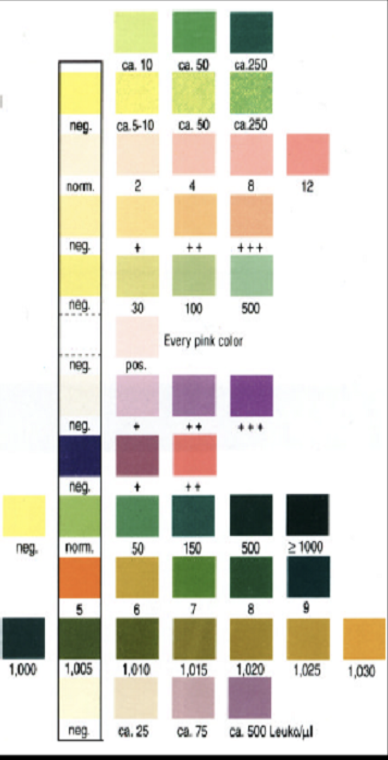
BLOOD hemolyzed
non-hemolyzed
Urobilinogen
Biliruben
Protein
Nitrite
Ketones
Ascorbic Acid
Glucose
pH
Specific gravity
Leukocytes
non-hemolyzed
Urobilinogen
Biliruben
Protein
Nitrite
Ketones
Ascorbic Acid
Glucose
pH
Specific gravity
Leukocytes
118
What does the specific gravity pads detect on the urine reagent strip?
Only measures ionic solutes (sodium, potassium, chloride, ammonium [NH4+])
119
What type of method measures SG?
"indirect chemical method"
120
What is the principle of Specific Gravity (SG) pad in urine reagent strips?
- reagent strip pad impregnated with reagents
- when strip immersed in urine, protons are released from reagent in proportion to ionic concentration changing the pad color.
- when strip immersed in urine, protons are released from reagent in proportion to ionic concentration changing the pad color.
121
What is the normal pH of urine?
4.5 to 8.0; slightly acidic but more alkaline after meals
122
What can the pH in urine affect?
stability of formed elements
123
What type of urine should the pH be tested on?
fresh urine!
124
What is the principle of pH of urine?
- based on a double indicator system
- uses bromothymol blue and methyl red
- produces color changes from orange (pH 5.0) to green (pH7.0) to blue (pH 9.0)
- uses bromothymol blue and methyl red
- produces color changes from orange (pH 5.0) to green (pH7.0) to blue (pH 9.0)
125
What urine pH do cystine crystals/stones and uric acid form in?
Acidic environment
126
What is hematuria?
red blood cells (RBCs) in urine
127
What is hemoglobinuria?
free hemoglobin in urine
128
What does the pad for blood detect in the urine reagent strip?
detects hemoglobin, so detects myoglobin
129
What does the pad for blood consists of?
-Pad has chromogen and peroxide
-Pseudoperoxidase "reduces" peroxide, and chromogen is "oxidized", causing color change.
-Pseudoperoxidase "reduces" peroxide, and chromogen is "oxidized", causing color change.
130
What pad is affected due to an increased amount of ascorbic acid?
ascorbic acid interferes with the reaction
131
What other conditions may not be pathologic but results in RBC in urine?
Blood thinners, aspirin, extraneous exercise.
132
How many WBCs in the urine indicate a pathologic process?
>20/ uL
133
Can WBC be seen in the urine?
WBCs are susceptible to lysis, so may not be seen but will release enzyme leukocyte esterase
134
What is the reaction for leukocyte esterase in the pad on the urine reagent strip?
leukocyte esterase cleaves the ester in pad and results in color change.
135
How many WBCs is the pad in the urine reagent strip able to detect?
as few as 10 WBCs/ uL
136
What conditions may large number of WBC in urine indicate?
Infection/UTI
137
A positive nitrite test in the urine reagent test indicates?
presence of nitrate-reducing bacteria in urine, but it must give it adequate time in bladder to be reduced
138
A negative nitrite test in the urine reagent test indicates?
bacteria does not reduce to nitrate to nitrite.
139
What does protein in urine indicate?
first sign of kidney disease
140
Which protein is most sensitive in the urine reagent test strip?
albumin
141
What is the cause of proteinuria?
diabetes and high blood pressure can cause damage to the kidneys
142
What is microalbumin?
low levels of albumin
143
Can routine test strips detect low levels of albumin?
no; anything that is <1 to 2 mg/dL; so senstivie albumin tests are used to detect low level albuminuria.
144
Sensitive albumin test are mostly used for which patients?
diabetic patients to screen for signs of early kidney damage.
145
Is glucose normally seen in urine?h
NO!
146
When does glucose usually appear in urine? (levels)
160 to 180 mg/dL plasma level in urine
147
What is the principle based on for glucose?
"double sequential enzyme reaction" that is specific for glucose;
Glucose oxidase in pad oxidizes glucose to form hydrogen peroxide and gluconic acid resulting in a color change.
Glucose oxidase in pad oxidizes glucose to form hydrogen peroxide and gluconic acid resulting in a color change.
148
What do reducing substances test for?
detects sugars (except sucrose) and other reducing substances such as ascorbic acid, cysteine, and some drugs (e.g. Galactosemia)
149
What is an example of a reducing substance test?
Benedict's copper reduction test
150
Why is the bendict's copper reduction test done?W
bc not all sugars are detected in urine strip. Glucose oxidase is detected in urine strip only!!
151
What is galactosemia?
an inherited metabolic disorder that makes your body unable to process a sugar called galactose. lack of GALT enzyme; patients do not have enough glucose in the body.
152
What are ketones?
breakdown products of fatty acids
Acetoacetate
Acetone
b-hydroxybutyrate
Acetoacetate
Acetone
b-hydroxybutyrate
153
is b-hydroxybutyrate detected by strip tests?
NO!
154
What the color changes for ketones using the reagent strip?
beige to purple; acetest
155
What type of biliruben is found in the urine?
direct (conjugated) bilirubin <-water soluble
156
What organ conjugated bilirubin?
Liver
157
Is indirect biliruben soluble?
no, so bound to albumin in plasma and too large filter at the kidneys
158
What does bilirubin change in the urine?
causes urine to be dark yellow to brown
159
What is urobilinogen?
a product of biliruben that forms in the intestines
160
What does the presence of urobilinogen in urine tests indicate?
hemolytic anemia in addition to cirrhosis and hepatitis.
161
what is the urobilinogen production?
RBC after 120 days break down and are picked up by the liver. Macrophage in the liver degrade hemoglobin. Hemoglobin converted to methmoglobin and then reduce to biliverdin (green color); biliverdin to billruben (red-orange color); bilirubin to bilirubin diglucuronide (move to bile) -> cont. 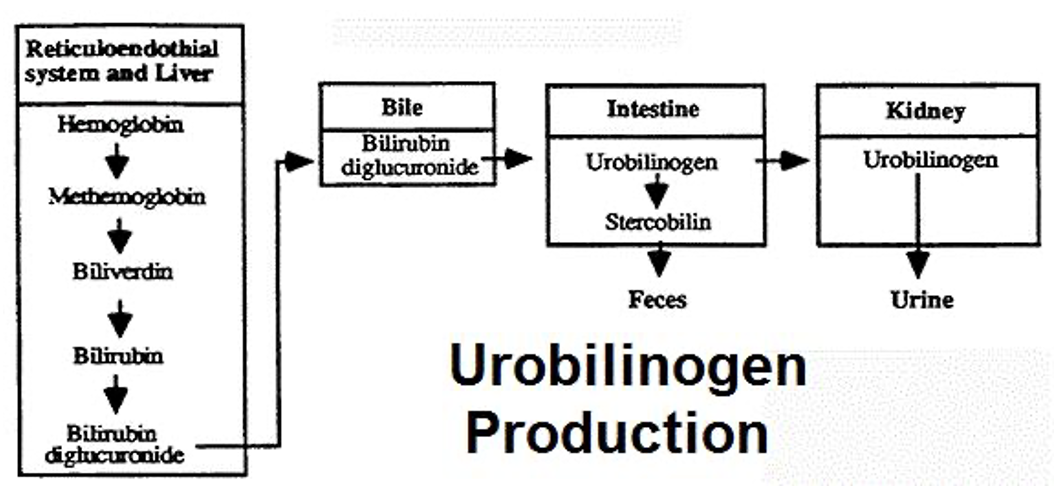
162
What is the reason for the color of poop?
stereobilin